

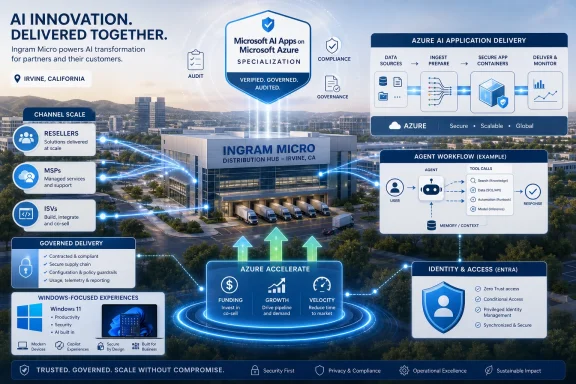
Ingram Micro said on May 4, 2026, in Irvine, California, that it has earned Microsoft’s AI Apps on Microsoft Azure Specialization, a partner credential tied to audited Azure AI, application, and data-services capabilities. The announcement is not just another badge for a distributor’s trophy case. It is a sign that Microsoft’s AI channel strategy is moving from inspiration decks to funded delivery motions, and that large distributors are trying to become the operating layer between Redmond’s agentic ambitions and the thousands of partners expected to sell them. For WindowsForum readers, the story is less about one stock moving 16 cents and more about how AI work will actually reach customers who do not have a hyperscaler architect on speed dial.
The most interesting word in Ingram Micro’s announcement is not “AI.” It is “specialization.”
Microsoft has spent the last few years teaching the market to treat AI as a platform shift: Copilot in the productivity stack, Azure OpenAI in the cloud stack, Fabric in the data stack, and agents as the new integration surface between business process and software. But platform shifts do not operationalize themselves. They require sellers, assessments, migration plans, funding programs, technical scoping, security reviews, deployment factories, and a depressing amount of paperwork.
That is where the old distribution model starts to mutate. Ingram Micro’s core business has historically been the unglamorous but essential machinery of the IT channel: moving products, extending credit, managing licenses, supporting resellers, and smoothing the path between vendors and customers. The AI Apps on Microsoft Azure Specialization suggests Microsoft now wants that same machinery to carry a more technical payload.
This is not merely a reseller enablement story. The specialization validates that Ingram Micro has passed an outside audit for work involving Azure AI, application, and data services. That matters because Microsoft’s partner ecosystem has long been crowded with firms that can talk cloud strategy, while customers increasingly need someone who can help build a working proof of value, wire it into existing data, and keep it from becoming an expensive demo.
Ingram Micro’s pitch is that it can help channel partners move from AI exploration to AI execution. That phrasing is corporate, but the distinction is real. The market has plenty of AI curiosity. It has fewer repeatable paths for turning a use case into an application that can survive compliance, procurement, identity, data residency, budget scrutiny, and production support.
That is not a footnote. In the channel, funding programs often shape what actually gets sold. A partner may believe a customer has a strong AI use case, but if the customer is skeptical, the data is messy, the app architecture is unclear, and the first phase requires unpaid discovery, the project can die before it begins. Vendor-funded assessments and deployments are designed to break that stalemate.
This is the part of the AI economy that tends to get less attention than model benchmarks and GPU supply. For small and midsize customers, the question is rarely whether Azure AI can do something impressive in principle. The question is whether a trusted provider can scope a project tightly enough that the customer is willing to fund the next phase.
Microsoft Azure Accelerate is built around that conversion problem. It offers expert guidance, funding, cloud credits, skilling, and partner-delivered assistance across cloud and AI projects. By giving specialized partners access to more defined funding motions, Microsoft is effectively trying to lower the friction between “we should do something with AI” and “we have an approved project with a delivery plan.”
That is why Ingram Micro’s status matters beyond branding. The company is not claiming to be the next OpenAI or Anthropic. It is claiming to be one of the places where Microsoft’s AI incentives, reseller capacity, technical expertise, and customer demand can be packaged into something sellable.
That is the role Ingram Micro wants to occupy with its Enable AI strategy and Xvantage platform. Xvantage is the company’s AI-powered digital platform for partner experience, bringing together hardware, cloud subscriptions, personalized recommendations, pricing, ordering, tracking, and billing automation. In a market where partners are being asked to sell increasingly complex bundles of infrastructure, cloud services, security, and managed support, that sort of platform is not decorative. It is the dashboard through which distributors try to make the business legible.
The company’s recent earnings commentary gives that strategy more weight. Ingram Micro reported first-quarter 2026 net sales of roughly $14.0 billion, up 13.7% year over year, with non-GAAP diluted earnings per share of $0.75. The company also highlighted automation and AI activity inside Xvantage, including large volumes of self-service orders, AI-led engagements, and sales influenced by its internal intelligence tools.
That does not mean every AI sales claim should be swallowed whole. “AI-led” can be a flexible phrase, and large distributors naturally want investors to see them as software-enabled platforms rather than low-margin logistics machines. But even allowing for investor-relations polish, the direction is clear: Ingram Micro is trying to convince the market that its value is shifting from fulfillment to orchestration.
That distinction is critical. Fulfillment is what happens after a customer knows what to buy. Orchestration is what helps a partner and customer decide what to build, how to fund it, what architecture to trust, and which Microsoft program can reduce the risk. AI apps live in the second category.
The language sounds futuristic, but the mechanics are familiar. Microsoft is creating a hierarchy of trusted partners and distributors that can help customers identify who is ready to deliver AI workloads. That helps Microsoft field sales teams, helps customers sort through partner claims, and gives distributors a clearer way to differentiate themselves.
The focus on agents is important. The first wave of generative AI in business was largely about individual productivity and chat interfaces. The next wave is about applications that can take actions, call tools, reason over enterprise data, and operate within business workflows. That shift makes the work more valuable, but also more dangerous.
An agent that summarizes a document is useful. An agent that modifies a quote, triggers a support workflow, checks inventory, or drafts a customer response inside a production process is a different governance problem. It requires identity controls, permissions, observability, data boundaries, testing, rollback plans, and clear accountability when automation goes wrong.
That is why Microsoft is turning agentic AI into a partner-readiness exercise. The company cannot scale this work only through its own architects. It needs a distribution layer that can train smaller partners, package repeatable scenarios, and help customers distinguish between a chatbot experiment and an application architecture.
Ingram Micro’s win should be read in that context. The company is being positioned as a multiplier. Microsoft builds the platform, establishes the incentive structure, and blesses partners with specializations. Ingram Micro turns that into something thousands of channel partners can actually attempt to sell.
This is where distributors can be more influential than they appear. The channel’s job is often to domesticate technology. Virtualization, cloud backup, Microsoft 365, endpoint detection, and zero-trust tooling all became normal not because vendors invented them, but because partners learned how to package, price, deploy, and support them repeatedly.
AI apps need the same treatment. A partner serving midmarket customers may not have deep bench strength in Azure AI Studio, Azure OpenAI, Fabric, containerized app services, serverless architecture, GitHub Copilot, and secure data integration. But that partner may have the customer relationship, the vertical knowledge, and the support contract. If Ingram Micro can supply the missing scaffolding, Microsoft gets reach that direct enterprise sales cannot provide.
The risk is that the channel turns AI into another acronym bundle without enough discipline. Customers are already hearing pitches for copilots, agents, assistants, AI search, AI automation, AI analytics, and AI-enabled modernization. If every workflow problem becomes an “agent opportunity,” the result will be disappointment, not transformation.
The better version is narrower. Start with constrained use cases. Tie them to data the customer can govern. Use Azure services where identity, security, and compliance can be managed consistently. Build proofs of value that are honest about cost and operational burden. Then scale only where the economics and controls make sense.
That is the kind of work a specialization is supposed to certify. It does not guarantee excellence. It does, however, create a baseline that says the partner has been evaluated against Microsoft’s criteria and has enough demonstrated capability to participate in higher-value motions.
The more important financial context is that Ingram Micro is a newly public company again, having returned to the NYSE in October 2024 under the ticker INGM. Its investor narrative depends on showing that distribution can be more than a scale game with thin margins. AI, cloud, and advanced solutions are therefore not just growth categories; they are central to how the company wants Wall Street to value its business.
That is a tricky balance. AI infrastructure can drive impressive revenue, especially when servers, GPUs, storage, networking, and cloud services are involved. But some of that business can also be lower margin, capital intensive, or dependent on supply constraints. Ingram Micro’s Q1 commentary included strong growth, but also pointed to the familiar reality that not all AI revenue is created equal.
Services and enablement are more strategically attractive because they imply stickier partner relationships and more differentiated value. If Ingram Micro can use Microsoft specializations to pull partners into Azure AI projects, then the company may benefit not just from one-time transactions but from ongoing consumption, managed services, licensing, security attachments, and follow-on modernization work.
That is the bullish reading. The cautious reading is that every major distributor and systems integrator is chasing the same AI budget. Microsoft designations help, but they do not eliminate competition, delivery risk, or customer hesitation. A badge opens the door; execution determines whether there is a business behind it.
The average channel partner does not wake up hoping for more portals, designations, eligibility rules, and program names. They want to know which customers qualify, which workloads are fundable, what documentation is required, who performs the work, how margins are protected, and how quickly claims or incentives move through the system. Distributors win when they simplify that complexity instead of merely forwarding it.
This is where Ingram Micro’s announcement becomes a test of operational credibility. The company says it can help partners design, develop, and deploy AI solutions using Microsoft AI, app, and data platforms. That promise will be judged in mundane places: pre-sales response times, architecture support, funding approvals, project handoffs, training quality, billing clarity, and whether partners feel empowered rather than bypassed.
There is also the question of trust. Some partners see distributors as essential allies. Others see them as necessary intermediaries whose service quality can vary widely by region, account team, or product line. AI raises the stakes because customers may be granting access to sensitive data, core workflows, and strategic business processes.
If Ingram Micro can deliver high-quality technical enablement while keeping partners at the center, it strengthens its position. If it becomes a bottleneck, or if partners feel that AI services are being pulled upstream, the designation could become another logo that looks better in a press release than in the field.
That is why the specialization’s inclusion of app and data services matters. The hard part of enterprise AI is rarely the model call itself. The hard part is connecting the model to the right data, wrapping it in an application users can access, enforcing permissions, monitoring cost, and preventing sensitive information from leaking into places it should not go.
A WindowsForum reader managing Microsoft estates should expect AI adoption to arrive through familiar channels. It may show up as an ISV adding AI features to a line-of-business application. It may appear as an MSP proposing an Azure-based knowledge agent for support tickets. It may come as a modernization project that wraps old data sources in a new app layer. It may be attached to security, compliance, or workflow automation rather than sold as a standalone AI initiative.
That means the procurement and architecture questions are going to become more concrete. Which Azure services are involved? Where does the customer’s data reside? Which identity model governs access? How are prompts and outputs logged? Who is responsible for model behavior? What happens when the proof of value becomes a production dependency?
These are not anti-AI questions. They are the questions that separate useful AI from theater. The more Microsoft pushes AI through the channel, the more IT pros will need to interrogate not just the demo, but the delivery chain behind it.
This is the terrain where distributors like Ingram Micro can matter most. A regional MSP or solution provider may know the customer’s environment intimately but lack the specialized Azure AI practice needed to scope and deliver agentic applications. A distributor-backed program can fill that gap with templates, funding, expertise, and escalation paths.
Microsoft also benefits from making the midmarket reachable. Azure consumption grows when projects move from trial to production. Copilot becomes more valuable when it is surrounded by data and workflows that make sense. Fabric, Azure SQL, app services, and security products become easier to attach when AI is part of a broader modernization conversation.
But the middle of the market is also where hype can do the most damage. These customers have less tolerance for speculative projects and fewer resources to absorb failed experiments. A poorly scoped AI deployment can sour a customer not just on one partner, but on the entire category.
That is why repeatability is the prize. The winning channel motions will not be “build anything with AI.” They will be specific, packaged, governable offers that solve recognizable business problems: document intake, support triage, sales knowledge retrieval, contract review assistance, field-service automation, compliance evidence gathering, and internal workflow routing. The distributor that helps partners productize those motions will have more influence than the one that simply advertises AI enthusiasm.
Ingram Micro’s announcement is therefore a signal of institutionalization. AI is being absorbed into the same partner machinery that made cloud mainstream: competencies, specializations, marketplace motions, incentive programs, assessments, deployments, and managed services. The romance of the technology is being converted into channel process.
That may disappoint those who prefer AI as a pure innovation story. But for IT pros, process is often where the truth lives. If a technology cannot be assessed, funded, implemented, secured, supported, and renewed, it will not become part of the enterprise fabric.
The question is whether the process can keep up with the technology. Agentic AI is still moving quickly, and today’s best practice can become tomorrow’s warning label. Microsoft’s partner ecosystem will need to evolve faster than it did during earlier cloud transitions, because the risks are not limited to downtime or overspending. They include automation mistakes, data exposure, hallucinated outputs, and governance failures inside business processes.
That gives Ingram Micro both an opportunity and a burden. A distributor that helps partners sell AI responsibly could become a crucial bridge between Microsoft’s platform ambitions and customer reality. A distributor that merely accelerates poorly governed deployments could help create the backlash that slows the whole market.
Source: Baystreet.ca Ingram Micro Tallies on AI Apps Status
 Microsoft’s AI Channel Is Turning Into a Credentialed Supply Chain
The most interesting word in Ingram Micro’s announcement is not “AI.” It is “specialization.”Microsoft has spent the last few years teaching the market to treat AI as a platform shift: Copilot in the productivity stack, Azure OpenAI in the cloud stack, Fabric in the data stack, and agents as the new integration surface between business process and software. But platform shifts do not operationalize themselves. They require sellers, assessments, migration plans, funding programs, technical scoping, security reviews, deployment factories, and a depressing amount of paperwork.
That is where the old distribution model starts to mutate. Ingram Micro’s core business has historically been the unglamorous but essential machinery of the IT channel: moving products, extending credit, managing licenses, supporting resellers, and smoothing the path between vendors and customers. The AI Apps on Microsoft Azure Specialization suggests Microsoft now wants that same machinery to carry a more technical payload.
This is not merely a reseller enablement story. The specialization validates that Ingram Micro has passed an outside audit for work involving Azure AI, application, and data services. That matters because Microsoft’s partner ecosystem has long been crowded with firms that can talk cloud strategy, while customers increasingly need someone who can help build a working proof of value, wire it into existing data, and keep it from becoming an expensive demo.
Ingram Micro’s pitch is that it can help channel partners move from AI exploration to AI execution. That phrasing is corporate, but the distinction is real. The market has plenty of AI curiosity. It has fewer repeatable paths for turning a use case into an application that can survive compliance, procurement, identity, data residency, budget scrutiny, and production support.
The Badge Matters Because the Money Follows It
The immediate practical effect of the specialization is access. Ingram Micro says the designation opens expanded Microsoft Azure Accelerate funding categories for AI apps, agents, and developer-focused pre-sales assessments and deployments. In plain English: the badge can make it easier for partners to get Microsoft-backed funding support for early project work.That is not a footnote. In the channel, funding programs often shape what actually gets sold. A partner may believe a customer has a strong AI use case, but if the customer is skeptical, the data is messy, the app architecture is unclear, and the first phase requires unpaid discovery, the project can die before it begins. Vendor-funded assessments and deployments are designed to break that stalemate.
This is the part of the AI economy that tends to get less attention than model benchmarks and GPU supply. For small and midsize customers, the question is rarely whether Azure AI can do something impressive in principle. The question is whether a trusted provider can scope a project tightly enough that the customer is willing to fund the next phase.
Microsoft Azure Accelerate is built around that conversion problem. It offers expert guidance, funding, cloud credits, skilling, and partner-delivered assistance across cloud and AI projects. By giving specialized partners access to more defined funding motions, Microsoft is effectively trying to lower the friction between “we should do something with AI” and “we have an approved project with a delivery plan.”
That is why Ingram Micro’s status matters beyond branding. The company is not claiming to be the next OpenAI or Anthropic. It is claiming to be one of the places where Microsoft’s AI incentives, reseller capacity, technical expertise, and customer demand can be packaged into something sellable.
Ingram Micro Is Selling Scale, Not Magic
The announcement leans heavily on Ingram Micro’s position as a global distributor, and for once the scale argument is not just padding. AI adoption through the channel will be uneven, confusing, and highly dependent on regional partner maturity. A distributor with broad reach can standardize playbooks, surface incentives, train partners, and translate Microsoft’s sprawling program architecture into a manageable commercial motion.That is the role Ingram Micro wants to occupy with its Enable AI strategy and Xvantage platform. Xvantage is the company’s AI-powered digital platform for partner experience, bringing together hardware, cloud subscriptions, personalized recommendations, pricing, ordering, tracking, and billing automation. In a market where partners are being asked to sell increasingly complex bundles of infrastructure, cloud services, security, and managed support, that sort of platform is not decorative. It is the dashboard through which distributors try to make the business legible.
The company’s recent earnings commentary gives that strategy more weight. Ingram Micro reported first-quarter 2026 net sales of roughly $14.0 billion, up 13.7% year over year, with non-GAAP diluted earnings per share of $0.75. The company also highlighted automation and AI activity inside Xvantage, including large volumes of self-service orders, AI-led engagements, and sales influenced by its internal intelligence tools.
That does not mean every AI sales claim should be swallowed whole. “AI-led” can be a flexible phrase, and large distributors naturally want investors to see them as software-enabled platforms rather than low-margin logistics machines. But even allowing for investor-relations polish, the direction is clear: Ingram Micro is trying to convince the market that its value is shifting from fulfillment to orchestration.
That distinction is critical. Fulfillment is what happens after a customer knows what to buy. Orchestration is what helps a partner and customer decide what to build, how to fund it, what architecture to trust, and which Microsoft program can reduce the risk. AI apps live in the second category.
Microsoft’s Frontier Push Is Really About Agents at Scale
The specialization also lands in the wake of Microsoft’s Frontier partner push. Microsoft has been evolving its partner structure around what it calls Frontier capabilities, including partner specialization and distributor designation for organizations that can support agentic AI across the channel. Ingram Micro says its AI Apps specialization builds on its recently achieved Frontier Distributor designation.The language sounds futuristic, but the mechanics are familiar. Microsoft is creating a hierarchy of trusted partners and distributors that can help customers identify who is ready to deliver AI workloads. That helps Microsoft field sales teams, helps customers sort through partner claims, and gives distributors a clearer way to differentiate themselves.
The focus on agents is important. The first wave of generative AI in business was largely about individual productivity and chat interfaces. The next wave is about applications that can take actions, call tools, reason over enterprise data, and operate within business workflows. That shift makes the work more valuable, but also more dangerous.
An agent that summarizes a document is useful. An agent that modifies a quote, triggers a support workflow, checks inventory, or drafts a customer response inside a production process is a different governance problem. It requires identity controls, permissions, observability, data boundaries, testing, rollback plans, and clear accountability when automation goes wrong.
That is why Microsoft is turning agentic AI into a partner-readiness exercise. The company cannot scale this work only through its own architects. It needs a distribution layer that can train smaller partners, package repeatable scenarios, and help customers distinguish between a chatbot experiment and an application architecture.
Ingram Micro’s win should be read in that context. The company is being positioned as a multiplier. Microsoft builds the platform, establishes the incentive structure, and blesses partners with specializations. Ingram Micro turns that into something thousands of channel partners can actually attempt to sell.
The Channel Has to Make AI Boring Before Customers Trust It
There is a paradox at the heart of enterprise AI: vendors sell it as revolutionary, but customers adopt it only when it becomes operationally boring. A CIO does not want a “frontier” project in the literal sense of the word. They want a project that solves a known problem, has an owner, fits within budget, passes security review, and does not strand them with a brittle prototype.This is where distributors can be more influential than they appear. The channel’s job is often to domesticate technology. Virtualization, cloud backup, Microsoft 365, endpoint detection, and zero-trust tooling all became normal not because vendors invented them, but because partners learned how to package, price, deploy, and support them repeatedly.
AI apps need the same treatment. A partner serving midmarket customers may not have deep bench strength in Azure AI Studio, Azure OpenAI, Fabric, containerized app services, serverless architecture, GitHub Copilot, and secure data integration. But that partner may have the customer relationship, the vertical knowledge, and the support contract. If Ingram Micro can supply the missing scaffolding, Microsoft gets reach that direct enterprise sales cannot provide.
The risk is that the channel turns AI into another acronym bundle without enough discipline. Customers are already hearing pitches for copilots, agents, assistants, AI search, AI automation, AI analytics, and AI-enabled modernization. If every workflow problem becomes an “agent opportunity,” the result will be disappointment, not transformation.
The better version is narrower. Start with constrained use cases. Tie them to data the customer can govern. Use Azure services where identity, security, and compliance can be managed consistently. Build proofs of value that are honest about cost and operational burden. Then scale only where the economics and controls make sense.
That is the kind of work a specialization is supposed to certify. It does not guarantee excellence. It does, however, create a baseline that says the partner has been evaluated against Microsoft’s criteria and has enough demonstrated capability to participate in higher-value motions.
The Stock-Market Reaction Was Small Because the Strategic Question Is Large
Baystreet noted that Ingram Micro shares rose 16 cents to $28.07 after the announcement. That is a tidy market-data sentence, but it should not be overinterpreted. A specialization alone is not an earnings event, and investors generally need to see revenue conversion before repricing a distributor.The more important financial context is that Ingram Micro is a newly public company again, having returned to the NYSE in October 2024 under the ticker INGM. Its investor narrative depends on showing that distribution can be more than a scale game with thin margins. AI, cloud, and advanced solutions are therefore not just growth categories; they are central to how the company wants Wall Street to value its business.
That is a tricky balance. AI infrastructure can drive impressive revenue, especially when servers, GPUs, storage, networking, and cloud services are involved. But some of that business can also be lower margin, capital intensive, or dependent on supply constraints. Ingram Micro’s Q1 commentary included strong growth, but also pointed to the familiar reality that not all AI revenue is created equal.
Services and enablement are more strategically attractive because they imply stickier partner relationships and more differentiated value. If Ingram Micro can use Microsoft specializations to pull partners into Azure AI projects, then the company may benefit not just from one-time transactions but from ongoing consumption, managed services, licensing, security attachments, and follow-on modernization work.
That is the bullish reading. The cautious reading is that every major distributor and systems integrator is chasing the same AI budget. Microsoft designations help, but they do not eliminate competition, delivery risk, or customer hesitation. A badge opens the door; execution determines whether there is a business behind it.
Partners Will Welcome the Funding and Still Worry About the Complexity
For Microsoft partners, the announcement is likely to land in two ways at once. On one hand, expanded access to funded assessments and deployments is exactly the kind of support partners need to turn AI conversations into pipeline. On the other hand, each new Microsoft program can feel like another layer in an already intricate partner economy.The average channel partner does not wake up hoping for more portals, designations, eligibility rules, and program names. They want to know which customers qualify, which workloads are fundable, what documentation is required, who performs the work, how margins are protected, and how quickly claims or incentives move through the system. Distributors win when they simplify that complexity instead of merely forwarding it.
This is where Ingram Micro’s announcement becomes a test of operational credibility. The company says it can help partners design, develop, and deploy AI solutions using Microsoft AI, app, and data platforms. That promise will be judged in mundane places: pre-sales response times, architecture support, funding approvals, project handoffs, training quality, billing clarity, and whether partners feel empowered rather than bypassed.
There is also the question of trust. Some partners see distributors as essential allies. Others see them as necessary intermediaries whose service quality can vary widely by region, account team, or product line. AI raises the stakes because customers may be granting access to sensitive data, core workflows, and strategic business processes.
If Ingram Micro can deliver high-quality technical enablement while keeping partners at the center, it strengthens its position. If it becomes a bottleneck, or if partners feel that AI services are being pulled upstream, the designation could become another logo that looks better in a press release than in the field.
Windows Shops Should Read This as an Azure App Story, Not Just an AI Story
For Windows-heavy environments, the announcement has a particular flavor. Microsoft’s AI strategy is deeply entwined with the rest of its platform: Entra identity, Microsoft 365, Defender, GitHub, Azure SQL, Fabric, Azure App Service, containers, serverless tools, and Windows endpoints. AI apps on Azure are not isolated science projects; they are likely to sit beside the systems IT teams already manage.That is why the specialization’s inclusion of app and data services matters. The hard part of enterprise AI is rarely the model call itself. The hard part is connecting the model to the right data, wrapping it in an application users can access, enforcing permissions, monitoring cost, and preventing sensitive information from leaking into places it should not go.
A WindowsForum reader managing Microsoft estates should expect AI adoption to arrive through familiar channels. It may show up as an ISV adding AI features to a line-of-business application. It may appear as an MSP proposing an Azure-based knowledge agent for support tickets. It may come as a modernization project that wraps old data sources in a new app layer. It may be attached to security, compliance, or workflow automation rather than sold as a standalone AI initiative.
That means the procurement and architecture questions are going to become more concrete. Which Azure services are involved? Where does the customer’s data reside? Which identity model governs access? How are prompts and outputs logged? Who is responsible for model behavior? What happens when the proof of value becomes a production dependency?
These are not anti-AI questions. They are the questions that separate useful AI from theater. The more Microsoft pushes AI through the channel, the more IT pros will need to interrogate not just the demo, but the delivery chain behind it.
The Real Competition Is for the Middle of the Market
The Fortune 500 can hire elite systems integrators, negotiate directly with Microsoft, and build internal AI centers of excellence. The midmarket cannot always do that. Yet midmarket companies often have the same pressure to automate support, improve sales operations, extract value from documents, modernize legacy workflows, and make better use of data.This is the terrain where distributors like Ingram Micro can matter most. A regional MSP or solution provider may know the customer’s environment intimately but lack the specialized Azure AI practice needed to scope and deliver agentic applications. A distributor-backed program can fill that gap with templates, funding, expertise, and escalation paths.
Microsoft also benefits from making the midmarket reachable. Azure consumption grows when projects move from trial to production. Copilot becomes more valuable when it is surrounded by data and workflows that make sense. Fabric, Azure SQL, app services, and security products become easier to attach when AI is part of a broader modernization conversation.
But the middle of the market is also where hype can do the most damage. These customers have less tolerance for speculative projects and fewer resources to absorb failed experiments. A poorly scoped AI deployment can sour a customer not just on one partner, but on the entire category.
That is why repeatability is the prize. The winning channel motions will not be “build anything with AI.” They will be specific, packaged, governable offers that solve recognizable business problems: document intake, support triage, sales knowledge retrieval, contract review assistance, field-service automation, compliance evidence gathering, and internal workflow routing. The distributor that helps partners productize those motions will have more influence than the one that simply advertises AI enthusiasm.
The Press Release Says “Frontier”; The Market Wants Proof
“Frontier AI” is an evocative phrase, but it has a burden attached. Frontier implies leading edge, but customers want stability. Microsoft and its partners are trying to square that circle by using designations, audits, and funding programs to make frontier technology feel purchasable.Ingram Micro’s announcement is therefore a signal of institutionalization. AI is being absorbed into the same partner machinery that made cloud mainstream: competencies, specializations, marketplace motions, incentive programs, assessments, deployments, and managed services. The romance of the technology is being converted into channel process.
That may disappoint those who prefer AI as a pure innovation story. But for IT pros, process is often where the truth lives. If a technology cannot be assessed, funded, implemented, secured, supported, and renewed, it will not become part of the enterprise fabric.
The question is whether the process can keep up with the technology. Agentic AI is still moving quickly, and today’s best practice can become tomorrow’s warning label. Microsoft’s partner ecosystem will need to evolve faster than it did during earlier cloud transitions, because the risks are not limited to downtime or overspending. They include automation mistakes, data exposure, hallucinated outputs, and governance failures inside business processes.
That gives Ingram Micro both an opportunity and a burden. A distributor that helps partners sell AI responsibly could become a crucial bridge between Microsoft’s platform ambitions and customer reality. A distributor that merely accelerates poorly governed deployments could help create the backlash that slows the whole market.
The Practical Signal Inside Ingram Micro’s Microsoft Win
Ingram Micro’s new specialization should not be treated as a revolution by itself. It is better understood as a marker of where the Microsoft channel is heading and what partners will need to compete in the next phase of Azure growth. The concrete implications are clear enough.- Ingram Micro has passed a third-party audit for Microsoft’s AI Apps on Azure specialization, giving it a stronger claim to Azure AI application-delivery capability.
- The designation gives Ingram Micro access to expanded Azure Accelerate funding categories for AI apps, agents, and developer-focused assessment and deployment work.
- Microsoft is using specializations and Frontier designations to separate partners that can talk about AI from partners that can help deliver agentic AI at channel scale.
- The biggest near-term value for resellers may be help with scoping, funding, and technical enablement rather than any single AI product SKU.
- Customers should treat the badge as a useful qualification, not a substitute for due diligence on security, data governance, cost, and production support.
- For Windows and Microsoft-centric IT environments, AI app adoption is likely to arrive through Azure, Entra, Microsoft 365, Fabric, GitHub, and partner-delivered modernization projects rather than through standalone AI experiments.
Source: Baystreet.ca Ingram Micro Tallies on AI Apps Status
