

Ingram Micro said on May 4, 2026, from Irvine, California, that it earned Microsoft’s AI Apps on Microsoft Azure Specialization after a third-party audit of its Azure AI, application, and data-services capabilities. The announcement sounds like another channel credential, but it is more revealing than that. Microsoft’s AI push is now moving through the plumbing of partner funding, distributor validation, and repeatable deployment programs. For Windows admins, MSPs, and enterprise buyers, the real story is that “AI adoption” is being converted from keynote language into a sales-and-delivery motion.
The past two years of Microsoft AI messaging have been dominated by Copilot, Azure OpenAI, agents, and an ever-expanding vocabulary of “frontier” capabilities. Those products matter, but they do not sell, configure, secure, integrate, and support themselves. The unglamorous question is who turns the demo into a working system for a midmarket customer with legacy data, compliance rules, cost limits, and a help desk already drowning in tickets.
That is where Ingram Micro’s new specialization lands. Microsoft’s AI Apps on Azure credential is not a consumer-facing label, and most end users will never ask whether their reseller’s distributor has it. But partners will care because the specialization is tied to Microsoft’s partner ecosystem, audited delivery capability, and access to Azure Accelerate funding categories for AI apps, agents, and pre-sales assessments.
The timing is important. Microsoft has spent years training customers to think of Azure as the default landing zone for enterprise AI, but the next bottleneck is no longer whether the model exists. It is whether a partner can stitch together Azure AI services, application platforms, data stores, security controls, and deployment funding into something a customer will actually approve.
Ingram Micro is positioning itself as the organization that helps smaller and midsize partners cross that gap. That is a familiar distributor role, but the AI version is more demanding. A reseller that once moved licenses and hardware now needs help proving value, managing data readiness, estimating consumption, and reducing the risk of projects that can otherwise become expensive prototypes.
That breadth is the point. A modern AI app is rarely just a chatbot attached to a model endpoint. It is an application architecture problem, a data architecture problem, a governance problem, and often a Windows estate problem when identity, endpoint security, productivity workflows, and legacy line-of-business applications are involved.
For Ingram Micro, passing a third-party audit gives it a stronger claim than “we are investing in AI.” It allows the company to say that Microsoft has validated its ability to support partners building AI-powered applications on Azure’s stack. The claim still deserves scrutiny, as all vendor-partner claims do, but the audit moves it beyond a self-awarded slogan.
That distinction matters for smaller partners. Many MSPs and regional integrators are under pressure to offer AI services because customers are asking about them, but they do not always have deep benches in Azure AI Foundry, Azure OpenAI, AKS, Azure App Service, Logic Apps, API Management, Cosmos DB, SQL, Fabric, GitHub tooling, and security architecture. A distributor with audited capability can become a force multiplier, or at least a scaffolding layer, for partners that cannot afford to build every competency internally.
That is strategically important because many AI projects die before procurement. Customers may want agents, copilots, intelligent apps, and automated workflows, but they also want a business case. They want proof that data can be connected safely, that costs can be forecast, and that the solution will not collapse into another abandoned innovation lab experiment.
Funding for pre-sales assessments and proof-of-value work changes the sales motion. It gives partners a way to take customers from curiosity to a scoped engagement without asking them to commit immediately to a large implementation. In a market where AI interest is high but buyer confidence is uneven, that bridge can matter as much as the technology itself.
It also reveals Microsoft’s channel strategy. Redmond does not simply want partners to talk about AI; it wants them to produce Azure consumption. The specialization aligns with workloads that drive use of Azure AI, application services, databases, Fabric, and developer platforms. That is not sinister; it is how cloud ecosystems work. But it means customers should understand that “AI readiness” advice from the channel is also shaped by the economics of Azure adoption.
Ingram Micro’s AI Apps specialization fits that evolution. The company is not presenting itself merely as a pass-through for Microsoft products. It is presenting itself as an extension of partner AI practices, helping with assessments, proof-of-value engagements, and production deployment.
That framing is especially notable because Ingram Micro also points to its Microsoft Frontier Distributor status. Frontier Distributor is Microsoft’s label for distributors that meet standards around performance, enablement, and partner support in the AI Cloud Partner Program. When paired with the AI Apps specialization, the message is clear: Ingram Micro wants Microsoft partners to see it as a trusted operating layer for AI work, not simply a procurement route.
There is a business logic behind that. AI projects require more pre-sales labor than conventional license renewals. They involve data discovery, security review, architecture workshops, prompt and agent design, integration planning, and cost modeling. If distributors can package that work into repeatable motions, they become more valuable to partners and more embedded in customer projects.
For WindowsForum readers, this is where the news becomes practical. The partner selling a Windows Server modernization project, a Microsoft 365 deployment, a Defender rollout, or an Azure migration may now bundle AI assessment and app modernization services into the same conversation. The boundaries between infrastructure, productivity, security, and AI are becoming less distinct.
That is the market Microsoft and its distributors are chasing. The phrase “from AI exploration to AI execution” appears often in vendor language because it describes a real customer problem. Plenty of organizations have tested Copilot, played with generative AI tools, or built internal proofs of concept. Far fewer have moved durable AI applications into production with governance, monitoring, security, and measurable ROI.
The midmarket problem is not lack of ambition. It is the absence of spare capacity. A 300-person company may have the same questions about data leakage, identity, retention, and model accuracy as a multinational, but it does not have the same staff to answer them. Its MSP or reseller becomes the translator.
That is why distributor enablement matters. If Ingram Micro can help partners run assessments, identify suitable workloads, create proof-of-value projects, and guide production deployments, the addressable market for Azure AI apps expands. If it cannot, the specialization risks becoming another badge in a crowded partner directory.
The strongest version of this model gives customers a more disciplined path into AI. The weaker version produces more sales pressure wrapped in funding language. The difference will be visible in how partners scope projects: whether they start with data quality, security, and business process fit, or whether they begin with a generic agent pitch.
That raises the stakes for architecture. A simple generative AI demo can be created quickly. A production agent that accesses customer records, updates tickets, summarizes contracts, or initiates business processes needs permissions, auditability, data boundaries, testing, rollback strategies, and monitoring. It is software engineering with a probabilistic component, not a magic layer sprinkled over SharePoint.
Microsoft’s specialization criteria reflect that complexity by spanning AI services, application platforms, developer tools, and data services. The agent becomes the visible interface, but the supporting stack is where most of the work lives. Azure OpenAI may provide the model access, but the real deployment may depend on Azure Functions, Container Apps, AKS, API Management, Logic Apps, Cosmos DB, Azure SQL, Fabric, Entra ID, Defender, GitHub, and a pile of integration glue.
That is why partners need help. Many channel firms are comfortable with Microsoft 365 administration, endpoint management, licensing, and classic Azure infrastructure. Fewer are ready to design secure, production-grade agentic applications. Distributor-led enablement could close part of that gap, provided it emphasizes engineering discipline rather than shortcut demos.
The risk is that “agent” becomes the new “digital transformation,” a term broad enough to sell anything. Customers should ask what the agent can do, what systems it touches, how its actions are logged, how permissions are constrained, how hallucinations are handled, and who supports it after launch. A funded assessment should answer those questions before a production build begins.
That matters because many AI app opportunities start as modernization problems. A company may want an agent to query service history, but the data may live in an old SQL database. A finance team may want automated document review, but the files may be scattered across SharePoint, file shares, and line-of-business applications. A support organization may want Copilot-style ticket triage, but the workflow may depend on APIs that were never designed for AI automation.
The Windows ecosystem is the substrate for much of this work. The partner that understands endpoint identity, conditional access, device posture, data loss prevention, application compatibility, and hybrid infrastructure will be better positioned than a partner that treats AI as a standalone product. Ingram Micro’s value proposition will depend on whether it helps partners connect those worlds.
For sysadmins, the practical implication is that AI adoption will arrive through familiar channels. It may not come as a board-approved “AI transformation” program. It may appear inside an Azure migration, a security refresh, a help desk automation project, a database modernization effort, or a Microsoft 365 optimization engagement.
That means IT teams should prepare their own questions early. Which data sources are in scope? Which identities can the AI app act as? Which logs prove what happened? Which workloads will generate Azure consumption? Which teams own incident response when the AI layer behaves badly? These are not anti-AI questions; they are production-readiness questions.
Ingram Micro’s certification is a trust signal aimed primarily at partners. It says: if you need help building AI apps on Azure, we have been validated to support you. It also says to Microsoft: we can help turn your AI platform strategy into channel execution.
That trust-broker role is lucrative but delicate. Partners do not want distributors to displace them in front of customers. Customers do not want a parade of overlapping vendors with unclear accountability. Microsoft wants scale without losing control of quality. Ingram Micro must thread that needle by being visible enough to reassure partners and invisible enough not to make them feel replaced.
Hans Mize’s quoted framing that Ingram Micro feels like an extension of a partner’s AI practice captures the intended balance. The distributor supplies expertise and structure, while the partner retains the customer relationship. That is the channel ideal.
But execution will determine whether it works. AI projects expose weaknesses quickly. If the assessment is shallow, the proof of value may disappoint. If the deployment ignores governance, the customer may block expansion. If costs are poorly modeled, the Azure bill may sour enthusiasm. If support boundaries are vague, every incident becomes a finger-pointing exercise.
For Microsoft, this is rational. AI workloads are expensive to build and operate, and Microsoft wants its ecosystem aligned around consumption of Azure AI, data, app platform, and developer services. Specializations create a way to sort partners by capability and steer customers toward firms that have demonstrated activity in the right areas.
For partners, the system creates both opportunity and pressure. A specialization can improve visibility, unlock funding, and strengthen credibility. But it can also push partners toward Microsoft’s preferred architecture and metrics. A partner may find that its route to funding is easier when the proposed solution maps cleanly to eligible Azure workloads.
Customers should not assume that is bad. Standardized architectures and funded assessments can lower risk. But customers should also remember that channel incentives are not neutral. The best partners will be transparent about why a workload belongs on Azure, what alternatives exist, and how the proposed design serves the customer rather than the program.
This is especially relevant for AI because platform lock-in can happen quietly. Once an organization builds agents around Azure services, data pipelines, identity policies, monitoring tools, and app platforms, it is making a strategic bet. That bet may be the right one, particularly for Microsoft-heavy environments, but it should be made consciously.
The first phase of generative AI in the enterprise was experimentation. The second phase is packaging. Microsoft is packaging capability into Copilot, Azure AI services, Foundry, Fabric, and agent frameworks. Distributors are packaging partner enablement and funded delivery motions. MSPs and integrators are packaging industry use cases and modernization offers.
That packaging is necessary because most customers do not buy raw possibility. They buy bounded projects. They buy assessments, pilots, deployments, migrations, and managed services. The more Microsoft can turn AI into partner-deliverable units, the easier it becomes for customers to approve spending and for Azure consumption to grow.
The danger is that packaging can hide complexity. A polished assessment may make an AI project look cleaner than it is. A funded proof of value may understate the cost of production support. A specialization may signal competence without guaranteeing that every downstream partner engagement will be well scoped.
That is why the news should be read neither as hype nor as trivia. It is a sign that the AI channel is maturing into something more operational. Maturity brings process, funding, audits, and repeatability. It also brings sales machinery.
A disciplined AI partner will start with the customer’s process, data, and risk profile. It will identify where AI can reduce friction or create value without pretending every workflow needs an agent. It will scope a proof of value around measurable outcomes. It will design for security and support from the beginning.
An undisciplined partner will lead with the technology and backfill the business case later. It will build demos that impress executives but leave admins with unresolved data-access problems. It will treat Azure funding as a reason to move quickly rather than a way to reduce uncertainty. It will discover production constraints after the customer has already been sold.
The specialization gives Ingram Micro a stronger platform to influence which version partners adopt. If it uses that platform to standardize good practices, it can raise the floor for AI delivery in the channel. If it uses it mainly to accelerate pipeline, customers will feel the difference.
This is where WindowsForum’s audience should pay attention. Many readers sit at the intersection between vendor ambition and operational reality. They know that a project is not successful when the demo works; it is successful when the help desk can support it, the security team can audit it, finance understands the bill, and users keep using it after the novelty fades.
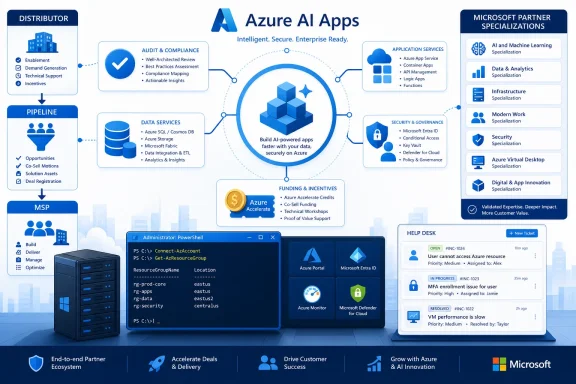 Microsoft’s AI Channel Story Is Leaving the Slide Deck
The past two years of Microsoft AI messaging have been dominated by Copilot, Azure OpenAI, agents, and an ever-expanding vocabulary of “frontier” capabilities. Those products matter, but they do not sell, configure, secure, integrate, and support themselves. The unglamorous question is who turns the demo into a working system for a midmarket customer with legacy data, compliance rules, cost limits, and a help desk already drowning in tickets.That is where Ingram Micro’s new specialization lands. Microsoft’s AI Apps on Azure credential is not a consumer-facing label, and most end users will never ask whether their reseller’s distributor has it. But partners will care because the specialization is tied to Microsoft’s partner ecosystem, audited delivery capability, and access to Azure Accelerate funding categories for AI apps, agents, and pre-sales assessments.
The timing is important. Microsoft has spent years training customers to think of Azure as the default landing zone for enterprise AI, but the next bottleneck is no longer whether the model exists. It is whether a partner can stitch together Azure AI services, application platforms, data stores, security controls, and deployment funding into something a customer will actually approve.
Ingram Micro is positioning itself as the organization that helps smaller and midsize partners cross that gap. That is a familiar distributor role, but the AI version is more demanding. A reseller that once moved licenses and hardware now needs help proving value, managing data readiness, estimating consumption, and reducing the risk of projects that can otherwise become expensive prototypes.
The Badge Matters Because the Audit Changes the Conversation
Microsoft specializations are marketing assets, but they are not merely marketing copy. The AI Apps on Microsoft Azure Specialization requires evidence of cloud consumption, customer work, skills, and an audit process. Microsoft’s own partner documentation ties the specialization to Azure AI, Azure OpenAI, application platform services, GitHub-related developer workflows, databases, Fabric, and related eligible workloads.That breadth is the point. A modern AI app is rarely just a chatbot attached to a model endpoint. It is an application architecture problem, a data architecture problem, a governance problem, and often a Windows estate problem when identity, endpoint security, productivity workflows, and legacy line-of-business applications are involved.
For Ingram Micro, passing a third-party audit gives it a stronger claim than “we are investing in AI.” It allows the company to say that Microsoft has validated its ability to support partners building AI-powered applications on Azure’s stack. The claim still deserves scrutiny, as all vendor-partner claims do, but the audit moves it beyond a self-awarded slogan.
That distinction matters for smaller partners. Many MSPs and regional integrators are under pressure to offer AI services because customers are asking about them, but they do not always have deep benches in Azure AI Foundry, Azure OpenAI, AKS, Azure App Service, Logic Apps, API Management, Cosmos DB, SQL, Fabric, GitHub tooling, and security architecture. A distributor with audited capability can become a force multiplier, or at least a scaffolding layer, for partners that cannot afford to build every competency internally.
Azure Accelerate Turns Validation Into Money
The most concrete part of the announcement is not the credential itself but the expanded access to Azure Accelerate funding categories. Azure Accelerate is Microsoft’s program for reducing friction around cloud and AI projects through expert guidance, assessments, credits, partner engagement funding, and deployment support. In plain English: Microsoft is putting money and structured assistance behind projects it wants to see happen on Azure.That is strategically important because many AI projects die before procurement. Customers may want agents, copilots, intelligent apps, and automated workflows, but they also want a business case. They want proof that data can be connected safely, that costs can be forecast, and that the solution will not collapse into another abandoned innovation lab experiment.
Funding for pre-sales assessments and proof-of-value work changes the sales motion. It gives partners a way to take customers from curiosity to a scoped engagement without asking them to commit immediately to a large implementation. In a market where AI interest is high but buyer confidence is uneven, that bridge can matter as much as the technology itself.
It also reveals Microsoft’s channel strategy. Redmond does not simply want partners to talk about AI; it wants them to produce Azure consumption. The specialization aligns with workloads that drive use of Azure AI, application services, databases, Fabric, and developer platforms. That is not sinister; it is how cloud ecosystems work. But it means customers should understand that “AI readiness” advice from the channel is also shaped by the economics of Azure adoption.
Ingram Micro Wants to Be More Than the Box Mover
The old distributor caricature is a warehouse with credit terms. That model still exists, but the modern IT distributor has been trying to move up the value chain for years. Cloud marketplaces, financing, lifecycle services, technical enablement, professional services, and partner platforms have all pushed distribution closer to consulting and managed services.Ingram Micro’s AI Apps specialization fits that evolution. The company is not presenting itself merely as a pass-through for Microsoft products. It is presenting itself as an extension of partner AI practices, helping with assessments, proof-of-value engagements, and production deployment.
That framing is especially notable because Ingram Micro also points to its Microsoft Frontier Distributor status. Frontier Distributor is Microsoft’s label for distributors that meet standards around performance, enablement, and partner support in the AI Cloud Partner Program. When paired with the AI Apps specialization, the message is clear: Ingram Micro wants Microsoft partners to see it as a trusted operating layer for AI work, not simply a procurement route.
There is a business logic behind that. AI projects require more pre-sales labor than conventional license renewals. They involve data discovery, security review, architecture workshops, prompt and agent design, integration planning, and cost modeling. If distributors can package that work into repeatable motions, they become more valuable to partners and more embedded in customer projects.
For WindowsForum readers, this is where the news becomes practical. The partner selling a Windows Server modernization project, a Microsoft 365 deployment, a Defender rollout, or an Azure migration may now bundle AI assessment and app modernization services into the same conversation. The boundaries between infrastructure, productivity, security, and AI are becoming less distinct.
The Midmarket Is Where the AI Promise Gets Tested
Large enterprises can hire hyperscaler architects, top-tier consultancies, and internal AI platform teams. Smaller organizations often cannot. They still want the benefits of AI, but they need packaged pathways that reduce technical ambiguity and financial risk.That is the market Microsoft and its distributors are chasing. The phrase “from AI exploration to AI execution” appears often in vendor language because it describes a real customer problem. Plenty of organizations have tested Copilot, played with generative AI tools, or built internal proofs of concept. Far fewer have moved durable AI applications into production with governance, monitoring, security, and measurable ROI.
The midmarket problem is not lack of ambition. It is the absence of spare capacity. A 300-person company may have the same questions about data leakage, identity, retention, and model accuracy as a multinational, but it does not have the same staff to answer them. Its MSP or reseller becomes the translator.
That is why distributor enablement matters. If Ingram Micro can help partners run assessments, identify suitable workloads, create proof-of-value projects, and guide production deployments, the addressable market for Azure AI apps expands. If it cannot, the specialization risks becoming another badge in a crowded partner directory.
The strongest version of this model gives customers a more disciplined path into AI. The weaker version produces more sales pressure wrapped in funding language. The difference will be visible in how partners scope projects: whether they start with data quality, security, and business process fit, or whether they begin with a generic agent pitch.
Agents Are the New Cloud Consumption Engine
The announcement’s reference to funding for AI apps and agents is not incidental. Agents are becoming the next major battleground for Microsoft’s cloud platform. The company wants customers to build AI systems that do more than answer questions: systems that retrieve information, call tools, trigger workflows, and interact with enterprise data.That raises the stakes for architecture. A simple generative AI demo can be created quickly. A production agent that accesses customer records, updates tickets, summarizes contracts, or initiates business processes needs permissions, auditability, data boundaries, testing, rollback strategies, and monitoring. It is software engineering with a probabilistic component, not a magic layer sprinkled over SharePoint.
Microsoft’s specialization criteria reflect that complexity by spanning AI services, application platforms, developer tools, and data services. The agent becomes the visible interface, but the supporting stack is where most of the work lives. Azure OpenAI may provide the model access, but the real deployment may depend on Azure Functions, Container Apps, AKS, API Management, Logic Apps, Cosmos DB, Azure SQL, Fabric, Entra ID, Defender, GitHub, and a pile of integration glue.
That is why partners need help. Many channel firms are comfortable with Microsoft 365 administration, endpoint management, licensing, and classic Azure infrastructure. Fewer are ready to design secure, production-grade agentic applications. Distributor-led enablement could close part of that gap, provided it emphasizes engineering discipline rather than shortcut demos.
The risk is that “agent” becomes the new “digital transformation,” a term broad enough to sell anything. Customers should ask what the agent can do, what systems it touches, how its actions are logged, how permissions are constrained, how hallucinations are handled, and who supports it after launch. A funded assessment should answer those questions before a production build begins.
The Windows Estate Is Still in the Room
This announcement is officially about Azure AI applications, not Windows. But in most businesses, Azure AI projects do not exist in a vacuum. They intersect with Windows endpoints, Microsoft 365 identities, Entra policies, Defender telemetry, Teams workflows, legacy .NET applications, SQL Server estates, and on-premises systems that are still essential to daily operations.That matters because many AI app opportunities start as modernization problems. A company may want an agent to query service history, but the data may live in an old SQL database. A finance team may want automated document review, but the files may be scattered across SharePoint, file shares, and line-of-business applications. A support organization may want Copilot-style ticket triage, but the workflow may depend on APIs that were never designed for AI automation.
The Windows ecosystem is the substrate for much of this work. The partner that understands endpoint identity, conditional access, device posture, data loss prevention, application compatibility, and hybrid infrastructure will be better positioned than a partner that treats AI as a standalone product. Ingram Micro’s value proposition will depend on whether it helps partners connect those worlds.
For sysadmins, the practical implication is that AI adoption will arrive through familiar channels. It may not come as a board-approved “AI transformation” program. It may appear inside an Azure migration, a security refresh, a help desk automation project, a database modernization effort, or a Microsoft 365 optimization engagement.
That means IT teams should prepare their own questions early. Which data sources are in scope? Which identities can the AI app act as? Which logs prove what happened? Which workloads will generate Azure consumption? Which teams own incident response when the AI layer behaves badly? These are not anti-AI questions; they are production-readiness questions.
The Distributor Becomes the Trust Broker
Microsoft’s partner ecosystem depends on layers of trust. Customers trust local partners. Partners trust distributors for access, financing, enablement, and escalation. Microsoft trusts designated partners and distributors to drive adoption at scale. The AI era makes that chain more important because the technology is harder to evaluate and the consequences of poor implementation are higher.Ingram Micro’s certification is a trust signal aimed primarily at partners. It says: if you need help building AI apps on Azure, we have been validated to support you. It also says to Microsoft: we can help turn your AI platform strategy into channel execution.
That trust-broker role is lucrative but delicate. Partners do not want distributors to displace them in front of customers. Customers do not want a parade of overlapping vendors with unclear accountability. Microsoft wants scale without losing control of quality. Ingram Micro must thread that needle by being visible enough to reassure partners and invisible enough not to make them feel replaced.
Hans Mize’s quoted framing that Ingram Micro feels like an extension of a partner’s AI practice captures the intended balance. The distributor supplies expertise and structure, while the partner retains the customer relationship. That is the channel ideal.
But execution will determine whether it works. AI projects expose weaknesses quickly. If the assessment is shallow, the proof of value may disappoint. If the deployment ignores governance, the customer may block expansion. If costs are poorly modeled, the Azure bill may sour enthusiasm. If support boundaries are vague, every incident becomes a finger-pointing exercise.
Microsoft’s Partner Program Is Becoming More Consumption-Driven
The AI Apps specialization also reflects a broader shift in Microsoft’s partner economics. The modern partner program increasingly rewards measurable cloud activity, eligible workloads, customer counts, certifications, and audited capability. This is not just about having trained staff or a glossy case study; it is about proving that partners can drive real Azure usage across strategic product areas.For Microsoft, this is rational. AI workloads are expensive to build and operate, and Microsoft wants its ecosystem aligned around consumption of Azure AI, data, app platform, and developer services. Specializations create a way to sort partners by capability and steer customers toward firms that have demonstrated activity in the right areas.
For partners, the system creates both opportunity and pressure. A specialization can improve visibility, unlock funding, and strengthen credibility. But it can also push partners toward Microsoft’s preferred architecture and metrics. A partner may find that its route to funding is easier when the proposed solution maps cleanly to eligible Azure workloads.
Customers should not assume that is bad. Standardized architectures and funded assessments can lower risk. But customers should also remember that channel incentives are not neutral. The best partners will be transparent about why a workload belongs on Azure, what alternatives exist, and how the proposed design serves the customer rather than the program.
This is especially relevant for AI because platform lock-in can happen quietly. Once an organization builds agents around Azure services, data pipelines, identity policies, monitoring tools, and app platforms, it is making a strategic bet. That bet may be the right one, particularly for Microsoft-heavy environments, but it should be made consciously.
The Announcement Is Small, but the Pattern Is Big
On its own, Ingram Micro earning a Microsoft specialization is not a market-shaking event. It will not change Windows overnight, and it will not settle the debate over enterprise AI ROI. But it is a useful marker of where the industry is heading.The first phase of generative AI in the enterprise was experimentation. The second phase is packaging. Microsoft is packaging capability into Copilot, Azure AI services, Foundry, Fabric, and agent frameworks. Distributors are packaging partner enablement and funded delivery motions. MSPs and integrators are packaging industry use cases and modernization offers.
That packaging is necessary because most customers do not buy raw possibility. They buy bounded projects. They buy assessments, pilots, deployments, migrations, and managed services. The more Microsoft can turn AI into partner-deliverable units, the easier it becomes for customers to approve spending and for Azure consumption to grow.
The danger is that packaging can hide complexity. A polished assessment may make an AI project look cleaner than it is. A funded proof of value may understate the cost of production support. A specialization may signal competence without guaranteeing that every downstream partner engagement will be well scoped.
That is why the news should be read neither as hype nor as trivia. It is a sign that the AI channel is maturing into something more operational. Maturity brings process, funding, audits, and repeatability. It also brings sales machinery.
The Real Test Will Be Partner Discipline
Ingram Micro’s CEO Paul Bay framed the achievement around keeping channel partners central and investing ahead of the market. That is the right message for a distributor. The question is whether the partner ecosystem can maintain discipline as AI demand rises.A disciplined AI partner will start with the customer’s process, data, and risk profile. It will identify where AI can reduce friction or create value without pretending every workflow needs an agent. It will scope a proof of value around measurable outcomes. It will design for security and support from the beginning.
An undisciplined partner will lead with the technology and backfill the business case later. It will build demos that impress executives but leave admins with unresolved data-access problems. It will treat Azure funding as a reason to move quickly rather than a way to reduce uncertainty. It will discover production constraints after the customer has already been sold.
The specialization gives Ingram Micro a stronger platform to influence which version partners adopt. If it uses that platform to standardize good practices, it can raise the floor for AI delivery in the channel. If it uses it mainly to accelerate pipeline, customers will feel the difference.
This is where WindowsForum’s audience should pay attention. Many readers sit at the intersection between vendor ambition and operational reality. They know that a project is not successful when the demo works; it is successful when the help desk can support it, the security team can audit it, finance understands the bill, and users keep using it after the novelty fades.
The Fine Print Behind Ingram Micro’s Azure AI Win
This is a channel story, but the practical lessons are concrete. The specialization is best understood as a signal that AI delivery is becoming more structured, more funded, and more dependent on the Microsoft partner machine.- Ingram Micro earned Microsoft’s AI Apps on Microsoft Azure Specialization after a third-party audit of its Azure AI, application, and data-services capabilities.
- The credential builds on Ingram Micro’s Microsoft Frontier Distributor status and strengthens its claim to support partners moving from AI pilots to production deployments.
- Expanded Azure Accelerate access matters because funded assessments, proof-of-value work, and deployment support can reduce the early financial friction that often stalls AI projects.
- The specialization is tied to a broad Azure stack, which means real AI apps will often involve data platforms, app services, developer tooling, identity, security, and integration work rather than a single model endpoint.
- Partners should treat the credential as an enablement resource, not a substitute for project discipline, customer-specific architecture, and clear support ownership.
- Customers should ask how any proposed AI app will be governed, logged, secured, costed, and maintained before letting a proof of value become production infrastructure.
References
- Primary source: sekbernews.id
Published: 2026-06-04T05:30:35.994754
Ingram Micro Secures Microsoft Azure AI Specialization
Ingram Micro expands its tech capabilities after earning the AI Apps on Microsoft Azure Specialization to help channel partners design AI solutions.www.sekbernews.id - Related coverage: ir.ingrammicro.com
Ingram Micro Earns the AI Apps on Microsoft Azure Specialization, Demonstrating Leadership in Delivering Frontier AI Services :: Ingram Micro Holding Corporation (INGM)
Achievement Spotlights Ingram Micro’s Frontier Distributor Status and AI Apps Leadership IRVINE, Calif.--(BUSINESS WIRE)-- Ingram Micro…...ir.ingrammicro.com - Related coverage: insidermonkey.com
Ingram Micro Holding Corporation (INGM) Earns the AI Apps on Microsoft Azure Specialization - Insider Monkey
On May 4, 2026, Ingram Micro Holding Corporation (NYSE:INGM) reported that it earned the AI Apps on Microsoft Azure Specialization. www.insidermonkey.com
- Related coverage: itreseller.es
Ingram Micro obtiene la especialización AI Apps sobre Microsoft Azure | Desarrollo de canal | IT Reseller
El mayorista supera una auditoría independiente y accede a nuevas categorías de financiación Azure Accelerate para aplicaciones y agentes de IA. El lo...www.itreseller.es - Official source: azure.microsoft.com
Azure Accelerate | Microsoft Azure
Explore Azure Accelerate to fuel transformation with experts across the cloud and AI journey.azure.microsoft.com
- Related coverage: investing.com
Ingram Micro earns Microsoft Frontier Distributor designation By Investing.com
Ingram Micro earns Microsoft Frontier Distributor designationwww.investing.com
- Related coverage: windowsforum.com
Ingram Micro earns Microsoft AI Apps on Azure specialization—what it means for partners | Windows Forum
Ingram Micro said on May 4, 2026, in Irvine, California, that it has earned Microsoft’s AI Apps on Microsoft Azure Specialization, a partner credential tied...windowsforum.com - Related coverage: crn.com.au
Ingram Micro receives Frontier Microsoft Distributor status
A “defined and disciplined” process that's aligned to strategic outcomes across AI, cloud and cybersecurity.www.crn.com.au - Related coverage: linkedin.com
Ingram Micro Acquires AI Apps on Microsoft Azure Specialization | Ingram Micro posted on the topic | LinkedIn
𝐋𝐞𝐚𝐝𝐢𝐧𝐠 𝐭𝐡𝐞 𝐀𝐈 𝐅𝐫𝐨𝐧𝐭𝐢𝐞𝐫: 𝐈𝐧𝐠𝐫𝐚𝐦 𝐌𝐢𝐜𝐫𝐨 𝐄𝐚𝐫𝐧𝐬 𝐭𝐡𝐞 𝐀𝐈 𝐀𝐩𝐩𝐬 𝐨𝐧 𝐌𝐢𝐜𝐫𝐨𝐬𝐨𝐟𝐭 𝐀𝐳𝐮𝐫𝐞 𝐒𝐩𝐞𝐜𝐢𝐚𝐥𝐢𝐳𝐚𝐭𝐢𝐨𝐧 We are pleased to announce that we have recently acquired the AI Apps on Microsoft Azure Specialization. This milestone speaks volumes about our advanced capabilities in designing, developing, and...www.linkedin.com
- Related coverage: tipranks.com
Ingram Micro achieves AI Apps on Microsoft Azure Specialization - TipRanks.com
Ingram Micro (INGM) Holding has achieved the AI Apps on Microsoft Azure Specialization, further validating the company’s advanced capabilities in designing, develop...www.tipranks.com
- Related coverage: na.ingrammicro.com
