

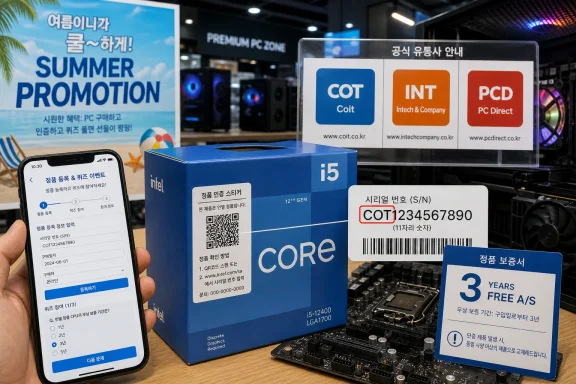
Intel’s three authorized South Korean desktop CPU distributors, Coit, Intech & Company, and PC Direct, have launched a “Cool Summer” registration-and-quiz promotion for buyers of genuine Intel processors, using prizes and warranty messaging to steer customers toward verified retail channels. The campaign is not really about summer giveaways. It is about trust in a PC component market where the box, the sticker, the serial number, and the warranty path have become part of the product. Intel’s latest desktop pitch now has to sell not only performance, but provenance.
At first glance, the promotion is ordinary channel marketing: register a product, answer a quiz, enter a lucky draw, maybe win something useful while the weather is miserable. Every major hardware vendor has run a version of this playbook, and PC buyers have learned to treat these events as background noise.
But the structure of this campaign is more revealing than the prizes. The user is being asked to learn how to identify a genuine Intel CPU, check the authentication sticker, use the 11-digit serial number, and understand which distributors are part of the official domestic channel. That is not just engagement marketing; it is consumer education wearing a promotional T-shirt.
The named distributors — Coit, Intech & Company, and PC Direct — matter because they define the boundary between “an Intel CPU” and “an Intel CPU that will be handled cleanly when something goes wrong.” For enthusiasts who buy boxed processors from familiar retailers, that distinction may sound obvious. For buyers shopping across online marketplaces, gray-market importers, bulk resellers, and secondhand listings, it can be the difference between a routine warranty claim and a dead end.
Intel’s message is therefore blunt beneath the seasonal packaging: if you want the benefits, buy through the channel we can see.
That matters because CPUs occupy an awkward place in the PC supply chain. They are high-value, easy to resell, relatively small, and often visually indistinguishable to a casual buyer until installed. Counterfeit packaging, remarking, tray-part ambiguity, and warranty-region confusion have all existed in various forms across the component market, even when outright fake silicon is less common than fake accessories or misleading listings.
For Intel, the authentication sticker is a way to make the support relationship visible before there is a problem. For distributors, it protects their service obligations from becoming a free repair desk for inventory they never sold. For the customer, it converts a purchase receipt and a sticker into leverage.
There is a quieter implication here as well: boxed desktop CPUs are no longer sold only to the classic PC hobbyist. The audience now includes creators buying workstation parts, small studios building machines outside formal procurement channels, parents buying parts for a gaming PC, and office buyers trying to save money on marketplaces. A quiz may sound unserious, but the need it addresses is not.
The campaign also says that if a registered genuine CPU is discontinued while still under warranty, it may be replaced with a next-tier product at no additional charge. That is the kind of clause that sounds like a small footnote until it happens to you. Processor lines move quickly, retail stock thins unpredictably, and warranty replacement often becomes complicated precisely when a part is no longer sitting in the warehouse.
This is where the authorized-channel argument becomes strongest. A cheaper CPU from an ambiguous source may boot, benchmark, and overclock just fine on day one. The hidden cost appears later, when the user discovers that the seller has vanished, the serial number does not map cleanly to domestic support, or the replacement process depends on a region the buyer never knowingly entered.
Intel’s distributors are not merely promising kindness. They are using warranty certainty as a competitive feature against gray-market entropy.
The timing is useful for Intel. The company’s desktop CPU story over the last several years has been technically active but narratively messy: socket changes, power debates, architecture transitions, intense AMD competition, and the difficult task of explaining why “Core Ultra” is not just old Core branding with extra syllables. A distributor-led promotion gives Intel a less adversarial stage than a benchmark chart.
The 270K Plus is being framed around large video and image projects, 3D work, real-time gaming, improved cache, die-to-die frequency improvements, and Intel binary optimization. That bundle of claims is important because it reflects how desktop performance is now sold. Raw clock speed still matters, but the marketing story has shifted toward platform behavior: cache, scheduling, optimization, memory support, and how the chip behaves across mixed workloads.
For Windows users, that is the right battlefield. Modern desktop PCs rarely run one clean workload at a time. A game sits beside Discord, a browser with too many tabs, capture software, RGB utilities, cloud sync, security tooling, and the occasional Windows update process deciding that now is an excellent moment to become relevant.
That is why the distributor campaign’s emphasis on registration and benefits pairs neatly with the processor messaging. A CPU in this class is not an impulse buy for most people. It is part of a platform decision involving motherboard, memory, cooler, power supply, operating system installation, and often a GPU that costs more than the rest of the machine.
When buyers spend that kind of money, the product’s afterlife matters. Enthusiasts tend to focus on the purchase moment — price, benchmark, thermals, overclocking headroom — but the ownership period is where the support channel earns or loses trust. Intel’s distributors are effectively saying that the boxed CPU is not only a piece of silicon; it is an entitlement to a defined support experience.
That message may sound conservative, but it is probably well targeted. A buyer choosing between a slightly cheaper ambiguous listing and a registered domestic-channel part may not need another bar chart. They may need to be reminded that a warranty is only as useful as the organization willing to honor it.
For Windows 11 users, the practical question is not whether a 24-core hybrid chip looks impressive on a spec sheet. It is whether the system feels fast while doing ordinary, messy things: exporting a video while browsing, compiling code while streaming, running a game while recording, or keeping a creator workstation responsive under load. That is where improved cache, higher clocks, and tuning utilities become meaningful rather than decorative.
Sysadmins and small-business IT buyers will see another angle. The more powerful the desktop CPU, the more tempting it becomes to use consumer-platform hardware for semi-professional workloads: CAD stations, local AI experimentation, media production, software builds, and lab virtualization. Those machines may not be servers, but they can become operationally important very quickly.
For that buyer, provenance matters even more. A workstation that fails under deadline pressure is not merely an inconvenience. It is lost billable time, a delayed render, a failed demo, or a support ticket that lands on someone who did not choose the component supplier.
This flexibility helps buyers. It also creates confusion. A processor can be genuine Intel silicon and still lack the domestic service path a buyer assumes comes with the brand. A listing can be accurate in the narrow technical sense while omitting the support implications that matter after purchase.
That ambiguity is what authorized-distributor campaigns try to collapse. They do not need to prove that every unofficial part is bad. They only need to show that the buyer takes on uncertainty, and uncertainty has a price.
This is especially relevant in regions where local distributors carry the burden of after-sales service. The vendor brand may be global, but warranty handling is often local, contractual, and tied to inventory movement. Consumers think in logos; service departments think in serial numbers.
In that environment, a genuine-registration campaign is not glamorous, but it is strategically sensible. It moves the conversation from “how fast is this chip?” to “what exactly am I buying, and who stands behind it?” That is a healthier frame for a company that wants to sell platform confidence rather than chase every benchmark headline.
The choice to highlight the Core Ultra 7 270K Plus also suggests Intel and its distributors know where the volume-interest sweet spot may be. Flagship CPUs generate attention, but upper-mainstream and high-performance mainstream parts often define the systems people actually build. A strong Core Ultra 7 can anchor gaming rigs, creator desktops, and long-lived home workstations without requiring the buyer to justify flagship pricing.
The risk is that marketing language can outrun observed reality. Claims about seamless editing, 3D workloads, and high-end gaming need to survive independent testing, BIOS maturity, cooler choice, memory configuration, and Windows behavior. Buyers should treat the distributor campaign as a support-channel message first and a performance claim second.
A substantial share of buyers do not read warranty terms before purchasing a CPU. They do not know which distributor prefix matters. They may not understand why a sticker on a chassis is more than decoration. The quiz forces attention onto the one moment when the customer still has power: before choosing where to buy.
The more interesting part is that the promotion acknowledges a knowledge gap that the industry helped create. Component naming has become dense, retail channels have become fragmented, and support terms are often scattered across regional sites, distributor pages, and retailer listings. If the correct buying behavior requires specialized knowledge, vendors should not be surprised when customers get it wrong.
Intel’s distributor network is using a promotion to simplify that knowledge into a few checks. Look for the genuine authentication sticker. Confirm the serial prefix. Register the part. Understand the support period. It is basic, but basic is exactly what many buyers need.
The Core Ultra 7 270K Plus looks like the kind of chip that will attract builders who want a machine to do more than one thing well. That includes gaming, encoding, image work, general productivity, and background-heavy multitasking. It also means the total platform should be chosen carefully: motherboard firmware, DDR5 compatibility, cooler capacity, case airflow, and Windows installation quality will all affect the experience.
A registered genuine CPU will not make a bad build good. It will not rescue a weak cooler, an unstable memory overclock, or a motherboard BIOS that needs updating. What it does provide is a cleaner line of accountability if the processor itself becomes the problem.
That distinction is important because marketing often compresses ownership into a single moment of purchase. The better view is lifecycle-based. A CPU has a buying phase, a build phase, a tuning phase, a daily-use phase, and eventually a failure-or-upgrade phase. Intel’s “Cool Summer” campaign is mostly about the last of those phases, even if it advertises itself at the first.
Marketplace listings can blur the difference between domestic retail stock and imported inventory. Secondhand sellers may not transfer useful documentation. Bulk or tray parts may be presented in ways that casual buyers misunderstand. Even experienced builders can become complacent when a price looks attractive and the seller’s photos look convincing.
That is why the distributor campaign is less trivial than it appears. It is trying to reinsert a trusted chain into a market that has become optimized for speed and price. The sticker and serial number are analog-feeling tools in a digital marketplace, but they give the buyer something concrete to verify.
There is also a community effect. When enthusiasts understand genuine-channel rules, they tend to pass that knowledge along in build advice, forum replies, and buyer warnings. A promotion built around a quiz may reach one customer at a time, but the information can travel through the same informal networks that influence component purchases.
 Intel Turns a Giveaway Into a Supply-Chain Lesson
At first glance, the promotion is ordinary channel marketing: register a product, answer a quiz, enter a lucky draw, maybe win something useful while the weather is miserable. Every major hardware vendor has run a version of this playbook, and PC buyers have learned to treat these events as background noise.But the structure of this campaign is more revealing than the prizes. The user is being asked to learn how to identify a genuine Intel CPU, check the authentication sticker, use the 11-digit serial number, and understand which distributors are part of the official domestic channel. That is not just engagement marketing; it is consumer education wearing a promotional T-shirt.
The named distributors — Coit, Intech & Company, and PC Direct — matter because they define the boundary between “an Intel CPU” and “an Intel CPU that will be handled cleanly when something goes wrong.” For enthusiasts who buy boxed processors from familiar retailers, that distinction may sound obvious. For buyers shopping across online marketplaces, gray-market importers, bulk resellers, and secondhand listings, it can be the difference between a routine warranty claim and a dead end.
Intel’s message is therefore blunt beneath the seasonal packaging: if you want the benefits, buy through the channel we can see.
The Sticker Is Doing More Work Than the Silicon
The campaign’s practical mechanism is a genuine authentication sticker attached to the product package or desktop chassis. Registration relies on an 11-digit serial number beginning with one of three distributor prefixes: COT, INT, or PCD. It is a simple system, but simple systems are often what survive contact with real retail behavior.That matters because CPUs occupy an awkward place in the PC supply chain. They are high-value, easy to resell, relatively small, and often visually indistinguishable to a casual buyer until installed. Counterfeit packaging, remarking, tray-part ambiguity, and warranty-region confusion have all existed in various forms across the component market, even when outright fake silicon is less common than fake accessories or misleading listings.
For Intel, the authentication sticker is a way to make the support relationship visible before there is a problem. For distributors, it protects their service obligations from becoming a free repair desk for inventory they never sold. For the customer, it converts a purchase receipt and a sticker into leverage.
There is a quieter implication here as well: boxed desktop CPUs are no longer sold only to the classic PC hobbyist. The audience now includes creators buying workstation parts, small studios building machines outside formal procurement channels, parents buying parts for a gaming PC, and office buyers trying to save money on marketplaces. A quiz may sound unserious, but the need it addresses is not.
Warranty Is the Real Prize
The most substantial offer attached to genuine registration is not the lucky draw. It is three years of free after-sales service through any of the three authorized distributors. The phrase “free A/S” is common in Korean retail language, but in component terms it maps to what buyers really care about: diagnosis, replacement, and a human path through failure.The campaign also says that if a registered genuine CPU is discontinued while still under warranty, it may be replaced with a next-tier product at no additional charge. That is the kind of clause that sounds like a small footnote until it happens to you. Processor lines move quickly, retail stock thins unpredictably, and warranty replacement often becomes complicated precisely when a part is no longer sitting in the warehouse.
This is where the authorized-channel argument becomes strongest. A cheaper CPU from an ambiguous source may boot, benchmark, and overclock just fine on day one. The hidden cost appears later, when the user discovers that the seller has vanished, the serial number does not map cleanly to domestic support, or the replacement process depends on a region the buyer never knowingly entered.
Intel’s distributors are not merely promising kindness. They are using warranty certainty as a competitive feature against gray-market entropy.
Arrow Lake Refresh Gets a Channel-Market Spotlight
The promotion also introduces Intel’s Core Ultra 7 Processor 270K Plus, a 2026 desktop part in the Core Ultra 200S Plus family. Its headline configuration is familiar from Intel’s modern hybrid playbook: up to 8 performance cores, 16 efficiency cores, and boost speeds up to 5.5GHz. It is aimed at the overlap between enthusiast gaming, creator workloads, and high-end multitasking.The timing is useful for Intel. The company’s desktop CPU story over the last several years has been technically active but narratively messy: socket changes, power debates, architecture transitions, intense AMD competition, and the difficult task of explaining why “Core Ultra” is not just old Core branding with extra syllables. A distributor-led promotion gives Intel a less adversarial stage than a benchmark chart.
The 270K Plus is being framed around large video and image projects, 3D work, real-time gaming, improved cache, die-to-die frequency improvements, and Intel binary optimization. That bundle of claims is important because it reflects how desktop performance is now sold. Raw clock speed still matters, but the marketing story has shifted toward platform behavior: cache, scheduling, optimization, memory support, and how the chip behaves across mixed workloads.
For Windows users, that is the right battlefield. Modern desktop PCs rarely run one clean workload at a time. A game sits beside Discord, a browser with too many tabs, capture software, RGB utilities, cloud sync, security tooling, and the occasional Windows update process deciding that now is an excellent moment to become relevant.
The 270K Plus Pitch Is Really About Value Discipline
Intel’s 270K Plus is notable because it sits in a position that would once have been easy to understand and now requires more explanation. It is not simply “the fastest Intel desktop CPU,” nor is it merely a modest midrange refresh. Its appeal depends on how much performance Intel can pull from a high-core-count configuration without asking buyers to climb all the way to a flagship tier.That is why the distributor campaign’s emphasis on registration and benefits pairs neatly with the processor messaging. A CPU in this class is not an impulse buy for most people. It is part of a platform decision involving motherboard, memory, cooler, power supply, operating system installation, and often a GPU that costs more than the rest of the machine.
When buyers spend that kind of money, the product’s afterlife matters. Enthusiasts tend to focus on the purchase moment — price, benchmark, thermals, overclocking headroom — but the ownership period is where the support channel earns or loses trust. Intel’s distributors are effectively saying that the boxed CPU is not only a piece of silicon; it is an entitlement to a defined support experience.
That message may sound conservative, but it is probably well targeted. A buyer choosing between a slightly cheaper ambiguous listing and a registered domestic-channel part may not need another bar chart. They may need to be reminded that a warranty is only as useful as the organization willing to honor it.
Microsoft’s Desktop Ecosystem Is the Unspoken Beneficiary
Windows is not named as the star of this promotion, but it is the operating environment in which most of these CPUs will prove themselves. Intel’s hybrid desktop designs depend on an OS scheduler that understands different core types, foreground responsiveness, background load, and gaming sensitivity. That makes the CPU purchase inseparable from the Windows platform experience.For Windows 11 users, the practical question is not whether a 24-core hybrid chip looks impressive on a spec sheet. It is whether the system feels fast while doing ordinary, messy things: exporting a video while browsing, compiling code while streaming, running a game while recording, or keeping a creator workstation responsive under load. That is where improved cache, higher clocks, and tuning utilities become meaningful rather than decorative.
Sysadmins and small-business IT buyers will see another angle. The more powerful the desktop CPU, the more tempting it becomes to use consumer-platform hardware for semi-professional workloads: CAD stations, local AI experimentation, media production, software builds, and lab virtualization. Those machines may not be servers, but they can become operationally important very quickly.
For that buyer, provenance matters even more. A workstation that fails under deadline pressure is not merely an inconvenience. It is lost billable time, a delayed render, a failed demo, or a support ticket that lands on someone who did not choose the component supplier.
The Gray Market Is a Feature Until It Becomes a Liability
The PC enthusiast economy has always had a complicated relationship with unofficial supply. Bargain hunting is part of the culture. So are imports, open-box deals, marketplace listings, bundle splits, tray processors, and parts sourced from channels that are legal but not always simple.This flexibility helps buyers. It also creates confusion. A processor can be genuine Intel silicon and still lack the domestic service path a buyer assumes comes with the brand. A listing can be accurate in the narrow technical sense while omitting the support implications that matter after purchase.
That ambiguity is what authorized-distributor campaigns try to collapse. They do not need to prove that every unofficial part is bad. They only need to show that the buyer takes on uncertainty, and uncertainty has a price.
This is especially relevant in regions where local distributors carry the burden of after-sales service. The vendor brand may be global, but warranty handling is often local, contractual, and tied to inventory movement. Consumers think in logos; service departments think in serial numbers.
Intel Needs Trust as Much as It Needs Benchmarks
Intel’s desktop brand has spent decades being synonymous with default reliability, but modern component buyers are less deferential than they used to be. AMD is no longer the perennial underdog. Review sites dissect power behavior, firmware revisions, scheduler quirks, motherboard defaults, and microcode changes with forensic enthusiasm. Social platforms can turn a batch of complaints into a reputation problem overnight.In that environment, a genuine-registration campaign is not glamorous, but it is strategically sensible. It moves the conversation from “how fast is this chip?” to “what exactly am I buying, and who stands behind it?” That is a healthier frame for a company that wants to sell platform confidence rather than chase every benchmark headline.
The choice to highlight the Core Ultra 7 270K Plus also suggests Intel and its distributors know where the volume-interest sweet spot may be. Flagship CPUs generate attention, but upper-mainstream and high-performance mainstream parts often define the systems people actually build. A strong Core Ultra 7 can anchor gaming rigs, creator desktops, and long-lived home workstations without requiring the buyer to justify flagship pricing.
The risk is that marketing language can outrun observed reality. Claims about seamless editing, 3D workloads, and high-end gaming need to survive independent testing, BIOS maturity, cooler choice, memory configuration, and Windows behavior. Buyers should treat the distributor campaign as a support-channel message first and a performance claim second.
The Quiz Is Corny, but the Lesson Is Correct
There is an unavoidable corniness to a CPU authenticity quiz. Hardware people tend to prefer teardown photos, benchmark tables, and firmware changelogs to consumer education games. But the format may be appropriate for the problem.A substantial share of buyers do not read warranty terms before purchasing a CPU. They do not know which distributor prefix matters. They may not understand why a sticker on a chassis is more than decoration. The quiz forces attention onto the one moment when the customer still has power: before choosing where to buy.
The more interesting part is that the promotion acknowledges a knowledge gap that the industry helped create. Component naming has become dense, retail channels have become fragmented, and support terms are often scattered across regional sites, distributor pages, and retailer listings. If the correct buying behavior requires specialized knowledge, vendors should not be surprised when customers get it wrong.
Intel’s distributor network is using a promotion to simplify that knowledge into a few checks. Look for the genuine authentication sticker. Confirm the serial prefix. Register the part. Understand the support period. It is basic, but basic is exactly what many buyers need.
Enthusiasts Should Read the Fine Print Before the Benchmarks
For WindowsForum readers, the practical advice is not to ignore the 270K Plus or distrust the promotion. It is to put the claims in the right order. First, confirm that the CPU is the right platform choice. Second, confirm that the seller is giving you the support path you expect. Third, worry about the prize draw.The Core Ultra 7 270K Plus looks like the kind of chip that will attract builders who want a machine to do more than one thing well. That includes gaming, encoding, image work, general productivity, and background-heavy multitasking. It also means the total platform should be chosen carefully: motherboard firmware, DDR5 compatibility, cooler capacity, case airflow, and Windows installation quality will all affect the experience.
A registered genuine CPU will not make a bad build good. It will not rescue a weak cooler, an unstable memory overclock, or a motherboard BIOS that needs updating. What it does provide is a cleaner line of accountability if the processor itself becomes the problem.
That distinction is important because marketing often compresses ownership into a single moment of purchase. The better view is lifecycle-based. A CPU has a buying phase, a build phase, a tuning phase, a daily-use phase, and eventually a failure-or-upgrade phase. Intel’s “Cool Summer” campaign is mostly about the last of those phases, even if it advertises itself at the first.
The Channel Message Lands Because the Market Is Messier Now
The modern PC market is both better and more confusing than it used to be. Buyers have more information, more retailers, more international access, and more competition. They also have more ways to make a purchase that is technically legitimate but operationally inconvenient.Marketplace listings can blur the difference between domestic retail stock and imported inventory. Secondhand sellers may not transfer useful documentation. Bulk or tray parts may be presented in ways that casual buyers misunderstand. Even experienced builders can become complacent when a price looks attractive and the seller’s photos look convincing.
That is why the distributor campaign is less trivial than it appears. It is trying to reinsert a trusted chain into a market that has become optimized for speed and price. The sticker and serial number are analog-feeling tools in a digital marketplace, but they give the buyer something concrete to verify.
There is also a community effect. When enthusiasts understand genuine-channel rules, they tend to pass that knowledge along in build advice, forum replies, and buyer warnings. A promotion built around a quiz may reach one customer at a time, but the information can travel through the same informal networks that influence component purchases.
The Useful Lesson Hidden Inside the Summer Gimmick
Intel’s Korean distributor promotion is easy to dismiss as seasonal marketing, but that would miss the real signal: CPU ownership now includes authentication, registration, and regional support awareness, not just specs and price.- Buyers should confirm that an Intel boxed CPU carries the genuine authentication sticker before assuming it qualifies for domestic distributor support.
- The 11-digit serial number prefix matters because COT, INT, and PCD identify the authorized South Korean distributor channel named in the campaign.
- Registration on the Real CPU site is positioned as the gateway to three years of free after-sales service through the participating distributors.
- The discontinued-product replacement promise is potentially more valuable than the lucky-draw prizes because it addresses a real warranty problem.
- The Core Ultra 7 270K Plus should be judged through independent performance data and full-platform behavior, not merely distributor marketing claims.
- A cheaper listing is not automatically a better deal if it weakens the buyer’s warranty path or complicates later support.
References
- Primary source: Inven Global
Published: Tue, 16 Jun 2026 00:54:23 GMT
Three Authorized Intel Distributors Launch 'Cool Summer' Promotion for Genuine Intel CPUs - Inven Global
Source: Intel©INTELThree authorized Intel distributors are hosting a product registration and quiz promotion for users of genuine Intel CPUs.www.invenglobal.com - Related coverage: intel.com
- Related coverage: intel.co.jp
- Related coverage: bhphotovideo.com
Intel Core Ultra 7 270K Plus 24-Core LGA 1851 BX80768270K B&H
Buy Intel Core Ultra 7 270K Plus 24-Core LGA 1851 Processor featuring 24 Cores & 24 Threads, 3.7 GHz P-Core Clock Speed, 5.5 GHz Maximum Turbo Boost Frequency, LGA 1851 Socket, 36MB Cache Memory, Dual-Channel DDR5-7200 Memory, Integrated Intel Graphics, Hybrid Core Architecture, Unlocked for...www.bhphotovideo.com - Related coverage: pcgamer.com
Intel Core Ultra 7 270K Plus review | PC Gamer
The latest Review,,,reviews, breaking news, comment, reviews and features from the experts at PC Gamerwww.pcgamer.com - Related coverage: bestbuy.com
- Related coverage: tomshardware.com
The Core Ultra 7 270K was too good, so Intel scrapped the flagship Core Ultra 9 290K Plus — benchmarks of the 290K prototype find slim 2% faster performance in gaming and applications | Tom's Hardware
The Core Ultra 9 290K Plus just wouldn't have made sense.www.tomshardware.com - Related coverage: intel.de
- Related coverage: computerorbit.com
Intel Core Ultra 7 270K Plus | Computer Orbit
Buy the Intel Core Ultra 7 270K Plus 24-core LGA 1851 processor with 5.5GHz turbo, DDR5 support, and Intel Graphics. computerorbit.com
- Related coverage: windowscentral.com
Intel Core Ultra 5 250K and 270K Plus review: CPUs for creators | Windows Central
Intel's Arrow Lake Refresh is a duo of refreshed processors with the Core Ultra 200S series, and they're refreshingly cheap with gaming benefits on the side.www.windowscentral.com - Related coverage: intel.cn
- Related coverage: techradar.com
'The fastest desktop gaming processors Intel has ever built': new Arrow Lake Refresh CPUs are priced to sell, and AMD should be worried | TechRadar
Meet the Intel Core Ultra 7 270K Plus and Core Ultra 5 250K Pluswww.techradar.com - Related coverage: intel.co.kr
- Related coverage: intel.la
