• Thread Author
The University of Georgia has launched a campus AI pilot program for students, marking the latest chapter in a nationwide push by colleges to move beyond blanket bans and toward guided, institution‑level adoption of generative AI tools — a shift that promises productivity and new learning pathways while raising urgent questions about privacy, pedagogy, and governance.

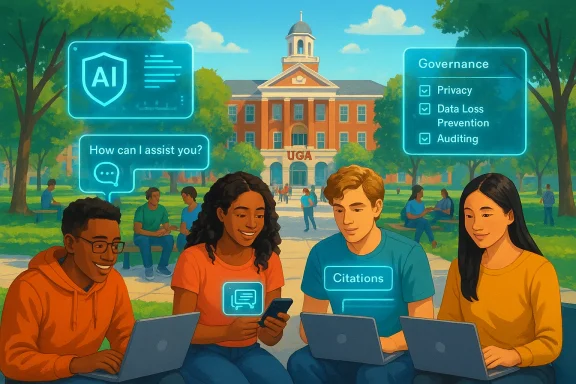
University students on campus use AI-powered tools and dashboards on laptops.Background and overview​

Colleges and universities across the United States are experimenting with how to integrate generative AI into everyday teaching, research, and student services. That experimentation ranges from small course‑level pilots to institution‑wide vendor partnerships that place advanced assistants at the center of campus productivity toolchains. One recent, large example saw a major university plan a broad roll‑out of Microsoft 365 Copilot for every student and staff member; that case has been widely discussed as a bellwether for what a full campus deployment looks like in practice and highlights the governance and technical work required to make such programs safe and educationally sound. om the University of Georgia — reported in a student newsroom article excerpt supplied to this piece — positions UGA’s effort as a pilot, not an unbounded deployment. The Red & Black excerpt highlights student social dynamics and the rise of campus‑focused platforms such as Yik Yak as part of the context for introducing campus AI: colleges are places where digital community and real‑world learning meet, and administrators are increasingly seeing AI literacy as part of the student experience. The description of Yik Yak in the excerpt underscores how campus technology often centers peer conversation and anonymity; that social context matters when designing AI initiatives because students use digital tools in ways administrators may not anticipate.
Important caveat: the original Red & Black article was provided as an excerpt for this assignment. I was unable to independently fetch the full Red & Black page from the public site at the time of writing; where this article makes broader factual claims about other universities or technical best practices, those claims are verified against independent institutional reporting and operational recommendations from documented campus rollouts. Where UGA‑specific details could not be corroborated beyond the supplied excerpt, I flag those statements clearly.

Why universities are shifting from bans to pilots​

The limits of prohibition​

Banning generative AI outright is still a tempting policy for instructors who fear AI will simplify away learning objectives, but bans have proven brittle. Students will continue to access powerful models on personal devices, and instructors who ban tools may miss an opportunity to teach how to use them responsibly. Research from campus policy labs and event summaries shows three dominant approaches emerging nationwide: (1) guided integration that emphasizes AI literacy, (2) course‑level restrictions where mastering raw reasoning or formal methods is the learning goal, and (3) institution‑level governance experiments that pair training, tool access, and enforcement mechanisms. These frameworks aim to preserve pedagogical integrity while preparing students for workplaces where AI is already part of the toolkit.

Equity and accesities argue that structured pilots and enterprise engagements can be equity tools: they close an emerging “AI access divide” between students who can afford premium tools and those who cannot. The University of Manchester’s recent campus‑wide Copilot partnership, for instance, was explicitly framed as an equity measure alongside workforce readiness. The Manchester case shows why large, vendor‑backed programs are attractive to administrators: they can rapidly scale access while offering centralized governance and training — but those benefits come with trade‑offs.​


What an effective AI pilot looksilot must be bounded, measurable, and tightly governed. Practical recommendations synthesized from campus rollouts and operational guidance include:​

  • Start small and measure. Bounded pilots should include clear metrics: adoption, accuracy/correction rates, DLP (data loss prevention) events, and user satisfaction. These allow institutions to decide whether broader rollout is justified.
  • Co‑design policy with stakeholders. Acceptable‑use policidance should be co‑authored with faculty, students, and academic integrity bodies so they reflect pedagogy rather than top‑down technology mandates.
  • Harden technical controls first. Before scaling, ensure DLP, conditional acceare in place to limit unauthorized data exfiltration and to preserve student privacy.
  • Invest in short, scenario‑based training. Teach prompt design, verification, and citation practiceels can do, but how to evaluate answers and document AI assistance.
  • Report outcomes publicly. Publish pilot outcomes — adoption, incidents, energy use, student experience metrics — so othearn and accountability is built into the process.
These are not aspirational checklists; they are pragmatic steps gleaned from institutions that have moved from experimentation to scaled deploymese they convert AI from a black box to a teachable set of practices.

The technical and governance checklist — what UGA should consider​

Data protection and privacy​

  • FERPA and consent. Student educational records are governed by privacy rules (e.g., FERPA in the United States). Any AI service that ingests student work must be vetted for how it stores, processes, and shares personally identifiable information. Institutions should demand contractual assurances covering data residency, retention, and deletion.
  • DLP and conditional access. Implementing Data Loss Prevention and conditional access policies at the perimeter and application layer helps prevent sensitive student data from being inadvertently transmitted to third‑party models. A hardened stack should precede a campus‑wide license distribution.
  • Audit trails and logging. Retain logs of AI interactions where possible so faculty, IT, and compliance teams can investigate suspected misuse or data incidents.
    and transparency
  • Model cards and vendor claims. Insist vendors provide model cards, training data provenance where feasible, and documentation on known limitations and bias assessments. Transparency underpins trust; without it, campus programs expose the institution to reputational and ethical risk.
  • Human‑in‑the‑loop (HITL) requirements. For high‑stakes uses (assessment feedback, grading support, mental‑health triage), mandate human review and require systems that flag low‑confidence outputs.

Security and vendor risk​

  • Vendor dependency. Campus‑level deals with large cloud vendors simplify deployment but risk long‑term vendor lock‑in. Negotiate exit clauses, data export rights, and interoperability guarantees where possible. The Manchester example demonstrates both the scale achievable and the governance burden of such partnerships.
  • Cost transparency. Large deployments carry direct licensing fees and hidden costs: IT integration, training, incident response, and environmental footprint. Track and disclose total --

Pedagogical implications: how to preserve learning while using AI​

Redefine assignments and assessment​

AI changes the kinds of assignments that reliably measure learning. Good practice includes:
  • Redesign tasks to emphasize process, sources, and critical reasoning rather than single‑deliverable outputs.
  • Require students to document AI assistance (what prompts were used, why, and how outputs were edited).
  • Use oral exams, in‑class problem solving, and iterative assessments to verify underlying competence.
These approaches are aligned with the “literacy‑first” strategy that many campuses are experimenting with: teach students how to use AI responsibly instead of pretending the tools do not exist.

Faculty development and incentives​

Faculty need both training and incentives. Short, scenario‑driven workshops that demonstrate effective prompt construction, verification techniques, and how to grade AIgh‑leverage investments. Institutions should also recognize the time faculty spend redesigning assessments in tenure and promotion considerations.

Student experience and campus culture​

Balancing anonymity, community apps, and AI​

The supplied Red & Black excerpt connects the social fabric of campus apps (the example given was Yik Yak) to student life. Anonymous campus platforms shape norms around sharing, feedback, and rumor flow — contexts where AI can both help and harm.
  • AI‑powered moderation may reduce harassment and improve safety, but poorly tuned systems can silence marginalized voices or misclassify nuance.
  • AI that integrates with community platforms must be transparent about moderation policies, appeals, and data retention — especially when anonymity is a design feature.
Because campus social dynamics are unique, any AI intervention on or adjacent to student communication needs a careful, community‑driven governance model.

Support and accessibility​

Pilots that bundle AI access with training and support can advance equity — but only if support is ubiquitous and easy to use. If licensing or technical integration creates friction (complex single‑sign‑on flows, additional authentication steps), the students who most need help may be excluded.

Risks and potential harms — a sober appraisal​

  • Academic integrity erosion. Left unchecked, AI can facilitate plagiarism and ghostwriting. This is an instructional design problem as much as a technology problem: the response must be assessment redesign, detection and documentation policies, and education on responsible use.
  • Data leakage and legal exposure. Unvetted AI tools can leak student or faculty data, triggering regulatory and contractual liabilities.
  • Bias and fairness. Models trained on large, heterogeneous corpora may produce outputs that embed societal biases; relying on those outputs in grading, advising, or admissions decisions is perilous.
  • Environmental cost. Large model inference at campus scale consumes energy; institutions should measure and disclose energy use in pilot reporting.
  • Vendor lock‑in and mission drift. Deeply embedding a single vendor’s assistant into teaching, research, and administration risks vendor dependency that may limit future autonomy and innovation. Transparent contracts and intecan mitigate but not eliminate this risk.
When universities move fast without governance, they risk creating brittle systems that require expensive fixes later. The Manchester experience underscores that successful deployments pair technical rollout with governance, training, and continuous monitoring.

Case lessons from other campuses​

The University of Manchester’s broad Copilot partnership shows both what’s possible and what to watch for: universal licences, in‑app Copilot features across productivity apps, and a stated emphasis on trainiompanied the announcement. Manchester coupled universal access for tens of thousands of users with structured training and a commitment to partner with student and staff representative bodies — a model UGA and others can study, while recognizing contextual differences between institutions.
Other institutions are staging more conservative pilots: short, outcome‑driven trials with published metrics and incremental scaling. These governance‑first pilots typically require DLP, audit logging, and co‑authored policy before wider distribution. The operational recse rollouts are consistent: start small, measure, govern, and invest in training.

Practical recommendations for University of Georgia (and peer institutions)​

If UGA intends to convert its pilot into a durable program, these pragmatic next steps will reduce risk and increase educational value:
  • Define pilot scope and success metrics before deployment: adoption,ncident rate, student satisfaction, time saved, and incidents per 10,000 interactions.
  • Establish a cross‑functional AI steering committee with students, faculty, IT, legal, and privacy officers.
  • Require vendor transparency: model documentation, data handling specifics, retention, and breach notification timelines.
  • Implement DLP, conditional access, and audit logging as a prerequisite for any broad license distribution.
  • Launch a mandatory short training module for pilot participants that covers prompt design, hallucination detection, citation, and ethical use.
  • Redesign assessments in pilot courses to focus on process and reasoning rather than reproducible final drafts that AI can generate.
  • Publish pilot outcomes publiclto build trust and enable peer learning.
  • Plan for accessibility and low‑bandwidth alternatives to ensure equitable access.
  • Negotiate exit and data export clauses in vendor contracts to prevent long‑term lock‑in.
  • Build a small incident response team dedicated to AI incidents, combining IT, student conduct, and counseling resources.
These steps reflect operational recommendations emerging from recent large pilots and governance analyses. They prioritize measurable outcomes and student‑centric governance over vendor enthusiasm alone.

How to measure success — realistic KPIs​

  • Adoption metrics: percentage of targeted students using the tool and frequency distribution of use.
  • Accuracy / correction rate: how often students or staff must correct or override AI outputs.
  • Academic integrity events: incidents per assessment type and remediation oisfaction and learning impact:** survey-based measures and performance differences in redesigned assessments.
  • Security incidents and DLP events: counts and severity of any data leakage.
  • Environmental cost: energy used per 1,000 interactions (where measurable).
Collecting and publishing these KPIs will allow UGA to make evidence‑based decisions about scaling or pausing the program.

Conclusion​

UGA’s pilot joins a wider, fast‑moving movement in higher education: institutions are recognizing that generative AI cannot simply be wished away or banned into irrelevance. Well‑designed pilots — those that pair technical controls with co‑created pedagogy, transparency, and public reporting — can turn a disruptive technology into an educational asset. But the path from pilot to campus‑wide adoption is littered with pitfalls: privacy gaps, academic integrity challenges, vendor dependency, and hidden costs.
The most important lesson from campus pilots elsewhere is unglamorous but crucial: governance, training, and measurement must be the foundation of any successful program. If UGA and its peers prioritize those elements, they can preserve the core mission of higher education while equipping students with the skills to use AI responsibly — not merely the capacity to rely on it.

Source: The Red & Black University of Georgia launches AI pilot program for students
 

The U.S. Immigration and Customs Enforcement (ICE) agency more than tripled the volume of data it held on Microsoft’s cloud in the six months leading up to January 2026, jumping from roughly 400 terabytes in July 2025 to nearly 1,400 terabytes by January — a surge that the leaked files link to increased purchases of cloud storage, virtual machines, and AI-powered image and video analysis tools on Microsoft’s Azure platform.

A glowing blue cloud hovers over a stack of servers as data streams upward.Background​

The documents at the center of this report were published by investigative teams working with The Guardian and partner outlets and were subsequently reported across multiple news organizations. They show a rapid expansion in ICE’s use of commercial cloud services over the back half of 2025, coinciding with a dramatic increase in ICE’s budget and hiring driven by recent federal legislation. The agency’s reported Azure holdings — nearly 1,400 terabytes in January 2026 — are notable not only for scale but for the kinds of cloud services the files suggest were in use: blob/object storage, virtual machines (VMs), and AI-driven video/image analysis and translation tools.
Crucially, the leaked files do not spell out the precise contents of that storage. The documents reference services and capacity — and indicate the use of features that can support automated extraction of faces, text, and scene metadata from images and video — but they stop short of identifying which datasets (surveillance footage, detention records, administrative files, flight logs, etc.) were actually placed on Azure. That distinction matters for legal and ethical assessment and must be treated as an open question until more granular information is released or independently verified.

Overview: what the numbers mean​

ICE’s reported holding of almost 1,400 TB on Azure is a striking technical figure. To put it into practical terms:
  • 1,400 TB (terabytes) = approximately 1.4 petabytes.
  • If stored material were only images at a modest 3 MB per photo, that would equal roughly 466 million images — a scale that supports large-scale image analysis across many sources.
  • Azure Blob Storage, the Microsoft product the files reference, is explicitly engineered to hold high volumes of unstructured data — images, videos, audio, and raw sensor logs — and includes lifecycle, tiering, and replication features suited to archival and active analytics workloads.
The files also suggest ICE rented virtual machines on Azure — effectively on-demand remote compute — to run software against that stored data. When combined with Azure’s AI services (image tagging, OCR, face detection/grouping, speech-to-text, translation and video indexing), the technical picture supports workflows that move from raw ingest (cameras, drones, phones, sensor feeds) to automated indexing, searchability, and downstream decision-making.

Technical anatomy: Azure services and what they enable​

Azure Blob Storage and scale​

Azure Blob Storage is Microsoft’s object-storage system for unstructured data. It supports:
  • Massive capacity: petabyte-scale storage and tiering (Hot/Cool/Archive).
  • Programmatic access: REST APIs, SDKs, and integration points for large-scale ingestion.
  • Security controls: Azure AD integration, role-based access control (RBAC), encryption at rest, and private endpoint/network integration.
For an agency ingesting diverse media (video, still images, audio, scanned documents), blob storage is the predictable architectural choice. Its pricing and durability models make it attractive for long-term retention or bulk analytics.

Virtual machines and compute-on-demand​

Azure VMs provide the elastic compute needed to run analysis pipelines — from transcoding hours of video to running computer vision or custom ML models. Renting VMs for batch or real-time processing is standard for organizations that need to scale processing capacity quickly without maintaining on-premises data centers.

Azure AI: vision, video indexing, speech & translation​

Microsoft’s Azure AI suite includes services that extract rich metadata from images and video:
  • Computer Vision / Azure AI Vision: image tagging, object detection, OCR, and responsible facial recognition primitives.
  • Azure AI Video Indexer: a video-focused service that runs dozens of models to extract transcription, speaker diarization, face detection/recognition (account-based identification), object detection, scene/shot detection, and keyword/topic extraction. It can also translate and generate searchable indices and summaries from audio/video content.
  • These services can automatically surface faces, spoken words, locations, and objects in media — effectively turning hours of visual/audio content into searchable, structured datasets.
Together, blob storage + VMs + AI indexing create a pipeline: store raw media, spin up compute to analyze media, and produce searchable outcomes that feed operations, investigations, or logistics.

What the documents say — and what they do not​

The leaked files and reporting highlight several concrete points:
  • A jump from ~400 TB to ~1,400 TB in Azure between July 2025 and January 2026.
  • Use of Azure blob storage and virtual machines.
  • References to AI-driven tools that can analyze images and videos and translate text.
  • Expanded licensing/access to Microsoft’s productivity suite and AI chatbot features within ICE/DHS accounts.
What the materials do not confirm:
  • The specific categories of data stored (e.g., whether the vast stores were surveillance media vs. administrative records).
  • Whether the data indexed by Azure AI services contained personally identifiable information (PII) or highly sensitive operational intelligence.
  • Which contracts or procurement vehicles directly tied ICE to specific Azure or AI services — some purchases in this procurement ecosystem flow through resellers or third-party integrators rather than direct vendor contracts.
Because those details are not explicit in the files released so far, any definitive claim about what was analyzed or how Microsoft services were used to support enforcement actions must be couched in careful language: the technical capabilities exist, the capacity is present, and the agency has the tools it would need to run large-scale surveillance-style analytics — but direct evidence tying specific datasets to particular enforcement outcomes remains withheld in the materials reported.

Policy and legal context​

ICE’s expansion of cloud use occurred at the same time the agency received a substantial supplemental funding allocation under recent federal legislation, turning it into the highest-funded U.S. law enforcement body by funds available for migration enforcement over the coming years. That funding increase has enabled expanded hiring, detention capacity plans, and significant procurement budgets for technology and infrastructure.
Key questions raised by the reported cloud shift:
  • Legal limits: Federal statutes, DHS policy, and the Constitution constrain how personally identifiable information, surveillance data, and protected classes of information can be used. But much of real-time oversight depends on internal governance, contract language, and judicial review — areas where transparency is limited.
  • Contractual diligence: Are there explicit limitations in ICE’s procurement contracts with cloud providers or resellers that forbid certain types of facial recognition, mass surveillance, or automated decisionmaking? Microsoft’s public customer terms assert limits on “mass surveillance,” but buyer-reseller arrangements and customized engineering services can create legal gray areas.
  • Oversight and redress: If automated indexing enables faster identification and targeting (e.g., of individuals for arrest or deportation), what oversight mechanisms ensure accuracy, prevent biased outcomes, and maintain avenues for challenge?
These questions are urgent because the technical trajectory — cheap storage, powerful AI indexing, fast compute — dramatically lowers the operational cost and latency for converting raw surveillance data into actionable intelligence.

Corporate responsibility and precedent​

Microsoft’s public posture in recent controversies is instructive. The company has stated that its policies and terms of service “do not allow” its technology to be used for mass surveillance of civilians and has told employees that it does not currently hold AI services contracts tied specifically to enforcement activities. Yet investigative reporting and internal staff concerns have repeatedly shown tension between policy statements and field-level usage.
The firm’s 2025 action to restrict some Azure and AI services to an Israeli military unit — following reporting that the unit stored and analyzed millions of intercepted calls — is a recent precedent showing that a cloud vendor can and has intervened when evidence suggested misuse inconsistent with terms of service. That episode illustrates both the leverage cloud companies possess to constrain misuse and the limits of such interventions: contracts, resellers, and opaque procurement chains can blunt or delay corporate enforcement.
Employee ethics and public protests have also become recurrent themes. Workers at multiple cloud companies have pressured leadership to cut ties with controversial law enforcement and defense customers. Those internal pressures influence vendor decisions and public messaging but do not substitute for strong, enforceable contract terms and independent oversight.

Security and operational risks of the cloud model​

Putting sensitive datasets on commercial cloud infrastructure offers many benefits — scalability, rapid provisioning, resilience — but it also concentrates risk. The following are some of the most salient security and operational hazards:
  • Data exfiltration and breaches: Third-party contractors and resellers have been linked to high-profile incidents. Historical breaches involving government subcontractors show that data copied to vendor networks or misconfigured storage can be exposed, often through ransomware or careless transfer policies. When surveillance images or biometric datasets are involved, exposure has outsized privacy and safety impacts.
  • Misconfiguration: Cloud misconfigs (publicly accessible storage containers, lax identity controls, weak keys) are one of the most common root causes of data exposure. The scale recorded in the ICE files multiplies the damage potential if misconfiguration occurs.
  • Insider threats and overprovisioned access: Broad cross-organizational access to productivity suites and storage increases the number of privileged users; misused credentials or overbroad permissions can facilitate unauthorized access.
  • Vendor lock-in and migration complexity: Large-scale migrations between cloud providers are costly, time-consuming, and operationally complex — a reality that raises the stakes of vendor governance and auditability.
  • Jurisdiction and data residency: Cloud data may reside in regions subject to different legal controls and cross-border disclosure rules, complicating legal process and privacy compliance in government operations.
  • Automated errors: AI models can misidentify people or produce biased outputs; when used to prioritize enforcement actions, such errors can cause real-world harm.
The Perceptics/CBP subcontractor breach from 2019 and other subcontractor incidents illustrate how vendor or sub-vendor lapses can lead to government data escaping control — a cautionary tale directly relevant to any agency centralizing large media troves in commercial clouds.

Ethical, civil liberties, and human-rights concerns​

From a civil liberties perspective, three core ethical hazards stand out:
  • Scale and scope creep: When agencies gain the technical ability to ingest, index, and search across millions of images and hours of footage, the effective surveillance perimeter expands. Systems designed for targeted analysis can be repurposed for bulk indexing.
  • Function creep: Tools acquired for administrative or process efficiencies (document management, chatbots, logistics) can be reconfigured or repurposed to support enforcement operations absent transparent policy constraints.
  • Uneven accountability: When private vendors provide the tools, and procurement often flows through third parties, accountability for misuse diffuses — responsibility becomes split among agencies, contractors, and platform providers.
These concerns are heightened in a context where enforcement operations have generated protests and public scrutiny. The combination of new funding, mass hiring, and expanded technological capabilities demands a commensurate upgrade in oversight.

What this means for Microsoft, ICE, and the public​

For Microsoft:
  • The company must reconcile stated policy limits with the operational reality of its platforms. Clearer contract language, enforceable technical controls (e.g., usage guardrails, restricted feature enablement), and independent audits would strengthen compliance.
  • Transparency reporting on government agency use of AI-powered features, scoped to protect lawful confidentiality but sufficient to validate compliance, would help rebuild public trust.
For ICE and DHS:
  • Policies and internal audit capacities must match the speed at which cloud services scale. That includes strict least-privilege IAM (identity and access management), encryption key control (preferably customer-managed keys for sensitive datasets), and retention and deletion policies aligned to legal constraints.
  • Any use of face recognition or identity-linking tools should be subject to explicit legal authorization, privacy impact assessments, and independent oversight mechanisms.
For policymakers and legislators:
  • Existing procurement and privacy frameworks were not built for this era of low-cost, high-scale AI analytics. New statutory guardrails — covering permissible use-cases, audit timelines, transparency to affected individuals, and stricter subcontractor accountability — are necessary to ensure civil liberties protections keep pace.
  • Budget appropriations that create massive, longer-term funding streams should be paired with binding requirements on procurement transparency and data governance.
For the public and civil-society groups:
  • Demand improved transparency (what datasets, retention lengths, automated decision rules), independent audit rights, and meaningful redress mechanisms for errors or abuses.
  • Monitor the use of third-party resellers and integrators that can obscure who has operational access to data.

Practical recommendations and technical controls​

To reduce risk while preserving legitimate law-enforcement needs, the following measures are recommended:
  • Implement customer-managed encryption keys (CMKs) so that the agency — not the cloud provider — controls the primary decryption capability for sensitive datasets.
  • Restrict PII-capable AI features by policy and by default: enable face-identification and other PII-returning services only for accounts with explicit, auditable approvals and logging.
  • Maintain a data minimization posture: store only what is legally necessary and for the shortest practical retention, leveraging automated lifecycle policies to move data to limited-retention tiers or purge it entirely.
  • Require full supply-chain visibility in procurement: contracts must specify whether resellers or integrators are permitted to copy or host government data, and if so, under what security certifications and oversight.
  • Conduct regular red-team audits and external security assessments to detect misconfiguration, permission creep, and insider-risk vectors.
  • Publish transparency reports that summarize, in privacy-respecting ways, the scale and categories of cloud usage, plus any restrictions on AI capabilities.
These steps combine technical hardening with procedural and contractual safeguards to reduce the chance that powerful analytic capabilities are wielded without proper legal or ethical constraint.

What remains unknown and why it matters​

The central piece that remains unverifiable from the publicly reported files is the content of the data stored: whether the 1,400 TB represents primarily administrative backups, detention center logs, manifest data, or vast troves of surveillance media such as doorbell, drone, camera, or mobile-device imagery. Each scenario carries different risks and legal framings.
Until investigative teams or oversight institutions gain access to more granular records, or ICE/DHS provide fuller transparency, the public must treat the presence of capacity and capability as a warning flag — not necessarily a proof of misuse, but a clear signal that the systems and tools now exist for large-scale, automated analysis of human populations, and that governance must catch up.

Broader implications for technology policy and vendor governance​

This episode speaks to a recurring modern dilemma: commercial cloud companies provide capable infrastructure faster and cheaper than most governments can build, but that convenience concentrates power and raises governance questions. The balance between enabling government functionality and preventing potential harm requires:
  • Contractual clarity that is enforceable and auditable.
  • Technical controls built into platforms to enforce policy decisions programmatically.
  • Independent oversight and judicial mechanisms that can review both the what and the how of automated analytics used by public agencies.
Absent those three pillars, large funding infusions combined with accessible cloud AI create an environment where scale is achievable faster than democratic checks can respond.

Conclusion​

The leaked documents showing ICE’s rapid growth in Azure-held capacity — from approximately 400 TB to nearly 1,400 TB within six months — are a clear technical signal: modern cloud platforms make it trivial, inexpensive, and fast to scale up repositories of media and to apply automated analysis at planetary scale. The presence of blob storage, virtual machines, and AI indexing/vision services in the procurement and operational footprint means the agency has the building blocks required to convert raw media into indexed, searchable intelligence.
That capability brings immense operational power — and correspondingly large responsibilities. Until policymakers, vendors, and oversight bodies can provide transparent, enforceable guardrails that bind the technical possibilities to legal and ethical constraints, the public will rightly voice concern about whether powerful cloud and AI platforms are being used in ways that respect privacy, civil liberties, and due process.
The technical facts are now clear: the scale and services exist. What remains to be decided — through contracts, audits, legislation, and public debate — is how that capability will be governed.

Source: Anadolu Ajansı US immigration agency more than tripled amount of data stored on Microsoft tech, documents show
 

The U.S. Immigration and Customs Enforcement (ICE) agency more than tripled the volume of data it held on Microsoft’s Azure cloud in the six months from July 2025 to January 2026 — rising from roughly 400 terabytes to about 1,400 terabytes — while also expanding its use of Azure’s AI-powered video and vision tools, according to leaked procurement records and investigative reporting.

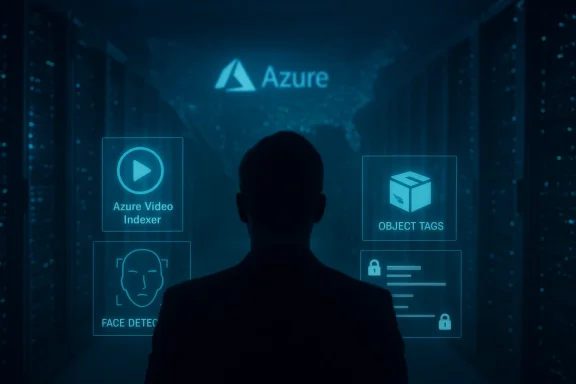
In a data center, a person faces blue holographic Azure panels for video indexing and object tagging.Background​

When reports surfaced this week that ICE’s Azure footprint surged dramatically through the second half of 2025, the reaction was immediate: civil liberties advocates, Microsoft employees, and lawmakers all asked the same two questions — what is in that data, and how is the agency using AI to make it actionable? The core facts appearing in the leaked documents are technically precise but substantively incomplete: the files identify storage volumes, service types (object/blob storage, virtual machines), and licensed AI features (video and image analysis), but they do not enumerate the spe provenance of the ingested media.
In context, ICE has been the beneficiary of a large federal funding expansion enacted in 2025 — the legislative package commonly referred to as the “One Big Beautiful Bill” — which includes tens of billions of dollars earmarked for detention capacity and enforcement operations. That infusion has driven rapid increases in hiring, procurement, and operational tempo across the agency, which in turn explains why command-and-control workloads, analytics, and storage needs ballooned in a short period. The funding surge and detention plans themselves have been reported and analyzed across multiple outlets and fiscal trackers.

What the numbers mean — technical perspective​

Scale in plain language​

  • 1,400 terabytes = 1.4 petabytes. To put this into practical terms, if each stored file were an ordinary 3 MB photo, 1.4 PB would represent roughly 466 million images — enough to build very large training sets or run broad, cross‑source image searches. Conversely, if the dataset were dominated by compressed video, the same raw capacity would translate to hundreds of thousands of hours of footage. The point is not to prove a particular content type, but to show that the scale reported enables mass indexing and automated analytics at population scale.

The cloud stack ICE appears to have been using​

The leaked files and follow-up reporting point to a classic analytics pipeline: Azure Blob/Object Storage for raw media and documents; rented virtual machines (Azure VMs) for processing and batch workloads; and Azure AI services — notably Azure AI Video Indexer and Azure AI Vision/Computer Vision — to extract searchable metadata from images, audio, and video. Together these services convert unstructured files into structured indices (faces, objects, OCR’d text, transcriptions, speaker segments, timestamps, and confidence scores) that make fast, queryable lookups possible.
Microsoft’s own documentation shows that Azure AI Video Indexer runs more than 30 AI models and can automatically produce transcripts, detect faces and group them, extract on‑screen text (OCR), identify objects and scenes, and produce searchable keyframes and summaries. Many of the most sensitive features — account‑based face identification, observed-people tracking, matched‑person detection — are governed by restricted access rules in Azure’s enterprise controls, but they are technically available as part of the platform. That capability set, paired with large-scale storage and on‑demand compute, is precisely what enables automated surveillance-style processing at scale.

What the documents do — and do not — prove​

The raw procurement and capacity : the upward trend in storage consumption, the presence of VMs, and license records for AI indexing services are documentable and corroborated across the investigative outlets and the leaked procurement materials.
But the materials stop short of answering the crucial operational questions:
  • Do the stored files primarily consist of surveillance footage (doorbell cams, CCTV, aerial drone video, cellphone imagery), or of benign administrative records, scanned legal documents, and backups from detention faciliting features are used, are PII-exposing modules (face matching, identity linking) enabled for enforcement accounts, or are they limited to closed, audit‑controlled research projects? Microsoft’s documents show “limited access” gating on some face-recognition features; the leaked files do not provide the contract-level terms that would clarify the gating in ICE’s deployment.
  • Which suppliers and resellers are part of the procurement chain? The presence of resellers or integrators can materially change who has copy access, and those supply-chain details are often absent from the public record.
The correct conclusion is therefore twofold: the technical capability and the capacity are clearly present; the content and operational rules governing those capabilities are not fully visible in the documents released so far. Treating capacity as a proxy for misuse would be tempting but premature; treating it as a red flag demanding immediate oversight and transparency is essential.

Why Azure + AI matters operationally​

Azure’s managed services are optimized for scale and speed. For a law-enforcement agency this provides three operational advantages:
  • Rapid ingestion: cloud storage + managed pipelines make it trivial to ingest media from many sources (sftp, camera feeds, mobile-device exports).
  • Fast, cheap indexing: AI models that produce transcripts, faces, locations, and object tags convert otherwise opaque footage into searchable events.
  • Elastic compute: VMs and serverless functions let analysts run re‑indexing, redaction, and batch matching without long procurement lead times.
Those advantages are also the reason civil‑liberties advocates worry: the same set of features lowers the cost and latency of converting bulk media into actionably searchable intelligence. If policies or contract terms do not strictly limit use, what began as targeted analysis can become broad sweeps of populations.

Microsoft’s public posture and precedent​

Microsoft has maintained a public position that it does not permit its cloud and AI to be used for mass civilian surveillance. In 2025 the company disabled a set of Azure and AI subscriptions used by an Israeli military unit after investigative reporting alleged large-scale misuse, and Brad Smith (Microsoft’s vice chair and president) publicly reiterated the company’s principle that “we do not provide technology to facilitate mass surveillance of civilians.” That episode is directly relevant because it demonstrates both the leverage vendors have to limit misuse and the practical limits of retrospective enforcement when procurement paths are complex.
Following the ICE reporting, Microsoft told employees that it “does not presently maintain AI services contracts tied specifically to enforcement activities,” and its internal messaging to staff has emphasized that its general terms prohibit mass surveillance. But those statements are not the same as a full public disclosure of contractual restrictions or audit results; the difference matters to oversight. The leaked materiang and usage of AI-indexing features inside accounts associated with ICE/Department of Homeland Security, even if company leadership says certain high-risk capabilities are restricted. That tension between corporate policy, engineering reality, and procurement nuance is the central governance problem of this story.

Security, privacy, and operational risks​

Centralizing hundreds of terabytes of potentially sensitive media on commercial cloud platforms concentrates risk in ways that are operationally and ethically important.
  • Misconfiguration risk: public or insufficiently protected storage containers and overly broad identity privileges remain a leading cause of large data exposures. A misconfigured container holding footage or biometric templates would magnify harm because it’s easier to search and repurpose than siloed on-prem datasets.
  • Insider and supply‑chain access: resellers, integrators, and contractors are often necessary to deploy large-scale cloud solutions. Each third party increases the number of human and system accounts that could access sensitive content. Contupply‑chain clauses can leave datasets exposed to parties with weaker controls.
  • AI error and bias: automated face detection and identification models make mistakes — false positives and misattributions — at nontrivial rates, especially across under-represented groups. When automated outputs prioritize enforcement actions (e.g., targeting for arrest), those errors translate directly into real-world harm. Microsoft’s own guidance counsels human oversight and caution when OCR and video insights are used for high‑stakes decisions.
  • Vendor governance limits: once data and integrated workflows are large and entrenched, migration away from a provider is costly. That raises questions about vendor accountability and the power vendors have to audit or remediate misuse. Recent Microsoft actions show the company can disable services, but disabling after the fact does not undo the earlier analyses or operational consequences.

Civil‑liberties and ethical concerns​

From a human‑rights perspective, three interlocking hazards should be at the center of public debate:
  • Scale + function creep: systems built for legitimate administrative tasks can be repurposed. Document management and chatbot tools — listed among the productivity services ICE expanded — can, if combined with imaging analytics, provide unexpected surveillance operational paths. The leaked files note expanded productivity app licenses and an AI chatbot, but do not clarify the operational boundaries between administrative and enforcement usage.
  • Automated prioritization: AI indexes can be used to triage leads and prioritize targets. Without strong audit trails and redress mechanisms, algorithmic prioritization that feeds enforcement decisions risks systematic bias and makes remediation difficult.
  • Lack of public transparency: absent contract disclosure, audit reports, or targeted oversight from independent bodies, the public cannot verify whether policy commitments (no mass surveillance, restricted access) are being respected in practice.
These are not theoretical; the stakes are immediate given ICE’s operational ramp-up and the contemporaneous purchase of intrusive surveillance hardware like cell‑site‑simulator vehicles (so‑called “stingrays”) reported in 2025 — a technology that can track phones en masse and has previously been used in domestic enforcement contexts. The convergence of mobile‑phone‑level surveillance, proliferating camera feeds, and cloud AI indexing heightens the urgency of oversight and strict, binding constraints.

Contractual and policy gaps that should worry policymakers​

There are concrete, fixable gaps in procurement practice and oversight that this episode highlights:
  • Contract-level restrictions: Procurement contracts should explicitly prohibit unapproved use of limited‑access AI capabilities (face identification, observed‑people tracking) and require auditable technical controls that prevent their use except under documented legal authority.
  • Supply‑chain visibility: Contracts must require contractors and resellers to disclose all parties with operational access to data and to hold every subcontractor to strict, verifiable security standards.
  • Customer‑managed keys and encryption: Agencies should default to customer‑managed encryption keys (CMKs) for sensitive datasets so that cloud vendors cannot access decrypted content without explicit customer action. This greatly reduces the risk of vendor-side accidental exposure or compelled access without the agency’s knowledge.
  • Transparency reporting and external audits: Cloud usage by law‑enforcement bodies that process personal data at scale should trigger mandatory transparency reports and periodic independent audits, with summaries suitable for public oversight without compromising operational secrecy.
  • Legal and judicial oversight: Any use of biometric identification for enforcement must be tethered to explicit legal standards, judicial authorization, and meaningful notice/redress for affected individuals.
These are practical, technical and legal controls that would materially reduce the risk of automated, large‑scale surveillance misuse while allowing legitimate, narrowly scoped operational needs to continue.

What independent sources show — cross‑checking the key claims​

  • Investigative outlets (The Guardian together with +972 Magazine and Local Call) published the leaked procurement materials and led the reporting that identified the storage growth, the services in use, and links to Azure AI features; DatacenterDynamics and other technology trade publications reported those same numbers and added cloud‑industry context. These independent investigations reproduce the core procurement numbers and the technical mapping to Azure services.
  • Microsoft’s own documentation confirms the technical capabilities of Azure AI Video Indexer and Azure AI Vision/Computer Vision (transcription, OCR, object and face detection, and advanced indexing features), while also noting that some face-identification features require registration and are subject to limited access. That combination — capability plus gating — is central to assessing whether particular deployments constitute mass surveillance or narrowly controlled analytics.
  • Separate reporting and federal contracting records confirm ICE’s procurement of mobile surveillance vehicles equipped to host cell‑site simulators during 2025, underscoring that cloud-based analytics are only one element of a broader technological toolset in active service within ICE. Those purchases were publicized by multiple outlets in autumn 2025.
Taken together, the independent sources corroborate the key technical facts: the storage surge, the types of Azure services in play, and the broader procurement context. What remains less well established in public sources are the precise contents of the stored datasets and the detailed contract terms that govern restricted‑feature use.

Practical, technical recommendations for immediate attention​

For ICE / DHS, for cloud providers, and for Congress, the following steps are the most urgent and achievable:
  • Enforce customer‑managed encryption keys for sensitive ICE workloads and publish a redacted compliance attestation showing CMKs are in use where required.
  • Institute default disabling of PII-returning AI features (account‑based face identification, observed‑people detection) for enforcement accounts — require a documented, auditable escalation and pre-approval process for any activation of those features.
  • Publish a redacted procurement map listing resellers and integrators with operational access to data, and require those vendors to hold modern security certifications (e.g., FedRAMP High or equivalent) with audit rights for independent oversight bodies.
  • Mandate external, third‑party audits of sensitive analytics pipelines used by DHS components, with a public executive summary of findings and corrective actions.
  • For Congress: condition large appropriations on binding transparency and oversight provisions that include timelines for audits, public reporting, and penalties for noncompliance.
These controls are both practical and proven in other high‑sensitivity cloud deployments; the absence of such protections at scale is the real risk exposed by the documents.

Conclusion — a governance problem, not just a technical one​

The leaked accounting of ICE’s Azure footprint makes plain that the technological capacity for automated, large‑scale image and video analysis now sits within the operational reach of a major domestic law‑enforcement agency. The architecture — blob storage, elastic compute, and managed AI indexers — is the same one used by legitimate archival, media, and compliance teams everywhere. What elevates this story frcurement to a public‑policy emergency is the confluence of: (a) a large political decision to dramatically expand enforcement capacity; (b) procurement patterns that concentrate sensitive media in commercial clouds; and (c) the opaque contractual and governance arrangements that leave critical oversight questions unanswered.
At stake is not merely whether a vendor’s terms of service prohibit a use case in abstract — it is whether those contractual words are paired with enforceable technical guardrails, independent oversight, and public transparency that together prevent function creep and real‑world harms. Microsoft’s precedent of disabling services in response to misuse shows vendor power to act; it also highlights that after‑the‑fact measures cannot fully undo earlier deployments or the operational knowledge derived from them. The right public response is immediate transparency around what was stored and why, binding technical controls on limited‑access AI features, and a legislative and procurement framework that recognizes the unique privacy and civil‑liberties risks of outsourcing high‑scale surveillance‑capable analytics to general‑purpose commercial clouds.
The technical details in the documents are clear; the policy and ethical answers they demand are not. The coming weeks should be dedicated to closing that gap — and ensuring that the same efficiencies that make cloud AI attractive are not converted into unchecked tools for mass enforcement.

Source: DatacenterDynamics US' ICE triples use of Microsoft cloud in six months
 

Intel’s support organization has launched an AI-powered virtual assistant called Ask Intel, built on Microsoft’s Copilot Studio, as part of a deliberate shift to a “digital‑first” support model that includes scaling back inbound phone and social‑media support in favor of agentic AI, guided self‑service, and deeper site integration.

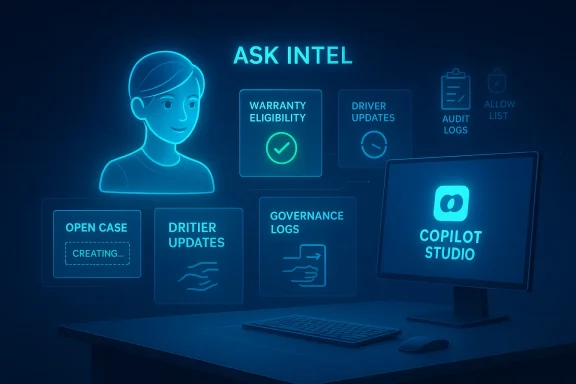
Futuristic blue holographic UI labeled ASK INTEL hovers above a desk with a Copilot Studio monitor.Background​

Intel’s move comes amid broader reorganization inside its Sales and Marketing Group (SMG), where management has been explicitly refocusing resources on “core services” and pursuing managed‑services and AI partnerships to drive efficiency. The company restructured support and operations during 2025 and announced managed‑services work with Accenture as part of that effort. Public reporting and internal memos cited by industry outlets describe the reorganization as producing a “strategic, leaner” support organization and a reallocation of tasks toward automation and partner‑facing digital tools.
Intel’s new Ask Intel virtual assistant is presented as the next phase of a multiyear evolution: the company first shipped a basic virtual assistant in 2021, and the new system brings agentic capabilities, case creation, warranty checks, and human handoff when appropriate. Intel says early partner feedback is positive and that preliminary metrics show improved satisfaction and issue resolution rates, though those metrics remain Intel’s internal claims at this stage.

What Ask Intel is — and what it promises​

Ask Intel is a conversational, AI‑driven support assistant that Intel says can:
  • Open and update support cases on behalf of customers and partners.
  • Check warranty and replacement eligibility information automatically.
  • Identify relevant driver updates and technical resources.
  • Escalate to human agents when issues are beyond routine scope.
Intel currently offers Ask Intel in English and German, with additional languages and features slated later in the year. The company describes Ask Intel as centralizing routine inquiry handling so human agents can focus on complex, high‑value engagements.
These are not just canned FAQ bots. The assistant is built on Microsoft Copilot Studio, which is explicitly designed for enterprise agents and offers tools for knowledge ingestion, orchestration, and computer use—the ability for an agent to interact with UIs and take actions across web and desktop applications when APIs do not exist. That capability is what Intel refers to when it describes “agentic AI” for actions like opening a case on behalf of a partner.

Why Intel picked Copilot Studio​

There are three clear drivers behind Intel’s decision to adopt Microsoft Copilot Studio:
  • Rapid enterprise readiness: Copilot Studio is an established product in Microsoft’s enterprise stack with admin controls, governance, and channels for publishing agents across business apps. Microsoft positions Copilot Studio as a turnkey environment for building and governing agents at scale.
  • Action‑capable agents: Recent updates to Copilot Studio — notably the public previews and Frontier program for “computer use” — allow agents to operate applications and sites through UI interactions. For a hardware vendor with many partner portals, legacy interfaces, and complex triage rules, that ability reduces the integration effort compared with building thousands of bespoke API connectors.
  • Ecosystem alignment and scale: Microsoft’s Copilot platform is already integrating into Microsoft 365, Teams, and messaging channels; for large B2B partners that already rely on Microsoft ecosystems, Copilot Studio agents can be surfaced in places partners use daily. This lowers the friction for partner adoption and reporting.
Taken together, these strengths make Copilot Studio an attractive commercial choice for a vendor like Intel that needs a secure, governable, and action‑capable platform in short order.

How Copilot Studio actually enables Ask Intel (technical primer)​

Understanding what Intel has built requires a quick look under the Copilot Studio hood.

Agent building blocks​

  • Knowledge sources: Agents are limited by the knowledge and document collections that are piped into their retrieval layer. The accuracy of answers depends heavily on how these sources are curated and updated.
  • Orchestration and flows: Copilot Studio supports agent flows — preconfigured workflows that let an agent follow multi‑step processes, validate inputs, and execute structured automation. This is how complex support actions (warranty lookup → case creation → callback scheduling) are stitched together.
  • Computer use: Where APIs are missing, Copilot Studio’s computer use feature lets an agent simulate human interactions (clicks, typing, navigation) in a hosted browser or on registered devices, with credential vaulting and allow‑listing for safety. That’s the technical mechanism that lets Ask Intel “open cases” in partner portals and enterprise systems.

Governance, logging and controls​

Copilot Studio includes admin controls for permissioning, allow‑listing domains and apps, and storing audit logs. For a global support function, these governance features are critical for compliance and trouble‑ticket auditing. Still, governance is only as effective as implementation and ongoing policy enforcement.

Security and compliance considerations​

  • Credential vaulting and scoped access reduce exposure, but they introduce privileged account risk if vaults are misconfigured.
  • Agents performing UI automation must operate under strict allow‑lists and monitoring to avoid lateral movement or accidental data exposure.
  • Audit trails must be maintained long enough and in sufficient detail to support warranty, regulatory, and internal audit needs. Microsoft provides tooling for admin‑level monitoring, but vendors must implement and test it.

Operational impact: phones, social media, and the “digital‑first” shift​

Intel has told partners it is moving to a “digital‑first support experience,” and in conjunction with Ask Intel the company reportedly removed inbound public phone numbers for support in “most countries,” directing contacts to start cases online; exceptions include more limited voicemail callbacks in the U.S. and Australia and full phone support in jurisdictions with regulatory requirements. Intel also said it is ending direct support on social platforms like X and WeChat, while continuing community‑led support on GitHub and Reddit.
This is a meaningful operational pivot with practical consequences:
  • SLA and escalation paths will change. Where phone queues once served as immediate escalation vectors, partners will now depend on the agent + digital case flow and designated human‑agent handoffs for urgent matters. That requires contractual clarity for service levels and response times.
  • Workforce reallocation. Human agents will be scoped toward complex diagnostics and escalations; routine intake, triage, and warranty checks will be handled by Ask Intel. Intel frames this as freeing humans for high‑value work, but it also means many traditional frontline roles will be reshaped or eliminated as part of leaner support operations.
  • Channel consolidation. Direct social support is being deprioritized; community channels and documented repositories become more important. That benefits organizations that already use GitHub/Reddit for technical collaboration, but it reduces direct social listening channels for fast customer signals.
Caveat: the exact scope and rollout vary by country and by partner tier (e.g., Premier Support customers retain their existing channels). Some details — most notably the partner communications about the phone number removals — are reported by CRN and Intel spokespeople; Intel’s public support KB documents the Ask Intel product and its limitations but does not replicate a full, public global schedule of phone number retirements, so that particular operational claim should be treated as reported company practice rather than independently verifiable regulatory filing.

Early reactions from partners and the channel​

Industry voices quoted in reporting frame the move as logical given market trends.
  • Distributors and resellers emphasize efficiency gains and faster triage when automation is done well, so long as a reliable escalation path to humans remains. That nuance is crucial: partners want speed, but not at the expense of being bounced between bots and web forms on mission‑critical incidents.
  • Channel observers note the competitive pressure Intel faces from rivals and the cost rationales behind outsourcing and automation. Intel’s managed‑services work with Accenture, reported in several outlets, and wider restructuring across marketing and SMG are part of a broader cost rationalization that underpins the support changes. These organizational decisions create practical and reputational trade‑offs for partner relations and talent retention.

Critical analysis: strengths, blind spots, and risks​

Strengths (what Intel gets right)​

  • Speed to capability. By leveraging Copilot Studio, Intel can stand up a sophisticated, agentic assistant much faster than building an equivalent in‑house automation stack. Microsoft’s tooling for agent orchestration and channel publishing shortens deployment times.
  • Consolidation of routine work. Case intake, warranty verification, and driver identification are well‑suited to scripted retrieval and workflow automation. Offloading routine triage reduces human backlog and can raise throughput if the AI is tuned correctly.
  • Enterprise governance tools. Copilot Studio’s admin controls, allow‑lists, and audit logging provide a framework to enforce operational boundaries and trace agent actions—essential for enterprise support functions.

Risks and blind spots (what could go wrong)​

  • Accuracy and hallucination risk. Generative models can produce plausible but incorrect outputs. In support workflows that change warranty eligibility or trigger RMA processes, an erroneous assertion could lead to financial or logistical errors unless strong retrieval, verification, and human‑in‑the‑loop checkpoints exist. Intel’s own KB warns that Ask Intel’s responses are generated and may be inaccurate.
  • Escalation friction. Removing phone-based inbound channels risks longer perceived time‑to‑resolution when partners cannot reach a live agent quickly. Even with callbacks, the lack of immediate voice interaction can frustrate partners handling urgent outages or launch issues. Field tests and SLA guarantees will determine whether callbacks meet business needs. Reported exceptions (U.S., Australia voicemail; China full support) suggest Intel recognizes regulatory and market constraints, but the global variability complicates partner expectations.
  • Data privacy and retention. Intel’s support KB states that Ask Intel chat content may be recorded and used in accordance with Intel’s privacy notice. That implies dialog retention and third‑party processor access (Microsoft and possibly others), which raises concerns for partners that handle regulated data or work with embargoed product information. Vendors must ensure appropriate contractual protections and controls for sensitive exchanges.
  • Supply‑chain and business continuity exposure. When an AI agent is the primary intake mechanism, outages in the agent platform, Microsoft services, or Intel’s connectors could disrupt support intake flow. Critical escalation paths must be declared and tested: Premier Support exceptions are helpful, but they may not cover all high‑impact scenarios.
  • Workforce and morale effects. The broader outsourcing to Accenture and workforce reductions in marketing and operations create morale and knowledge‑transfer risks. Outsourcing and automation can be efficient, but institutional knowledge loss can harm long‑tail troubleshooting and partner trust. Public reporting shows these decisions are material to Intel’s internal structure.

Practical advice for Intel partners and enterprise IT teams​

If you are a systems integrator, OEM partner, or corporate purchaser who relies on Intel support, take these concrete steps now:
  • Map your escalation needs. Identify which support issues require immediate voice escalation (e.g., production server failures, contractual warranty disputes) and confirm whether Premier Support or your account manager provides a guaranteed voice path. Demand documented SLAs.
  • Test Ask Intel early and script edge cases. Run realistic scenarios through Ask Intel during your integration window to evaluate data accuracy, expected case numbers, and escalation handoffs. Capture failure modes and share them with Intel support contacts.
  • Protect sensitive data. Treat AI dialogs like a recorded support channel. Review Intel’s privacy statements and insist on contractual terms that limit how dialogue content with third parties can be used, retained, and shared. Where necessary, use redaction and anonymization processes before sending proprietary or regulated content into the assistant.
  • Request audit trails. Make sure that all agent actions (case creation, warranty decisions, driver patch recommendations) are logged and accessible to your compliance teams for audit and post‑mortem analysis. Confirm retention windows and export formats.
  • Plan for redundancy. Build internal fallback processes for intake if Ask Intel or its underlying services are degraded. This might include a backup email intake address, a named escalation manager, or retaining a limited phone callback pool for critical cases.
  • Negotiate training and feedback loops. Push for a formal mechanism to feed corrections into Ask Intel’s knowledge base and to receive release notes for knowledge updates that affect your product lines. A shared feedback lane accelerates improvement cycles.

The wider industry context: is this a one‑off or a trend?​

Intel’s choice mirrors a broader industry movement: vendors and software firms are rapidly adopting agentic AI and prebuilt agent platforms to automate routine workflows and customer interactions. Microsoft’s emphasis on Copilot Studio, the ability to publish agents across channels, and the emergence of computer use features demonstrate that the tools are now mature enough for enterprise support scenarios. Analysts predict broad adoption of AI‑capable PCs and agentic assistants across enterprise workflows in the next few years, accelerating investment in vendor‑facing automation.
For the semiconductor industry specifically, this is noteworthy because hardware support often involves warranty verification, cross‑reference of serial numbers, and coordination across long supply chains. Automating routine, deterministic steps offers real productivity gains — but the unique combination of long device lifecycles, complex RMA rules, and global regulatory variance means that hardware vendors must be especially cautious about how they automate and where human oversight is preserved.

Final assessment and what to watch​

Intel’s Ask Intel, built on Microsoft Copilot Studio, is a sensible tactical move to modernize partner support and reduce friction for routine tasks. The platform choice gives Intel access to powerful agent orchestration, UI automation, and enterprise governance. If executed well, partners will benefit from faster triage and reduced waiting for simple warranty and driver tasks.
However, the move also exposes several nontrivial risks that partners, customers, and auditors must address:
  • Don’t accept voice channel removal without written SLAs for urgent cases. Reported phone reductions are real but unevenly applied across regions; insist on clarity for your geography and product tier.
  • Treat Ask Intel as an operational tool that requires continuous tuning. Generative models require ongoing maintenance, failure‑mode testing, and human feedback loops to avoid erosion of trust.
  • Audit data flows aggressively. If you handle regulated or embargoed information in support interactions, you must understand where logs are stored, who can access them, and for how long. Intel’s documentation already signals recording and third‑party processing of dialog content, so contractual protections are essential.
  • Monitor workforce and knowledge continuity. Outsourcing and automation can accelerate delivery, but losing institutional knowledge creates long‑term support gaps unless explicitly mitigated through documentation and shadowing programs during transitions. Public reporting shows Intel has leaned into managed services and outsourcing in 2025.
Watch for these signals over the coming months:
  • Formal SLA and Premier Support clarifications from Intel.
  • Product‑level post‑deployment metrics for Ask Intel’s accuracy and escalation speed.
  • Public security audits, penetration tests, or third‑party attestations about Ask Intel and related connectors.
  • Changes to partner contracts that codify response times and data handling commitments.

Ask Intel is not merely a headline—it is a substantive redesign of how a major vendor routes incoming work. For partners, the upside is real: less time wrestling with menu trees, more time on engineering and integration. For customers and auditors, the cautionary tale is also clear: automation must be paired with robust governance, human oversight, and contractual clarity to avoid turning efficiency gains into operational vulnerability. As agentic AI moves from novelty to the backbone of enterprise workflows, the companies that balance speed with safeguards will capture the real value.

Source: crn.com Intel Turns To Microsoft’s Copilot Studio For Partner Support After Dialing Back Phone Use
 

Frontline work is finally getting an AI playbook that respects the messy, time‑sensitive realities of retail floors, hospital wards, kitchens, service vans, and customer counters—and that change is visible now, not sometime in the future.

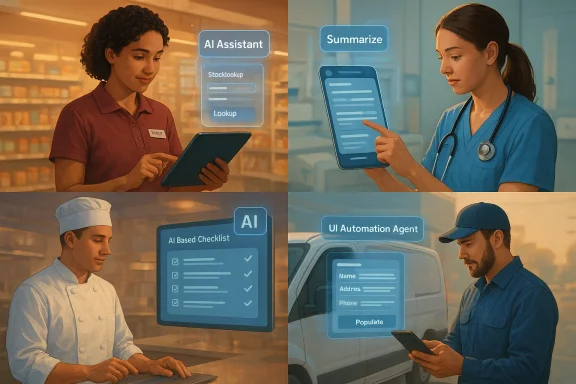
A collage of workers using AI-powered tablets across pharmacy, healthcare, kitchen, and delivery.Background / Overview​

Frontline workers make up the backbone of service delivery across virtually every sector, yet their digital tools have long been mismatched to the pace and context of the work they do. Recent deployments and pilots show a clear pattern: rather than sweeping automation, the most effective AI interventions are small, situational, and embedded directly into the tools and surfaces frontline employees already use. Microsoft’s approach—anchoring intelligence inside Microsoft 365 Copilot and placing purpose‑built agents into collaboration surfaces like Teams, SharePoint, and OneDrive—illustrates that strategy in action.
This article synthesizes the practical lessons emerging from those early implementations, weighs measurable outcomes from public pilots, and lays out what IT leaders and frontline managers need to know to adopt AI responsibly where it matters most.

Why frontline work is different—and why that matters for AI​

Frontline work is defined by unpredictability, short time horizons, and high interaction costs: the person who can solve a problem is often the same person who is already engaged with a customer, patient, or machine. That creates three constraints any AI must meet to be useful:
  • Low friction: interventions must require minimal onboarding and be accessible from shared or mobile devices.
  • Context awareness: assistance is valuable only when it understands the local state—shift schedules, inventory, equipment status, or patient charts.
  • Trust and governance: frontline environments often have strict safety, privacy, and compliance demands that require transparent, auditable AI behavior.
The emergent design pattern is to embed intelligence into familiar workflows so assistance is available without context switching. This is the philosophy behind agent‑centred Copilot features and the “AI‑in‑the‑flow” approach that Microsoft and partners are emphasizing.

How AI is being embedded into everyday frontline workflows​

From assistants to agents: a practical evolution​

Early workplace AI took the form of single‑task automations or isolated chatbots. What’s different now is the shift toward AI agents—task‑focused assistants that live within collaboration surfaces and act on shared context, such as a Teams channel, shift roster, or a store’s inventory list.
These agents are designed to:
  • Surface answers to operational questions (e.g., “Is item X in stock?”)
  • Summarize communications and documents (meeting notes, incident reports)
  • Execute routine actions through APIs or UI automation (create tickets, populate forms)
    Microsoft’s recent product evolution moves Copilot from individual help to collaboration‑first agents that can prepare meeting agendas, summarize channel threads, and run repeated admin tasks on behalf of teams.

Practical design choices that matter​

Successful frontline AI implementations share a set of practical choices:
  • Embed within familiar apps (Teams, Outlook, Dynamics) to reduce training overhead.
  • Prioritize micro‑value: automate scheduling, note‑taking, and lookup queries before attempting complex decision automation.
  • Provide explicit guardrails and provenance for answers so supervisors and auditors can trace the AI’s reasoning.
These choices lower the adoption barrier and reduce the cognitive load on staff who are under time pressure.

Real-world evidence: pilots and frontline wins​

Theory matters, but outcomes are what convince managers. Several public and private pilots demonstrate measurable impact—and they share a common theme: small, well‑scoped use cases deliver outsized returns.

Government case: time saved on routine admin​

A six‑month trial in a large UK government department reported average daily time savings of roughly 19 minutes per user on routine administrative tasks after deploying a licensed AI assistant. Those savings came from faster information retrieval, email drafting, and summarization—classic “low‑glamour” productivity wins that compound across thousands of users. For public sector teams with heavy documentation demands, those minutes translate into substantial capacity.

Transport case: seconds, not minutes, to mission‑critical procedures​

In a rail operations pilot, a Copilot‑powered mobile app reduced the time to find an operational procedure from minutes (reported at around four minutes) to seconds (reported as roughly three seconds). That shift—eliminating paper manuals and radio calls—represents not just efficiency but improved safety and situational awareness for crews. While the precise numbers come from vendor and partner reports, the pattern—dramatic reductions in lookup time for critical procedures—is consistent across frontline transport pilots.

Local government and ROI: a structured rollout​

A county‑level rollout reported quantifiable net present value in its Copilot proof‑of‑concept and emphasized governance, training, and measurement as the keys to moving from pilot to scale. Those findings echo a repeated lesson: treat AI adoption as an organizational change program, not merely a technology deployment.

Industrial integration: operational AI in the flow of work​

Industry vendors are embedding operational models and OT data directly into collaboration surfaces via protocols like the Model Context Protocol (MCP). That enables plant operators and maintenance teams to receive contextual, actionable intelligence inside Teams and Copilot—turning analytics into prescriptive next steps without routing people through separate control rooms or dashboards. Early integrations with industrial AI platforms show how domain‑trained models can become first‑class citizens in frontline workflows.

The practical benefits frontline teams are already seeing​

When properly scoped, AI delivers consistent, measurable benefits at the frontline:
  • Time savings: automation of summaries, scheduling, and routine lookups frees minutes each shift that add up to meaningful capacity gains.
  • Faster decision cycles: conversational queries and context‑aware agents reduce time to answer, which is crucial in customer service and field maintenance.
  • Better onboarding: new hires get rapid access to procedures and institutional knowledge without pulling supervisors off the floor.
  • Consistency and compliance: agents can surface authoritative content and apply organization‑level guardrails to ensure consistent responses across locations.
These benefits are not speculative—they’re the recurring outcomes across multiple, diverse pilots and early production rollouts.

Governance, trust, and responsible scaling​

People‑led adoption is non‑negotiable​

Every successful rollout we examined emphasized a people‑first approach: empower frontline employees to test, critique, and shape AI behavior, rather than imposing tools top‑down. That fosters practical, use‑case driven adoption and surfaces real operational constraints early.

Technical guardrails and observability​

Good governance for frontline AI must include:
  • Access controls and role‑based permissions for agent capabilities.
  • Logging and provenance for generated content and actions.
  • Human review thresholds for safety‑critical decisions.
    Microsoft’s enterprise controls for Copilot and related agent features aim to provide those capabilities, and successful public sector pilots paired time savings metrics with strict governance programs.

Data residency and privacy concerns​

Frontline scenarios—especially in healthcare and public services—raise privacy and data‑residency requirements. Implementers must be explicit about what data is used to answer queries, where models run, and how long logs are retained. These are not checklist items—they materially affect which use cases are legally and ethically feasible.

Risks, limitations, and where caution is needed​

AI is a tool, not a panacea. The following risks deserve explicit mitigation plans.
  • Hallucination and incorrect guidance: generative models can produce plausible but wrong outputs. For frontline tasks with safety or legal implications, answers must include citations, provenance, and human sign‑offs.
  • Over‑automation: automating decision points that require human judgment can erode skills and accountability. Use AI to augment, not to replace, frontline judgment in customer‑facing or safety‑critical contexts.
  • Fragmented tool sprawl: patchwork AI solutions that live outside core workflows increase friction. Success favors embedding agents into existing platforms (Teams, Dynamics 365, the point‑of‑sale), not piling on new standalone apps.
  • Security exposure: agentic features that automate UI interactions or execute tasks increase the attack surface and require hardened credentials, privileged access management, and careful monitoring.
Where claims are drawn from vendor materials or pilot press releases, treat specific ROI numbers and time‑savings as indicative rather than universally guaranteed; outcomes depend heavily on the use case, data quality, and the rigor of governance applied. When a pilot reports multi‑minute savings per task, that’s a strong signal—but organizations must replicate measurement frameworks before assuming identical returns.

How to pilot AI on the frontline: a practical playbook​

  • Identify the highest‑value micro‑use cases
  • Start with lookup and summarization tasks (schedules, procedures, inventory). These are low‑risk and high‑frequency.
  • Choose the right surface
  • Embed agents in the apps your teams already use—Teams, Outlook, Dynamics—so new behavior aligns with existing routines.
  • Build measurable pilot metrics
  • Track time‑to‑answer, task completion time, error rates, and employee satisfaction before and after deployment. Public pilots have used minutes‑saved and NPS changes as primary measures.
  • Establish governance and human‑in‑the‑loop controls
  • Define approval thresholds, logging retention, and review workflows for safety‑critical outputs.
  • Run short, iterative pilots with frontline cohorts
  • Empower a cross‑functional team (IT, legal/compliance, operations, frontline reps) to iterate weekly and act on real feedback.
  • Scale with training and change management
  • Move from pilots to scale only after governance, security, and measurement frameworks are stable.
This sequence keeps investments low and learning fast while minimizing operational risk.

Technology that supports frontline realities​

Several technical trends and Microsoft capabilities deserve attention from IT teams planning rollouts:
  • Agent stores and templates: prebuilt agents for surveys, scheduling, and notes accelerate time‑to‑value and reduce engineering effort.
  • UI automation and “computer use”: agents that can interact with legacy apps (clicks, form fills) help bridge modernization gaps without risky, long migration projects. These capabilities enable AI to complete the last mile of automation on interfaces that have no modern APIs.
  • Domain integrations: industrial and operational platforms that surface OT data into Copilot contexts enable frontline engineers to act on real‑time telemetry from the same collaboration surface they use for coordination.
  • Enterprise controls: role‑based access, admin controls, and audit trails are increasingly standard for commercial Copilot offerings—critical for regulated sectors.
Adopting these building blocks lowers technical risk and keeps the focus on usable outcomes.

A human‑centered conclusion: augment, don’t replace​

Across the cases we reviewed, the recurring throughline is not that AI replaces frontline people, but that it removes friction so those people can spend more time on high‑value human interactions. Whether it’s a store associate using an agent to confirm stock so they can help a customer, or an ambulance crew getting rapid access to protocol guidance at the scene, the highest ROI comes from augmenting human judgment and time.
Practical pilots demonstrate meaningful gains—minutes saved per task, faster access to mission‑critical procedures, and improved onboarding—but these wins require disciplined governance, measurement, and an insistence that tools fit the frontline context. Investments in change management and in the small details—mobile access, shared‑device UX, auditable provenance—will separate durable adoption from pilot noise.

What IT leaders should do next​

  • Start with empathy: embed pilots that solve specific, painful daily problems reported by frontline staff.
  • Measure rigorously: instrument before‑and‑after metrics and publish the results to build momentum.
  • Insist on governance: require provenance, logging, and role‑based controls before expanding agent capabilities.
  • Iterate publicly: empower frontline champions to test agents, report failures, and co‑design improvements.
  • Consider procurement posture: evaluate vendor guarantees around model provenance, data handling, and update cadences.
When these elements align—human‑led design, clear metrics, technical guardrails, and incremental value—AI becomes a practical tool that reshapes frontline work where it matters most: in the day‑to‑day moments of service, safety, and human connection. The examples and pilots referenced here show that this is not a future promise but a present‑day shift already under way.

Frontline teams are demanding tools that meet them at the point of work, and early evidence suggests that embedding thoughtfully governed AI agents inside existing collaboration and operational surfaces is the fastest, safest route to delivering that capability at scale. The job for leaders now is to pilot with discipline, protect people and data with strong governance, and measure outcomes so that the promise of time reclaimed for human connection becomes an organizational reality.

Source: Microsoft Frontline AI in action: How AI-powered tools are reshaping work where it matters most - Microsoft in Business Blogs
 

Back
Top