

Interact’s Autumn 2025 release pushes the company beyond a traditional intranet vendor role and into the fast-moving world of agentic AI for employee experience, combining a Microsoft 365 Copilot connector, always‑on listening agents that surface sentiment shifts and recognition, and prebuilt HR/IT marketplace integrations designed to reduce context switching and turn informal workplace signals into actionable insights.
Interact announced its Autumn 2025 launch as a package of features aimed squarely at a familiar enterprise problem: employees waste time toggling between systems and leaders miss important, informal signals buried in conversations. The vendor frames its update around three outcomes—move work along, know where your focus is needed, and make success the norm—delivering a Microsoft Copilot Connector, a Signal Agent for continuous employee listening, a Recognition Agent to surface praise, and out‑of‑the‑box marketplace connectors to systems such as SAP SuccessFactors and ServiceNow. These features sit within a broader industry inflection: major platform providers and enterprise software vendors are shipping agent primitives, Copilot/assistant extensibility and connector frameworks that let vendors surface tenant data in flow (Teams, Outlook, Copilot Chat) while applying tenant‑scoped permissions. Independent roadmaps and platform documentation show Microsoft’s Copilot extensibility and custom connector work has matured through 2025—making the technical promise Interact describes feasible in principle.
Treat the release as an invitation to pilot with discipline. Validate connector architecture and permission guarantees, run agents in alert‑only modes to measure accuracy, and harden governance before expanding. When deployed with clear scope, auditable controls and human oversight, these agentic features can reduce friction and make the invisible visible—accelerating work and helping every employee feel more seen.
Source: The Manila Times Interact's Enterprise Employee Experience Platform Adds Agentic AI to Drive Employee Listening at Scale
 Background / Overview
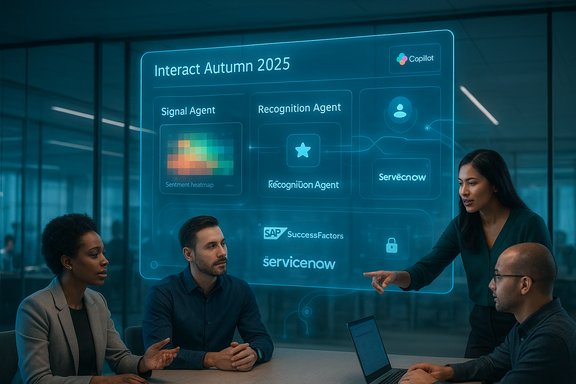
Interact announced its Autumn 2025 launch as a package of features aimed squarely at a familiar enterprise problem: employees waste time toggling between systems and leaders miss important, informal signals buried in conversations. The vendor frames its update around three outcomes—move work along, know where your focus is needed, and make success the norm—delivering a Microsoft Copilot Connector, a Signal Agent for continuous employee listening, a Recognition Agent to surface praise, and out‑of‑the‑box marketplace connectors to systems such as SAP SuccessFactors and ServiceNow. These features sit within a broader industry inflection: major platform providers and enterprise software vendors are shipping agent primitives, Copilot/assistant extensibility and connector frameworks that let vendors surface tenant data in flow (Teams, Outlook, Copilot Chat) while applying tenant‑scoped permissions. Independent roadmaps and platform documentation show Microsoft’s Copilot extensibility and custom connector work has matured through 2025—making the technical promise Interact describes feasible in principle. What Interact announced — feature roundup
The headline items
- Microsoft Copilot Connector: Interact says the connector securely exposes intranet content to Microsoft 365 Copilot so employees can get permission‑aware answers inline in Microsoft apps without leaving their workflow. This is presented as a first‑class integration with Copilot’s custom connector model.
- Signal Agent: An always‑on, agentic AI that analyzes posts, comments and forum threads to detect sentiment shifts, trending topics and potential risks, and then routes alerts to appropriate teams (Internal Comms, HR, IT, Security).
- Recognition Agent: Agentic AI designed to detect moments of praise across channels and route them to the right manager with context—aimed at amplifying recognition and ensuring frontline achievements aren’t lost.
- Marketplace integrations: Prebuilt widgets/connectors for SAP SuccessFactors and ServiceNow intended to bring HR and IT self‑service into the intranet (e.g., check PTO, view tasks, submit tickets).
Why this matters now: market context and technical feasibility
Platform plumbing now exists
Microsoft’s 2024–2025 push to make Copilot extensible and to support custom connectors has produced a clearer path for vendors to surface tenant knowledge safely in Copilot experiences. Roadmap items and admin features rolled through 2025 include MCP (Model Context Protocol)‑style connectors, Graph API enhancements for custom connectors, permissioned indexing, and admin controls for connector discovery—exactly the primitives Interact would need to deliver a permission‑aware Copilot connector. That makes the integration Interact describes plausible from a platform standpoint.Agentic AI is mainstream enterprise strategy
The transition from “chatbot” to agentic systems—agents that reason across steps, call tools, and execute bounded actions—is no longer theoretical. Large vendors and cloud platforms are treating agents as first‑class artifacts, with identity, lifecycle and observability patterns emerging (e.g., Entra Agent ID, Copilot Studio, Agent registries). This industry context explains why Interact’s product is being framed around "agentic AI" rather than simple NLP analytics.Strengths: what Interact brings to the table
- Reduced context switching — Packaging HR, IT tasks and knowledge into a single intranet surface, and exposing that surface to Copilot, can materially cut the number of tool switches employees endure daily, improving focus and time-to-action. The UX benefits follow a straightforward principle: fewer detours equals less cognitive load.
- Operationalised employee listening — The Signal Agent promises continuous, passive listening across channels. For Internal Communications and HR teams, this can reduce reliance on periodic surveys and reveal emerging issues earlier—potentially reducing risk and speeding remediation. Early access quotes cited by Interact (e.g., Love’s Travel Stops) signal practical lift in discovery and recognition amplification, albeit anecdotally.
- Recognition at scale — The Recognition Agent attempts to solve a perennial people problem: informal recognition evaporates in chat threads. Surfacing praise with context and routing to managers can improve morale and make rewards more consistent, especially for frontline and deskless cohorts who are traditionally harder to reach.
- Ecosystem-first approach — Shipping marketplace connectors for SuccessFactors and ServiceNow is pragmatic: many enterprises use these systems extensively, and prebuilt connectors lower time-to-value compared to bespoke integrations. If those connectors truly support the typical HR/IT workflows enterprises expect, they will be useful adoption accelerators.
Risks and limitations: governance, privacy, and operational traps
Privacy and trust are the principal hazards
Continuous monitoring of internal communications—even when limited to public intranet forums and comment threads—can erode employee trust if not governed transparently. Legal, HR and privacy teams must align on scope: which channels are monitored, what is retained, who sees raw transcripts, and what opt‑out or consent mechanisms exist. Without clear policies, even well‑intentioned listening can be perceived as surveillance. This is a material organizational risk, particularly in jurisdictions with strong employee privacy protections.Hallucination and false positives
Agentic models can misread context, misattribute praise, or confuse sarcasm for sentiment. False positives routed to managers or security teams waste time and can harm employee relations. Any automatic escalation should be paired with conservative thresholds and a human‑in‑the‑loop review stage. Interact’s materials don’t publish independent accuracy figures—customers must validate precision and recall during pilots.Permission‑and‑audit detail matters
The promise of “permission‑aware answers in Copilot” hinges on correct identity mapping, runtime permission enforcement, and full audit trails. Enterprises must verify whether the connector enforces tenant permissions at query time (not just during indexing), whether connector hosting is tenant‑controlled or vendor‑managed, and whether query logs, agent actions and telemetry export cleanly to existing SIEM and eDiscovery pipelines. These are procurement‑level facts that differ between implementations. Roadmap traces show Microsoft invested heavily in connector security and admin UX in 2025—but buyers should demand tenant‑level evidence.Integration complexity and "out‑of‑the‑box" semantics
“Out‑of‑the‑box” integrations frequently require tenant-specific configuration: API versions, OAuth flows, field mappings and read/write privileges vary across SuccessFactors and ServiceNow customers. Expect initial pilots to require engineering effort to map authorization scopes, test latency under peak load, and validate error cases. Treat marketplace connectors as accelerators rather than plug‑and‑play miracles.Practical validation checklist: what to require before production rollout
- Confirm connector architecture and hosting: vendor‑hosted managed service vs tenant‑installed connector (VNet/private endpoint). Demand a data flow diagram showing where content is indexed and where model inference occurs.
- Verify runtime permission enforcement: test tenant‑scoped queries to ensure Copilot responses respect the same ACLs as the intranet surface.
- Auditability and observability: ensure all agent actions, connector queries and tool calls are logged and exportable to SIEM/eDiscovery in a vendor-neutral format.
- Model provenance and data usage: require the vendor to disclose model providers, whether customer data is used for model training, and retention/telemetry policies. Include contractual protections for data portability.
- Start in alert‑only mode: run Signal Agent in monitoring/alerting mode with human reviewers for a defined pilot cohort to measure false positive rates and tune thresholds.
- Scoped pilot for Recognition Agent: pick a frontline cohort and measure manager response rates, perceived fairness, and actionability before wider rollout.
Recommended roadmap for IT, HR and Internal Comms teams
Phase 1 — Pilot and technical validation (4–8 weeks)
- Select a bounded user group (one business unit or frontline cohort).
- Validate Copilot connector indexing and permission behavior using tenant‑scoped test prompts.
- Run Signal and Recognition Agents in non‑actionable monitoring mode with human reviewers.
Phase 2 — Governance and security parallel work
- Integrate agent identities into access reviews and IAM lifecycle.
- Configure export of logs to SIEM, define retention and data deletion policies, and complete legal and privacy sign‑off.
Phase 3 — Operationalize and expand (8–16 weeks)
- Open out integrations to HR/IT use cases after SLAs and security posture validated.
- Roll Recognition Agent routing to managers with playbooks and training on how to respond to surfaced recognition.
Phase 4 — Measure, iterate and institutionalize
- Track KPIs: manager response rate to recognition prompts, time‑to‑resolution for issues surfaced by Signal Agent, ticket automation outcomes, and false positive rates.
- Conduct quarterly privacy and security audits; refine thresholds and models based on human feedback.
Vendor claims vs independent verification: what’s corroborated and what needs checking
- Interact’s public announcement and product pages clearly describe the features (Copilot connector, Signal Agent, Recognition Agent, SuccessFactors/ServiceNow marketplace items). These are vendor statements and are corroborated by the company’s Autumn Launch page and multiple press releases.
- Platform-level feasibility is supported by Microsoft’s 2025 Copilot extensibility roadmap entries and admin features that enable permissioned, tenant‑scoped connectors—meaning the integration described is technically plausible. However, exact operational characteristics (hosting model, whether query logs are tenant‑exportable by default, exact permission enforcement behavior) are tenant‑specific and require validation in each deployment.
- Customer impact claims (e.g., measurable cultural uplift, detection rates, time savings) in Interact’s release are qualitative and rely on early access anecdotes. These are signals not audited metrics; customers should treat them as vendor‑provided case examples and insist on pilot KPIs before expecting identical outcomes.
Technical and legal red flags to watch for during procurement
- Ambiguous training data usage clauses: ensure contracts explicitly state whether customer content or logs may be used to further train vendor models, and include opt‑out or data segregation protections if required.
- Lack of tenant‑controlled hosting for connectors: if connectors are vendor‑hosted without clear private‑network options, that may conflict with corporate data residency or regulatory requirements. Ask for private endpoint/VNet options and proof of compliance controls.
- Missing exportable audit trails: require a commitment to export agent runbooks, logs and telemetry in an open format for independent review and incident response.
- Overbroad monitoring scope: negotiate explicit scopes for what channels and content types are monitored by Signal Agent; ensure there’s an appeals path for employees flagged by automated systems.
The broader takeaway for EX leaders and IT architects
Interact’s Autumn 2025 release is a timely example of how intranets are evolving into decision surfaces that combine knowledge, transactional services and agentic listening to recover lost time and surface cultural signals. The move aligns with Microsoft’s platform investments around Copilot extensibility and agent orchestration, which means vendors have real technical paths to deliver permission‑aware, in‑flow knowledge and agent actions. At the same time, the most impactful—and risk‑prone—part of these products is not the LLM itself but the operational plumbing: identity, connector hosting, auditability, legal controls and change management. Organizations that treat agentic EX features as a product—complete with pilots, governance, logging, SLAs and human review—will extract value; those that flip them on without controls risk eroding trust, exposing data, or surfacing a stream of false positives.Conclusion
Interact’s Autumn 2025 launch packages a realistic set of capabilities—Copilot integration, agentic Signal and Recognition features, and HR/IT connectors—that reflect the current enterprise trajectory toward embedded, agent‑enabled productivity. The technical plumbing for permissioned Copilot connectors is present in the market; the value proposition of surfacing recognition and early signals is compelling; but the operational and legal details will determine whether this technology strengthens culture or undermines it.Treat the release as an invitation to pilot with discipline. Validate connector architecture and permission guarantees, run agents in alert‑only modes to measure accuracy, and harden governance before expanding. When deployed with clear scope, auditable controls and human oversight, these agentic features can reduce friction and make the invisible visible—accelerating work and helping every employee feel more seen.
Source: The Manila Times Interact's Enterprise Employee Experience Platform Adds Agentic AI to Drive Employee Listening at Scale
