

Apple’s fourth iOS 27 developer beta contains unusually specific references to an iPhone with multiple internal batteries, strengthening the case that the company’s long-rumored foldable handset is moving from laboratory project to launch-ready product. The pluralized Battery Health messages do not prove that an “iPhone Ultra” will appear in September 2026, but when combined with earlier iOS references to hinge angles, folding states, and multiple built-in displays, they reveal something more consequential than an isolated software string: Apple is preparing iOS, diagnostics, repair workflows, and app behavior for an entirely new class of iPhone hardware.
Apple has spent roughly a decade exploring foldable devices without committing one to retail shelves. Patents dating back to the middle of the 2010s described flexible OLED screens, protective layers, specialized hinges, crack-resistant coatings, and mechanisms intended to support a display as it opened and closed.
That extended development period reflects the unusually difficult engineering trade-offs involved. A foldable phone must combine the structural integrity of a conventional handset with a flexible display, a moving hinge, two thin chassis sections, and enough battery capacity to power what effectively becomes a small tablet.
That strategy has advantages, but it also raises expectations. Apple can no longer introduce a foldable merely because the screen bends; its first model must demonstrate why waiting was worthwhile.
The first iOS 27 developer beta, released on June 8, 2026, reportedly introduced internal references to folding states, mechanical angles, and a method for determining the number of built-in displays. Those additions suggested that iOS needed to understand whether a device was closed, partially open, or fully unfolded.
The fourth developer beta now adds plural Battery Health language. Together, the discoveries describe several interconnected requirements of a foldable device rather than one ambiguous experiment.
Among the new messages are descriptions stating that the “batteries” are operating normally, that their health has significantly degraded, or that one of the batteries cannot be verified as a genuine Apple component. The wording reportedly also directs users to an Apple Authorized Service Provider for replacement.
The most important clue is not simply the word batteries. It is the combination of plural health reporting, authenticity verification, degradation warnings, and replacement guidance.
That suggests Apple is accounting for a device in which:
The code does not confirm the product name, launch date, retail price, final capacity, screen dimensions, or whether separate battery replacement will actually be offered. It also does not establish that both cells will receive independent consumer-facing health percentages.
The strongest defensible conclusion is narrower: Apple has built iOS 27 support for an iPhone configuration containing multiple batteries, and a book-style foldable is the most plausible explanation.
Splitting the battery allows engineers to use otherwise fragmented internal volume. It also helps distribute mass across both halves, which matters because users will frequently hold a foldable by one side while the other remains unsupported.
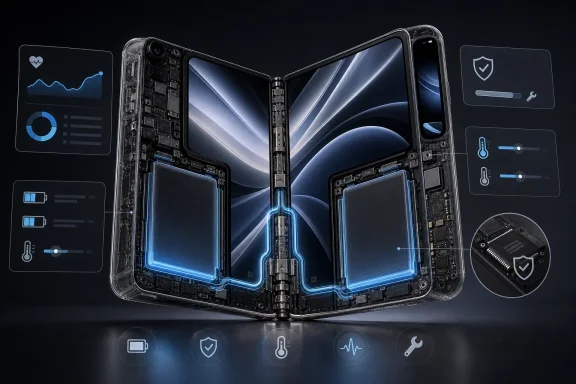
The likely arrangement would place the logic board and cameras in one half, with a larger battery cell occupying much of the other. A smaller secondary cell could fill the space left around the denser electronic components.
Reported capacities of 1,921mAh and 2,962mAh would produce a combined nominal capacity of 4,883mAh. Those figures remain unconfirmed, but their asymmetry makes engineering sense because the two halves are unlikely to offer identical internal space.
If the cells are connected in parallel, their voltage characteristics must remain closely matched. If Apple uses a more complex switching arrangement, iOS and dedicated power-management hardware must decide how to charge and discharge each side without creating excessive heat or uneven aging.
The system must also prevent a weaker cell from becoming a bottleneck. A battery pair can be only as dependable as the management logic governing the more degraded component.
The cell near the processor, modem, or charging hardware could experience more heat. The other might have a different size, chemistry, current load, or thermal environment, causing its degradation curve to diverge over time.
Alternatively, iOS could display separate values for Battery A and Battery B. That would be more transparent, yet it risks confusing users who may not understand why one cell reads 91 percent while the other reads 86 percent.
A third approach would combine both models: show one overall health status by default and expose cell-level details to technicians, diagnostic tools, or users who expand an advanced information panel. That would align with Apple’s preference for simple consumer interfaces backed by more detailed service diagnostics.
On a dual-battery iPhone, performance management may need to consider:
If only one pack has degraded, replacing both would waste a usable component and increase parts costs. Independent replacement could therefore reduce the price of some repairs and lower the environmental impact of routine maintenance.
The service procedure could still require both cells to be replaced as a matched pair. Apple may determine that cells of different ages, capacities, or electrical characteristics should not be mixed, especially if doing so complicates calibration or long-term safety.
Independent authenticity checking is nevertheless meaningful. It suggests each pack may contain its own identification data and may be individually visible to diagnostic software.
A dual-battery iPhone could intensify that debate. Replacing one pack might require the following sequence:
A folding chassis can distribute heat across two sides, but the hinge interrupts the continuous metal frame that conventional phones use as a heat spreader. Apple must move thermal energy without creating one uncomfortable hot zone or exposing the flexible display to damaging temperatures.
That imbalance would make separate health monitoring particularly useful. It might also explain why Apple needs plural diagnostic messages even if the Settings app ultimately presents a unified battery percentage.
Software could reduce the problem by shifting workloads, adjusting charging rates, dimming the display, or limiting peak performance when sensors detect an unfavorable temperature difference. Such intervention would need to be subtle; buyers of a premium foldable will not accept frequent throttling during gaming, video capture, navigation, or multitasking.
Apple will likely prioritize predictable longevity over headline-grabbing charging wattage. The company may also use optimized charging to hold one or both cells below full charge until the device expects to be unplugged.
Wireless charging creates another constraint because the charging coil normally occupies valuable central space. On a foldable, its position must work when the handset is closed, align reliably with MagSafe accessories, and avoid concentrating heat near the battery or hinge.
Those capabilities allow the operating system to understand the device’s physical posture. That awareness is essential because a foldable cannot behave like a conventional iPhone with a larger screen permanently attached.
iOS must preserve scroll position, keyboard state, media playback, active calls, authentication prompts, and unsaved work. Apps must also respond correctly if the available window changes shape midway through an animation or touch gesture.
A rough transition would make the device feel experimental. Apple’s competitive advantage lies in controlling the operating system, frameworks, silicon, and hardware, giving it an opportunity to make display continuity feel more coherent than on fragmented platforms.
Hinge-angle data could support:
That creates an intermediate category: larger than a standard iPhone, more portable than an iPad mini, and capable of changing dimensions while an app remains active.
Developers may need to test at least four states:
Apple can draw on iPadOS, but it must adapt those ideas for a device frequently used one-handed and opened for brief sessions. Users may want to drag content between applications, keep a chat beside a browser, or reference a document while composing an email without managing desktop-style windows.
For Windows users, the most interesting question is how the device integrates with Microsoft 365, OneDrive, Teams, Windows 365, Phone Link, and cross-platform browser workflows. A foldable iPhone could become a stronger mobile companion for Windows PCs if its larger canvas improves document review and remote access, even though Apple’s deepest continuity features will remain tied to the Mac.
It also confirms how much complexity sits beneath the simple promise of “an iPhone that opens into a tablet.” Two screens, two batteries, a hinge, flexible display layers, and posture-aware software create more potential failure points than a conventional handset.
Efficiency improvements in Apple silicon, display drivers, modem hardware, and variable refresh technology may matter more than the nominal capacity. The exterior screen could also reduce power use by allowing users to complete short tasks without activating the larger panel.
Apple must deliver battery life that feels normal in both modes. Buyers will not accept having to ration unfolded use merely because the device contains an expansive screen.
Potential buyers should pay attention not only to the retail price but also to:
The device could also reduce the need to carry both an iPhone and a small tablet. That advantage must be weighed against high acquisition costs, uncertain durability, and more complicated repair logistics.
Administrators may eventually need visibility into:
Standardized cases, charging mounts, vehicle accessories, and kiosk equipment may also lag behind launch. IT teams should treat the first model as a specialized endpoint rather than a direct replacement for every conventional iPhone.
That experience gives Android manufacturers a technical advantage, but Apple brings ecosystem scale, developer influence, retail support, and a large base of premium customers. Its arrival could move foldables from a niche category into a more visible part of mainstream mobile computing.
Apple must therefore compete against current-generation foldables, not the fragile devices of 2019. Improvements in display structure and crease reduction across the industry raise the minimum acceptable quality for an iPhone launch.
Phone Link support for iPhone has historically been more limited than its Android integration. If premium foldables become common among business users, Microsoft and Apple will face pressure to improve notification handling, file transfer, hotspot management, clipboard workflows, and remote-session continuity.
The opportunity is significant, but Apple has little incentive to make an iPhone-to-Windows workflow as seamless as iPhone-to-Mac continuity. Windows users should expect useful interoperability rather than full ecosystem parity.
A disappearance would not necessarily mean the device has been canceled. Apple routinely hides unreleased features before launch, particularly when early beta code attracts public attention.
Service documentation will be particularly revealing. Exploded diagrams and parts lists could establish whether the batteries are separately replaceable, whether both must be ordered together, and which components must be removed to reach them.
Three questions will determine whether the launch changes the market:
The dual-battery references in iOS 27 are the clearest indication yet that Apple’s foldable ambitions extend beyond display prototypes and industrial-design experiments. They point toward a complete platform involving power management, genuine-part verification, degradation reporting, repair procedures, adaptive applications, and posture-aware behavior. If Apple introduces the expected foldable iPhone later in 2026, its success will not be measured simply by whether the screen folds; it will depend on whether two batteries, two displays, a sophisticated hinge, and a transformed version of iOS can behave like one dependable device.
 Background
Apple has spent roughly a decade exploring foldable devices without committing one to retail shelves. Patents dating back to the middle of the 2010s described flexible OLED screens, protective layers, specialized hinges, crack-resistant coatings, and mechanisms intended to support a display as it opened and closed.That extended development period reflects the unusually difficult engineering trade-offs involved. A foldable phone must combine the structural integrity of a conventional handset with a flexible display, a moving hinge, two thin chassis sections, and enough battery capacity to power what effectively becomes a small tablet.
Apple’s unusually cautious path to foldables
Samsung released its first Galaxy Fold in 2019 and has iterated publicly ever since, while manufacturers including Google, Motorola, Huawei, Honor, and Oppo have developed competing formats. Apple instead allowed the Android market to expose early weaknesses in foldable technology, including fragile display layers, visible creases, dust-sensitive hinges, awkward exterior screens, high repair costs, and mediocre battery life.That strategy has advantages, but it also raises expectations. Apple can no longer introduce a foldable merely because the screen bends; its first model must demonstrate why waiting was worthwhile.
From patents to operating-system evidence
Hardware rumors are easy to generate and difficult to verify. References found inside shipping or beta operating-system code are more substantial because they indicate that software teams are actively building support for specific hardware capabilities, even if those capabilities do not necessarily reach consumers.The first iOS 27 developer beta, released on June 8, 2026, reportedly introduced internal references to folding states, mechanical angles, and a method for determining the number of built-in displays. Those additions suggested that iOS needed to understand whether a device was closed, partially open, or fully unfolded.
The fourth developer beta now adds plural Battery Health language. Together, the discoveries describe several interconnected requirements of a foldable device rather than one ambiguous experiment.
What the iOS 27 Code Actually Reveals
The newly discovered strings appear to adapt the Battery Health interface for an iPhone containing more than one internal battery. Current iPhones use singular terminology because they present one battery system to the user, even where a battery pack may have an unconventional internal shape.Among the new messages are descriptions stating that the “batteries” are operating normally, that their health has significantly degraded, or that one of the batteries cannot be verified as a genuine Apple component. The wording reportedly also directs users to an Apple Authorized Service Provider for replacement.
Plural wording matters
Apple localizes iOS into many languages, and every new diagnostic message creates work across engineering, legal, support, documentation, and translation teams. A developer might leave behind a temporary identifier, but polished customer-facing sentences are less likely to appear without a practical use case.The most important clue is not simply the word batteries. It is the combination of plural health reporting, authenticity verification, degradation warnings, and replacement guidance.
That suggests Apple is accounting for a device in which:
- Two internal cells may be identified or monitored as distinct service components.
- One cell may fail authenticity checks while the other remains recognized.
- Battery degradation may need to be assessed across the combined power system.
- Technicians may require procedures for replacing one or both cells.
What the code does not confirm
Software strings should not be treated as a product announcement. Apple frequently develops support for prototype hardware, future accessories, regulatory requirements, and features that are delayed or abandoned.The code does not confirm the product name, launch date, retail price, final capacity, screen dimensions, or whether separate battery replacement will actually be offered. It also does not establish that both cells will receive independent consumer-facing health percentages.
The strongest defensible conclusion is narrower: Apple has built iOS 27 support for an iPhone configuration containing multiple batteries, and a book-style foldable is the most plausible explanation.
Why a Foldable iPhone Needs Two Batteries
A book-style foldable consists of two narrow chassis halves connected by a hinge. Placing the entire battery in one side would create poor weight distribution, consume space needed by cameras or logic boards, and make the device feel unbalanced when held open.Splitting the battery allows engineers to use otherwise fragmented internal volume. It also helps distribute mass across both halves, which matters because users will frequently hold a foldable by one side while the other remains unsupported.
The physical layout problem
A conventional smartphone can devote a large uninterrupted area to its battery. A foldable must reserve space for a hinge, flexible display connections, structural reinforcement, multiple screen controllers, and cabling that crosses or routes around the folding mechanism.The likely arrangement would place the logic board and cameras in one half, with a larger battery cell occupying much of the other. A smaller secondary cell could fill the space left around the denser electronic components.
Reported capacities of 1,921mAh and 2,962mAh would produce a combined nominal capacity of 4,883mAh. Those figures remain unconfirmed, but their asymmetry makes engineering sense because the two halves are unlikely to offer identical internal space.
Electrical coordination
Two cells do not automatically behave like one larger cell. The power-management system must monitor voltage, temperature, charge state, degradation, and internal resistance across both packs.If the cells are connected in parallel, their voltage characteristics must remain closely matched. If Apple uses a more complex switching arrangement, iOS and dedicated power-management hardware must decide how to charge and discharge each side without creating excessive heat or uneven aging.
The system must also prevent a weaker cell from becoming a bottleneck. A battery pair can be only as dependable as the management logic governing the more degraded component.
Battery Health Becomes More Complicated
Users currently expect one Maximum Capacity figure and one general performance status from the iPhone Battery Health screen. A dual-cell device challenges that simple model because the two batteries may age at different rates.The cell near the processor, modem, or charging hardware could experience more heat. The other might have a different size, chemistry, current load, or thermal environment, causing its degradation curve to diverge over time.
One percentage or two?
Apple could hide the complexity and show a combined health estimate. That would preserve the familiar interface, but it might conceal an important imbalance between the cells.Alternatively, iOS could display separate values for Battery A and Battery B. That would be more transparent, yet it risks confusing users who may not understand why one cell reads 91 percent while the other reads 86 percent.
A third approach would combine both models: show one overall health status by default and expose cell-level details to technicians, diagnostic tools, or users who expand an advanced information panel. That would align with Apple’s preference for simple consumer interfaces backed by more detailed service diagnostics.
Performance management
Battery aging affects more than runtime. A degraded cell may struggle to provide peak current, particularly at low charge levels or in cold conditions.On a dual-battery iPhone, performance management may need to consider:
- The combined charge remaining across both cells.
- The maximum current each cell can safely deliver.
- Temperature differences between the two chassis halves.
- Whether one battery has degraded significantly faster.
- Whether a replaced cell has been correctly paired and calibrated.
Separate Replacement Could Change Repair Economics
The new wording has prompted speculation that each battery may be independently serviceable. That possibility is important because batteries are consumable components, and a foldable handset expected to cost around $2,000 or more cannot be treated as disposable when one cell loses capacity.If only one pack has degraded, replacing both would waste a usable component and increase parts costs. Independent replacement could therefore reduce the price of some repairs and lower the environmental impact of routine maintenance.
Why the strings are suggestive, not definitive
A warning that “one of the batteries” cannot be verified as genuine strongly implies separate component identification. It does not necessarily guarantee that Apple will authorize replacing only that battery.The service procedure could still require both cells to be replaced as a matched pair. Apple may determine that cells of different ages, capacities, or electrical characteristics should not be mixed, especially if doing so complicates calibration or long-term safety.
Independent authenticity checking is nevertheless meaningful. It suggests each pack may contain its own identification data and may be individually visible to diagnostic software.
Repair pairing and genuine-part verification
Apple has historically used software pairing and parts verification to confirm the identity and status of replacement components. The company has gradually expanded self-service options and calibration processes, but independent repair businesses continue to scrutinize how those systems affect salvaged, aftermarket, and original replacement parts.A dual-battery iPhone could intensify that debate. Replacing one pack might require the following sequence:
- A technician safely opens the relevant half of the phone.
- The original cell is disconnected without damaging the flexible display or hinge cabling.
- A replacement battery is installed and electronically identified.
- Apple’s diagnostic or Repair Assistant process authenticates the component.
- iOS recalibrates the two-cell power system and updates Battery Health data.
- The device completes charging and discharge checks to confirm balanced operation.
Thermal Management Will Be Critical
Battery capacity attracts headlines, but thermal behavior may determine whether Apple’s foldable feels polished in daily use. A larger inner display, powerful processor, cellular modem, cameras, and on-device artificial-intelligence workloads can generate substantial heat inside an exceptionally thin enclosure.A folding chassis can distribute heat across two sides, but the hinge interrupts the continuous metal frame that conventional phones use as a heat spreader. Apple must move thermal energy without creating one uncomfortable hot zone or exposing the flexible display to damaging temperatures.
Uneven heat affects aging
Lithium-ion batteries degrade faster when repeatedly exposed to elevated temperatures. If one cell sits beside the processor while the other remains in a cooler half, the hotter pack may lose capacity more rapidly.That imbalance would make separate health monitoring particularly useful. It might also explain why Apple needs plural diagnostic messages even if the Settings app ultimately presents a unified battery percentage.
Software could reduce the problem by shifting workloads, adjusting charging rates, dimming the display, or limiting peak performance when sensors detect an unfavorable temperature difference. Such intervention would need to be subtle; buyers of a premium foldable will not accept frequent throttling during gaming, video capture, navigation, or multitasking.
Charging two cells safely
Fast charging compounds the thermal challenge. A dual-cell layout can theoretically spread charging current and heat, but only if the architecture, cell chemistry, and charging controller are designed for it.Apple will likely prioritize predictable longevity over headline-grabbing charging wattage. The company may also use optimized charging to hold one or both cells below full charge until the device expects to be unplugged.
Wireless charging creates another constraint because the charging coil normally occupies valuable central space. On a foldable, its position must work when the handset is closed, align reliably with MagSafe accessories, and avoid concentrating heat near the battery or hinge.
The Bigger iOS 27 Foldable Story
The battery strings fit into a broader software transition already visible in iOS 27. Earlier code references reportedly include values related to folding state, hinge angle, mechanical angle, and the number of integrated displays.Those capabilities allow the operating system to understand the device’s physical posture. That awareness is essential because a foldable cannot behave like a conventional iPhone with a larger screen permanently attached.
Continuity between displays
A user may begin reading a message on the cover screen, open the phone, and expect the app to expand instantly onto the inner display. The reverse transition should be equally reliable when the device closes.iOS must preserve scroll position, keyboard state, media playback, active calls, authentication prompts, and unsaved work. Apps must also respond correctly if the available window changes shape midway through an animation or touch gesture.
A rough transition would make the device feel experimental. Apple’s competitive advantage lies in controlling the operating system, frameworks, silicon, and hardware, giving it an opportunity to make display continuity feel more coherent than on fragmented platforms.
Hinge-angle awareness
A partially folded device can serve as its own stand. One half might display video while the other presents playback controls, or the lower section could become a keyboard during a call or productivity session.Hinge-angle data could support:
- Hands-free photography with one half acting as a stable base.
- Video calls that place participants above controls and notes.
- A bedside or desk mode tailored to a partially open posture.
- Games that divide content and touch controls between screen regions.
- Camera previews on the cover display while the main cameras face the subject.
App Developers Face a New iPhone Form Factor
A foldable iPhone would force developers to reconsider assumptions built around portrait-oriented rectangular screens. When opened, the rumored device may offer a roughly tablet-like 4:3 canvas of about 7.8 inches while continuing to run iOS rather than becoming a conventional iPad.That creates an intermediate category: larger than a standard iPhone, more portable than an iPad mini, and capable of changing dimensions while an app remains active.
Adaptive layouts become mandatory
Well-designed apps already use responsive layout tools, size classes, scalable typography, and multitasking concepts inherited from iPadOS. Even so, many iPhone applications contain fixed assumptions about width, orientation, navigation, and modal presentation.Developers may need to test at least four states:
- The app running on the narrow exterior display.
- The app transitioning while the device opens.
- The app occupying the full interior display.
- The app sharing the interior display with another application.
Multitasking changes the value proposition
The foldable’s success may depend less on the crease than on whether iOS 27 supports useful side-by-side multitasking. A large display without flexible window management risks becoming an expensive platform for oversized single apps.Apple can draw on iPadOS, but it must adapt those ideas for a device frequently used one-handed and opened for brief sessions. Users may want to drag content between applications, keep a chat beside a browser, or reference a document while composing an email without managing desktop-style windows.
For Windows users, the most interesting question is how the device integrates with Microsoft 365, OneDrive, Teams, Windows 365, Phone Link, and cross-platform browser workflows. A foldable iPhone could become a stronger mobile companion for Windows PCs if its larger canvas improves document review and remote access, even though Apple’s deepest continuity features will remain tied to the Mac.
Consumer Impact
For consumers, the dual-battery discovery offers both reassurance and new uncertainty. It suggests Apple is thinking beyond launch-day specifications and building software support for degradation, authenticity checks, and servicing.It also confirms how much complexity sits beneath the simple promise of “an iPhone that opens into a tablet.” Two screens, two batteries, a hinge, flexible display layers, and posture-aware software create more potential failure points than a conventional handset.
Battery life expectations
A reported combined capacity of 4,883mAh would be substantial for an iPhone, but raw milliamp-hours do not determine runtime by themselves. The large internal display will consume more power, particularly at high brightness and refresh rates.Efficiency improvements in Apple silicon, display drivers, modem hardware, and variable refresh technology may matter more than the nominal capacity. The exterior screen could also reduce power use by allowing users to complete short tasks without activating the larger panel.
Apple must deliver battery life that feels normal in both modes. Buyers will not accept having to ration unfolded use merely because the device contains an expansive screen.
Ownership costs
The expected premium pricing makes repairability especially important. A foldable that costs as much as a capable Windows laptop should remain usable for several years, and its battery service should not approach the cost of replacing an ordinary smartphone.Potential buyers should pay attention not only to the retail price but also to:
- The cost of replacing one battery compared with both cells.
- Whether accidental-damage coverage includes the inner display and hinge.
- How water and dust resistance affect warranty decisions.
- Whether independent shops can obtain parts and complete calibration.
- How long Apple guarantees software and hardware service support.
- Whether trade-in values account for visible crease, hinge, or battery wear.
Enterprise and IT Management Impact
Businesses are unlikely to deploy a first-generation foldable iPhone broadly on day one, but certain roles may benefit from the expanded display. Executives, field personnel, sales teams, healthcare workers, and technicians could use the inner screen for dashboards, documents, maps, remote desktops, and side-by-side communications.The device could also reduce the need to carry both an iPhone and a small tablet. That advantage must be weighed against high acquisition costs, uncertain durability, and more complicated repair logistics.
Fleet diagnostics
Enterprise mobility teams will want battery data exposed through established management and diagnostic channels. A simple “healthy” status may not be sufficient if one cell is degrading much faster than the other.Administrators may eventually need visibility into:
- Combined battery health and cycle count.
- Cell-level degradation or imbalance warnings.
- Temperature-related performance events.
- Genuine-part verification after third-party repair.
- Charging patterns that shorten service life.
- Hinge or display faults that correlate with battery problems.
Support and spare-device planning
A foldable may require longer repair turnaround times because technicians must protect the inner display, reseal two chassis sections, and calibrate multiple components. Enterprises may therefore need a larger pool of spare devices.Standardized cases, charging mounts, vehicle accessories, and kiosk equipment may also lag behind launch. IT teams should treat the first model as a specialized endpoint rather than a direct replacement for every conventional iPhone.
Competitive Implications
Apple is entering a market shaped by years of Android experimentation. Samsung has had multiple generations to refine hinges, reduce thickness, improve multitasking, and study long-term failure patterns.That experience gives Android manufacturers a technical advantage, but Apple brings ecosystem scale, developer influence, retail support, and a large base of premium customers. Its arrival could move foldables from a niche category into a more visible part of mainstream mobile computing.
Samsung’s head start
Samsung’s foldable strategy has matured through repeated public releases rather than private prototypes. It understands manufacturing yield, display replacement, hinge contamination, and consumer expectations in ways Apple has not yet demonstrated at retail.Apple must therefore compete against current-generation foldables, not the fragile devices of 2019. Improvements in display structure and crease reduction across the industry raise the minimum acceptable quality for an iPhone launch.
Pressure on Microsoft’s mobile strategy
Microsoft no longer sells a mainstream smartphone platform of its own, but it remains highly relevant through Windows, Microsoft 365, Teams, Edge, OneDrive, Copilot, and cloud PCs. A successful foldable iPhone could increase demand for stronger Windows integration because users may treat the opened device as a compact productivity screen.Phone Link support for iPhone has historically been more limited than its Android integration. If premium foldables become common among business users, Microsoft and Apple will face pressure to improve notification handling, file transfer, hotspot management, clipboard workflows, and remote-session continuity.
The opportunity is significant, but Apple has little incentive to make an iPhone-to-Windows workflow as seamless as iPhone-to-Mac continuity. Windows users should expect useful interoperability rather than full ecosystem parity.
Strengths and Opportunities
The dual-battery architecture is not merely an accommodation for the hinge. If implemented well, it could help Apple optimize balance, capacity, thermal distribution, and repair.- Distributed weight could make the opened phone easier to hold. A cell in each half should reduce the top-heavy sensation that can occur when most components sit on one side.
- Separate monitoring could improve diagnostics. iOS may detect unusual degradation, temperature differences, or authenticity problems more precisely than a system treating both cells as an opaque pack.
- Independent service could lower some repair bills. Replacing only the degraded component would reduce parts waste, provided Apple permits mixed-age cells.
- The exterior display could save energy. Users may handle messages, calls, payments, and notifications without powering the larger internal panel.
- A larger canvas could improve Windows-related workflows. Remote Desktop, Windows 365, Microsoft 365, and browser-based tools become more practical on a tablet-like screen.
- Apple’s framework control could encourage better app adaptation. Major developers are more likely to optimize responsive layouts when a new iPhone category has a clear software target.
- More granular battery telemetry could benefit future products. Lessons from dual-cell management may carry into foldable iPads, Macs, or other thin devices.
Risks and Concerns
Every additional component creates another interaction that can fail. In a dual-battery foldable, software, electrical, mechanical, and service problems can overlap in ways that do not exist on a standard iPhone.- The cells may degrade at different rates. Unequal temperature and workload exposure could create an imbalance that reduces usable capacity.
- Repair access may remain difficult. A replaceable component is not necessarily an affordable component if technicians must remove the flexible display or hinge assembly.
- Parts pairing could restrict independent repair. Authentication warnings may persist until Apple’s software recognizes and calibrates the replacement.
- Battery Health reporting could become misleading. One combined percentage might hide a weak cell, while two percentages may confuse owners.
- The larger screen may overwhelm capacity gains. A 4,883mAh system can still deliver disappointing runtime if the internal OLED panel and multitasking workloads consume too much power.
- Thinness could compromise durability or cooling. Pursuing an elegant profile may leave less room for structural reinforcement and thermal material.
- First-generation prices may limit adoption. A device approaching or exceeding $2,000 will remain aspirational unless it replaces both a phone and a tablet for the buyer.
- Launch supply could be constrained. Foldable OLED yields, complex assembly, and specialized hinges may prevent Apple from meeting early demand.
- Beta evidence may be overinterpreted. Apple could postpone the hardware while leaving supporting strings in the final iOS 27 release.
What to Watch Next
The next iOS 27 beta releases may add, remove, or refine the plural Battery Health messages. Additional code could reveal whether iOS calculates separate cycle counts, maximum capacities, charge levels, or authenticity states.A disappearance would not necessarily mean the device has been canceled. Apple routinely hides unreleased features before launch, particularly when early beta code attracts public attention.
Software clues
Developers and researchers should watch for:- New APIs or layout behaviors related to folding posture.
- Distinct identifiers for internal and external displays.
- Changes to application lifecycle handling during screen transitions.
- Battery diagnostics that expose two serial numbers or health values.
- Charging interfaces that describe one cell as limited or unavailable.
- Accessibility features designed for partially folded use.
- Updated simulator profiles with a resizable or hinged iPhone screen.
Hardware and service evidence
Supply-chain reports become more credible when several independent signs align. Display module production, hinge orders, protective cases, repair documentation, regulatory filings, and accessory certification would collectively provide stronger evidence than any single leak.Service documentation will be particularly revealing. Exploded diagrams and parts lists could establish whether the batteries are separately replaceable, whether both must be ordered together, and which components must be removed to reach them.
September remains the key window
Multiple reports point to a September 2026 introduction alongside the iPhone 18 Pro family, although a later release or limited initial supply remains possible. Apple could announce the device with other iPhones but ship it weeks afterward, giving developers more time to optimize applications and suppliers more time to build inventory.Three questions will determine whether the launch changes the market:
- Can Apple deliver all-day endurance under heavy unfolded use?
- Can the hinge and display survive years of ordinary handling without a distracting crease or costly failure?
- Can iOS make the larger screen useful enough to justify the premium over an iPhone Pro Max and an iPad mini?
The dual-battery references in iOS 27 are the clearest indication yet that Apple’s foldable ambitions extend beyond display prototypes and industrial-design experiments. They point toward a complete platform involving power management, genuine-part verification, degradation reporting, repair procedures, adaptive applications, and posture-aware behavior. If Apple introduces the expected foldable iPhone later in 2026, its success will not be measured simply by whether the screen folds; it will depend on whether two batteries, two displays, a sophisticated hinge, and a transformed version of iOS can behave like one dependable device.
References
- Primary source: Kursiv Media
Published: 2026-07-21T05:20:00+00:00
iOS 27 Beta Code Reveals Dual Battery Foldable iPhone
The latest iOS 27 developer beta contains system strings referencing multiple batteries, fuelling rumours of an upcoming foldable iPhone Ultra from Apple.uz.kursiv.media
- Independent coverage: MacRumors
Published: 2026-07-20T19:10:25+00:00
iOS 27 Code References iPhone With Two Batteries
The fourth developer beta of iOS 27 has references to an iPhone with two batteries, according to Macworld. New Battery Health strings include mentions of multiple internal batteries, instead of a single battery. MacRumors confirmed the mentions are in the beta. "The batteries in this iPhone...www.macrumors.com - Related coverage: 9to5mac.com
Apple leaks foldable iPhone references in iOS 27 beta - 9to5Mac
Apple seems to have leaked references to features that can only belong to a foldable iPhone—like iPhone Ultra—as found in iOS 27 beta code.9to5mac.com - Related coverage: gadgetsnow.indiatimes.com
- Related coverage: briefs.co
Apple's Foldable iPhone Hinted in iOS 27 Code
Code in Apple's iOS 27 beta tracks a folded screen, hinting Apple's first foldable iPhone could arrive alongside this fall's new hardware lineup in September.www.briefs.co - Related coverage: macworld.com
Apple left some major folding iPhone hints in the iOS 27 code | Macworld
References hidden in iOS 27 code strongly suggest Apple is preparing iOS for a foldable device.www.macworld.com
