

Microsoft’s SQL Server remains a multibillion-dollar database business in 2026, but the company’s Build messaging, Azure data strategy, and new Postgres investments suggest Redmond increasingly sees its flagship DBMS as a durable franchise rather than the center of its future. That distinction matters. SQL Server is not being abandoned, but it is being repositioned: less as Microsoft’s database destiny, more as one engine inside a broader cloud-and-AI estate.
The Register’s report lands because it names what many database administrators have already felt. SQL Server still pays the bills, still runs critical workloads, and still has a support runway stretching into the next decade. Yet the oxygen around Microsoft’s data story has shifted toward Fabric, Azure SQL, Cosmos DB, HorizonDB, PostgreSQL, and the gravitational pull of AI agents that need data wherever it lives.
For WindowsForum readers, the question is not whether SQL Server disappears. It will not. The sharper question is whether Microsoft’s most important database customers can still expect SQL Server itself to receive the kind of product attention that once made it feel like a first-class strategic weapon.
The paradox of SQL Server is that it is both old-fashioned and indispensable. First released in 1989 for OS/2, it became one of Microsoft’s great enterprise beachheads: a Windows-friendly relational database that let organizations standardize around familiar tooling, T-SQL, Active Directory-era identity models, and later Visual Studio and .NET development patterns.
That history is not nostalgia. It is installed base. SQL Server sits under ERP systems, line-of-business applications, healthcare platforms, manufacturing systems, retail systems, reporting stacks, and countless internal applications whose owners may not even know what database backs them until a migration project goes sideways.
This is why talk of Microsoft “ditching” SQL Server quickly runs into reality. Gartner analyst Adam Ronthal told The Register that Microsoft’s on-premises DBMS business was worth around $15 billion, largely from SQL Server, and that it continued growing in high single digits in 2025. A company can neglect a product culturally while still defending it commercially, and SQL Server is exactly the sort of annuity Microsoft knows how to defend.
The awkward part is that SQL Server does not map cleanly onto Microsoft’s current story. Build is now about Copilot, agents, Fabric, model orchestration, Azure AI Foundry, and data estates that feed retrieval-augmented generation. A boxed or self-managed relational database, even a very capable one, does not supply the keynote drama that cloud-native AI infrastructure does.
That does not make SQL Server irrelevant. It makes it less glamorous. In enterprise software, that is often the first sign that a product has moved from “future platform” to “strategic cash cow.”
The Register points to Microsoft’s emphasis on AI agent Scout, Fabric, Azure Data, and HorizonDB while SQL Server received little attention despite SQL Server 2025 being fresh in market. That is the sort of omission that product communities notice because timing matters. If a major database release with AI-era features cannot win keynote oxygen during an AI-era Build, customers are entitled to ask where the internal priority sits.
SQL Server 2025’s vector search support should have been an easy bridge between legacy strength and AI relevance. Vector search is not a toy feature anymore; it is part of how applications retrieve semantically similar documents, recommendations, embeddings, and knowledge chunks for AI workflows. Microsoft added native vector capabilities to SQL Server and related SQL offerings, giving customers a path to build AI-adjacent workloads without ripping data out of existing relational systems.
Yet the bigger Build story reportedly went elsewhere: HorizonDB, a Postgres-compatible distributed database service aimed at AI applications, plus Microsoft’s continued integration of databases into Fabric. That does not mean SQL Server lacked engineering work. It means Microsoft’s public growth narrative favored Postgres-compatible cloud scale and unified data experiences over the venerable engine that made SQL Server DBAs a professional class.
This is where Andrew Snodgrass’s criticism stings. His argument is not that SQL Server has no future; it is that Microsoft has allowed it to feel like a product being maintained for monetization rather than led with conviction. When a longtime champion leaves, when the new executive owner also carries Fabric, AI, and open-source database responsibilities, and when the keynote energy moves elsewhere, the community reads the room.
The problem is that not every SQL Server customer experiences cloud integration as a top request. Many want predictable performance, better tooling, licensing clarity, operational simplicity, improved developer ergonomics, query optimizer improvements, better high availability, and fewer migration traps. A release that feels like a brochure for Azure can land poorly with teams whose job is to keep regulated, latency-sensitive, or vendor-certified workloads running on infrastructure they control.
That divide is not new. Microsoft has spent years trying to turn on-premises estates into Azure adjacency. SQL Server enabled by Azure Arc, Azure SQL Managed Instance, SQL Server on Azure VMs, Azure Hybrid Benefit, and migration tooling all serve the same strategic arc: keep the SQL Server customer inside Microsoft’s orbit even as deployment models change.
From Microsoft’s point of view, this is rational. From a DBA’s point of view, it can look like the product is being steered toward Microsoft’s commercial destination rather than the customer’s operational pain. Those two things often overlap, but when they diverge, trust erodes.
SQL Server 2025 appears to have done more to answer a real technical trend with vector capabilities, but it entered a market where Postgres ecosystems, MongoDB, Oracle, and specialist vector stores had already conditioned developers to expect native or extension-based vector workflows. A late but useful feature can still matter. It just does not automatically restore the sense that SQL Server is setting the pace.
That is why so many distributed SQL and cloud database vendors either build on Postgres or advertise compatibility with its wire protocol, syntax, extensions, or ecosystem. CockroachDB, Yugabyte, Neon, AlloyDB, Aurora PostgreSQL, pgEdge, and others have all benefited from the perception that Postgres reduces lock-in while supporting modern application patterns. Even when compatibility is imperfect, the procurement story is powerful.
Microsoft cannot ignore that market just because it owns SQL Server. Azure Database for PostgreSQL was already an acknowledgment that customers want first-party Postgres on Azure. HorizonDB pushes the point harder by positioning Microsoft around distributed, AI-ready, Postgres-compatible infrastructure rather than around T-SQL-first legacy modernization.
This is not betrayal. It is platform pragmatism. Microsoft wants workloads on Azure, and if the workload speaks Postgres, Microsoft would rather sell the cloud service than lose the customer to AWS, Google, or a specialist database startup.
But there is a psychological cost. SQL Server customers spent decades inside Microsoft’s database worldview. Now they are watching Microsoft court the database culture that often marketed itself as the escape hatch from proprietary enterprise stacks. For some shops, that will feel like validation. For others, it will feel like Microsoft has accepted that the center of gravity has moved.
The brutal truth is that the cloud database market rewards services more than engines. If Azure consumption rises, Microsoft wins whether the query language is T-SQL, PostgreSQL, MongoDB-compatible, Kusto, or something abstracted through Fabric. SQL Server remains valuable, but Azure is the scoreboard.
That framing is good for Microsoft because it lets the company sell unification. It is more complicated for customers because unification can blur product boundaries that once made decisions clearer. A SQL Server shop now has to evaluate SQL Server, Azure SQL Database, Azure SQL Managed Instance, SQL Server on Azure VMs, SQL database in Fabric, Fabric warehouses, lakehouses, Cosmos DB, Azure Database for PostgreSQL, and now HorizonDB depending on workload shape.
Ronthal’s point that Microsoft has rationalization to do is understated. The SQL Server family alone can be confusing. Azure SQL Database offers a highly managed PaaS model. Managed Instance offers greater compatibility for lift-and-shift workloads. SQL Server on Azure VMs gives customers operating system control at the cost of management overhead. On-prem SQL Server remains the compatibility anchor. Fabric adds another SQL-flavored experience aimed at analytics and AI workflows.
Choice is useful until it becomes a decision tax. The more overlapping paths Microsoft offers, the more customers need expensive architecture work just to understand which Microsoft database product Microsoft wants them to use. That creates opportunities for consultants, but it also creates room for AWS, Oracle, Google, and Postgres-native vendors to offer simpler narratives.
For IT pros, the strategic message is clear: Microsoft wants to meet workloads where they are, but it also wants those workloads observable, governable, and monetizable through Azure and Fabric. SQL Server is part of that map. It is no longer the whole map.
If a SQL Server customer moves to AWS and keeps paying Microsoft for SQL Server rights, Microsoft has lost the Azure infrastructure opportunity but preserved the database relationship. In a world where the alternative may be a migration to Aurora PostgreSQL, native Postgres, MySQL, or another cloud database, keeping the SQL Server license stream alive is not a loss Microsoft should dismiss.
This is the enterprise version of “better rented elsewhere than replaced entirely.” SQL Server’s value is not only in runtime revenue; it is in application compatibility, stored procedures, operational knowledge, vendor certification, and the inertia of T-SQL estates. Microsoft knows that if a customer exits SQL Server completely, the odds of winning that workload back later shrink dramatically.
Licensing flexibility therefore becomes defensive strategy. It keeps SQL Server viable across environments and reduces the incentive to rewrite under pressure. Microsoft can still pitch Azure later, especially if the customer wants tighter integration with Fabric, Microsoft Defender, Purview, Entra, or Azure AI services.
The catch is that this strategy reinforces SQL Server’s new role. It is not necessarily the magnet pulling everything into Azure. It is also a retention layer that prevents Microsoft’s database franchise from bleeding out while the cloud platform war continues around it.
A SQL Server estate is not a single thing. It may include vendor applications that only certify specific versions, internal applications loaded with T-SQL assumptions, SSIS packages, SQL Agent jobs, linked servers, CLR integrations, Reporting Services, Analysis Services, and monitoring practices built around years of operational muscle memory. Moving that estate is not like changing a connection string.
Managed cloud offerings reduce some burdens but remove some control. As Ronthal noted, once a workload moves fully into managed services, administrators may not have the same access to the underlying operating system or database configuration. That trade can be acceptable, even welcome, but it is not neutral.
The practical question becomes workload segmentation. Some SQL Server systems belong on managed Azure SQL services because the operational savings and platform integration outweigh compatibility constraints. Some belong on VMs because compatibility and control matter. Some belong on-premises because latency, regulation, cost, vendor support, or organizational reality says so. Some may be candidates for Postgres migration, but only after a sober look at application logic and operational risk.
This is where Microsoft’s messaging needs to mature. “Choice” is not enough. Customers need sharper guidance about which SQL Server paths are strategic, which are transitional, and which are compatibility shelters. Without that, Microsoft’s portfolio breadth can feel less like freedom and more like fog.
That gives SQL Server a natural role in retrieval, grounding, compliance-aware data access, and application modernization. Vector search inside SQL Server can reduce the need to duplicate sensitive data into separate vector databases. It can let organizations enrich existing applications with semantic search while keeping governance, backup, identity, and auditing closer to established systems.
But AI relevance is not automatic. Developers follow ecosystems, samples, SDKs, managed services, and community energy. Postgres has pgvector and a vibrant AI-app developer culture. Cloud-native document and search systems have their own momentum. Microsoft’s own Fabric and Azure AI stack may abstract database choices enough that the underlying SQL Server engine becomes invisible.
For SQL Server to feel loved again, Microsoft would need to make it not only compatible with AI workloads but compelling for them. That means first-rate vector performance, clean developer experiences, transparent limits, strong hybrid search, integration with modern frameworks, and documentation that treats SQL Server as a place where new applications start — not only where old ones stay.
SQL Server has one advantage that fashionable systems often lack: enterprise trust. Its challenge is that trust alone does not win new architecture. It preserves estates; it does not necessarily inspire them.
This engine-agnostic posture is not altruism. It is how hyperscalers win. The customer brings a workload; the cloud provider supplies compute, storage, networking, identity, governance, security, AI services, observability, and a monthly bill. The database engine matters, but the platform relationship matters more.
AWS has played this game brilliantly, offering first-party services for multiple engines while building proprietary cloud-native databases such as Aurora and DynamoDB. Google has pushed AlloyDB and BigQuery. Oracle has defended its database franchise while trying to make Oracle Cloud Infrastructure unavoidable for Oracle workloads. Microsoft’s advantage is that it owns both a massive database franchise and a massive cloud platform, but that also creates internal tension.
SQL Server is still a weapon. It is just no longer the only weapon Microsoft wants to carry. In some sales conversations, Azure SQL will be the natural destination. In others, PostgreSQL will be the better developer story. In analytics-heavy environments, Fabric will be the strategic wrapper. In globally distributed workloads, HorizonDB may get the pitch. In document-heavy applications, Cosmos DB enters the room.
That portfolio makes sense if you are Microsoft. It is harder if you are the customer trying to decide which bet will still receive attention five years from now.
The lesson is to stop assuming that SQL Server is automatically Microsoft’s preferred answer to every database question. That assumption was once safe in many Windows-centric organizations. It is now incomplete.
New application teams should be allowed to evaluate Postgres, Azure SQL, Cosmos DB, and Fabric-native options on their merits. Existing SQL Server teams should inventory compatibility constraints and identify which workloads are genuinely tied to SQL Server versus merely historically located there. Architects should be explicit about whether they are optimizing for portability, Microsoft integration, operational control, managed-service convenience, or AI feature velocity.
Procurement teams also need to understand the difference between preserving licenses and preserving leverage. A licensing path that lets SQL Server run on AWS may be valuable, but it does not eliminate migration complexity or vendor dependency. Likewise, Azure Hybrid Benefit can improve economics without answering whether the target service is the right technical fit.
Security-minded readers should pay special attention to data duplication. AI projects have a habit of spawning shadow pipelines, experimental vector stores, and copied datasets with weaker governance than the source systems. If SQL Server’s built-in vector capabilities can keep sensitive data closer to established controls, that is a real advantage. But it only works if the feature set is good enough that developers do not route around it.
That is why Fabric matters so much. It is not simply competing with Snowflake, Databricks, or traditional analytics stacks. It is also a way to make Microsoft the coordinator of enterprise data gravity. Once governance, lineage, access control, reporting, and AI retrieval sit inside Microsoft’s fabric — lowercase and uppercase — the individual engine becomes less politically central.
SQL Server fits this world as a trusted participant. Its consistency with Azure SQL and SQL database in Fabric gives Microsoft a migration and modernization story. Its installed base gives Microsoft a huge pool of data estates to attach to cloud services. Its licensing revenue gives Microsoft every reason to keep investing enough to maintain confidence.
But enough investment is not the same as leadership. Customers can live with a mature product. They become uneasy when they suspect maturity has become a euphemism for strategic demotion.
Microsoft’s task is therefore not simply to deny neglect. Its task is to show SQL Server customers a future that is more specific than “run it wherever you like and connect it to Azure when ready.” The product needs a crisp role in the AI era, not just a long support lifecycle.
SQL Server’s next decade will probably look less like a fall from grace than a long negotiation with its own success: too embedded to abandon, too profitable to starve, and too legacy-branded to dominate Microsoft’s AI stage. The winning organizations will not wait for Redmond to clarify every signal. They will map their estates now, modernize where the benefits are real, keep boring systems boring where that is the right call, and treat Microsoft’s database future as plural rather than singular.
The Register’s report lands because it names what many database administrators have already felt. SQL Server still pays the bills, still runs critical workloads, and still has a support runway stretching into the next decade. Yet the oxygen around Microsoft’s data story has shifted toward Fabric, Azure SQL, Cosmos DB, HorizonDB, PostgreSQL, and the gravitational pull of AI agents that need data wherever it lives.
For WindowsForum readers, the question is not whether SQL Server disappears. It will not. The sharper question is whether Microsoft’s most important database customers can still expect SQL Server itself to receive the kind of product attention that once made it feel like a first-class strategic weapon.
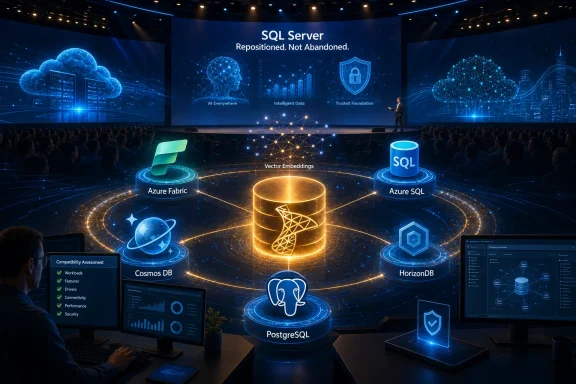 SQL Server Is Too Profitable to Kill and Too Awkward to Celebrate
The paradox of SQL Server is that it is both old-fashioned and indispensable. First released in 1989 for OS/2, it became one of Microsoft’s great enterprise beachheads: a Windows-friendly relational database that let organizations standardize around familiar tooling, T-SQL, Active Directory-era identity models, and later Visual Studio and .NET development patterns.That history is not nostalgia. It is installed base. SQL Server sits under ERP systems, line-of-business applications, healthcare platforms, manufacturing systems, retail systems, reporting stacks, and countless internal applications whose owners may not even know what database backs them until a migration project goes sideways.
This is why talk of Microsoft “ditching” SQL Server quickly runs into reality. Gartner analyst Adam Ronthal told The Register that Microsoft’s on-premises DBMS business was worth around $15 billion, largely from SQL Server, and that it continued growing in high single digits in 2025. A company can neglect a product culturally while still defending it commercially, and SQL Server is exactly the sort of annuity Microsoft knows how to defend.
The awkward part is that SQL Server does not map cleanly onto Microsoft’s current story. Build is now about Copilot, agents, Fabric, model orchestration, Azure AI Foundry, and data estates that feed retrieval-augmented generation. A boxed or self-managed relational database, even a very capable one, does not supply the keynote drama that cloud-native AI infrastructure does.
That does not make SQL Server irrelevant. It makes it less glamorous. In enterprise software, that is often the first sign that a product has moved from “future platform” to “strategic cash cow.”
Build’s Silence Was the Signal
One conference omission rarely proves much. Build is a developer conference, not a SQL Server user group meeting, and Microsoft has too many products to give each one equal stage time. But silence becomes meaningful when it fits a wider pattern.The Register points to Microsoft’s emphasis on AI agent Scout, Fabric, Azure Data, and HorizonDB while SQL Server received little attention despite SQL Server 2025 being fresh in market. That is the sort of omission that product communities notice because timing matters. If a major database release with AI-era features cannot win keynote oxygen during an AI-era Build, customers are entitled to ask where the internal priority sits.
SQL Server 2025’s vector search support should have been an easy bridge between legacy strength and AI relevance. Vector search is not a toy feature anymore; it is part of how applications retrieve semantically similar documents, recommendations, embeddings, and knowledge chunks for AI workflows. Microsoft added native vector capabilities to SQL Server and related SQL offerings, giving customers a path to build AI-adjacent workloads without ripping data out of existing relational systems.
Yet the bigger Build story reportedly went elsewhere: HorizonDB, a Postgres-compatible distributed database service aimed at AI applications, plus Microsoft’s continued integration of databases into Fabric. That does not mean SQL Server lacked engineering work. It means Microsoft’s public growth narrative favored Postgres-compatible cloud scale and unified data experiences over the venerable engine that made SQL Server DBAs a professional class.
This is where Andrew Snodgrass’s criticism stings. His argument is not that SQL Server has no future; it is that Microsoft has allowed it to feel like a product being maintained for monetization rather than led with conviction. When a longtime champion leaves, when the new executive owner also carries Fabric, AI, and open-source database responsibilities, and when the keynote energy moves elsewhere, the community reads the room.
The 2022 Release Still Casts a Shadow
SQL Server 2022 was supposed to modernize the platform, but for some customers it reinforced a suspicion: Microsoft’s idea of SQL Server innovation increasingly meant Azure attachment. Features such as Azure Synapse Link integration, Microsoft Purview integration, and managed disaster recovery scenarios had obvious strategic logic. They also fit Microsoft’s broader cloud migration agenda.The problem is that not every SQL Server customer experiences cloud integration as a top request. Many want predictable performance, better tooling, licensing clarity, operational simplicity, improved developer ergonomics, query optimizer improvements, better high availability, and fewer migration traps. A release that feels like a brochure for Azure can land poorly with teams whose job is to keep regulated, latency-sensitive, or vendor-certified workloads running on infrastructure they control.
That divide is not new. Microsoft has spent years trying to turn on-premises estates into Azure adjacency. SQL Server enabled by Azure Arc, Azure SQL Managed Instance, SQL Server on Azure VMs, Azure Hybrid Benefit, and migration tooling all serve the same strategic arc: keep the SQL Server customer inside Microsoft’s orbit even as deployment models change.
From Microsoft’s point of view, this is rational. From a DBA’s point of view, it can look like the product is being steered toward Microsoft’s commercial destination rather than the customer’s operational pain. Those two things often overlap, but when they diverge, trust erodes.
SQL Server 2025 appears to have done more to answer a real technical trend with vector capabilities, but it entered a market where Postgres ecosystems, MongoDB, Oracle, and specialist vector stores had already conditioned developers to expect native or extension-based vector workflows. A late but useful feature can still matter. It just does not automatically restore the sense that SQL Server is setting the pace.
Postgres Has Become the API Microsoft Cannot Ignore
The most important shift in relational databases is not that PostgreSQL became fashionable. It is that Postgres compatibility became a form of buyer insurance. Developers and architects increasingly see Postgres not merely as an open-source database, but as a common dialect for cloud-native relational systems.That is why so many distributed SQL and cloud database vendors either build on Postgres or advertise compatibility with its wire protocol, syntax, extensions, or ecosystem. CockroachDB, Yugabyte, Neon, AlloyDB, Aurora PostgreSQL, pgEdge, and others have all benefited from the perception that Postgres reduces lock-in while supporting modern application patterns. Even when compatibility is imperfect, the procurement story is powerful.
Microsoft cannot ignore that market just because it owns SQL Server. Azure Database for PostgreSQL was already an acknowledgment that customers want first-party Postgres on Azure. HorizonDB pushes the point harder by positioning Microsoft around distributed, AI-ready, Postgres-compatible infrastructure rather than around T-SQL-first legacy modernization.
This is not betrayal. It is platform pragmatism. Microsoft wants workloads on Azure, and if the workload speaks Postgres, Microsoft would rather sell the cloud service than lose the customer to AWS, Google, or a specialist database startup.
But there is a psychological cost. SQL Server customers spent decades inside Microsoft’s database worldview. Now they are watching Microsoft court the database culture that often marketed itself as the escape hatch from proprietary enterprise stacks. For some shops, that will feel like validation. For others, it will feel like Microsoft has accepted that the center of gravity has moved.
The brutal truth is that the cloud database market rewards services more than engines. If Azure consumption rises, Microsoft wins whether the query language is T-SQL, PostgreSQL, MongoDB-compatible, Kusto, or something abstracted through Fabric. SQL Server remains valuable, but Azure is the scoreboard.
Fabric Turns Databases Into Ingredients
Microsoft Fabric is where this strategy becomes most visible. Fabric is not just another analytics product; it is Microsoft’s attempt to make data integration, governance, analytics, AI, and operational data feel like parts of one cloud control plane. In that world, individual databases become sources, engines, or experiences inside a larger data estate.That framing is good for Microsoft because it lets the company sell unification. It is more complicated for customers because unification can blur product boundaries that once made decisions clearer. A SQL Server shop now has to evaluate SQL Server, Azure SQL Database, Azure SQL Managed Instance, SQL Server on Azure VMs, SQL database in Fabric, Fabric warehouses, lakehouses, Cosmos DB, Azure Database for PostgreSQL, and now HorizonDB depending on workload shape.
Ronthal’s point that Microsoft has rationalization to do is understated. The SQL Server family alone can be confusing. Azure SQL Database offers a highly managed PaaS model. Managed Instance offers greater compatibility for lift-and-shift workloads. SQL Server on Azure VMs gives customers operating system control at the cost of management overhead. On-prem SQL Server remains the compatibility anchor. Fabric adds another SQL-flavored experience aimed at analytics and AI workflows.
Choice is useful until it becomes a decision tax. The more overlapping paths Microsoft offers, the more customers need expensive architecture work just to understand which Microsoft database product Microsoft wants them to use. That creates opportunities for consultants, but it also creates room for AWS, Oracle, Google, and Postgres-native vendors to offer simpler narratives.
For IT pros, the strategic message is clear: Microsoft wants to meet workloads where they are, but it also wants those workloads observable, governable, and monetizable through Azure and Fabric. SQL Server is part of that map. It is no longer the whole map.
Licensing Flexibility Is a Retention Strategy, Not Generosity
The licensing detail in The Register story is easy to miss but important. Microsoft’s terms reportedly allow customers to bring SQL Server licenses to AWS’s RDS database service without paying twice, using an option that lets them provide their own SQL Server installation media. That sounds like Microsoft enabling a competitor, but the economics are subtler.If a SQL Server customer moves to AWS and keeps paying Microsoft for SQL Server rights, Microsoft has lost the Azure infrastructure opportunity but preserved the database relationship. In a world where the alternative may be a migration to Aurora PostgreSQL, native Postgres, MySQL, or another cloud database, keeping the SQL Server license stream alive is not a loss Microsoft should dismiss.
This is the enterprise version of “better rented elsewhere than replaced entirely.” SQL Server’s value is not only in runtime revenue; it is in application compatibility, stored procedures, operational knowledge, vendor certification, and the inertia of T-SQL estates. Microsoft knows that if a customer exits SQL Server completely, the odds of winning that workload back later shrink dramatically.
Licensing flexibility therefore becomes defensive strategy. It keeps SQL Server viable across environments and reduces the incentive to rewrite under pressure. Microsoft can still pitch Azure later, especially if the customer wants tighter integration with Fabric, Microsoft Defender, Purview, Entra, or Azure AI services.
The catch is that this strategy reinforces SQL Server’s new role. It is not necessarily the magnet pulling everything into Azure. It is also a retention layer that prevents Microsoft’s database franchise from bleeding out while the cloud platform war continues around it.
The DBA’s Problem Is Not Abandonment, It Ambiguity
For database administrators, the risk is not that Microsoft turns off SQL Server. Support for SQL Server 2025 runs into 2036, and enterprises will likely be running supported SQL Server systems well beyond the point at which today’s AI branding feels dated. The risk is ambiguity about where to invest skills, modernization effort, and application architecture.A SQL Server estate is not a single thing. It may include vendor applications that only certify specific versions, internal applications loaded with T-SQL assumptions, SSIS packages, SQL Agent jobs, linked servers, CLR integrations, Reporting Services, Analysis Services, and monitoring practices built around years of operational muscle memory. Moving that estate is not like changing a connection string.
Managed cloud offerings reduce some burdens but remove some control. As Ronthal noted, once a workload moves fully into managed services, administrators may not have the same access to the underlying operating system or database configuration. That trade can be acceptable, even welcome, but it is not neutral.
The practical question becomes workload segmentation. Some SQL Server systems belong on managed Azure SQL services because the operational savings and platform integration outweigh compatibility constraints. Some belong on VMs because compatibility and control matter. Some belong on-premises because latency, regulation, cost, vendor support, or organizational reality says so. Some may be candidates for Postgres migration, but only after a sober look at application logic and operational risk.
This is where Microsoft’s messaging needs to mature. “Choice” is not enough. Customers need sharper guidance about which SQL Server paths are strategic, which are transitional, and which are compatibility shelters. Without that, Microsoft’s portfolio breadth can feel less like freedom and more like fog.
AI Gives SQL Server a Reason to Matter, But Not a Guarantee
SQL Server’s AI story is stronger than its keynote presence suggests. Enterprise AI does not live on pristine greenfield data. It needs access to customer records, transactions, documents, telemetry, audit trails, and operational facts — much of which sits in boring relational systems that have survived multiple waves of architectural fashion.That gives SQL Server a natural role in retrieval, grounding, compliance-aware data access, and application modernization. Vector search inside SQL Server can reduce the need to duplicate sensitive data into separate vector databases. It can let organizations enrich existing applications with semantic search while keeping governance, backup, identity, and auditing closer to established systems.
But AI relevance is not automatic. Developers follow ecosystems, samples, SDKs, managed services, and community energy. Postgres has pgvector and a vibrant AI-app developer culture. Cloud-native document and search systems have their own momentum. Microsoft’s own Fabric and Azure AI stack may abstract database choices enough that the underlying SQL Server engine becomes invisible.
For SQL Server to feel loved again, Microsoft would need to make it not only compatible with AI workloads but compelling for them. That means first-rate vector performance, clean developer experiences, transparent limits, strong hybrid search, integration with modern frameworks, and documentation that treats SQL Server as a place where new applications start — not only where old ones stay.
SQL Server has one advantage that fashionable systems often lack: enterprise trust. Its challenge is that trust alone does not win new architecture. It preserves estates; it does not necessarily inspire them.
Microsoft’s Database Strategy Is Becoming Engine-Agnostic
The larger story is that Microsoft is becoming less religious about database engines. That may be uncomfortable for SQL Server loyalists, but it is consistent with the company’s broader transformation. Microsoft once fought Linux; now it runs Linux workloads everywhere. Microsoft once treated open source databases as competition; now Azure sells them as managed services. Microsoft once used Windows Server as the enterprise default; now the cloud platform is the default.This engine-agnostic posture is not altruism. It is how hyperscalers win. The customer brings a workload; the cloud provider supplies compute, storage, networking, identity, governance, security, AI services, observability, and a monthly bill. The database engine matters, but the platform relationship matters more.
AWS has played this game brilliantly, offering first-party services for multiple engines while building proprietary cloud-native databases such as Aurora and DynamoDB. Google has pushed AlloyDB and BigQuery. Oracle has defended its database franchise while trying to make Oracle Cloud Infrastructure unavoidable for Oracle workloads. Microsoft’s advantage is that it owns both a massive database franchise and a massive cloud platform, but that also creates internal tension.
SQL Server is still a weapon. It is just no longer the only weapon Microsoft wants to carry. In some sales conversations, Azure SQL will be the natural destination. In others, PostgreSQL will be the better developer story. In analytics-heavy environments, Fabric will be the strategic wrapper. In globally distributed workloads, HorizonDB may get the pitch. In document-heavy applications, Cosmos DB enters the room.
That portfolio makes sense if you are Microsoft. It is harder if you are the customer trying to decide which bet will still receive attention five years from now.
Windows Shops Should Read the Signal, Not Panic
For traditional Microsoft shops, the lesson is not to flee SQL Server. Panic migrations are how organizations turn stable systems into expensive incident generators. SQL Server remains deeply capable, widely supported, and commercially important to Microsoft. It will be patched, sold, supported, and integrated for years.The lesson is to stop assuming that SQL Server is automatically Microsoft’s preferred answer to every database question. That assumption was once safe in many Windows-centric organizations. It is now incomplete.
New application teams should be allowed to evaluate Postgres, Azure SQL, Cosmos DB, and Fabric-native options on their merits. Existing SQL Server teams should inventory compatibility constraints and identify which workloads are genuinely tied to SQL Server versus merely historically located there. Architects should be explicit about whether they are optimizing for portability, Microsoft integration, operational control, managed-service convenience, or AI feature velocity.
Procurement teams also need to understand the difference between preserving licenses and preserving leverage. A licensing path that lets SQL Server run on AWS may be valuable, but it does not eliminate migration complexity or vendor dependency. Likewise, Azure Hybrid Benefit can improve economics without answering whether the target service is the right technical fit.
Security-minded readers should pay special attention to data duplication. AI projects have a habit of spawning shadow pipelines, experimental vector stores, and copied datasets with weaker governance than the source systems. If SQL Server’s built-in vector capabilities can keep sensitive data closer to established controls, that is a real advantage. But it only works if the feature set is good enough that developers do not route around it.
The Real Bet Is on Control of the Data Estate
Microsoft’s public language around “unified data estates” can sound like conference fog, but the business logic is precise. The company wants to own the layer where data is discovered, governed, secured, transformed, queried, analyzed, and fed into AI systems. Whether the underlying workload began life in SQL Server, Postgres, Cosmos DB, or a lakehouse matters less than whether Microsoft controls the operational plane around it.That is why Fabric matters so much. It is not simply competing with Snowflake, Databricks, or traditional analytics stacks. It is also a way to make Microsoft the coordinator of enterprise data gravity. Once governance, lineage, access control, reporting, and AI retrieval sit inside Microsoft’s fabric — lowercase and uppercase — the individual engine becomes less politically central.
SQL Server fits this world as a trusted participant. Its consistency with Azure SQL and SQL database in Fabric gives Microsoft a migration and modernization story. Its installed base gives Microsoft a huge pool of data estates to attach to cloud services. Its licensing revenue gives Microsoft every reason to keep investing enough to maintain confidence.
But enough investment is not the same as leadership. Customers can live with a mature product. They become uneasy when they suspect maturity has become a euphemism for strategic demotion.
Microsoft’s task is therefore not simply to deny neglect. Its task is to show SQL Server customers a future that is more specific than “run it wherever you like and connect it to Azure when ready.” The product needs a crisp role in the AI era, not just a long support lifecycle.
The Signal for SQL Server Shops Is Written in Microsoft’s Portfolio
The most useful reading of the moment is neither doom nor reassurance. SQL Server is not going away, but Microsoft’s energy is diffusing across a wider database portfolio where Azure consumption, Fabric adoption, and AI integration outrank loyalty to any single engine.- SQL Server remains a major Microsoft business, and its revenue base makes abandonment commercially irrational.
- Microsoft’s Build-era emphasis on HorizonDB, Fabric, PostgreSQL, and AI agents suggests SQL Server is no longer the symbolic center of the data strategy.
- SQL Server 2025’s vector capabilities matter because they give existing estates a way to participate in AI workloads without immediate data relocation.
- The growing importance of Postgres compatibility means Microsoft will increasingly support database choices that compete culturally and technically with SQL Server.
- Customers should treat Microsoft’s many SQL deployment options as an architecture decision, not a simple upgrade path.
- The safest strategy is workload-by-workload planning that separates systems needing SQL Server compatibility from systems that merely inherited it.
SQL Server’s next decade will probably look less like a fall from grace than a long negotiation with its own success: too embedded to abandon, too profitable to starve, and too legacy-branded to dominate Microsoft’s AI stage. The winning organizations will not wait for Redmond to clarify every signal. They will map their estates now, modernize where the benefits are real, keep boring systems boring where that is the right call, and treat Microsoft’s database future as plural rather than singular.
References
- Primary source: The Register
Published: Tue, 16 Jun 2026 10:00:00 GMT
SQL Server may be too lucrative for Microsoft to ditch, but too legacy to love
Analysts say Redmond still has billions of reasons to keep backing its flagship DBMS, even as Azure, Postgres, and AI hog the spotlightwww.theregister.com - Official source: microsoft.com
Advancing agentic AI with Microsoft databases across a unified data estate - Microsoft SQL Server Blog
Find out how you can achieve better price performance, elastic scale, and resilience for all workloads with Azure SQL Database Hyperscale.www.microsoft.com - Official source: learn.microsoft.com
End of Support Options - SQL Server | Microsoft Learn
Learn about the different options available for SQL Server products that reach end of support, including SQL Server 2014.learn.microsoft.com - Official source: techcommunity.microsoft.com
Azure HorizonDB: Enterprise-Ready Postgres, Engineered for the AI Era | Microsoft Community Hub
Affan Dar, Vice President of Engineering, PostgreSQL at MicrosoftCharles Feddersen, Partner Director of Program Management, PostgreSQL at Microsoft Today at... techcommunity.microsoft.com
- Related coverage: epcgroup.net
Build 2026 for Azure Architects: Databases, Agents,...
Build 2026 for Azure architects: HorizonDB, Cosmos DB enhancements, the Foundry agentic app stack, and what to architect around when every workload.www.epcgroup.net - Related coverage: windowsreport.com
Microsoft Launches SQL Server 2026, Fabric Databases, and Rebranded Azure DocumentDB
Microsoft has announced general availability of SQL Server 2025, Fabric Databases, and Rebranded Azure DocumentDB at the Ignite 2025 event. windowsreport.com
- Related coverage: postgresqltips.com
- Related coverage: pages.awscloud.com
IDC MarketScape: Worldwide Analytical Databases 2025–2026 Vendor Assessment
PDF documentpages.awscloud.com
