John Jumper, the American computational biologist and Google DeepMind vice president who helped lead AlphaFold to a 2024 Nobel Prize in Chemistry, said on June 19, 2026, that he is leaving Google DeepMind after nearly nine years to join Anthropic after a break. The move is more than a celebrity transfer in the AI industry’s increasingly expensive talent market. It is a signal that Anthropic wants scientific credibility, not merely model-scale bravado, as the next phase of AI competition shifts from chatbots to systems that can help reason through hard technical work. For Google DeepMind, it is a reminder that even the labs with Nobel medals on the wall are now competing in a labor market where mission, compute, money, and culture all pull in different directions.
The AI industry has spent the last three years treating talent like infrastructure. GPUs are scarce, data is strategic, and the people who know how to turn both into working systems are now treated as almost irreplaceable assets. Jumper’s move from Google DeepMind to Anthropic fits that pattern, but it has a different texture from the usual carousel of foundation-model engineers and startup founders.
Jumper is not famous because he made a chatbot more charming or shaved a few milliseconds off inference latency. He is famous because AlphaFold helped change what biologists could expect from computation. The system’s success gave AI a laboratory-grade example of usefulness: not a demo, not a benchmark leaderboard, but a tool that altered the pace and shape of research.
That makes his departure politically awkward for Google DeepMind and strategically useful for Anthropic. DeepMind has long sold itself as the place where AI meets serious science, a lab with enough patience and prestige to work on problems larger than advertising, search, or enterprise productivity. Anthropic, by contrast, has built its public identity around safety, interpretability, and cautious frontier-model development. Hiring Jumper lets Anthropic borrow some of DeepMind’s strongest institutional mythology: that advanced AI should not merely talk about the world, but help discover it.
The immediate facts are straightforward. Jumper announced that he would leave Google DeepMind after nearly nine years and join Anthropic after taking time to recharge. He thanked DeepMind CEO Demis Hassabis for giving him responsibility for AlphaFold shortly after his doctorate and described DeepMind as formative in his scientific life. The subtext is the part the industry will argue over: why a Nobel-winning scientist would choose Anthropic now, and what that says about where high-end AI research is headed.
For decades, determining protein structures required painstaking experimental work using methods such as X-ray crystallography, cryo-electron microscopy, and nuclear magnetic resonance spectroscopy. These methods remain essential, but they are slow, expensive, and technically demanding. The old dream was that computers might infer a protein’s shape from its sequence. The old frustration was that biology did not make that easy.
AlphaFold did not make experimental biology obsolete, and serious scientists have always known that prediction is not the same as proof. But AlphaFold2’s performance in the 2020 Critical Assessment of Structure Prediction competition marked a genuine break with the past. It showed that deep learning could predict many protein structures with an accuracy that stunned a field accustomed to incremental progress.
The importance of that breakthrough was not simply that an AI system performed well. It was that a system trained and engineered at scale could compress part of a scientific workflow that had been measured in months or years into something far faster. That is the sort of progress that changes expectations. Once researchers can start with a high-quality predicted structure, they ask different questions, design different experiments, and move more quickly toward the failures and confirmations that science still requires.
That decision now looks obvious only because it worked. At the time, it was a bet on a researcher whose background sat across physics, chemistry, computation, and biology. The AlphaFold project needed exactly that kind of boundary-crossing fluency. It was not enough to be good at neural networks, and it was not enough to understand proteins in the abstract. The project required a team that could translate biological structure into a form machine learning could exploit without flattening the science into toy data.
The Nobel Prize in Chemistry in 2024 made that bet part of the permanent scientific record. The prize was divided between David Baker for computational protein design and Demis Hassabis and John Jumper for protein structure prediction. That pairing mattered because it recognized two sides of the same revolution: predicting what nature has made and designing what nature has not.
Jumper, then 39, became one of the youngest chemistry laureates in modern memory. More importantly for the technology industry, he became proof that frontier AI could produce a scientific result worthy of the Nobel committee, not just the venture-capital circuit. That distinction is why his next employer matters.
Jumper’s arrival helps fill that gap. It says Anthropic wants to be seen not only as a safer alternative to OpenAI or a more cautious frontier lab, but as a place where first-rank scientific researchers can do ambitious work. That matters because the next phase of AI competition is likely to be judged less by conversational polish and more by performance in domains where mistakes are expensive.
Medicine, biology, chemistry, software engineering, chip design, materials science, and cyber defense all demand something more rigorous than a model that sounds confident. They require systems that can reason under constraints, expose uncertainty, work with tools, and fit into workflows where human experts remain accountable. Anthropic’s brand already leans toward the language of reliability. Jumper’s career gives that language a harder scientific edge.
There is also a recruiting effect. Elite AI labs do not hire stars only for their individual output; they hire them as magnets. A Nobel laureate who led one of the most successful applied AI projects in history sends a message to researchers deciding whether to stay in academia, join a startup, or disappear into a hyperscaler. The message is that Anthropic wants to be a serious scientific home.
Still, symbolism matters in technology because morale and recruitment matter. DeepMind’s aura has always been built on the idea that it is not just another corporate AI division. It was the lab that mastered Go, tackled protein folding, built general-purpose research teams, and kept alive the dream of artificial general intelligence as a scientific project rather than a marketing phrase. Losing a Nobel-winning AlphaFold architect to Anthropic does not destroy that identity, but it dents it.
The timing also lands in a broader pattern. Google has faced repeated questions about whether its sprawling AI operation can move quickly enough against focused rivals. It has more distribution than almost anyone, but distribution can become bureaucracy. Researchers who want to ship, publish, or pursue a particular scientific agenda may decide that a smaller frontier lab offers a clearer line between idea and impact.
DeepMind’s counterargument is strong: it can offer scale, world-class colleagues, Alphabet infrastructure, and a record of converting deep research into global tools. But in the current market, that may no longer be enough to keep every marquee researcher. Prestige is now portable.
It showed that deep learning can be scientifically profound when aimed at a well-structured problem with rich data, clear evaluation, and serious domain expertise. It also showed that success depends on more than making a model larger. Architecture, representation, training targets, scientific intuition, and evaluation all mattered.
That lesson is directly relevant to the foundation-model race. General models are becoming more capable, but many of the most valuable applications will require specialized scaffolding around them. A model that helps a biologist, chemist, kernel developer, or security analyst cannot simply be a generic autocomplete system with a lab coat. It must be adapted to the grammar, failure modes, and verification practices of the field.
This is where Jumper’s experience becomes strategically interesting for Anthropic. He has already lived through the process of turning AI from an impressive model into a scientific workflow accelerant. That is different from building a benchmark champion. It is the difference between a clever assistant and an instrument that experts begin to trust, cautiously, because it repeatedly earns its place.
Jumper’s move does not resolve that tension, but it gives Anthropic a more concrete way to argue for its model of progress. Scientific AI work rewards caution because false certainty is dangerous. A protein prediction, a molecular interaction, or a biomedical hypothesis is not useful because a model phrases it elegantly. It is useful only if it survives contact with experimental reality.
That sensibility aligns naturally with interpretability and reliability research. If Anthropic wants its models to support advanced scientific or technical work, it will need systems that can explain their reasoning in ways experts can audit, identify when they are outside their competence, and integrate with external tools that check claims. The company’s safety language can sound abstract when attached to consumer chat. It becomes more concrete when attached to scientific workflows.
The challenge is that science also rewards ambition. Safe, cautious systems that do not push boundaries will not transform research. Anthropic is therefore trying to occupy a difficult middle ground: building models capable enough to matter and constrained enough not to become reckless. Hiring someone associated with AlphaFold suggests that the company understands that the highest-value AI systems may be those that combine audacity with verification.
In enterprise IT, that could mean models that triage incidents, analyze logs, generate remediation plans, test patches, map dependencies, or help reason through misconfigurations. In software development, it means systems that do more than write code snippets: they inspect architectures, understand build chains, propose migrations, and catch subtle regressions. In security, it means assistants that can help defenders correlate signals across noisy environments while also raising the stakes for attackers.
The AlphaFold analogy should be used carefully. Protein structure prediction is not the same problem as endpoint management or vulnerability analysis. But the institutional lesson carries over: AI becomes valuable when it is paired with high-quality data, clear feedback, domain expertise, and rigorous validation. Without those, it becomes another source of plausible noise.
That is why talent like Jumper’s is so coveted. The industry has plenty of people who can talk about general intelligence in sweeping terms. It has fewer people who have helped ship an AI system that changed a technical field while retaining the respect of domain experts. For enterprise buyers already trying to separate AI roadmaps from AI theater, that distinction should sound familiar.
Anthropic, OpenAI, Google DeepMind, Microsoft, Meta, and xAI are all chasing the same broad prize: systems that can act as dependable collaborators rather than passive text generators. The name for that ambition changes depending on the press release. Sometimes it is agents. Sometimes it is AI coworkers. Sometimes it is scientific discovery. Sometimes it is automation. The underlying goal is the same: models that can pursue goals across tools and time.
Jumper’s background speaks directly to that transition. AlphaFold was not a toy chatbot answering trivia about proteins. It was a computational system designed to solve a hard representational problem and serve researchers. Its value came from reducing uncertainty in a domain where uncertainty is the work.
If Anthropic can apply that kind of thinking to frontier models, the result could be more than a better Claude. It could be a family of systems tuned for complex work where correctness, provenance, and expert oversight are first-class design constraints. That is a harder product story than “our model is smarter,” but it may be the one that wins durable enterprise trust.
Yet the company has repeatedly struggled with the perception that it invents the future and then watches others package it more aggressively. That perception is not always fair, but it is persistent enough to matter. When major researchers leave for competitors, it reinforces the narrative that Google’s scale can be both advantage and trap.
Jumper’s departure is not necessarily a referendum on Google culture. Senior researchers change jobs for many reasons: new problems, new teams, personal timing, financial incentives, or the simple need for a different environment after a long project. His public comments were gracious toward DeepMind. There is no need to invent drama where the record does not show it.
But for Google, the strategic concern is larger than one scientist. If frontier AI becomes a contest over who can assemble the best small groups around high-conviction missions, the hyperscaler model has to prove it can still offer urgency. DeepMind’s great challenge is not proving it can do science. It is proving that its best scientists still see it as the place to do their next impossible thing.
The Nobel committee’s recognition did not mean every claim about AI-driven discovery should be believed. If anything, it raised the standard. AlphaFold’s success was specific, measurable, and tested against a long-running scientific challenge. That is very different from vague promises that AI will soon cure diseases, replace programmers, or reinvent education.
Jumper therefore carries a kind of credibility that is difficult to manufacture. He is associated with an AI system whose value is not primarily rhetorical. Scientists used it, debated it, tested it, and built on it. That gives his move to Anthropic weight beyond the usual executive reshuffle.
For Anthropic, the temptation will be to turn that credibility into a halo around everything it does. The better path would be narrower and more demanding: use it to build systems whose claims can be evaluated as seriously as AlphaFold’s were. AI needs fewer sweeping declarations and more results that survive expert scrutiny.
Those are familiar questions in Windows environments. Administrators already manage layers of automation, from Group Policy and Intune to PowerShell scripts, endpoint detection, identity rules, and update rings. The promise of AI in that world is seductive: fewer repetitive tasks, faster troubleshooting, better documentation, and smarter detection. The risk is equally familiar: opaque automation can break things at machine speed.
A model that confidently misreads a security event or invents a remediation step is not merely unhelpful. It is operationally dangerous. The more AI is embedded into admin consoles, developer tools, SOC workflows, and cloud control planes, the more the industry will need a culture of validation that looks closer to scientific practice than consumer software growth hacking.
That is why the Jumper move has resonance outside biology. The people who understand how to make AI useful in demanding fields are likely to shape how the technology enters every other demanding field. Enterprise IT should be watching not because Anthropic just hired a famous scientist, but because the hiring points to where the frontier is moving: toward models that must be useful under audit.
The Jumper hire fits Anthropic’s preferred story better than most. It suggests that the company wants to compete for researchers whose ambitions are not limited to consumer assistants or viral demos. It also strengthens the case that safety and capability are not separate tracks, but mutually dependent ones. A model that cannot be trusted in difficult work is not truly capable for that work.
Still, seriousness has to scale operationally. Anthropic will need to show that it can give elite researchers room to build without drowning them in product pressure. It will also need to show that its safety culture can handle domains where mistakes are not theoretical. Scientific and technical AI systems do not merely offend users when they fail; they can misdirect research, waste resources, or create security risk.
The prize for getting this right is large. The next truly important AI products may not look like standalone chat interfaces at all. They may look like research engines, codebase agents, diagnostic copilots, security analysts, and infrastructure planners. Jumper’s career suggests that the most valuable AI may be the kind that disappears into expert work and makes the impossible merely difficult.
For now, the industry should resist two easy overreactions. This is not proof that Google DeepMind is in decline. It is also not proof that Anthropic is suddenly the natural home of AI science. What it does prove is that the frontier AI labor market has become fluid enough that even Nobel-grade achievement does not anchor a researcher permanently to one institution.
The more interesting question is what Jumper’s next work will reveal about AI’s future. If he helps Anthropic build models that are more interpretable, more reliable, or more useful in scientific domains, the move may look in hindsight like an inflection point. If not, it will remain a high-profile hire in an industry full of them.
For readers trying to separate signal from spectacle, the near-term read is simple:
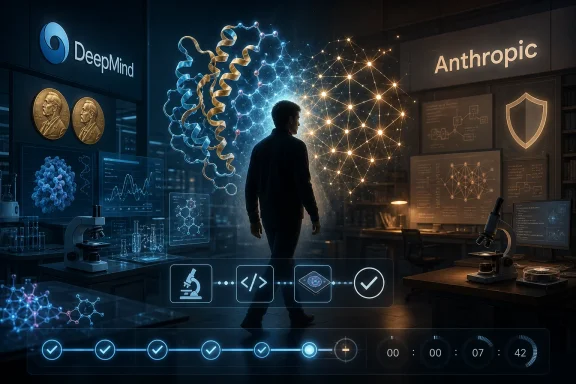 A Nobel Exit Turns the AI Talent War Into a Scientific Story
The AI industry has spent the last three years treating talent like infrastructure. GPUs are scarce, data is strategic, and the people who know how to turn both into working systems are now treated as almost irreplaceable assets. Jumper’s move from Google DeepMind to Anthropic fits that pattern, but it has a different texture from the usual carousel of foundation-model engineers and startup founders.Jumper is not famous because he made a chatbot more charming or shaved a few milliseconds off inference latency. He is famous because AlphaFold helped change what biologists could expect from computation. The system’s success gave AI a laboratory-grade example of usefulness: not a demo, not a benchmark leaderboard, but a tool that altered the pace and shape of research.
That makes his departure politically awkward for Google DeepMind and strategically useful for Anthropic. DeepMind has long sold itself as the place where AI meets serious science, a lab with enough patience and prestige to work on problems larger than advertising, search, or enterprise productivity. Anthropic, by contrast, has built its public identity around safety, interpretability, and cautious frontier-model development. Hiring Jumper lets Anthropic borrow some of DeepMind’s strongest institutional mythology: that advanced AI should not merely talk about the world, but help discover it.
The immediate facts are straightforward. Jumper announced that he would leave Google DeepMind after nearly nine years and join Anthropic after taking time to recharge. He thanked DeepMind CEO Demis Hassabis for giving him responsibility for AlphaFold shortly after his doctorate and described DeepMind as formative in his scientific life. The subtext is the part the industry will argue over: why a Nobel-winning scientist would choose Anthropic now, and what that says about where high-end AI research is headed.
AlphaFold Made AI Useful Before AI Became Ubiquitous
To understand why this move matters, it helps to remember what AlphaFold represented before “AI” became a consumer product category. Protein folding was one of those problems that sat at the boundary between science and metaphor. Proteins are chains of amino acids, but their function depends on how those chains fold into three-dimensional structures. Knowing that shape can help researchers understand disease, design drugs, study enzymes, and reason about biology at a molecular level.For decades, determining protein structures required painstaking experimental work using methods such as X-ray crystallography, cryo-electron microscopy, and nuclear magnetic resonance spectroscopy. These methods remain essential, but they are slow, expensive, and technically demanding. The old dream was that computers might infer a protein’s shape from its sequence. The old frustration was that biology did not make that easy.
AlphaFold did not make experimental biology obsolete, and serious scientists have always known that prediction is not the same as proof. But AlphaFold2’s performance in the 2020 Critical Assessment of Structure Prediction competition marked a genuine break with the past. It showed that deep learning could predict many protein structures with an accuracy that stunned a field accustomed to incremental progress.
The importance of that breakthrough was not simply that an AI system performed well. It was that a system trained and engineered at scale could compress part of a scientific workflow that had been measured in months or years into something far faster. That is the sort of progress that changes expectations. Once researchers can start with a high-quality predicted structure, they ask different questions, design different experiments, and move more quickly toward the failures and confirmations that science still requires.
Jumper Became the Face of a Different Kind of AI Ambition
Jumper’s biography has become part of the AlphaFold story because it neatly breaks the usual myth of slow institutional ascent. He studied at Vanderbilt, received a Marshall Scholarship, worked at Cambridge, earned a doctorate in theoretical chemistry at the University of Chicago, and then moved into DeepMind’s scientific orbit. DeepMind handed him a leadership role on AlphaFold astonishingly early in his post-PhD career.That decision now looks obvious only because it worked. At the time, it was a bet on a researcher whose background sat across physics, chemistry, computation, and biology. The AlphaFold project needed exactly that kind of boundary-crossing fluency. It was not enough to be good at neural networks, and it was not enough to understand proteins in the abstract. The project required a team that could translate biological structure into a form machine learning could exploit without flattening the science into toy data.
The Nobel Prize in Chemistry in 2024 made that bet part of the permanent scientific record. The prize was divided between David Baker for computational protein design and Demis Hassabis and John Jumper for protein structure prediction. That pairing mattered because it recognized two sides of the same revolution: predicting what nature has made and designing what nature has not.
Jumper, then 39, became one of the youngest chemistry laureates in modern memory. More importantly for the technology industry, he became proof that frontier AI could produce a scientific result worthy of the Nobel committee, not just the venture-capital circuit. That distinction is why his next employer matters.
Anthropic Is Buying More Than a Famous Name
Anthropic does not need Jumper to explain transformers to it. The company is already one of the central players in frontier AI, with the Claude family of models, a strong enterprise push, and an identity built around constitutional AI, alignment research, and interpretability. What it lacks, compared with Google DeepMind, is the same long public record of landmark scientific systems.Jumper’s arrival helps fill that gap. It says Anthropic wants to be seen not only as a safer alternative to OpenAI or a more cautious frontier lab, but as a place where first-rank scientific researchers can do ambitious work. That matters because the next phase of AI competition is likely to be judged less by conversational polish and more by performance in domains where mistakes are expensive.
Medicine, biology, chemistry, software engineering, chip design, materials science, and cyber defense all demand something more rigorous than a model that sounds confident. They require systems that can reason under constraints, expose uncertainty, work with tools, and fit into workflows where human experts remain accountable. Anthropic’s brand already leans toward the language of reliability. Jumper’s career gives that language a harder scientific edge.
There is also a recruiting effect. Elite AI labs do not hire stars only for their individual output; they hire them as magnets. A Nobel laureate who led one of the most successful applied AI projects in history sends a message to researchers deciding whether to stay in academia, join a startup, or disappear into a hyperscaler. The message is that Anthropic wants to be a serious scientific home.
Google DeepMind Still Has the Institution, But the Aura Takes a Hit
It would be easy to overstate the damage to Google DeepMind. One high-profile departure does not erase AlphaFold, AlphaFold 3, Gemini, or the enormous research organization Alphabet has assembled. DeepMind remains one of the few AI institutions with the money, compute, talent, and patience to pursue long-horizon work that may not become a product next quarter.Still, symbolism matters in technology because morale and recruitment matter. DeepMind’s aura has always been built on the idea that it is not just another corporate AI division. It was the lab that mastered Go, tackled protein folding, built general-purpose research teams, and kept alive the dream of artificial general intelligence as a scientific project rather than a marketing phrase. Losing a Nobel-winning AlphaFold architect to Anthropic does not destroy that identity, but it dents it.
The timing also lands in a broader pattern. Google has faced repeated questions about whether its sprawling AI operation can move quickly enough against focused rivals. It has more distribution than almost anyone, but distribution can become bureaucracy. Researchers who want to ship, publish, or pursue a particular scientific agenda may decide that a smaller frontier lab offers a clearer line between idea and impact.
DeepMind’s counterargument is strong: it can offer scale, world-class colleagues, Alphabet infrastructure, and a record of converting deep research into global tools. But in the current market, that may no longer be enough to keep every marquee researcher. Prestige is now portable.
The Protein-Folding Breakthrough Was Never Just About Proteins
The reason AlphaFold keeps resurfacing in AI debates is that it serves as a rebuttal to two lazy narratives. The first says modern AI is mostly a stochastic parlor trick, impressive at producing language but thin as a scientific instrument. The second says scale alone will solve everything if companies spend enough money on compute. AlphaFold complicates both.It showed that deep learning can be scientifically profound when aimed at a well-structured problem with rich data, clear evaluation, and serious domain expertise. It also showed that success depends on more than making a model larger. Architecture, representation, training targets, scientific intuition, and evaluation all mattered.
That lesson is directly relevant to the foundation-model race. General models are becoming more capable, but many of the most valuable applications will require specialized scaffolding around them. A model that helps a biologist, chemist, kernel developer, or security analyst cannot simply be a generic autocomplete system with a lab coat. It must be adapted to the grammar, failure modes, and verification practices of the field.
This is where Jumper’s experience becomes strategically interesting for Anthropic. He has already lived through the process of turning AI from an impressive model into a scientific workflow accelerant. That is different from building a benchmark champion. It is the difference between a clever assistant and an instrument that experts begin to trust, cautiously, because it repeatedly earns its place.
Safety Culture Meets Scientific Ambition
Anthropic’s public posture has always carried a tension. It wants to build frontier AI systems powerful enough to compete with OpenAI, Google, Meta, and xAI, while also insisting that safety and interpretability must shape deployment. Critics see that as branding wrapped around the same race everyone else is running. Supporters see it as the only realistic way to keep safety inside the room where frontier systems are actually built.Jumper’s move does not resolve that tension, but it gives Anthropic a more concrete way to argue for its model of progress. Scientific AI work rewards caution because false certainty is dangerous. A protein prediction, a molecular interaction, or a biomedical hypothesis is not useful because a model phrases it elegantly. It is useful only if it survives contact with experimental reality.
That sensibility aligns naturally with interpretability and reliability research. If Anthropic wants its models to support advanced scientific or technical work, it will need systems that can explain their reasoning in ways experts can audit, identify when they are outside their competence, and integrate with external tools that check claims. The company’s safety language can sound abstract when attached to consumer chat. It becomes more concrete when attached to scientific workflows.
The challenge is that science also rewards ambition. Safe, cautious systems that do not push boundaries will not transform research. Anthropic is therefore trying to occupy a difficult middle ground: building models capable enough to matter and constrained enough not to become reckless. Hiring someone associated with AlphaFold suggests that the company understands that the highest-value AI systems may be those that combine audacity with verification.
The Enterprise Lesson Is Not About Biology Alone
WindowsForum readers may reasonably ask why a protein-folding scientist’s job move should matter to IT pros, developers, or administrators. The answer is that the AlphaFold story is a preview of how AI may enter serious professional workflows. It will not always arrive as a chatbot bolted onto an existing interface. Sometimes it will arrive as a domain-specific capability that changes the economics of a task.In enterprise IT, that could mean models that triage incidents, analyze logs, generate remediation plans, test patches, map dependencies, or help reason through misconfigurations. In software development, it means systems that do more than write code snippets: they inspect architectures, understand build chains, propose migrations, and catch subtle regressions. In security, it means assistants that can help defenders correlate signals across noisy environments while also raising the stakes for attackers.
The AlphaFold analogy should be used carefully. Protein structure prediction is not the same problem as endpoint management or vulnerability analysis. But the institutional lesson carries over: AI becomes valuable when it is paired with high-quality data, clear feedback, domain expertise, and rigorous validation. Without those, it becomes another source of plausible noise.
That is why talent like Jumper’s is so coveted. The industry has plenty of people who can talk about general intelligence in sweeping terms. It has fewer people who have helped ship an AI system that changed a technical field while retaining the respect of domain experts. For enterprise buyers already trying to separate AI roadmaps from AI theater, that distinction should sound familiar.
The AI Race Is Moving From Model Size to Model Usefulness
For much of the generative AI boom, public competition centered on model releases: bigger context windows, better coding scores, faster multimodal demos, cheaper APIs, and more fluent consumer experiences. Those things still matter. But the market is slowly becoming less impressed by raw capability claims and more interested in where those capabilities actually produce leverage.Anthropic, OpenAI, Google DeepMind, Microsoft, Meta, and xAI are all chasing the same broad prize: systems that can act as dependable collaborators rather than passive text generators. The name for that ambition changes depending on the press release. Sometimes it is agents. Sometimes it is AI coworkers. Sometimes it is scientific discovery. Sometimes it is automation. The underlying goal is the same: models that can pursue goals across tools and time.
Jumper’s background speaks directly to that transition. AlphaFold was not a toy chatbot answering trivia about proteins. It was a computational system designed to solve a hard representational problem and serve researchers. Its value came from reducing uncertainty in a domain where uncertainty is the work.
If Anthropic can apply that kind of thinking to frontier models, the result could be more than a better Claude. It could be a family of systems tuned for complex work where correctness, provenance, and expert oversight are first-class design constraints. That is a harder product story than “our model is smarter,” but it may be the one that wins durable enterprise trust.
Google’s AI Problem Is Not Invention, But Retention and Translation
Google remains one of the most inventive organizations in AI. The transformer architecture that underpins modern large language models came from Google researchers. DeepMind’s scientific record is formidable. Google has the cloud infrastructure, Android distribution, Workspace footprint, and search surface to put AI in front of billions of users.Yet the company has repeatedly struggled with the perception that it invents the future and then watches others package it more aggressively. That perception is not always fair, but it is persistent enough to matter. When major researchers leave for competitors, it reinforces the narrative that Google’s scale can be both advantage and trap.
Jumper’s departure is not necessarily a referendum on Google culture. Senior researchers change jobs for many reasons: new problems, new teams, personal timing, financial incentives, or the simple need for a different environment after a long project. His public comments were gracious toward DeepMind. There is no need to invent drama where the record does not show it.
But for Google, the strategic concern is larger than one scientist. If frontier AI becomes a contest over who can assemble the best small groups around high-conviction missions, the hyperscaler model has to prove it can still offer urgency. DeepMind’s great challenge is not proving it can do science. It is proving that its best scientists still see it as the place to do their next impossible thing.
The Nobel Prize Changed the Meaning of AI Credibility
The 2024 Nobel Prize in Chemistry did something unusual for the AI industry: it moved part of the field’s legitimacy from conference halls and product launches into the oldest prestige economy in science. That mattered because AI companies often ask society to trust them based on projected futures. AlphaFold offered a completed achievement.The Nobel committee’s recognition did not mean every claim about AI-driven discovery should be believed. If anything, it raised the standard. AlphaFold’s success was specific, measurable, and tested against a long-running scientific challenge. That is very different from vague promises that AI will soon cure diseases, replace programmers, or reinvent education.
Jumper therefore carries a kind of credibility that is difficult to manufacture. He is associated with an AI system whose value is not primarily rhetorical. Scientists used it, debated it, tested it, and built on it. That gives his move to Anthropic weight beyond the usual executive reshuffle.
For Anthropic, the temptation will be to turn that credibility into a halo around everything it does. The better path would be narrower and more demanding: use it to build systems whose claims can be evaluated as seriously as AlphaFold’s were. AI needs fewer sweeping declarations and more results that survive expert scrutiny.
The Windows Angle Is Trust, Not Proteins
For sysadmins and IT pros, the most relevant part of this story is not that Anthropic may do more scientific AI. It is that the AI industry is beginning to converge on the same trust problem enterprise technology has always had. Can the tool be verified? Can it be governed? Can it be integrated without creating new failure modes? Can humans understand enough about its behavior to remain accountable?Those are familiar questions in Windows environments. Administrators already manage layers of automation, from Group Policy and Intune to PowerShell scripts, endpoint detection, identity rules, and update rings. The promise of AI in that world is seductive: fewer repetitive tasks, faster troubleshooting, better documentation, and smarter detection. The risk is equally familiar: opaque automation can break things at machine speed.
A model that confidently misreads a security event or invents a remediation step is not merely unhelpful. It is operationally dangerous. The more AI is embedded into admin consoles, developer tools, SOC workflows, and cloud control planes, the more the industry will need a culture of validation that looks closer to scientific practice than consumer software growth hacking.
That is why the Jumper move has resonance outside biology. The people who understand how to make AI useful in demanding fields are likely to shape how the technology enters every other demanding field. Enterprise IT should be watching not because Anthropic just hired a famous scientist, but because the hiring points to where the frontier is moving: toward models that must be useful under audit.
Anthropic’s Bet Is That Seriousness Can Scale
Anthropic has always tried to sound like the adult in the frontier-model room. That posture carries benefits and burdens. It attracts customers worried about governance, but it also invites scrutiny whenever the company behaves like every other fast-scaling AI business. Raising money, chasing enterprise deals, and hiring star researchers are not acts of monastic restraint.The Jumper hire fits Anthropic’s preferred story better than most. It suggests that the company wants to compete for researchers whose ambitions are not limited to consumer assistants or viral demos. It also strengthens the case that safety and capability are not separate tracks, but mutually dependent ones. A model that cannot be trusted in difficult work is not truly capable for that work.
Still, seriousness has to scale operationally. Anthropic will need to show that it can give elite researchers room to build without drowning them in product pressure. It will also need to show that its safety culture can handle domains where mistakes are not theoretical. Scientific and technical AI systems do not merely offend users when they fail; they can misdirect research, waste resources, or create security risk.
The prize for getting this right is large. The next truly important AI products may not look like standalone chat interfaces at all. They may look like research engines, codebase agents, diagnostic copilots, security analysts, and infrastructure planners. Jumper’s career suggests that the most valuable AI may be the kind that disappears into expert work and makes the impossible merely difficult.
The Jumper Move Gives the AI Race a More Demanding Scoreboard
The practical consequences of Jumper’s move will take time to see. He is taking a break before joining Anthropic, and neither his exact role nor the projects he will lead have been publicly defined in detail. But the directional signal is already clear: Anthropic is recruiting for scientific depth, and Google DeepMind is facing the same retention pressures as every other major AI lab.For now, the industry should resist two easy overreactions. This is not proof that Google DeepMind is in decline. It is also not proof that Anthropic is suddenly the natural home of AI science. What it does prove is that the frontier AI labor market has become fluid enough that even Nobel-grade achievement does not anchor a researcher permanently to one institution.
The more interesting question is what Jumper’s next work will reveal about AI’s future. If he helps Anthropic build models that are more interpretable, more reliable, or more useful in scientific domains, the move may look in hindsight like an inflection point. If not, it will remain a high-profile hire in an industry full of them.
For readers trying to separate signal from spectacle, the near-term read is simple:
- John Jumper announced on June 19, 2026, that he is leaving Google DeepMind after nearly nine years and plans to join Anthropic after a break.
- Jumper shared the 2024 Nobel Prize in Chemistry with Demis Hassabis and David Baker for work connected to protein structure prediction and computational protein design.
- AlphaFold mattered because it showed that AI could accelerate a real scientific workflow rather than merely perform well in a consumer-facing demo.
- Anthropic gains a researcher whose reputation supports its pitch that advanced AI should be reliable, interpretable, and useful in serious technical domains.
- Google DeepMind remains a powerhouse, but the departure underlines how competitive and mobile elite AI talent has become.
- For enterprise technology, the larger lesson is that useful AI will depend on verification, domain expertise, and trust as much as raw model capability.
References
- Primary source: NewsX
Published: 2026-06-20T04:50:10.421862
Who Is John Jumper? The Nobel-Winning AI Scientist and AlphaFold Architect Leaving Google DeepMind For Anthropic
Google DeepMind's Nobel Prize-winning AI scientist John Jumper is leaving for Anthropic after nearly nine years. Learn who John Jumper is, why he won the 2024 Nobel Prize in Chemistry, the AlphaFold breakthrough, and why his move could reshape the global AI race. www.newsx.com
- Independent coverage: Latest news from Azerbaijan
Published: Fri, 19 Jun 2026 19:45:40 GMT
Anthropic hires Google DeepMind VP John Jumper after Nobel success | News.az
Jumper shared the 2024 Nobel Prize in Chemistry with DeepMind CEO Demis Hassabis for their work on protein structure prediction. Winning a Nobel and t...news.az - Independent coverage: Crypto Briefing
Published: Fri, 19 Jun 2026 19:34:57 GMT
Google DeepMind vice president John Jumper joins Anthropic after Nobel win
Nobel Prize-winning AlphaFold scientist John Jumper leaves Google DeepMind after nearly nine years to join Anthropic, intensifying the AI talent war.cryptobriefing.com - Independent coverage: the-decoder.com
Published: Fri, 19 Jun 2026 17:57:27 GMT
Google Deepmind loses another top AI researcher as Nobel laureate John Jumper leaves for Anthropic
Nobel Prize winner John Jumper is leaving Google Deepmind for Anthropic after nearly nine years. Days earlier, Gemini co-lead Noam Shazeer left for OpenAI. Weeks before that, AlphaGo researcher David Silver started his own company. Three of Google's most prominent AI minds, gone within months.the-decoder.com - Related coverage: nsf.gov
NSF congratulates laureates of the 2024 Nobel Prize in chemistry
The U.S. National Science Foundation congratulates David Baker, Demis Hassabis and John Jumper on being awarded the 2024 Nobel Prize in chemistry. Baker and his colleagues revolutionized protein… www.nsf.gov
- Related coverage: scientificamerican.com
2024 Chemistry Nobel Awarded for Cracking the Secret Code of Proteins | Scientific American
The Nobel Prize in Chemistry goes to biochemist David Baker, and Google DeepMind scientists Demis Hassabis and John Jumper, for predicting protein shapes and functions— and for creating entirely new ones that can improve health and the environmentwww.scientificamerican.com
- Related coverage: embl.org
Computational protein design and protein structure prediction win Nobel Prize in Chemistry | EMBL
AlphaFold won the 2024 Nobel Prize in Chemistry for protein structure prediction.www.embl.org
- Related coverage: axial.acs.org
The 2024 Nobel Prize in Chemistry Goes to David Baker, Demis Hassabis, and John Jumper | ACS Publications Chemistry Blog
The 2024 Nobel Prize in Chemistry was awarded to David Baker “for computational protein design,” and Demis Hassabis and John Jumper “for protein structure prediction.” Browse noteworthy articles surrounding the winning research in ACS journals.axial.acs.org - Related coverage: acs.org
- Related coverage: sciencenews.org
Work on protein structure and design wins the 2024 chemistry Nobel
David Baker figured out how to build entirely new proteins. Demis Hassabis and John Jumper developed an AI tool to predict protein structures. www.sciencenews.org
- Related coverage: cen.acs.org
Baker, Hassabis, and Jumper win 2024 Nobel Prize in Chemistry
Computational chemists receive prize for protein design and structure predictioncen.acs.org
- Related coverage: techcrunch.com
OpenAI co-founder Andrej Karpathy joins Anthropic's pre-training team | TechCrunch
Pre-training is responsible for the large-scale training runs that give Claude its core knowledge and capabilities, according to the company. It's also one of the most expensive, compute-intensive phases of building a frontier model.techcrunch.com - Related coverage: elpais.com
- Related coverage: washingtonpost.com
- Related coverage: livescience.com
2024 Nobel Prize in chemistry awarded to scientists who revealed a 'completely new world of protein structures' | Live Science
David Baker, Demis Hassabis and John Jumper shared the Nobel prize in chemistry for work that revolutionized our understanding of protein structure.www.livescience.com - Related coverage: lemonde.fr
2024 Nobel Prize for Chemistry: Artificial intelligence garners more recognition
At least half of Wednesday's prize was awarded to a tool that has revolutionized the lives of biochemists, designed by Demis Hassabis of the UK and John Jumper of the US.www.lemonde.fr - Related coverage: time.com
Nobel Prize 2024: All the Winners
A list of all the winners of the 2024 Nobel Prizes in all categories.time.com - Related coverage: cadenaser.com
- Related coverage: compoundchem.com
- Related coverage: xtal.iqfr.csic.es