

On June 26, 2026, Microsoft published a customer story detailing how KARL STORZ, a Germany-headquartered MedTech company with nearly 10,000 employees worldwide, is using Microsoft 365 Copilot as a governed AI layer across its enterprise collaboration environment. The interesting part is not that another large organization has adopted Copilot. It is that KARL STORZ treated generative AI less like a productivity toy and more like regulated infrastructure. In a sector where documentation, permissions, retention, and auditability can matter as much as speed, that distinction is the whole story.
The first wave of enterprise generative AI was sold on spectacle: summarize this meeting, draft that email, find the buried file nobody remembers naming correctly. Those demos still matter because they make the technology legible to workers who do not care about model architecture. But in regulated industries, the demo is not the deployment.
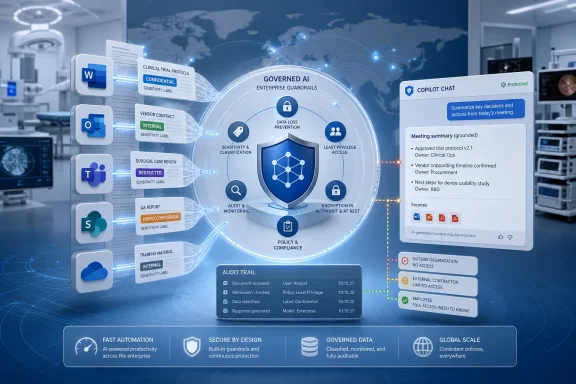
KARL STORZ’s use case shows where the Microsoft 365 Copilot argument has matured. Microsoft is no longer merely pitching an assistant that can sit inside Word, Outlook, Teams, SharePoint, and OneDrive. It is pitching a way to put AI into the existing corporate information estate without forcing IT to invent a parallel governance regime from scratch.
That is the point Microsoft wants IT leaders to absorb. The company’s strongest Copilot argument is not that its model will always be the cleverest. It is that the assistant can inherit the identity, access, compliance, and data protection structures that many organizations already use to run their daily work.
For KARL STORZ, that mattered because the company’s problem was not simply “too much information.” It was too much information spread across a global enterprise that must satisfy medical technology expectations around accuracy, confidentiality, and record discipline. In that context, unmanaged AI is not a shortcut. It is a new source of risk.
KARL STORZ described a familiar enterprise pattern. Employees were spending too much time locating data, summarizing meetings, and aligning on decisions. Information lived across email, documents, and collaboration tools, but the work of finding and applying it remained manual.
That is exactly the kind of white-collar friction that Copilot is designed to attack. Meeting summaries reduce the need to reconstruct context. Drafting assistance reduces the blank-page tax. Retrieval across Microsoft 365 reduces the time spent hopping between Outlook, SharePoint, OneDrive, and Teams.
But the regulated-industry version of this story is more demanding than “employees got faster.” The question is whether the system can make information more accessible without making sensitive information more exposed. KARL STORZ’s leadership appears to have understood that the access problem and the control problem are the same problem viewed from different angles.
That is the boring sentence that matters. Many AI pilots fail not because the model is useless, but because the organization treats the pilot as exempt from the rules that govern everything else. People test with real documents, permissions are messy, content owners are unclear, and nobody wants to answer hard questions until the usage numbers look promising.
KARL STORZ appears to have inverted that sequence. The company’s concern was not just whether Copilot could summarize a meeting. It was whether AI could be introduced while respecting regional requirements for data residency, retention, and access.
That is the right instinct. Generative AI does not remove the need for governance; it increases the value of governance. A search box can expose bad permissions one query at a time. An AI assistant can synthesize the consequences of bad permissions into a confident paragraph.
That does not make Copilot risk-free. It makes Copilot a mirror. If SharePoint sites are overexposed, if Teams channels have become dumping grounds, if OneDrive links are too permissive, Copilot can make those governance weaknesses more visible and more consequential.
This is why “Copilot readiness” is really Microsoft 365 hygiene by another name. The assistant is not just querying documents; it is querying the organization’s access model. If that model is clean, Copilot looks controlled. If that model is sloppy, Copilot may become the fastest way to discover how sloppy it is.
KARL STORZ’s reported experience reinforces that point. Once Copilot was enabled, the company realized how important document hygiene had become. Outdated or inconsistently structured content became easier to spot because employees were relying on AI to surface and summarize enterprise knowledge.
That is a subtle but important shift. AI adoption did not merely consume the information architecture. It fed back into it. The company’s documents, labels, ownership patterns, and storage habits became part of the AI system’s operational quality.
Still, usage is not the same as transformation. A high active-use number can mean employees genuinely depend on the tool, but it can also reflect novelty, license pressure, or a narrow set of repetitive tasks. The more important signal is the reported return rate, because repeat use suggests the tool is fitting into work rather than merely attracting curiosity.
The company’s early use cases are also telling. Meeting summaries, drafting, information retrieval, and follow-ups are not glamorous. They are the repetitive connective tissue of modern office work.
That may be exactly why they matter. Enterprise AI does not need to replace a profession to justify itself. If it removes enough coordination drag across a large workforce, the aggregate effect can be meaningful.
The harder question is how that productivity gets measured. Time saved in meetings is easy to claim and difficult to bank. Faster drafting can improve throughput, but only if review cycles, compliance checks, and decision rights also move faster. In a regulated business, the promise is not just speed. It is speed with fewer uncontrolled workarounds.
Traditional enterprise search often fails because employees do not know where information lives, what it is called, or whether the authoritative version is a file, email thread, meeting note, or Teams conversation. Copilot’s promise is that users can ask in ordinary language and receive a synthesized answer grounded in material they are allowed to see.
That is powerful, but it also changes user expectations. Once employees get used to asking a system for “the latest status,” “the decision from last week,” or “the relevant policy,” they may stop caring where the underlying record lives. That can be convenient for users and uncomfortable for records managers.
The system therefore depends on confidence in the underlying corpus. If the wrong document is still accessible, if the obsolete deck has better keywords than the current policy, or if meeting decisions are captured inconsistently, AI can accelerate confusion as easily as clarity.
That is why the KARL STORZ story should not be read as “Copilot solved knowledge management.” It is better understood as “Copilot made knowledge management impossible to ignore.”
A governed Copilot deployment gives IT a defensible answer. Employees get AI features inside familiar tools, while the organization keeps the experience closer to existing identity, compliance, and administrative controls. That does not eliminate leakage risk, but it offers a sanctioned path that is easier to monitor and govern than a sprawl of unmanaged services.
For a MedTech organization, that distinction is crucial. Sensitive company information, intellectual property, product documentation, quality data, and regulatory material cannot be treated as casual prompt fodder. The official tool must be not only useful, but trustworthy enough that users do not route around it.
That is also why adoption is a governance metric. If employees actually use the governed system, IT has a chance to shape behavior. If they do not, the organization may still have AI usage — just outside the fence.
Microsoft 365 already contains the documents, calendars, emails, chats, meetings, permissions, groups, labels, and audit trails that define how many organizations work. An AI assistant sitting inside that environment has context that a standalone chatbot must either import, integrate with, or ask the user to provide manually.
That integration is commercially potent. The more work lives in Microsoft 365, the more useful Copilot can become. The more useful Copilot becomes, the more incentive organizations have to clean up and consolidate work inside Microsoft 365.
This is platform gravity. Microsoft is not just adding AI to Office; it is using AI to make Office feel like the natural home of enterprise knowledge work. For customers already deeply invested in the stack, that can be convenient. For competitors, it is a reminder that AI assistants are becoming distribution channels for ecosystems.
There is a risk for customers, too. A governed AI foundation built around Microsoft 365 may reduce fragmentation, but it can also deepen dependence on Microsoft’s licensing, roadmap, and administrative model. In highly regulated environments, the convenience of one platform must be weighed against concentration risk.
Summarizing a meeting is one thing. Guiding a process is another. Once AI begins to help drive workflows, prepare decisions, route tasks, or interpret business context, the organization must care not only about what the system can access, but what it can influence.
This is the frontier that should make administrators cautious and interested at the same time. AI grounded in enterprise content can reduce friction in approvals, quality processes, training, sales operations, service workflows, and internal support. But the more the system moves from retrieval to recommendation, the more it needs clear accountability.
Who owns the output when Copilot drafts a regulatory response? Who verifies the source when it summarizes product documentation? Who decides whether an AI-assisted process is sufficiently validated for a regulated workflow? Those are not objections to adoption. They are the next set of implementation requirements.
KARL STORZ’s staged approach is therefore sensible. Start with information access and productivity tasks. Use adoption to identify value. Use governance work to improve the content estate. Then expand into more tailored scenarios once the foundation is better understood.
Admins have seen this pattern before. Endpoint security became less about installing antivirus and more about managing identity, patching, telemetry, least privilege, and response workflows. Copilot readiness follows a similar arc. The visible tool is only the front end of a larger operational system.
Document hygiene is the phrase that deserves to survive the marketing cycle. It includes removing stale content, fixing overshared sites, clarifying ownership, applying sensitivity labels where appropriate, and making sure authoritative material is easier to find than outdated duplicates.
Without that work, AI can become a beautifully designed interface to a poorly governed archive. With that work, it can become a forcing function for long-overdue cleanup that many organizations avoided because conventional search made the mess tolerable.
KARL STORZ’s experience suggests that the arrival of Copilot can make the mess less tolerable in a useful way. When employees depend on AI to synthesize information, bad content quality becomes visible. That visibility can be uncomfortable, but it gives IT and business owners a reason to invest in cleanup.
Large organizations constantly lose context. People change roles, meetings produce decisions that never make it into formal documents, files accumulate in personal drives, and email threads become private archives of public work. The result is a strange contradiction: enterprises possess enormous amounts of information but routinely behave as if they cannot remember what they already know.
Copilot attacks that problem by making buried context easier to retrieve. In the KARL STORZ story, that meant pulling relevant documents, summarizing meetings, drafting follow-ups, and helping teams align faster. Those are modest actions individually, but collectively they reduce the distance between stored information and operational decision-making.
In regulated industries, institutional memory is not just a productivity asset. It is a control mechanism. The organization needs to know why decisions were made, what documentation supported them, who had access to which materials, and whether current work reflects current policy.
That is why auditability matters. AI-generated summaries and responses are useful only if the organization can understand, govern, and challenge them. The future of enterprise AI will belong less to systems that sound confident and more to systems that can be placed inside accountable business processes.
 The Copilot Sale Has Moved From Magic Trick to Control Plane
The first wave of enterprise generative AI was sold on spectacle: summarize this meeting, draft that email, find the buried file nobody remembers naming correctly. Those demos still matter because they make the technology legible to workers who do not care about model architecture. But in regulated industries, the demo is not the deployment.KARL STORZ’s use case shows where the Microsoft 365 Copilot argument has matured. Microsoft is no longer merely pitching an assistant that can sit inside Word, Outlook, Teams, SharePoint, and OneDrive. It is pitching a way to put AI into the existing corporate information estate without forcing IT to invent a parallel governance regime from scratch.
That is the point Microsoft wants IT leaders to absorb. The company’s strongest Copilot argument is not that its model will always be the cleverest. It is that the assistant can inherit the identity, access, compliance, and data protection structures that many organizations already use to run their daily work.
For KARL STORZ, that mattered because the company’s problem was not simply “too much information.” It was too much information spread across a global enterprise that must satisfy medical technology expectations around accuracy, confidentiality, and record discipline. In that context, unmanaged AI is not a shortcut. It is a new source of risk.
Information Overload Becomes a Compliance Problem
Every large company complains about information overload, but MedTech gives the phrase sharper edges. A missed decision, stale document, or incorrectly shared file can have consequences beyond wasted time. Documentation is not just internal memory; it is often part of the evidence trail that supports quality systems, regulatory reviews, product development, training, and customer commitments.KARL STORZ described a familiar enterprise pattern. Employees were spending too much time locating data, summarizing meetings, and aligning on decisions. Information lived across email, documents, and collaboration tools, but the work of finding and applying it remained manual.
That is exactly the kind of white-collar friction that Copilot is designed to attack. Meeting summaries reduce the need to reconstruct context. Drafting assistance reduces the blank-page tax. Retrieval across Microsoft 365 reduces the time spent hopping between Outlook, SharePoint, OneDrive, and Teams.
But the regulated-industry version of this story is more demanding than “employees got faster.” The question is whether the system can make information more accessible without making sensitive information more exposed. KARL STORZ’s leadership appears to have understood that the access problem and the control problem are the same problem viewed from different angles.
The Guardrails Were the Deployment, Not the Afterthought
The most revealing detail in Microsoft’s case study is that KARL STORZ did not frame Copilot as a standalone AI experiment. The company treated it as part of core IT from the beginning, with IT, legal, compliance, and security aligned around how the system would operate.That is the boring sentence that matters. Many AI pilots fail not because the model is useless, but because the organization treats the pilot as exempt from the rules that govern everything else. People test with real documents, permissions are messy, content owners are unclear, and nobody wants to answer hard questions until the usage numbers look promising.
KARL STORZ appears to have inverted that sequence. The company’s concern was not just whether Copilot could summarize a meeting. It was whether AI could be introduced while respecting regional requirements for data residency, retention, and access.
That is the right instinct. Generative AI does not remove the need for governance; it increases the value of governance. A search box can expose bad permissions one query at a time. An AI assistant can synthesize the consequences of bad permissions into a confident paragraph.
Microsoft’s Advantage Is the Tenant Boundary
Microsoft’s case for Copilot rests heavily on a claim that matters to administrators: Copilot works within the user’s existing permissions. In plain English, the assistant should only surface material the signed-in user is already allowed to access.That does not make Copilot risk-free. It makes Copilot a mirror. If SharePoint sites are overexposed, if Teams channels have become dumping grounds, if OneDrive links are too permissive, Copilot can make those governance weaknesses more visible and more consequential.
This is why “Copilot readiness” is really Microsoft 365 hygiene by another name. The assistant is not just querying documents; it is querying the organization’s access model. If that model is clean, Copilot looks controlled. If that model is sloppy, Copilot may become the fastest way to discover how sloppy it is.
KARL STORZ’s reported experience reinforces that point. Once Copilot was enabled, the company realized how important document hygiene had become. Outdated or inconsistently structured content became easier to spot because employees were relying on AI to surface and summarize enterprise knowledge.
That is a subtle but important shift. AI adoption did not merely consume the information architecture. It fed back into it. The company’s documents, labels, ownership patterns, and storage habits became part of the AI system’s operational quality.
Adoption Numbers Tell a Story, but Not the Whole Story
Microsoft says KARL STORZ reached 97 percent active usage across about 2,000 licensed Copilot users, with 93 percent returning month over month. Those are strong numbers by enterprise software standards, where shelfware is practically an industry tradition.Still, usage is not the same as transformation. A high active-use number can mean employees genuinely depend on the tool, but it can also reflect novelty, license pressure, or a narrow set of repetitive tasks. The more important signal is the reported return rate, because repeat use suggests the tool is fitting into work rather than merely attracting curiosity.
The company’s early use cases are also telling. Meeting summaries, drafting, information retrieval, and follow-ups are not glamorous. They are the repetitive connective tissue of modern office work.
That may be exactly why they matter. Enterprise AI does not need to replace a profession to justify itself. If it removes enough coordination drag across a large workforce, the aggregate effect can be meaningful.
The harder question is how that productivity gets measured. Time saved in meetings is easy to claim and difficult to bank. Faster drafting can improve throughput, but only if review cycles, compliance checks, and decision rights also move faster. In a regulated business, the promise is not just speed. It is speed with fewer uncontrolled workarounds.
Copilot Chat Changes the Shape of Search
One KARL STORZ executive described Microsoft 365 Copilot Chat as a game changer because it can draw from SharePoint, OneDrive, Outlook, and related Microsoft 365 sources in a more unified way. That is the heart of the experience Microsoft is trying to normalize: the enterprise search box becomes conversational, contextual, and action-oriented.Traditional enterprise search often fails because employees do not know where information lives, what it is called, or whether the authoritative version is a file, email thread, meeting note, or Teams conversation. Copilot’s promise is that users can ask in ordinary language and receive a synthesized answer grounded in material they are allowed to see.
That is powerful, but it also changes user expectations. Once employees get used to asking a system for “the latest status,” “the decision from last week,” or “the relevant policy,” they may stop caring where the underlying record lives. That can be convenient for users and uncomfortable for records managers.
The system therefore depends on confidence in the underlying corpus. If the wrong document is still accessible, if the obsolete deck has better keywords than the current policy, or if meeting decisions are captured inconsistently, AI can accelerate confusion as easily as clarity.
That is why the KARL STORZ story should not be read as “Copilot solved knowledge management.” It is better understood as “Copilot made knowledge management impossible to ignore.”
The Regulated Enterprise Wants AI Without a Shadow IT Hangover
One reason Microsoft is well positioned here is that enterprises are already worried about employees pasting company information into consumer AI tools. The demand for AI assistance exists whether IT approves it or not. If the official channel feels too limited, workers will look elsewhere.A governed Copilot deployment gives IT a defensible answer. Employees get AI features inside familiar tools, while the organization keeps the experience closer to existing identity, compliance, and administrative controls. That does not eliminate leakage risk, but it offers a sanctioned path that is easier to monitor and govern than a sprawl of unmanaged services.
For a MedTech organization, that distinction is crucial. Sensitive company information, intellectual property, product documentation, quality data, and regulatory material cannot be treated as casual prompt fodder. The official tool must be not only useful, but trustworthy enough that users do not route around it.
That is also why adoption is a governance metric. If employees actually use the governed system, IT has a chance to shape behavior. If they do not, the organization may still have AI usage — just outside the fence.
Microsoft Is Selling the Installed Base as an AI Moat
The KARL STORZ deployment also reveals Microsoft’s broader strategy. Copilot’s biggest competitive advantage may be less about the model and more about the installed base.Microsoft 365 already contains the documents, calendars, emails, chats, meetings, permissions, groups, labels, and audit trails that define how many organizations work. An AI assistant sitting inside that environment has context that a standalone chatbot must either import, integrate with, or ask the user to provide manually.
That integration is commercially potent. The more work lives in Microsoft 365, the more useful Copilot can become. The more useful Copilot becomes, the more incentive organizations have to clean up and consolidate work inside Microsoft 365.
This is platform gravity. Microsoft is not just adding AI to Office; it is using AI to make Office feel like the natural home of enterprise knowledge work. For customers already deeply invested in the stack, that can be convenient. For competitors, it is a reminder that AI assistants are becoming distribution channels for ecosystems.
There is a risk for customers, too. A governed AI foundation built around Microsoft 365 may reduce fragmentation, but it can also deepen dependence on Microsoft’s licensing, roadmap, and administrative model. In highly regulated environments, the convenience of one platform must be weighed against concentration risk.
The Next Phase Is Where the Stakes Rise
KARL STORZ’s leaders describe the first step as providing information from documents. The next step is making information more tailored to individuals and eventually supporting broader business processes. That progression is where enterprise AI becomes more consequential.Summarizing a meeting is one thing. Guiding a process is another. Once AI begins to help drive workflows, prepare decisions, route tasks, or interpret business context, the organization must care not only about what the system can access, but what it can influence.
This is the frontier that should make administrators cautious and interested at the same time. AI grounded in enterprise content can reduce friction in approvals, quality processes, training, sales operations, service workflows, and internal support. But the more the system moves from retrieval to recommendation, the more it needs clear accountability.
Who owns the output when Copilot drafts a regulatory response? Who verifies the source when it summarizes product documentation? Who decides whether an AI-assisted process is sufficiently validated for a regulated workflow? Those are not objections to adoption. They are the next set of implementation requirements.
KARL STORZ’s staged approach is therefore sensible. Start with information access and productivity tasks. Use adoption to identify value. Use governance work to improve the content estate. Then expand into more tailored scenarios once the foundation is better understood.
Document Hygiene Becomes the New Endpoint Security
For WindowsForum readers, the most practical lesson is that AI readiness is not confined to AI settings. It is a tenant-wide discipline involving identity, SharePoint, OneDrive, Teams, Purview, retention, labeling, ownership, and user behavior.Admins have seen this pattern before. Endpoint security became less about installing antivirus and more about managing identity, patching, telemetry, least privilege, and response workflows. Copilot readiness follows a similar arc. The visible tool is only the front end of a larger operational system.
Document hygiene is the phrase that deserves to survive the marketing cycle. It includes removing stale content, fixing overshared sites, clarifying ownership, applying sensitivity labels where appropriate, and making sure authoritative material is easier to find than outdated duplicates.
Without that work, AI can become a beautifully designed interface to a poorly governed archive. With that work, it can become a forcing function for long-overdue cleanup that many organizations avoided because conventional search made the mess tolerable.
KARL STORZ’s experience suggests that the arrival of Copilot can make the mess less tolerable in a useful way. When employees depend on AI to synthesize information, bad content quality becomes visible. That visibility can be uncomfortable, but it gives IT and business owners a reason to invest in cleanup.
The Win Is Not Automation, but Institutional Memory
The most interesting promise in this deployment is not that Copilot can draft faster emails. It is that a governed AI layer may help preserve and activate institutional memory.Large organizations constantly lose context. People change roles, meetings produce decisions that never make it into formal documents, files accumulate in personal drives, and email threads become private archives of public work. The result is a strange contradiction: enterprises possess enormous amounts of information but routinely behave as if they cannot remember what they already know.
Copilot attacks that problem by making buried context easier to retrieve. In the KARL STORZ story, that meant pulling relevant documents, summarizing meetings, drafting follow-ups, and helping teams align faster. Those are modest actions individually, but collectively they reduce the distance between stored information and operational decision-making.
In regulated industries, institutional memory is not just a productivity asset. It is a control mechanism. The organization needs to know why decisions were made, what documentation supported them, who had access to which materials, and whether current work reflects current policy.
That is why auditability matters. AI-generated summaries and responses are useful only if the organization can understand, govern, and challenge them. The future of enterprise AI will belong less to systems that sound confident and more to systems that can be placed inside accountable business processes.
The KARL STORZ Lesson Is Smaller, Sharper, and More Useful Than the Hype
The concrete lesson from KARL STORZ is not that every company should immediately buy thousands of Copilot licenses. It is that regulated AI adoption succeeds or fails on the foundation beneath the assistant.- KARL STORZ’s deployment shows that Copilot’s strongest enterprise pitch is governance inside an existing Microsoft 365 environment, not novelty as a standalone chatbot.
- The company’s high reported active usage and returning-user rates suggest that mundane tasks such as summaries, drafting, and retrieval remain the most credible early use cases.
- Copilot’s reliance on existing permissions makes Microsoft 365 hygiene more important, because overshared or outdated content can become easier to surface.
- The move from document retrieval to tailored process support will require stronger accountability, validation, and ownership than basic productivity scenarios.
- For administrators, AI readiness now means cleaning up identity, access, retention, labels, SharePoint sites, OneDrive sharing, and content ownership before users discover the gaps conversationally.
References
- Primary source: Microsoft
Published: 2026-06-26T22:30:15.886299
KARL STORZ builds a governed AI foundation with Microsoft 365 Copilot | Microsoft Customer Stories
With Microsoft 365 Copilot, KARL STORZ scaled governed AI, reaching 97% active usage across licensed users.www.microsoft.com
