

Microsoft’s Copilot Story Is Becoming an Operations Story
For much of the Copilot era, Microsoft has sold the product through the familiar language of office productivity. Summarize the meeting. Draft the email. Turn the document into a presentation. Help the overloaded employee spend less time swimming through Outlook and Teams.
That pitch still matters, and Megacable is using Copilot in exactly those ways. Microsoft’s customer story describes employees using Microsoft 365 Copilot to summarize long documents, analyze contracts, generate presentations, and recap meetings. These are the classic “knowledge worker” use cases that made Copilot legible to executives in the first place.
But Megacable is a telecommunications provider, and telecom does not run on beautifully summarized meeting notes alone. It runs on call centers, installation schedules, product catalogs, network operations, field technicians, outage response, billing details, customer records, service-level expectations, and the messy human urgency of a household or business losing connectivity.
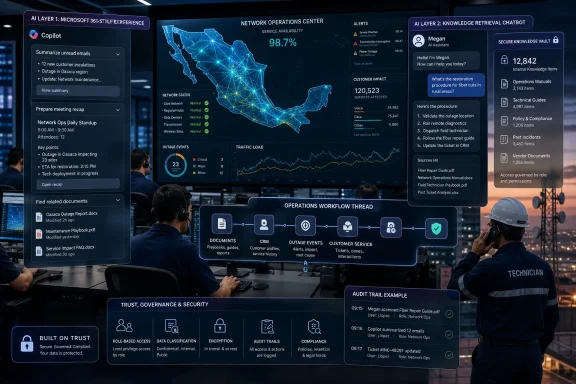
That is why this case is more interesting than another productivity testimonial. Microsoft is presenting Megacable as an example of Copilot moving from a personal assistant model into an enterprise operating layer. The company’s internal chatbot Megan, built on Microsoft technologies including Azure AI Foundry, gives employees a controlled way to query thousands of corporate documents. Copilot, meanwhile, sits in the daily workflow of employees already living in Microsoft 365.
The distinction matters. Copilot answers the “help me with my work” problem. Megan answers the “what does this company know?” problem. Together, they point toward the next enterprise AI battleground: not whether generative AI can produce text, but whether it can reliably connect a worker to the right decision at the right moment.
Megacable’s Real Problem Was Not a Lack of AI
Microsoft frames Megacable’s challenge around speed, scale, and information fragmentation. The company needed to respond to millions of operational interactions while information was spread across multiple systems, making decisions slower and customer experience harder to protect.
That description will sound familiar to anyone who has worked inside a mature enterprise. The obstacle is rarely that nobody has documented the answer. The obstacle is that the answer lives in a PDF, an intranet page, an outdated spreadsheet, a Teams thread, a CRM field, a service manual, a pricing sheet, a knowledge-base article, or someone’s memory.
Telecom magnifies that pain. A connectivity problem is rarely a single data point. A customer-facing worker may need to know whether an outage is local or regional, whether equipment is compatible, whether an installation note explains a recurring issue, whether pricing changed, whether the account has a service restriction, and whether a technician can be dispatched. Each lookup is tiny on its own. Together, they turn customer service into a relay race across systems.
Megacable’s Chief AI Officer, Ricardo Carreón, put the company’s AI rationale in customer terms: artificial intelligence allows the company to serve customers better, and that means transforming every part of the company. That is the right framing, because a telecom customer does not care whether the answer came from Copilot, Megan, a CRM query, or a human supervisor. They care whether the representative can solve the problem.
The important shift is that Megacable appears to be treating AI not as a novelty layer, but as a response to accumulated operational drag. This is where many enterprise AI projects either become useful or collapse into theater. If the deployment starts with a real workflow bottleneck, AI has a chance to matter. If it starts with a mandate to “use AI,” it usually produces demos.
The Megan Chatbot Shows Why Generic Copilots Are Not Enough
Megan is the more revealing half of Megacable’s strategy. Microsoft 365 Copilot can work across the Microsoft 365 environment, but it cannot magically understand every private business rule, internal procedure, product exception, and operational nuance unless those sources are accessible, governed, and structured well enough to be retrieved.
That is the purpose of a corporate chatbot grounded in internal documents. Megan accesses a database made up of thousands of Megacable corporate documents and uses information retrieval techniques to answer questions from that controlled body of knowledge. In plain English, it gives employees a way to ask the company questions without forcing them to manually hunt through the company’s filing cabinet.
This is also where the limits of the AI hype cycle become obvious. A chatbot is only as useful as the knowledge environment beneath it. If the documents are stale, contradictory, poorly permissioned, or written for compliance rather than comprehension, AI will not fix the knowledge problem. It may simply make bad knowledge faster to retrieve.
The Megacable case implicitly recognizes this by separating Megan from Copilot. Megan is described as providing secure, specific responses based on internal knowledge. Copilot accompanies daily work across the organization. That architecture avoids pretending one tool can do everything. It also suggests a more mature understanding of enterprise AI: some tasks require broad productivity assistance, while others require carefully bounded retrieval from approved internal sources.
For WindowsForum readers managing Microsoft-heavy environments, this is the part worth watching. The future of Copilot in the enterprise is not only the icon in Word or Teams. It is the ecosystem of internal agents, connectors, permissions, semantic indexes, and governance policies that determine whether AI can be trusted with company-specific work.
Sales Adoption Is the Cleanest Win Microsoft Can Point To
Microsoft says Megacable has enabled Copilot for more than 11,000 employees, mainly people who work intensively with information. The sharper figure is in sales: roughly 2,000 sellers, with Microsoft reporting 100 percent adoption across that sales force.
That is a useful signal because sales is one of the easiest departments in which to understand Copilot’s value. Sales teams need current product information, pricing, customer context, meeting preparation, follow-up emails, proposal drafts, and quick answers to repetitive questions. If AI can reduce friction in those tasks, the payoff is visible quickly.
Megacable’s sales use case also avoids one of the more inflated claims around generative AI: the idea that every worker will suddenly become dramatically more productive in every task. In reality, Copilot tends to show its value where information is already digitized, workflows already run through Microsoft 365, and employees repeatedly turn the same raw material into customer-facing communication.
That does not make the win trivial. A 2,000-person sales organization using AI to retrieve product and price information more consistently could materially improve customer interactions. In telecom, where bundles, promotions, regional availability, equipment requirements, and service tiers can create confusion, faster access to the right commercial information is not just an internal convenience. It can reduce misquotes, shorten calls, and improve the odds that customers receive accurate answers.
Still, “adoption” is not the same thing as “impact.” Microsoft’s customer story reports broad enablement and adoption, but it does not provide a detailed independent productivity audit, error-rate analysis, customer-satisfaction delta, or quantified time savings for Megacable. That does not invalidate the deployment. It simply means readers should distinguish between operational scale and measured business outcome.
The Agent Ambition Raises the Stakes
The most forward-looking part of the Megacable story is the move from chatbots to what Carreón describes as a federation of intelligent agents. In this model, agents are specialized by function, connected to enterprise systems, and governed by clear rules. They do not merely answer questions; they can consult systems, analyze information in real time, and potentially execute actions.
That is where enterprise AI becomes both more powerful and more dangerous. A chatbot that gives a wrong answer can waste time or mislead an employee. An agent that takes a wrong action can change a record, trigger a workflow, misroute a customer, escalate a ticket unnecessarily, or expose data to the wrong audience. The governance burden increases as AI moves from conversation to execution.
For telecom operations, however, the temptation is obvious. Consider a connectivity complaint. A properly designed agent could gather customer account data, check network status, inspect equipment records, review recent outage events, compare service history, and present the human agent with a narrowed diagnosis. In more advanced scenarios, it might open or update a ticket, recommend dispatch, or notify a customer of an area incident.
That is not science fiction. It is the workflow integration enterprise software vendors have been trying to sell for decades, now repackaged with natural-language interfaces and probabilistic reasoning. The difference is that large language models make the interface feel dramatically more flexible, while the underlying enterprise systems remain as rigid, inconsistent, and politically complicated as ever.
Megacable reportedly plans to implement dozens of specialized agents across areas such as customer service and network operations. If that succeeds, it could become a case study in how AI changes frontline enterprise work. If it stumbles, it will likely stumble on familiar terrain: permissions, data quality, exception handling, system integration, and accountability.
Governance Is the Part Microsoft Wants Enterprises to Hear
Microsoft has learned that enterprise buyers do not merely want AI enthusiasm. They want reassurance. Every Copilot case study now carries an implicit message to CIOs and CISOs: this can be done inside the Microsoft cloud, with identity, compliance, permissions, and administrative controls that resemble the systems you already manage.
That is why the Megacable story leans on Microsoft infrastructure. Megan is built on Microsoft technologies, and the broader strategy is described as integrating data, tools, and AI models under a single environment. The promise is not only productivity; it is controlled productivity.
This is a strategically important point for Microsoft. The company’s advantage in enterprise AI is not that it alone has access to generative models. It is that Windows, Microsoft 365, Entra ID, Teams, SharePoint, Purview, Defender, Azure, Power Platform, Copilot Studio, and developer tooling already occupy so much of the enterprise estate. Microsoft wants AI adoption to feel like an extension of the Microsoft stack rather than a risky detour around it.
For administrators, that is both comforting and constraining. Comforting, because AI that respects existing access controls is preferable to workers pasting corporate data into unsanctioned tools. Constraining, because the more an organization builds its AI workflows around Microsoft’s stack, the more difficult it becomes to separate productivity strategy from vendor dependency.
There is a practical tradeoff here. Enterprises want speed, and Microsoft offers a path of least resistance for companies already standardized on Microsoft 365 and Azure. But the same path can narrow architectural choices over time. Once internal agents, knowledge retrieval, workflow automation, and employee productivity are all intertwined with the same platform, switching costs move from licensing spreadsheets into the daily nervous system of the company.
The Windows Angle Is the Management Layer, Not the Desktop Wallpaper
For Windows enthusiasts, it is tempting to see every Copilot story through the consumer-facing drama of the Windows taskbar, Copilot key, Recall, or the broader debate over whether Microsoft is pushing AI too aggressively into the operating system. But Megacable’s deployment is a reminder that the more consequential AI shift may happen above the desktop.
The enterprise Windows estate is no longer just a fleet of endpoints. It is a managed access layer into SaaS applications, identity systems, security controls, cloud-hosted documents, Teams meetings, device compliance policies, and business workflows. Copilot lives in that context. Its usefulness depends less on whether a user likes an AI button and more on whether the organization’s data estate is fit for retrieval and automation.
That is where IT pros come in. Rolling out Copilot is not like deploying a new version of a PDF reader. It requires decisions about licensing, user targeting, training, sensitivity labels, data-loss prevention, SharePoint hygiene, Teams sprawl, auditability, and acceptable use. If custom agents are added, administrators also have to think about connectors, action permissions, service accounts, workflow boundaries, and incident response.
Megacable’s scale makes these concerns concrete. Enabling 11,000 employees is not a lab trial. It requires organizational change, not just tenant configuration. A company that gives AI access to thousands of internal documents must know who owns those documents, who should see them, how they are updated, and what happens when an answer is wrong.
This is the unglamorous side of enterprise AI, and it is precisely where WindowsForum’s IT pro audience should pay attention. The real work is not prompting. The real work is preparing the environment so prompts do not become a high-speed route to confusion.
Productivity Claims Need a Longer Measuring Stick
Microsoft’s customer stories are marketing assets, not peer-reviewed operational studies. That does not make them useless. It means they should be read with the right filter.
The Megacable story provides concrete deployment numbers: more than 11,000 employees enabled with Copilot and approximately 2,000 sellers using it across the sales organization. It describes qualitative benefits around faster access to information, better customer support, improved productivity, and preparation for intelligent agents. Those are meaningful indicators of momentum.
What it does not provide is the harder evidence that would let outsiders judge return on investment with precision. We do not see before-and-after averages for call handling time, truck-roll reduction, first-contact resolution, sales conversion, ticket escalation, knowledge-base accuracy, or employee time saved by role. We also do not see the cost side: licensing, implementation, training, data preparation, governance staffing, and agent maintenance.
That gap is not unique to Megacable. It is a broader feature of the current enterprise AI market. Vendors and customers are eager to show adoption and anecdotes because the financial model is still settling. Many organizations believe AI will pay off, but the measurement frameworks are still catching up with the spending.
A mature assessment will require looking beyond whether employees use Copilot. It will ask which tasks changed, which metrics improved, which errors decreased, which employees benefited most, and which workflows remained stubbornly unchanged. AI adoption is easy to inflate if every meeting summary counts as a success. It becomes more rigorous when tied to business outcomes customers can feel.
The Human Workflow Still Decides Whether AI Helps
The most persuasive part of Megacable’s framing is that it keeps returning to the customer. Carreón’s argument is not that AI is impressive because it is AI. It is that AI can help employees serve customers better by giving them the context they need when they need it.
That is the correct test. In a telecom company, a customer-service representative with faster access to the right answer is more valuable than a generic chatbot that produces polished but vague responses. A field technician who can quickly verify installation guidance is more valuable than a dashboard full of AI-generated summaries nobody trusts. A network operations team that can correlate incidents faster is more valuable than a novelty assistant that drafts status updates.
The danger is that enterprise AI can also create a new kind of work: checking the AI, correcting the AI, arguing with the AI, documenting why the AI was wrong, and redesigning processes around the AI’s limitations. Anyone who has deployed automation at scale knows that time saved in one part of the workflow can reappear as oversight burden somewhere else.
That is why Megacable’s dual approach is sensible. Copilot handles everyday productivity tasks where a user can judge the output quickly. Megan handles internal knowledge retrieval where grounding matters. Future agents may handle more complex operational workflows, but only if they are specialized and governed.
The lesson is not that every company needs a chatbot with a friendly name. The lesson is that AI needs a job description. Without one, it becomes another search box employees try for a week and abandon.
The Copilot Rollout Is Also a Data Readiness Audit
Every serious Copilot deployment eventually becomes a mirror. It shows the organization what its data estate really looks like, not what executives hoped it looked like.
If documents are duplicated, Copilot may surface conflicting answers. If permissions are too broad, AI may make oversharing easier. If Teams channels have become shadow archives, important information may be buried in conversational sludge. If SharePoint sites were allowed to grow without lifecycle management, the AI layer inherits the mess.
Megacable’s Megan chatbot suggests the company understood that internal knowledge needed a controlled retrieval path. That is a sign of discipline. The question for any similar organization is whether it has invested enough in content curation and governance before putting AI in front of employees.
This is where many AI programs will separate themselves. The winners will not simply be the companies with the most Copilot licenses. They will be the companies that treat information architecture as operational infrastructure. They will know which documents are authoritative, which systems are sources of record, which roles can access which answers, and which actions require human approval.
The uncomfortable truth is that AI does not eliminate information governance. It makes information governance more urgent. A bad intranet frustrates employees slowly. A bad AI retrieval system can distribute the wrong answer instantly and with undeserved confidence.
Microsoft’s Enterprise AI Flywheel Is Working as Designed
The Megacable case also reveals Microsoft’s broader commercial strategy. Microsoft is not selling a single AI product. It is building a flywheel.
Microsoft 365 Copilot gives employees a daily AI interface inside the apps they already use. Azure AI Foundry and related services give developers and IT teams a place to build custom AI applications and agents. Copilot Studio offers a path toward low-code agent creation. Microsoft Graph, Entra, Purview, Teams, SharePoint, and Power Platform provide the identity, data, compliance, collaboration, and workflow substrate.
Once a customer uses all of that together, Microsoft becomes less of a software vendor and more of an AI operations platform. That is exactly where the company wants to be. It is also why Copilot’s success cannot be judged only by whether a user likes its answer in Word. The strategic value is in making Microsoft the default layer through which enterprise work is queried, summarized, automated, and audited.
For Megacable, the benefit is speed. A company already operating in Microsoft’s ecosystem can move faster by building on familiar infrastructure rather than assembling a bespoke AI stack from scratch. For Microsoft, the benefit is gravity. Each additional agent, workflow, and internal knowledge integration makes the customer’s AI strategy more deeply tied to Microsoft’s cloud.
This is not inherently bad. Standardization can reduce risk and complexity. But enterprises should be clear-eyed about the bargain. The more AI becomes woven into operational decision-making, the more platform choices become long-term strategic commitments.
Where This Leaves IT Departments Holding the Real Checklist
Megacable’s deployment will be read by many executives as proof that AI is ready to scale. IT departments should read it as proof that AI scaling requires discipline.
The visible deployment is the easy headline: 11,000 employees enabled, 2,000 sellers onboarded, internal chatbot created, agents planned. The invisible deployment is the governance machinery behind it. That includes access control, data curation, user education, security review, workflow mapping, and ongoing measurement.
The organizational question is not “Should we use Copilot?” Most Microsoft-centric companies will at least test it. The better question is which business processes are mature enough for AI assistance and which ones need cleanup first. A department drowning in unmanaged documents may get less value from Copilot than a smaller team with clean content, clear ownership, and repeatable workflows.
There is also a change-management issue that vendors tend to understate. Employees do not become effective AI users merely because a license appears in their account. They need examples tied to their role, boundaries for acceptable use, guidance on verification, and permission to redesign low-value routines. Otherwise, Copilot becomes another enterprise tool that power users exploit and everyone else politely ignores.
Megacable’s reported full sales adoption suggests the company did something more deliberate than a passive rollout. That is the model other organizations should study. AI works best when it is attached to a real job function, not when it is sprayed across the org chart and left to find its own purpose.
Megacable’s AI Bet Comes Down to Execution, Not Enthusiasm
The most concrete lesson from Megacable’s Microsoft 365 Copilot rollout is that enterprise AI is becoming less about isolated productivity tricks and more about coordinated access to company knowledge, customer context, and operational systems.
- Megacable has enabled Microsoft 365 Copilot for more than 11,000 employees, primarily information-intensive roles across the organization.
- The company reports full Copilot adoption among roughly 2,000 sales employees, where faster access to product and pricing information can directly affect customer interactions.
- Megan, the company’s internal chatbot, is designed to retrieve answers from thousands of corporate documents in a more controlled way than generic search.
- The company is moving toward specialized AI agents that can connect to enterprise systems, analyze real-time information, and support operational decisions.
- The deployment’s long-term value will depend on governance, data quality, workflow integration, and measurable improvements in customer-facing outcomes.
- For Microsoft-centric IT departments, the case shows that Copilot adoption is as much an information architecture project as it is a licensing decision.
Megacable’s rollout is not the final proof that Microsoft 365 Copilot has transformed enterprise productivity, but it is a useful marker of where the market is going. The next phase of AI in business will not be won by the flashiest chatbot or the most confident demo. It will be won by companies that can connect AI to real work without losing control of their data, their processes, or their accountability. For Microsoft, Megacable is a customer story; for everyone else running Windows, Microsoft 365, and Azure at scale, it is a preview of the management problem arriving next.
References
- Megacable boosts productivity for 11,000 employees with Microsoft 365 Copilot - Microsoft Microsoft · Thu, 04 Jun 2026 19:38:03 GMT