

Kaseya previewed an API-driven version of Kaseya Intelligence at Connect Europe in Prague on June 16–18, 2026, opening its agentic IT platform to outside work surfaces including Anthropic’s Claude and Microsoft Copilot Cowork. The pitch is simple: technicians should not have to leave the place where they are already working to query status, approve remediation, update tickets, or generate reports. The harder claim is that Kaseya can turn that convenience into a trustworthy automation layer across managed services, security, backup, compliance, and endpoint operations. That is where the announcement becomes less about AI branding and more about who gets to control the operational cockpit for modern IT.
The most important part of Kaseya’s Prague announcement is not that Claude and Copilot Cowork are name-checked. It is that Kaseya is trying to make its own platform less visibly central while becoming more operationally unavoidable.
For years, vendors have told technicians to consolidate into a single pane of glass. The phrase has become so tired because the reality rarely matches it. MSPs and internal IT teams still live across ticketing queues, remote monitoring consoles, security dashboards, backup portals, Teams chats, customer emails, documentation systems, and spreadsheets that should have been retired three audits ago.
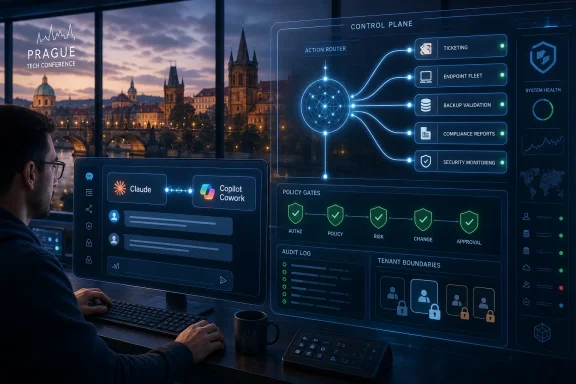
Kaseya’s new angle is that the single pane may not be a pane at all. If a technician can ask Claude about a client’s endpoint fleet, approve a remediation from Copilot Cowork, and have Kaseya Intelligence update Autotask or another downstream system in the background, the interface becomes portable. The system of record remains Kaseya’s integrated stack, but the technician’s daily workspace can be whatever tool they already trust.
That is a subtle but meaningful shift. Instead of asking the user to adapt to the software, Kaseya is betting that the software should project itself into the user’s workflow. CTO Pratik Wadher framed the move in exactly those terms, arguing that technicians have spent years bending around software and that Kaseya now wants the platform to meet them inside the tools they already use.
The obvious comparison is Microsoft’s broader Copilot strategy: put AI beside the work rather than in a separate app. But Kaseya’s version has a sharper operational edge. A Word document can be rewritten with human review and little infrastructure risk. A remediation action on an endpoint fleet is a different species of problem.
For MSPs, control-plane software is where margin lives. Whoever owns the workflow that triages tickets, spots risk, remediates common faults, validates backups, and produces customer-facing evidence can shape both technician behavior and customer perception. The dashboard is less important than the decision loop.
Kaseya’s historical strength has been bundling. The company has spent years building and acquiring a broad IT management estate, including RMM, PSA, backup, documentation, compliance, security, and identity-related tools. Kaseya Intelligence is now being positioned as the connective tissue across that estate, not merely as another assistant bolted onto one product.
That is why the API story matters. If Kaseya Intelligence can expose real-time operational context to Claude or Copilot Cowork, then those third-party assistants become front doors into Kaseya’s data and workflows. But if the underlying execution, approval, ticket updates, and reporting all resolve through Kaseya, the company remains the operational authority.
This is the balancing act every enterprise AI platform is now trying to perform. Vendors want to say they are open enough to fit into the customer’s environment, but closed enough to remain indispensable. Kaseya’s announcement sits directly in that tension.
That loop is where the real productivity gains may exist. A technician who spends fewer minutes correlating alerts, checking endpoint status, writing ticket notes, and assembling reports has more time for the work customers actually notice. In MSP economics, shaving repetitive minutes from thousands of tickets is not cosmetic. It can change staffing models.
But ticket queues are also where AI hallucination becomes operational debt. A bad summary is annoying. A bad remediation recommendation can break a line-of-business application, close the wrong ticket, or create a misleading compliance record. The more an agent writes back into systems of record, the more important auditability becomes.
Kaseya’s insistence on technician approval is therefore not a small detail. It is the difference between an assistant and an autonomous operator. For now, the Prague preview is framed around AI that can move from insight to action while keeping a human in the loop. That is the prudent version of agentic IT, especially for MSPs that may be acting across many customer environments with different risk appetites.
The harder question is how long that human gate remains central. Automation platforms tend to begin with approvals, then add policies, then offer exceptions, then quietly normalize routine autonomous action. That may be exactly what customers want for password resets, ticket categorization, failed service restarts, patch compliance fixes, and report generation. It is much less comfortable when the system is touching security containment, backup recovery, privilege changes, or endpoint remediation at scale.
Microsoft has been pushing Copilot from a chat assistant toward an agentic work layer inside Microsoft 365. Copilot Cowork, built in collaboration with Anthropic, is part of that direction: long-running, multi-step tasks, embedded in the familiar world of Microsoft work. For many organizations, especially in the Windows and Microsoft 365 ecosystem, that is where users already spend much of their day.
Kaseya’s decision to support Copilot Cowork is therefore practical. IT teams already live in Teams, Outlook, SharePoint, Excel, and the Microsoft admin universe. If an MSP technician can check client status or kick off an approved workflow from a Microsoft-adjacent agent experience, Kaseya reduces context switching without asking the business to adopt yet another AI shell.
Claude matters for a slightly different reason. Anthropic has gained strong credibility among enterprise users for reasoning-heavy workflows, coding assistance, and controlled agent behavior. By making Kaseya Intelligence available through Claude, Kaseya signals that it does not expect every customer to standardize on Microsoft’s agent interface.
That said, the integration story will need detail. “Works with Claude and Copilot” can mean anything from a lightweight connector to a deeply permissioned operational integration. For IT pros, the difference is enormous. The useful version needs identity mapping, scoped permissions, tenant isolation, approval trails, rollback logic, and clear boundaries between a conversational request and an executed administrative action.
The MSP business model rewards repeatability. Every ticket that can be categorized correctly, routed quickly, and enriched with useful context reduces friction. Every compliance issue that can be detected and remediated without manual endpoint hunting preserves technician time. Every executive report that writes itself removes work that customers want but engineers rarely enjoy.
That is why Kaseya’s Digital Specialists concept is commercially plausible. A digital specialist for ticket triage, backup validation, or endpoint compliance is not trying to replace a senior engineer designing a network migration. It is trying to absorb the dull, frequent, error-prone work that clogs the queue before the senior engineer ever gets involved.
The risk is that MSPs may be tempted to over-automate before they have cleaned up their own processes. AI agents are only as useful as the systems they can safely read and write. If ticket categories are inconsistent, endpoint naming is chaotic, permissions are overbroad, and documentation is stale, an agentic layer may amplify mess rather than solve it.
This is where the better MSPs will separate themselves. The winners will not simply switch on AI features. They will standardize workflows, narrow permissions, define approval policies, test automations on low-risk tasks, and measure whether the promised time savings survive contact with real client environments.
That does not mean Kaseya’s new AI platform is inherently unsafe. It does mean the scrutiny should be unusually serious. An AI-connected operational control plane that can trigger remediation, update tickets, query environment state, and potentially interact with security or backup systems needs a security model that is visible, enforceable, and boringly reliable.
The nightmare scenario is not a chatbot giving a bad answer. It is an agent with excessive privileges executing a plausible but harmful workflow across many endpoints or many customers. MSPs already understand blast radius because they live with multi-tenant risk every day. Any agentic IT product must prove that it can constrain action by tenant, role, policy, device group, workflow type, and approval threshold.
This is also why audit logs cannot be an afterthought. When an AI agent suggests an action, a technician approves it, a script runs, a ticket updates, and a report goes to a customer, each step needs to be attributable. The organization must be able to answer who requested the action, what data the agent used, what it recommended, who approved it, what actually ran, what changed, and whether the outcome was validated.
Kaseya’s broader positioning around Unified Cyber Resilience and Kaseya SIEM points toward this need for visibility. The company is trying to connect security telemetry, backup resilience, endpoint management, and operational reporting into one decision fabric. That is compelling, but it also raises the stakes. The more unified the fabric, the more damaging a tear can be.
The company also pointed to ISO 27001 and NIS2 pressure on MSPs and internal IT teams. NIS2 in particular has broadened the compliance conversation across European organizations and supply chains, increasing attention on cyber risk management, reporting, and accountability. For MSPs, that means customers will ask harder questions about the tools used to manage them.
Compliance Manager GRC support for UK Cyber Essentials v3.3 and the planned Compliance Monitor Automatic Remediation through Datto RMM fit neatly into this narrative. Kaseya is saying that its AI and automation layer can help identify compliance gaps and close some of them automatically. That is useful if the remediation is well-scoped and the evidence is credible.
But compliance automation has a recurring trap: fixing the checkbox does not always fix the risk. An endpoint may be brought into a desired configuration state, but the business still needs to understand exceptions, compensating controls, and whether the change affects users or applications. Automated remediation should reduce toil, not replace governance.
European customers are likely to be especially sensitive to where data flows when Claude or Copilot becomes an interface into Kaseya-managed environments. If a technician asks a third-party assistant to summarize security posture, what data leaves the Kaseya environment? What is retained? Which tenant controls apply? Which model processes the request? Which contractual terms govern the interaction? These are not philosophical AI ethics questions. They are procurement questions.
The preview arrives after Kaseya’s April 2026 push around an agentic IT management platform powered by Kaseya Intelligence. That earlier wave emphasized Agentic Digital Specialists, Unified Cyber Resilience, and Kaseya SIEM. Prague extends the story outward: not just what Kaseya Intelligence can do inside the Kaseya environment, but where technicians can invoke it.
That staged rollout is sensible. Agentic automation should not be shipped like a cosmetic UI refresh. The company needs time to test integrations, refine permissions, validate workflows, and learn where customers are comfortable letting AI act. MSP environments are diverse, and the edge cases are not theoretical.
The challenge is expectation management. Vendors are currently under pressure to describe AI roadmaps in sweeping terms, while customers need narrow, reliable functions that solve real work. Kaseya’s strongest near-term wins will probably come from constrained workflows: ticket triage, report generation, compliance drift detection, backup validation evidence, alert summarization, and guided remediation for known endpoint issues.
If the platform tries to do everything too soon, it risks becoming another layer of AI theater. If it does a few boring things extremely well, it could become the kind of operational plumbing technicians stop noticing because it simply works.
That geographic emphasis matters because MSP ecosystems are local as well as global. Distribution relationships, language support, regulatory expectations, data residency concerns, and partner enablement all shape whether a platform succeeds in Europe. Kaseya’s appointment of Amaury Dutilleul-Francoeur as Vice President of Distribution and Alliance, based in the UK, fits that channel-focused strategy.
For a company that says it serves more than 40,000 organizations worldwide, Europe is not just another sales territory. It is a test of whether the unified platform story can adapt to fragmented regulatory and market realities. France, Germany, Italy, the UK, and the DACH region do not behave like one generic “EMEA” block.
There is also a competitive layer. European MSPs have choices, and many are wary of vendor lock-in even when they appreciate integrated suites. By making Kaseya Intelligence callable through familiar AI tools, Kaseya can soften the perception that customers must live entirely inside its own interface. The platform can feel more open even as the underlying service stack becomes more integrated.
That is clever positioning, but it will be judged by execution. Partners will want to know whether distribution expansion brings better support, clearer pricing, faster localization, stronger compliance documentation, and practical enablement. AI announcements draw attention; partner operations determine renewal decisions.
For Windows-heavy environments, the implications are immediate. Endpoint compliance, patch status, backup health, identity signals, security alerts, and ticket workflows are already deeply interconnected. A platform that can reason across those domains and act through approved workflows could genuinely reduce operational drag.
But IT pros know that context is everything. Restarting a service may be harmless on one machine and disastrous on another. A missing patch may be routine on a test device and urgent on an internet-facing system. A backup warning may be noise until it is the only signal before a recovery failure.
This is where Kaseya’s “real-time insights to automated remediation” pitch must mature into policy-driven execution. The agent should know not only what action is technically possible, but whether it is allowed for that customer, that asset, that time window, and that severity level. The technician should not have to become the safety mechanism for every workflow forever, but the system should make human review meaningful when it is required.
Approval fatigue is a real risk. If technicians are asked to rubber-stamp dozens of AI-suggested actions, the human-in-the-loop model becomes theater. The better design is tiered autonomy: low-risk actions execute under policy, medium-risk actions require review, high-risk actions require explicit authorization and change documentation.
The proof will come in the unglamorous details that technicians notice immediately.
 Kaseya Wants the Chat Window to Become the Service Desk
The most important part of Kaseya’s Prague announcement is not that Claude and Copilot Cowork are name-checked. It is that Kaseya is trying to make its own platform less visibly central while becoming more operationally unavoidable.For years, vendors have told technicians to consolidate into a single pane of glass. The phrase has become so tired because the reality rarely matches it. MSPs and internal IT teams still live across ticketing queues, remote monitoring consoles, security dashboards, backup portals, Teams chats, customer emails, documentation systems, and spreadsheets that should have been retired three audits ago.
Kaseya’s new angle is that the single pane may not be a pane at all. If a technician can ask Claude about a client’s endpoint fleet, approve a remediation from Copilot Cowork, and have Kaseya Intelligence update Autotask or another downstream system in the background, the interface becomes portable. The system of record remains Kaseya’s integrated stack, but the technician’s daily workspace can be whatever tool they already trust.
That is a subtle but meaningful shift. Instead of asking the user to adapt to the software, Kaseya is betting that the software should project itself into the user’s workflow. CTO Pratik Wadher framed the move in exactly those terms, arguing that technicians have spent years bending around software and that Kaseya now wants the platform to meet them inside the tools they already use.
The obvious comparison is Microsoft’s broader Copilot strategy: put AI beside the work rather than in a separate app. But Kaseya’s version has a sharper operational edge. A Word document can be rewritten with human review and little infrastructure risk. A remediation action on an endpoint fleet is a different species of problem.
The Open Platform Claim Is Really a Control-Plane Claim
Kaseya describes the new Kaseya Intelligence as an open platform that works through APIs. In plain English, that means the company wants its AI and automation engine to be callable from outside its own interface. The value proposition is speed, but the strategic proposition is control.For MSPs, control-plane software is where margin lives. Whoever owns the workflow that triages tickets, spots risk, remediates common faults, validates backups, and produces customer-facing evidence can shape both technician behavior and customer perception. The dashboard is less important than the decision loop.
Kaseya’s historical strength has been bundling. The company has spent years building and acquiring a broad IT management estate, including RMM, PSA, backup, documentation, compliance, security, and identity-related tools. Kaseya Intelligence is now being positioned as the connective tissue across that estate, not merely as another assistant bolted onto one product.
That is why the API story matters. If Kaseya Intelligence can expose real-time operational context to Claude or Copilot Cowork, then those third-party assistants become front doors into Kaseya’s data and workflows. But if the underlying execution, approval, ticket updates, and reporting all resolve through Kaseya, the company remains the operational authority.
This is the balancing act every enterprise AI platform is now trying to perform. Vendors want to say they are open enough to fit into the customer’s environment, but closed enough to remain indispensable. Kaseya’s announcement sits directly in that tension.
Agentic IT Sounds Grand Until It Touches a Ticket Queue
The word agentic is doing a lot of work in enterprise software this year. In Kaseya’s case, it refers to AI agents and Digital Specialists that can identify issues, recommend remediation, and, with technician approval, carry out tasks, update tickets, and generate reports. The vendor is not merely promising better search or prettier summaries; it is promising an automation loop.That loop is where the real productivity gains may exist. A technician who spends fewer minutes correlating alerts, checking endpoint status, writing ticket notes, and assembling reports has more time for the work customers actually notice. In MSP economics, shaving repetitive minutes from thousands of tickets is not cosmetic. It can change staffing models.
But ticket queues are also where AI hallucination becomes operational debt. A bad summary is annoying. A bad remediation recommendation can break a line-of-business application, close the wrong ticket, or create a misleading compliance record. The more an agent writes back into systems of record, the more important auditability becomes.
Kaseya’s insistence on technician approval is therefore not a small detail. It is the difference between an assistant and an autonomous operator. For now, the Prague preview is framed around AI that can move from insight to action while keeping a human in the loop. That is the prudent version of agentic IT, especially for MSPs that may be acting across many customer environments with different risk appetites.
The harder question is how long that human gate remains central. Automation platforms tend to begin with approvals, then add policies, then offer exceptions, then quietly normalize routine autonomous action. That may be exactly what customers want for password resets, ticket categorization, failed service restarts, patch compliance fixes, and report generation. It is much less comfortable when the system is touching security containment, backup recovery, privilege changes, or endpoint remediation at scale.
Microsoft and Anthropic Give Kaseya a New Route Into the Technician’s Day
The Claude and Copilot Cowork integrations are more than brand garnish. They acknowledge that the next interface war in IT operations may be fought inside general-purpose AI workspaces rather than specialist admin consoles.Microsoft has been pushing Copilot from a chat assistant toward an agentic work layer inside Microsoft 365. Copilot Cowork, built in collaboration with Anthropic, is part of that direction: long-running, multi-step tasks, embedded in the familiar world of Microsoft work. For many organizations, especially in the Windows and Microsoft 365 ecosystem, that is where users already spend much of their day.
Kaseya’s decision to support Copilot Cowork is therefore practical. IT teams already live in Teams, Outlook, SharePoint, Excel, and the Microsoft admin universe. If an MSP technician can check client status or kick off an approved workflow from a Microsoft-adjacent agent experience, Kaseya reduces context switching without asking the business to adopt yet another AI shell.
Claude matters for a slightly different reason. Anthropic has gained strong credibility among enterprise users for reasoning-heavy workflows, coding assistance, and controlled agent behavior. By making Kaseya Intelligence available through Claude, Kaseya signals that it does not expect every customer to standardize on Microsoft’s agent interface.
That said, the integration story will need detail. “Works with Claude and Copilot” can mean anything from a lightweight connector to a deeply permissioned operational integration. For IT pros, the difference is enormous. The useful version needs identity mapping, scoped permissions, tenant isolation, approval trails, rollback logic, and clear boundaries between a conversational request and an executed administrative action.
The MSP Market Is Being Sold Capacity, Not Magic
Kaseya’s customer quote from Advisor ICT Solutions lands on the word that matters most: scale. MSPs do not buy automation because it sounds futuristic. They buy it because hiring enough skilled technicians is hard, margins are watched closely, and customers expect fast answers even when their monthly contract does not justify bespoke attention.The MSP business model rewards repeatability. Every ticket that can be categorized correctly, routed quickly, and enriched with useful context reduces friction. Every compliance issue that can be detected and remediated without manual endpoint hunting preserves technician time. Every executive report that writes itself removes work that customers want but engineers rarely enjoy.
That is why Kaseya’s Digital Specialists concept is commercially plausible. A digital specialist for ticket triage, backup validation, or endpoint compliance is not trying to replace a senior engineer designing a network migration. It is trying to absorb the dull, frequent, error-prone work that clogs the queue before the senior engineer ever gets involved.
The risk is that MSPs may be tempted to over-automate before they have cleaned up their own processes. AI agents are only as useful as the systems they can safely read and write. If ticket categories are inconsistent, endpoint naming is chaotic, permissions are overbroad, and documentation is stale, an agentic layer may amplify mess rather than solve it.
This is where the better MSPs will separate themselves. The winners will not simply switch on AI features. They will standardize workflows, narrow permissions, define approval policies, test automations on low-risk tasks, and measure whether the promised time savings survive contact with real client environments.
Security Teams Will Ask About Blast Radius Before They Ask About Productivity
Kaseya’s history gives this announcement an unavoidable security backdrop. The 2021 Kaseya VSA ransomware incident remains part of the industry’s memory because RMM platforms occupy a privileged place in customer environments. Tools that can manage endpoints at scale can also become high-value targets.That does not mean Kaseya’s new AI platform is inherently unsafe. It does mean the scrutiny should be unusually serious. An AI-connected operational control plane that can trigger remediation, update tickets, query environment state, and potentially interact with security or backup systems needs a security model that is visible, enforceable, and boringly reliable.
The nightmare scenario is not a chatbot giving a bad answer. It is an agent with excessive privileges executing a plausible but harmful workflow across many endpoints or many customers. MSPs already understand blast radius because they live with multi-tenant risk every day. Any agentic IT product must prove that it can constrain action by tenant, role, policy, device group, workflow type, and approval threshold.
This is also why audit logs cannot be an afterthought. When an AI agent suggests an action, a technician approves it, a script runs, a ticket updates, and a report goes to a customer, each step needs to be attributable. The organization must be able to answer who requested the action, what data the agent used, what it recommended, who approved it, what actually ran, what changed, and whether the outcome was validated.
Kaseya’s broader positioning around Unified Cyber Resilience and Kaseya SIEM points toward this need for visibility. The company is trying to connect security telemetry, backup resilience, endpoint management, and operational reporting into one decision fabric. That is compelling, but it also raises the stakes. The more unified the fabric, the more damaging a tear can be.
Compliance Is the European Part of the Story, Not an Add-On
Kaseya used Connect Europe to emphasize European cloud security and compliance requirements, including movement toward alignment with ENISA’s European Cybersecurity Certification Scheme for Cloud Services. That is not incidental stagecraft. In Europe, AI-powered IT operations will be judged not only by productivity claims but by governance, data handling, and regulatory posture.The company also pointed to ISO 27001 and NIS2 pressure on MSPs and internal IT teams. NIS2 in particular has broadened the compliance conversation across European organizations and supply chains, increasing attention on cyber risk management, reporting, and accountability. For MSPs, that means customers will ask harder questions about the tools used to manage them.
Compliance Manager GRC support for UK Cyber Essentials v3.3 and the planned Compliance Monitor Automatic Remediation through Datto RMM fit neatly into this narrative. Kaseya is saying that its AI and automation layer can help identify compliance gaps and close some of them automatically. That is useful if the remediation is well-scoped and the evidence is credible.
But compliance automation has a recurring trap: fixing the checkbox does not always fix the risk. An endpoint may be brought into a desired configuration state, but the business still needs to understand exceptions, compensating controls, and whether the change affects users or applications. Automated remediation should reduce toil, not replace governance.
European customers are likely to be especially sensitive to where data flows when Claude or Copilot becomes an interface into Kaseya-managed environments. If a technician asks a third-party assistant to summarize security posture, what data leaves the Kaseya environment? What is retained? Which tenant controls apply? Which model processes the request? Which contractual terms govern the interaction? These are not philosophical AI ethics questions. They are procurement questions.
The Product Roadmap Is Ambitious Enough to Need Patience
Kaseya says early access to the new open-platform functions is expected later in 2026, with general availability planned for 2027. That timeline matters. This is not a finished product landing on every customer’s desk tomorrow morning.The preview arrives after Kaseya’s April 2026 push around an agentic IT management platform powered by Kaseya Intelligence. That earlier wave emphasized Agentic Digital Specialists, Unified Cyber Resilience, and Kaseya SIEM. Prague extends the story outward: not just what Kaseya Intelligence can do inside the Kaseya environment, but where technicians can invoke it.
That staged rollout is sensible. Agentic automation should not be shipped like a cosmetic UI refresh. The company needs time to test integrations, refine permissions, validate workflows, and learn where customers are comfortable letting AI act. MSP environments are diverse, and the edge cases are not theoretical.
The challenge is expectation management. Vendors are currently under pressure to describe AI roadmaps in sweeping terms, while customers need narrow, reliable functions that solve real work. Kaseya’s strongest near-term wins will probably come from constrained workflows: ticket triage, report generation, compliance drift detection, backup validation evidence, alert summarization, and guided remediation for known endpoint issues.
If the platform tries to do everything too soon, it risks becoming another layer of AI theater. If it does a few boring things extremely well, it could become the kind of operational plumbing technicians stop noticing because it simply works.
Kaseya’s European Push Is About Distribution as Much as Data
The Prague announcements were also wrapped in a broader European expansion message. Kaseya said more than 1,500 IT professionals, MSPs, and industry executives attended Connect Europe, and the company highlighted investment in the region, including a focus on Munich for the DACH market.That geographic emphasis matters because MSP ecosystems are local as well as global. Distribution relationships, language support, regulatory expectations, data residency concerns, and partner enablement all shape whether a platform succeeds in Europe. Kaseya’s appointment of Amaury Dutilleul-Francoeur as Vice President of Distribution and Alliance, based in the UK, fits that channel-focused strategy.
For a company that says it serves more than 40,000 organizations worldwide, Europe is not just another sales territory. It is a test of whether the unified platform story can adapt to fragmented regulatory and market realities. France, Germany, Italy, the UK, and the DACH region do not behave like one generic “EMEA” block.
There is also a competitive layer. European MSPs have choices, and many are wary of vendor lock-in even when they appreciate integrated suites. By making Kaseya Intelligence callable through familiar AI tools, Kaseya can soften the perception that customers must live entirely inside its own interface. The platform can feel more open even as the underlying service stack becomes more integrated.
That is clever positioning, but it will be judged by execution. Partners will want to know whether distribution expansion brings better support, clearer pricing, faster localization, stronger compliance documentation, and practical enablement. AI announcements draw attention; partner operations determine renewal decisions.
The Agentic Future Still Needs a Human Change Board
The central paradox of agentic IT is that it promises to remove friction while demanding stronger governance. The more capable the agent, the more carefully organizations must define what it is allowed to do.For Windows-heavy environments, the implications are immediate. Endpoint compliance, patch status, backup health, identity signals, security alerts, and ticket workflows are already deeply interconnected. A platform that can reason across those domains and act through approved workflows could genuinely reduce operational drag.
But IT pros know that context is everything. Restarting a service may be harmless on one machine and disastrous on another. A missing patch may be routine on a test device and urgent on an internet-facing system. A backup warning may be noise until it is the only signal before a recovery failure.
This is where Kaseya’s “real-time insights to automated remediation” pitch must mature into policy-driven execution. The agent should know not only what action is technically possible, but whether it is allowed for that customer, that asset, that time window, and that severity level. The technician should not have to become the safety mechanism for every workflow forever, but the system should make human review meaningful when it is required.
Approval fatigue is a real risk. If technicians are asked to rubber-stamp dozens of AI-suggested actions, the human-in-the-loop model becomes theater. The better design is tiered autonomy: low-risk actions execute under policy, medium-risk actions require review, high-risk actions require explicit authorization and change documentation.
The Prague Preview Narrows the Real Test
Kaseya’s announcement is easiest to understand as a bet on where IT work is heading: less console-hopping, more embedded automation, and more AI-mediated decision-making. The company has the ingredients for a serious attempt, including a broad MSP footprint, a large operational data estate, security and backup products, and a customer base under pressure to do more with less.The proof will come in the unglamorous details that technicians notice immediately.
- Kaseya Intelligence must preserve tenant boundaries and role-based permissions when invoked from Claude, Copilot Cowork, or any other external interface.
- The platform must produce audit trails that explain what an agent saw, recommended, executed, and changed.
- Early workflows should focus on repeatable, low-risk operational tasks before expanding into sensitive remediation.
- Compliance automation must generate usable evidence, not just configuration changes that look good in a dashboard.
- MSPs should treat agentic features as process redesign projects, not as switches to flip during a busy service week.
- Kaseya’s open-platform promise will be judged by the quality of its APIs, governance controls, and integrations rather than by the number of AI logos on a slide.
References
- Primary source: IT Brief UK
Published: 2026-06-17T09:20:19.101159
Kaseya opens Intelligence platform to Claude, Copilot
IT teams will be able to use Claude and Microsoft Copilot for real-time Kaseya workflows, with general release due in 2027. itbrief.co.uk
- Related coverage: kaseya.com
Kaseya Unveils the First Agentic IT Management Platform – Turning Data into Autonomous Action - Kaseya
Powered by Kaseya Intelligence, Kaseya’s platform combines the industry’s deepest real-world IT dataset with an execution layer that acts with accuracywww.kaseya.com
- Related coverage: itpro.com
Kaseya shifts from AI ‘insights’ to autonomous action with new agentic platform | ChannelPro
The company aims to evolve from its suite of management tools into an autonomous operating system for MSPswww.itpro.com - Related coverage: guide-du-msp.com
- Related coverage: geekwire.com
Microsoft's new Copilot Cowork integrates Anthropic's Claude in rollout of new E7 licensing tier – GeekWire
Microsoft is launching Copilot Cowork, a new AI assistant built with Anthropic that can run tasks in the background and work across Microsoft 365 apps, as part of a broader wave of updates including a new $99-per-user E7 licensing tier.www.geekwire.com - Official source: news.microsoft.com
Introducing the Frontier Suite - Source EMEA
 news.microsoft.com
