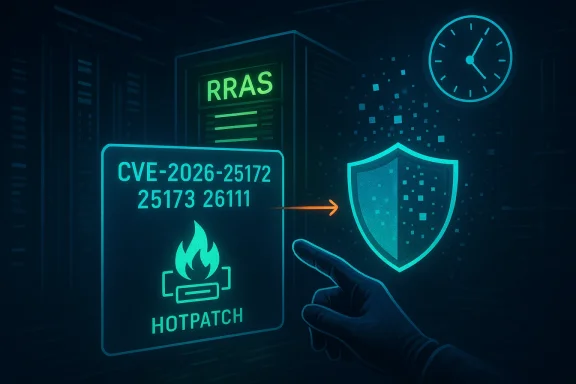
KB5084597: Windows RRAS Hotpatch Fix for RCE Flaws in Enterprise

  • Thread Author
Microsoft’s out‑of‑band hotpatch KB5084597, quietly deployed in mid‑March 2026, closes a cluster of critical remote‑code‑execution flaws in the Windows Routing and Remote Access Service (RRAS) management tool — and it does so using Microsoft’s hotpatch mechanism so eligible enterprise endpoints can receive the fix without an immediate reboot. osoft.com]

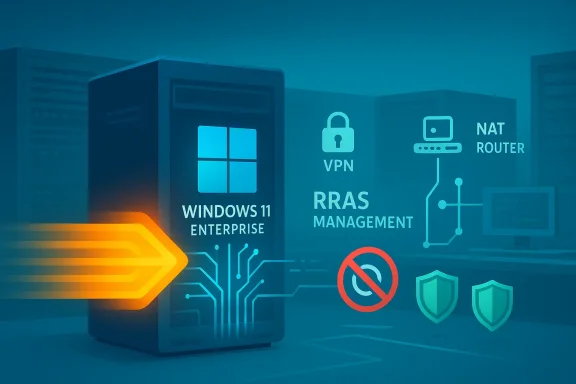
Windows 11 Enterprise server with VPN, RRAS management, NAT routing and security icons.Background / Overview​

Windows’ Routing and Remote Access Service (RRAS) is a long‑standing Windows component that implements VPN termination, NAT, routing and related management capabilities. Historically it has been a high‑value target because it exposes network management surfaces and is frequently present on infrastructure machines and management workstations. The March 2026 remedialtiple RRAS weaknesses that a motivated attacker could chain into remote code execution (RCE) on a target device.
What makes this particular release operationally noteworthy is the delivery mechanism: KB5084597 was pushed as an out‑of‑band hotpatch to devices enrolled in Microsoft’s hotpatch program (managed through Windows Autopatch and Intune). Hotpatching applies changes in memory and writes patched binaries to disk so fixes persist after the next scheduled restart — delivering immediate protection while avoiding the routine downtime associated with cumulative updates. Microsoft has been accelerating hotpatch availability for Windows 11 Enterprise, and the company recently announced hotpatch will be enabled by default for eligible Autopatch devices beginning with the May 2026 security update, making this delivery model a mainstream option for enterprises.
The practical result: eligible Windows 11 Enterprise devices (notably versions 24H2 and 25H2, and Windows 11 Enterprise LTSC 2024 where supported) received KB5084hotpatch on or around March 13, 2026; devices not enrolled in hotpatching were patched through the regular March 10, 2026 Patch Tuesday cumulative updates. This split delivery model is typical for hotpatch‑eligible and non‑eligible devices.

The vulnerabilities: what was fixed​

Microsoft and community trackers list three distinct CVE identifiers associated with this update: CVE‑2026‑25172, CVE‑2026‑25173, and CVE‑2026‑26111. These issues are described in vendor advisories and vulnerability trackers as flaws in RRAS management components that can be abused to disrupt RRAS or to execute code remotely ws are met. One reported exploitation scenario involves an authenticated domain user tricking a domain‑joined administrator into sending a management request from the RRAS snap‑in to a malicious server — an interaction that opens a remote‑code‑execution path if the crafted response triggers the underlying RRAS bug.

Key technical points (verified)​

  • The cluster includes at least one integer‑overflow/wraparound style defect that can lead to RCE when triggered over the network. That class of bug has historically allowed full code execution if an attacker supplies crafted inputs that cause size/calculation logic to corrupt memory. CVE trackers reference an integer overflow for CVE‑2026‑26111.
  • Twot‑plane flaws (CVE‑2026‑25172 and CVE‑2026‑25173) map to the RRAS management UI and network request handling, creating attack vectors when an authenticated user interacts with RRAS management components and the tool reaches out to a hostile endpoint. Public reporting describes the exploit path as involving tricking a domain‑joined user into sending a malicious request which then triggers unsafe RRAS behavior.
Where available, I cross‑checked these descriptions with vendor guidance and independent trackers; Microsoft’s hotpatch and hotpatch‑eligibility documentation confirm that these hotpatch updates are intended to cover urgent security fixes for managed Windows 11 Enterprise endpoints. Note: while community reporting and security trackers list the CVEs and attack scenarios, vendor‑authored deep technical writeups for each CVE remain limited under Microsoft’s protective disclosure posture — treat the public technical detail as intentionally restrained in some advisories.

Hotpatch mechanics: how this update differs operationally​

Hotpatching is a distinct servicing model from normal cumulative updates:
  • Restartless: Hotpatch packages are designed to be applied to running processes in memory so they take effect immediately without forcing an OS restart.
  • Persistent: Hotpatch writes patched files to disk so changes survive the next scheduled reboot and baseline cumulative update.
  • Scoped: Hotpatches typically carry only security fixes and are intended for high‑urgency CVE remediation; full LCUs (latest cumulative updates) still require baseline restarts on scheduled months.
Microsoft uses Autopatch and Intune quality update policies to orchestrate hotpatch rollouts. Devices must meet a set of prerequisites to be eligible (Enterprise SKU, eligible licensing, management through Intune/Autopatch, virtualization‑based security enabled in many scenarios, and for Arm64 devices additional configuration such as disabling compiled hybrid PE). If a device does not meet prerequisites it receitive update (LCU) instead, which requires a restart. These prerequisites and the orchestration model were confirmed in Microsoft’s Intune guidance and Tech Community posts.

Who is affected — and who should act now​

This hotpatch primarily targets enterprise endpoints that use Windows 11 Enterprise versions (24H2 and 25H2) and Windows 11 Enterprise LTSC 2024 where hotpatch enrollment exists. The fix was delivered automatically to devices enrolled in Microsoft’s hotpatch program and managed through Windows Autopatch; unmanaged machines or consumer SKUs received the March 10 cumulative updates instead.
If you manage Windows fleets, treat the following groups as priority:
  • Administrators and management workstations that run the RRAS management snap‑in.
  • Servers and gateways exposing RRAS services (VPN endpoints, routing/NAT appliances that use RRAS).
  • Domain‑joined devices where authenticated users may be able to interact with RRAS management tooling (the attack vector described involves an authenticated domain user persuading a domain‑joined admin to send a request).
  • Environments that have not yet adopted hotpatching but run the affected Windows versions — confirm Patch Tuesday March updates are applied.

Immediate recommended actions for IT teams​

  • Verify installation status
  • Check your hotpatch/enrollment reporting in Intune / Windows Autopatch to confirm KB5084597 was applied to all hotpatch‑eligible endpoints. Use the Hotpatch quality updates report in Intune for per‑device status.
  • Confirm non‑hotpatch devices were updated
  • For devices not enrolled in hotpatch, ensure the March 10, 2026 cumulative update (or the vendor mapping that contains the RRAS fixes) was installed and that the device has been restarted to receive the LCU changes.
  • Harden RRAS management plane
  • Where possible, restrict access to RRAS management tools to dedicated, hardened admin workstations and management VLANs.
  • Use conditional access and MFA for admin access to domain‑joined management systems.
  • Apply firewall rules and allow RRAS management only from known administrative subnets.
  • Contain and monitor
  • Search endpoint telemetry and network logs for suspicious RRAS snap‑in outbound connections or for unexpected responses to RRAS management traffic.
  • Increase monitoring of VPN/routing gateways for anomalous connections, configuration changes, and unexpected process behavior.
  • Test and validate EDR / third‑party integrations
  • Hotpatch packages modify running memory; some EDR/AV stacks have previously flagged hotpatch operations. Confirm vendor compatibility in a pilot cohort and coordinate with security vendors if you see unexpected behavior. Microsoft’s guidance notes that if you encounter problems you can uninstall the hotpatch and install the LCU and reboot as a rollback path.
  • Plan for remediation windows
  • Whether you use hotpatch or LCUs, plan to verify mitigations and ensure quarterly baseline reboots are scheduled so persistent updates are consolidated. Hotpatch reduces immediate restarts but does not eliminate the baseline restart cadence.

Detection and incident response: what to look for​

  • Unusual outbound management traffic from admin consoles to external IPs or domains that should never host RRAS endpoints.
  • Unexpected use of RRAS management RPCs or APIs from authenticated user sessions.
  • Alerts indicating process memory corruption or anomalous code execution in RRAS management binaries.
  • Evidence of lateral movement or follow‑on activity from devices that had RRAS management activity during the vulnerability window.
If you identify a potential compromise, isolate the affected host, preserve forensic artifacts (memory image, network captures, event logs), and follow your incident response plan. Where hotpatching prevented a reboot, be particularly careful to capture memory artifacts quickly because in‑memory state may hold evidence of exploitation.

Hotpatch: benefits and operational risks​

Hotpatching is attractive because it materially reduces the operational friction of urgent security rollouts. For time‑sensitive RCE vulnerabilities that threaten enterprise management surfaces, hotpatches can compress the window of exposure from days (waiting for mass restarts) to minutes (hotpatch applied in memory). Microsoft highlights improved compliance and reduced disruption as primary benefits.
That said, hotpatching introduces specific risks and tradeoffs admins must consider:
  • Compatibility with security stack: Some EDR/AV agents or deep kernel instrumentation can interact unexpectedly with hotpatches. Organizations should validate vendor compatibility in pilot rings before broad rollout. Microsoft documents a rollback path (uninstall hotpatch then install LCU and restart) but operational complexity increases if hotpatching interacts with protective tooling.
  • Visibility and trust: Hotpatch modifies in‑memory code paths. Organizations accustomed to reboot‑based validation may need to extend testing to include immediate post‑hotpatch functional checks.
  • Limited surface for remediation: Hotpatches are intentionally narrow; if a vulnerability requires broad behaep kernel fix, an LCU and reboot may still be necessary.
  • Change management: Hotpatch tooling requires correctly configured Autopatch/Intune policies and licensing. Misconfiguration may leave devices on the LCU path without the intended restartless benefit.

Operational case study: interpreting this patch in your environment​

Consider a mid‑sized enterprise that uses Autopatch with hotpatch enabled for production endpoints. When KB5084597 rolled out:
  • Eligible admin workstations received the hotpatch immediately, removing the immediate need for scheduled downtime. Administrators could keep management consoles online and continue operations.
  • The security team validated that EDR telemetry showed no false positives. A small pilot fleet was used to validate functional integrity before the broader ring received the update.
  • Simultaneously, servers that were not hotpatch‑eligible (older builds or non‑Enterprise SKUs) were updated using the March 10 cumulative update; the operations team scheduled those servers for reboot windows within 48 hours to finalize the patching.
This model highlights the hybrid reality of modern enterprise patching: hotpatch reduces disruption for eligible endpoints but does not eliminate the need for traditional patch management discipline across a diverse fleet.

Broader context: why Microsoft is betting on hotpatch​

Hotpatching is Microsoft’s response to a decades‑old operational tension: security vs. uptime. Enterprises hate unexpected reboots during business hours; attackers exploit delays between patch publication and restart‑driven enforcement. Hotpatch offers a middle path that reduces the “window of vulnerability” while retaining baseline restarts for broader quality updates. Microsoft is pushing hotpatch into mainstream tooling (Windows Autopatch/Intune) and enabling it by default for eligible devices in 2026 — a signal that rebootless security updates are becoming a first‑class option for enterprise Windows.
That shift matters because it changes how incident response and patch operations interplay: shorter enforcement windows for RCE flaws means defenders can reduce attacker dwell time, but it also raises demands on patch validation and EDR vendor coordination.

Caveats and unverifiable claims​

  • At the time of writing, Microsoft’s public KB page specifically titled KB5084597 is referenced in community reporting and uploaded internal summaries; however, an immediately visible, dedicated vendor KB article that dissects the update at the same depth as standard LCUs was not discoverable in the public Microsoft Support corpus by my checks. Community and vendor tracking, together with Microsoft’s hotpatch guidance, support the overall claims about delivery, affected families, and CVEs — but readers should treat granular exploit proof‑of‑concept details as intentionally limited in public advisories. If your organization requires absolute canonical mapping to a specific vendor KB page, verify the KB number in your enterprise update catalog or the Microsoft Update Catalog and with your Microsoft representative.
  • Some secondary reporting (community forums and social posts) assert March 13, 2026 as the date of deployment for KB5084597; vendor communications confirm hotpatch deployment windows in mid‑Marchs, but exact timestamps for individual tenants can vary by Autopatch ring and tenant configuration. Confirm the date your tenant reported the hotpatch via Intune/Autopatch reporting.

Practical checklist for administrators (actionable summary)​

  • Immediately: Use Intune/Autopatch Hotpatch quality updates report to confirm KB5084597 installation status on hotpatch‑eligible endpoints.
  • Within 24 hours: Validate critical admin workstations and RRAS gateways for functional integrity and EDR compatibility.
  • Within 48 hours: Schedule reboots for non‑hotpatch devices that received the March cumulative updates; verify LCUs applied successfully.
  • Ongoing: Harden RRAS management access, restrict management plane to hardened admin workstations, enable strong authentication and monitoring.
  • If issues arise: Use the documented rollback path—uninstall the hotpatch, install LCU and restart—and open a support case with your security vendor and Microsoft if necessary.

Conclusion​

KB5084597 is a pragmatic example of how Microsoft is operationalizing hotpatching to close high‑risk vulnerabilities in real time while minimizing disruption for enterprise customers. The RRAS flaws addressed by this out‑of‑band update are serious — they enable remote code execution under realistic attack scenarios — and the hotpatch delivery allowed organizations to push a fix into running memory, dramatically shortening the window in which attackers could exploit the flaw.
Hotpatching is not a silver bullet: it raises operational questions about compatibility, visibility, and rollback procedures that security and operations teams must address. But for administrators balancing uptime and security, hotpatches like KB5084597 represent a valuable tool when paired with disciplined testing, monitoring, and change control. Confirm your fleet’s update status, validate your management workstations, and apply the recommended hardening steps now — the lane between patch publication and attacker exploitation is narrow, and this hotpatch closes a critical gap without the usual cost of downtime.

Source: Evrim Ağacı Microsoft Issues Urgent Hotpatch For Windows 11 RRAS Flaw
 

Microsoft pushed an out‑of‑band, restartless hotpatch — identified as KB5084597 and released on March 13, 2026 — to close a cluster of serious vulnerabilities in the Windows Routing and Remote Access Service (RRAS) management components used in enterprise VPN, NAT and routing scenarios. The fix was delivered through Microsoft's hotpatch channel to eligible, hotpatch‑enrolled Windows 11 Enterprise endpoints and LTSC devices, allowing many managed fleets to receive protection without an immediate reboot. This emergency delivery highlights both the criticality of the RRAS flaws and the growing operational role of hotpatching for uptime‑sensitive environments. om]

Cybersecurity concept art showing an RRAS shield and a VPN tunnel protecting data.Background / Overview​

RRAS remains an important component in many enterprise networks — providing VPN termination, site‑to‑site tunnels, NAT, legacy dial‑up support and protocol routing such as BGP. Although RRAS is less visible on consumer desktops, its management tool and server role sit close to administrative workflows and network edges, making flaws in RRAS disproportionately risky for organizations that still rely on Windows for remote‑access or branch networking duties.
The March emergency is notable for two operational reasons. First, Microsoft mapped three CVEs (CVE‑2026‑25172, CVE‑2026‑25173 and CVE‑2026‑26111) to RRAS weaknesses that include integer overflow / wraparound conditions capable of remote code execution. Second, Microsoft used its hotpatch (restart‑free) servicing channel for the response — a targeted, in‑memory delivery path intended for devices prepared in advance to receive hotpatch updates. The combination of severity and the chosen delivery mechanism explains why some fleets saw an automatic, no‑reboot remediation appear in mid‑March while other devices needed standard, restart‑requiring updates.

What KB5084597 fixes​

The CVEs and the impact​

The hotpatch addresses three RRAS‑related CVEs that Microsoft and third‑party trackers classify as high‑impact remote‑code‑execution issues:
  • CVE‑2026‑25172 — Integer overflow / wraparound in RRAS that can enable remote code execution with no privileges required in some scenarios.
  • CVE‑2026‑25173 — A related RRAS issue with slightly different required privileges and attack surface, also enabling elevated impact network exploits.
  • CVE‑2026‑26111 — Another RRAS integer overflow / wraparound marked as able to allow remote execution and listed among March Patch Tuesday fixes; vendor advisories describe the defect class and network exposure.
Multiple security trackers give these CVEs high CVSS scores and note they are network‑facing issues where an attacker could coerce a target to connect to a malicious RRAS management endpoint, or could otherwise manipulate RRAS inputs, causing memory arithmetic to wrap and enabling code execution or denial‑of‑service. The enterprise risk is therefore concentrated where RRAS administrative tools and server roles are present (VPN servers, branch routers running on Windows, or administrative workstations that manage RRAS).

Why the integer‑overflow class matters here​

An integer overflow (wraparound) in parsing or buffer size calculations is dangerous because it can silently convert a large input size into a small one used for memory allocation or copy operations — a classic precursor to heap overflows, out‑of‑bounds writes, or other memory corruptions that lead to arbitrary code execution. Because RRAS routinely processes network‑supplied data and often runs with elevated privileges, an exploitable overflow in its management or protocol handling code substantially raises the stakes for attackers who can reach or trick an endpoint into interacting with a malicious server. Several independent vulnerability summaries and the NVD entry reinforce this technical class and the attack vector.

Which systems received the hotpatch (and why not every machine did)​

Microsoft limited the restartless distribution of KB5084597 to devices enrolled and configured for hotpatching. In practice that means:
  • Eligible devices included those running Windows 11 Enterprise, versions 24H2 and 25H2, and Windows 11 Enterprise LTSC 2024, on specific post‑baseline builds. Microsoft’s hotpatch program targets enterprise editions where administrators have opted in and configured device policies through Intune or Autopatch.
  • Hotpatch delivery is policy and prerequisite dependent. For x86/x64 devices the baseline is Windows 11 Enterprise 24H2/25H2 on a supported build. For Arm64 devices additional prerequisites apply: the OS must be at or newer than specific builds (for client hotpatches many Microsoft docs reference Build 26100.4929 or later as a starting baseline), Virtualization‑Based Security (VBS) must be enabled, and Compiled Hybrid PE (CHPE) must be disabled (a one‑time configuration step required for Arm64 hotpatching). Microsoft also requires an eligible license and an Intune quality update policy with hotpatch enabled.
That targetting explains why KB5084597 appeared automatically on some managed endpoints (no reboot required) while other machines — even those in the same estate — showed no hotpatch activity and instead relied on the standard March cumulative updates. Hotpatching is intentionally narrow: it protects high‑value, uptime‑sensitive environments that were prepared in advance to accept in‑memory fixes.

How to confirm whether an endpoint is hotpatch‑eligible and whether the fix is applied​

For IT teams, the immediate operational tasks are verification and prioritization. Here’s a practical checklist to determine hotpatch eligibility and confirm the RRAS fix:
  • Check the hotpatch enrollment and quality update policy
  • Confirm devices are managed with Microsoft Intune (or Microsoft Autopatch) and that a Windows quality update policy with Hotpatch enabled is assigned to the device group. Microsoft’s Intune guidance explains the exact policy settings and enrollment controls.
  • Verify OS build and baseline
  • Ensure devices are on the required baseline build (documentation references Windows 11 Enterprise 24H2/25H2 with Build 26100.4929 or later for Arm64 readiness). Devices below the baseline will not be offered hotpatch updates.
  • Check VBS and CHPE state on Arm64 devices
  • VBS must be enabled and CHPE disabled for Arm64 hotpatching. Microsoft documents the registry and CSP policy to disable CHPE (the registry DWORD HotPatchRestrictions = 1 under the Memory Management key is one documented approach). If CHPE remains enabled, the device will be ineligible.
  • Review Windows Update / Intune update reports
  • On managed endpoints, use Intune/Autopatch reporting and Windows Update event logs to confirm receipt of KB5084597 (or the hotpatch ID in the update history). On devices that accepted the hotpatch, Microsoft notes no restart is required; the update may be reflected in the update history with an installation timestamp rather than a traditional reboot‑applied install.
  • If hotpatch is not available, apply the standard March cumulative updates
  • Devices that do not meet hotpatch prerequisites will still receive the regular security updates via the March security package (Patch Tuesday) that include fixes for the same CVEs; those updates do require restarts per normal servicing rules. Cross‑check the March KB for your specific Windows build and server edition if you are not on the hotpatch path.

Deployment considerations and immediate mitigation guidance​

  • Prioritize RRAS endpoints: Inventory every server and management workstation running RRAS or hosting the RRAS role. These systems should be treated as high‑priority for verification and patching because the flaws are network‑facing and could facilitate RCE. Use EDR, firewall logs and UTM appliances to identify externally reachable RRAS services and ensure those services are patched or isolated first.
  • Hotpatch readiness checklist (short version):
  • Confirm Intune/Autopatch hotpatch policy assignment.
  • Confirm device build meets baseline and the device is licensed appropriately.
  • On Arm64, ensure VBS is enabled and CHPE has been disabled (registry or CSP step, then a one‑time restart to make the CHPE disable persistent).
  • If you cannot apply the hotpatch immediately:
  • Limit exposure by blocking or restricting RRAS management traffic from untrusted networks and ensuring administrative access to RRAS tools is limited to trusted admin networks or jump hosts.
  • Harden remote admin clients and monitor for suspicious outbound connections that might indicate attempts to coerce an admin tool into connecting to a malicious RRAS server.
  • Enable extra logging and EDR rules to flag unusual RRAS service behavior and memory corruption indicators.
  • Test before wide deployment: Though Microsoft reported no known issues with KB5084597 at publication, hotpatches are applied to in‑memory components and third‑party drivers or uncommon service configurations can cause unexpected interactions. Validate in a small pilot ring before broad rollout when practical.

Why Microsoft used hotpatching — operational tradeoffs​

Hotpatching is still a relatively new default for eligible enterprise endpoints. Microsoft’s hotpatch program is explicitly designed to reduce downtime by delivering certain security fixes without restarts for prepared systems. That model is attractive for uptime‑sensitive infrastructure (call centers, hospital workstations, financial trading floors). The RRAS hotpatch demonstrates a practical, time‑sensitive use: when a network‑facing, high‑impact CVE appears, hotpatch allows organizations that invested in the readiness work (Intune policy, licenses, CHPE/VBS configuration on Arm64) to obtain immediate protection without disrupting services.
However, the approach creates operational inequality inside heterogeneous estates. Organizations that completed hotpatch readiness will often achieve faster, lower‑impact remediation. Teams still on standard servicing must perform reboots, schedule downtime, and manage potential compatibility tests. The net effect is a speed differential that rewards advance preparation and a modern device‑management posture. Microsoft’s hotpatch prerequisites (VBS, CHPE disablement, Intune policies) are nontrivial to apply at scale in conservative or legacy environments, so expect staggered coverage and plan accordingly.

Risks, unknowns, and cautionary notes​

  • Exploitation status: At the time of the hotpatch release, public reporting and vendor trackers categorized the RRAS CVEs as high severity but did not universally report active widespread exploitation. Even without confirmed mass exploitation, the mix of network exposure and high impact (RCE) justified the emergency hotpatch. Security teams must nevertheless operate under the assumption that proof‑of‑concept or targeted exploitation could follow public disclosure and should prioritize patching accordingly.
  • Incomplete visibility across fleet: Hotpatch eligibility depends on configuration that may not be uniformly documented in every organization. Expect to find devices that appear patched (hotpatch applied) next to devices that still need the cumulative March updates. Create a concise dashboard that shows hotpatch policy assignment, CHPE/VBS state, and update install status to remove ambiguity.
  • Arm64 caveats: Arm64 hotpatching requires careful one‑time steps to disable CHPE and enable VBS. Disabling CHPE has functional implications when organizations rely on CHPE‑accelerated compatibility for x86 apps on Arm64 devices. This step often requires a planned restart and application compatibility checks; it is not an on‑the‑fly toggle. Administrators should test the CHPE disablement process in pilot fleets before blanket application.
  • Third‑party interactions: As with any in‑memory or kernel‑adjacent update, there’s small but real risk of incompatibility with third‑party drivers, security agents or management tools. Microsoft’s hotpatch notes historically mention that known issues are rare, but IT teams should watch their telemetry and have rollback or remediation plans for any post‑patch anomalies. If a restartless hotpatch fails in‑place, a reboot plus standard servicing can often achieve a clean state.

Recommendations for enterprise administrators (actionable)​

  • Inventory RRAS usage now. Immediately identify all systems running the RRAS role or hosting tools used to manage RRAS. Mark them as highest‑priority for patch confirmation.
  • Confirm hotpatch coverage. Use Intune/Autopatch reporting to determine which device groups have hotpatch enabled and which do not. For groups without hotpatch, schedule the March cumulative update and a controlled reboot window.
  • On Arm64 endpoints: plan CHPE changes. If you manage Arm64 devices and want the benefits of hotpatching, test and document the CHPE disable process (registry/CSP approach) in a pilot and verify application compatibility before mass application. This is a one‑time, reboot‑required change.
  • Apply network mitigations for exposed RRAS endpoints. Block RRAS management traffic from untrusted networks, require jump hosts for management, and enforce strong segmentation for any externally reachable RRAS services.
  • Monitor for Indicators of Compromise (IoCs). Heighten lo VPN termination points. Look for anomalous inbound connections, unexpected RPC or management session patterns, and any memory‑corruption signatures.
  • Communicate across teams. Inform networking, security operations, and desktop engineering teams of the change in servicing model: hotpatch‑enrolled devices may already be remediated without a reported reboot, while others will need a planned reboot. Clear communication reduces confusion and duplicate troubleshooting.

How this episode reframes hotpatching as an operational capability​

The KB5084597 emergency shows hotpatching maturing from a convenience feature into a strategic capability for risk reduction. Organizations that proactively ready their devices for hotpatching gain the ability to close critical, network‑facing flaws with minimal operational impact. That said, readiness itself — Intune policies, licensing, VBS adoption and CHPE handling on Arm64 — requires careful planning and administrative buy‑in.
Strategically, security and ops teams should evaluate hotpatch readiness as part of a broader resilience posture: for truly uptime‑sensitive workloads, the ability to apply in‑memory security fixes without disruption can be decisive. But the model is not a substitute for disciplined patching on non‑hotpatch fleets; it is a force multiplier only when paired with inventory, testing, and robust telemetry.

Conclusion​

KB5084597 is an urgent, narrowly targeted hotpatch that addresses three high‑impact RRAS vulnerabilities capable of enabling remote code execution. Microsoft’s choice to deliver the fix via the hotpatch channel on March 13, 2026 underscores the operational benefit of restartless security delivery — but only for organizations that invested in the prerequisites. For everyone else, the March Patch Tuesday cumulative packages carry the same protections but require the usual restart and scheduling.
Action items for administrators are simple and immediate: inventory RRAS endpoints, confirm hotpatch eligibility and policy coverage, apply the hotpatch or the equivalent March security updates where necessary, and mitigate/segment any externally reachable RRAS management surfaces until remediation is validated. The incident is a clear reminder that operational readiness — modern device management, baseline builds, and documented prerequisites — directly maps to how quickly enterprises can close time‑sensitive attack surfaces without disrupting business services.

Source: WinBuzzer Microsoft Issues Emergency KB5084597 Hotpatch for RRAS Flaws
 

Microsoft has issued an out‑of‑band hotpatch for Windows 11 to close three serious remote‑code‑execution (RCE) flaws in the Routing and Remote Access Service (RRAS) management snap‑in, delivering the fix to eligible Enterprise devices enrolled in Microsoft’s hotpatch program without forcing a reboot.

Two IT workers monitor a Windows 11 Enterprise interface showing a memory patch injected into running services.Background​

The Routing and Remote Access Service (RRAS) is a long‑standing Windows component that lets a Windows machine act as a router and remote access server. In business environments RRAS is used to host VPN endpoints, provide remote user connections, do network address translation (NAT), and route traffic between networks or branch offices. Because RRAS can be installed on domain‑joined systems and is often administered through the RRAS management snap‑in, it is a sensitive control plane in many enterprise networks.
Hotpatching — the ability to apply a security patch in memory without requiring an immediate reboot — has moved from experimental to production capability for a growing set of Windows 11 Enterprise devices. That capability is surfaced through Windows Autopatch and Intune’s quality update policies. Starting in the spring of 2026 Microsoft announced a broader rollout of hotpatch as a default option for eligible Autopatch‑managed devices, intending to accelerate the deployment of critical fixes while minimizing downtime for high‑availability systems.
This emergency Windows 11 update leverages that hotpatch mechanism to close three RRAS‑related RCE vulnerabilities identified during Microsoft’s March 2026 security cycle.

What Microsoft fixed (the vulnerabilities at a glance)​

Microsoft addressed three RRAS vulnerabilities tracked as:
  • CVE‑2026‑25172
  • CVE‑2026‑25173
  • CVE‑2026‑26111
Collectively these defects allow remote code execution in the RRAS management component. At a high level the documented attack vector hinges on the RRAS snap‑in forwarding crafted requests to the RRAS management service; an attacker who can coerce a domain‑joined user or system to send a request to a malicious server may be able to trigger execution of attacker‑controlled code on the target machine.
Two important technical takeaways about the flaws:
  • At least one of the issues is an integer overflow / wraparound in RRAS that can lead to memory corruption and arbitrary code execution when triggered by specially crafted input. Integer wrap/wraparound defects in network processing code commonly lead to out‑of‑bounds reads/writes and RCE when combined with predictable memory layout.
  • The principal exploitation scenario Microsoft describes relies on an authenticated domain context where a user or machine is tricked into interacting with a malicious server (for example by clicking a crafted link or if an attacker controls an intermediary network). That means the attack is not strictly a purely unauthenticated remote exploit — but it is highly practical in modern enterprise settings where domain‑joined machines routinely talk to internal or third‑party services.
Security vendors that analyzed the March 2026 releases rated these RRAS bugs as high severity (CVSS scores reported in the high‑sevens to high‑eights range), and multiple independent vulnerability trackers confirmed the three CVE IDs and categorized them as remote‑code vulnerabilities in RRAS.

The hotpatch that shipped: what admins need to know​

Microsoft released an out‑of‑band hotpatch, delivered as a special KB package for Windows 11 Enterprise devices that are enrolled in the hotpatch program and managed via Windows Autopatch/Intune quality update policies. The key operational details for administrators:
  • The hotpatch was distributed as an out‑of‑band package specifically intended for Windows 11 Enterprise endpoints that are hotpatch enabled through Windows Autopatch.
  • For devices enrolled in the hotpatch program, the fix can be applied in memory and takes effect without requiring a system reboot, preserving uptime for critical workloads.
  • Microsoft’s out‑of‑band hotpatch is cumulative — it was issued after the March Patch Tuesday release and is intended to deliver the RRAS fixes to hotpatch‑eligible endpoints without waiting for the normal cumulative update cadence.
  • Devices that are not enrolled in Autopatch or otherwise not configured for hotpatching still received the RRAS fixes via the regular March 2026 cumulative security update. In other words, two distribution paths exist: the standard cumulative update for the broad installed base, and the hotpatch path for Autopatch‑enrolled Enterprise devices that cannot tolerate immediate reboots.
Operational impact: If you run Windows 11 Enterprise and you have accepted Autopatch / hotpatch enrollment, the patch should install automatically and close these RRAS issues without disrupting services. If you do not use Autopatch or if your devices are not configured for hotpatch, the March 10 cumulative security update contains the fixes but will follow the normal reboot rules and your usual update deployment process.
Note of caution: some community reports from early hotpatch rollouts have highlighted compatibility checks and occasional functional differences observed after hotpatches are applied (false positives reported by certain EDR/AV products, or transient behavior changes in administrative UI). These reports make it essential to verify hotpatch readiness and test in a pilot ring before broad deployment.

Who is affected​

  • Primary: Windows 11 Enterprise devices that expose the RRAS management snap‑in and are running supported builds. Microsoft’s advisories and multiple patch trackers identify Windows 11 Enterprise editions (including versions 24H2, 25H2, and Enterprise LTSC variants) among the targeted builds.
  • Secondary: Any domain‑joined Windows endpoint that uses the RRAS management tools or where RRAS is present. Even if RRAS is not deployed as a network server, privilege or admin access to the management snap‑in could be leveraged in the attack scenario described by Microsoft.
  • Attack surface: The critical path is an attacker’s ability to coerce a domain‑joined user or machine into reaching a malicious server. Environments with lax internal web/email filtering, legacy clients, or where remote management tools are exposed to less‑trusted networks are at higher risk.
If your enterprise uses RRAS for VPN termination, branch routing, or NAT, prioritize patching those hosts and the admin endpoints that manage them. RRAS instances on edge devices or systems exposed to partner or remote access traffic should be treated as high priority.

Why this matters: practical risk scenarios​

  • Lateral movement: An attacker who can trick a domain‑joined user to contact a malicious service might escalate to arbitrary code execution on that host and use that foothold to move laterally across the network.
  • Supply‑chain/third‑party exposure: Admin workstations that manage RRAS and which also browse or access third‑party services can be used as an entry point if a crafted reply is delivered by a malicious server.
  • Persistence and privilege escalation: RRAS runs in privileged contexts. Successful exploitation could give an attacker a foothold with higher privileges than a standard user account, enabling persistence.
  • Operational disruption: An exploited RRAS server could be used to sabotage VPN and remote access services, locking out remote employees and complicating incident response at scale.
All of the above are genuine enterprise threats. Hotpatching reduces the window between patch availability and deployment, but it does not remove the need for layered defenses, least privilege on admin tools, and rigorous network controls.

Strengths of Microsoft’s hotpatch approach — and the limits​

Strengths
  • Reduced downtime: Hotpatch allows applied fixes to take effect without an immediate reboot, which is invaluable for servers and appliances that must run continuously.
  • Faster remediation: Pushing critical fixes immediately to Autopatch‑managed endpoints shortens the time attackers have to exploit disclosed vulnerabilities.
  • Lifecycle integration: Microsoft’s increasing integration of hotpatch into Autopatch and Intune quality update policies simplifies the workflow for organizations that have adopted these services.
Limits and risks
  • Scope and eligibility: Hotpatch is not universal. It targets eligible Windows 11 Enterprise devices enrolled in Autopatch and configured with a hotpatch‑enabled quality update policy. Non‑enrolled systems rely on regular security updates.
  • Compatibility and observability: Early rollouts of hotpatch have revealed compatibility concerns: some EDR/AV stacks flagged hotpatched changes; other software observed functional differences. Organizations must validate vendor compatibility before mass adoption.
  • Operational trust and rollback complexity: Hotpatches are powerful, but rollback options for in‑memory fixes are more complicated than uninstalling a standard cumulative update. In complex environments, rollback may require Microsoft engagement or a reboot to restore pre‑patch state.
  • False sense of security: No reboot required is convenient, but it may lull teams into thinking an issue is fully resolved across the estate. Patching coverage must still be audited and confirmed.

Actionable checklist for IT and security teams​

  • Confirm whether your environment is enrolled in Windows Autopatch and whether hotpatch is enabled for your quality update policy.
  • Check Autopatch admin console or your Intune Quality Update policy settings to verify hotpatch enrollment.
  • Verify installation status for the hotpatch on Autopatch devices.
  • Inspect Windows Update history on sample machines or use your management tool’s reporting (Autopatch/Intune reporting, WSUS, SCCM/MECM) to confirm KB5084597 (hotpatch) or the March cumulative has been applied.
  • For non‑Autopatch devices, ensure the March 2026 cumulative security update is deployed promptly and that reboots are scheduled in line with your change windows.
  • Prioritize systems that host RRAS roles, admin consoles, or that are privileged domain‑joined endpoints:
  • Apply fixes first to edge RRAS servers, admin workstations, and any server performing NAT/VPN duties.
  • Restrict access to the RRAS management tools:
  • Limit who can run the RRAS snap‑in via admin segmentation and group policy, and require admin accounts only for maintenance windows.
  • Implement immediate mitigations if patching will be delayed:
  • Block or closely monitor outbound connections from admin workstations to untrusted servers.
  • Harden network controls and Egress filtering for administrative subnets.
  • Enforce multi‑factor authentication and just‑in‑time access to reduce risk of account misuse.
  • Hunt for exploitation indicators:
  • Use EDR to query for anomalous RRAS process behavior, unexpected inbound connections to RRAS services, or suspicious activity originating from admin workstations.
  • Inspect Windows Event Logs for unusual RPC or service invocation patterns tied to RRAS administration.
  • Test in a pilot ring:
  • If you intend to enable hotpatch organization‑wide, do a controlled pilot with representative hardware, AV/EDR stacks, and EMM/Intune profiles to validate functional stability.
  • Communicate with vendors:
  • Confirm that your AV/EDR, backup, and monitoring vendors recognize hotpatched states and that their detection and remediation tooling is compatible.
  • Document remediation and recovery procedures:
  • If a hotpatch produces operational issues, preserve logs and contact Microsoft Autopatch support; ensure you have a tested rollback path that includes rebooting to fall back to a known good image as required.

Detection and monitoring guidance​

  • Prioritize telemetry from host EDR, sysmon/audit logs, firewall egress logs, and VPN gateways. An attacker exploiting RRAS management behavior will likely create unusual outbound/inbound patterns.
  • Run targeted EDR hunts for:
  • Unexpected process injection or memory modifications in RRAS‑related processes.
  • Administrative sessions that created or modified RRAS configurations outside scheduled maintenance windows.
  • New services or scheduled tasks on devices that manage RRAS.
  • Network IDS/IPS rules should be tuned to detect anomalous RRAS protocol sequences or malformed packets consistent with integer overflow attempts — consult your network security vendor for signatures tuned to RRAS CVE patterns.
  • Check update inventories across your estate and produce a prioritized list of non‑compliant hosts. Use management reports to prove compliance to stakeholders and to guide forensic triage if an incident occurs.

Testing, rollback and risk management​

Hotpatch is a low‑disruption mechanism, but it is not a replacement for a patch testing lifecycle.
  • Test hotpatch application in a controlled lab that mirrors production hardware, software, and EDR tools.
  • Observe behavior after hotpatch: look for UI regressions, driver or kernel interactions, AV alerts, and performance changes.
  • If a hotpatch creates unacceptable side effects, plan a recovery strategy:
  • Some issues can be resolved by rolling back the hotpatch through management tooling; others may require a standard reboot to revert to a pre‑patch state or to apply an updated cumulative package that replaces the hotpatch.
  • Have Microsoft Autopatch support contacts available for critical recovery scenarios in large enterprise environments.
Be mindful that the hotpatch pathway has distinct rollback semantics from the standard cumulative updates. Document which devices received a hotpatch versus standard updates; this inventory is essential if you need to remediate or investigate incidents.

Longer‑term implications for patching strategy​

Microsoft’s push to make hotpatching a default behavior for eligible Autopatch devices signals a material change in how enterprise patch management will operate going forward. For IT teams this means:
  • A renewed focus on validating compatibility between hotpatch and security/monitoring tools.
  • The need to update operational runbooks and incident response plans to account for in‑memory patches and the different rollback semantics they introduce.
  • An opportunity to reduce planned downtime windows for critical infrastructure if hotpatch can deliver high confidence fixes without service interruptions.
  • A requirement to strengthen perimeter and egress controls—hotpatch reduces patching friction, but network controls that block crafted external servers remain a critical defensive layer.
Organizations that move aggressively to adopt Autopatch and hotpatch should establish a formal pilot program that includes security, operations, and software vendors. Communication with vendors is especially important: some third‑party code (security agents, low‑level drivers) may need updates to fully support hotpatched OS states.

Final analysis and recommendations​

Microsoft’s out‑of‑band hotpatch for the RRAS management tool resolves a real and dangerous class of remote code execution vulnerabilities. The decision to deliver the fix via hotpatch for Autopatch‑enrolled Windows 11 Enterprise devices reflects an operational trade‑off: get critical fixes applied instantly and avoid reboots on uptime‑sensitive systems, while accepting the need to validate vendor compatibility and to maintain precise visibility into which systems received which update path.
What to do now — immediate checklist:
  • If you have Autopatch and hotpatch enabled: verify KB5084597 (hotpatch) is applied to your enterprise endpoints and confirm there are no functional regressions in your admin tooling or EDR stack.
  • If you do not use Autopatch: ensure the March 2026 cumulative security updates have been deployed and schedule reboots as required for the patch to take effect.
  • Audit who can access the RRAS snap‑in and lock down those controls tightly until every relevant host has been patched.
  • Validate detection and response playbooks: add RRAS‑specific hunts and network signatures to catch suspicious exploitation attempts.
  • Pilot hotpatch in a representative environment if you plan to enable it fleet‑wide; validate compatibility with security, backup, monitoring, and management agents.
The RRAS fixes are another reminder that administrative tooling — not just server or network daemons — is an attractive target for modern attackers. Patch rapidly, but patch smart: combine rapid remediation (hotpatch where appropriate) with access controls, telemetry, and defense‑in‑depth so that a single exploited management interface does not become the start of a full‑scale breach.
In short: treat RRAS as a high‑value asset, confirm hotpatch coverage on Autopatch devices, deploy the March cumulative to all others, and harden the administrative surface while you validate vendor compatibility and monitor for suspicious activity.

Source: Petri IT Knowledgebase Windows 11 Emergency Hotpatch Addresses RRAS Flaws
 

Microsoft has quietly pushed an out‑of‑band, restart‑less hotpatch (tracked as KB5084597) to Windows 11 Enterprise devices to remediate a cluster of high‑risk Remote Code Execution (RCE) flaws in the Routing and Remote Access Service (RRAS) management components — a targeted emergency fix delivered to hotpatch‑eligible endpoints to close an immediate, network‑facing attack surface with minimal operational disruption. om]

Cybersecurity illustration: RRAS servers, CVE vulnerability card, shield lock and refresh icon.Background​

RRAS is a long‑running Windows component that provides VPN termination, NAT, routing, and remote‑access management capabilities in both server and certain client configurations. Historically RRAS has been a frequent target for attackers because it exposes network protocol handling logic to unauthenticated remote peers and, in many deployments, sits on the network perimeter as a VPN gateway or management endpoint. The March 2026 emergency patch activity traces to that same exposure: parsing or management code paths in RRAS were found to contain integer‑wraparound / overflow defects and related memory‑safety weaknesses that could allow unauthenticated, network‑based attackers to execute arbitrary code on affected hosts.
Hotpatching is Microsoft’s low‑disruption servicing mechanism for eligible Windows 11 enterprise clients and LTSC devices. Rather than requiring a full reboot to apply a fix, hotpatches can update in‑memory components on devices enrolled in Microsoft’s hotpatch program (typically managed by Autopatch/Intune in enterprise environments). That approach is deliberately narrow: hotpatches are intended for urgent security fixes where downtime is costly, but they are only available to a subset of devices that meet enrollment and servicing prerequisites. Microsoft delivered this RRAS fix as KB5084597 on or about March 13, 2026, using that mechanism to protect production systems rapidly while minimizing reboots.

What Microsoft fixed (technical summary)​

The vulnerabilities at a glance​

  • A cluster of RRAS vulnerabilities was addressed; public trackers and vendor advisories list multiple related CVEs tied to RRAS remote‑code‑execution and protocol‑parsing defects — notably CVE‑2026‑26111, CVE‑2026‑25172, and CVE‑2026‑25173 among others. These are described as integer overflow / wraparound or related memory‑safety issues in RRAS protocol handling that could be weaponized for RCE.
  • Microsoft’s emergency hotpatch packaging targeted Windows 11 servicing families where RRAS management tools are still supported and used in enterprise VPN/NAT scenarios; the hotpatch notes indicate builds in the 24H2/25H2 servicing lines were covered by the out‑of‑band package.

How an attacker could exploit these flaws​

  • The technical root causes are integer overflows, wraparounds, or unsafe parsing in RRAS; an attacker could craft malicious packets or coerce a client to connect to a malicious server and trigger the vulnerable code paths in RRAS management components.
  • Exploitation paths described in vendor trackers emphasize remote, unauthenticated attack scenarios: a remote peer or network‑accessible service that interacts with RRAS could deliver exploit data and obtain code execution on the RRAS host, potentially leading to full system compromise. This makes the issues high priority for systems exposed to untrusted networks. (cvedetails.com)

What KB5084597 does​

  • KB5084597 is an out‑of‑band hotpatch that updates the in‑memory RRAS management components on enrolled devices to close the vulnerable code paths. The package was intentionally narrow in scope, focusing on the RRAS management snap‑in and associated network parsing layers to eliminate the exploit windows without broad feature changes. Because it’s a hotpatch, the update can take effect without forcing immediate reboots on eligible enterprise devices.

Why Microsoft used a hotpatch — benefits and operational context​

Hotpatching is operationally attractive in high‑availability environments: it reduces downtime, avoids user disruption, and allows security fixes to be deployed rapidly across managed fleets. For RRAS — a component often situated on production VPN gateways and remote‑access concentrators — the ability to remediate an RCE without immediate service interruption is a clear advantage for critical infrastructures and service providers. Microsoft’s decision to push KB5084597 out‑of‑band reflects the combination of exploitability, potential impact, and the operational cost of rebooting production VPN gateways at scale.
Key benefits of the hotpatch approach:
  • No‑reboot protection for enrolled enterprise endpoints.
  • Rapid deployment through existing enterprise management (Autopatch, Intune).
  • Narrow, targeted scope reduces the chance of broad regressions compared with a large cumulative update.
However, the choice also brings tradeoffs (detailed below) that every administrator should weigh carefully.

Who is affected — scope and limitations​

Affected device families​

  • The hotpatch was targeted at Windows 11 Enterprise servicing lines (24H2 and 25H2) and LTSC variants that participate in Microsoft’s hotpatch program. Devices that meet hotpatch prerequisites and are enrolled in the hotpatch channel were eligible to receive KB5084597 automatically.

Who is NOT automatically protected​

  • Consumer Windows 11 PCs, unmanaged endpoints, Windows Server hosts, and non‑hotpatch‑enrolled devices will not necessarily receive the hotpatch template. Organizations that do not use Autopatch/Intune hotpatching must apply the regular cumulative updates or follow Microsoft’s manual KB guidance where provided. This difference creates a coverage gap: the no‑reboot fix is convenient for some fleets but not a universal remedy.

Network‑exposed RRAS hosts are highest risk​

  • Any host with RRAS VPN/NAT exposed to the internet or untrusted networks should be treated as high priority for patching, irrespective of enrollment. Attackers scanning for RRAS endpoints could attempt remote exploitation, and the RCE nature of the flaws elevates the risk to full system compromise.

Immediate actions for administrators (operational checklist)​

If you manage Windows environments that might be affected, prioritize the following steps now:
  • Confirm whether devices are enrolled in Microsoft’s hotpatch program and whether KB5084597 was applied automatically. Check hotpatch‑eligible device update histories and management dashboards.
  • For non‑hotpatch systems: locate Microsoft’s corresponding cumulative update or manual KB guidance for your OS build and apply the vendor patch immediately. If a hotpatch landing page isn’t available for your build, deploy the full monthly security cumulative update that addresses the RRAS CVEs.
  • Isolate RRAS hosts from untrusted networks where possible. Implement network segmentation so management or RRAS control ports are only accessible from trusted administrative subnets.
  • Apply short‑term network mitigations:
  • Block or restrict traffic to RRAS endpoints from public IPs using perimeter firewalls.
  • Enforce VPN gateway controls and require mutual authentication where supported.
  • Monitor and hunt:
  • Search endpoint logs, network captures, and firewall logs for anomalous RRAS traffic or repeated protocol decoding errors.
  • Audit Windows Event Logs for crashes or unexpected behavior in RRAS/RemoteAccess services, which could indicate attempted exploit activity.
  • Maintain a test/dev staging plan: verify the vendor patch or hotpatch in a representative staging environment before wide production rollout where possible.
This rapid checklist balances the need for immediate protection with testing discipline to avoid regressions in critical infrastructure.

Detection and threat‑hunting tips​

  • Look for unexpected restarts or service crashes of the RemoteAccess service; memory corruption exploits may cause service instability prior to successful code execution.
  • Monitor network flows for suspicious session attempts against RRAS management ports and unexpected protocol handshakes that diverge from normal VPN traffic.
  • Use packet captures to examine malformed RRAS‑related packets or excessive session renegotiation attempts.
  • Deploy host‑level endpoint detection rules that flag anomalous calls to token‑stealing APIs or unexpected spawning of system processes from RRAS‑associated contexts.
Actively hunt for these indicators in the window before complete coverage is achieved — real attackers often try to weaponize unpatched exposures quickly after advisories appear.

Critical analysis — strengths, risks, and unanswered questions​

Notable strengths​

  • Speed and friction reduction. Applying KB5084597 as a hotpatch allowed many managed enterprises to close dangerous RCE windows without scheduling mass reboots — a meaningful operational win for high‑availability VPN and management infrastructure. This demonstrates the practical value of targeted hotpatch tooling for urgent vulnerabilities.
  • Narrow scope reduces regression risk. A targeted fix that changes only the vulnerable RRAS surface is less likely to introduce broad platform regressions than a large cumulative update.

Real and practical risks​

  • Coverage gaps. Hotpatch eligibility is limited. Many endpoints (consumer devices, on‑prem servers, unmanaged devices) will not receive the KB5084597 hotpatch and therefore remain exposed until the holistic cumulative is installed. Administrators must avoid assuming “the problem is fixed everywhere” simply because hotpatches were deployed in some estates.
  • Opaque telemetry for some admins. Microsoft’s hotpatch program reduces disruption but also changes the update surface and telemetry patterns. Organizations without clear inventory and hotpatch enrollment visibility may not realize which machines received in‑memory fixes and which did not.
  • Potential for exploit details to leak or expand. Emergency patches often follow public disclosure of PoC, CVE, or exploit chatter. While no definitive public exploit timeline was widely reported at the time of the hotpatch release, security teams must assume that motivated attackers may already be working on weaponizing described CVEs. Cross‑referenced CVE trackers indicate the issues are serious and publicized.
  • Hotpatch complexity. In‑memory updates complicate rollback, forensic timelines, and validation: detecting whether a hotpatch applied successfully may require different tools and logs than regular cumulative updates.

Communication and documentation concerns​

  • Vendor advisories for emergency fixes can be brief; administrators should expect concise hotpatch notes and might need to rely on Microsoft Support pages and CVE trackers for fuller technical details. Third‑party analyses (security reporters and community trackers) filled in context rapidly in this case, but each organization should verify vendor KBs for definitive deployment instructions.

Long‑term hardening and resilience recommendations​

Hotpatches buy time — but they are not a substitute for layered hardening. Treat KB5084597 as step one of a broader remediation and resilience plan:
  • Inventory and minimize attack surface: assess whether RRAS is required on every host. If a server doesn’t need RRAS, remove the role or shut down the service.
  • Move away from exposed RRAS endpoints where practical: modern secure VPN appliances, SASE, or cloud‑native VPN gateways can reduce dependency on legacy RRAS roles in many organizations.
  • Adopt defense‑in‑depth: network segmentation, strict firewall rules, and zero‑trust access controls should restrict which principals can talk to RRAS management interfaces.
  • Integrate patch telemetry into ITSM: ensure update status for hotpatches is visible in change and incident management systems so administrators can prove coverage and compliance.
  • Practice incident response for memory‑corruption RCEs: ensure runbooks for spotting and containing the fallout of RCE exploitation are current and tested.
These steps reduce reliance on emergency hotpatches as the only line of defense in future incidents.

How to verify whether KB5084597 or equivalent fixes are applied​

  • Check Windows Update history and your management console (Intune / Autopatch) for the KB ID or associated hotpatch entry on each device.
  • Query the OS build and servicing stack on endpoints; hotpatch notes reference specific OS build targets that indicate where the in‑memory fix was applied.
  • For non‑hotpatch devices, confirm the presence of the March 2026 cumulative update that addresses the listed RRAS CVEs; Microsoft’s monthly release notes and security update guide identify the mappings between CVEs and monthly KBs.

What the community and independent researchers reported​

Security outlets and community threads documented Microsoft’s emergency response and the CVE cluster tied to RRAS. Independent reporting emphasized the emergency nature of the hotpatch and called attention to the fact that the patch was delivered only to hotpatch‑enrolled machines, leaving a patching gap for other environments. Coverage from multiple security news sites and public CVE trackers reinforced the urgency and provided corroborating technical detail on the vulnerabilities and affected components. Administrators should consult both the vendor KB and reputable independent analysis when planning remediation.
The two source summaries you provided also tracked the same emergency activity and emphasized the operational implications — notably the minimal disruption benefit of a restart‑less hotpatch and the residual risk for non‑hotpatch systems. Those writeups are consistent with other independent reporting and the CVE records.

Caveats, verification, and transparency​

  • Wherever possible, verify hotpatch and cumulative KB identifiers against the Microsoft Security Update Guide and MSRC CVE pages. Public CVE databases (NVD, CVEDetails, and vendor MSRC pages) list the vulnerabilities and their CVSS or technical descriptions; use those authoritative records as the baseline for technical details.
  • Exercise caution if you find third‑party writeups that list CVE numbers or exploit details not reflected in Microsoft’s advisory. Whenever discrepancies appear, prioritize vendor KBs for deployment instructions and CVE registries for official identifiers.
  • If you encounter systems that displayed unexplained crashes or instability after hotpatch application, treat them as operational tickets: gather logs, check hotpatch rollout state, and coordinate with vendor support channels for remediation.

Conclusion​

Microsoft’s emergency hotpatch (KB5084597) for Windows 11 RRAS RCE vulnerabilities is an operationally pragmatic response to a high‑risk cluster of remote, network‑accessible flaws. Delivered as a restart‑less patch to hotpatch‑enrolled enterprise devices, it eliminated an immediate attack window for many managed fleets while preserving service continuity. That operational advantage is real — but so are the coverage limitations. Organizations must not assume universal protection: non‑hotpatch devices, unmanaged endpoints, and RRAS hosts exposed to untrusted networks remain high‑priority patch targets.
Administrators should verify hotpatch enrollment and KB installation status, apply the appropriate cumulative updates where hotpatching is not available, and layer network restrictions around RRAS endpoints. Finally, treat this incident as a reminder that hotpatch effectiveness depends on robust device inventory, clear update telemetry, and disciplined patch governance — the critical ingredients for turning a short‑term emergency fix into long‑term security resilience.

Source: eSecurity Planet Microsoft Issues Hotpatch for Windows 11 RRAS RCE Bugs | eSecurity Planet
Source: cyberpress.org Microsoft Releases Emergency Patch for Critical RRAS RCE Flaw in Windows 11
 

Back
Top