

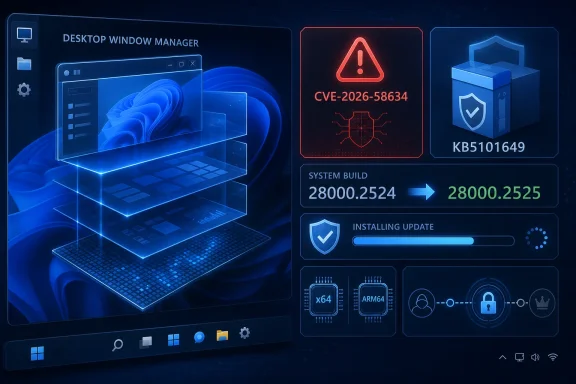
Microsoft published the advisory on July 14, describing the issue as a use-after-free vulnerability in Desktop Window Manager (DWM). The company rates it Important, while the National Vulnerability Database records Microsoft’s CVSS 3.1 base score of 7.8 out of 10. The weakness affects Windows 11 26H1 on both x64 and ARM64 systems, and it requires a local, authenticated attacker rather than exposure to an internet-facing service.
That distinction matters. This is not a remote-code-execution bug that allows an unauthenticated attacker to compromise a PC over the network. But once an adversary has a foothold through a malicious application, stolen low-privilege account, or another local execution route, an elevation-of-privilege flaw can turn that limited access into something considerably more damaging.
A DWM flaw with high impact but a local starting point
Desktop Window Manager is the Windows component responsible for compositing the desktop: drawing and arranging application windows, rendering visual effects, and managing how those graphics reach the display. It is a core part of the interactive Windows session, which makes defects in or around its memory handling particularly significant even when they are not directly remotely reachable.
CVE-2026-58634 is categorized as CWE-416, “use after free.” In plain terms, the software can continue using memory after it has been released. That class of bug can lead to unstable behavior, data corruption, or—when an attacker can reliably shape the memory state—code execution or privilege escalation.
Microsoft’s CVSS vector spells out the operational constraints. The attack vector is local, attack complexity is low, privileges required are low, and user interaction is not required. Confidentiality, integrity, and availability are each rated High in the successful-exploitation outcome.
For defenders, “local” should not be read as harmless. Endpoint attacks frequently come in stages: initial execution at a standard-user level, followed by an attempt to obtain more powerful permissions, establish persistence, disable protections, access protected data, or move laterally. A local privilege-escalation bug is often the bridge between the first step and the more consequential steps that follow.
At the same time, the advisory does not say an attacker can remotely trigger the bug, and it does not identify public exploitation. That makes CVE-2026-58634 a patch-now issue for affected systems, not a reason to assume every Windows endpoint is under immediate attack.
Microsoft’s confidence is high; public exploit evidence is not
The vulnerability record’s temporal metrics are useful here because they separate the certainty of the defect from the maturity of exploit information. Microsoft’s CVSS data uses a report confidence value of Confirmed, indicating that the vendor has validated the vulnerability and its technical characterization. The remediation is not speculative: the July cumulative update is the vendor-provided fix.
The exploitation-code maturity component, however, is listed as Unproven. That does not mean exploitation is impossible, nor does it guarantee that no private proof of concept exists. It means Microsoft’s published scoring does not treat functional exploit code as publicly established.
CISA’s SSVC enrichment similarly lists exploitation as “none” and automation as “no,” while marking the potential technical impact as total. Those fields should be read as a prioritization signal rather than a safety guarantee. There is no disclosed active exploitation in the available record, but a successful local escalation could still give an attacker control well beyond the privileges they started with.
Microsoft’s own Exploitability Index assessment for the latest software release is “Exploitation Less Likely,” according to the July Patch Tuesday advisory data reproduced by BleepingComputer. That is a meaningful data point for triage teams, but it should not be used to defer a routine security update indefinitely. Public patch availability can also encourage vulnerability research, making the time after Patch Tuesday the period when organizations want their exposure shrinking, not sitting unaddressed.
KB5101649 is the practical fix for the affected build range
For Windows 11 version 26H1, the relevant package is KB5101649, released July 14, 2026. Microsoft Support says the cumulative update raises the operating system to build 28000.2525 and includes the month’s security fixes. Systems already at build 28000.2525 or later are outside the affected version range Microsoft supplied for CVE-2026-58634.
Administrators should verify both the feature version and build number rather than relying solely on a device’s hardware architecture. Microsoft’s affected-software data explicitly names Windows 11 26H1 for ARM64-based and x64-based systems, starting at build 28000.0 and ending before build 28000.2525.
For an individual device, winver remains the quickest check. In managed environments, the more useful validation is deployment reporting from Windows Update for Business, Microsoft Intune, WSUS, Configuration Manager, or the organization’s endpoint-management platform. The key compliance condition is build 28000.2525 or newer, not merely that the July update has been approved.
Microsoft says it is not currently aware of known issues with KB5101649. That is encouraging, but it is not a substitute for the usual phased rollout practice in environments with specialized drivers, security agents, kiosk configurations, line-of-business software, or nonstandard graphics stacks.
A sensible deployment sequence is straightforward:
- Prioritize Windows 11 26H1 endpoints that handle sensitive data, permit local application installation, or are used by administrators and developers.
- Confirm that the July 2026 cumulative update has installed successfully and that devices report build 28000.2525.
- Reboot systems where required by the update workflow, because a downloaded cumulative update is not equivalent to a fully serviced endpoint.
- Watch endpoint telemetry for unexpected crashes or instability involving desktop rendering after rollout, while recognizing that Microsoft has not listed a known issue for this package.
Scope is narrower than “all Windows,” but it is still real
CVE-2026-58634’s affected product list is notably narrow: Windows 11 version 26H1. Microsoft has positioned 26H1 as a release aimed at new devices with select newer silicon, not as an in-place feature update for existing Windows 11 24H2 or 25H2 installations. That means many organizations will have relatively few affected machines today.
The narrow scope should simplify, rather than delay, remediation. Security teams can identify 26H1 devices as a discrete population and confirm KB5101649 deployment quickly. Users on Windows 11 24H2, 25H2, Windows 10, and Windows Server should not assume they are affected by this particular CVE merely because DWM exists on their platform; Microsoft’s published affected list for CVE-2026-58634 does not name those releases.
There is also no published workaround or mitigation that substitutes for patching. Restricting untrusted software, maintaining least-privilege user accounts, and monitoring endpoint behavior remain valuable layers of defense, but none removes the underlying memory-safety defect from an affected build.
For Windows 11 26H1, the operational answer is therefore uncomplicated: deploy KB5101649, verify build 28000.2525, and treat the absence of known exploitation as breathing room—not a reason to leave a confirmed DWM privilege-escalation flaw open.
References
- CVE-2026-58634 Desktop Window Manager Elevation of Privilege Vulnerability MSRC · 2026-07-14T07:00:00-07:00