

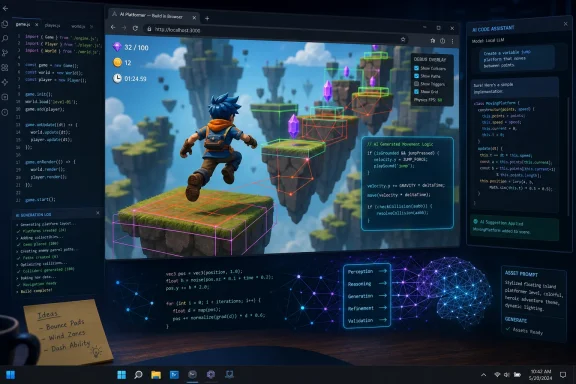
Startup Fortune reports that Moonshot AI’s new Kimi K3 generated a playable browser-based 3D platformer resembling Super Mario 64 from a single prompt. The circulating demo shows third-person camera controls, jumping, collision handling, and navigable level geometry—not just a rendered mock-up.
That is a more useful, if still imperfect, test of code generation than a polished web page. A 3D platformer needs input, camera, physics, collision detection, scene logic, and rendering to work together. A model can produce plausible-looking code without delivering any of that reliably.
The clip should be treated as a selected demonstration rather than a reproducible benchmark. Startup Fortune says it also shows prompt-generated versions of Call of Duty: Black Ops 2 and Natural Disaster Survival, but no independent test suite has established how consistently K3 can produce working games, how much iteration was required, or whether the generated projects hold up outside the showcased path.
That distinction matters for developers and IT teams evaluating generative coding tools. A successful one-shot build is encouraging; it does not establish that the model can maintain a larger codebase, write secure software, produce tests, or integrate with an existing Windows application stack.
Third-party rankings have given K3 a strong early showing. Reuters reported that Arena.ai placed it first in a web interface-building evaluation, while other evaluators put it near leading closed models on broader tasks. Tom’s Hardware reported a Frontend Code Arena score of 1,679, placing K3 ahead of competing models in that particular blind developer ranking.
Those results are worth watching, but they do not turn the Mario-style clip into a formal measurement. Moonshot’s performance claims and hosted behavior can be examined today; independent local testing and deeper inspection will only become practical once the weights are released.
The practical next step is to wait for the July 27 weights release and see whether independent Windows and web developers can reproduce more than a well-chosen demo.
That is a more useful, if still imperfect, test of code generation than a polished web page. A 3D platformer needs input, camera, physics, collision detection, scene logic, and rendering to work together. A model can produce plausible-looking code without delivering any of that reliably.
 A public demo, not independent validation
The clip should be treated as a selected demonstration rather than a reproducible benchmark. Startup Fortune says it also shows prompt-generated versions of Call of Duty: Black Ops 2 and Natural Disaster Survival, but no independent test suite has established how consistently K3 can produce working games, how much iteration was required, or whether the generated projects hold up outside the showcased path.That distinction matters for developers and IT teams evaluating generative coding tools. A successful one-shot build is encouraging; it does not establish that the model can maintain a larger codebase, write secure software, produce tests, or integrate with an existing Windows application stack.
K3’s claims are substantial, but the weights are not out yet
Moonshot introduced Kimi K3 this week as a 2.8-trillion-parameter multimodal model with a one-million-token context window. The company is offering hosted access now and says it will publish the model weights on July 27, 2026.Third-party rankings have given K3 a strong early showing. Reuters reported that Arena.ai placed it first in a web interface-building evaluation, while other evaluators put it near leading closed models on broader tasks. Tom’s Hardware reported a Frontend Code Arena score of 1,679, placing K3 ahead of competing models in that particular blind developer ranking.
Those results are worth watching, but they do not turn the Mario-style clip into a formal measurement. Moonshot’s performance claims and hosted behavior can be examined today; independent local testing and deeper inspection will only become practical once the weights are released.
What it means for Windows developers
Kimi is available through a browser, API, and a Windows desktop client, but K3 is not a model most users will run locally. Tom’s Hardware notes that Moonshot recommends large accelerator deployments for serving it, despite its mixture-of-experts design. For most Windows developers, K3 is therefore a hosted coding assistant or API option, not a replacement for a local Copilot-style model on a workstation.The practical next step is to wait for the July 27 weights release and see whether independent Windows and web developers can reproduce more than a well-chosen demo.
References
- Primary source: Startup Fortune
Published: 2026-07-18T12:10:27+00:00
Kimi K3 Recreated a Playable Super Mario 64 Clone From a Single Prompt - Startup Fortune
Kimi K3's one-shot Super Mario 64 clone is going viral, showing Moonshot AI's open model can build a working 3D game from a single prompt.startupfortune.com
