

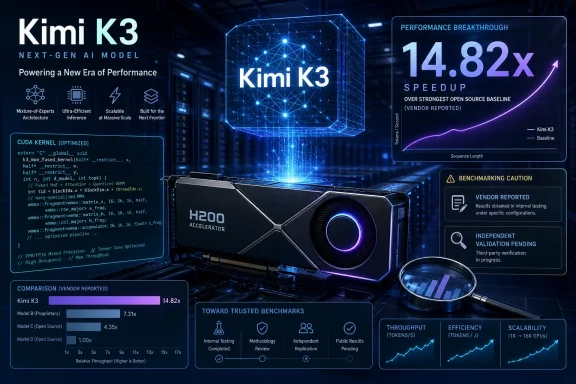
Moonshot AI’s newly announced Kimi K3 has drawn attention for a vendor-reported CUDA optimization result: on an NVIDIA H200, the model generated a kernel that ran 14.82 times faster than an optimized PyTorch baseline. The result, highlighted by Crypto Briefing and also discussed in Moonshot’s launch material, is notable—but it is not yet an independently reproduced benchmark.
The headline claim needs one correction for infrastructure readers: available launch coverage describes the kernel test as running on an NVIDIA H200, not an H100. That distinction matters. H200 systems have different memory characteristics, and a single task-specific kernel speedup is not a general measure of PyTorch, CUDA, or model quality.
Moonshot launched Kimi K3 on July 16 as a 2.8-trillion-parameter mixture-of-experts model with a 1,048,576-token context window and native image input. The company says its Kimi Delta Attention and Attention Residuals designs improve long-context efficiency, while sparse expert activation keeps inference practical relative to the total parameter count.
Kimi K3 is available through Moonshot’s API, Kimi Code, and its consumer products. The company has said full model weights will arrive on July 27, which means it is not yet a model that Windows developers, enterprises, or home-lab users can download and run locally.
That point is especially relevant here: a 2.8T-parameter model is far beyond a normal workstation deployment even with aggressive quantization. Any eventual self-hosted setup will likely require multi-node, datacenter-class GPU infrastructure, not a single Windows PC with a high-end GeForce card.
But the 14.82x figure should be treated as a benchmark result for one workload against one baseline. PyTorch is a framework with multiple execution paths, backends, compiler options, tensor layouts, precision modes, and library kernels. A hand-tuned or model-generated kernel can dramatically outperform a generic path in a narrow case without replacing PyTorch across production workloads.
Tom’s Hardware similarly reported that Moonshot’s kernel benchmarks involved NVIDIA H200 hardware and an unnamed alternative GPU, reinforcing that the published results are controlled vendor demonstrations rather than a broad, independently audited suite.
Moonshot prices Kimi K3 API use at $3 per million cache-miss input tokens, $0.30 per million cached-input tokens, and $15 per million output tokens. For now, the relevant next step is independent validation after the July 27 weight release.
The headline claim needs one correction for infrastructure readers: available launch coverage describes the kernel test as running on an NVIDIA H200, not an H100. That distinction matters. H200 systems have different memory characteristics, and a single task-specific kernel speedup is not a general measure of PyTorch, CUDA, or model quality.
 A huge model, with caveats
Moonshot launched Kimi K3 on July 16 as a 2.8-trillion-parameter mixture-of-experts model with a 1,048,576-token context window and native image input. The company says its Kimi Delta Attention and Attention Residuals designs improve long-context efficiency, while sparse expert activation keeps inference practical relative to the total parameter count.Kimi K3 is available through Moonshot’s API, Kimi Code, and its consumer products. The company has said full model weights will arrive on July 27, which means it is not yet a model that Windows developers, enterprises, or home-lab users can download and run locally.
That point is especially relevant here: a 2.8T-parameter model is far beyond a normal workstation deployment even with aggressive quantization. Any eventual self-hosted setup will likely require multi-node, datacenter-class GPU infrastructure, not a single Windows PC with a high-end GeForce card.
Kernel work is the story, not the raw multiplier
According to Moonshot’s claims, Kimi K3 also produced “MiniTriton,” a compiler-like GPU programming system intended to rival or exceed PyTorch’storch.compile and OpenAI’s Triton on selected workloads. The practical appeal is clear: GPU kernels remain a high-value bottleneck in AI stacks, and a model that can propose, test, and refine low-level CUDA code could shorten optimization cycles.But the 14.82x figure should be treated as a benchmark result for one workload against one baseline. PyTorch is a framework with multiple execution paths, backends, compiler options, tensor layouts, precision modes, and library kernels. A hand-tuned or model-generated kernel can dramatically outperform a generic path in a narrow case without replacing PyTorch across production workloads.
Tom’s Hardware similarly reported that Moonshot’s kernel benchmarks involved NVIDIA H200 hardware and an unnamed alternative GPU, reinforcing that the published results are controlled vendor demonstrations rather than a broad, independently audited suite.
What Windows AI developers should do
There is no immediate deployment action for most Windows users. Teams using CUDA on Windows or through WSL should watch for the promised weights, technical report, benchmark code, and reproducible kernel sources before drawing conclusions.Moonshot prices Kimi K3 API use at $3 per million cache-miss input tokens, $0.30 per million cached-input tokens, and $15 per million output tokens. For now, the relevant next step is independent validation after the July 27 weight release.
References
- Primary source: Crypto Briefing
Published: 2026-07-19T03:17:47+00:00
Kimi K3 writes H100 CUDA kernel 14.82x faster than PyTorch, intensifying US-China AI race
Moonshot AI's Kimi K3 generates an H100 CUDA kernel 14.82x faster than PyTorch. The 2.8T parameter open-weight model challenges top US AI labs at GPUcryptobriefing.com - Related coverage: easternherald.com
Moonshot AI Launches Kimi K3 Open-Weight 2.8T Model
Moonshot AI's Kimi K3 is the world's first open-weight 2.8-trillion-parameter model with a million-token context, sending chip stocks lower globally.easternherald.com
