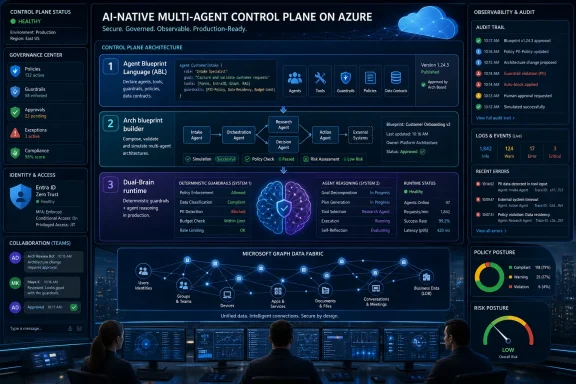
Kore.ai launched the Artemis edition of its Agent Platform on May 21, 2026, initially on Microsoft Azure, positioning it as a governed enterprise system for building, deploying, and operating multi-agent AI workflows across large organisations. The announcement is less about another chatbot builder and more about a fight over who owns the control plane for agentic AI. Kore.ai is betting that enterprises will not scale autonomous software through prompt libraries and enthusiasm alone. Microsoft, meanwhile, gets another partner reinforcing Azure as the place where agents become managed infrastructure rather than experimental side projects.
The enterprise AI market has spent the past two years selling possibility. Agents would answer tickets, triage invoices, query databases, draft responses, and orchestrate work across departments. What has been harder to sell is the boring part: who approves what the agent can do, how its decisions are audited, and how a regulated company proves that a software worker did not quietly improvise its way into a compliance problem.
That is the opening Kore.ai is aiming at with Artemis. The company is not presenting the new platform as a single-purpose assistant or a departmental automation tool. It is pitching a layer where agents are defined, governed, observed, refined, and connected to enterprise systems before they are allowed near production work.
The timing matters. The first wave of generative AI in business was about access to models. The second was about adding copilots to existing software. The third, if vendors are right, is about agents that perform chains of work across systems. That third wave is where the risk profile changes, because a bad answer is one thing; a bad action taken through authenticated enterprise systems is another.
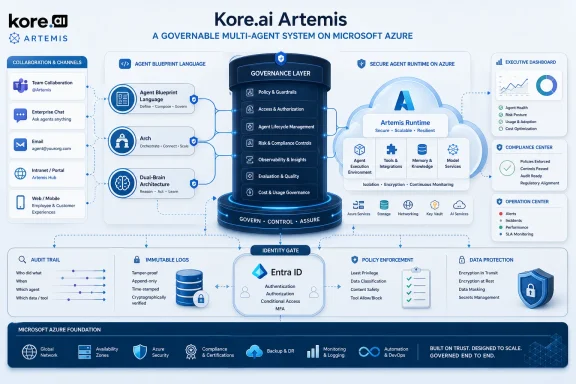
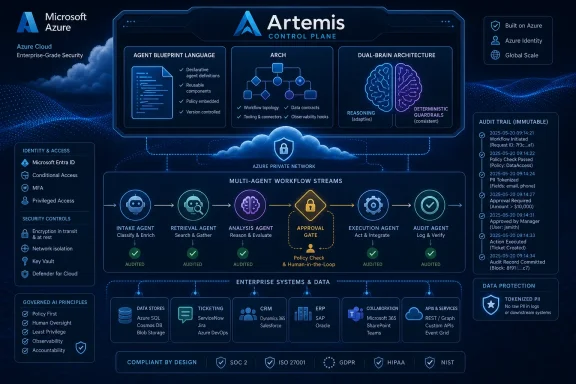
Kore.ai’s argument is that agentic AI needs more than model choice. It needs architecture. Artemis wraps that argument in three branded components: Agent Blueprint Language, Arch, and a Dual-Brain Architecture. Strip away the naming, and the core pitch is straightforward: enterprises need a repeatable way to describe agent behavior, convert business goals into governed workflows, and combine flexible reasoning with deterministic guardrails.
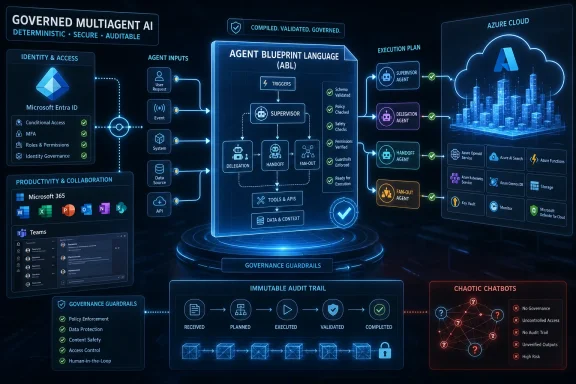
That is why the platform’s emphasis on a standard agent definition language is significant. Agent Blueprint Language, or ABL, is presented as a compiled, declarative way to define and validate agents, workflows, and multi-agent systems. In ordinary IT terms, Kore.ai is trying to move agent design closer to infrastructure-as-code discipline: describe the desired system, validate it, govern it, deploy it, and keep a record of what changed.
This is the correct direction for enterprise buyers, even if the product still has to prove itself in real deployments. One of the great weaknesses of the agent boom is that too much of it has treated behavior as something emerging from prompts, tool calls, and vibes. That may be tolerable for a prototype. It is a poor foundation for a bank, insurer, hospital, or multinational support operation that must explain why a system made a decision.
Kore.ai’s “Dual-Brain Architecture” is also a response to that tension. Agentic reasoning is useful precisely because it can interpret context and adapt. Deterministic flows are useful precisely because they constrain behavior and make outcomes more predictable. The platform’s promise is to let those modes operate together through shared memory and a single runtime, rather than forcing enterprises to choose between brittle workflow automation and unconstrained AI autonomy.
That Microsoft integration also reflects the emerging shape of the market. AI agents are not being treated as isolated apps. They are being pulled into the same management logic that governs users, devices, data access, and SaaS permissions. The enterprise does not want a thousand clever agents running in parallel; it wants accountable digital workers with policy, observability, and lifecycle management.
For Microsoft, the partnership helps reinforce Azure’s role as the operating environment for enterprise AI. Microsoft has spent the last several product cycles turning AI into a platform story: Copilot for users, Foundry for builders, Agent 365 for management, and Graph as the connective tissue across workplace data. Kore.ai’s Azure-first launch fits neatly into that narrative.
For Kore.ai, the benefit is distribution and credibility. The company can say it is meeting enterprises where they already are, rather than asking them to build a parallel AI governance stack. That is especially important for buyers that have already consolidated identity, compliance, and endpoint management around Microsoft’s ecosystem.
Kore.ai is clearly trying to claim the latter. The company says Artemis includes governance before agents go live, immutable audit trails for agent actions, tenant isolation, real-time personally identifiable information tokenisation, and deployment choices spanning public cloud, sovereign regions, private cloud, and on-premises environments. It also lists enterprise certifications and compliance alignments including SOC 2 Type II, ISO 27001, PCI DSS, FedRAMP Moderate authorisation, HIPAA alignment, HiTrust, and GDPR compliance.
Those claims will matter most in sectors where AI has been stuck between executive enthusiasm and risk-office skepticism. Customer service, workplace support, claims processing, onboarding, and IT operations all look attractive for agentic automation. They also involve sensitive data, regulated workflows, and reputational downside when automation fails in public.
The more consequential claim is that governance is “architectural, not an afterthought,” as one early customer put it. That phrasing captures the market’s mood. Enterprises are no longer asking whether AI can produce an impressive answer in a controlled demo. They are asking whether it can survive procurement, legal review, security review, data residency constraints, and the operational messiness of real business systems.
A standard agent language could help close that gap. If an organisation can define an agent’s role, tools, escalation paths, orchestration pattern, policy boundaries, and expected behavior in a consistent format, it becomes easier to review, reuse, test, and govern agent designs. It also becomes easier to move from artisanal agent-building to portfolio management.
Kore.ai says ABL supports built-in orchestration patterns including supervisor, delegation, handoff, fan-out, escalation, and agent-to-agent federation. That list is revealing because it treats multi-agent systems less like magic and more like distributed operations. Agents need supervisors. They need handoff rules. They need escalation points. They need ways to delegate without losing accountability.
The challenge, of course, is adoption. A language only matters if enough builders use it, enough tools understand it, and enough organisations trust it as a durable abstraction rather than a vendor-specific configuration format. Kore.ai does not have the standards-setting power of Microsoft, Google, Amazon, or OpenAI. Its opportunity is to make ABL useful enough inside its own platform that enterprises stop caring whether it becomes universal.
The attraction is obvious. Business units rarely describe automation needs in clean technical specifications. They describe outcomes: reduce call handling time, speed up claims intake, route internal support requests, reconcile exceptions, or improve onboarding. If Arch can convert those goals into structured agent designs that IT can review, modify, and deploy, it could reduce one of the biggest bottlenecks in enterprise AI adoption.
The skepticism is equally obvious. “AI builds the agent” sounds elegant until the agent touches a legacy CRM, a custom claims system, a regional data store, and a policy exception process known only to three people in operations. Enterprise workflows are full of edge cases that do not show up in strategy decks. Any platform claiming to generate production-ready systems must still confront the lived reality of business process archaeology.
Kore.ai appears to understand this by positioning Arch as part of a lifecycle rather than a one-shot generator. The more credible promise is not that AI will instantly replace solution architects. It is that AI can accelerate the drafting, refinement, and optimisation of agent designs while keeping human review and governance in the loop. That may sound less revolutionary, but it is much closer to how large organisations actually buy and operate software.
For WindowsForum readers, the Teams and Microsoft 365 connection is particularly important. Many enterprise agents will not appear to users as exotic new applications. They will appear inside the collaboration tools workers already use. They will answer in Teams, pull context from Microsoft Graph, authenticate through Entra ID, and be monitored through Microsoft-aligned governance tooling.
That creates convenience, but it also raises the stakes. Once agents are embedded into the Microsoft workplace estate, they inherit both the power and the risk of that estate. A well-governed agent can become a useful front door into business systems. A poorly governed one can become a confused but authenticated actor with access to sensitive data and operational workflows.
This is why Agent 365 matters in the background of the Kore.ai announcement. Microsoft has been framing it as a way to manage agents across the enterprise, including agents built with Microsoft tools and third-party frameworks. Kore.ai integrating with that strategy is not just a checkbox. It is a signal that the market expects agent governance to become a first-class administrative discipline.
But security-minded buyers should still separate platform controls from application outcomes. A platform can provide identity integration, logs, policy enforcement, and deployment isolation. It cannot automatically guarantee that every agent built on top of it is safe, useful, or compliant in its specific business context. The hardest risks often live in the gap between technical capability and process design.
For example, immutable audit trails are valuable only if someone knows what to review and how to respond. PII tokenisation reduces exposure but does not eliminate the need for data classification and access policy. Model independence protects against supplier lock-in, but it also means organisations must test behavior across models and versions. Deterministic flows can constrain actions, but they still need to be designed around the messy exceptions that define real operations.
That does not weaken Kore.ai’s pitch; it clarifies it. Artemis should be judged not as a magic safety wrapper for AI, but as an attempt to give enterprises the machinery they need to impose discipline. The success or failure will depend on how well customers use that machinery, and how honestly the vendor handles the inevitable cases where agents do not behave as expected.
That is the voice of enterprise AI in 2026. The excitement is still there, but the buyer has changed. The first proof-of-concept could be sponsored by innovation teams. Production deployment requires security, architecture, legal, compliance, procurement, operations, and business owners to agree that the system is controllable enough to matter.
This is where Kore.ai’s decade in conversational AI and enterprise automation may help. The company has long sold into environments where contact center workflows, support operations, and regulated customer interactions demand reliability. Artemis extends that heritage into the agent era, where the unit of automation is no longer just a conversation but a sequence of actions across systems.
The danger is that every vendor now wants to frame itself as the adult in the room. “Governed AI” has become the new “enterprise-grade.” The market will need evidence beyond launch language: deployment metrics, failure modes, customer retention, integration depth, administrative usability, and proof that non-trivial agents can be maintained over time without collapsing into bespoke consulting projects.
This is why the cloud partnership matters. Agent platforms will be sticky if they sit near identity, data, applications, and security operations. A vendor that controls only the model endpoint is vulnerable to substitution. A vendor that controls the agent lifecycle, approvals, permissions, observability, and integrations becomes much harder to dislodge.
Kore.ai’s challenge is to occupy that layer without being swallowed by the larger platforms around it. Azure gives Artemis reach, but it also places the product inside Microsoft’s orbit. If Microsoft’s own tools become good enough for a large portion of enterprise use cases, Kore.ai will need to prove that its specialised architecture, multi-agent orchestration, and governance model justify an additional platform commitment.
The same tension applies to model independence. Enterprises like flexibility, but they also like consolidation when budgets tighten. Kore.ai must persuade buyers that abstraction is worth paying for because it protects them from model churn and lets them standardise agent operations across changing AI infrastructure. That is a plausible argument, but not an automatic one.
That shift could be uncomfortable. Many IT departments are still cleaning up SaaS sprawl, shadow automation, and unmanaged data access. Agents add a new class of actor: software entities that can reason, call tools, retrieve information, and potentially initiate changes. Treating them like ordinary apps will be too loose. Treating them like ordinary users will be too crude.
The likely answer is a new administrative category with its own lifecycle. Agents will need owners, permissions, environments, versioning, test histories, approval gates, logging, and retirement processes. They will also need monitoring for behavior, not just uptime. A healthy agent is not merely one that responds quickly; it is one that acts within policy and produces outcomes the business can defend.
Kore.ai’s Artemis announcement should therefore be read as part of a larger operational transition. AI is leaving the sandbox and entering the estate. Once that happens, the center of gravity moves from demos to controls.
 Kore.ai Wants the Agent Boom to Grow Up
The enterprise AI market has spent the past two years selling possibility. Agents would answer tickets, triage invoices, query databases, draft responses, and orchestrate work across departments. What has been harder to sell is the boring part: who approves what the agent can do, how its decisions are audited, and how a regulated company proves that a software worker did not quietly improvise its way into a compliance problem.That is the opening Kore.ai is aiming at with Artemis. The company is not presenting the new platform as a single-purpose assistant or a departmental automation tool. It is pitching a layer where agents are defined, governed, observed, refined, and connected to enterprise systems before they are allowed near production work.
The timing matters. The first wave of generative AI in business was about access to models. The second was about adding copilots to existing software. The third, if vendors are right, is about agents that perform chains of work across systems. That third wave is where the risk profile changes, because a bad answer is one thing; a bad action taken through authenticated enterprise systems is another.
Kore.ai’s argument is that agentic AI needs more than model choice. It needs architecture. Artemis wraps that argument in three branded components: Agent Blueprint Language, Arch, and a Dual-Brain Architecture. Strip away the naming, and the core pitch is straightforward: enterprises need a repeatable way to describe agent behavior, convert business goals into governed workflows, and combine flexible reasoning with deterministic guardrails.
The Most Important Feature Is Not the Model
Kore.ai describes Artemis as model-independent, and that detail is more than a procurement footnote. In enterprise AI, the model is often the star of the demo, but it is rarely the whole system. A production agent also needs identity, permissions, memory, connectors, monitoring, escalation rules, data controls, and a rollback story when something behaves badly.That is why the platform’s emphasis on a standard agent definition language is significant. Agent Blueprint Language, or ABL, is presented as a compiled, declarative way to define and validate agents, workflows, and multi-agent systems. In ordinary IT terms, Kore.ai is trying to move agent design closer to infrastructure-as-code discipline: describe the desired system, validate it, govern it, deploy it, and keep a record of what changed.
This is the correct direction for enterprise buyers, even if the product still has to prove itself in real deployments. One of the great weaknesses of the agent boom is that too much of it has treated behavior as something emerging from prompts, tool calls, and vibes. That may be tolerable for a prototype. It is a poor foundation for a bank, insurer, hospital, or multinational support operation that must explain why a system made a decision.
Kore.ai’s “Dual-Brain Architecture” is also a response to that tension. Agentic reasoning is useful precisely because it can interpret context and adapt. Deterministic flows are useful precisely because they constrain behavior and make outcomes more predictable. The platform’s promise is to let those modes operate together through shared memory and a single runtime, rather than forcing enterprises to choose between brittle workflow automation and unconstrained AI autonomy.
Azure Gives Artemis a Door Into the Enterprise Estate
Launching first on Microsoft Azure is the commercially obvious move. Many of the customers Kore.ai wants already use Microsoft identity, collaboration, security, development, and productivity tools. If an agent platform can plug into Entra ID, Microsoft Graph, Microsoft Teams, Microsoft Foundry, and Agent 365, it has a much easier story to tell a CIO than a standalone AI product asking to be trusted from scratch.That Microsoft integration also reflects the emerging shape of the market. AI agents are not being treated as isolated apps. They are being pulled into the same management logic that governs users, devices, data access, and SaaS permissions. The enterprise does not want a thousand clever agents running in parallel; it wants accountable digital workers with policy, observability, and lifecycle management.
For Microsoft, the partnership helps reinforce Azure’s role as the operating environment for enterprise AI. Microsoft has spent the last several product cycles turning AI into a platform story: Copilot for users, Foundry for builders, Agent 365 for management, and Graph as the connective tissue across workplace data. Kore.ai’s Azure-first launch fits neatly into that narrative.
For Kore.ai, the benefit is distribution and credibility. The company can say it is meeting enterprises where they already are, rather than asking them to build a parallel AI governance stack. That is especially important for buyers that have already consolidated identity, compliance, and endpoint management around Microsoft’s ecosystem.
Governance Moves From Slideware to Product Architecture
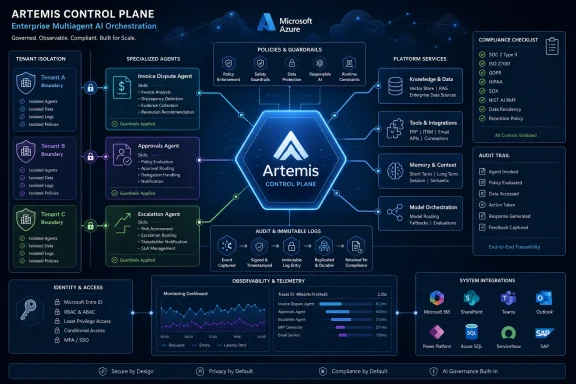
Every AI vendor now talks about governance. The more interesting question is where governance lives. If it is a dashboard bolted onto a model after deployment, it is mostly a reporting feature. If it is embedded in how agents are defined, validated, executed, and audited, it becomes part of the system’s operating model.Kore.ai is clearly trying to claim the latter. The company says Artemis includes governance before agents go live, immutable audit trails for agent actions, tenant isolation, real-time personally identifiable information tokenisation, and deployment choices spanning public cloud, sovereign regions, private cloud, and on-premises environments. It also lists enterprise certifications and compliance alignments including SOC 2 Type II, ISO 27001, PCI DSS, FedRAMP Moderate authorisation, HIPAA alignment, HiTrust, and GDPR compliance.
Those claims will matter most in sectors where AI has been stuck between executive enthusiasm and risk-office skepticism. Customer service, workplace support, claims processing, onboarding, and IT operations all look attractive for agentic automation. They also involve sensitive data, regulated workflows, and reputational downside when automation fails in public.
The more consequential claim is that governance is “architectural, not an afterthought,” as one early customer put it. That phrasing captures the market’s mood. Enterprises are no longer asking whether AI can produce an impressive answer in a controlled demo. They are asking whether it can survive procurement, legal review, security review, data residency constraints, and the operational messiness of real business systems.
Agent Blueprint Language Is a Bet on Standardisation
The most intriguing part of Artemis may be ABL, because it points to a broader industry problem: enterprises do not yet have a mature grammar for agentic systems. Traditional software has source code, tests, build pipelines, deployment manifests, logging conventions, and change-control processes. Robotic process automation has workflows and runbooks. AI agents often have prompts, tools, memory settings, and a loose promise that observability will catch the rest.A standard agent language could help close that gap. If an organisation can define an agent’s role, tools, escalation paths, orchestration pattern, policy boundaries, and expected behavior in a consistent format, it becomes easier to review, reuse, test, and govern agent designs. It also becomes easier to move from artisanal agent-building to portfolio management.
Kore.ai says ABL supports built-in orchestration patterns including supervisor, delegation, handoff, fan-out, escalation, and agent-to-agent federation. That list is revealing because it treats multi-agent systems less like magic and more like distributed operations. Agents need supervisors. They need handoff rules. They need escalation points. They need ways to delegate without losing accountability.
The challenge, of course, is adoption. A language only matters if enough builders use it, enough tools understand it, and enough organisations trust it as a durable abstraction rather than a vendor-specific configuration format. Kore.ai does not have the standards-setting power of Microsoft, Google, Amazon, or OpenAI. Its opportunity is to make ABL useful enough inside its own platform that enterprises stop caring whether it becomes universal.
Arch Sells the Dream of AI Building AI, With a Human Still in the Loop
Arch, Kore.ai’s agent architect, is the platform’s most fashionable component. It promises to translate business objectives into production-ready blueprints and then refine agents using production traces. That is the sort of claim that will attract both interest and skepticism from experienced IT teams.The attraction is obvious. Business units rarely describe automation needs in clean technical specifications. They describe outcomes: reduce call handling time, speed up claims intake, route internal support requests, reconcile exceptions, or improve onboarding. If Arch can convert those goals into structured agent designs that IT can review, modify, and deploy, it could reduce one of the biggest bottlenecks in enterprise AI adoption.
The skepticism is equally obvious. “AI builds the agent” sounds elegant until the agent touches a legacy CRM, a custom claims system, a regional data store, and a policy exception process known only to three people in operations. Enterprise workflows are full of edge cases that do not show up in strategy decks. Any platform claiming to generate production-ready systems must still confront the lived reality of business process archaeology.
Kore.ai appears to understand this by positioning Arch as part of a lifecycle rather than a one-shot generator. The more credible promise is not that AI will instantly replace solution architects. It is that AI can accelerate the drafting, refinement, and optimisation of agent designs while keeping human review and governance in the loop. That may sound less revolutionary, but it is much closer to how large organisations actually buy and operate software.
Microsoft’s Agent Stack Gets Another Tenant
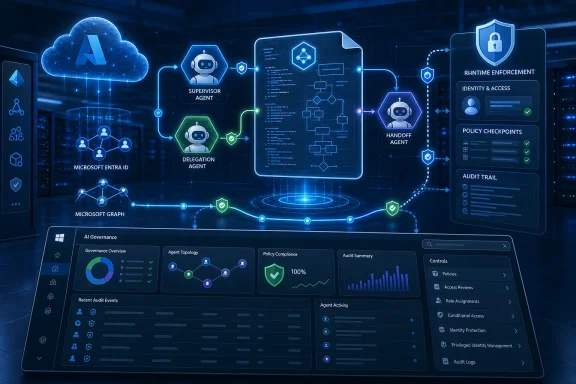
The Azure-first launch also shows how Microsoft’s agent strategy is becoming gravitational. Microsoft does not need to build every agent platform itself if it can make Azure, Foundry, Entra ID, Graph, Teams, and Agent 365 the environment where third-party agents live. That is a familiar platform play: own the identity, control plane, data fabric, and developer surface, then let partners fill in specialised layers.For WindowsForum readers, the Teams and Microsoft 365 connection is particularly important. Many enterprise agents will not appear to users as exotic new applications. They will appear inside the collaboration tools workers already use. They will answer in Teams, pull context from Microsoft Graph, authenticate through Entra ID, and be monitored through Microsoft-aligned governance tooling.
That creates convenience, but it also raises the stakes. Once agents are embedded into the Microsoft workplace estate, they inherit both the power and the risk of that estate. A well-governed agent can become a useful front door into business systems. A poorly governed one can become a confused but authenticated actor with access to sensitive data and operational workflows.
This is why Agent 365 matters in the background of the Kore.ai announcement. Microsoft has been framing it as a way to manage agents across the enterprise, including agents built with Microsoft tools and third-party frameworks. Kore.ai integrating with that strategy is not just a checkbox. It is a signal that the market expects agent governance to become a first-class administrative discipline.
The Security Claims Are Necessary, Not Sufficient
Kore.ai’s security and compliance list is substantial, and it will help the company in enterprise evaluations. Certifications, audit trails, tenant isolation, PII tokenisation, and data residency controls are table stakes for the regulated customers the company wants. Without them, Artemis would be excluded before the first serious architecture meeting.But security-minded buyers should still separate platform controls from application outcomes. A platform can provide identity integration, logs, policy enforcement, and deployment isolation. It cannot automatically guarantee that every agent built on top of it is safe, useful, or compliant in its specific business context. The hardest risks often live in the gap between technical capability and process design.
For example, immutable audit trails are valuable only if someone knows what to review and how to respond. PII tokenisation reduces exposure but does not eliminate the need for data classification and access policy. Model independence protects against supplier lock-in, but it also means organisations must test behavior across models and versions. Deterministic flows can constrain actions, but they still need to be designed around the messy exceptions that define real operations.
That does not weaken Kore.ai’s pitch; it clarifies it. Artemis should be judged not as a magic safety wrapper for AI, but as an attempt to give enterprises the machinery they need to impose discipline. The success or failure will depend on how well customers use that machinery, and how honestly the vendor handles the inevitable cases where agents do not behave as expected.
The Customer Quotes Reveal the Real Buyer Anxiety
The early customer comments from Vanguard and Blue Cross Blue Shield of Massachusetts are notable for what they emphasize. They do not gush about creativity, personality, or a futuristic user experience. They talk about architectural rigor, compiled blueprints, deterministic governance, and the ability to move from pilot to production without creating compliance exposure.That is the voice of enterprise AI in 2026. The excitement is still there, but the buyer has changed. The first proof-of-concept could be sponsored by innovation teams. Production deployment requires security, architecture, legal, compliance, procurement, operations, and business owners to agree that the system is controllable enough to matter.
This is where Kore.ai’s decade in conversational AI and enterprise automation may help. The company has long sold into environments where contact center workflows, support operations, and regulated customer interactions demand reliability. Artemis extends that heritage into the agent era, where the unit of automation is no longer just a conversation but a sequence of actions across systems.
The danger is that every vendor now wants to frame itself as the adult in the room. “Governed AI” has become the new “enterprise-grade.” The market will need evidence beyond launch language: deployment metrics, failure modes, customer retention, integration depth, administrative usability, and proof that non-trivial agents can be maintained over time without collapsing into bespoke consulting projects.
The Agent Platform Market Is Becoming a Control-Plane War
Kore.ai is not launching Artemis into an empty field. Microsoft, Salesforce, ServiceNow, Google, Amazon, OpenAI, Anthropic, UiPath, and a swarm of startups are all circling the same enterprise budget. They may use different labels, but the strategic ambition is similar: become the layer where AI workers are created, connected, monitored, and governed.This is why the cloud partnership matters. Agent platforms will be sticky if they sit near identity, data, applications, and security operations. A vendor that controls only the model endpoint is vulnerable to substitution. A vendor that controls the agent lifecycle, approvals, permissions, observability, and integrations becomes much harder to dislodge.
Kore.ai’s challenge is to occupy that layer without being swallowed by the larger platforms around it. Azure gives Artemis reach, but it also places the product inside Microsoft’s orbit. If Microsoft’s own tools become good enough for a large portion of enterprise use cases, Kore.ai will need to prove that its specialised architecture, multi-agent orchestration, and governance model justify an additional platform commitment.
The same tension applies to model independence. Enterprises like flexibility, but they also like consolidation when budgets tighten. Kore.ai must persuade buyers that abstraction is worth paying for because it protects them from model churn and lets them standardise agent operations across changing AI infrastructure. That is a plausible argument, but not an automatic one.
Windows and Microsoft 365 Admins Should Watch the Operational Layer
For Windows administrators and Microsoft 365 teams, the Kore.ai launch is another sign that AI management is moving into familiar territory. The relevant skills will not be limited to prompt engineering. Identity design, conditional access, data governance, audit review, endpoint policy, Teams administration, API permissions, and incident response will all become part of the agent operations picture.That shift could be uncomfortable. Many IT departments are still cleaning up SaaS sprawl, shadow automation, and unmanaged data access. Agents add a new class of actor: software entities that can reason, call tools, retrieve information, and potentially initiate changes. Treating them like ordinary apps will be too loose. Treating them like ordinary users will be too crude.
The likely answer is a new administrative category with its own lifecycle. Agents will need owners, permissions, environments, versioning, test histories, approval gates, logging, and retirement processes. They will also need monitoring for behavior, not just uptime. A healthy agent is not merely one that responds quickly; it is one that acts within policy and produces outcomes the business can defend.
Kore.ai’s Artemis announcement should therefore be read as part of a larger operational transition. AI is leaving the sandbox and entering the estate. Once that happens, the center of gravity moves from demos to controls.
The Azure Launch Tells Enterprises Where the Battle Lines Are
Kore.ai’s Artemis debut does not settle the agent platform race, but it does sharpen the terms of competition.- Enterprises are moving from AI pilots toward production systems that need identity, auditability, policy enforcement, and operational ownership.
- Kore.ai’s Agent Blueprint Language is an attempt to make agent behavior more standardized, reviewable, and governable than prompt-centric development allows.
- The Azure-first launch gives Kore.ai access to Microsoft-standardized enterprises and aligns the platform with Entra ID, Microsoft Graph, Teams, Foundry, and Agent 365.
- The Dual-Brain Architecture reflects a practical compromise between flexible agentic reasoning and deterministic workflow controls.
- Security certifications and deployment options will help with procurement, but customers still need strong internal governance and process design.
- The bigger market fight is over the agent control plane, not merely over which model produces the best answer.
References
- Primary source: IT Brief UK
Published: Fri, 22 May 2026 11:34:00 GMT

Kore.ai launches Artemis AI platform on Microsoft Azure
Enterprises may be able to deploy governed multi-agent AI systems in days, as Kore.ai ties its Artemis platform to Microsoft Azure.
itbrief.co.uk
- Related coverage: kore.ai
Kore.ai Launches Artemis, the New Generation of the Kore.ai Agent Platform for Building, Governing, and Optimizing Enterprise AI
Kore.ai launches the AI-native Agent Platform Artemis edition on Microsoft Azure, enabling enterprises to build, govern, and optimize multiagent AI systems at scale. www.kore.ai
- Related coverage: docs.kore.ai
Agent Platform Release Notes - Kore.ai Docs
 docs.kore.ai
- Related coverage: vktr.com
Kore.ai's Artemis Brings Governed Multiagent AI to Azure
Agent Blueprint Language (ABL) compounds returns and compresses agent delivery from months to days.www.vktr.com - Related coverage: businesstoday.in
Kore.ai launches Artemis to help enterprises manage AI agents at scale - BusinessToday
Kore.ai said the new platform can reduce the time required to deploy production-ready AI agents from months to days by using what it calls an AI-native architecture.www.businesstoday.in - Related coverage: windowscentral.com
Microsoft doubles down on agentic AI — Agent 365 prepares for a future with over 1 billion agents | Windows Central
Microsoft kicked off Ignite with a major push into agentic AI, unveiling Agent 365 as its newest tool for automating workflows.www.windowscentral.com
- Related coverage: mphasis.com
- Official source: cdn-dynmedia-1.microsoft.com
- Official source: adoption.microsoft.com