

Secondary school students across Kuwait began final examinations in June 2026 under Ministry of Education supervision, as schools combined routine exam logistics with emergency planning, online revision support through Microsoft Teams, and public appeals for calm amid regional tension and an unusually disrupted academic year. The official message is simple: keep the exams moving, keep students safe, and keep anxiety from becoming the story. But beneath the reassurance is a sharper lesson about how modern education systems now operate when uncertainty is no longer an interruption but the operating environment.
Final exams are supposed to be a controlled ritual. Students revise, parents hover, teachers invigilate, and ministries publish schedules that promise order. This year in Kuwait, that familiar choreography has acquired a heavier edge.
The Ministry of Education’s posture is deliberately calm, and that matters. Officials have emphasized monitoring, preparedness, and the continuity of examinations for secondary students, particularly grades 10 and 11 from June 3 to June 15 and grade 12 from June 17 to June 29. Those dates are not just calendar entries; they are a signal to students and families that the state intends to preserve academic normality even while the region around them remains tense.
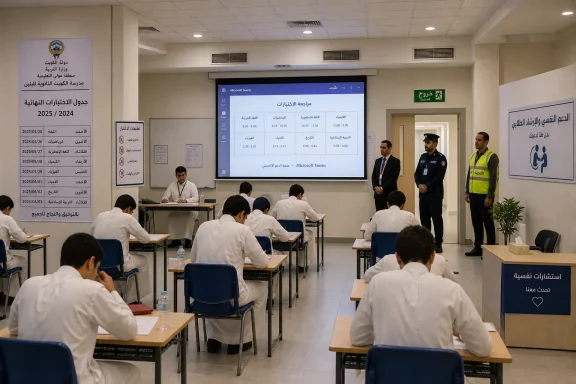
At Jassim Al-Kharafi Secondary School in Granada, Principal Dr Abdulaziz Al-Jassim described the work in practical terms: sample questions, practice exams, revision sessions, committees at school entrances, committees in exam halls, and rapid intervention teams. The language is bureaucratic, but the implication is human. A student walking into an exam hall does not need a grand speech about resilience; they need working air conditioning, functioning lights, cold water, clear instructions, and adults who appear to know what they are doing.
That is why the calm urged by educators should not be mistaken for passivity. It is an administrative strategy. In a high-pressure exam cycle, calm is built out of logistics.
For years, ministries and schools across the world have spoken about flexibility as a virtue. The pandemic turned that virtue into a requirement. Regional instability has now extended the same lesson: students are expected not merely to learn content, but to absorb changes in delivery, assessment, schedule, and emotional climate.
Family counselor Dr Aroub Al-Qattan framed this as a source of strength, arguing that the graduating class had faced exceptional circumstances and developed resilience. That is true, but it is also incomplete. Resilience is admirable; it is not a substitute for stability. When students are repeatedly asked to adapt, the adults in the system owe them more than applause.
The strongest version of Kuwait’s response is not that students endured difficulty. It is that schools appear to be trying to convert uncertainty into structure. Online review through Microsoft Teams, in-person revision classes, published sample questions, and psychological support all serve the same purpose: they reduce ambiguity at a moment when ambiguity is the enemy.
Teams and similar platforms entered many school systems as emergency infrastructure. They were tools for keeping lessons alive when classrooms closed. In Kuwait’s current exam season, they are functioning differently: not as a replacement for school, but as a pressure valve around it.
That distinction matters for IT administrators and educators alike. A hybrid revision model lets schools preserve the authority of the physical exam process while extending academic support beyond the building. It gives students who missed material, faced interruptions, or need repeated explanations a second route into the content. It also gives ministries a practical way to standardize support across schools without pretending every household has the same bandwidth, devices, or quiet study space.
For WindowsForum readers, the point is not that Teams is the hero of the story. It is that education technology has quietly moved from the category of contingency plan to the category of core public infrastructure. When a ministry can mention online revision in the same breath as lighting, air conditioning, and drinking water, the software stack has become part of the school building.
That raises uncomfortable questions. Are teachers trained to use these systems well, or merely expected to improvise? Are students’ accounts secure? Are recordings, chat histories, and shared files governed by clear retention policies? Are schools prepared if the platform fails during the exact week students need it most? The human story is exam stress; the systems story is dependency.
The report refers to emergency response plans and precautionary measures inside schools. That includes reception committees, rapid intervention committees, and committees within examination halls. Such language can sound excessive until one remembers the context: regional tensions, uncertainty, and the need to reassure families that exam continuity does not come at the expense of student safety.
The challenge is psychological as much as operational. Too little visible preparation can make families fear complacency. Too much visible preparation can make students feel they are walking into a crisis zone rather than an exam room. Good school leadership lives in the narrow corridor between those two failures.
Kuwait’s education authorities appear to be trying to keep emergency readiness in the background while foregrounding routine. The message from schools is not “be afraid, we have a plan.” It is “take your exam; the adults have handled the plan.” That is the right instinct.
Still, the presence of emergency planning in final examinations is a sign of the times. The old model assumed that exam integrity was mostly about preventing cheating and standardizing conditions. The new model adds continuity of operations, crisis communications, student mental health, and physical safety to the same checklist.
None of this is revolutionary. That is precisely why it matters. During a stressful exam season, students do not need novelty; they need repetition of the basics from trusted adults.
There is also a subtle shift here in how exam performance is understood. The old model treats achievement as a function of study alone. The newer model recognizes that sleep, attention, device use, confidence, and the emotional climate at home can alter the outcome. That is not soft thinking. It is operational realism.
Smart-device advice is especially relevant. Asking students to limit phone use before exams is not merely moral scolding about screens. In a tense regional environment, phones can become anxiety amplifiers: alerts, rumors, group chats, speculation, and comparison loops all compete with revision. The device that delivers a practice paper can also deliver the panic that ruins a night’s sleep.
Parents, too, are part of this system. Al-Jassim’s thanks to families was more than polite ceremony. In exam season, the home becomes an annex of the school. A calm household cannot guarantee a good grade, but a chaotic one can sabotage preparation even when the student has done the work.
By keeping examinations on schedule, the ministry is making a bet that predictability is itself a form of support. Students who have spent months preparing need a clear path to completion. Universities, scholarship processes, and family plans all depend on the credibility of the exam calendar. If the system hesitates too visibly, uncertainty spreads faster than any official correction can contain it.
But continuity has to be earned. It depends on whether schools can deliver safe exam environments, whether communication is timely, whether contingency plans are real, and whether students with legitimate disruptions are treated fairly. The calendar alone does not create confidence.
That is why the practical details from Jassim Al-Kharafi Secondary School matter. Air conditioning, lighting, cold water, reception committees, in-hall organization, online review, and rapid intervention teams are the texture of credibility. Ministries announce policy; schools make it believable.
In this sense, Kuwait’s exam season is an institutional performance. Students are being assessed in Arabic, mathematics, science, or humanities. The education system is being assessed in coordination, communication, and trust.
That means access cannot be an afterthought. If revision materials are online, students need reliable credentials, compatible devices, and usable connections. If teachers are expected to run virtual sessions, they need training, scheduling support, and clear rules for recordings and attendance. If ministry websites host practice exams and sample questions, those sites must remain available under peak demand.
This is where IT departments become invisible educators. A platform outage the night before a major exam may not appear in a student’s answer booklet, but it can shape the performance captured there. Authentication problems, file permission errors, weak Wi-Fi, and overloaded portals are not mere technical annoyances during final exams. They are equity problems.
Security also matters. Exam-adjacent systems attract rumors, phishing, impersonation, and attempts to circulate fake papers. Kuwait’s earlier attention to exam integrity and reported attempts to undermine examination processes show why digital governance cannot be separated from academic governance. If students are told to rely on official online resources, the official channels must be unmistakable, stable, and protected.
There is a broader lesson for ministries everywhere: hybrid education is not a temporary compromise. It is a permanent operating model that needs budgets, standards, audits, and support desks. The classroom and the cloud now fail or succeed together.
The advice offered by Kuwait’s educators reflects that. Read the question carefully. Start with what you know. Manage your time. Sleep. Eat. Avoid unnecessary distractions. These are small behaviors, but together they create a student who can function under pressure.
The school environment either reinforces or undermines those behaviors. A noisy corridor, unclear instructions, overheated hall, late paper distribution, or visible staff confusion can undo a week of careful revision. Conversely, a well-run exam hall teaches students that pressure can be managed.
That may be the deeper educational value of this season. Students are not only learning how to complete a paper; they are learning how institutions behave under stress. If the adults manage uncertainty with steadiness, students carry that model forward. If the adults panic, students learn that panic is the rational response.
Al-Qattan’s point about character formation is persuasive when read this way. The year’s disruptions may strengthen students not because difficulty is inherently good, but because competent support can turn difficulty into mastery. Resilience is not produced by abandonment. It is produced when challenge is paired with structure.
Parents are often told to motivate students, but motivation can become pressure when poorly handled. The most useful parental support during final exams is usually boring: regular meals, quiet space, transport planning, phone boundaries, realistic encouragement, and restraint from last-minute catastrophizing. A parent who turns every exam into a family referendum on the future may think they are showing seriousness; the student experiences it as threat.
Kuwait’s educators appear to understand this. The call for parents to continue support and motivation is carefully phrased. It asks families to remain involved without turning anxiety into command-and-control.
There is a cultural dimension here as well. In many families, final secondary exams carry enormous symbolic weight because they influence university access, scholarships, social expectations, and professional pathways. That weight is real. But students perform better when adults distinguish between importance and panic.
The best exam support treats young people as capable, not fragile; serious, not doomed. That is a difficult balance, especially in a year already shaped by uncertainty. It is also exactly the balance the system is asking students to achieve inside the exam hall.
A resilient exam system has physical readiness, digital readiness, psychological support, family communication, and contingency planning working at the same time. It does not rely on one heroic principal, one online platform, or one ministry statement. It distributes responsibility across the system.
That does not mean everything is solved. Students may still be anxious. Families may still distrust official timelines. Schools may still differ in resources. Online revision may help some students more than others. Emergency plans may be unevenly understood. Those are not reasons to dismiss the effort; they are reasons to keep measuring it honestly.
The encouraging sign is that Kuwait’s public messaging is not confined to grades and discipline. It includes environment, mental health, digital support, and parental cooperation. That is a more mature vocabulary for education under pressure.
The danger is that once exams pass, the system treats this year as an exception and files away the lessons. It should not. The conditions that made this exam season difficult — regional uncertainty, digital dependency, curriculum adjustment, student anxiety — are unlikely to disappear neatly at the end of June.
That expanded boundary is the defining feature of modern schooling. The exam no longer begins when the paper lands on the desk. It begins when sample questions go online, when students join revision sessions, when parents decide whether to amplify or reduce stress, when schools test air conditioning, when committees rehearse what to do if something goes wrong, and when officials choose whether to communicate clearly or hide behind generalities.
The Kuwait case is therefore not merely a local education story. It is a case study in public-sector continuity. The ministry is trying to prove that the school system can absorb shocks without transferring all of that shock to students.
That is the right goal. But it should also be judged by outcomes students can feel: fewer surprises, clearer instructions, accessible support, safe facilities, and adults who do not confuse severity with seriousness.
 Kuwait’s Exam Season Has Become a Test of Institutional Nerves
Final exams are supposed to be a controlled ritual. Students revise, parents hover, teachers invigilate, and ministries publish schedules that promise order. This year in Kuwait, that familiar choreography has acquired a heavier edge.The Ministry of Education’s posture is deliberately calm, and that matters. Officials have emphasized monitoring, preparedness, and the continuity of examinations for secondary students, particularly grades 10 and 11 from June 3 to June 15 and grade 12 from June 17 to June 29. Those dates are not just calendar entries; they are a signal to students and families that the state intends to preserve academic normality even while the region around them remains tense.
At Jassim Al-Kharafi Secondary School in Granada, Principal Dr Abdulaziz Al-Jassim described the work in practical terms: sample questions, practice exams, revision sessions, committees at school entrances, committees in exam halls, and rapid intervention teams. The language is bureaucratic, but the implication is human. A student walking into an exam hall does not need a grand speech about resilience; they need working air conditioning, functioning lights, cold water, clear instructions, and adults who appear to know what they are doing.
That is why the calm urged by educators should not be mistaken for passivity. It is an administrative strategy. In a high-pressure exam cycle, calm is built out of logistics.
The Real Curriculum This Year Was Adaptation
Kuwait’s graduating students have had a year defined by disruption. The article’s most revealing line is not about exam halls or ministry committees, but about students adjusting to curriculum changes and shifts between in-person and online learning. That is where the educational story becomes larger than this exam season.For years, ministries and schools across the world have spoken about flexibility as a virtue. The pandemic turned that virtue into a requirement. Regional instability has now extended the same lesson: students are expected not merely to learn content, but to absorb changes in delivery, assessment, schedule, and emotional climate.
Family counselor Dr Aroub Al-Qattan framed this as a source of strength, arguing that the graduating class had faced exceptional circumstances and developed resilience. That is true, but it is also incomplete. Resilience is admirable; it is not a substitute for stability. When students are repeatedly asked to adapt, the adults in the system owe them more than applause.
The strongest version of Kuwait’s response is not that students endured difficulty. It is that schools appear to be trying to convert uncertainty into structure. Online review through Microsoft Teams, in-person revision classes, published sample questions, and psychological support all serve the same purpose: they reduce ambiguity at a moment when ambiguity is the enemy.
Microsoft Teams Is No Longer an Emergency Tool
One detail in the school’s preparation deserves more attention than it usually gets: revision sessions were offered both online through Microsoft Teams and in person. That hybrid arrangement is now so familiar that it can sound unremarkable. It is not.Teams and similar platforms entered many school systems as emergency infrastructure. They were tools for keeping lessons alive when classrooms closed. In Kuwait’s current exam season, they are functioning differently: not as a replacement for school, but as a pressure valve around it.
That distinction matters for IT administrators and educators alike. A hybrid revision model lets schools preserve the authority of the physical exam process while extending academic support beyond the building. It gives students who missed material, faced interruptions, or need repeated explanations a second route into the content. It also gives ministries a practical way to standardize support across schools without pretending every household has the same bandwidth, devices, or quiet study space.
For WindowsForum readers, the point is not that Teams is the hero of the story. It is that education technology has quietly moved from the category of contingency plan to the category of core public infrastructure. When a ministry can mention online revision in the same breath as lighting, air conditioning, and drinking water, the software stack has become part of the school building.
That raises uncomfortable questions. Are teachers trained to use these systems well, or merely expected to improvise? Are students’ accounts secure? Are recordings, chat histories, and shared files governed by clear retention policies? Are schools prepared if the platform fails during the exact week students need it most? The human story is exam stress; the systems story is dependency.
Safety Planning Has Entered the Exam Hall
The emergency committees described by school leaders are a reminder that education policy in the Gulf cannot be separated from regional security. Schools are not military installations, but they are dense public institutions full of young people, and ministries have to plan accordingly.The report refers to emergency response plans and precautionary measures inside schools. That includes reception committees, rapid intervention committees, and committees within examination halls. Such language can sound excessive until one remembers the context: regional tensions, uncertainty, and the need to reassure families that exam continuity does not come at the expense of student safety.
The challenge is psychological as much as operational. Too little visible preparation can make families fear complacency. Too much visible preparation can make students feel they are walking into a crisis zone rather than an exam room. Good school leadership lives in the narrow corridor between those two failures.
Kuwait’s education authorities appear to be trying to keep emergency readiness in the background while foregrounding routine. The message from schools is not “be afraid, we have a plan.” It is “take your exam; the adults have handled the plan.” That is the right instinct.
Still, the presence of emergency planning in final examinations is a sign of the times. The old model assumed that exam integrity was mostly about preventing cheating and standardizing conditions. The new model adds continuity of operations, crisis communications, student mental health, and physical safety to the same checklist.
Exam Stress Is Being Treated as an Administrative Risk
The most encouraging part of the ministry’s public messaging is that stress is not being dismissed as weakness. Social worker Mariam Al-Bloushi and Shatha Al-Marri of the Social and Psychological Services Department offered advice that is familiar but still necessary: organize time, avoid distractions, sleep properly, eat well, read questions carefully, begin with easier questions, and do not rush.None of this is revolutionary. That is precisely why it matters. During a stressful exam season, students do not need novelty; they need repetition of the basics from trusted adults.
There is also a subtle shift here in how exam performance is understood. The old model treats achievement as a function of study alone. The newer model recognizes that sleep, attention, device use, confidence, and the emotional climate at home can alter the outcome. That is not soft thinking. It is operational realism.
Smart-device advice is especially relevant. Asking students to limit phone use before exams is not merely moral scolding about screens. In a tense regional environment, phones can become anxiety amplifiers: alerts, rumors, group chats, speculation, and comparison loops all compete with revision. The device that delivers a practice paper can also deliver the panic that ruins a night’s sleep.
Parents, too, are part of this system. Al-Jassim’s thanks to families was more than polite ceremony. In exam season, the home becomes an annex of the school. A calm household cannot guarantee a good grade, but a chaotic one can sabotage preparation even when the student has done the work.
The Ministry’s Message Is Continuity, Not Denial
There is a difference between pretending nothing is wrong and deciding that schools must continue functioning because young people need a future beyond the crisis of the week. Kuwait’s education authorities are walking that line.By keeping examinations on schedule, the ministry is making a bet that predictability is itself a form of support. Students who have spent months preparing need a clear path to completion. Universities, scholarship processes, and family plans all depend on the credibility of the exam calendar. If the system hesitates too visibly, uncertainty spreads faster than any official correction can contain it.
But continuity has to be earned. It depends on whether schools can deliver safe exam environments, whether communication is timely, whether contingency plans are real, and whether students with legitimate disruptions are treated fairly. The calendar alone does not create confidence.
That is why the practical details from Jassim Al-Kharafi Secondary School matter. Air conditioning, lighting, cold water, reception committees, in-hall organization, online review, and rapid intervention teams are the texture of credibility. Ministries announce policy; schools make it believable.
In this sense, Kuwait’s exam season is an institutional performance. Students are being assessed in Arabic, mathematics, science, or humanities. The education system is being assessed in coordination, communication, and trust.
The Digital Layer Must Be Governed Like Infrastructure
The use of Microsoft Teams for revision is beneficial, but it also highlights a structural dependency that education ministries worldwide are still learning to manage. Once online platforms become part of exam preparation, they must be treated with the seriousness of exam halls.That means access cannot be an afterthought. If revision materials are online, students need reliable credentials, compatible devices, and usable connections. If teachers are expected to run virtual sessions, they need training, scheduling support, and clear rules for recordings and attendance. If ministry websites host practice exams and sample questions, those sites must remain available under peak demand.
This is where IT departments become invisible educators. A platform outage the night before a major exam may not appear in a student’s answer booklet, but it can shape the performance captured there. Authentication problems, file permission errors, weak Wi-Fi, and overloaded portals are not mere technical annoyances during final exams. They are equity problems.
Security also matters. Exam-adjacent systems attract rumors, phishing, impersonation, and attempts to circulate fake papers. Kuwait’s earlier attention to exam integrity and reported attempts to undermine examination processes show why digital governance cannot be separated from academic governance. If students are told to rely on official online resources, the official channels must be unmistakable, stable, and protected.
There is a broader lesson for ministries everywhere: hybrid education is not a temporary compromise. It is a permanent operating model that needs budgets, standards, audits, and support desks. The classroom and the cloud now fail or succeed together.
Calm Is a Skill Schools Can Teach
Educators often tell students to stay calm as if calm were a switch. It is not. Calm is learned through preparation, environment, habit, and trust.The advice offered by Kuwait’s educators reflects that. Read the question carefully. Start with what you know. Manage your time. Sleep. Eat. Avoid unnecessary distractions. These are small behaviors, but together they create a student who can function under pressure.
The school environment either reinforces or undermines those behaviors. A noisy corridor, unclear instructions, overheated hall, late paper distribution, or visible staff confusion can undo a week of careful revision. Conversely, a well-run exam hall teaches students that pressure can be managed.
That may be the deeper educational value of this season. Students are not only learning how to complete a paper; they are learning how institutions behave under stress. If the adults manage uncertainty with steadiness, students carry that model forward. If the adults panic, students learn that panic is the rational response.
Al-Qattan’s point about character formation is persuasive when read this way. The year’s disruptions may strengthen students not because difficulty is inherently good, but because competent support can turn difficulty into mastery. Resilience is not produced by abandonment. It is produced when challenge is paired with structure.
Parents Are the Unofficial Invigilators of the Week Before
No ministry can regulate the atmosphere at a kitchen table. Yet that atmosphere may decide how a student sleeps, revises, and walks into the exam hall.Parents are often told to motivate students, but motivation can become pressure when poorly handled. The most useful parental support during final exams is usually boring: regular meals, quiet space, transport planning, phone boundaries, realistic encouragement, and restraint from last-minute catastrophizing. A parent who turns every exam into a family referendum on the future may think they are showing seriousness; the student experiences it as threat.
Kuwait’s educators appear to understand this. The call for parents to continue support and motivation is carefully phrased. It asks families to remain involved without turning anxiety into command-and-control.
There is a cultural dimension here as well. In many families, final secondary exams carry enormous symbolic weight because they influence university access, scholarships, social expectations, and professional pathways. That weight is real. But students perform better when adults distinguish between importance and panic.
The best exam support treats young people as capable, not fragile; serious, not doomed. That is a difficult balance, especially in a year already shaped by uncertainty. It is also exactly the balance the system is asking students to achieve inside the exam hall.
This Is What a Resilient Exam System Looks Like in Practice
The most concrete lesson from Kuwait’s exam season is that resilience is not a slogan. It is a collection of small, testable arrangements that either exist before the crisis or do not.A resilient exam system has physical readiness, digital readiness, psychological support, family communication, and contingency planning working at the same time. It does not rely on one heroic principal, one online platform, or one ministry statement. It distributes responsibility across the system.
That does not mean everything is solved. Students may still be anxious. Families may still distrust official timelines. Schools may still differ in resources. Online revision may help some students more than others. Emergency plans may be unevenly understood. Those are not reasons to dismiss the effort; they are reasons to keep measuring it honestly.
The encouraging sign is that Kuwait’s public messaging is not confined to grades and discipline. It includes environment, mental health, digital support, and parental cooperation. That is a more mature vocabulary for education under pressure.
The danger is that once exams pass, the system treats this year as an exception and files away the lessons. It should not. The conditions that made this exam season difficult — regional uncertainty, digital dependency, curriculum adjustment, student anxiety — are unlikely to disappear neatly at the end of June.
The Exam Hall Now Extends Beyond Its Walls
For students, the immediate task remains simple and demanding: sit the paper, read carefully, answer well, and move on to the next exam. For administrators, the task is larger. They must maintain trust in a system whose boundaries now run from the ministry website to the family living room, from Microsoft Teams sessions to the physical exam hall, from emergency planning to mental-health messaging.That expanded boundary is the defining feature of modern schooling. The exam no longer begins when the paper lands on the desk. It begins when sample questions go online, when students join revision sessions, when parents decide whether to amplify or reduce stress, when schools test air conditioning, when committees rehearse what to do if something goes wrong, and when officials choose whether to communicate clearly or hide behind generalities.
The Kuwait case is therefore not merely a local education story. It is a case study in public-sector continuity. The ministry is trying to prove that the school system can absorb shocks without transferring all of that shock to students.
That is the right goal. But it should also be judged by outcomes students can feel: fewer surprises, clearer instructions, accessible support, safe facilities, and adults who do not confuse severity with seriousness.
The Grade Kuwait’s System Is Really Chasing
The useful lessons from this exam season are practical, not sentimental. They show what students need when the academic calendar collides with uncertainty, and they show where education systems must invest before the next disruption arrives.- Students are being asked to perform academically while also managing the emotional load of a difficult regional and school year.
- Schools are using both physical preparation and online revision to reduce uncertainty before students enter exam halls.
- Microsoft Teams and ministry web resources have become part of the exam-support infrastructure, not optional extras.
- Emergency planning inside schools is now inseparable from exam administration in tense regional conditions.
- Parents can help most by creating calm routines rather than adding pressure disguised as motivation.
- The ministry’s credibility will depend less on reassuring language than on whether students experience the process as safe, organized, and fair.
References
- Primary source: Kuwait Times
Published: 2026-06-07T18:42:07.004484
Educators urge calm as students sit for final exams | Kuwait Times Newspaper
KUWAIT: Final examinations are underway for secondary school students across Kuwait, with education authorities monitoring the testing process and implementing ...kuwaittimes.com
- Related coverage: timeskuwait.com
Back to school, Education Ministry rolls out plan as students return to campuses - Times Kuwait
Examinations for tenth and eleventh grade students will begin on June 3 Grade 12 students to sit for their exams starting June 17 High schools across Kuwait reopened today, welcoming students, teachers, and administrative staff back to classrooms after 64 days of remote learning implemented in...timeskuwait.com - Related coverage: en.akhbrna.ae
Kuwait Sets Final Academic Calendar Dates for 2025-2026 with Key Exam Schedule Announced - Akhbrna News
Kuwait’s Minister of Education has officially approved the completion schedule for the second semester of the 2025-2026 academic year, marking a critical s.en.akhbrna.ae - Related coverage: indianexpress.com
CBSE cancels Class 12 board exams in Middle East region as tensions escalate
In a circular, the board announced that all Class 12 examinations scheduled between March 16 and April 10, 2026, stand cancelled for students in Bahrain, Iran, Kuwait, Oman, Qatar, Saudi Arabia and the United Arab Emirates.indianexpress.com - Related coverage: almasryingulf.com
جدول امتحانات الثانوية في الكويت 2026.. مواعيد الصفين العاشر والثاني عشر | المصري في الخليج
يشمل جدول امتحانات الثانوية في الكويت 2026 مواعيد اختبارات الصفين العاشر والحادي عشر والثاني عشر، إضافة إلى امتحانات الدور الثاني وقرارات وزارة التربية.www.almasryingulf.com
