

North Korea’s Lazarus Group is targeting crypto and fintech executives with a macOS-focused campaign called Mach-O Man, disclosed by CertiK in April 2026, using fake Zoom, Microsoft Teams, and Google Meet invitations to trick victims into pasting malicious Terminal commands. The important part is not that Lazarus found another software bug. It is that the group has refined a method that turns the victim’s own hands into the delivery mechanism. For Windows shops, even if this specific kit is aimed at Apple environments, the lesson is painfully familiar: collaboration tools have become the new perimeter.
Lazarus Group has always occupied an uncomfortable space in cybersecurity reporting. It is described as a hacking group, but that phrase undersells the scale, patience, and institutional purpose of its work. The group is widely associated with North Korean state interests, and its crypto theft operations are better understood as a revenue stream than as ordinary cybercrime.
That distinction matters because defenders tend to budget, staff, and prioritize differently depending on the enemy they think they are facing. A criminal crew may chase the easiest payout. A state-backed operation can afford reconnaissance, tailored lures, operational losses, and repeated attempts against the same sector because the mission is strategic.
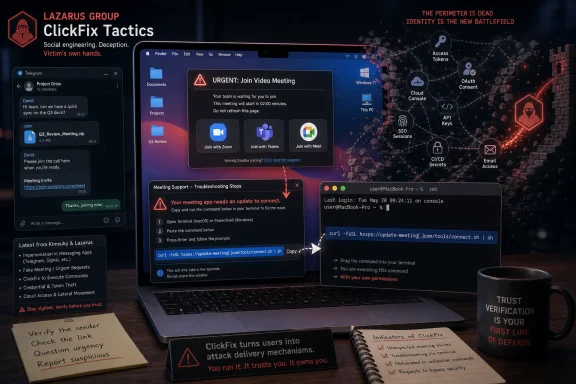
The latest campaign, dubbed Mach-O Man by CertiK researchers, fits that pattern. It does not depend on a spectacular zero-day or a noisy exploit chain. It depends on a carefully staged business interaction: an urgent meeting, a familiar collaboration brand, a plausible connection failure, and a “fix” that asks the user to run a command.
That is the grim elegance of ClickFix. It replaces exploit development with interface manipulation. The attacker does not need to bypass every technical barrier if the target can be persuaded to do the dangerous thing voluntarily.
That choice is not incidental. Video meetings have become an ambient obligation for executives, investors, founders, vendors, and incident responders. People join calls from airports, hotel rooms, home offices, and phones tethered to laptops. The muscle memory is already there: click the link, fix the audio, approve the prompt, get into the meeting before everyone assumes you are late.
Mach-O Man weaponizes that impatience. The fake meeting page tells the user that something has gone wrong and provides instructions that look like support guidance. On macOS, the target is told to paste a command into Terminal to resolve the issue.
For a security-aware reader, that sentence should trigger alarms. For a busy executive trying to enter a call, it may feel like one more irritating workaround in a world already full of browser permissions, camera prompts, app updates, and single sign-on loops. The attack succeeds because it borrows the language of productivity.
This is why “user education” is both essential and insufficient. Telling people not to paste commands into terminals is good policy. But the adversary is not sending the prompt in a vacuum; it is embedding the prompt inside a time-sensitive business ritual where the victim expects minor technical friction.
Security teams have spent years teaching users to be suspicious of attachments, macros, and password reset pages. ClickFix shifts the danger to a place many organizations have not modeled with the same rigor: copied commands. A command pasted into Terminal, PowerShell, Command Prompt, or a browser console can retrieve code, change permissions, install persistence, harvest tokens, or disable protections.
That is why Windows administrators should not dismiss Mach-O Man as a Mac problem. The delivery concept is portable. The exact binary format may be Apple’s Mach-O, but the behavioral exploit works just as well against employees who can be coaxed into PowerShell, Windows Terminal, or a “Run” dialog.
Microsoft has hardened many parts of Windows over the years, and enterprise controls can make script execution harder. But the reality inside many companies is messier. Developers, IT staff, finance operators, founders, and power users often have enough local privilege and enough SaaS access to make a single compromised workstation valuable.
The broader shift is from phishing for credentials to phishing for execution. Multi-factor authentication made password theft harder to monetize in isolation. Endpoint detection made commodity droppers noisier. ClickFix adapts by persuading the trusted user to become the installer.
That reflects a change in enterprise reality. In many startups, crypto firms, design-heavy organizations, and executive teams, macOS is not an exception. It is the default. The old security cliché that Macs are “safer” because attackers mostly target Windows has been obsolete for years, but it still lingers in procurement habits and user behavior.
Crypto and fintech firms are especially exposed to that mismatch. The people with the most valuable access may not sit behind the most mature controls. Founders and executives often prize speed, autonomy, and device preference. They also sit near treasury operations, investor communications, domain administration, cloud dashboards, code repositories, and signing workflows.
Lazarus understands that hierarchy. A malware campaign aimed at “executives” is not merely chasing status. It is chasing access density. One compromised executive device may contain browser sessions, password manager access, messaging history, wallet-adjacent material, cloud console permissions, and the social credibility to move laterally.
The fact that the malware reportedly deletes itself after execution only compounds the problem. Defenders may be left reconstructing an incident from endpoint telemetry, SaaS logs, identity events, and whatever traces survived cleanup. In crypto, where theft can become irreversible in minutes, that delay can be catastrophic.
This is an old phishing principle applied to a newer work pattern. The more routine a tool becomes, the less consciously people inspect it. A fake bank login once worked because online banking was familiar enough to trust but technical enough to confuse. Fake meeting lures work because online meetings now occupy that same cognitive space.
Telegram adds another layer. In crypto, Telegram is not an exotic side channel; it is part of the industry’s bloodstream. Deals, support conversations, community management, investor chats, and founder-to-founder introductions all flow through it. A compromised or impersonated Telegram account can therefore carry more social weight than an unknown email address.
That makes traditional email-centric controls less complete. Secure email gateways, domain-based authentication, and attachment scanning do not help much when the lure starts in a messaging platform and ends in a pasted local command. The attack path crosses identity, browser, endpoint, messaging, and SaaS boundaries.
Enterprise defenders often organize around those same boundaries. The attacker does not care. The attacker cares only that the executive believes the meeting is real long enough to run the command.
That is the tension behind Newson’s reported framing of Lazarus as something closer to a state-directed financial operation than random hacking. Banks have long treated nation-state cyber actors as permanent environmental risk. They assume targeting, persistence, and well-funded adversaries. Crypto firms often inherit the same threat level without the same governance maturity.
The result is a sector where the technical sophistication of the product can exceed the operational maturity of the company. A protocol team may understand cryptographic primitives deeply while still running executive communications through informal channels, weak device management, or ad hoc approval processes. A treasury operation may have multisig controls but weak protection around the humans who coordinate signing.
Mach-O Man exposes that gap. The attack does not need to break a blockchain if it can compromise the people and systems surrounding it. Domains, front-end deployments, cloud accounts, browser sessions, and internal chat all become part of the financial attack surface.
This is why the reported use of related techniques in DeFi domain hijacking matters. Replacing a legitimate site with a fake Cloudflare-style verification page is not simply a prank on visitors. It is a way to turn a trusted project’s own web presence into a malware delivery point.
PowerShell has long been both an administrator’s tool and an attacker’s favorite living-off-the-land environment. Microsoft has added logging, constrained language modes, Antimalware Scan Interface integration, and other defenses, but many organizations still struggle to operationalize them consistently. A pasted one-liner can be enough to pull down a payload, create persistence, or steal tokens if controls are loose.
The same applies to Windows Terminal, command prompts, WSL environments, developer shells, package managers, and remote management utilities. The more capable the workstation, the more dangerous the fake “fix” becomes. Developers and IT staff are especially attractive because running commands is normal for them.
That means security awareness training needs to become more specific. “Do not click suspicious links” is too vague for this threat. A better rule is blunt: no meeting platform, browser verification page, recruiter, investor, vendor, or support technician should ever require you to paste a command into a local shell to join a call.
There is also a policy implication. Organizations should consider whether high-risk users need technical guardrails that make these commands harder to execute casually. That can include application control, endpoint privilege management, script restrictions, shell logging, and conditional access rules that treat unusual device behavior as an identity risk.
When the binary is gone, investigators need process execution history, command-line logs, DNS queries, network connections, identity provider events, SaaS audit logs, browser artifacts, endpoint detection records, and cloud control-plane activity. That is not glamorous security work. It is retention, normalization, and disciplined review.
This is where mature enterprises have an advantage over younger firms with expensive assets but thin operations. They can answer boring questions quickly. Which command was run? Which process spawned it? Which domain did it contact? Which tokens were used afterward? Which SaaS sessions changed? Which files were accessed? Which MFA prompts appeared?
Crypto firms often need that capability even more than conventional companies because the blast radius can include irreversible asset movement. A delayed investigation is not just a compliance headache. It may be the difference between freezing downstream accounts and watching funds scatter through laundering infrastructure.
For Windows-heavy environments, the equivalent readiness means enabling and actually reviewing PowerShell logs, process creation events, Defender telemetry, identity sign-in anomalies, and cloud app audit trails. Logs are not a product feature to admire during procurement. They are the memory of the organization after the attacker tries to erase the scene.
Attackers exploit that learned obedience. The page need only look close enough, especially under time pressure. A fake Cloudflare verification page that asks a visitor to run a terminal command should be absurd, but the web has trained people to tolerate increasingly strange rituals before reaching content.
That is a design failure as much as a user failure. Legitimate services have normalized opaque checks, arbitrary prompts, background device tests, and troubleshooting flows that ask users to trust the page. Attackers then insert one malicious step into a familiar procession.
Security vendors often describe this as social engineering, and that is accurate. But the phrase can obscure the ecosystem’s contribution. If normal software constantly asks users to approve, paste, install, retry, verify, and bypass friction, users become easier to manipulate when the attacker asks for one more step.
The answer is not to make users paranoid about every prompt. It is to make certain prompts categorically out of bounds. A web page asking for a local shell command should be treated like a stranger asking for a house key.
One simple rule is that employees should prefer meetings created inside known corporate tenants. If an external party insists on a last-minute link through chat, staff should verify through a second channel. If a meeting page claims the app is broken and requests a command, the meeting should be considered hostile until proven otherwise.
This sounds cumbersome, but financial organizations already live with comparable friction. Wire transfers, vendor payment changes, and privileged access requests require confirmation because the cost of a mistake is high. Crypto firms need to apply the same thinking to collaboration workflows.
The trick is to make the secure path easier than improvisation. Provide approved conferencing defaults. Give executives a known internal helpdesk escalation path. Teach assistants and operations staff to challenge unusual meeting behavior. Make it normal to say, “Send the invite to my corporate calendar,” rather than accepting whatever link arrives in a Telegram message.
Security culture is not built by posters. It is built by repeated permission to slow down.
But Mach-O Man illustrates the limits of tools that assume maliciousness begins after execution. If the user willingly runs a command, the early stages may resemble administrative activity. If the payload is modular and short-lived, detection windows narrow. If the account belongs to an executive, exceptions may already exist.
This is especially dangerous in companies where senior leaders are exempt from controls because they find them inconvenient. Attackers know who gets exceptions. They know who travels. They know who handles urgent deals. They know who is least likely to sit through annual security training without multitasking.
A serious response therefore has to include executive constraint. Not symbolic participation, but real limits: managed devices, enforced updates, restricted local privilege, protected password managers, phishing-resistant MFA, conditional access, and logging that applies upward as well as downward.
The person with the most authority should not have the weakest endpoint.
That does not make them soft. It makes them efficient. A fake meeting invite can be tailored to a target’s current business context. A compromised account can provide credibility. A plausible page can supply the script. The victim can perform the action. The malware can vanish.
The economics are attractive for the attacker. Instead of burning a rare exploit, the operation burns infrastructure and social pretexts. Those can be regenerated. The same pattern can be reused across macOS, Windows, and Linux with platform-specific commands.
This is why Lazarus remains so dangerous to crypto. The group does not need one perfect tool. It needs a factory of workable intrusions. Mach-O Man appears to be one more line in that factory, optimized for the Apple-heavy executive layer of the financial technology world.
The defensive response must therefore be equally procedural. Organizations should not wait for indicators of compromise to decide whether fake meeting prompts are bad. They should predefine the behavior as unacceptable and build controls around it.
Lazarus will keep adapting because the incentive is enormous and the target environment remains rich. The next version may not be called Mach-O Man, may not start on Telegram, and may not target Macs first. But it will almost certainly exploit the same modern weakness: work now moves so quickly across chat, browser, identity, and endpoint that a convincing interruption can become an intrusion. The organizations that survive this phase will be the ones that make slowing down a security control rather than a cultural failure.
 Lazarus Has Stopped Looking Like a Gang and Started Looking Like a Finance Ministry
Lazarus Group has always occupied an uncomfortable space in cybersecurity reporting. It is described as a hacking group, but that phrase undersells the scale, patience, and institutional purpose of its work. The group is widely associated with North Korean state interests, and its crypto theft operations are better understood as a revenue stream than as ordinary cybercrime.That distinction matters because defenders tend to budget, staff, and prioritize differently depending on the enemy they think they are facing. A criminal crew may chase the easiest payout. A state-backed operation can afford reconnaissance, tailored lures, operational losses, and repeated attempts against the same sector because the mission is strategic.
The latest campaign, dubbed Mach-O Man by CertiK researchers, fits that pattern. It does not depend on a spectacular zero-day or a noisy exploit chain. It depends on a carefully staged business interaction: an urgent meeting, a familiar collaboration brand, a plausible connection failure, and a “fix” that asks the user to run a command.
That is the grim elegance of ClickFix. It replaces exploit development with interface manipulation. The attacker does not need to bypass every technical barrier if the target can be persuaded to do the dangerous thing voluntarily.
The Fake Meeting Is the Payload Before the Malware Arrives
The attack begins where modern work already lives: in chat. According to reporting around the CertiK disclosure, targets receive urgent meeting invitations over Telegram, often framed around routine business conversations. The links appear to lead to common conferencing platforms such as Zoom, Microsoft Teams, or Google Meet.That choice is not incidental. Video meetings have become an ambient obligation for executives, investors, founders, vendors, and incident responders. People join calls from airports, hotel rooms, home offices, and phones tethered to laptops. The muscle memory is already there: click the link, fix the audio, approve the prompt, get into the meeting before everyone assumes you are late.
Mach-O Man weaponizes that impatience. The fake meeting page tells the user that something has gone wrong and provides instructions that look like support guidance. On macOS, the target is told to paste a command into Terminal to resolve the issue.
For a security-aware reader, that sentence should trigger alarms. For a busy executive trying to enter a call, it may feel like one more irritating workaround in a world already full of browser permissions, camera prompts, app updates, and single sign-on loops. The attack succeeds because it borrows the language of productivity.
This is why “user education” is both essential and insufficient. Telling people not to paste commands into terminals is good policy. But the adversary is not sending the prompt in a vacuum; it is embedding the prompt inside a time-sensitive business ritual where the victim expects minor technical friction.
ClickFix Turns Helpdesk Theater Into an Attack Surface
ClickFix is a useful name because it captures the psychological contract being abused. The victim is not told, “Install malware.” The victim is told, “Your meeting is broken; here is the fix.” The command becomes a kind of counterfeit support script.Security teams have spent years teaching users to be suspicious of attachments, macros, and password reset pages. ClickFix shifts the danger to a place many organizations have not modeled with the same rigor: copied commands. A command pasted into Terminal, PowerShell, Command Prompt, or a browser console can retrieve code, change permissions, install persistence, harvest tokens, or disable protections.
That is why Windows administrators should not dismiss Mach-O Man as a Mac problem. The delivery concept is portable. The exact binary format may be Apple’s Mach-O, but the behavioral exploit works just as well against employees who can be coaxed into PowerShell, Windows Terminal, or a “Run” dialog.
Microsoft has hardened many parts of Windows over the years, and enterprise controls can make script execution harder. But the reality inside many companies is messier. Developers, IT staff, finance operators, founders, and power users often have enough local privilege and enough SaaS access to make a single compromised workstation valuable.
The broader shift is from phishing for credentials to phishing for execution. Multi-factor authentication made password theft harder to monetize in isolation. Endpoint detection made commodity droppers noisier. ClickFix adapts by persuading the trusted user to become the installer.
macOS Is No Longer the Quiet Corner of the Enterprise
The Mach-O detail is more than branding. Mach-O is the native executable format used by Apple operating systems, and CertiK’s description of the malware as built from native Mach-O binaries points to a campaign designed specifically for Apple environments. This is not Windows malware awkwardly ported to a Mac. It is built for the machines crypto executives actually carry.That reflects a change in enterprise reality. In many startups, crypto firms, design-heavy organizations, and executive teams, macOS is not an exception. It is the default. The old security cliché that Macs are “safer” because attackers mostly target Windows has been obsolete for years, but it still lingers in procurement habits and user behavior.
Crypto and fintech firms are especially exposed to that mismatch. The people with the most valuable access may not sit behind the most mature controls. Founders and executives often prize speed, autonomy, and device preference. They also sit near treasury operations, investor communications, domain administration, cloud dashboards, code repositories, and signing workflows.
Lazarus understands that hierarchy. A malware campaign aimed at “executives” is not merely chasing status. It is chasing access density. One compromised executive device may contain browser sessions, password manager access, messaging history, wallet-adjacent material, cloud console permissions, and the social credibility to move laterally.
The fact that the malware reportedly deletes itself after execution only compounds the problem. Defenders may be left reconstructing an incident from endpoint telemetry, SaaS logs, identity events, and whatever traces survived cleanup. In crypto, where theft can become irreversible in minutes, that delay can be catastrophic.
The Collaboration Stack Has Become a Trust Laundromat
Zoom, Teams, and Google Meet are not being attacked here in the conventional sense. Their brands are being used as trust containers. The victim sees the familiar meeting workflow and lends it credibility before evaluating the domain, the prompt, or the command.This is an old phishing principle applied to a newer work pattern. The more routine a tool becomes, the less consciously people inspect it. A fake bank login once worked because online banking was familiar enough to trust but technical enough to confuse. Fake meeting lures work because online meetings now occupy that same cognitive space.
Telegram adds another layer. In crypto, Telegram is not an exotic side channel; it is part of the industry’s bloodstream. Deals, support conversations, community management, investor chats, and founder-to-founder introductions all flow through it. A compromised or impersonated Telegram account can therefore carry more social weight than an unknown email address.
That makes traditional email-centric controls less complete. Secure email gateways, domain-based authentication, and attachment scanning do not help much when the lure starts in a messaging platform and ends in a pasted local command. The attack path crosses identity, browser, endpoint, messaging, and SaaS boundaries.
Enterprise defenders often organize around those same boundaries. The attacker does not care. The attacker cares only that the executive believes the meeting is real long enough to run the command.
The Crypto Sector Keeps Confusing Speed With Resilience
Crypto firms face a peculiar defensive burden. They operate in a sector where assets are liquid, settlement can be final, and attackers have a direct financial path from compromise to payout. Yet many organizations in the space still behave like startups first and financial institutions second.That is the tension behind Newson’s reported framing of Lazarus as something closer to a state-directed financial operation than random hacking. Banks have long treated nation-state cyber actors as permanent environmental risk. They assume targeting, persistence, and well-funded adversaries. Crypto firms often inherit the same threat level without the same governance maturity.
The result is a sector where the technical sophistication of the product can exceed the operational maturity of the company. A protocol team may understand cryptographic primitives deeply while still running executive communications through informal channels, weak device management, or ad hoc approval processes. A treasury operation may have multisig controls but weak protection around the humans who coordinate signing.
Mach-O Man exposes that gap. The attack does not need to break a blockchain if it can compromise the people and systems surrounding it. Domains, front-end deployments, cloud accounts, browser sessions, and internal chat all become part of the financial attack surface.
This is why the reported use of related techniques in DeFi domain hijacking matters. Replacing a legitimate site with a fake Cloudflare-style verification page is not simply a prank on visitors. It is a way to turn a trusted project’s own web presence into a malware delivery point.
Windows Admins Should Read This as a PowerShell Warning
WindowsForum readers may be tempted to file Mach-O Man under “Apple security.” That would be a mistake. The campaign is macOS-focused, but the tradecraft is cross-platform in spirit. If an attacker can persuade a user to paste a command into Terminal, the same adversary can rewrite the lure for PowerShell.PowerShell has long been both an administrator’s tool and an attacker’s favorite living-off-the-land environment. Microsoft has added logging, constrained language modes, Antimalware Scan Interface integration, and other defenses, but many organizations still struggle to operationalize them consistently. A pasted one-liner can be enough to pull down a payload, create persistence, or steal tokens if controls are loose.
The same applies to Windows Terminal, command prompts, WSL environments, developer shells, package managers, and remote management utilities. The more capable the workstation, the more dangerous the fake “fix” becomes. Developers and IT staff are especially attractive because running commands is normal for them.
That means security awareness training needs to become more specific. “Do not click suspicious links” is too vague for this threat. A better rule is blunt: no meeting platform, browser verification page, recruiter, investor, vendor, or support technician should ever require you to paste a command into a local shell to join a call.
There is also a policy implication. Organizations should consider whether high-risk users need technical guardrails that make these commands harder to execute casually. That can include application control, endpoint privilege management, script restrictions, shell logging, and conditional access rules that treat unusual device behavior as an identity risk.
The Disappearing Malware Problem Rewards Teams With Boring Logs
One of the more troubling claims around Mach-O Man is that the malware may remove itself by the time a breach is discovered. Self-deletion is not magical, and it does not erase every trace. But it does shift the burden onto telemetry that many organizations do not retain long enough or correlate well enough.When the binary is gone, investigators need process execution history, command-line logs, DNS queries, network connections, identity provider events, SaaS audit logs, browser artifacts, endpoint detection records, and cloud control-plane activity. That is not glamorous security work. It is retention, normalization, and disciplined review.
This is where mature enterprises have an advantage over younger firms with expensive assets but thin operations. They can answer boring questions quickly. Which command was run? Which process spawned it? Which domain did it contact? Which tokens were used afterward? Which SaaS sessions changed? Which files were accessed? Which MFA prompts appeared?
Crypto firms often need that capability even more than conventional companies because the blast radius can include irreversible asset movement. A delayed investigation is not just a compliance headache. It may be the difference between freezing downstream accounts and watching funds scatter through laundering infrastructure.
For Windows-heavy environments, the equivalent readiness means enabling and actually reviewing PowerShell logs, process creation events, Defender telemetry, identity sign-in anomalies, and cloud app audit trails. Logs are not a product feature to admire during procurement. They are the memory of the organization after the attacker tries to erase the scene.
The Browser Is Now a Stage, Not Just a Window
A fake meeting page or fake verification page is effective because the browser has become the stage on which users expect software to explain itself. Camera permission? Browser prompt. SSO redirect? Browser prompt. CAPTCHA? Browser prompt. Cloudflare check? Browser prompt. Meeting troubleshooting? Browser prompt.Attackers exploit that learned obedience. The page need only look close enough, especially under time pressure. A fake Cloudflare verification page that asks a visitor to run a terminal command should be absurd, but the web has trained people to tolerate increasingly strange rituals before reaching content.
That is a design failure as much as a user failure. Legitimate services have normalized opaque checks, arbitrary prompts, background device tests, and troubleshooting flows that ask users to trust the page. Attackers then insert one malicious step into a familiar procession.
Security vendors often describe this as social engineering, and that is accurate. But the phrase can obscure the ecosystem’s contribution. If normal software constantly asks users to approve, paste, install, retry, verify, and bypass friction, users become easier to manipulate when the attacker asks for one more step.
The answer is not to make users paranoid about every prompt. It is to make certain prompts categorically out of bounds. A web page asking for a local shell command should be treated like a stranger asking for a house key.
The Meeting Invite Needs a New Chain of Custody
High-value organizations should treat meeting links with more skepticism than they do today. Not every meeting requires a full verification ritual, but meetings involving treasury, investor relations, executive access, domain administration, hiring, partnerships, or incident response deserve stronger norms.One simple rule is that employees should prefer meetings created inside known corporate tenants. If an external party insists on a last-minute link through chat, staff should verify through a second channel. If a meeting page claims the app is broken and requests a command, the meeting should be considered hostile until proven otherwise.
This sounds cumbersome, but financial organizations already live with comparable friction. Wire transfers, vendor payment changes, and privileged access requests require confirmation because the cost of a mistake is high. Crypto firms need to apply the same thinking to collaboration workflows.
The trick is to make the secure path easier than improvisation. Provide approved conferencing defaults. Give executives a known internal helpdesk escalation path. Teach assistants and operations staff to challenge unusual meeting behavior. Make it normal to say, “Send the invite to my corporate calendar,” rather than accepting whatever link arrives in a Telegram message.
Security culture is not built by posters. It is built by repeated permission to slow down.
Vendor Controls Will Help, but They Will Not Save the Reckless
There are technical mitigations that matter. Endpoint detection can flag suspicious shell activity. Application control can block unknown binaries. Browser isolation can reduce exposure to malicious pages. Identity systems can detect impossible travel, new device sessions, suspicious OAuth grants, and risky sign-ins. SaaS platforms can alert on privilege changes, token creation, and abnormal downloads.But Mach-O Man illustrates the limits of tools that assume maliciousness begins after execution. If the user willingly runs a command, the early stages may resemble administrative activity. If the payload is modular and short-lived, detection windows narrow. If the account belongs to an executive, exceptions may already exist.
This is especially dangerous in companies where senior leaders are exempt from controls because they find them inconvenient. Attackers know who gets exceptions. They know who travels. They know who handles urgent deals. They know who is least likely to sit through annual security training without multitasking.
A serious response therefore has to include executive constraint. Not symbolic participation, but real limits: managed devices, enforced updates, restricted local privilege, protected password managers, phishing-resistant MFA, conditional access, and logging that applies upward as well as downward.
The person with the most authority should not have the weakest endpoint.
The Industry Keeps Chasing Exploits While Lazarus Chases Habits
There is a comforting clarity to vulnerability management. A CVE appears, a patch is issued, scanners light up, dashboards track compliance. It is measurable, and measurable things feel controllable. ClickFix attacks are messier because they target habits, urgency, and trust.That does not make them soft. It makes them efficient. A fake meeting invite can be tailored to a target’s current business context. A compromised account can provide credibility. A plausible page can supply the script. The victim can perform the action. The malware can vanish.
The economics are attractive for the attacker. Instead of burning a rare exploit, the operation burns infrastructure and social pretexts. Those can be regenerated. The same pattern can be reused across macOS, Windows, and Linux with platform-specific commands.
This is why Lazarus remains so dangerous to crypto. The group does not need one perfect tool. It needs a factory of workable intrusions. Mach-O Man appears to be one more line in that factory, optimized for the Apple-heavy executive layer of the financial technology world.
The defensive response must therefore be equally procedural. Organizations should not wait for indicators of compromise to decide whether fake meeting prompts are bad. They should predefine the behavior as unacceptable and build controls around it.
The Practical Lesson Hidden Inside Mach-O Man
Mach-O Man is not just another Lazarus campaign name to add to a threat intelligence slide. It is a warning that the collaboration layer has become a financial attack surface, and that high-value users need rules that match their risk. The most concrete lessons are simple enough to write down and hard enough to enforce.- No legitimate meeting platform should require a user to paste a command into Terminal, PowerShell, Command Prompt, or any local shell to join a call.
- Executives, founders, developers, finance staff, and administrators should use managed devices with the same or stronger controls applied to the rest of the company.
- Meeting invitations involving money, access, hiring, partnerships, or incident response should be verified through trusted corporate channels when they arrive through chat apps.
- Security teams should log and alert on suspicious shell execution, especially commands launched after visiting conferencing, verification, or support-themed web pages.
- Crypto and fintech firms should treat domain administration, SaaS sessions, browser profiles, and executive messaging accounts as part of their treasury security model.
- Incident response plans should assume the malware may be gone by discovery time and should preserve identity, endpoint, network, and SaaS telemetry accordingly.
Lazarus will keep adapting because the incentive is enormous and the target environment remains rich. The next version may not be called Mach-O Man, may not start on Telegram, and may not target Macs first. But it will almost certainly exploit the same modern weakness: work now moves so quickly across chat, browser, identity, and endpoint that a convincing interruption can become an intrusion. The organizations that survive this phase will be the ones that make slowing down a security control rather than a cultural failure.
References
- Primary source: CoinMarketCap
Published: 2026-06-22T21:42:07.940617
- Related coverage: cryptotimes.io
Lazarus Group Targets Crypto Firms With “Mach-O Man”: Certik
North Korea’s Lazarus Group is running a new “Mach-O Man” macOS malware campaign targeting crypto executives through fake meeting invites on Telegram.www.cryptotimes.io - Related coverage: coindesk.com
Hackers respaldados por Corea del Norte implementan un nuevo vector de ataque dirigido a ejecutivos y empresas de criptomonedas
La firma de seguridad CertiK advierte que el Grupo Lazarus ha creado un nuevo malware que lo hace especialmente peligroso.www.coindesk.com - Related coverage: crypto.news
Lazarus Group Uses Fake Meeting Hack
North Korea's Lazarus Group is targeting crypto executives with a new macOS malware campaigncrypto.news - Related coverage: coinalertnews.com
Lazarus Group Deploys New macOS Malware 'Mach-O Man' to Target Crypto Executives, Linked to $500M+ DeFi Exploits
North Korean hackers use fake meeting invites to deploy macOS malware, stealing credentials and directly funding major exploits on DeFi platforms like Drift and KelpDAO.coinalertnews.com - Related coverage: cointelegraph.com
Lazarus Group Malware Targets Crypto, Business Execs via macOS
Lazarus Group is targeting fintech and crypto executives using macOS through a new malware kit delivered via social engineering schemes using fake Zoom or Google Meet calls. cointelegraph.com
- Related coverage: block-chain24.com
По словам CertiK, группа Lazarus стала особенно опасна благодаря новой атаке типа «Mach-O Man»
«Северокорейская государственная группа Lazarus Group проводит новую кампанию под названием «Mach-O Man», которая превращает обычную деловую переписку в прямой путь к краже учетных данных и потере информации», - предупредили в среду эксперты по безопасности.www.block-chain24.com - Related coverage: news.bitcoin.com
Mach-O Man-skadevare stjeler macOS-nøkkelringdata i Lazarus-gruppens kryptokampanje - Bitcoin News
Nord-Koreas Lazarus Group retter seg mot macOS-kryptobrukere med Mach-O Man-skadevare via falske Zoom- og Teams-møtelenker ved å bruke Clickfix-taktikker. news.bitcoin.com
- Related coverage: en.spaziocrypto.com
Mach-O Man: Lazarus Targets Crypto CEOs on Mac
Lazarus Group's Mach-O Man malware hits macOS crypto executives via fake Zoom calls. KelpDAO and Drift already compromised. Protect yourself now. en.spaziocrypto.com
- Related coverage: lazarus.day
