

Leica announced the Cine Compact 1, a 4K triple-RGB laser mini projector with 360-degree rotation, automatic setup, VIDAA streaming, and a June 18, 2026 launch across major regions, positioning it as the company’s smallest and least expensive home-cinema projector to date. The short version is that Leica is no longer treating projection as furniture. It is trying to turn the projector into a movable screen engine for rooms that were never designed as theaters. That shift matters because the projector market is being pulled in two directions at once: toward premium optical claims at one end and casual, ceiling-friendly lifestyle viewing at the other.
Leica’s first wave of home-cinema projectors leaned into permanence. The Cine 1 was an ultra-short-throw machine built around the idea that a projector could replace a television, provided the buyer had the right wall, the right cabinet, the right screen, and a tolerance for high-end pricing. It was less a gadget than an installation.
The Cine Compact 1 is a different kind of bet. It still wears the Leica vocabulary — Summicron lens, aluminum body, glass front, image optimization, triple-laser color — but it moves the product into the looser world of portable projection. The interesting part is not merely that it is smaller. It is that Leica is conceding that many people no longer want the home theater to be a room.
That concession puts Leica into a category already crowded with “lifestyle” projectors from brands that know how to sell convenience. The rotating body, automatic keystone correction, autofocus, intelligent framing, built-in sound, and streaming operating system are all familiar features in that world. Leica’s challenge is to persuade buyers that its optical and color story is not just a luxury badge pasted onto a trend.
At $1,995 in the United States, this is still not an impulse buy. But it is a very different price signal from Leica’s earlier projector efforts. It places the Cine Compact 1 in the uncomfortable middle ground between serious home-theater hardware and premium portable entertainment appliance — and that middle ground is exactly where the projector market is becoming most interesting.
Traditional projectors ask the room to cooperate. Ultra-short-throw projectors ask for a dedicated surface and precise placement. Long-throw models ask for distance, mounting, cables, and patience. The Cine Compact 1 asks for a table and a blank-enough surface.
That is a very consumer-electronics way of thinking. The product is less about reproducing the ritual of cinema and more about removing the friction that keeps people from using a projector on a Tuesday night. Leica’s promise is that the device can be set down, rotated into position, allowed to focus and correct itself, and then left to do the hard work.
For WindowsForum readers, that matters because the projector is increasingly becoming just another display endpoint. Whether the source is a built-in app, a console, a laptop, a mini PC, or a handheld gaming device, the value of the projector increasingly depends on how quickly it can become useful. In that sense, the rotating stand is not an accessory. It is the user interface.
The technical foundation is familiar: a DLP system using a small DMD chip and pixel-shifting techniques to deliver a 4K image. That is not unusual in compact projectors, and it does not automatically make the Leica inferior. But it does mean buyers should understand that “4K projector” can describe several different implementations, not all of which resemble a native 4K panel in the way a TV buyer might assume.
The triple-RGB laser light source is the more consequential claim. By using separate red, green, and blue lasers, the projector can target very wide color coverage without the same compromises associated with some lamp or LED designs. Leica says the Cine Compact 1 covers more than 100 percent of BT.2020, a bold figure that will appeal to spec-sheet readers even if real-world perception will depend heavily on calibration, content, screen material, and ambient light.
The 1,700-lumen brightness rating also needs context. That is strong for a compact lifestyle projector, but it is not magic. Leica’s own positioning implies a practical distinction between smaller images in brighter spaces and very large images in dark conditions. A 220-inch projection is an impressive number, but it is the kind of number best read as an upper limit rather than an everyday recommendation.
This is where Leica’s camera heritage both helps and hurts. Buyers expect Leica to care about image character, contrast, color, and lens quality. They may also expect miracles that physics does not provide. A compact projector can be excellent, but it cannot repeal the relationship between image size, brightness, ambient light, and screen quality.
Still, HDR on projectors remains a more complicated subject than HDR on televisions. A good OLED or Mini LED TV can produce intense highlights and deep blacks in a way that projectors struggle to match, especially in rooms with stray light. Projector HDR is often about tone mapping — deciding what to preserve, what to compress, and how to keep the image watchable without destroying the intent of the content.
Leica’s Image Optimization processing is therefore central to the product’s credibility. The company can talk about laser color and lens quality, but the everyday experience will often be determined by processing decisions. Skin tones, shadow detail, highlight clipping, motion handling, and color volume are where premium projectors separate themselves from flashy spec-sheet hardware.
The inclusion of Filmmaker Mode is a useful signal, though not a guarantee. It suggests that Leica knows some buyers want less processing, not more. That is important in a category where lifestyle projectors can overcook images in pursuit of showroom punch.
The best version of the Cine Compact 1 is not necessarily the brightest or most saturated version. It is the one that lets a user move the projector around without feeling as if every new wall requires a full calibration session. That is the promise Leica is selling: not just picture quality, but portable picture quality that survives ordinary rooms.
The deeper issue is that smart-TV platforms are never just app launchers. They determine update cadence, app availability, privacy posture, voice-control behavior, wireless-casting compatibility, and how gracefully the device ages. A premium projector is expected to last longer than a cheap streaming dongle, but streaming platforms have a habit of making expensive hardware feel old before the optics give out.
That tension is not unique to Leica. Every premium display manufacturer faces it. The panel or projection engine may remain capable for a decade, while the software stack can become annoying in three years. Buyers who care about longevity will still want to know how easily the Cine Compact 1 works with external devices over HDMI and how cleanly it can be treated as a display rather than an app appliance.
For Windows users, the obvious question is how well it behaves with laptops, mini PCs, and handheld gaming systems. Leica’s advertised 4K at 60Hz and 2K at up to 240Hz give it a credible gaming and PC-display story on paper. The 20ms gaming latency figure is respectable for casual play, though competitive players will still prefer monitors or gaming TVs with lower input lag.
The presence of Apple AirPlay is convenient, but Windows households will care more about HDMI behavior, Bluetooth audio reliability, and whether the projector avoids the handshake weirdness that can plague HDR, refresh-rate switching, and copy-protected streaming. In real homes, the difference between “premium” and “frustrating” often shows up in those moments.
The 240Hz figure will attract attention, especially from PC gamers, but it should be interpreted carefully. Resolution, source compatibility, HDMI bandwidth, and actual input latency all matter. A projector can advertise a high refresh mode while still being less suitable for serious competitive play than a dedicated monitor.
Even so, the appeal is real. A rotating compact projector paired with a Windows handheld, a small gaming PC, or a console can produce the kind of oversized, casual gaming experience that a monitor cannot. This is not about esports precision. It is about turning a bedroom ceiling, dorm wall, patio screen, or basement into a temporary play space.
That is where the Cine Compact 1’s form factor may be more important than its peak specs. The best gaming display is often the one already connected and aimed correctly. If Leica’s auto setup works as advertised, the device could become a surprisingly practical social gaming machine.
There is a broader market signal here. Gaming has pushed display makers to treat refresh rate and latency as mainstream requirements, not niche features. The fact that Leica is including a specific gaming story in a compact projector says something about where home-cinema products are going. The theater is no longer the only room that matters.
Built-in audio will probably be good enough for casual use, especially in bedrooms, kitchens, dorm rooms, and temporary outdoor setups. It will not replace a proper surround system, and Leica likely knows that. The more important feature is flexibility: wired outputs, Bluetooth pairing, and the ability to hand audio off to a better system when the projector becomes part of a more deliberate setup.
This is another area where compact projectors live or die by convenience. A portable projector with weak audio becomes a two-device problem. A portable projector with acceptable built-in sound becomes something people actually use. The threshold is not cinematic perfection; it is whether the device can deliver a complete-enough experience without turning every viewing session into a wiring project.
Virtual surround branding should be treated with the usual skepticism. Small speakers can create a wider soundstage, but they cannot produce the physical scale of a real multi-speaker setup. Still, for a projector designed to beam an image onto a ceiling or wall at odd angles, integrated audio is not optional. It is part of the portability promise.
Leica is therefore not competing on raw value. It is competing on trust, industrial design, optics, color claims, and the expectation that the product will feel more polished than a generic box with a laser engine. That is a viable premium strategy, but only if the experience is consistently premium.
The risk is that lifestyle projector buyers may not assign the same value to Leica’s optical story that camera buyers do. A photographer may immediately understand why a lens name matters. A streaming-first household may care more about app speed, remote design, fan noise, boot time, Wi-Fi reliability, and whether the projector remembers its settings.
This is the core tension of the product. Leica is bringing a prestige-image argument into a category increasingly defined by convenience. The Cine Compact 1 has to win both ways. If it is merely convenient, cheaper rivals will pressure it. If it is merely optically refined, casual buyers may ignore it.
The most persuasive version of the product is one where the Leica premium is felt every time the image snaps into place. That means quiet operation, consistent autofocus, reliable keystone correction, restrained processing, good color out of the box, and a body that feels durable enough to be moved often. Premium, in this category, is not a logo. It is the absence of fiddling.
The Cine Compact 1 shows that the concept has climbed into a more serious tier. Leica is not the first to make a rotating projector, and it will not be the last. What matters is that a company built on premium optics now sees this form factor as worthy of its name.
That says something about changing display habits. The television remains the center of the living room, but it is no longer the only screen that matters. Tablets, laptops, handheld consoles, and phones have trained users to expect media to follow them. A portable projector is an attempt to make the large screen behave the same way.
There is a tradeoff, of course. A TV is predictable. It has fixed brightness, fixed geometry, fixed speakers, and a known relationship to the room. A projector is conditional. It depends on surface, light, distance, angle, and setup. The Cine Compact 1 is an attempt to automate away enough of those conditions that the projector feels less like equipment and more like a display you can point.
That is why the automation stack matters as much as the laser engine. Autofocus and keystone correction used to be convenience features. In a rotating projector, they become essential. If the user has to manually correct the image every time the body moves, the whole premise collapses.
That distinction is useful. Many “portable” devices are technically movable but practically annoying. They lack battery power, require external speakers, need a streaming stick, or demand a stable tripod. Leica’s approach appears to be less about camping minimalism and more about domestic flexibility.
The device’s aluminum body and glass front reinforce that reading. This is not rugged outdoor gear. It is a premium object meant to live in a home and occasionally migrate from a living room table to a bedroom dresser to a patio. That may be exactly what many buyers want.
The lack of a built-in battery, if confirmed in practice by retail units, would not be surprising. High-brightness laser projection and long battery life are not easy partners. For a device promising 1,700 lumens and 4K playback, wall power is a reasonable expectation.
The more important portability question is cable discipline. A projector that needs only power and Wi-Fi feels portable. A projector that quickly accumulates HDMI cables, audio cables, adapters, and streaming devices becomes semi-permanent by accident. Leica’s built-in software and sound system are designed to prevent that slide.
A compact laser projector with automatic alignment and wireless features could be attractive in small offices, training rooms, studios, classrooms, and temporary meeting spaces. That does not mean Leica is the obvious enterprise choice. Procurement departments are rarely eager to pay a Leica premium for a device whose main pitch is cinematic lifestyle design.
But the product points toward where business projection is going. Fixed ceiling mounts and complicated room-control systems still matter in formal spaces, but smaller teams increasingly want gear that can be moved, reconfigured, and used without a technician. Automatic setup is not just a consumer convenience. It is an IT labor reducer.
The caution for administrators is the same as with smart TVs. Any display with an operating system, Wi-Fi, Bluetooth, streaming apps, voice features, and update requirements becomes part of the managed environment whether the vendor calls it an endpoint or not. If a projector joins the network, it deserves the same scrutiny as any other smart device.
That includes update policy, account handling, wireless casting controls, app permissions, and whether the device can be segmented away from sensitive systems. A premium brand does not automatically imply enterprise-grade manageability. In mixed-use offices, the smartest projector may still be the one that can behave dumbly when IT asks it to.
The 60-to-220-inch image range gives Leica room to claim both everyday practicality and cinematic scale. The 1.0-to-1.3 optical throw ratio suggests useful placement flexibility without drifting into ultra-short-throw territory. The 1.3x optical zoom helps resize the image without relying entirely on digital tricks. The 25,000-hour laser lifespan claim reinforces the idea that this is a long-term display device, not a disposable gadget.
The automatic image adjustment features are where those specs become usable. Autofocus, keystone correction, and intelligent screen framing are especially important because a rotating projector will constantly be used at non-ideal angles. The more the projector is moved, the more valuable automation becomes.
There is also an honest limit here. Keystone correction is convenient, but it is not free. Heavy correction can reduce effective resolution and introduce artifacts. Serious users will still prefer careful placement when image quality matters most. Convenience features make a projector easier to live with; they do not eliminate geometry.
That is why Leica’s best pitch is not “no compromises.” It is “fewer compromises in more places.” A portable projector will always trade some fixed-installation purity for flexibility. The question is whether the trade feels worth it.
Leica’s presence helps because the brand has reputational capital. Buyers may reasonably expect better lens quality, more conservative image tuning, and a higher level of fit and finish. But reputation is not a substitute for measurement.
Independent reviews will need to answer the hard questions. How bright is the projector in calibrated modes? How accurate is its color out of the box? How loud is the fan under real viewing conditions? How well does it handle Dolby Vision tone mapping? Does autofocus remain stable after the unit warms up? Does the image stay sharp across the frame? How intrusive is laser speckle on common screen materials?
Those answers will determine whether the Cine Compact 1 is a serious premium compact projector or simply a beautiful one. Leica can win the announcement cycle with industrial design and specifications. It wins the living room only if the image holds up after the novelty of ceiling projection fades.
That is the burden of entering a maturing category. Early portable projectors were allowed to be charmingly flawed. A $1,995 Leica is not. The logo raises expectations, and expectations are expensive.
Televisions are brutally competitive. They are bright, simple, increasingly large, and often discounted. A 75-inch or 85-inch TV can deliver excellent HDR performance in a lit room with far fewer variables than any projector. For buyers who want the best image per dollar in a fixed location, a TV remains hard to beat.
The projector’s advantage is scale and flexibility. It can create an image much larger than most affordable televisions, disappear when not in use, and move to places where a TV would be absurd. The Cine Compact 1 leans into those advantages rather than pretending to be a direct TV replacement.
That is a smart distinction. Leica’s earlier ultra-short-throw products were more clearly aimed at replacing the living-room television for affluent buyers. The Cine Compact 1 is more of an addition: the screen for rooms without screens, nights when the couch is not the destination, and users who want a cinematic image without committing a wall to hardware.
In other words, Leica is not just selling better projection. It is selling optionality. The buyer is paying for the ability to make a big screen appear in more places, with fewer rituals.
That is a harder standard than it sounds. A lifestyle projector is handled more often, placed in worse locations, connected to more sources, and judged by people who may not care about calibration charts. It has to be technically competent and emotionally frictionless.
Leica seems to understand that. The product’s design language is restrained rather than toy-like. The automation features are front and center. The streaming system is built in. The audio is included. The rotation mechanism is not hidden as a secondary feature; it defines the product’s posture.
The company’s challenge is that convenience is easier for rivals to copy than optical heritage. Other manufacturers can build rotating stands, add autofocus, license streaming apps, and chase high brightness figures. Leica’s defensible ground is the quality of the whole system: lens, processing, color, build, support, and reliability.
If that whole system works, the Cine Compact 1 could become the first Leica projector that feels less like a statement purchase and more like a practical luxury. If it does not, it risks becoming another beautiful device in a category full of surprisingly capable alternatives.
 Leica Shrinks the Theater Instead of Shrinking the Ambition
Leica’s first wave of home-cinema projectors leaned into permanence. The Cine 1 was an ultra-short-throw machine built around the idea that a projector could replace a television, provided the buyer had the right wall, the right cabinet, the right screen, and a tolerance for high-end pricing. It was less a gadget than an installation.The Cine Compact 1 is a different kind of bet. It still wears the Leica vocabulary — Summicron lens, aluminum body, glass front, image optimization, triple-laser color — but it moves the product into the looser world of portable projection. The interesting part is not merely that it is smaller. It is that Leica is conceding that many people no longer want the home theater to be a room.
That concession puts Leica into a category already crowded with “lifestyle” projectors from brands that know how to sell convenience. The rotating body, automatic keystone correction, autofocus, intelligent framing, built-in sound, and streaming operating system are all familiar features in that world. Leica’s challenge is to persuade buyers that its optical and color story is not just a luxury badge pasted onto a trend.
At $1,995 in the United States, this is still not an impulse buy. But it is a very different price signal from Leica’s earlier projector efforts. It places the Cine Compact 1 in the uncomfortable middle ground between serious home-theater hardware and premium portable entertainment appliance — and that middle ground is exactly where the projector market is becoming most interesting.
The Rotating Stand Is the Product Strategy
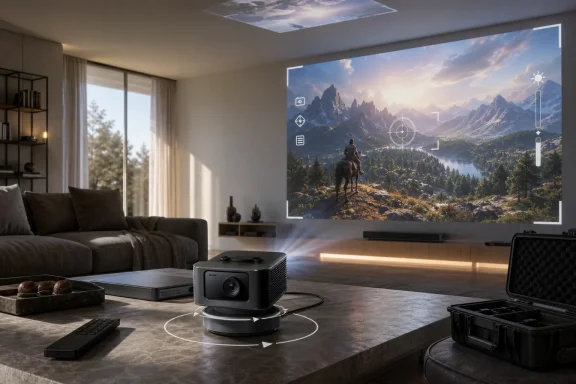
The headline feature is the 360-degree rotation system, and it should not be dismissed as a gimmick. Ceiling projection has become a shorthand for a new use case: watching a film in bed, playing a casual game on a blank wall, throwing a workout video across a room, or turning an outdoor surface into a temporary screen. A projector that can easily aim upward is not just more flexible; it changes when and where the device gets used.Traditional projectors ask the room to cooperate. Ultra-short-throw projectors ask for a dedicated surface and precise placement. Long-throw models ask for distance, mounting, cables, and patience. The Cine Compact 1 asks for a table and a blank-enough surface.
That is a very consumer-electronics way of thinking. The product is less about reproducing the ritual of cinema and more about removing the friction that keeps people from using a projector on a Tuesday night. Leica’s promise is that the device can be set down, rotated into position, allowed to focus and correct itself, and then left to do the hard work.
For WindowsForum readers, that matters because the projector is increasingly becoming just another display endpoint. Whether the source is a built-in app, a console, a laptop, a mini PC, or a handheld gaming device, the value of the projector increasingly depends on how quickly it can become useful. In that sense, the rotating stand is not an accessory. It is the user interface.
Leica’s Optics Story Meets the Reality of DLP Projection
Leica’s brand gives the Cine Compact 1 an immediate advantage in a category where many buyers struggle to distinguish between spec sheets. The company is leaning on a Leica Summicron zoom lens with aspherical elements, triple RGB laser illumination, and Leica Image Optimization processing. Those phrases are doing a lot of work.The technical foundation is familiar: a DLP system using a small DMD chip and pixel-shifting techniques to deliver a 4K image. That is not unusual in compact projectors, and it does not automatically make the Leica inferior. But it does mean buyers should understand that “4K projector” can describe several different implementations, not all of which resemble a native 4K panel in the way a TV buyer might assume.
The triple-RGB laser light source is the more consequential claim. By using separate red, green, and blue lasers, the projector can target very wide color coverage without the same compromises associated with some lamp or LED designs. Leica says the Cine Compact 1 covers more than 100 percent of BT.2020, a bold figure that will appeal to spec-sheet readers even if real-world perception will depend heavily on calibration, content, screen material, and ambient light.
The 1,700-lumen brightness rating also needs context. That is strong for a compact lifestyle projector, but it is not magic. Leica’s own positioning implies a practical distinction between smaller images in brighter spaces and very large images in dark conditions. A 220-inch projection is an impressive number, but it is the kind of number best read as an upper limit rather than an everyday recommendation.
This is where Leica’s camera heritage both helps and hurts. Buyers expect Leica to care about image character, contrast, color, and lens quality. They may also expect miracles that physics does not provide. A compact projector can be excellent, but it cannot repeal the relationship between image size, brightness, ambient light, and screen quality.
Dolby Vision on a Projector Is Useful, but Not a Spell
The Cine Compact 1 supports Dolby Vision, HDR10+, HDR10, and HLG. That is the kind of format checklist premium buyers increasingly expect, and it matters because streaming libraries have become fragmented across HDR standards. A projector that handles more of them reduces the odds that a user ends up watching a flattened or poorly mapped image.Still, HDR on projectors remains a more complicated subject than HDR on televisions. A good OLED or Mini LED TV can produce intense highlights and deep blacks in a way that projectors struggle to match, especially in rooms with stray light. Projector HDR is often about tone mapping — deciding what to preserve, what to compress, and how to keep the image watchable without destroying the intent of the content.
Leica’s Image Optimization processing is therefore central to the product’s credibility. The company can talk about laser color and lens quality, but the everyday experience will often be determined by processing decisions. Skin tones, shadow detail, highlight clipping, motion handling, and color volume are where premium projectors separate themselves from flashy spec-sheet hardware.
The inclusion of Filmmaker Mode is a useful signal, though not a guarantee. It suggests that Leica knows some buyers want less processing, not more. That is important in a category where lifestyle projectors can overcook images in pursuit of showroom punch.
The best version of the Cine Compact 1 is not necessarily the brightest or most saturated version. It is the one that lets a user move the projector around without feeling as if every new wall requires a full calibration session. That is the promise Leica is selling: not just picture quality, but portable picture quality that survives ordinary rooms.
VIDAA Makes the Projector Independent, but Not Neutral
Leica chose VIDAA as the operating system for the Cine Compact 1, giving the projector built-in access to major streaming services including Netflix, Disney+, and Amazon Prime Video. That is the right move for a portable product. A projector that needs a separate streaming stick is still useful, but it is less spontaneous.The deeper issue is that smart-TV platforms are never just app launchers. They determine update cadence, app availability, privacy posture, voice-control behavior, wireless-casting compatibility, and how gracefully the device ages. A premium projector is expected to last longer than a cheap streaming dongle, but streaming platforms have a habit of making expensive hardware feel old before the optics give out.
That tension is not unique to Leica. Every premium display manufacturer faces it. The panel or projection engine may remain capable for a decade, while the software stack can become annoying in three years. Buyers who care about longevity will still want to know how easily the Cine Compact 1 works with external devices over HDMI and how cleanly it can be treated as a display rather than an app appliance.
For Windows users, the obvious question is how well it behaves with laptops, mini PCs, and handheld gaming systems. Leica’s advertised 4K at 60Hz and 2K at up to 240Hz give it a credible gaming and PC-display story on paper. The 20ms gaming latency figure is respectable for casual play, though competitive players will still prefer monitors or gaming TVs with lower input lag.
The presence of Apple AirPlay is convenient, but Windows households will care more about HDMI behavior, Bluetooth audio reliability, and whether the projector avoids the handshake weirdness that can plague HDR, refresh-rate switching, and copy-protected streaming. In real homes, the difference between “premium” and “frustrating” often shows up in those moments.
Gaming Mode Pushes the Projector Beyond Movie Night
Leica’s Game Mode is one of the more revealing parts of the spec sheet. The Cine Compact 1 can run 4K at 60Hz, but it can also support 2K at 120Hz or 240Hz with latency rated below 20ms in gaming mode. That tells us Leica knows the modern projector is no longer only competing with televisions during film night.The 240Hz figure will attract attention, especially from PC gamers, but it should be interpreted carefully. Resolution, source compatibility, HDMI bandwidth, and actual input latency all matter. A projector can advertise a high refresh mode while still being less suitable for serious competitive play than a dedicated monitor.
Even so, the appeal is real. A rotating compact projector paired with a Windows handheld, a small gaming PC, or a console can produce the kind of oversized, casual gaming experience that a monitor cannot. This is not about esports precision. It is about turning a bedroom ceiling, dorm wall, patio screen, or basement into a temporary play space.
That is where the Cine Compact 1’s form factor may be more important than its peak specs. The best gaming display is often the one already connected and aimed correctly. If Leica’s auto setup works as advertised, the device could become a surprisingly practical social gaming machine.
There is a broader market signal here. Gaming has pushed display makers to treat refresh rate and latency as mainstream requirements, not niche features. The fact that Leica is including a specific gaming story in a compact projector says something about where home-cinema products are going. The theater is no longer the only room that matters.
The Audio System Is a Convenience, Not a Replacement for a Theater
The Cine Compact 1 includes a 20W stereo sound system with Dolby Digital Plus and DTS Virtual:X support. That is sensible for a portable projector. If the goal is to move from room to room, the product cannot assume a soundbar follows behind it.Built-in audio will probably be good enough for casual use, especially in bedrooms, kitchens, dorm rooms, and temporary outdoor setups. It will not replace a proper surround system, and Leica likely knows that. The more important feature is flexibility: wired outputs, Bluetooth pairing, and the ability to hand audio off to a better system when the projector becomes part of a more deliberate setup.
This is another area where compact projectors live or die by convenience. A portable projector with weak audio becomes a two-device problem. A portable projector with acceptable built-in sound becomes something people actually use. The threshold is not cinematic perfection; it is whether the device can deliver a complete-enough experience without turning every viewing session into a wiring project.
Virtual surround branding should be treated with the usual skepticism. Small speakers can create a wider soundstage, but they cannot produce the physical scale of a real multi-speaker setup. Still, for a projector designed to beam an image onto a ceiling or wall at odd angles, integrated audio is not optional. It is part of the portability promise.
The Price Is Lower for Leica, Not Low for Everyone Else
At $1,995, the Cine Compact 1 is inexpensive only by Leica projector standards. That distinction matters. The broader projector market includes many cheaper portable models, including compact 4K-labeled devices and bright lifestyle projectors from companies that have been chasing this category aggressively.Leica is therefore not competing on raw value. It is competing on trust, industrial design, optics, color claims, and the expectation that the product will feel more polished than a generic box with a laser engine. That is a viable premium strategy, but only if the experience is consistently premium.
The risk is that lifestyle projector buyers may not assign the same value to Leica’s optical story that camera buyers do. A photographer may immediately understand why a lens name matters. A streaming-first household may care more about app speed, remote design, fan noise, boot time, Wi-Fi reliability, and whether the projector remembers its settings.
This is the core tension of the product. Leica is bringing a prestige-image argument into a category increasingly defined by convenience. The Cine Compact 1 has to win both ways. If it is merely convenient, cheaper rivals will pressure it. If it is merely optically refined, casual buyers may ignore it.
The most persuasive version of the product is one where the Leica premium is felt every time the image snaps into place. That means quiet operation, consistent autofocus, reliable keystone correction, restrained processing, good color out of the box, and a body that feels durable enough to be moved often. Premium, in this category, is not a logo. It is the absence of fiddling.
The Ceiling Projector Trend Has Grown Up
Ceiling projection began as a novelty for many consumers. Cheap portable projectors promised giant images from tiny boxes, often with underwhelming brightness, noisy fans, clumsy software, and exaggerated specifications. But the underlying idea was sound: people wanted screens that could appear where televisions could not.The Cine Compact 1 shows that the concept has climbed into a more serious tier. Leica is not the first to make a rotating projector, and it will not be the last. What matters is that a company built on premium optics now sees this form factor as worthy of its name.
That says something about changing display habits. The television remains the center of the living room, but it is no longer the only screen that matters. Tablets, laptops, handheld consoles, and phones have trained users to expect media to follow them. A portable projector is an attempt to make the large screen behave the same way.
There is a tradeoff, of course. A TV is predictable. It has fixed brightness, fixed geometry, fixed speakers, and a known relationship to the room. A projector is conditional. It depends on surface, light, distance, angle, and setup. The Cine Compact 1 is an attempt to automate away enough of those conditions that the projector feels less like equipment and more like a display you can point.
That is why the automation stack matters as much as the laser engine. Autofocus and keystone correction used to be convenience features. In a rotating projector, they become essential. If the user has to manually correct the image every time the body moves, the whole premise collapses.
Portable Does Not Always Mean Travel-Friendly
Leica describes the Cine Compact 1 as portable, and the company includes a transport case. But this is not a pocket projector, and it should not be judged as one. It is better understood as house-portable — easy to move between rooms, not necessarily something you toss into a backpack without thinking.That distinction is useful. Many “portable” devices are technically movable but practically annoying. They lack battery power, require external speakers, need a streaming stick, or demand a stable tripod. Leica’s approach appears to be less about camping minimalism and more about domestic flexibility.
The device’s aluminum body and glass front reinforce that reading. This is not rugged outdoor gear. It is a premium object meant to live in a home and occasionally migrate from a living room table to a bedroom dresser to a patio. That may be exactly what many buyers want.
The lack of a built-in battery, if confirmed in practice by retail units, would not be surprising. High-brightness laser projection and long battery life are not easy partners. For a device promising 1,700 lumens and 4K playback, wall power is a reasonable expectation.
The more important portability question is cable discipline. A projector that needs only power and Wi-Fi feels portable. A projector that quickly accumulates HDMI cables, audio cables, adapters, and streaming devices becomes semi-permanent by accident. Leica’s built-in software and sound system are designed to prevent that slide.
Enterprise Buyers Will Notice the Shape, Even If Leica Is Selling the Sofa
Leica is marketing the Cine Compact 1 as a home-cinema product, not a conference-room machine. Still, IT pros may recognize a parallel trend. Displays are becoming more flexible, more software-defined, and less tied to fixed room layouts.A compact laser projector with automatic alignment and wireless features could be attractive in small offices, training rooms, studios, classrooms, and temporary meeting spaces. That does not mean Leica is the obvious enterprise choice. Procurement departments are rarely eager to pay a Leica premium for a device whose main pitch is cinematic lifestyle design.
But the product points toward where business projection is going. Fixed ceiling mounts and complicated room-control systems still matter in formal spaces, but smaller teams increasingly want gear that can be moved, reconfigured, and used without a technician. Automatic setup is not just a consumer convenience. It is an IT labor reducer.
The caution for administrators is the same as with smart TVs. Any display with an operating system, Wi-Fi, Bluetooth, streaming apps, voice features, and update requirements becomes part of the managed environment whether the vendor calls it an endpoint or not. If a projector joins the network, it deserves the same scrutiny as any other smart device.
That includes update policy, account handling, wireless casting controls, app permissions, and whether the device can be segmented away from sensitive systems. A premium brand does not automatically imply enterprise-grade manageability. In mixed-use offices, the smartest projector may still be the one that can behave dumbly when IT asks it to.
The Spec Sheet Is Strongest Where It Serves the Setup Story
The Cine Compact 1’s most important specifications are not isolated numbers. They work together to support a particular behavior: move the projector, aim the projector, let it correct itself, and start watching. That is the product narrative.The 60-to-220-inch image range gives Leica room to claim both everyday practicality and cinematic scale. The 1.0-to-1.3 optical throw ratio suggests useful placement flexibility without drifting into ultra-short-throw territory. The 1.3x optical zoom helps resize the image without relying entirely on digital tricks. The 25,000-hour laser lifespan claim reinforces the idea that this is a long-term display device, not a disposable gadget.
The automatic image adjustment features are where those specs become usable. Autofocus, keystone correction, and intelligent screen framing are especially important because a rotating projector will constantly be used at non-ideal angles. The more the projector is moved, the more valuable automation becomes.
There is also an honest limit here. Keystone correction is convenient, but it is not free. Heavy correction can reduce effective resolution and introduce artifacts. Serious users will still prefer careful placement when image quality matters most. Convenience features make a projector easier to live with; they do not eliminate geometry.
That is why Leica’s best pitch is not “no compromises.” It is “fewer compromises in more places.” A portable projector will always trade some fixed-installation purity for flexibility. The question is whether the trade feels worth it.
Leica Is Selling Confidence in a Market Full of Exaggeration
The projector market has a specification problem. Brightness claims can be confusing. Resolution language can be slippery. Contrast ratios can be wildly optimistic. HDR support can mean anything from thoughtful tone mapping to a badge on a box. Consumers are right to be cautious.Leica’s presence helps because the brand has reputational capital. Buyers may reasonably expect better lens quality, more conservative image tuning, and a higher level of fit and finish. But reputation is not a substitute for measurement.
Independent reviews will need to answer the hard questions. How bright is the projector in calibrated modes? How accurate is its color out of the box? How loud is the fan under real viewing conditions? How well does it handle Dolby Vision tone mapping? Does autofocus remain stable after the unit warms up? Does the image stay sharp across the frame? How intrusive is laser speckle on common screen materials?
Those answers will determine whether the Cine Compact 1 is a serious premium compact projector or simply a beautiful one. Leica can win the announcement cycle with industrial design and specifications. It wins the living room only if the image holds up after the novelty of ceiling projection fades.
That is the burden of entering a maturing category. Early portable projectors were allowed to be charmingly flawed. A $1,995 Leica is not. The logo raises expectations, and expectations are expensive.
The Real Competition Is the Television You Already Own
It is tempting to compare the Cine Compact 1 only with other projectors, but that misses the everyday buying decision. For many households, the alternative is not another laser projector. It is a large television, a soundbar, and maybe a streaming box.Televisions are brutally competitive. They are bright, simple, increasingly large, and often discounted. A 75-inch or 85-inch TV can deliver excellent HDR performance in a lit room with far fewer variables than any projector. For buyers who want the best image per dollar in a fixed location, a TV remains hard to beat.
The projector’s advantage is scale and flexibility. It can create an image much larger than most affordable televisions, disappear when not in use, and move to places where a TV would be absurd. The Cine Compact 1 leans into those advantages rather than pretending to be a direct TV replacement.
That is a smart distinction. Leica’s earlier ultra-short-throw products were more clearly aimed at replacing the living-room television for affluent buyers. The Cine Compact 1 is more of an addition: the screen for rooms without screens, nights when the couch is not the destination, and users who want a cinematic image without committing a wall to hardware.
In other words, Leica is not just selling better projection. It is selling optionality. The buyer is paying for the ability to make a big screen appear in more places, with fewer rituals.
The Leica Premium Now Has to Earn Its Place on the Coffee Table
The Cine Compact 1 makes Leica’s projection lineup more accessible, but it also makes the company’s value proposition more exposed. In a fixed home-theater installation, buyers may be more willing to pay for specialized hardware. In a portable lifestyle device, expectations are shaped by consumer tech: it should be fast, friendly, attractive, quiet, and forgiving.That is a harder standard than it sounds. A lifestyle projector is handled more often, placed in worse locations, connected to more sources, and judged by people who may not care about calibration charts. It has to be technically competent and emotionally frictionless.
Leica seems to understand that. The product’s design language is restrained rather than toy-like. The automation features are front and center. The streaming system is built in. The audio is included. The rotation mechanism is not hidden as a secondary feature; it defines the product’s posture.
The company’s challenge is that convenience is easier for rivals to copy than optical heritage. Other manufacturers can build rotating stands, add autofocus, license streaming apps, and chase high brightness figures. Leica’s defensible ground is the quality of the whole system: lens, processing, color, build, support, and reliability.
If that whole system works, the Cine Compact 1 could become the first Leica projector that feels less like a statement purchase and more like a practical luxury. If it does not, it risks becoming another beautiful device in a category full of surprisingly capable alternatives.
The Practical Read Before the First Reviews Land
The Cine Compact 1 is promising because its features point in the same direction: large-screen viewing without fixed-room commitment. But buyers should separate launch claims from lived experience, especially in a category where environment matters as much as hardware.- The Cine Compact 1 is scheduled to arrive on June 18, 2026, with Leica positioning it as a compact 4K triple-laser projector for flexible home use.
- Its 360-degree rotation system is the defining feature because it enables wall, ceiling, and unconventional projection angles without a fixed mount.
- The 1,700-lumen brightness claim is strong for the category, but very large image sizes will still require careful control of ambient light.
- VIDAA streaming, built-in audio, autofocus, keystone correction, and intelligent framing are central to the product because portability fails when setup becomes tedious.
- PC and gaming users should pay close attention to real-world input lag, HDMI behavior, HDR handling, and high-refresh compatibility once independent testing begins.
- The $1,995 price is lower than Leica’s earlier home-cinema positioning, but it still demands a premium experience beyond the badge.
References
- Primary source: coolthings.com
Published: 2026-06-04T16:52:10.778145
Leica Cine Compact 1 Laser Projector
Leica's jumping into the ceiling projector trend with their most compact laser projector yet.www.coolthings.com - Related coverage: leica-camera.com
Leica Cine Compact 1 | Leica Camera US
Smart Mini Projector with 4K, Dolby Vision & 360° Flexibility for Greater Home Cinema Freedomleica-camera.com - Related coverage: notebookcheck.org
Leica Cine Compact 1 reduce el tamaño y el precio del proyector láser Leica - NotebookCheck.org News
Leica ha encogido el proyector láser. Con el Cine Compact 1, Leica presenta una alternativa mucho más pequeña, ligera y asequible que el Cine Play 1. A pesar de su menor precio, se dice que el proyector láser RGB triple ofrece resolución 4K, autoenfoque, un objetivo zoom y un modo de juego de... www.notebookcheck.org
- Related coverage: notebookcheck.net
Leica Cine Compact 1 shrinks Leica laser projector in size and price - Notebookcheck News
Leica has shrunk the laser projector. With the Cine Compact 1, Leica is presenting a much smaller, lighter and more affordable alternative to the Cine Play 1. Despite its lower price, the triple RGB laser projector is said to offer 4K resolution, autofocus, a zoom lens and a 240 Hz gaming mode. www.notebookcheck.net
- Related coverage: chip.de
Kompakter 4K-Beamer aus Deutschland: Leica bringt den Cine Compact 1 zur WM - CHIP
Leica stellt passend zur WM einen kleinen, flexiblen Heimkinoprojektor vor. Der Leica Cine Compact 1 bietet RGB-Laser-Technologie und 4K-Auflösung.www.chip.de
- Related coverage: wallpaper.com
Leica Cine Compact 1 projector review: portable and capable | Wallpaper*
Leica expands its Smart Projection range of home TV solutions with the new small-scale Leica Cine Compact 1, offering big-screen capabilitieswww.wallpaper.com
- Related coverage: newsroom.notified.com
Leica Cine Compact 1 delivers big-screen cinema in a compact format
With a light output of 1,700 lumens and projection sizes of up to 220 inches, the Cine Compact 1 delivers a top-class cinema experience to virtually any room. newsroom.notified.com
- Related coverage: projectorcentral.com
