

Levi Strauss & Co. is using Microsoft Foundry, Microsoft 365 Copilot, GitHub Copilot, Azure Functions, and Teams to build a “super agent” layer that connects enterprise systems and helps employees find information, automate workflows, and make decisions faster across the business. The announcement is less about denim discovering chatbots than about a 175-year-old retailer trying to make AI boring enough to run through HR, finance, engineering, stores, and warehouses. That is the real test for Microsoft’s agent strategy: whether it can turn scattered enterprise data and brittle workflows into something employees will actually use. Levi’s is betting that the answer is not another app, but a single front door.
The most interesting part of Levi Strauss & Co.’s Microsoft Foundry story is not that the company is using generative AI. By 2026, that fact alone barely qualifies as news. The sharper point is that Levi’s has moved from giving employees AI assistants to redesigning how internal work is routed, authenticated, executed, and measured.
Microsoft’s customer story frames the shift as a move from enterprise Copilot adoption into a broader agentic architecture. Employees began with Microsoft 365 Copilot as a productivity layer: summarizing research for designers, surfacing insights for finance, and helping HR teams explore employee experience signals. That first phase matters because it gave AI a familiar foothold inside Office-style work rather than demanding that employees learn a new operational system from scratch.
But the second phase is where the strategy becomes more consequential. Levi’s is using Microsoft Foundry to build purpose-specific agents that connect to live business systems, interpret intent, and perform tasks through governed workflows. The company’s goal is not simply to answer questions faster; it is to reduce the number of places employees must go before they can act.
That distinction is crucial. A chatbot that summarizes stale documents is a convenience. An agent framework that can securely reach SAP, HR systems, retail platforms, engineering tools, and operational data is a change to the company’s nervous system. Levi’s is trying to put AI at the seam where information becomes action.
Levi’s appears to have run directly into that problem. As more agents were introduced, employees faced too many entry points. That is the kind of adoption failure that looks minor in a demo but becomes fatal in production: workers do not want to remember which bot handles benefits, which one knows policy, which one talks to SAP, and which one can execute a retail workflow.
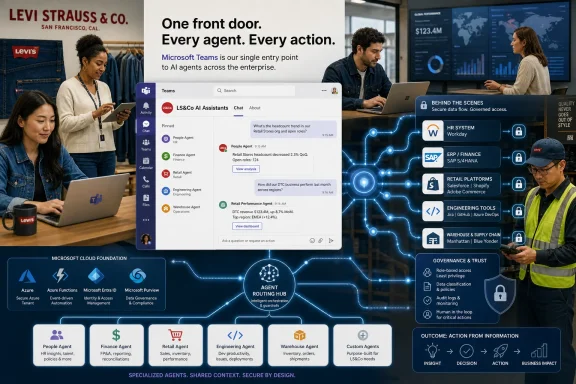
The company’s answer is a Teams-based front end that routes requests to specialized agents behind the scenes. In practice, the employee asks one conversational interface, while Foundry and related orchestration components determine which agent, data source, or workflow should handle the task. If this works, the “super” part is not intelligence in the sci-fi sense; it is coordination.
That makes Teams the strategic surface. Microsoft has spent years turning Teams from a collaboration product into an enterprise operating layer, and Levi’s use case shows why. If the employee interface for AI becomes the same place people already message colleagues, attend meetings, and receive work notifications, Microsoft gains a powerful distribution advantage over standalone AI tools.
That is a deeply enterprise pitch. Large companies rarely suffer from a shortage of software. They suffer from duplicated data, inconsistent permissions, old integrations, departmental exceptions, and years of workflows that made sense at the time but now slow everyone down. AI does not automatically solve that; in many cases, it can make the mess easier to query while leaving the underlying mess intact.
Levi’s architecture, at least as described, tries to avoid that trap. Agents connect to enterprise systems using governed data access based on user identity, without duplicating information into shadow repositories. That point deserves attention because many AI pilots quietly create new data risks by copying sensitive information into experimental stores in the name of convenience.
The company is also emphasizing orchestration over fine-tuning. Rather than training one large custom model to know everything about Levi’s, the system uses specialized agents, structured prompts, intent detection, and reasoning workflows. That is a pragmatic enterprise pattern: constrain the task, route it to the right system, and keep the execution path auditable.
The company’s direct-to-consumer push raises the pressure. When a brand sells through more direct channels, it must respond faster to demand signals, inventory movement, customer expectations, and localized retail conditions. The data needed to make those calls tends to live in different systems, and the people who need the answers are not always data specialists.
That is why Levi’s language around “fan experiences” should not be dismissed as brand theater. In retail, customer experience is downstream of employee experience. A store associate who cannot find policy information, a planner who cannot interpret demand data quickly, or an engineer slowed by legacy modernization work all contribute indirectly to what the customer eventually sees.
The promise of Foundry-built agents is that those internal delays can be compressed. A benefits agent can spare HR from repetitive navigation questions. An engineering agent paired with GitHub Copilot can help modernize code and support junior developers. A workflow agent can reduce the time spent hunting across systems before a decision is made.
GitHub Copilot is already familiar as a pair programmer, but Levi’s is applying it in a broader modernization context. Junior developers can get support while learning codebases, and senior engineers can spend more time on architecture, integration, and higher-value work. That is the idealized version, of course; any engineering leader knows that generated code still has to be reviewed, tested, secured, and maintained.
The more interesting possibility is that Foundry agents can sit around the software development lifecycle rather than only inside the editor. A developer might use Copilot to write or refactor code, while agents help locate internal documentation, interpret platform standards, route requests, or trigger backend workflows. In that model, the AI layer becomes less like autocomplete and more like connective tissue across engineering operations.
For legacy-heavy companies, this is where AI may deliver more value than flashy demos suggest. The hard work is not always inventing a new application; it is understanding old systems, safely changing them, and keeping the business running while modernization happens. If AI can reduce the friction around that work, the productivity gain is less glamorous but more durable.
That shift raises the stakes. A summarization error is annoying. A workflow execution error can be expensive, embarrassing, or a security incident. When agents move from suggesting actions to taking them, enterprises need identity, permissions, logs, rollback plans, exception handling, and clear ownership.
Microsoft’s agent strategy depends on persuading companies that these governance problems are easier to solve inside its stack. Foundry, Agent Framework, Azure Functions, Microsoft 365 Copilot, Teams, Intune, Windows 11, and GitHub Copilot are not isolated products in this story. They form a platform argument: keep the user interface, device layer, identity model, developer tools, and automation fabric close together.
That argument will appeal to many CIOs precisely because it is conservative. It does not require throwing out the Microsoft estate; it extends it. The risk is that convenience becomes lock-in, and that enterprise AI architecture hardens around one vendor’s assumptions before the market has fully settled.
This is one of the quiet tensions in Microsoft’s Copilot and agent story. Microsoft often points out that Copilot respects existing permissions, which is important. But “existing permissions” are not always a gold standard in real enterprises. They are often the accumulated sediment of reorganizations, urgent exceptions, forgotten groups, and old SharePoint sites nobody wants to audit.
For Levi’s and companies like it, the agent rollout should create pressure to clean up the substrate. Identity-based access, zero-trust practices, endpoint management, and data lifecycle controls become more important when conversational interfaces can traverse systems quickly. The better the assistant, the more dangerous sloppy governance becomes.
That is why AI workplace transformation is also an IT hygiene project. It rewards organizations that already have disciplined identity, endpoint, and data practices. It exposes those that hoped a chatbot could paper over structural disorder.
That does not make the story meaningless. It means readers should separate the reported implementation details from the broader sales frame. Levi’s is not simply buying AI magic; it is standardizing on a Microsoft-heavy stack that includes Windows 11, Copilot+ PCs, Intune, Microsoft 365 Copilot, GitHub Copilot, Teams, Azure Functions, and Foundry.
For WindowsForum readers, that stack is the story. Microsoft’s AI ambitions are increasingly tied to the entire Windows and Microsoft 365 environment. The endpoint, the collaboration hub, the identity plane, the development tools, and the cloud orchestration layer are being positioned as parts of one system.
This is why Microsoft keeps pushing the idea that AI agents are the next major enterprise interface. If agents become a new application layer, Microsoft wants them created, governed, discovered, and used through Microsoft infrastructure. Levi’s gives that argument a recognizable brand and a practical setting.
Levi’s describes Copilot as a thought partner for designers, analysts, HR teams, and engineers. That is the friendly framing. The less sentimental version is that many employees spend too much of their day translating organizational complexity into something they can act on.
An effective agent layer could reduce that translation cost. It could help a designer synthesize prior research, a finance analyst interrogate complex data, or an HR professional identify patterns without manually stitching together reports. None of that removes human judgment; it changes where human judgment enters the process.
That is why Sheena Kunhiraman’s framing of human-agent collaboration as augmentation is important. The near-term workplace impact of AI is not a clean replacement story. It is a redistribution of attention away from search, navigation, and repetitive interpretation toward review, decision-making, and exception handling.
That is especially true for frontline, retail, and warehouse environments, where time, training, and context switching are real constraints. A corporate employee may tolerate a new AI dashboard. A store employee during a busy shift probably will not. The closer the agent experience is to an existing communication pattern, the better its odds of survival.
Microsoft has an advantage here because Teams is already embedded in many organizations. But that advantage can become a weakness if Teams turns into a dumping ground for every workflow, notification, bot, and corporate initiative. A super agent is supposed to reduce complexity, not move it into a chat window.
The interface challenge is therefore editorial as much as technical. Someone has to decide what the agent should surface, how it should respond, when it should escalate, and when it should refuse. A bad agent does not just fail to help; it trains employees not to trust the system.
The most credible proof will not be a single productivity statistic. It will be evidence that employees use the system repeatedly because it saves time without creating new risk. In practical terms, that means fewer tickets, faster policy navigation, shorter project cycles, better engineering throughput, cleaner handoffs, and less time spent searching across systems.
Microsoft’s earlier Levi’s customer material claimed some dramatic time compression, including project work moving from a year-scale manual effort to results in a day in a specific document-review scenario. Those examples are attention-grabbing, but the long-term question is whether such gains generalize beyond isolated workflows. AI pilots often succeed when the target is narrow and the champions are enthusiastic; enterprise platforms succeed when ordinary users adopt them without ceremony.
By mid-2026, the market is rightly more skeptical of AI transformation claims than it was during the initial generative AI boom. Companies can no longer rely on novelty. They have to show operational leverage.
A half-successful AI rollout can also obscure accountability. If an agent summarizes policy incorrectly, who owns the mistake: the model provider, the agent builder, the data owner, the department, or the employee who relied on it? If an agent executes a workflow based on ambiguous intent, who validates that the outcome was appropriate?
These are not reasons to avoid AI agents. They are reasons to design them like enterprise systems rather than productivity toys. Logging, testing, access review, prompt management, model evaluation, and incident response must become normal parts of agent operations.
The Levi’s approach, with Foundry as an orchestration layer and Azure Functions handling backend execution, suggests an awareness of that reality. The architecture matters because it determines whether agents are manageable software assets or just clever conversations with unclear boundaries.
That does not mean every organization should copy Levi’s. A global retailer with thousands of employees, complex supply chains, and a direct-to-consumer growth strategy has different needs from a regional manufacturer or a public-sector agency. But the pattern is portable: start with productivity assistants, identify repeatable workflows, connect governed data, centralize the user experience, and treat agents as managed enterprise assets.
The Windows angle is also practical. If AI work depends on device consistency, endpoint security, identity enforcement, and user access controls, then old-fashioned IT management becomes newly strategic. Intune policies and Windows baselines are not glamorous, but they form the floor beneath the agent story.
Microsoft’s most persuasive argument may be that AI transformation does not begin with the model. It begins with whether the organization can trust the device, the user, the data, and the workflow. Without that, the smartest agent in the world becomes another unmanaged risk.
Microsoft will happily present this as validation of its Foundry and Copilot strategy, and to some extent it is. But the more important lesson belongs to IT leaders: AI becomes valuable when it disappears into the work without disappearing from control. If Levi’s can make that balance hold across offices, stores, warehouses, engineering teams, and corporate functions, the company will have done more than modernize a heritage brand; it will have sketched the operating model many Windows-centric enterprises are about to attempt next.
 Levi’s Is Turning AI from a Side Tool into Workplace Plumbing
The most interesting part of Levi Strauss & Co.’s Microsoft Foundry story is not that the company is using generative AI. By 2026, that fact alone barely qualifies as news. The sharper point is that Levi’s has moved from giving employees AI assistants to redesigning how internal work is routed, authenticated, executed, and measured.Microsoft’s customer story frames the shift as a move from enterprise Copilot adoption into a broader agentic architecture. Employees began with Microsoft 365 Copilot as a productivity layer: summarizing research for designers, surfacing insights for finance, and helping HR teams explore employee experience signals. That first phase matters because it gave AI a familiar foothold inside Office-style work rather than demanding that employees learn a new operational system from scratch.
But the second phase is where the strategy becomes more consequential. Levi’s is using Microsoft Foundry to build purpose-specific agents that connect to live business systems, interpret intent, and perform tasks through governed workflows. The company’s goal is not simply to answer questions faster; it is to reduce the number of places employees must go before they can act.
That distinction is crucial. A chatbot that summarizes stale documents is a convenience. An agent framework that can securely reach SAP, HR systems, retail platforms, engineering tools, and operational data is a change to the company’s nervous system. Levi’s is trying to put AI at the seam where information becomes action.
The Super Agent Is Really an Anti-Fragmentation Strategy
The phrase “super agent” sounds like marketing excess, and in Microsoft’s ecosystem it inevitably carries a whiff of platform evangelism. Still, the underlying problem is real. Once every department starts building its own agent, the enterprise risks replacing app sprawl with bot sprawl.Levi’s appears to have run directly into that problem. As more agents were introduced, employees faced too many entry points. That is the kind of adoption failure that looks minor in a demo but becomes fatal in production: workers do not want to remember which bot handles benefits, which one knows policy, which one talks to SAP, and which one can execute a retail workflow.
The company’s answer is a Teams-based front end that routes requests to specialized agents behind the scenes. In practice, the employee asks one conversational interface, while Foundry and related orchestration components determine which agent, data source, or workflow should handle the task. If this works, the “super” part is not intelligence in the sci-fi sense; it is coordination.
That makes Teams the strategic surface. Microsoft has spent years turning Teams from a collaboration product into an enterprise operating layer, and Levi’s use case shows why. If the employee interface for AI becomes the same place people already message colleagues, attend meetings, and receive work notifications, Microsoft gains a powerful distribution advantage over standalone AI tools.
Microsoft Foundry’s Pitch Is Control, Not Just Capability
The Levi’s deployment also illustrates how Microsoft is trying to differentiate Foundry from the more generic language-model conversation. The value proposition is not “we have a model.” It is “we can help you orchestrate many models, agents, data sources, security policies, and execution services inside your existing Microsoft estate.”That is a deeply enterprise pitch. Large companies rarely suffer from a shortage of software. They suffer from duplicated data, inconsistent permissions, old integrations, departmental exceptions, and years of workflows that made sense at the time but now slow everyone down. AI does not automatically solve that; in many cases, it can make the mess easier to query while leaving the underlying mess intact.
Levi’s architecture, at least as described, tries to avoid that trap. Agents connect to enterprise systems using governed data access based on user identity, without duplicating information into shadow repositories. That point deserves attention because many AI pilots quietly create new data risks by copying sensitive information into experimental stores in the name of convenience.
The company is also emphasizing orchestration over fine-tuning. Rather than training one large custom model to know everything about Levi’s, the system uses specialized agents, structured prompts, intent detection, and reasoning workflows. That is a pragmatic enterprise pattern: constrain the task, route it to the right system, and keep the execution path auditable.
Retail Is a Brutal Test Bed for Agentic AI
Levi’s is a useful case study because retail exposes the weaknesses of enterprise AI faster than many white-collar environments. A retailer has corporate planning, design, merchandising, e-commerce, store operations, warehouse logistics, HR, finance, and customer experience all pulling on the same underlying business. It is not enough for AI to write a decent email; it has to survive operational reality.The company’s direct-to-consumer push raises the pressure. When a brand sells through more direct channels, it must respond faster to demand signals, inventory movement, customer expectations, and localized retail conditions. The data needed to make those calls tends to live in different systems, and the people who need the answers are not always data specialists.
That is why Levi’s language around “fan experiences” should not be dismissed as brand theater. In retail, customer experience is downstream of employee experience. A store associate who cannot find policy information, a planner who cannot interpret demand data quickly, or an engineer slowed by legacy modernization work all contribute indirectly to what the customer eventually sees.
The promise of Foundry-built agents is that those internal delays can be compressed. A benefits agent can spare HR from repetitive navigation questions. An engineering agent paired with GitHub Copilot can help modernize code and support junior developers. A workflow agent can reduce the time spent hunting across systems before a decision is made.
GitHub Copilot Shows the Engineering Side of the Same Bet
The Levi’s story is not limited to office productivity. Engineering teams are pairing GitHub Copilot with Foundry-built agents to modernize systems, accelerate development, and help upskill talent. That combination matters because it joins two different versions of AI assistance: code-level help inside the developer workflow and process-level orchestration across enterprise systems.GitHub Copilot is already familiar as a pair programmer, but Levi’s is applying it in a broader modernization context. Junior developers can get support while learning codebases, and senior engineers can spend more time on architecture, integration, and higher-value work. That is the idealized version, of course; any engineering leader knows that generated code still has to be reviewed, tested, secured, and maintained.
The more interesting possibility is that Foundry agents can sit around the software development lifecycle rather than only inside the editor. A developer might use Copilot to write or refactor code, while agents help locate internal documentation, interpret platform standards, route requests, or trigger backend workflows. In that model, the AI layer becomes less like autocomplete and more like connective tissue across engineering operations.
For legacy-heavy companies, this is where AI may deliver more value than flashy demos suggest. The hard work is not always inventing a new application; it is understanding old systems, safely changing them, and keeping the business running while modernization happens. If AI can reduce the friction around that work, the productivity gain is less glamorous but more durable.
The Enterprise AI Debate Is Moving from “Can It Answer?” to “Can It Act?”
The first wave of generative AI inside companies was dominated by knowledge work: summarization, drafting, brainstorming, search, and document analysis. Those tasks are useful, but they rarely transform the operating model by themselves. The Levi’s deployment sits in the next phase, where the question becomes whether AI can perform work through controlled systems.That shift raises the stakes. A summarization error is annoying. A workflow execution error can be expensive, embarrassing, or a security incident. When agents move from suggesting actions to taking them, enterprises need identity, permissions, logs, rollback plans, exception handling, and clear ownership.
Microsoft’s agent strategy depends on persuading companies that these governance problems are easier to solve inside its stack. Foundry, Agent Framework, Azure Functions, Microsoft 365 Copilot, Teams, Intune, Windows 11, and GitHub Copilot are not isolated products in this story. They form a platform argument: keep the user interface, device layer, identity model, developer tools, and automation fabric close together.
That argument will appeal to many CIOs precisely because it is conservative. It does not require throwing out the Microsoft estate; it extends it. The risk is that convenience becomes lock-in, and that enterprise AI architecture hardens around one vendor’s assumptions before the market has fully settled.
The Data Governance Problem Has Not Gone Away
Levi’s emphasis on live, governed data access is the right one, but it does not make governance automatic. AI agents are only as safe as the permissions, data classification, and business rules surrounding them. If an employee already has excessive access, an agent may simply make that excessive access easier to exploit.This is one of the quiet tensions in Microsoft’s Copilot and agent story. Microsoft often points out that Copilot respects existing permissions, which is important. But “existing permissions” are not always a gold standard in real enterprises. They are often the accumulated sediment of reorganizations, urgent exceptions, forgotten groups, and old SharePoint sites nobody wants to audit.
For Levi’s and companies like it, the agent rollout should create pressure to clean up the substrate. Identity-based access, zero-trust practices, endpoint management, and data lifecycle controls become more important when conversational interfaces can traverse systems quickly. The better the assistant, the more dangerous sloppy governance becomes.
That is why AI workplace transformation is also an IT hygiene project. It rewards organizations that already have disciplined identity, endpoint, and data practices. It exposes those that hoped a chatbot could paper over structural disorder.
Microsoft’s Customer Story Is Also Microsoft’s Platform Story
Vendor customer stories are not neutral artifacts. They are polished narratives designed to show a product strategy working in the wild. In this case, Microsoft wants Levi’s to stand as proof that Foundry can power real enterprise agent orchestration, not just experimental AI apps.That does not make the story meaningless. It means readers should separate the reported implementation details from the broader sales frame. Levi’s is not simply buying AI magic; it is standardizing on a Microsoft-heavy stack that includes Windows 11, Copilot+ PCs, Intune, Microsoft 365 Copilot, GitHub Copilot, Teams, Azure Functions, and Foundry.
For WindowsForum readers, that stack is the story. Microsoft’s AI ambitions are increasingly tied to the entire Windows and Microsoft 365 environment. The endpoint, the collaboration hub, the identity plane, the development tools, and the cloud orchestration layer are being positioned as parts of one system.
This is why Microsoft keeps pushing the idea that AI agents are the next major enterprise interface. If agents become a new application layer, Microsoft wants them created, governed, discovered, and used through Microsoft infrastructure. Levi’s gives that argument a recognizable brand and a practical setting.
The Employee Experience Angle Is More Than HR Gloss
There is a tendency in enterprise technology coverage to treat “employee experience” as soft language, especially when vendors use it to wrap infrastructure deals in human warmth. But in this case, employee experience is a hard operational issue. If a system is too fragmented, people route around it, make decisions with incomplete information, or waste time asking colleagues to find things.Levi’s describes Copilot as a thought partner for designers, analysts, HR teams, and engineers. That is the friendly framing. The less sentimental version is that many employees spend too much of their day translating organizational complexity into something they can act on.
An effective agent layer could reduce that translation cost. It could help a designer synthesize prior research, a finance analyst interrogate complex data, or an HR professional identify patterns without manually stitching together reports. None of that removes human judgment; it changes where human judgment enters the process.
That is why Sheena Kunhiraman’s framing of human-agent collaboration as augmentation is important. The near-term workplace impact of AI is not a clean replacement story. It is a redistribution of attention away from search, navigation, and repetitive interpretation toward review, decision-making, and exception handling.
The Best AI Interface May Be the One Workers Barely Notice
The decision to use Teams as the user interface reflects a broader truth about enterprise adoption. Workers generally do not want another portal. They want the tools they already use to become less frustrating.That is especially true for frontline, retail, and warehouse environments, where time, training, and context switching are real constraints. A corporate employee may tolerate a new AI dashboard. A store employee during a busy shift probably will not. The closer the agent experience is to an existing communication pattern, the better its odds of survival.
Microsoft has an advantage here because Teams is already embedded in many organizations. But that advantage can become a weakness if Teams turns into a dumping ground for every workflow, notification, bot, and corporate initiative. A super agent is supposed to reduce complexity, not move it into a chat window.
The interface challenge is therefore editorial as much as technical. Someone has to decide what the agent should surface, how it should respond, when it should escalate, and when it should refuse. A bad agent does not just fail to help; it trains employees not to trust the system.
The Calendar Now Matters as Much as the Architecture
Levi’s and Microsoft announced the super-agent effort in late 2025, with rollout plans pointing into 2026 and global expansion over the year. That timeline matters because enterprise AI has entered the uncomfortable phase between announcement and measurable return. The demos are impressive; the budget owners now want proof.The most credible proof will not be a single productivity statistic. It will be evidence that employees use the system repeatedly because it saves time without creating new risk. In practical terms, that means fewer tickets, faster policy navigation, shorter project cycles, better engineering throughput, cleaner handoffs, and less time spent searching across systems.
Microsoft’s earlier Levi’s customer material claimed some dramatic time compression, including project work moving from a year-scale manual effort to results in a day in a specific document-review scenario. Those examples are attention-grabbing, but the long-term question is whether such gains generalize beyond isolated workflows. AI pilots often succeed when the target is narrow and the champions are enthusiastic; enterprise platforms succeed when ordinary users adopt them without ceremony.
By mid-2026, the market is rightly more skeptical of AI transformation claims than it was during the initial generative AI boom. Companies can no longer rely on novelty. They have to show operational leverage.
The Risk Is Not That AI Fails, but That It Half-Succeeds
There is a particular danger in enterprise AI deployments that are useful enough to spread but not disciplined enough to govern. If every department builds agents, employees may gain pockets of convenience while IT inherits a new class of semi-autonomous workflow dependencies. That is the future Levi’s is trying to avoid with a centralized orchestration layer.A half-successful AI rollout can also obscure accountability. If an agent summarizes policy incorrectly, who owns the mistake: the model provider, the agent builder, the data owner, the department, or the employee who relied on it? If an agent executes a workflow based on ambiguous intent, who validates that the outcome was appropriate?
These are not reasons to avoid AI agents. They are reasons to design them like enterprise systems rather than productivity toys. Logging, testing, access review, prompt management, model evaluation, and incident response must become normal parts of agent operations.
The Levi’s approach, with Foundry as an orchestration layer and Azure Functions handling backend execution, suggests an awareness of that reality. The architecture matters because it determines whether agents are manageable software assets or just clever conversations with unclear boundaries.
For Windows Shops, This Is the Shape of the Next Microsoft Stack
WindowsForum readers should see the Levi’s case as a preview of where Microsoft wants the enterprise desktop and cloud stack to go. Windows 11, Copilot+ PCs, Intune, Microsoft 365 Copilot, Teams, GitHub Copilot, Foundry, and Azure are converging into a workplace AI platform. The PC is still there, but it is increasingly one endpoint in a larger agentic workflow fabric.That does not mean every organization should copy Levi’s. A global retailer with thousands of employees, complex supply chains, and a direct-to-consumer growth strategy has different needs from a regional manufacturer or a public-sector agency. But the pattern is portable: start with productivity assistants, identify repeatable workflows, connect governed data, centralize the user experience, and treat agents as managed enterprise assets.
The Windows angle is also practical. If AI work depends on device consistency, endpoint security, identity enforcement, and user access controls, then old-fashioned IT management becomes newly strategic. Intune policies and Windows baselines are not glamorous, but they form the floor beneath the agent story.
Microsoft’s most persuasive argument may be that AI transformation does not begin with the model. It begins with whether the organization can trust the device, the user, the data, and the workflow. Without that, the smartest agent in the world becomes another unmanaged risk.
The Denim Maker’s AI Lesson Is Smaller and More Useful Than the Hype
The Levi’s story is useful because it points to a more grounded version of enterprise AI than the usual future-of-work fireworks.- Levi Strauss & Co. is using Microsoft Foundry to orchestrate specialized agents rather than relying on one general-purpose assistant to understand the whole company.
- Microsoft Teams is becoming the employee-facing front door for AI workflows, which reduces the need for workers to choose among multiple departmental agents.
- The architecture depends on governed access to live enterprise systems, which makes identity, permissions, and data hygiene central to whether the project succeeds.
- GitHub Copilot and Foundry-built agents extend the effort into engineering, where modernization and developer enablement are part of the same AI strategy.
- The rollout’s real test in 2026 will be sustained operational use, not demo-day productivity claims or isolated workflow wins.
Microsoft will happily present this as validation of its Foundry and Copilot strategy, and to some extent it is. But the more important lesson belongs to IT leaders: AI becomes valuable when it disappears into the work without disappearing from control. If Levi’s can make that balance hold across offices, stores, warehouses, engineering teams, and corporate functions, the company will have done more than modernize a heritage brand; it will have sketched the operating model many Windows-centric enterprises are about to attempt next.
References
- Primary source: Microsoft
Published: Thu, 04 Jun 2026 14:26:12 GMT
Levi Strauss & Co. simplifies work and accelerates decision-making with Microsoft Foundry | Microsoft Customer Stories
Levi Strauss & Co. builds a unified Super Agent with Microsoft Azure AI Foundry to reduce complexity, accelerate work, and deliver better fan experiences.www.microsoft.com
- Official source: news.microsoft.com
- Official source: blogs.microsoft.com
How Microsoft is empowering Frontier Transformation with Intelligence + Trust - The Official Microsoft Blog
At Microsoft Ignite in November, we introduced Frontier Transformation — a holistic reimagining of business aligning AI with human ambition to help organizations achieve their highest aspirations and growth potential. While AI Transformation centered on efficiency and productivity, Frontier... blogs.microsoft.com
- Related coverage: businesswire.com
- Related coverage: ciodive.com

Levi’s picks Microsoft to deploy ‘super-agent’
The apparel giant said it will launch a "complex agentic framework" in 2026 that will integrate several sub-agents across IT, HR and operations.www.ciodive.com
- Related coverage: retaildive.com
Levi’s picks Microsoft to deploy ‘super-agent’
The apparel giant said it will launch a "complex agentic framework" in 2026 that will integrate several sub-agents across IT, HR and operations.www.retaildive.com


- Related coverage: owler.com
- Related coverage: windowscentral.com

Microsoft doubles down on agentic AI — Agent 365 prepares for a future with over 1 billion agents
Microsoft kicked off Ignite with a major push into agentic AI, unveiling Agent 365 as its newest tool for automating workflows. www.windowscentral.com
- Related coverage: press.spglobal.com
- Official source: cdn-dynmedia-1.microsoft.com
- Official source: marketingassets.microsoft.com
