

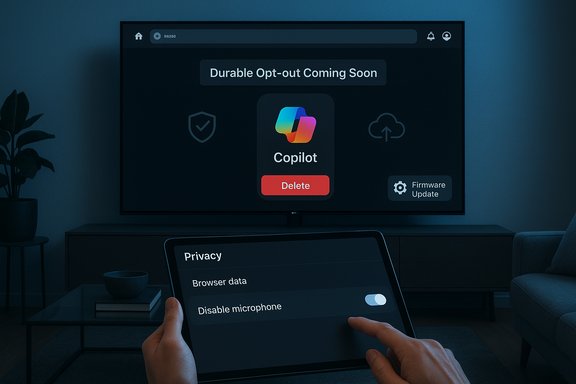
LG’s sudden reversal on the Copilot shortcut is a rare win for consumer pushback: after a mid‑December webOS update pinned a Microsoft Copilot icon to many LG TVs’ home screens with no clear uninstall path, the company has announced it will add a true delete option — while insisting the tile is a browser‑based shortcut and that microphone features require explicit user permission.
Background / Overview
LG and other major TV makers framed 2025 as the year of the “AI TV,” publicly partnering with Microsoft to bring Copilot — a conversational, cloud‑based assistant — to living‑room screens. The integration promises features like episode recaps, on‑screen conversational search, and voice‑driven discovery designed for large displays. That strategic push was showcased at industry events and product roadmaps earlier in the year, and manufacturers have been shipping incremental AI features to existing hardware via firmware‑over‑the‑air (FOTA) updates. What changed in mid‑December was not the idea of Copilot on TVs, but the mechanics of delivery: an automatic webOS update added a Copilot tile to many LG home screens. Users reported that the tile could be hidden but not deleted via the normal Edit/App Manager flows, and several owners who performed factory resets found the tile reappeared — behavior consistent with a privileged, firmware‑provisioned asset rather than a removable store app. That discovery ignited a viral Reddit thread and a broad media reaction.What actually happened (timeline and mechanics)
- A routine webOS FOTA update pushed a new home‑screen tile labeled “Copilot” to many LG televisions.
- Launching the tile typically opens Microsoft’s Copilot interface in the TV’s built‑in browser (LG describes it as a browser shortcut, not an embedded native app).
- Users discovered the usual uninstall/delete affordance was missing: the UI often allowed only hide or disable; a factory reset sometimes restored the tile, suggesting the asset is contained in the firmware image or provisioned as a privileged system component.
LG’s response: what the company actually said
LG spokesperson Chris De Maria told reporters the company “respects consumer choice and will take steps to allow users to delete the shortcut icon if they wish.” He also clarified that the Copilot tile launches a web‑based Copilot experience in the TV browser, and that microphone input and other sensitive features are enabled only with explicit user permission. LG did not publish a firm timeline for the promised deletion option at the time of the statement. This distinction — web shortcut vs native app — matters technically, but it does not resolve the core user complaint: a visible, seemingly permanent entry was added to devices after purchase without an obvious, persistent opt‑out. Community reports and independent checks support LG’s claim that Copilot is a browser interface in many cases, but they also underscore that packaging and delivery choices made the tile effectively non‑removable for affected users.Why the packaging and delivery method matters
Web shortcut vs native application
- A web shortcut is effectively a pinned link that opens a remote web interface inside the TV’s browser. Core model inference and heavy data processing happen in Microsoft’s cloud; the TV behaves as a thin client that forwards inputs when the user interacts with it.
- A native app would be installed as a system or user app, with local binaries, sandboxed storage, and a different update and permissions model.
Firmware provisioning and persistence
When an OEM pushes UI assets or privileged tiles via firmware updates, those components can be restored by factory resets because they are included in the device image. That makes a simple reset an unreliable remedy for users who want to remove unwanted, post‑sale additions. Community testing showing reappearance after resets strongly suggests the Copilot tile was provisioned at a system level in at least some cases.User reaction and practical workarounds
The backlash centered less on Copilot’s utility and more on choice: users objected to a post‑sale change that inserted a third‑party AI entry point into a device they already owned. Practical responses shared by the community included:- Hiding the tile via the launcher’s Edit mode (visually removes it but does not uninstall).
- Disconnecting the TV from the network to prevent access to the web app (effective but disables all smart features and future updates).
- Blocking access at the network level using DNS/firewall tools (Pi‑hole, router‑level domain blocking) to prevent the TV from reaching Copilot endpoints. This is a more targeted but technically involved remedy.
- Using an external streaming stick or set‑top box while keeping the TV’s smart features offline for a predictable, controllable UX.
Privacy, telemetry and the real risks
The most acute worry among privacy‑conscious owners is the expansion of the telemetry surface and how Copilot might interact with other platform features such as Automatic Content Recognition (ACR) or LG’s “Live Plus” personalization. Key points to consider:- Even when Copilot runs as a browser shortcut, the assistant will send user queries (text, typed inputs, and audio when the mic is used) to Microsoft’s cloud. That data flow is not the same as an app running locally, but it still raises questions about logging, linking to accounts, and retention policies.
- ACR and content‑level signals already used for recommendations and ad personalization can materially increase the value of contextual data. If defaults or sign‑in flows link Copilot to platform telemetry, the net privacy impact grows.
- LG’s assurances that microphone features require explicit permission are welcome but need concrete, visible consent flows and clear telemetry disclosures. Without a published telemetry FAQ and model of what’s transmitted, independent verification is difficult. Several outlets and security analysts have called for forensic network analysis to verify exactly what endpoints the TV hits when Copilot is launched.
The industry context: precedent and parallels
This episode echoes prior disputes over OEM behavior and preinstalled services. Samsung and LG both announced Copilot integrations during CES 2025 as part of AI personalization strategies; Samsung’s rollout was staged with clearer sign‑in guidance, whereas LG’s silent provision to already‑sold units created more friction. Some users also drew comparisons to forced app installs or bundled advertising experiences on smart TVs over the past several years. Regulatory scrutiny is not hypothetical. Post‑sale changes that materially affect user control, privacy, or advertising defaults can attract attention from consumer protection bodies and state attorneys general. The combination of visible user frustration and unclear opt‑out durability makes enforcement interest likely if vendors do not remedy the situation transparently.Product governance failure: what went wrong and why
This is a textbook case of a product‑management mismatch: the feature itself (a conversational assistant) is defensible, but the rollout violated several basic governance rules:- Expectation mismatch: Customers expect hardware they buy to remain under their control; adding persistent, partner‑branded features after sale needs explicit consent.
- Transparency deficit: The update lacked clear, prominent release notes explaining the change and opt‑out mechanisms.
- Durability oversight: Implementing the tile as a firmware‑provisioned or privileged asset removed the usual UI affordance for deletion and made simple resets unreliable as a cure.
- Telemetry ambiguity: Without a published, model‑by‑model telemetry FAQ it is hard to know what data Copilot will access or how it interacts with existing LG services.
Practical, prioritized recommendations for LG (and Microsoft)
To repair trust and set a better industry standard, LG should implement the following, ideally in the order below:- Publish a model‑by‑model rollout timeline and the webOS build that adds deletion functionality, along with clear release notes.
- Ship a durable deletion mechanism that persists across firmware updates and factory resets (or provide a documented rollback path).
- Release a telemetry and privacy FAQ that lists all endpoints contacted, what metadata is included, retention windows, and how account linkage works when users sign in to Copilot.
- Implement explicit, granular consent flows for microphone use and ACR features, with visible indicators and easy revocation.
- Improve update communications: ship prominent on‑screen notifications explaining the change, how customers can opt out, and a one‑click path to remove or hide the feature while the full deletion update is rolled out.
What owners can do now (practical checklist)
- Use the home screen’s Edit/App Manager to hide the Copilot tile to reduce visual clutter. This does not uninstall it but removes daily visibility.
- Review and disable any ACR/Live Plus or personalization settings in the TV’s privacy menu. Disabling those features reduces cross‑service data linking.
- If you prioritize control over smart features, place the TV on a guest Wi‑Fi network or isolate it with router‑level rules. Use Pi‑hole or DNS blocking to stop specific domains if you can identify Copilot endpoints. This approach requires technical skill and may break legitimate features.
- Avoid signing into accounts on the TV if you want to limit cross‑device linkage between Copilot and other services.
- Consider using an external streaming device you manage (Chromecast, Roku, Fire TV stick) and disable the TV’s smart features for a predictable experience.
Bigger picture: the politics of post‑sale updates
This incident is symptomatic of a larger commercial dynamic: hardware vendors increasingly treat devices as platforms for recurring services and partner integrations. That model drives revenue and “features” to aging devices, but it also changes the post‑purchase contract between buyer and seller.Consumers expect two things from the devices in their homes: reliable security updates and the ability to control what runs on those devices. When those expectations clash — as in the Copilot shortcut case — the social contract frays quickly. The right balance is not to oppose platform evolution, but to ensure changes are consented to, reversible, and accompanied by transparent telemetry policies.
Strengths and opportunities in LG’s approach — and the risks that remain
Strengths- Bringing Copilot to TVs makes practical sense: large displays are natural endpoints for conversational discovery and accessibility features. When opt‑in, Copilot can reduce menu navigation and make content discovery more fluid.
- Implementing Copilot as a cloud‑based web interface reduces local compute requirements on a broad range of hardware and lets the service be updated server‑side.
- Forced or opaque provisioning erodes trust and invites public backlash, as seen here. Even if the assistant is harmless technically, the perception of a vendor imposing software without durable opt‑out is politically and commercially costly.
- Without transparent telemetry disclosures and durable opt‑outs, the addition heightens regulatory and reputational exposure — particularly if defaults favor personalization and ad targeting.
- Rolling out via firmware images without an uninstall path sets a precedent for future non‑removable partner features, which could prompt legislative or enforcement responses.
Conclusion
The Copilot tile controversy is not an argument against AI on TVs; it is a lesson in how AI should be introduced to owned hardware. Convenience and novelty cannot replace consent and clear controls. LG’s commitment to add a delete option acknowledges the customer grievance, but that promise must be followed by concrete firmware updates, transparent telemetry disclosures, and durable opt‑out mechanisms that persist across resets and updates.Until LG publishes a timeline and technical documentation, owners have only imperfect workarounds: hiding the tile, isolating the TV on a network, or relying on external devices for streaming. The episode will likely shape future expectations: manufacturers that ship AI features without explicit, persistent user control will pay an immediate price in trust — and possibly attract regulatory scrutiny. The living room is proving to be a battleground for control over data, interfaces, and the limits of post‑sale software changes; vendors who internalize that reality and design with consumer choice first will fare far better in the long run.
Source: Dataconomy LG backs down on Copilot shortcut after TV users push back
