

LG’s Micro RGB evo arrived in the United States in April 2026 as LG’s first flagship RGB-backlit LCD TV, offered in 75-, 86-, and 100-inch sizes with U.S. pricing starting at $4,999.99 and a top 100-inch model listed at $7,999.99. That matters because this is not simply another Mini LED set with a louder badge. LG is trying to sell a third premium-TV lane: not OLED, not MicroLED, but an LCD architecture borrowing OLED-era processing, AI control, and color discipline. The result is impressive, but the marketing around “OLED-level” performance needs a careful unpacking before anyone mistakes this for an OLED replacement.
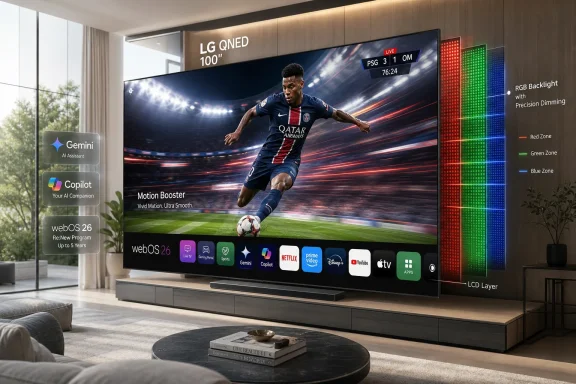
The most important thing about Micro RGB evo is also the easiest thing to miss: it is still an LCD television. The pixels are not self-emissive. Light is still coming from a backlight system, then passing through an LCD layer before it becomes the image you see.
That does not make the technology uninteresting. Traditional Mini LED TVs use dense arrays of small backlights, usually white or blue LEDs combined with filters, phosphors, or quantum-dot layers to generate color. LG’s pitch is that Micro RGB evo uses dedicated red, green, and blue backlights, giving the set finer control over both luminance and color before the LCD layer does its work.
In plain English, LG is trying to solve the two classic LCD problems at once. It wants more brightness than OLED can comfortably sustain, while also narrowing the gap in color purity and contrast control that has made OLED the premium-TV benchmark for a decade.
That is a smart bet because the TV market has split into two emotional camps. OLED buyers love black levels, viewing angles, pixel response, and cinematic contrast. High-end LCD buyers love searing brightness, low burn-in anxiety, and huge-screen value. Micro RGB evo is LG’s attempt to tell both groups: you can have much of each.
The danger is that “much of” becomes “the same as.” It is not. A backlit LCD with thousands of dimming zones can be spectacular, but it still cannot turn off every individual pixel the way OLED can. The better comparison is not “OLED killer.” It is “the most ambitious LCD LG has put in front of consumers.”
LG’s own product language pairs “up to 165Hz refresh rate” with “Motion Booster 330.” That distinction matters. The television is positioned for high-refresh gaming with VRR up to 165Hz, while the 330Hz figure is tied to motion processing or optimized modes rather than a simple promise that every game, every resolution, and every input scenario runs at native 4K 330Hz.
For Windows gamers, that is not a small distinction. Driving modern AAA games at 4K beyond 120Hz already requires expensive GPU hardware, aggressive settings management, frame generation, or all three. Driving them anywhere near 330 frames per second at high fidelity is fantasy for most titles.
The more realistic gaming story is still strong. A 100-inch display with 4K, VRR up to 165Hz, AMD FreeSync Premium, ALLM, and LG’s game dashboard features is a genuine luxury setup for PC and console players. For people using GeForce NOW or other cloud gaming services, the display may be more capable than the stream feeding it.
That is not a criticism of the panel so much as a criticism of how TV marketing turns edge-case modes into central claims. Motion Booster 330 is a useful phrase for a spec sheet. For buyers, the operative number is more likely 120Hz or 165Hz, depending on source, resolution, and game.
BT.2020 is especially important because it is larger than the color spaces most current content fully uses. Many TVs advertise strong DCI-P3 coverage because that is central to modern HDR mastering. Full BT.2020 coverage is harder and more future-facing, even if much of today’s streaming and disc content does not fully exploit it.
For creators, this is the part worth watching. A very large display with strong Adobe RGB and DCI-P3 coverage could be useful in review rooms, small studios, design offices, and production spaces where multiple people need to evaluate an image at once. It is not a replacement for a calibrated mastering monitor, but it may be a compelling client-facing or edit-suite display.
For ordinary families, the value is less direct. Better color volume can make HDR animation, sports, games, and nature documentaries look stunning. But if the TV is mostly used for compressed streaming, cable sports, YouTube, and background viewing, the difference between very good and theoretically complete color coverage may be less dramatic than the spec implies.
This is where the product becomes more interesting as a market signal than as a mass-market recommendation. LG is not merely trying to make LCD brighter. It is trying to make LCD more precise, and that is the right place to fight OLED.
The phrase is partly marketing, but it is not empty. Modern premium TVs are as much about processing as panels. Upscaling, tone mapping, motion handling, object enhancement, local dimming, and scene recognition can change a set’s character as much as the hardware behind the screen.
That is especially true for backlit LCDs, where the processor has to decide how to handle local dimming without creating halos, crushed shadows, delayed transitions, or elevated blacks. OLED avoids much of that problem because each pixel emits its own light. LCD has to choreograph the backlight and LCD shutter system in real time.
LG’s claim is that its OLED development experience gives it better control logic for this harder problem. That may be true, and it is plausible that the Alpha 11 can make Micro RGB evo look more refined than a conventional Mini LED set. But it also means reviews will matter more than spec sheets.
A TV like this can win on a showroom loop and still stumble in a dark room with subtitles, star fields, hockey, or mixed-brightness HDR scenes. The processor is not just an enhancement layer. It is the referee between the promise of the backlight and the compromises of LCD.
That is still expensive. It is just not absurd in the way early rumor pricing suggested. In a world where premium OLEDs, huge Mini LED sets, and short-throw projection systems can all climb quickly, an 100-inch flagship LCD at around eight thousand dollars is a halo product, but not an unreachable concept car.
The pricing also says something about LG’s strategy. Micro RGB evo is not being positioned like MicroLED, which remains a fantasy-object category for most households. Nor is it replacing the C-series OLED, the set many buyers actually cross-shop. It sits above mainstream premium and below the truly exotic.
For WindowsForum readers, the practical question is not whether the TV is affordable in an abstract sense. It is whether it delivers enough over a high-end OLED or Mini LED to justify occupying the same mental category as a PC upgrade, home-theater rebuild, and wall renovation all at once.
That answer will vary sharply by room. In a dark theater, OLED remains difficult to beat. In a bright multipurpose living room where 83 inches suddenly feels too small, Micro RGB evo becomes more persuasive.
At 100 inches, OLED becomes expensive, rare, or impractical depending on the model and market. Projection becomes tempting, but projection struggles with ambient light, installation complexity, screen choice, and the simple fact that many people do not want their living room to become a theater project.
A giant bright LCD solves some of those problems. It is still a large physical object, but it behaves like a TV. It turns on instantly, works in daylight, runs smart apps, handles HDMI sources, supports gaming modes, and does not require a dedicated screen wall or controlled lighting environment.
That makes Micro RGB evo interesting for sports bars, conference rooms, boutique retail, design studios, and wealthy living rooms that double as social spaces. The TV’s strongest case may not be cinematic perfection. It may be high-impact visibility at a scale where OLED is less convenient and projection is more fragile.
This is also why comparisons to 65-inch OLEDs can be misleading. At normal living-room sizes, OLED’s pixel-level blacks and mature pricing are brutally competitive. At 100 inches, the buying logic changes. Brightness, scale, and installation simplicity start to matter more.
This is where the TV stops being merely a display and becomes an appliance in the modern AI stack. The sales pitch is convenience: ask the TV what to watch, get personalized recommendations, switch profiles by voice, troubleshoot problems, generate art, and surface sports information without digging through apps.
The skeptical reading is just as obvious. A premium TV is now another always-updating computer in the home, with user profiles, voice recognition, recommendation systems, cloud features, security claims, and shifting service integrations. The better the AI layer gets, the more the television becomes a platform LG can change after purchase.
That is not unique to LG. Samsung, Google TV, Roku, Amazon, and Apple have all pushed televisions toward service-driven interfaces. But LG’s pairing of Microsoft Copilot and Google Gemini is notable because it makes the TV feel less like a passive screen and more like a family-room endpoint for the same AI assistants invading PCs, phones, browsers, and productivity suites.
For Windows users, the Copilot branding will be familiar, and perhaps divisive. Some will see it as useful continuity between PC and living room. Others will see it as another sign that the AI button is spreading faster than the use cases.
But it is too easy to turn that into vague environmental alarmism. The question is not whether Micro RGB evo consumes more power than smaller or dimmer televisions. It almost certainly will. The question is whether its power draw is reasonable for its size, brightness, and use case, and how it compares with giant OLEDs, projectors, and conventional Mini LED sets.
The AI processor also needs perspective. TV silicon running upscaling, tone mapping, and picture analysis is not new. What is new is the branding and complexity of the AI features layered on top. The more consequential energy factor is likely screen size and brightness behavior, not the mere existence of a neural processor.
Durability is the more interesting unknown. OLED has burn-in discourse, even as modern panels and compensation systems have improved. LCDs have their own aging patterns: backlight uniformity, dimming-zone behavior, color stability, and panel defects over time. Micro RGB evo’s RGB backlight architecture will need real-world years before anyone can say how gracefully it ages.
That is the curse of first-generation prestige hardware. The buyers who get the bragging rights also become the long-term test fleet.
MicroLED is self-emissive. Micro RGB evo is not. That distinction should be written in large type anywhere this TV is sold. The former is a display technology that aims to combine OLED-like pixel-level control with inorganic LED durability. The latter is an advanced RGB-backlit LCD system.
That does not make LG’s naming deceptive by default, but it does make the risk of misunderstanding obvious. “Micro” has become one of the display industry’s most abused prefixes. Mini LED, MicroLED, Micro Lens Array, Micro RGB, and various “evo” labels now crowd the same aisle with meanings that range from architecture to processing to brightness enhancement.
The useful Reddit instinct is not cynicism for its own sake. It is the refusal to let branding collapse technical categories. Micro RGB evo can be excellent without being OLED. It can be premium without being MicroLED. It can be fast without making 330Hz the everyday reality of gaming.
That kind of distinction matters because TV buyers keep products for years. A misleading mental model at purchase becomes five years of disappointment.
The Micro RGB evo buyer is different. This is for someone who wants a very large screen in a bright room, cares about HDR impact, wants strong gaming support, and is willing to trade absolute black-level purity for scale and brightness. It is also for buyers who find projectors annoying and MicroLED unaffordable.
Creators are a plausible audience, but with caveats. The color coverage claims are impressive, and a 100-inch review display could be genuinely useful. But anyone doing color-critical work still needs calibration discipline, controlled lighting, and awareness that a consumer TV’s processing can help or hurt depending on mode.
Small businesses may be the under-discussed market. A boutique office, showroom, sports lounge, or high-end retail space could benefit more from Micro RGB evo than a movie purist would. In those contexts, size, brightness, color pop, and smart-TV simplicity often matter more than the last percentage point of dark-room accuracy.
Families will care less about BT.2020 and more about whether the interface is fast, profiles behave, voice recognition works, and the TV survives mixed use. Ironically, webOS 26 may matter more to them than the RGB backlight.
The answer is not that OLED was overrated. It is that OLED is not perfect for every job. Bright-room performance, very large sizes, static-image anxiety, and cost at extreme dimensions remain real considerations. Micro RGB evo gives LG a way to compete harder in the bright, huge, premium LCD space without ceding that ground to Samsung, TCL, Hisense, or Sony.
That is strategically important. The high-end TV market is no longer a simple OLED-versus-cheap-LCD fight. Mini LED improved dramatically. Quantum-dot systems matured. Gaming features moved from niche to expected. AI upscaling became central as households mixed 4K HDR films with compressed streams and old HD broadcasts.
Micro RGB evo is LG saying that premium LCD is not a fallback category. It is a place where the company wants to lead.
The risk is internal confusion. If Micro RGB evo is too expensive, buyers pick OLED. If it is too good, LG has to defend OLED’s premium aura. If the naming is unclear, buyers misunderstand both. Managing that portfolio may be harder than building the panel.
 LG Is Selling an OLED Alternative, Not an OLED Successor
The most important thing about Micro RGB evo is also the easiest thing to miss: it is still an LCD television. The pixels are not self-emissive. Light is still coming from a backlight system, then passing through an LCD layer before it becomes the image you see.That does not make the technology uninteresting. Traditional Mini LED TVs use dense arrays of small backlights, usually white or blue LEDs combined with filters, phosphors, or quantum-dot layers to generate color. LG’s pitch is that Micro RGB evo uses dedicated red, green, and blue backlights, giving the set finer control over both luminance and color before the LCD layer does its work.
In plain English, LG is trying to solve the two classic LCD problems at once. It wants more brightness than OLED can comfortably sustain, while also narrowing the gap in color purity and contrast control that has made OLED the premium-TV benchmark for a decade.
That is a smart bet because the TV market has split into two emotional camps. OLED buyers love black levels, viewing angles, pixel response, and cinematic contrast. High-end LCD buyers love searing brightness, low burn-in anxiety, and huge-screen value. Micro RGB evo is LG’s attempt to tell both groups: you can have much of each.
The danger is that “much of” becomes “the same as.” It is not. A backlit LCD with thousands of dimming zones can be spectacular, but it still cannot turn off every individual pixel the way OLED can. The better comparison is not “OLED killer.” It is “the most ambitious LCD LG has put in front of consumers.”
The 330Hz Claim Is Real, but It Needs an Asterisk the Size of a Graphics Card
The headline number is 330Hz, and it is doing exactly what headline numbers are designed to do. It makes the TV sound like it belongs next to esports monitors rather than living-room displays. But the practical reality is more complicated.LG’s own product language pairs “up to 165Hz refresh rate” with “Motion Booster 330.” That distinction matters. The television is positioned for high-refresh gaming with VRR up to 165Hz, while the 330Hz figure is tied to motion processing or optimized modes rather than a simple promise that every game, every resolution, and every input scenario runs at native 4K 330Hz.
For Windows gamers, that is not a small distinction. Driving modern AAA games at 4K beyond 120Hz already requires expensive GPU hardware, aggressive settings management, frame generation, or all three. Driving them anywhere near 330 frames per second at high fidelity is fantasy for most titles.
The more realistic gaming story is still strong. A 100-inch display with 4K, VRR up to 165Hz, AMD FreeSync Premium, ALLM, and LG’s game dashboard features is a genuine luxury setup for PC and console players. For people using GeForce NOW or other cloud gaming services, the display may be more capable than the stream feeding it.
That is not a criticism of the panel so much as a criticism of how TV marketing turns edge-case modes into central claims. Motion Booster 330 is a useful phrase for a spec sheet. For buyers, the operative number is more likely 120Hz or 165Hz, depending on source, resolution, and game.
The Real Upgrade Is Color Control, Not Raw Speed
The more consequential claim is not the refresh rate. It is color coverage. LG says Micro RGB evo has Intertek certification for 100 percent coverage of BT.2020, DCI-P3, and Adobe RGB, which is a striking claim for any consumer television.BT.2020 is especially important because it is larger than the color spaces most current content fully uses. Many TVs advertise strong DCI-P3 coverage because that is central to modern HDR mastering. Full BT.2020 coverage is harder and more future-facing, even if much of today’s streaming and disc content does not fully exploit it.
For creators, this is the part worth watching. A very large display with strong Adobe RGB and DCI-P3 coverage could be useful in review rooms, small studios, design offices, and production spaces where multiple people need to evaluate an image at once. It is not a replacement for a calibrated mastering monitor, but it may be a compelling client-facing or edit-suite display.
For ordinary families, the value is less direct. Better color volume can make HDR animation, sports, games, and nature documentaries look stunning. But if the TV is mostly used for compressed streaming, cable sports, YouTube, and background viewing, the difference between very good and theoretically complete color coverage may be less dramatic than the spec implies.
This is where the product becomes more interesting as a market signal than as a mass-market recommendation. LG is not merely trying to make LCD brighter. It is trying to make LCD more precise, and that is the right place to fight OLED.
The OLED Processor Becomes the Brains of a Backlit TV
LG’s Alpha 11 AI Processor Gen3 is the bridge between the company’s OLED heritage and this new RGB-backlight architecture. LG says the processor powers a Micro RGB Engine and Micro Dimming Ultra, controlling thousands of dimming zones and coordinating color at a fine level. That is the heart of the “OLED smarts” argument.The phrase is partly marketing, but it is not empty. Modern premium TVs are as much about processing as panels. Upscaling, tone mapping, motion handling, object enhancement, local dimming, and scene recognition can change a set’s character as much as the hardware behind the screen.
That is especially true for backlit LCDs, where the processor has to decide how to handle local dimming without creating halos, crushed shadows, delayed transitions, or elevated blacks. OLED avoids much of that problem because each pixel emits its own light. LCD has to choreograph the backlight and LCD shutter system in real time.
LG’s claim is that its OLED development experience gives it better control logic for this harder problem. That may be true, and it is plausible that the Alpha 11 can make Micro RGB evo look more refined than a conventional Mini LED set. But it also means reviews will matter more than spec sheets.
A TV like this can win on a showroom loop and still stumble in a dark room with subtitles, star fields, hockey, or mixed-brightness HDR scenes. The processor is not just an enhancement layer. It is the referee between the promise of the backlight and the compromises of LCD.
The Price Story Is Better Than the Rumor Mill Suggested
Early discussion around Micro RGB evo drifted into “over $15,000” territory, helped by the general association between giant next-generation panels and luxury pricing. LG’s U.S. numbers are more grounded. The 75-inch model starts at $4,999.99, the 86-inch model is listed at $6,999.99, and the 100-inch version appears at $7,999.99 on LG’s U.S. site.That is still expensive. It is just not absurd in the way early rumor pricing suggested. In a world where premium OLEDs, huge Mini LED sets, and short-throw projection systems can all climb quickly, an 100-inch flagship LCD at around eight thousand dollars is a halo product, but not an unreachable concept car.
The pricing also says something about LG’s strategy. Micro RGB evo is not being positioned like MicroLED, which remains a fantasy-object category for most households. Nor is it replacing the C-series OLED, the set many buyers actually cross-shop. It sits above mainstream premium and below the truly exotic.
For WindowsForum readers, the practical question is not whether the TV is affordable in an abstract sense. It is whether it delivers enough over a high-end OLED or Mini LED to justify occupying the same mental category as a PC upgrade, home-theater rebuild, and wall renovation all at once.
That answer will vary sharply by room. In a dark theater, OLED remains difficult to beat. In a bright multipurpose living room where 83 inches suddenly feels too small, Micro RGB evo becomes more persuasive.
The 100-Inch Screen Changes the Argument
Screen size is not a footnote here. It is central to the product’s identity. LG’s Micro RGB evo line tops out at 100 inches in the U.S. launch configuration, and that alone moves the conversation away from normal TV shopping.At 100 inches, OLED becomes expensive, rare, or impractical depending on the model and market. Projection becomes tempting, but projection struggles with ambient light, installation complexity, screen choice, and the simple fact that many people do not want their living room to become a theater project.
A giant bright LCD solves some of those problems. It is still a large physical object, but it behaves like a TV. It turns on instantly, works in daylight, runs smart apps, handles HDMI sources, supports gaming modes, and does not require a dedicated screen wall or controlled lighting environment.
That makes Micro RGB evo interesting for sports bars, conference rooms, boutique retail, design studios, and wealthy living rooms that double as social spaces. The TV’s strongest case may not be cinematic perfection. It may be high-impact visibility at a scale where OLED is less convenient and projection is more fragile.
This is also why comparisons to 65-inch OLEDs can be misleading. At normal living-room sizes, OLED’s pixel-level blacks and mature pricing are brutally competitive. At 100 inches, the buying logic changes. Brightness, scale, and installation simplicity start to matter more.
webOS 26 Turns the TV Into an AI Appliance
The other half of LG’s pitch is not panel technology at all. Micro RGB evo runs webOS 26, with LG promoting Google Gemini and Microsoft Copilot integration, Voice ID, AI Concierge, AI Search, AI Chatbot, personalized home screens, and picture-and-sound tuning features.This is where the TV stops being merely a display and becomes an appliance in the modern AI stack. The sales pitch is convenience: ask the TV what to watch, get personalized recommendations, switch profiles by voice, troubleshoot problems, generate art, and surface sports information without digging through apps.
The skeptical reading is just as obvious. A premium TV is now another always-updating computer in the home, with user profiles, voice recognition, recommendation systems, cloud features, security claims, and shifting service integrations. The better the AI layer gets, the more the television becomes a platform LG can change after purchase.
That is not unique to LG. Samsung, Google TV, Roku, Amazon, and Apple have all pushed televisions toward service-driven interfaces. But LG’s pairing of Microsoft Copilot and Google Gemini is notable because it makes the TV feel less like a passive screen and more like a family-room endpoint for the same AI assistants invading PCs, phones, browsers, and productivity suites.
For Windows users, the Copilot branding will be familiar, and perhaps divisive. Some will see it as useful continuity between PC and living room. Others will see it as another sign that the AI button is spreading faster than the use cases.
The Power Question Is Real, Even If the Panic Is Premature
Large, bright, complex LCD TVs use power. That is not a scandal; it is physics. A 100-inch display with thousands of dimming zones, RGB backlights, AI processing, high HDR brightness, and smart-TV compute will not behave like a modest 55-inch set sipping energy in a bedroom.But it is too easy to turn that into vague environmental alarmism. The question is not whether Micro RGB evo consumes more power than smaller or dimmer televisions. It almost certainly will. The question is whether its power draw is reasonable for its size, brightness, and use case, and how it compares with giant OLEDs, projectors, and conventional Mini LED sets.
The AI processor also needs perspective. TV silicon running upscaling, tone mapping, and picture analysis is not new. What is new is the branding and complexity of the AI features layered on top. The more consequential energy factor is likely screen size and brightness behavior, not the mere existence of a neural processor.
Durability is the more interesting unknown. OLED has burn-in discourse, even as modern panels and compensation systems have improved. LCDs have their own aging patterns: backlight uniformity, dimming-zone behavior, color stability, and panel defects over time. Micro RGB evo’s RGB backlight architecture will need real-world years before anyone can say how gracefully it ages.
That is the curse of first-generation prestige hardware. The buyers who get the bragging rights also become the long-term test fleet.
Reddit Skepticism Gets One Thing Right
Online reaction has been predictable: excitement from spec chasers, suspicion from OLED loyalists, and a lot of argument about naming. The skeptics have a point. “Micro RGB” sounds close enough to “MicroLED” to confuse casual buyers, even though the technologies are fundamentally different.MicroLED is self-emissive. Micro RGB evo is not. That distinction should be written in large type anywhere this TV is sold. The former is a display technology that aims to combine OLED-like pixel-level control with inorganic LED durability. The latter is an advanced RGB-backlit LCD system.
That does not make LG’s naming deceptive by default, but it does make the risk of misunderstanding obvious. “Micro” has become one of the display industry’s most abused prefixes. Mini LED, MicroLED, Micro Lens Array, Micro RGB, and various “evo” labels now crowd the same aisle with meanings that range from architecture to processing to brightness enhancement.
The useful Reddit instinct is not cynicism for its own sake. It is the refusal to let branding collapse technical categories. Micro RGB evo can be excellent without being OLED. It can be premium without being MicroLED. It can be fast without making 330Hz the everyday reality of gaming.
That kind of distinction matters because TV buyers keep products for years. A misleading mental model at purchase becomes five years of disappointment.
The Best Buyer Is Not the Average Movie Fan
The average movie fan should still start with OLED. If the room is light-controlled, the seating is reasonable, and the desired size is somewhere between 55 and 83 inches, LG’s own OLED lineup remains the cleaner premium choice. Perfect blacks, pixel-level contrast, and mature processing are not suddenly obsolete.The Micro RGB evo buyer is different. This is for someone who wants a very large screen in a bright room, cares about HDR impact, wants strong gaming support, and is willing to trade absolute black-level purity for scale and brightness. It is also for buyers who find projectors annoying and MicroLED unaffordable.
Creators are a plausible audience, but with caveats. The color coverage claims are impressive, and a 100-inch review display could be genuinely useful. But anyone doing color-critical work still needs calibration discipline, controlled lighting, and awareness that a consumer TV’s processing can help or hurt depending on mode.
Small businesses may be the under-discussed market. A boutique office, showroom, sports lounge, or high-end retail space could benefit more from Micro RGB evo than a movie purist would. In those contexts, size, brightness, color pop, and smart-TV simplicity often matter more than the last percentage point of dark-room accuracy.
Families will care less about BT.2020 and more about whether the interface is fast, profiles behave, voice recognition works, and the TV survives mixed use. Ironically, webOS 26 may matter more to them than the RGB backlight.
LG’s Real Rival Is Its Own OLED Line
The most awkward part of Micro RGB evo is that LG already makes the product most premium buyers associate with the company: OLED. For years, LG trained consumers to believe self-lit pixels were the high ground. Now it has to explain why a high-end LCD deserves a nearby shelf.The answer is not that OLED was overrated. It is that OLED is not perfect for every job. Bright-room performance, very large sizes, static-image anxiety, and cost at extreme dimensions remain real considerations. Micro RGB evo gives LG a way to compete harder in the bright, huge, premium LCD space without ceding that ground to Samsung, TCL, Hisense, or Sony.
That is strategically important. The high-end TV market is no longer a simple OLED-versus-cheap-LCD fight. Mini LED improved dramatically. Quantum-dot systems matured. Gaming features moved from niche to expected. AI upscaling became central as households mixed 4K HDR films with compressed streams and old HD broadcasts.
Micro RGB evo is LG saying that premium LCD is not a fallback category. It is a place where the company wants to lead.
The risk is internal confusion. If Micro RGB evo is too expensive, buyers pick OLED. If it is too good, LG has to defend OLED’s premium aura. If the naming is unclear, buyers misunderstand both. Managing that portfolio may be harder than building the panel.
The Spec Sheet Finally Meets the Living Room
Here is the practical version of the Micro RGB evo story before the marketing fog rolls back in. It is ambitious, it is expensive, and it is more credible than the early rumor cycle made it sound.- LG’s Micro RGB evo is an advanced RGB-backlit LCD TV, not an OLED TV and not a self-emissive MicroLED display.
- The U.S. launch lineup consists of 75-, 86-, and 100-inch models, with official pricing starting at $4,999.99 and the 100-inch model listed at $7,999.99.
- The 330Hz branding should be read carefully because the everyday gaming story is more realistically built around 4K, VRR, and refresh support up to 165Hz.
- The strongest technical claim is the certified 100 percent coverage of BT.2020, DCI-P3, and Adobe RGB, which gives the set a serious color-performance argument.
- OLED remains the better default choice for dark-room cinematic contrast, while Micro RGB evo makes more sense for very large screens, bright rooms, gaming, and commercial-style visibility.
- The AI platform features may be useful, but they also make the TV another long-lived connected computer whose interface and assistant integrations will evolve after purchase.
References
- Primary source: Techgenyz
Published: 2026-06-05T14:50:36.532610
LG Micro RGB Evo: Striking 330Hz TV With OLED Smarts
LG Micro RGB evo pairs the α11 AI Processor Gen3 with 330Hz refresh and Intertek colour certification, but is its $15,000 price tag worth it?techgenyz.com - Related coverage: lg.com
- Related coverage: anintent.com
LG Micro RGB evo Explained: Between MiniLED and OLED | AnIntent
LG Micro RGB evo replaces white LED backlights with RGB arrays. How the MRGB95 compares to OLED, MiniLED, and Samsung's R95H, fully explained.anintent.com - Related coverage: tomsguide.com
LG just announced its first Micro RGB TV — and it's a massive upgrade for Mini-LED | Tom's Guide
Ahead of CES 2026, LG has taken the wraps off of its first-ever Micro RGB TV that looks like a serious upgrade for Mini-LED TVs.www.tomsguide.com - Related coverage: techradar.com
LG reveals Micro RGB evo TV with bold claims of perfect color | TechRadar
Meet the Micro RGB evowww.techradar.com - Related coverage: techspot.com
LG to unveil Micro RGB TVs at CES 2026 with near-perfect color performance | TechSpot
We've heard quite a bit about Micro RGB TVs this year. Samsung revealed its first set in August – a 115-inch model that costs an eye-watering $32,000....www.techspot.com

- Related coverage: whathifi.com
LG has unveiled a Micro RGB Evo TV for 2026 – but it's not quite what the name suggests | What Hi-Fi?
Could this new category of TV be an OLED-killer?www.whathifi.com - Related coverage: tomshardware.com
LG UltraGear evo gaming monitor lineup announced ahead of CES 2026 — 27-inch 5K Mini LED, 39-inch curved Tandem OLED, and a 52-inch 5K2K large format display | Tom's Hardware
The new UltraGear evo lineup debuts three flagship 5K gaming monitorswww.tomshardware.com - Related coverage: pcworld.com
LG's Micro RGB Evo smart TV promises color that rivals OLED | PCWorld
The new set, which will be available in 85-, 86-, and 100-inch sizes, will be on display at CES in Las Vegas this January.www.pcworld.com - Related coverage: tbreak.com
LG Micro RGB evo: LG’s most advanced LCD TV yet
LG’s Micro RGB evo pushes LCD tech forward with OLED-level control, 100% BT.2020 colour coverage and LG’s new Alpha 11 AI Processor Gen 3. Here’s what’s new ahead of CES 2026. tbreak.com
- Related coverage: pcgameshardware.de
LG Micro RGB evo: Neuer LCD-TV mit RGB-Backlight soll OLED angreifen
LG zeigt zur CES 2026 mit Micro RGB evo einen neuen LCD-TV mit RGB-Backlight, 100 % Farbraum und Alpha-11-Prozessor als OLED-Alternative.www.pcgameshardware.de
- Related coverage: choose.tv
LG presents the first LCD TVs with RGB LED backlighting – the Micro RGB evo series!
LG presents the first LCD TVs with Micro RGB evo technology. The models MRGB95B, MRGB9M, and MRGB85B are set to compete with Mini LEDs and OLEDs thanks to RGB LED, the Alpha 11 processor, and support for Dolby Vision. www.choose.tv
- Related coverage: windowsforum.com
LG Micro RGB evo: OLED-style control in a premium LCD TV | Windows Forum
LG’s new Micro RGB evo arrives as a deliberate challenge to the status quo in high-end TVs: an LCD-based flagship that borrows OLED control philosophies...windowsforum.com
