
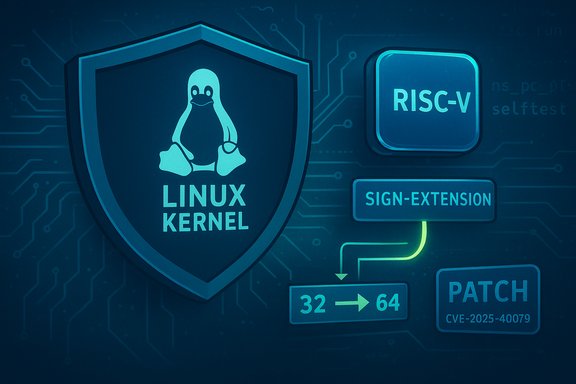
The Linux kernel received a focused upstream fix for CVE-2025-40079 — a RISC‑V specific BPF correctness bug where struct ops return values were not being sign‑extended according to the RISC‑V ABI, a mismatch that could trigger kernel panics in the ns_bpf_qdisc selftest and destabilize hosts running affected kernels.
eBPF (extended Berkeley Packet Filter) is an in‑kernel virtual machine used for tracing, networking, and security tooling. It exposes context structures and function models to user‑loaded programs; the kernel’s verifier and architecture‑specific epilogue/ABI handling are both part of the trusted execution surface that determines whether a program is allowed and how its return values are interpreted.
On RISC‑V, the calling convention and register/return‑value semantics are architecture‑specific. A mismatch between the BPF program return‑value handling and the RISC‑V ABI can cause pointers or integers to be misinterpreted when the kernel JIT/epilogue converts 32‑bit values into native 64‑bit registers — a subtle correctness bug that can produce a kernel paging fault or OOPS. The official vulnerability record describes a concrete panic observed during the ns_bpf_qdisc selftest and explains that the bpf_fifo_dequeue program returned an skb pointer that was treated as a 32‑bit value and sign‑extended in the epilogue; that is correct for most BPF program types but wrong for struct ops on RISC‑V, which require ABI‑compliant sign extension. Upstream kernel commits that implement the fix are available in the stable kernel tree; the canonical CVE entries and aggregator pages mirror the same explanation and link to the kernel patches.
This CVE is another reminder that as eBPF’s role in production grows, so does the importance of architecture‑aware correctness. The fix is small but important: sign‑extending struct ops return values correctly on RISC‑V preserves ABI invariants and prevents a class of kernel panics that would otherwise disrupt systems running BPF‑heavy workloads. Apply vendor patches promptly, tighten BPF loading policy where appropriate, and validate fixes in a controlled pilot before broad rollout.
Source: MSRC Security Update Guide - Microsoft Security Response Center
 Background / Overview
eBPF (extended Berkeley Packet Filter) is an in‑kernel virtual machine used for tracing, networking, and security tooling. It exposes context structures and function models to user‑loaded programs; the kernel’s verifier and architecture‑specific epilogue/ABI handling are both part of the trusted execution surface that determines whether a program is allowed and how its return values are interpreted.On RISC‑V, the calling convention and register/return‑value semantics are architecture‑specific. A mismatch between the BPF program return‑value handling and the RISC‑V ABI can cause pointers or integers to be misinterpreted when the kernel JIT/epilogue converts 32‑bit values into native 64‑bit registers — a subtle correctness bug that can produce a kernel paging fault or OOPS. The official vulnerability record describes a concrete panic observed during the ns_bpf_qdisc selftest and explains that the bpf_fifo_dequeue program returned an skb pointer that was treated as a 32‑bit value and sign‑extended in the epilogue; that is correct for most BPF program types but wrong for struct ops on RISC‑V, which require ABI‑compliant sign extension. Upstream kernel commits that implement the fix are available in the stable kernel tree; the canonical CVE entries and aggregator pages mirror the same explanation and link to the kernel patches.
Technical deep dive — what went wrong
The observable symptom: a kernel panic trace
The public NVD and CVE summaries include the kernel OOPS backtrace captured during the ns_bpf_qdisc selftest: an instruction stream that ends in __qdisc_run / __dev_queue_xmit and shows a faulting virtual address and a “Unable to handle kernel paging request” style message. That trace was reproducible in test environments and was the visible consequence of the underlying ABI mismatch.Root cause: return-value sign extension vs. architecture ABI
- Many BPF helper return values or program return paths produce 32‑bit values that the JIT/epilogue expands to native width. On architectures with different ABI expectations (RISC‑V in this case), how the expansion is performed (zero‑extend vs sign‑extend) matters.
- The vulnerable code path treated the returned pointer as a 32‑bit value and sign‑extended it in the epilogue. For most BPF program classes that is safe or expected. However, struct ops (a class of BPF program hooks that use a different function model) must follow the RISC‑V return semantics precisely.
- The mismatch meant that returned pointers could end up with incorrect high‑order bits after the sign‑extend step, producing invalid addresses and triggering a paging fault when subsequent kernel code dereferenced them. The upstream fix ensures struct ops return values are sign‑extended according to the RISC‑V function model and ABI, closing the hole.
The patch approach
Upstream maintainers applied a targeted, architecture‑aware change that adjusts the epilogue/return handling for struct ops on RISC‑V so the sign‑extension matches the function model. The conservative, minimal change preserves semantics for other BPF program types while making the struct ops path ABI-correct. The kernel stable commits referenced by CVE records implement this fix and were pushed into the stable trees for backporting by distributions.Affected systems and practical exposure
- Scope: The vulnerability is in Linux kernel code that touches the eBPF infrastructure on RISC‑V platforms — specifically the path that handles struct ops return values on that architecture. The fail‑case surfaced during a kernel selftest but maps to any system running a kernel with the vulnerable code path on RISC‑V hardware or emulated environments built for that architecture.
- Attack vector: Local / program‑loading. To trigger the specific scenario an attacker (or unprivileged process) would need the ability to load BPF programs of the affected type or otherwise exercise the struct ops hook. Whether that is possible without privileges depends on system policy (for example, kernel.unprivileged_bpf_disabled and capability gating like CAP_BPF/CAP_SYS_ADMIN). Many distros and hardened systems disallow unprivileged BPF loads by default; permissive developer systems and some containers can be more exposed.
- Exploitability: The public record does not show a remote, unauthenticated exploit. The immediate observable impact is an availability issue (kernel panic / OOPS), not a confirmed integrity/confidentiality compromise. The NVD/CVE pages and public aggregators frame this as a correctness/robustness fix to ensure ABI correctness rather than an obvious RCE vector. That said, kernel faults are high‑value primitives for attackers with a foothold, and a path to more powerful primitives cannot be ruled out in a complex exploit chain.
Mitigation and recommended immediate actions
Applying the upstream or vendor kernel update that contains the fix is the definitive remediation. For operations teams that cannot immediately patch, use these short‑term mitigations:- Install vendor patches and reboot into the patched kernel as soon as practical. Verify distribution advisories reference CVE‑2025‑40079 or the upstream commit.
- If you must delay patching, restrict BPF program loading on at‑risk hosts:
- Set kernel.unprivileged_bpf_disabled = 1 to prevent unprivileged users from using the bpf syscall where appropriate.
- Ensure only trusted users/groups hold CAP_BPF or CAP_SYS_ADMIN.
- Temporarily restrict or audit deployment of untrusted eBPF tooling (XDP, Cilium, Falco, tc filters, etc..
- For multi‑tenant or shared build hosts, enforce stricter sandboxing and capability limits on containers and CI runners that could otherwise load arbitrary BPF programs.
- Validate remediation in a pilot ring: after applying updates, exercise representative eBPF workloads and the selftests that previously triggered the OOPS, and monitor kernel logs for any residual traces.
- Inventory RISC‑V hosts and determine whether they run BPF/JIT‑enabled kernels (uname -r; check kernel config).
- Confirm vendor/distro advisories and map kernel package versions to the upstream fix.
- Stage patched kernels in a test ring and run BPF/eBPF workloads for 7–14 days.
- Deploy patched kernels in waves (pilot → expand → production).
- Monitor kernel logs, dmesg, and crash telemetry for related OOPS patterns.
- Retain rollback plans and pre‑patch logs for comparison.
Detection, hunting and verification guidance
Look for the following telemetry signals and kernel log strings when triaging or hunting for the issue:- Kernel OOPS messages containing “Unable to handle kernel paging request” combined with qdisc/net transmit traces (the official backtrace includes __qdisc_run, __dev_queue_xmit and tcp_connect frames in the selftest reproduction).
- Repeated verifier or BPF load failures correlated with processes that recently attempted to load struct ops style BPF programs.
- Sudden reboots or kernel panics on RISC‑V hosts after deploying new eBPF tooling or kernels.
- Reboot into the patched kernel and re-run the ns_bpf_qdisc selftest (or your representative BPF test suite) to confirm the panic is no longer triggered.
- Confirm the kernel changelog or package notes explicitly reference CVE‑2025‑40079 or the upstream commit IDs.
Why this matters — a risk analysis
- Strengths of the upstream response
- The fix is small and architecture‑targeted: it enforces correct sign‑extension semantics for struct ops on RISC‑V without altering well‑tested behavior in other code paths.
- The patch was committed to stable trees for backporting, enabling distributions to package and ship updates quickly. That conservative approach reduces regression risk while resolving the ABI mismatch.
- Operational risks and long tail
- Vendor and distribution lag: embedded devices, vendor kernels, or appliance images built for RISC‑V may not receive backports promptly. Those images can remain vulnerable long after mainstream distributions are fixed — a persistent operational risk for fleets that include RISC‑V systems.
- Unprivileged BPF policy variance: systems that allow unprivileged BPF loads increase exposure. Developer workstations and permissive containers are particular hotspots.
- Detection gap: the bug manifests as a panic/OOPS in many cases; if panic is suppressed or systems auto‑reboot, the underlying cause could be missed unless kernel telemetry is centralized and examined.
- Realistic severity: primarily availability. While not currently framed as an easy path to remote code execution, kernel faults are compelling to attackers who already have a local foothold. Any reliability corruption in the verifier / ABI glue code merits prompt patching because it sits on the trusted path that gates eBPF program execution.
For kernel developers and maintainers — technical takeaways
- ABI correctness matters: architecture‑specific calling conventions must be respected across JITs, epilogues, and verifier conversion logic. A return‑value sign/zero‑extension mismatch is easy to overlook in a codebase that targets multiple ISAs.
- Add regression tests: extend the BPF selftests and unit tests to cover struct ops return semantics on RISC‑V. Tests that include corner cases for return widths are the most direct safety net.
- Leverage fuzzing: this class of bug is exactly what Syzkaller and similar coverage‑guided fuzzers are designed to find. Continue investing in fuzz coverage for architecture/machine‑specific paths to catch ABI mismatches earlier.
- Keep patches minimal and well‑documented: upstream’s surgical approach made the fix easy to reason about and backport — a helpful template for other subtle correctness fixes.
What we verified and what remains uncertain
Verified- The NVD and public CVE mirrors describe the panic and the sign‑extension mismatch, and they link to upstream kernel commits implementing the fix.
- The issue reproduces in a kernel selftest (ns_bpf_qdisc) and manifests as an OOPS in the public backtrace.
- There are no authoritative public reports of in‑the‑wild exploitation turning this defect into a privilege escalation or remote code execution chain at the time of writing. Absence of evidence is not proof of absence; defenders should treat any kernel fault as a high‑value primitive and patch accordingly.
Final operational checklist (quick reference)
- Confirm whether you run kernels on RISC‑V hardware or emulated RISC‑V environments. If “no,” this CVE is not operationally relevant to your fleet.
- If yes, consult your distro/vendor security tracker for a CVE‑2025‑40079 patch and apply the supplied kernel update. Reboot as required.
- If patching must wait, set kernel.unprivileged_bpf_disabled=1 and restrict CAP_BPF/CAP_SYS_ADMIN recipients.
- Test representative BPF workloads in a staging ring before mass rollout. Monitor kernel logs for OOPS patterns and verifier warnings.
- For embedded/RISC‑V device vendors, request and track vendor backports and firmware/kernel images; isolate or segment devices that cannot be promptly updated.
This CVE is another reminder that as eBPF’s role in production grows, so does the importance of architecture‑aware correctness. The fix is small but important: sign‑extending struct ops return values correctly on RISC‑V preserves ABI invariants and prevents a class of kernel panics that would otherwise disrupt systems running BPF‑heavy workloads. Apply vendor patches promptly, tighten BPF loading policy where appropriate, and validate fixes in a controlled pilot before broad rollout.
Source: MSRC Security Update Guide - Microsoft Security Response Center
