

A MakeUseOf dual-boot benchmark published around a Windows 11 and EndeavourOS Linux gaming laptop found Windows leading by 8.5 percent in Geekbench single-core CPU performance and 23 percent in Unigine Superposition frame rate, while Linux led in multi-core CPU, OpenCL compute, and idle memory use. The result is not a clean victory for either operating system. It is a reminder that “Linux gaming is good now” and “Windows is bloated now” are both true only in the narrow places where the workload lets them be true. For PC gamers, the operating-system war has become less ideological and more embarrassingly practical: the fastest platform depends on which part of the machine is under pressure.
The most useful thing about this comparison is not that Windows won the gaming benchmark. That has been the default assumption for years, especially on Nvidia laptops. The useful part is that Windows did not win everything, and Linux did not merely win the low-overhead consolation prize.
The test machine was an MSI Cyborg 15 with a 13th-generation Intel Core i7, an Nvidia GeForce RTX 4050 Laptop GPU, 16GB of DDR5 memory, and a 1080p 144Hz display. Windows 11 lived on one partition, EndeavourOS with KDE Plasma on another, and both used the same Nvidia driver version listed in the MakeUseOf test. That is not a laboratory-grade methodology, but it is closer to the decision many real users face than a sterile test bench: one laptop, two operating systems, and a boot menu that turns theory into habit.
The numbers tell a split story. Windows posted a Geekbench 6 single-core score of 2,353 against Linux’s 2,170. Linux posted a slightly higher multi-core score, 11,273 against 11,188. In Geekbench’s OpenCL GPU compute test, Linux scored 78,007 to Windows’ 73,090. Then Unigine Superposition delivered the result gamers will notice first: Windows averaged 87.65 FPS, while Linux averaged 71.3 FPS on the same 1080p Medium preset.
That last gap is the headline, but it is not the whole article. A 23 percent frame-rate deficit is large enough to change how a game feels, especially on a laptop GPU where performance margins are already tight. Yet the same comparison also showed Windows idling at 8.5GB of RAM while EndeavourOS with KDE Plasma sat at 3.4GB. If the GPU result says Windows remains the safer gaming default, the memory result explains why so many users feel Linux is lighter before they ever open a benchmark.
The Superposition result is the cleanest example. A 23 percent Windows lead in a real-time 3D benchmark is not a rounding error, and it matters more than the small CPU spread because rendered frame rate is what most players are buying a gaming laptop to improve. If a laptop can push the same scene at nearly 88 FPS on Windows and about 71 FPS on Linux, the practical difference shows up in motion clarity, latency headroom, and how much quality you can afford before dipping under a personal threshold.
The test also exposed a familiar Linux-on-hybrid-graphics trap. The first Linux run reportedly landed at about 20 FPS because the benchmark was not actually using the RTX 4050. Once Nvidia PRIME render offload variables were used, performance jumped dramatically. That is a fixable problem, but it is also precisely the kind of fix that separates enthusiast Linux from consumer Windows.
That distinction matters. The fairest version of Linux did not score 20 FPS; the benchmark had to be pointed at the right GPU. But the user experience still included the possibility of accidentally benchmarking the wrong chip. Windows has its own absurdities, but hybrid graphics on gaming laptops is one area where the default user path is usually more polished.
Nvidia’s Linux stack has improved substantially, and the old caricature of Linux as a platform for people who enjoy manually recompiling pain is out of date. But “works” and “matches Windows frame-for-frame on an Optimus-style gaming laptop” are different claims. The benchmark lands exactly in that gap.
Single-core performance tends to correlate with the snap of everyday computing: opening applications, rendering parts of web pages, compressing smaller files, running lightly threaded desktop work, and pushing the main thread in games that still lean heavily on it. Windows doing better here may reflect scheduler behavior, power-state decisions, benchmark implementation details, background services, or some mix of all four. The important point is not that Windows is universally faster; it is that small differences in policy can become visible when one thread is the center of the workload.
Multi-core performance tells a different story. Linux has long had a strong reputation in server, development, and parallel workloads, and a near-tie on a 10-core laptop chip is consistent with that reputation without proving very much by itself. A difference of less than one percent is inside the zone where run-to-run variance, thermals, boost clocks, and background tasks can easily blur the line.
That is why the CPU result should cool down anyone hunting for a sweeping conclusion. Windows did not crush Linux at the processor level. Linux did not embarrass Windows. For raw CPU work on this laptop, the two operating systems were close enough that application choice, power profile, cooling, and silicon lottery could matter as much as the OS.
The larger lesson is that operating-system comparisons often collapse too many subsystems into one tribal answer. The same kernel and driver stack that looks efficient in one benchmark can be less competitive in another. The same Windows install that looks heavy at idle can still feed the GPU more effectively under a game-like rendering load.
That result will not surprise people who use Linux for development, machine learning experiments, rendering pipelines, scientific work, or workstation tasks. In those spaces, Linux is not an underdog platform trying to borrow Windows’ clothes. It is often the native environment where toolchains, scripting, dependency management, containers, and automation feel more coherent.
But GPU compute and GPU gaming are not interchangeable categories. Geekbench’s GPU compute test measures a different kind of work from a real-time graphics benchmark. It does not necessarily stress the same shader paths, presentation model, windowing behavior, frame pacing, or engine assumptions. A driver can look excellent in compute and still trail in frame delivery.
That distinction is where many casual benchmark debates go wrong. A Linux win in OpenCL does not refute a Windows win in Superposition. It explains that the GPU is not slower under Linux in some absolute physical sense. Instead, the software path around the GPU differs depending on what kind of work is being asked of it.
This is why developers and gamers can talk past each other about Linux performance. A developer compiling, containerizing, scripting, and running compute workloads may experience Linux as obviously faster and cleaner. A gamer launching an Nvidia-heavy 3D workload may see Windows as obviously smoother. Both are describing the same machine honestly.
Windows defenders can correctly point out that Task Manager’s “used” memory does not map perfectly to memory unavailable for applications. Windows preloads, caches, runs security components, sync clients, update services, indexing, telemetry-adjacent tasks, device utilities, and background frameworks that may release memory under pressure. The simplistic reading — that Windows permanently steals 5GB from every game — is not quite right.
Still, the lived experience matters. A 16GB gaming laptop is not a workstation with memory to burn. Once a browser, launcher, voice chat client, RGB utility, anti-cheat service, overlay, and a modern game are in memory, the difference between a lean desktop and a hungry one can stop being theoretical. It can mean more paging, fewer background tabs, worse multitasking, or a system that simply feels busier.
Linux’s win here is also not magic. EndeavourOS with KDE Plasma can be kept relatively lean, and many Linux distributions do less by default because they assume less centralized account integration, fewer bundled commercial services, and fewer OEM utilities. That minimalism is partly philosophy and partly market position. Linux can be light because it is not trying to be the same consumer services platform Windows has become.
This is where Windows 11’s problem is not merely performance but trust. Users see widgets, cloud prompts, bundled apps, background processes, Copilot-era integrations, account nudges, and update orchestration, then they look at an idle memory number and feel vindicated. The benchmark does not prove every complaint about Windows bloat, but it gives the complaint a number with teeth.
Nvidia laptops are a particularly tricky test case because they combine proprietary GPU drivers, hybrid graphics, power management, display routing, vendor control panels, and thermal constraints. Desktop Linux has made significant progress with Wayland, explicit sync, VRR, HDR work, and better driver integration, but laptops remain where the seams are easiest to see. The RTX 4050 in the MSI Cyborg 15 is not a bad GPU; it is simply living in a platform design that was historically optimized around Windows first.
Hybrid graphics also makes “same hardware” less simple than it sounds. A laptop may route internal display output through the integrated GPU while rendering on the discrete GPU. Power mode, mux behavior, BIOS options, driver selection, compositor behavior, and launch environment can all affect what actually happens. The MakeUseOf test’s initial 20 FPS result was not a silly mistake so much as a miniature case study in why Linux laptop gaming can still demand literacy from the user.
That literacy tax has real consequences. Enthusiasts often undercount it because they enjoy solving the problem. Most gamers do not. They want to install a driver, click Play, and trust that the expensive GPU is the one doing the work.
This does not mean Linux is unsuitable for gaming laptops. It means buyers need to understand the bargain. On some hardware, with the right games and the right APIs, Linux can be excellent. On an Nvidia hybrid laptop, Windows may still offer more predictable performance, fewer launch-time surprises, and better vendor-tested defaults.
But the new answer — “Linux is just as good as Windows for gaming” — is too broad. Compatibility and performance are separate wins. A game can launch perfectly and still run slower. A game can run faster and still be blocked from multiplayer by anti-cheat. A game can perform well on AMD and stumble on Nvidia. A game can be flawless on a Steam Deck-style target and awkward on a hybrid laptop.
Anti-cheat remains the clearest example of how technical progress can run into business decisions. Valve’s documentation for Proton support includes paths for titles using common anti-cheat middleware, but developers and publishers still have to enable and validate support for their games. When they do not, the block often looks like a Linux failure to the end user even when the compatibility layer is not the real obstacle.
The MakeUseOf benchmark wisely separates that issue from raw frame rate. Anti-cheat determines whether some games can be played at all. Rendering performance determines how well many playable games feel. For single-player gaming, the 23 percent Superposition gap may matter more than a compatibility debate. For multiplayer players locked out by anti-cheat, performance is irrelevant because the game never reaches the match.
That is the modern Linux gaming paradox. The platform has become good enough that the remaining problems are more specific, more annoying, and harder to summarize. Linux is no longer losing because it cannot run games. It loses particular contests because the PC ecosystem still assumes Windows at too many critical points.
Balanced power mode is especially worth noting. “Balanced” does not necessarily mean identical across operating systems. Windows and Linux can interpret boost behavior, GPU power states, fan curves, and idle policies differently. On laptops, the firmware and OEM utilities may expose better-tuned behavior to Windows than to Linux, even when the visible setting name looks similar.
The benchmark suite also matters. Geekbench 6 is a useful cross-platform synthetic benchmark, and Unigine Superposition remains a handy graphics workload, but neither represents the entire gaming universe. A DirectX 12 game translated through VKD3D-Proton, a native Vulkan game, an OpenGL title, an esports shooter, a CPU-bound strategy game, and a ray-traced AAA release could each tell a different story.
That does not make the results meaningless. It makes them directional. Windows winning Superposition by 23 percent on an Nvidia laptop is a serious signal. Linux using dramatically less memory at idle is also a serious signal. The mistake would be turning either into a universal verdict.
For WindowsForum readers, the better interpretation is practical. If your priority is maximum frame rate on an Nvidia gaming laptop, Windows remains the low-friction recommendation. If your priority is development, general responsiveness, memory headroom, or control over the operating system, Linux deserves to be more than a weekend experiment.
Windows 11’s idle memory footprint reinforces a growing frustration among power users. The operating system often feels like a platform trying to serve too many masters: enterprise management, consumer cloud services, gaming, advertising surfaces, AI features, legacy compatibility, security hardening, and OEM monetization. Some of those goals are legitimate. Together, they can make the OS feel heavy even when it performs well under load.
That creates a strange opening for Linux. Linux does not need to beat Windows in every benchmark to win mindshare among enthusiasts. It needs to be good enough at gaming while being noticeably better at the everyday things users resent Windows for. Fast booting, lower idle resource use, transparent package management, fewer unsolicited prompts, and a desktop that feels owned by the user all count.
Microsoft can afford that trade-off as long as Windows remains the obvious gaming platform. The risk is gradual erosion at the edges. Developers move to Linux or WSL-heavy workflows. Handheld gaming normalizes SteamOS. Anti-cheat support improves title by title. AMD and Mesa continue making open graphics stacks feel less exotic. Each step reduces the number of users who keep Windows because they must.
The MakeUseOf numbers show Microsoft’s moat and its liability at the same time. Windows still delivers frames. Linux increasingly delivers everything around the frames.
A great default is invisible. The user launches a benchmark, and the right GPU wakes up. The game opens on the right display. The performance profile behaves sensibly. The overlay works. The controller works. The anti-cheat works. The update does not break the session. Windows has spent decades accumulating these assumptions, and even when it is messy, the mess is familiar to hardware vendors and game studios.
Linux has improved its defaults dramatically, but the ecosystem is more fragmented. Distribution choice, desktop environment, display server, driver packaging, kernel version, and graphics vendor can all matter. Enthusiasts see that flexibility as a strength. Ordinary users see it as the risk that a search result from two years ago may be the only thing standing between them and the hardware they paid for.
SteamOS succeeds partly because it hides that fragmentation. Valve controls the target, curates the update path, and makes Linux feel appliance-like. EndeavourOS on a gaming laptop is a different proposition. It gives the user power, but it also expects the user to know when the integrated GPU has stolen the show.
That is why the future of Linux gaming may depend less on abstract Linux adoption than on curated Linux experiences. Steam Deck proved that a locked-down, gamer-first Linux environment can work. The challenge is extending that confidence to the broader chaos of PC hardware without losing the openness that made Linux attractive in the first place.
That split is already visible in how many enthusiasts use their machines. Windows is the game partition, the VR partition, the anti-cheat partition, the “it just works with this launcher” partition. Linux is the work partition, the browsing partition, the coding partition, the system that feels calmer when the fan is quiet and the desktop is empty.
Dual-booting used to be a declaration of allegiance in progress: a user slowly migrating away from Windows or grudgingly keeping Linux around for experiments. Now it can be a rational equilibrium. Boot Windows when frames, multiplayer compatibility, or vendor utilities matter. Boot Linux when memory headroom, development tools, and desktop control matter.
Microsoft should not take too much comfort in that arrangement. A second operating system that becomes the pleasant place to live and leaves Windows as the necessary place to game is still a strategic warning. Users who once never saw Linux now compare it every day against Windows’ defaults, and Windows does not always come out looking like the premium experience.
Linux advocates should not overclaim either. A 23 percent rendering deficit is not a minor footnote for a gaming laptop. If the pitch is that Linux can replace Windows for gamers, the answer still depends on the game, the GPU, the anti-cheat stack, and the user’s willingness to troubleshoot.
The bigger story is that Linux has become good enough to make Windows justify itself benchmark by benchmark, not slogan by slogan. Windows still wins where the commercial PC gaming pipeline is most optimized, but Linux now wins enough surrounding territory — memory use, compute behavior, desktop restraint, developer comfort — that the old hierarchy feels less permanent than it once did. The next phase will not be decided by forum arguments about which kernel is superior; it will be decided by defaults, drivers, anti-cheat checkboxes, and whether users keep finding that the operating system they need for games is not always the one they prefer to use.
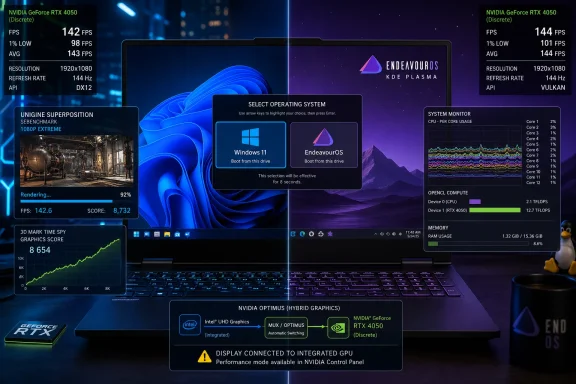 The Benchmark That Refuses to Fit the Culture War
The most useful thing about this comparison is not that Windows won the gaming benchmark. That has been the default assumption for years, especially on Nvidia laptops. The useful part is that Windows did not win everything, and Linux did not merely win the low-overhead consolation prize.The test machine was an MSI Cyborg 15 with a 13th-generation Intel Core i7, an Nvidia GeForce RTX 4050 Laptop GPU, 16GB of DDR5 memory, and a 1080p 144Hz display. Windows 11 lived on one partition, EndeavourOS with KDE Plasma on another, and both used the same Nvidia driver version listed in the MakeUseOf test. That is not a laboratory-grade methodology, but it is closer to the decision many real users face than a sterile test bench: one laptop, two operating systems, and a boot menu that turns theory into habit.
The numbers tell a split story. Windows posted a Geekbench 6 single-core score of 2,353 against Linux’s 2,170. Linux posted a slightly higher multi-core score, 11,273 against 11,188. In Geekbench’s OpenCL GPU compute test, Linux scored 78,007 to Windows’ 73,090. Then Unigine Superposition delivered the result gamers will notice first: Windows averaged 87.65 FPS, while Linux averaged 71.3 FPS on the same 1080p Medium preset.
That last gap is the headline, but it is not the whole article. A 23 percent frame-rate deficit is large enough to change how a game feels, especially on a laptop GPU where performance margins are already tight. Yet the same comparison also showed Windows idling at 8.5GB of RAM while EndeavourOS with KDE Plasma sat at 3.4GB. If the GPU result says Windows remains the safer gaming default, the memory result explains why so many users feel Linux is lighter before they ever open a benchmark.
Windows Still Owns the Path From Driver to Frame
Gaming performance is not just GPU horsepower. It is the shape of the whole path between the game engine, graphics API, driver stack, compositor, display server, power-management logic, shader compilation, and the vendor’s own assumptions about where its customers are. On that path, Windows still benefits from being the primary commercial target.The Superposition result is the cleanest example. A 23 percent Windows lead in a real-time 3D benchmark is not a rounding error, and it matters more than the small CPU spread because rendered frame rate is what most players are buying a gaming laptop to improve. If a laptop can push the same scene at nearly 88 FPS on Windows and about 71 FPS on Linux, the practical difference shows up in motion clarity, latency headroom, and how much quality you can afford before dipping under a personal threshold.
The test also exposed a familiar Linux-on-hybrid-graphics trap. The first Linux run reportedly landed at about 20 FPS because the benchmark was not actually using the RTX 4050. Once Nvidia PRIME render offload variables were used, performance jumped dramatically. That is a fixable problem, but it is also precisely the kind of fix that separates enthusiast Linux from consumer Windows.
That distinction matters. The fairest version of Linux did not score 20 FPS; the benchmark had to be pointed at the right GPU. But the user experience still included the possibility of accidentally benchmarking the wrong chip. Windows has its own absurdities, but hybrid graphics on gaming laptops is one area where the default user path is usually more polished.
Nvidia’s Linux stack has improved substantially, and the old caricature of Linux as a platform for people who enjoy manually recompiling pain is out of date. But “works” and “matches Windows frame-for-frame on an Optimus-style gaming laptop” are different claims. The benchmark lands exactly in that gap.
CPU Scores Show the Operating System Is Not the Whole Machine
The CPU numbers are more restrained and more interesting than the gaming headline suggests. Windows’ 8.5 percent single-core lead is meaningful but not decisive. Linux’s multi-core edge of less than 1 percent is technically a win and practically a tie.Single-core performance tends to correlate with the snap of everyday computing: opening applications, rendering parts of web pages, compressing smaller files, running lightly threaded desktop work, and pushing the main thread in games that still lean heavily on it. Windows doing better here may reflect scheduler behavior, power-state decisions, benchmark implementation details, background services, or some mix of all four. The important point is not that Windows is universally faster; it is that small differences in policy can become visible when one thread is the center of the workload.
Multi-core performance tells a different story. Linux has long had a strong reputation in server, development, and parallel workloads, and a near-tie on a 10-core laptop chip is consistent with that reputation without proving very much by itself. A difference of less than one percent is inside the zone where run-to-run variance, thermals, boost clocks, and background tasks can easily blur the line.
That is why the CPU result should cool down anyone hunting for a sweeping conclusion. Windows did not crush Linux at the processor level. Linux did not embarrass Windows. For raw CPU work on this laptop, the two operating systems were close enough that application choice, power profile, cooling, and silicon lottery could matter as much as the OS.
The larger lesson is that operating-system comparisons often collapse too many subsystems into one tribal answer. The same kernel and driver stack that looks efficient in one benchmark can be less competitive in another. The same Windows install that looks heavy at idle can still feed the GPU more effectively under a game-like rendering load.
Linux’s Compute Win Is Real, but It Is Not the Same as Gaming
The Geekbench OpenCL result gives Linux its cleanest performance bragging right. A 6.7 percent lead on the same RTX 4050 suggests that Nvidia’s Linux driver can be more than merely adequate when the workload fits. For compute tasks that call into OpenCL or CUDA-style paths directly, Linux can absolutely be competitive.That result will not surprise people who use Linux for development, machine learning experiments, rendering pipelines, scientific work, or workstation tasks. In those spaces, Linux is not an underdog platform trying to borrow Windows’ clothes. It is often the native environment where toolchains, scripting, dependency management, containers, and automation feel more coherent.
But GPU compute and GPU gaming are not interchangeable categories. Geekbench’s GPU compute test measures a different kind of work from a real-time graphics benchmark. It does not necessarily stress the same shader paths, presentation model, windowing behavior, frame pacing, or engine assumptions. A driver can look excellent in compute and still trail in frame delivery.
That distinction is where many casual benchmark debates go wrong. A Linux win in OpenCL does not refute a Windows win in Superposition. It explains that the GPU is not slower under Linux in some absolute physical sense. Instead, the software path around the GPU differs depending on what kind of work is being asked of it.
This is why developers and gamers can talk past each other about Linux performance. A developer compiling, containerizing, scripting, and running compute workloads may experience Linux as obviously faster and cleaner. A gamer launching an Nvidia-heavy 3D workload may see Windows as obviously smoother. Both are describing the same machine honestly.
Memory Is Where Windows Loses the Vibe Test
The idle RAM result is the least sophisticated measurement in the comparison and probably the one many readers will understand immediately. Windows 11 using 8.5GB at idle against EndeavourOS KDE using 3.4GB is the kind of number that cuts through benchmark caveats. Even if one argues that modern operating systems cache aggressively and unused memory is not inherently virtuous, the spread is too large to ignore.Windows defenders can correctly point out that Task Manager’s “used” memory does not map perfectly to memory unavailable for applications. Windows preloads, caches, runs security components, sync clients, update services, indexing, telemetry-adjacent tasks, device utilities, and background frameworks that may release memory under pressure. The simplistic reading — that Windows permanently steals 5GB from every game — is not quite right.
Still, the lived experience matters. A 16GB gaming laptop is not a workstation with memory to burn. Once a browser, launcher, voice chat client, RGB utility, anti-cheat service, overlay, and a modern game are in memory, the difference between a lean desktop and a hungry one can stop being theoretical. It can mean more paging, fewer background tabs, worse multitasking, or a system that simply feels busier.
Linux’s win here is also not magic. EndeavourOS with KDE Plasma can be kept relatively lean, and many Linux distributions do less by default because they assume less centralized account integration, fewer bundled commercial services, and fewer OEM utilities. That minimalism is partly philosophy and partly market position. Linux can be light because it is not trying to be the same consumer services platform Windows has become.
This is where Windows 11’s problem is not merely performance but trust. Users see widgets, cloud prompts, bundled apps, background processes, Copilot-era integrations, account nudges, and update orchestration, then they look at an idle memory number and feel vindicated. The benchmark does not prove every complaint about Windows bloat, but it gives the complaint a number with teeth.
The Nvidia Laptop Remains Linux Gaming’s Stress Test
If this had been an AMD desktop GPU running a native Vulkan game, the story might have been different. That is the point. Linux gaming performance is no longer one thing, and hardware choice matters enormously.Nvidia laptops are a particularly tricky test case because they combine proprietary GPU drivers, hybrid graphics, power management, display routing, vendor control panels, and thermal constraints. Desktop Linux has made significant progress with Wayland, explicit sync, VRR, HDR work, and better driver integration, but laptops remain where the seams are easiest to see. The RTX 4050 in the MSI Cyborg 15 is not a bad GPU; it is simply living in a platform design that was historically optimized around Windows first.
Hybrid graphics also makes “same hardware” less simple than it sounds. A laptop may route internal display output through the integrated GPU while rendering on the discrete GPU. Power mode, mux behavior, BIOS options, driver selection, compositor behavior, and launch environment can all affect what actually happens. The MakeUseOf test’s initial 20 FPS result was not a silly mistake so much as a miniature case study in why Linux laptop gaming can still demand literacy from the user.
That literacy tax has real consequences. Enthusiasts often undercount it because they enjoy solving the problem. Most gamers do not. They want to install a driver, click Play, and trust that the expensive GPU is the one doing the work.
This does not mean Linux is unsuitable for gaming laptops. It means buyers need to understand the bargain. On some hardware, with the right games and the right APIs, Linux can be excellent. On an Nvidia hybrid laptop, Windows may still offer more predictable performance, fewer launch-time surprises, and better vendor-tested defaults.
Proton Changed the Argument Without Ending It
The reason this comparison feels timely is that Linux gaming is no longer a novelty act. Proton, DXVK, VKD3D-Proton, the Steam Deck, and years of compatibility work have turned a once-niche hobby into a mainstream alternative for a substantial slice of the PC library. The old answer — “Linux is not for games” — is obsolete.But the new answer — “Linux is just as good as Windows for gaming” — is too broad. Compatibility and performance are separate wins. A game can launch perfectly and still run slower. A game can run faster and still be blocked from multiplayer by anti-cheat. A game can perform well on AMD and stumble on Nvidia. A game can be flawless on a Steam Deck-style target and awkward on a hybrid laptop.
Anti-cheat remains the clearest example of how technical progress can run into business decisions. Valve’s documentation for Proton support includes paths for titles using common anti-cheat middleware, but developers and publishers still have to enable and validate support for their games. When they do not, the block often looks like a Linux failure to the end user even when the compatibility layer is not the real obstacle.
The MakeUseOf benchmark wisely separates that issue from raw frame rate. Anti-cheat determines whether some games can be played at all. Rendering performance determines how well many playable games feel. For single-player gaming, the 23 percent Superposition gap may matter more than a compatibility debate. For multiplayer players locked out by anti-cheat, performance is irrelevant because the game never reaches the match.
That is the modern Linux gaming paradox. The platform has become good enough that the remaining problems are more specific, more annoying, and harder to summarize. Linux is no longer losing because it cannot run games. It loses particular contests because the PC ecosystem still assumes Windows at too many critical points.
Benchmarks Are Maps, Not Court Verdicts
A dual-boot benchmark is a strong anecdote, not universal law. The same machine removes many hardware variables, but it does not remove every variable. Thermal state, firmware behavior, benchmark order, power profiles, background services, filesystem differences, compositor settings, X11 versus Wayland, driver packaging, and run-to-run variance can all shape the result.Balanced power mode is especially worth noting. “Balanced” does not necessarily mean identical across operating systems. Windows and Linux can interpret boost behavior, GPU power states, fan curves, and idle policies differently. On laptops, the firmware and OEM utilities may expose better-tuned behavior to Windows than to Linux, even when the visible setting name looks similar.
The benchmark suite also matters. Geekbench 6 is a useful cross-platform synthetic benchmark, and Unigine Superposition remains a handy graphics workload, but neither represents the entire gaming universe. A DirectX 12 game translated through VKD3D-Proton, a native Vulkan game, an OpenGL title, an esports shooter, a CPU-bound strategy game, and a ray-traced AAA release could each tell a different story.
That does not make the results meaningless. It makes them directional. Windows winning Superposition by 23 percent on an Nvidia laptop is a serious signal. Linux using dramatically less memory at idle is also a serious signal. The mistake would be turning either into a universal verdict.
For WindowsForum readers, the better interpretation is practical. If your priority is maximum frame rate on an Nvidia gaming laptop, Windows remains the low-friction recommendation. If your priority is development, general responsiveness, memory headroom, or control over the operating system, Linux deserves to be more than a weekend experiment.
Microsoft’s Advantage Is Inertia, Not Elegance
The uncomfortable part for Microsoft is that Windows wins the gaming result without looking especially elegant. It wins because the industry routes through it. GPU vendors, OEMs, anti-cheat makers, game studios, launcher companies, and peripheral vendors all test Windows first because Windows is where the customers are. That is a powerful advantage, but it is not the same as affection.Windows 11’s idle memory footprint reinforces a growing frustration among power users. The operating system often feels like a platform trying to serve too many masters: enterprise management, consumer cloud services, gaming, advertising surfaces, AI features, legacy compatibility, security hardening, and OEM monetization. Some of those goals are legitimate. Together, they can make the OS feel heavy even when it performs well under load.
That creates a strange opening for Linux. Linux does not need to beat Windows in every benchmark to win mindshare among enthusiasts. It needs to be good enough at gaming while being noticeably better at the everyday things users resent Windows for. Fast booting, lower idle resource use, transparent package management, fewer unsolicited prompts, and a desktop that feels owned by the user all count.
Microsoft can afford that trade-off as long as Windows remains the obvious gaming platform. The risk is gradual erosion at the edges. Developers move to Linux or WSL-heavy workflows. Handheld gaming normalizes SteamOS. Anti-cheat support improves title by title. AMD and Mesa continue making open graphics stacks feel less exotic. Each step reduces the number of users who keep Windows because they must.
The MakeUseOf numbers show Microsoft’s moat and its liability at the same time. Windows still delivers frames. Linux increasingly delivers everything around the frames.
The Real Contest Is Defaults
The most revealing moment in the benchmark was not the final FPS score. It was the need to force the Linux benchmark onto the discrete Nvidia GPU. That is where operating systems win or lose normal users: not in peak capability, but in defaults.A great default is invisible. The user launches a benchmark, and the right GPU wakes up. The game opens on the right display. The performance profile behaves sensibly. The overlay works. The controller works. The anti-cheat works. The update does not break the session. Windows has spent decades accumulating these assumptions, and even when it is messy, the mess is familiar to hardware vendors and game studios.
Linux has improved its defaults dramatically, but the ecosystem is more fragmented. Distribution choice, desktop environment, display server, driver packaging, kernel version, and graphics vendor can all matter. Enthusiasts see that flexibility as a strength. Ordinary users see it as the risk that a search result from two years ago may be the only thing standing between them and the hardware they paid for.
SteamOS succeeds partly because it hides that fragmentation. Valve controls the target, curates the update path, and makes Linux feel appliance-like. EndeavourOS on a gaming laptop is a different proposition. It gives the user power, but it also expects the user to know when the integrated GPU has stolen the show.
That is why the future of Linux gaming may depend less on abstract Linux adoption than on curated Linux experiences. Steam Deck proved that a locked-down, gamer-first Linux environment can work. The challenge is extending that confidence to the broader chaos of PC hardware without losing the openness that made Linux attractive in the first place.
The Numbers Point to a Split-Brain PC Future
The cleanest reading of the benchmark is that the desktop PC is becoming a split-brain machine. Windows remains the performance and compatibility default for mainstream gaming, especially on Nvidia laptop hardware. Linux increasingly looks like the better daily driver for users who value low overhead, development workflows, and control.That split is already visible in how many enthusiasts use their machines. Windows is the game partition, the VR partition, the anti-cheat partition, the “it just works with this launcher” partition. Linux is the work partition, the browsing partition, the coding partition, the system that feels calmer when the fan is quiet and the desktop is empty.
Dual-booting used to be a declaration of allegiance in progress: a user slowly migrating away from Windows or grudgingly keeping Linux around for experiments. Now it can be a rational equilibrium. Boot Windows when frames, multiplayer compatibility, or vendor utilities matter. Boot Linux when memory headroom, development tools, and desktop control matter.
Microsoft should not take too much comfort in that arrangement. A second operating system that becomes the pleasant place to live and leaves Windows as the necessary place to game is still a strategic warning. Users who once never saw Linux now compare it every day against Windows’ defaults, and Windows does not always come out looking like the premium experience.
Linux advocates should not overclaim either. A 23 percent rendering deficit is not a minor footnote for a gaming laptop. If the pitch is that Linux can replace Windows for gamers, the answer still depends on the game, the GPU, the anti-cheat stack, and the user’s willingness to troubleshoot.
The RTX 4050 Verdict in Plain English
The MakeUseOf comparison does not crown a universal winner, but it gives Windows users and Linux-curious gamers a useful decision frame. The most concrete lesson is that workload matters more than operating-system identity.- Windows 11 was faster in the single-core CPU test and substantially faster in the Unigine Superposition graphics benchmark on this Nvidia laptop.
- EndeavourOS Linux was effectively tied in multi-core CPU performance and faster in the Geekbench OpenCL GPU compute test.
- Linux used far less memory at idle, which helps explain why many users perceive it as lighter in everyday desktop use.
- Nvidia hybrid graphics on Linux can still require manual intervention to ensure the discrete GPU is actually being used.
- Anti-cheat support has improved through Proton-era work, but publishers still decide whether many multiplayer games are truly playable.
- For this class of gaming laptop, Windows remains the safer choice for raw frame rates, while Linux remains increasingly compelling for everything around gaming.
The bigger story is that Linux has become good enough to make Windows justify itself benchmark by benchmark, not slogan by slogan. Windows still wins where the commercial PC gaming pipeline is most optimized, but Linux now wins enough surrounding territory — memory use, compute behavior, desktop restraint, developer comfort — that the old hierarchy feels less permanent than it once did. The next phase will not be decided by forum arguments about which kernel is superior; it will be decided by defaults, drivers, anti-cheat checkboxes, and whether users keep finding that the operating system they need for games is not always the one they prefer to use.
References
- Primary source: MakeUseOf
Published: Sat, 27 Jun 2026 19:30:19 GMT
I benchmarked my gaming PC on Windows vs Linux, and the difference was bigger than I expected
I ran the same tests on both sides of my dual-boot and one of them embarrassed the other. www.makeuseof.com
- Related coverage: store.steampowered.com
Mentor de Steam: Linux VS Anti-Cheat
Purpose of this is to help players see which steam game with Anti-Cheat is working on Linux and Steam Deck with Valve's compatibility layer Proton...store.steampowered.com
- Related coverage: download.nvidia.com
- Related coverage: pcgamer.com
Rust developer has 'no plans' for Linux or Proton support, says games that support them are 'not serious about anti-cheat' | PC Gamer
So much for my Steam Machine plans.www.pcgamer.com - Related coverage: caniplayonlinux.com
Anti-Cheat on Linux: EAC, BattlEye, and Kernel-Level Systems | Can I Play on Linux?
Your anti-cheat problem might be fixable — or might not. Learn which systems work on Linux via Proton, which block it entirely, and what you can do. caniplayonlinux.com
- Related coverage: gamesradar.com
Rust dev shoots down hopes of playing the hit survival game on Valve's Steam Machine: "There are no plans to support Proton or Linux" | GamesRadar+
Compatibility would open the game to cheaterswww.gamesradar.com
- Related coverage: windowscentral.com
The Steam Machine will face the same anti-cheat woes as the Steam Deck — but will it ever get better? | Windows Central
The biggest issue SteamOS devices face is a lack of anti-cheat support in many of the most popular titles, but is there any hope it'll get better?www.windowscentral.com
