

Apple’s macOS 27 beta broke Asahi Linux dual-boot visibility on Apple Silicon Macs in June 2026, while Microsoft’s low-cost Surface Go line and Sony’s physical PlayStation discs are now reportedly headed for retirement. Taken together, these are not just three unrelated bits of platform news. They are reminders that the personal computer, the console, and the mobile-adjacent device market are all moving in the same direction: less user-controlled, less repairable in spirit even when repairable in parts, and more dependent on vendor-managed paths.
The week’s small stories often say more than the keynote-sized ones. A boot picker bug, an out-of-stock tablet, and a phaseout plan for game discs do not look like one trend at first glance. But each one exposes a different seam in modern computing: who controls the boot chain, who gets an affordable first-party device, and who really owns the media they buy.
Asahi Linux exists because Apple Silicon Macs are excellent computers that Apple does not intend to support as general-purpose Linux machines. That distinction matters. The Asahi team has never been merely packaging a distro; it has been reverse-engineering and maintaining a compatibility bridge across hardware, firmware, graphics, power management, audio, and Apple’s evolving boot process.
When macOS 27 arrived in beta form, that bridge faltered. Users who upgraded found that their Asahi Linux volumes no longer appeared where they expected them to appear, effectively stranding existing installations behind Apple’s boot and recovery tooling. The Linux installs were not necessarily erased, but from a practical user standpoint, invisible can feel a lot like gone.
The fix from the Asahi project is therefore more than routine maintenance. New installations now get the workaround by default, and existing users can use the installer to repair affected setups. That is a credit to Asahi’s engineering discipline, but it also underlines the fragility of running an alternative OS on a machine whose platform owner can change foundational assumptions with a beta update.
It is tempting to frame this as Apple versus Linux, but the more interesting story is architectural. On old Intel Macs, installing Linux was never always elegant, but the PC-like substrate gave users and developers a familiar set of tools. Apple Silicon changed the power, performance, and battery-life equation in Apple’s favor, but it also moved more of the experience into Apple-controlled mechanisms that third-party operating systems must continuously track.
That tradeoff is now the real price of Apple’s vertical integration. The hardware is better because Apple controls more of the stack. Alternative operating systems are harder for exactly the same reason.
But the incident also demonstrates the asymmetry between community projects and platform vendors. Apple can change the behavior of macOS recovery, startup disk handling, or the boot picker as part of a beta cycle. Asahi then has to identify the change, determine whether it is intentional or accidental, find a safe workaround, and update user-facing tools quickly enough that the project does not look broken to newcomers.
That burden is not unique to Asahi. Hackintosh projects lived under it. Android custom ROM communities live under it. Windows-on-Arm tinkerers live under it. But Apple Silicon gives the issue a sharper edge because the hardware is so desirable and the vendor has so little incentive to preserve non-macOS workflows unless they align with Apple’s own priorities.
For users, the lesson is not “never install betas,” though that remains sound advice for any machine you rely on. The deeper lesson is that an alternative OS on a locked-down or semi-locked-down platform is only as stable as the undocumented behaviors it depends on. Asahi is impressive precisely because it makes an unsupported thing feel nearly normal.
The danger is that “nearly normal” can lull users into forgetting how much engineering stands between them and a boot prompt. When a macOS beta can make Linux disappear from the picker, the old PC assumption — that the machine is yours first and the operating system is merely installed on it — looks increasingly historical.
The Surface Go in particular occupied an odd but useful space. It was not an iPad killer, not a workstation, and not a premium ultrabook. It was a small Windows tablet with a real desktop OS, a kickstand, a keyboard cover, and enough familiarity to fit into organizations that already managed Windows.
That made it easy to mock and hard to replace. A cheap Chromebook can do some of the same jobs. An iPad can do others. A full Surface Pro is more capable. But none of those is quite the same thing as a low-cost, first-party, ultra-portable Windows device that behaves like a Windows PC because it is one.
If Microsoft is indeed done with the Go brand for the foreseeable future, it says something uncomfortable about the company’s hardware ambitions. Surface began as a challenge to PC makers: build better Windows devices, or Microsoft will show you how. In 2026, the Surface portfolio increasingly looks less like a full expression of Windows possibilities and more like a narrower premium showcase.
That may make financial sense. Low-end hardware is unforgiving, margins are thin, and component pricing has not been kind. But Windows has always depended on breadth. A Windows ecosystem without compelling first-party entry points cedes the low end to Chromebooks, used business laptops, and no-name tablets that rarely show Windows at its best.
The Go devices were different because they were not concept cars. They were not trying to redefine the category. They were trying to make the Surface formula cheaper and smaller, which is exactly the kind of boring product line a mature ecosystem needs.
Losing that tier matters for IT because procurement is not driven only by benchmark charts. A fleet device needs predictable availability, parts and accessory continuity, manageable firmware, and a vendor story that does not change every two years. If Microsoft exits the entry-level Surface space, organizations that liked the Go form factor have to decide whether to buy remaining stock, move to larger Surface models, or look outside the Surface family entirely.
That is where the “no successor currently planned” part of the reporting stings. Product gaps are tolerable when a replacement is obvious. They are more disruptive when a vendor simply decides the category no longer deserves attention.
Microsoft may argue that its partners can serve this market. That is true in the abstract. Lenovo, HP, Dell, Acer, and others all sell lower-cost Windows hardware. But Surface has always carried symbolic weight beyond unit volume. When Microsoft makes a device category, it validates that category as part of the Windows story.
Without Surface Go, the Windows tablet story becomes more expensive, more enterprise-specific, or more dependent on OEMs whose incentives may not include preserving Microsoft’s cleanest small-device experience. That is not a crisis. It is a narrowing.
Digital distribution is already dominant, and pretending otherwise would be sentimental. Players buy through storefronts because it is convenient. Publishers prefer digital because it reduces manufacturing costs, discourages resale, enables live-service monetization, and gives platform holders tighter control over pricing, refunds, regional availability, and access.
Still, ending discs for new PlayStation games would be a line-crossing moment. It would not merely acknowledge that most users have chosen digital most of the time. It would remove the physical option for the users who still want it, including collectors, rural players with poor broadband, households with data caps, preservationists, and anyone who dislikes tying a library entirely to account status and server availability.
The timing is also telling. The industry has been training customers for this outcome for years through day-one patches, incomplete on-disc builds, online authentication, deluxe digital editions, subscription catalogs, and disc boxes that sometimes contain little more than entitlement codes. The physical product has been hollowed out before being formally retired.
Sony can reasonably point to consumer behavior. But consumer behavior inside a constrained marketplace is not the same as a referendum. If the industry makes digital easier, discounts digital aggressively, designs consoles without drives, and ships physical editions that still require massive downloads, it should not be surprising when digital becomes the path of least resistance.
A platform holder with a digital-only future has more leverage over the life of a game. It can delist a title, alter storefront visibility, enforce refund rules, restrict regional purchases, and shape discount cadence. It can also offer genuinely useful features: instant access, remote downloads, preloading, cross-buy entitlements, and less clutter under the TV.
The problem is not that digital is bad. The problem is that digital ownership remains underdeveloped compared with physical ownership. When a disc disappears, users lose a fallback mechanism before the legal, technical, and preservation frameworks around digital libraries have matured enough to replace it.
Console makers will say that backward compatibility, account libraries, and cloud services solve much of this. Sometimes they do. But anyone who has watched licensed content vanish, online modes die, or storefronts close knows the anxiety is not theoretical. A digital library is only as durable as the platform holder’s willingness and ability to keep honoring it.
That does not mean discs were perfect preservation media. Many modern discs depend on patches, and optical media degrade. But they did create a secondary market and a user-held artifact outside the storefront’s direct control. Removing that artifact changes the power balance.
Even as rumor, it belongs in the same conversation because it shows the same gravitational pull. Every ambitious technology company eventually looks at the full stack and wonders why it should depend on someone else’s hardware, someone else’s operating system, someone else’s app policies, or someone else’s network.
Apple already answered that question by owning the device, silicon, operating system, services, and much of the developer relationship. Microsoft has tried repeatedly to own more of the device experience, with mixed results. Sony owns the console platform and is tightening the distribution model. SpaceX, if the report is accurate, may be exploring whether connectivity, hardware, AI, and proprietary software can be fused into a new kind of consumer device.
The lesson for WindowsForum readers is not that every company will successfully become Apple. Most will not. The lesson is that the strategic ideal across the industry is increasingly Apple-like: control more layers, expose fewer seams, and turn users into account holders inside managed ecosystems.
That model can produce excellent products. It can also produce brittle dependencies. When everything works, the integration feels magical. When a vendor changes direction, kills a product tier, breaks a boot path, or retires a media format, users discover how few independent handles remain.
An escape hatch is not always something most users need. Most Mac owners will never boot Linux. Most Surface buyers may prefer a larger laptop. Most PlayStation players may already buy digitally. The value of an escape hatch is that it protects the minority use case that later becomes important: recovery, preservation, affordability, experimentation, resale, education, or simply user autonomy.
Technology companies tend to describe these transitions as simplification. Simplification is often real. Supporting fewer devices can improve focus. Digital distribution can reduce friction. Secure boot chains can protect users from malware and tampering. Integrated platforms can deliver battery life, performance, and reliability that looser ecosystems struggle to match.
But simplification for the vendor is not always simplification for the user. A user who cannot boot Linux after a beta update has a more complicated life. A school or small business that planned around Surface Go has a more complicated procurement problem. A player who wants to buy, lend, resell, or preserve a game has a more complicated ownership story in an all-digital console future.
The industry’s favorite word for this is modernization. Sometimes that is accurate. Sometimes it is a polite word for removing old freedoms after enough customers have been nudged away from using them.
The Surface Go report should land closer to home. Microsoft’s hardware decisions influence OEM priorities, accessory ecosystems, education deployments, and the public image of what a Windows device can be. If the company retreats upward into premium devices and specialized developer hardware, the approachable end of Windows becomes someone else’s responsibility.
That matters because Windows’ greatest strength has always been range. It runs on bargain desktops, gaming towers, rugged tablets, CAD workstations, handheld PCs, mini PCs, and business laptops old enough to have shiny keyboard legends. The Surface line was never going to cover all of that, but it did give Microsoft a first-party way to define certain experiences.
A disappearing Go line narrows that definition. A Windows world with fewer small, affordable, well-supported reference devices is still vast, but it is less coherent. And coherence matters when Microsoft is asking users to accept more cloud identity, more AI integration, more security requirements, and more managed experiences.
The irony is that Windows, for all its annoyances, remains one of the last mainstream computing environments where general-purpose flexibility is still expected by default. That expectation is worth defending, because the broader industry is clearly less attached to it than users are.
Many users accept that bargain because it works. They do not want to manage installers, discs, drivers, partitions, firmware, or local backups. They want the device to turn on, update, sync, and stay out of the way. There is no virtue in making computing harder just to preserve rituals that most people no longer enjoy.
But the bargain should be explicit. Users should understand when convenience is replacing ownership, when integration is replacing interoperability, and when a discontinued product line removes an option that may not come back. The problem is not progress. The problem is progress that arrives as a one-way door.
Asahi’s quick fix is the hopeful version of the story because it shows a community creating its own door back in. But that work depends on talent, time, goodwill, and the absence of active obstruction. Communities can patch around platform changes; they cannot guarantee the platform will remain hospitable forever.
Sony’s disc phaseout is the harder version because once manufacturing and retail channels vanish, they are unlikely to return. Microsoft’s Go retreat sits somewhere in the middle: OEMs can fill the gap, but the first-party signal is gone unless Microsoft changes course.
The week’s small stories often say more than the keynote-sized ones. A boot picker bug, an out-of-stock tablet, and a phaseout plan for game discs do not look like one trend at first glance. But each one exposes a different seam in modern computing: who controls the boot chain, who gets an affordable first-party device, and who really owns the media they buy.
 The Boot Menu Is Now a Policy Surface
Asahi Linux exists because Apple Silicon Macs are excellent computers that Apple does not intend to support as general-purpose Linux machines. That distinction matters. The Asahi team has never been merely packaging a distro; it has been reverse-engineering and maintaining a compatibility bridge across hardware, firmware, graphics, power management, audio, and Apple’s evolving boot process.When macOS 27 arrived in beta form, that bridge faltered. Users who upgraded found that their Asahi Linux volumes no longer appeared where they expected them to appear, effectively stranding existing installations behind Apple’s boot and recovery tooling. The Linux installs were not necessarily erased, but from a practical user standpoint, invisible can feel a lot like gone.
The fix from the Asahi project is therefore more than routine maintenance. New installations now get the workaround by default, and existing users can use the installer to repair affected setups. That is a credit to Asahi’s engineering discipline, but it also underlines the fragility of running an alternative OS on a machine whose platform owner can change foundational assumptions with a beta update.
It is tempting to frame this as Apple versus Linux, but the more interesting story is architectural. On old Intel Macs, installing Linux was never always elegant, but the PC-like substrate gave users and developers a familiar set of tools. Apple Silicon changed the power, performance, and battery-life equation in Apple’s favor, but it also moved more of the experience into Apple-controlled mechanisms that third-party operating systems must continuously track.
That tradeoff is now the real price of Apple’s vertical integration. The hardware is better because Apple controls more of the stack. Alternative operating systems are harder for exactly the same reason.
Asahi’s Fix Shows the Strength and Weakness of Community Porting
The Asahi team’s response is the sort of thing that keeps open-source platforms alive: document the problem, ship an installer update, protect new users, and give existing users a route back. In practical terms, that is exactly what affected Mac owners needed. It turns a scary failure mode into a recoverable one.But the incident also demonstrates the asymmetry between community projects and platform vendors. Apple can change the behavior of macOS recovery, startup disk handling, or the boot picker as part of a beta cycle. Asahi then has to identify the change, determine whether it is intentional or accidental, find a safe workaround, and update user-facing tools quickly enough that the project does not look broken to newcomers.
That burden is not unique to Asahi. Hackintosh projects lived under it. Android custom ROM communities live under it. Windows-on-Arm tinkerers live under it. But Apple Silicon gives the issue a sharper edge because the hardware is so desirable and the vendor has so little incentive to preserve non-macOS workflows unless they align with Apple’s own priorities.
For users, the lesson is not “never install betas,” though that remains sound advice for any machine you rely on. The deeper lesson is that an alternative OS on a locked-down or semi-locked-down platform is only as stable as the undocumented behaviors it depends on. Asahi is impressive precisely because it makes an unsupported thing feel nearly normal.
The danger is that “nearly normal” can lull users into forgetting how much engineering stands between them and a boot prompt. When a macOS beta can make Linux disappear from the picker, the old PC assumption — that the machine is yours first and the operating system is merely installed on it — looks increasingly historical.
Microsoft’s Go Line Was the Surface Idea at Human Scale
The reported end of Surface Go and Surface Laptop Go is a different kind of retreat. These devices were never the flashiest members of the Surface family. They were small, comparatively affordable, and often compromised in ways reviewers did not forgive but schools, field workers, front-desk staff, and casual users could.The Surface Go in particular occupied an odd but useful space. It was not an iPad killer, not a workstation, and not a premium ultrabook. It was a small Windows tablet with a real desktop OS, a kickstand, a keyboard cover, and enough familiarity to fit into organizations that already managed Windows.
That made it easy to mock and hard to replace. A cheap Chromebook can do some of the same jobs. An iPad can do others. A full Surface Pro is more capable. But none of those is quite the same thing as a low-cost, first-party, ultra-portable Windows device that behaves like a Windows PC because it is one.
If Microsoft is indeed done with the Go brand for the foreseeable future, it says something uncomfortable about the company’s hardware ambitions. Surface began as a challenge to PC makers: build better Windows devices, or Microsoft will show you how. In 2026, the Surface portfolio increasingly looks less like a full expression of Windows possibilities and more like a narrower premium showcase.
That may make financial sense. Low-end hardware is unforgiving, margins are thin, and component pricing has not been kind. But Windows has always depended on breadth. A Windows ecosystem without compelling first-party entry points cedes the low end to Chromebooks, used business laptops, and no-name tablets that rarely show Windows at its best.
The Surface Culling Leaves Windows With Fewer Reference Designs
Microsoft has killed plenty of Surface branches before. Surface Book, Surface Studio, Surface Duo, Surface Headphones, and Surface Laptop Studio all served, at various points, as statements about what Microsoft thought computing could become. Some were brilliant. Some were overengineered. Some were expensive answers to questions too few people asked.The Go devices were different because they were not concept cars. They were not trying to redefine the category. They were trying to make the Surface formula cheaper and smaller, which is exactly the kind of boring product line a mature ecosystem needs.
Losing that tier matters for IT because procurement is not driven only by benchmark charts. A fleet device needs predictable availability, parts and accessory continuity, manageable firmware, and a vendor story that does not change every two years. If Microsoft exits the entry-level Surface space, organizations that liked the Go form factor have to decide whether to buy remaining stock, move to larger Surface models, or look outside the Surface family entirely.
That is where the “no successor currently planned” part of the reporting stings. Product gaps are tolerable when a replacement is obvious. They are more disruptive when a vendor simply decides the category no longer deserves attention.
Microsoft may argue that its partners can serve this market. That is true in the abstract. Lenovo, HP, Dell, Acer, and others all sell lower-cost Windows hardware. But Surface has always carried symbolic weight beyond unit volume. When Microsoft makes a device category, it validates that category as part of the Windows story.
Without Surface Go, the Windows tablet story becomes more expensive, more enterprise-specific, or more dependent on OEMs whose incentives may not include preserving Microsoft’s cleanest small-device experience. That is not a crisis. It is a narrowing.
Sony’s Disc Decision Turns Ownership Into a Service Relationship
Sony’s reported plan to stop producing physical discs for new PlayStation games beginning in January 2028 is the most emotionally charged of these stories because games are not just software. They are collections, gifts, resale goods, preservation artifacts, and cultural memory. A disc is clumsy, but it is also legible: you can lend it, trade it, shelve it, lose it, or find it again in a box ten years later.Digital distribution is already dominant, and pretending otherwise would be sentimental. Players buy through storefronts because it is convenient. Publishers prefer digital because it reduces manufacturing costs, discourages resale, enables live-service monetization, and gives platform holders tighter control over pricing, refunds, regional availability, and access.
Still, ending discs for new PlayStation games would be a line-crossing moment. It would not merely acknowledge that most users have chosen digital most of the time. It would remove the physical option for the users who still want it, including collectors, rural players with poor broadband, households with data caps, preservationists, and anyone who dislikes tying a library entirely to account status and server availability.
The timing is also telling. The industry has been training customers for this outcome for years through day-one patches, incomplete on-disc builds, online authentication, deluxe digital editions, subscription catalogs, and disc boxes that sometimes contain little more than entitlement codes. The physical product has been hollowed out before being formally retired.
Sony can reasonably point to consumer behavior. But consumer behavior inside a constrained marketplace is not the same as a referendum. If the industry makes digital easier, discounts digital aggressively, designs consoles without drives, and ships physical editions that still require massive downloads, it should not be surprising when digital becomes the path of least resistance.
The Console War Is Over; the Storefront War Won
The old console war was about hardware power, exclusives, controller design, and living-room loyalty. The newer fight is about accounts, subscriptions, catalogs, cloud saves, identity, and storefront gravity. Sony’s disc move fits that second war perfectly.A platform holder with a digital-only future has more leverage over the life of a game. It can delist a title, alter storefront visibility, enforce refund rules, restrict regional purchases, and shape discount cadence. It can also offer genuinely useful features: instant access, remote downloads, preloading, cross-buy entitlements, and less clutter under the TV.
The problem is not that digital is bad. The problem is that digital ownership remains underdeveloped compared with physical ownership. When a disc disappears, users lose a fallback mechanism before the legal, technical, and preservation frameworks around digital libraries have matured enough to replace it.
Console makers will say that backward compatibility, account libraries, and cloud services solve much of this. Sometimes they do. But anyone who has watched licensed content vanish, online modes die, or storefronts close knows the anxiety is not theoretical. A digital library is only as durable as the platform holder’s willingness and ability to keep honoring it.
That does not mean discs were perfect preservation media. Many modern discs depend on patches, and optical media degrade. But they did create a secondary market and a user-held artifact outside the storefront’s direct control. Removing that artifact changes the power balance.
SpaceX’s Rumored Handset Shows Everyone Wants the Stack
The week’s stranger aside is the reported SpaceX prototype: a handset-like device with a Snapdragon processor, slim hardware, proprietary software, and an AI emphasis. It may never ship. It may be a negotiating prop, an internal experiment, a Starlink companion concept, or an early attempt to imagine a post-smartphone satellite-native endpoint.Even as rumor, it belongs in the same conversation because it shows the same gravitational pull. Every ambitious technology company eventually looks at the full stack and wonders why it should depend on someone else’s hardware, someone else’s operating system, someone else’s app policies, or someone else’s network.
Apple already answered that question by owning the device, silicon, operating system, services, and much of the developer relationship. Microsoft has tried repeatedly to own more of the device experience, with mixed results. Sony owns the console platform and is tightening the distribution model. SpaceX, if the report is accurate, may be exploring whether connectivity, hardware, AI, and proprietary software can be fused into a new kind of consumer device.
The lesson for WindowsForum readers is not that every company will successfully become Apple. Most will not. The lesson is that the strategic ideal across the industry is increasingly Apple-like: control more layers, expose fewer seams, and turn users into account holders inside managed ecosystems.
That model can produce excellent products. It can also produce brittle dependencies. When everything works, the integration feels magical. When a vendor changes direction, kills a product tier, breaks a boot path, or retires a media format, users discover how few independent handles remain.
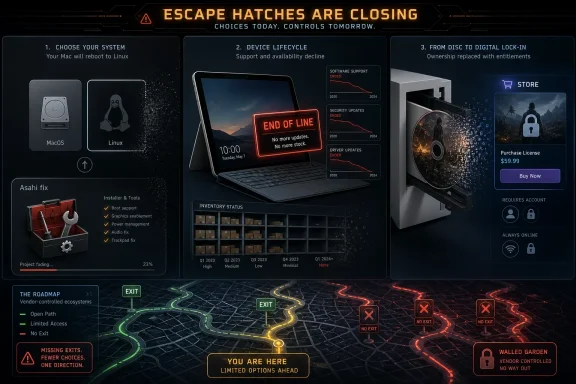
The Common Thread Is the Slow Disappearance of Escape Hatches
The Asahi, Surface, and PlayStation stories differ in severity. A boot issue that now has a fix is not the same as the death of a hardware line or a future end to physical game discs. But they all point toward the shrinking of escape hatches.An escape hatch is not always something most users need. Most Mac owners will never boot Linux. Most Surface buyers may prefer a larger laptop. Most PlayStation players may already buy digitally. The value of an escape hatch is that it protects the minority use case that later becomes important: recovery, preservation, affordability, experimentation, resale, education, or simply user autonomy.
Technology companies tend to describe these transitions as simplification. Simplification is often real. Supporting fewer devices can improve focus. Digital distribution can reduce friction. Secure boot chains can protect users from malware and tampering. Integrated platforms can deliver battery life, performance, and reliability that looser ecosystems struggle to match.
But simplification for the vendor is not always simplification for the user. A user who cannot boot Linux after a beta update has a more complicated life. A school or small business that planned around Surface Go has a more complicated procurement problem. A player who wants to buy, lend, resell, or preserve a game has a more complicated ownership story in an all-digital console future.
The industry’s favorite word for this is modernization. Sometimes that is accurate. Sometimes it is a polite word for removing old freedoms after enough customers have been nudged away from using them.
Windows Users Should Read This as a Warning, Not a Spectator Sport
It would be easy for Windows enthusiasts to look at the Asahi story and shrug because it is an Apple problem. That would be a mistake. Windows hardware is also moving toward tighter firmware rules, more aggressive security baselines, cloud account onboarding, AI services integrated into the shell, and device categories that come and go according to corporate strategy.The Surface Go report should land closer to home. Microsoft’s hardware decisions influence OEM priorities, accessory ecosystems, education deployments, and the public image of what a Windows device can be. If the company retreats upward into premium devices and specialized developer hardware, the approachable end of Windows becomes someone else’s responsibility.
That matters because Windows’ greatest strength has always been range. It runs on bargain desktops, gaming towers, rugged tablets, CAD workstations, handheld PCs, mini PCs, and business laptops old enough to have shiny keyboard legends. The Surface line was never going to cover all of that, but it did give Microsoft a first-party way to define certain experiences.
A disappearing Go line narrows that definition. A Windows world with fewer small, affordable, well-supported reference devices is still vast, but it is less coherent. And coherence matters when Microsoft is asking users to accept more cloud identity, more AI integration, more security requirements, and more managed experiences.
The irony is that Windows, for all its annoyances, remains one of the last mainstream computing environments where general-purpose flexibility is still expected by default. That expectation is worth defending, because the broader industry is clearly less attached to it than users are.
The 2026 Platform Bargain Is Getting Easier to See
The bargain offered by modern platforms is not hidden. Give the vendor more control, and the vendor promises a smoother experience. Let the store manage your games. Let the boot chain protect your device. Let the hardware lineup become simpler. Let the account become the center of your computing life.Many users accept that bargain because it works. They do not want to manage installers, discs, drivers, partitions, firmware, or local backups. They want the device to turn on, update, sync, and stay out of the way. There is no virtue in making computing harder just to preserve rituals that most people no longer enjoy.
But the bargain should be explicit. Users should understand when convenience is replacing ownership, when integration is replacing interoperability, and when a discontinued product line removes an option that may not come back. The problem is not progress. The problem is progress that arrives as a one-way door.
Asahi’s quick fix is the hopeful version of the story because it shows a community creating its own door back in. But that work depends on talent, time, goodwill, and the absence of active obstruction. Communities can patch around platform changes; they cannot guarantee the platform will remain hospitable forever.
Sony’s disc phaseout is the harder version because once manufacturing and retail channels vanish, they are unlikely to return. Microsoft’s Go retreat sits somewhere in the middle: OEMs can fill the gap, but the first-party signal is gone unless Microsoft changes course.
Three Small Stories, One Shrinking Map
The immediate advice is simple, but the larger pattern is what matters. Users and IT teams should treat platform decisions as long-term dependencies, not just product news that scrolls by between bigger launches.- Asahi Linux users on Apple Silicon should update or rerun the installer if macOS 27 beta changes have made Linux boot volumes disappear.
- Mac owners who rely on Linux should treat major macOS betas as infrastructure changes, not cosmetic previews.
- Surface Go and Surface Laptop Go buyers should assume remaining stock may be the end of the line unless Microsoft publicly reverses course.
- Organizations that standardized on small Surface devices should begin testing alternatives before procurement becomes urgent.
- PlayStation collectors and preservation-minded players should plan for a digital-only future for new releases beginning in 2028 if Sony follows through as reported.
- Anyone buying into a digital library should understand that access is governed by accounts, licenses, storefront policy, and long-term server support.
References
- Primary source: Liliputing
Published: 2026-07-01T21:47:10.171371
Lilbits: Asahi Linux release fix for booting Linux on macOS 27, Surface Go is going away, and Sony announces plans to stop making PlayStation game discs - Liliputing
Lilbits: Asahi Linux release fix for booting Linux on macOS 27, Surface Go is going away, and Sony announces plans to stop making PlayStation game discsliliputing.com - Related coverage: axios.com
PlayStation physical disc change: Why and when it happens
The move signals a hard lean into the digital age.www.axios.com
- Related coverage: tomshardware.com
Microsoft's flagship Windows PC lineup will drop reportedly drop budget options — firm prunes Surface Go and Surface Laptop Go | Tom's Hardware
No plans for refreshes of aging, out of stock devices.www.tomshardware.com - Related coverage: techradar.com
'This should be illegal': Sony is deleting over 500 purchased movies from PlayStation Store accounts — and it's the ultimate warning to buy 4K Blu-rays instead | TechRadar
'Play has no limits,' Sony says, as it stops people playing TV shows and movies they paid to ownwww.techradar.com - Related coverage: gamesradar.com
After GTA 6's controversial code-in-a-box decision, Marvel's Wolverine devs confirm the PS5 game comes with a disc | GamesRadar+
Wolverine also won't be following GTA 6's lead on pricingwww.gamesradar.com - Related coverage: techtimes.com
Asahi Linux macOS 27 Warning: Golden Gate Beta Boot Picker Breaks Linux Dual Boot
Asahi Linux macOS 27 users face a critical warning: the Golden Gate developer beta released June 8 breaks the Apple Silicon boot picker, making Linux partitions invisible. No data is lost, butwww.techtimes.com
- Related coverage: phoronix.com
macOS 27 Beta Breaks The Ability To Boot Asahi Linux - Phoronix
Asahi Linux is warning its users from trying out the new macOS 27 'Golden Gate' beta released this week by Applewww.phoronix.com
- Related coverage: windowscentral.com
Surface Go and Surface Laptop Go are dead: Microsoft's budget Surface PCs are the last to be cut from its portfolio | Windows Central
Surface Go 4 and Surface Laptop Go 3 are now out of stock in most places, and sources say there are no plans to restock them or replace them with a successor.www.windowscentral.com - Related coverage: techcrunch.com
Sony to end physical PlayStation game disc production in 2028 | TechCrunch
Sony will stop producing physical discs for all new PlayStation games beginning in 2028, as the company embraces an all-digital future.techcrunch.com - Related coverage: fosslinux.com
macOS 27 Golden Gate Breaks Asahi Linux — What It Means and How to Recover
macOS 27 Golden Gate beta changed the boot picker behavior on Apple Silicon Macs, hiding Asahi Linux partitions from view. The partition data is intact, but you cannot boot into Linux. This guide covers three verified recovery methods and what the Asahi team is doing about it.www.fosslinux.com - Related coverage: macg.co
macOS 27 casse la compatibilité avec Asahi Linux - MacGeneration
On le disait récemment, les retours concernant macOS 27 sont pour le moment très positifs. Mais attention, cela ne veut pas dire que tout est parfait : les bogues finissent souvent par pointer leur nez dans un second temps. Les utilisateurs d’Asahi L...www.macg.co - Related coverage: mac4ever.com
macOS 27 casse le multi-boot des Mac : Asahi Linux disparaît
Première tuile pour macOS 27. La beta développeur de « Golden Gate », distribuée le 8 juin juste après la keynote de la WWDC, fait disparaître Asahi…www.mac4ever.com - Related coverage: korben.info
The macOS 27 beta wipes Asahi Linux off Macs - Korben
Bad news for Asahi Linux users — the project that runs Linux natively on Macs equipped with Apple Silicon chips (the famous M1, M2, and beyond). The first ...korben.info
- Related coverage: dotesports.com
PlayStation physical discs ending for new games in January 2028
Sony will stop producing physical discs for new PlayStation games from January 2028, with future releases sold digitally through PlayStation Store and retailers.dotesports.com - Related coverage: linux-magazin.de
Asahi Linux stolpert über MacOS 27 Golden Gate
Das Asahi-Linux-Projekt, das Linux auf Macs mit Apples ARM-Prozessoren (Apple Silicon) bringt, warnt vor einem Upgrade auf MacOS 27 Golden Gate.www.linux-magazin.de - Related coverage: borncity.com
macOS 27: Apple sperrt Linux-Nutzer aus – Asahi Linux blockiert
Apple beendet mit macOS 27 die Intel-Ära und blockiert Linux-Dual-Boot. Asahi Linux wird unsichtbar, Entwickler raten vom Update ab.borncity.com - Related coverage: surface-world.de
Microsoft Surface Go 4 bald nicht mehr verfügbar
Aktuell sind vereinzelte Geräte des Microsoft Surface Go 4 erhältlich. Wer ein Gerät aus dieser Serie erwerben möchte, muss zeitnah handeln.surface-world.de - Related coverage: elpais.com
Adiós a los discos de la PlayStation: Sony dejará de publicar ese formato de videojuegos | Tecnología | EL PAÍS
La compañía anuncia que a partir de enero 2028 todos los títulos nuevos serán solo en formato digitalelpais.com - Related coverage: as.com
- Related coverage: los40.com
El fin de una era en PlayStation: Sony pone fecha a los videojuegos con disco físico | Actualidad | LOS40
La industria acelera su salto al formato digital y marca el principio del adiós definitivo a las cajaslos40.com - Official source: microsoft.com
