

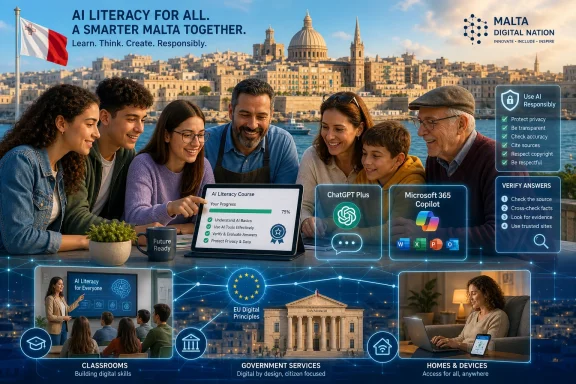
Malta launched a national AI literacy programme on May 16, 2026, offering residents aged 14 and over a free two-hour online course and, on completion, a one-year subscription to either ChatGPT Plus or Microsoft 365 Personal Copilot. The move is small in geography but large in symbolism: a government is treating consumer AI access not as a perk, but as civic infrastructure. For Microsoft and OpenAI, Malta becomes a neatly bounded national test case. For everyone else, it is a preview of the next argument over digital inclusion: not whether citizens should use AI, but who teaches them, who pays, and whose platforms become the default.
The most striking part of Malta’s “AI for Everyone” programme is not the two-hour course. It is the bundle attached to the certificate. A resident who completes the self-paced training can receive a year of access to one of the two most recognizable paid AI products in the consumer market: ChatGPT Plus or Microsoft 365 Personal Copilot.
That makes the programme more than a public-awareness campaign. Governments have been producing digital-skills portals, online safety courses, and technology roadmaps for years, often with modest public uptake and little measurable effect on daily behavior. Malta is adding a concrete incentive: learn the basics, then use the tool in real life.
The programme was developed by the Malta Digital Innovation Authority with the University of Malta, and is available in both Maltese and English. That matters because language has become one of the under-discussed dividing lines in AI adoption. A tool that works best in English can still be socially unequal in a bilingual or multilingual country if training, public guidance, and institutional examples are not localized.
Malta is also setting a deliberately low entry threshold. The course is free, self-paced, and requires no technical background. The government is clearly aiming beyond software developers, IT staff, and university students. Its target audience is the general population: parents, workers, retirees, teenagers, small-business owners, and public-service users who may have heard of AI but not yet built it into their routines.
The thesis is simple: AI literacy cannot remain a specialist skill if AI is going to be embedded in documents, search, email, government services, schoolwork, and everyday administration. The gamble is that a modest amount of structured education, paired with temporary access to premium tools, can move citizens from curiosity or anxiety into practical competence.
A two-hour course can teach basic concepts: what generative AI does, where it fails, how to write prompts, how to avoid sharing sensitive information, and why outputs need checking. But literacy is not formed by instruction alone. It is formed by repeated use, especially when the technology is woven into normal tasks.
That is where ChatGPT Plus and Microsoft 365 Personal Copilot come in. ChatGPT Plus gives citizens a direct line to OpenAI’s consumer AI experience. Microsoft 365 Personal Copilot brings AI closer to Word, Excel, PowerPoint, Outlook, OneDrive, and the broader productivity environment where many people already live.
The choice between those products is revealing. Malta is not merely handing out one vendor’s tool and calling it literacy. It is giving citizens a fork in the road between a general-purpose AI assistant and a productivity-suite-integrated assistant. That choice maps onto the broader market split: AI as a standalone conversational service, or AI as a layer inside the software people already use.
Still, “choice” has limits. The programme is built around two American platform companies, one of which is a major investor and infrastructure partner in the other. From a practical standpoint, this is understandable. If a government wants to give citizens access to widely used AI tools at scale, Microsoft and OpenAI are obvious partners. From a sovereignty standpoint, it raises harder questions about dependency, data flows, procurement leverage, and the long-term shape of a country’s digital habits.
The subscription is free for a year, not forever. That makes the first year a bridge and a funnel. Some citizens will learn enough to use free tools afterward. Some will stop using AI once the paid access expires. Others will build workflows, habits, and expectations that make renewal feel necessary.
That is not an accident; it is the economics of platform adoption. The civic case is that people should not be excluded from AI merely because they cannot afford early access to premium systems. The commercial case is that a trained user is much more valuable than an untrained one.
This is classic Microsoft strategy, updated for the AI era. The company has always understood that productivity software becomes stickier when institutions standardize around it. Schools, governments, and employers do not merely buy tools; they normalize workflows. Once a population thinks in Word documents, Excel sheets, Outlook calendars, Teams meetings, and OneDrive folders, the operating environment becomes cultural as much as technical.
Copilot is the AI version of that same play. Microsoft does not need every citizen to become an AI power user overnight. It needs AI assistance to feel like a natural extension of office work, homework, forms, planning, budgeting, and email. The prize is not a single subscription. It is the habit of asking Microsoft’s layer first.
For Windows users, this is especially significant because Microsoft’s AI strategy has never been confined to the browser. Copilot has appeared across Windows, Edge, Microsoft 365, and the company’s cloud services. The branding has sometimes outrun the product clarity, and users have had to navigate a confusing spread of Copilot experiences: free Copilot, Copilot in Windows, Copilot Pro, Microsoft 365 Copilot for work, Copilot features in consumer Microsoft 365 subscriptions, and various enterprise tiers.
Malta’s offer simplifies that mess for a broad audience by attaching AI to an already familiar consumer subscription. But the simplification is also political. Instead of asking citizens to decode Microsoft’s product matrix, the government creates a front door: take the course, pick a tool, start using it.
That approach may become attractive to other governments because it solves a messaging problem. “AI transformation” is abstract. “Finish this short course and receive a year of a premium AI assistant” is concrete. It turns an industrial policy slogan into something a household can understand.
That ordering matters. Most consumer AI adoption has happened backward: people get the tool first, stumble through use cases, encounter hallucinations or privacy concerns, then maybe learn best practices later. Malta flips the sequence. It asks citizens to absorb a baseline of responsible use before receiving premium access.
If that produces better outcomes, it could become a model. Vendors have a strong incentive to reduce misuse, disappointment, and reputational damage. Governments have an incentive to reduce panic and inequality. A literacy-first access model offers both sides a defensible story.
But it also creates an uncomfortable public-private bargain. A government programme that introduces citizens to AI through vendor-supplied tools can easily blur the line between education and acquisition. Even if the course itself is developed by local institutions, the practical experience afterward happens inside commercial systems with commercial interfaces, commercial limits, and commercial incentives.
That is why Malta’s programme should be judged not only by enrollment numbers, but by what it teaches about skepticism. Real AI literacy is not prompt fluency. It is knowing when not to use the tool, what not to paste into it, how to verify its claims, how to detect fabricated confidence, and how to understand that a fluent answer is not the same as a correct one.
If Malta gets that right, the programme is more than a giveaway. If it gets that wrong, it risks becoming a state-backed customer acquisition campaign with a civics wrapper.
Baseline literacy has always been different from expertise. Basic internet literacy did not require every citizen to understand TCP/IP. Basic cybersecurity literacy does not require every worker to become a malware analyst. Basic AI literacy should not require people to understand transformer internals before they can use a chatbot to draft an email or summarize a document.
The political challenge is that AI sits closer to judgment than previous consumer technologies. A spreadsheet can produce a wrong result, but usually through visible formulas or bad inputs. A generative AI system can produce a wrong result with elegant prose, invented citations, plausible numbers, and a tone of authority. That makes literacy harder to compress.
A short course can still do useful work if it is honest about limits. It can teach people to treat AI output as a draft, not a verdict. It can normalize verification. It can warn against uploading personal, medical, financial, legal, or workplace-sensitive information without understanding the rules. It can show examples where AI is helpful and examples where it fails.
The inclusion of residents aged 14 and over is also notable. Teenagers are already using AI, with or without government blessing. Pretending otherwise would be policy theater. By bringing younger users into a structured programme, Malta is acknowledging that the education system cannot simply ban its way out of the problem.
That does not mean schools can relax. If anything, a national AI literacy course raises expectations for teachers and administrators. Once students have sanctioned access to powerful AI tools, assessment design, plagiarism policy, digital equity, and classroom practice all become more urgent.
The country’s Digital Innovation Authority has a role in AI governance, and the programme sits within a broader national push toward digitalization and Malta Vision 2050. The government has tied the effort to a larger budget commitment and to quality-of-life ambitions rather than presenting it as a standalone tech stunt.
That framing is important because AI literacy is becoming a competitiveness issue. Small states cannot outspend the United States or China on frontier model development. They cannot build hyperscale infrastructure on the same terms as the cloud giants. But they can move quickly on adoption, education, and public-sector deployment.
Malta’s size may be an advantage. A national programme in a country of roughly half a million people is administratively imaginable in a way that a similar effort in Germany, France, or the United States would not be. The feedback loop is shorter. The number of institutions is smaller. The government can plausibly coordinate universities, regulators, ministries, and vendor partners without years of federal complexity.
That makes Malta a useful proving ground. If the programme produces measurable improvements in confidence, productivity, public-service access, or small-business experimentation, other governments will notice. If it becomes a lightly used portal with a flashy launch and little follow-through, that will also be instructive.
The key metric will not be how many people claim a free subscription. It will be whether people build safer, more effective habits after the first wave of curiosity fades.
Copilot has already become a fixture of Microsoft’s software narrative, sometimes to the irritation of users who feel the company has been too aggressive in surfacing AI features. Microsoft has pushed AI into Windows, Edge, Office, and its cloud services with the confidence of a company that believes the next interface shift is already underway. Whether users agree is another matter.
Malta’s programme gives Microsoft a cleaner route than nagging icons and product prompts. Instead of pushing Copilot at users through interface real estate, Microsoft can appear as a partner in national capability building. That is a much better story than “the button appeared in my taskbar.”
The distinction matters because AI adoption has a trust problem. Many users do not object to assistance in principle. They object to confusing controls, unclear data practices, uneven quality, subscription fragmentation, and the feeling that vendors are using operating systems and productivity suites to force behavior. A government-backed literacy programme can soften that resistance, but only if it is transparent.
For personal Microsoft 365 users, Copilot’s value depends heavily on context. If the assistant can help draft, summarize, organize, and reason across documents, email, and personal files, it becomes meaningfully different from a generic chatbot. If it feels like a chatbot awkwardly bolted onto Office, users will notice.
That is why Malta’s offer is a test not only for citizens, but for Microsoft’s product promise. A user who spends a year with Copilot inside Microsoft 365 will learn whether AI is genuinely useful in ordinary productivity work or merely impressive in demos. The market will not be convinced by launch speeches forever.
Consumer AI tools are not the same as enterprise deployments with negotiated data-processing terms, administrative controls, retention policies, and compliance frameworks. A citizen using ChatGPT Plus or Microsoft 365 Personal Copilot is not in the same position as a ministry using a managed enterprise environment. That distinction needs to be made plainly.
The risk is not only a dramatic breach. It is ordinary oversharing. A student pastes a medical note. A worker uploads an internal document from an employer. A small-business owner asks for help with a client contract. A family member uses AI to draft an appeal involving personal financial details. None of these actions require malice; they require only convenience.
This is where “AI literacy” has to be more than cheerful empowerment language. It must include data minimization, account awareness, verification, and an understanding of when professional advice is required. Citizens should learn that AI can help them prepare for a conversation with a lawyer, doctor, accountant, teacher, or government office, but it does not replace those authorities.
Malta’s leaders have framed the programme around inclusion and practical benefit. That is the right political message. But inclusion without caution can become exposure. The more successful the programme is, the more important its safety guidance becomes.
That is the strength of Malta’s approach. It gives residents access to tools they may already recognize and may otherwise not pay for. It also gives the programme immediate relevance. A government-built chatbot with limited capabilities would not carry the same appeal.
But the same partnership creates vulnerability. The public may reasonably ask why these tools, why these companies, and what happens after the free year. If the programme succeeds, will the government negotiate renewals? Will citizens be expected to pay? Will schools, businesses, and public agencies start designing workflows around tools whose future pricing and features are outside Malta’s control?
This is the central tension in national AI policy. Governments want to accelerate adoption without surrendering agency. Vendors want to expand adoption while presenting themselves as infrastructure providers rather than mere software sellers. Citizens want access, but not manipulation.
The healthiest version of Malta’s programme would treat Microsoft and OpenAI as important partners, not as the definition of AI itself. The course should expose users to concepts that transfer across tools: prompting, verification, privacy, bias, accessibility, productivity, and responsible use. If citizens come away understanding AI as a category rather than a brand, the public value is much higher.
That distinction will become more important as the AI market changes. Models improve, products merge, subscription tiers shift, and assistants become more agentic. A literacy programme tied too closely to today’s interface risks aging quickly. A literacy programme built around durable habits can survive vendor churn.
In the broadband era, the question was whether households had a connection. In the smartphone era, it was whether citizens could access services through mobile devices. In the AI era, the divide may be between those who can afford capable assistants and those stuck with limited, slower, or less integrated tools.
Malta’s programme directly addresses that problem, at least for one year. It says that premium AI access is not only for affluent professionals, tech hobbyists, or companies with enterprise contracts. A teenager, pensioner, job seeker, or small-business owner can experiment with the same class of tools.
That does not solve every equity issue. Access to a subscription does not guarantee access to a good device, reliable connectivity, quiet time, strong language skills, or the confidence to experiment. Nor does it guarantee that AI will be useful for every citizen. But it lowers one obvious barrier.
There is also a dignity argument here. If AI is going to reshape work and public services, citizens should not encounter it only as something done to them by employers, banks, schools, insurers, or government agencies. They should encounter it as something they can interrogate, use, challenge, and understand.
That is the best case for Malta’s approach. It treats AI literacy as civic preparation rather than optional professional development. In an era when automated systems increasingly mediate opportunity, that is not a luxury.
Malta will need to know who takes the course and who does not. If uptake is concentrated among students, professionals, and already digitally confident citizens, the programme may widen the confidence gap even while offering universal access. If older adults, low-income residents, and less digitally fluent groups participate meaningfully, the inclusion claim becomes stronger.
The government will also need to understand how people use the tools after activation. Are they using AI for language support, job applications, schoolwork, coding, business planning, government forms, email, creative projects, or entertainment? Are they becoming more productive, or merely more dependent on autocomplete? Are they learning to verify outputs, or trusting them too much?
These are not abstract evaluation questions. They determine whether the programme should be expanded, revised, or treated as a one-off subsidy. A free year is enough time to gather evidence, but only if evidence gathering is built in carefully and ethically.
The expiry date matters too. A citizen who builds a workflow around a paid assistant may face a cliff when the subscription ends. That cliff could produce frustration, private spending, or pressure for continued public support. Malta should be honest about that from the beginning.
The worst outcome would be a national AI habit that becomes unaffordable once the promotional period ends. The best outcome would be a population that learns enough to choose wisely among free, paid, public, and workplace tools.
A good AI literacy programme should make citizens more capable and more skeptical at the same time. It should help them draft a letter, summarize a policy, translate a message, brainstorm a business idea, and understand a confusing document. It should also make them slower to believe a generated answer, more cautious with private data, and more aware of the interests behind the interface.
That duality is difficult to teach because the technology is genuinely useful. The danger is not that AI is useless hype. The danger is that it is useful enough to become trusted before it is understood. People tend to forgive tools that save time, even when those tools make subtle errors.
This is especially relevant for Microsoft 365 Copilot, because its value proposition is proximity to work and personal documents. The closer AI gets to real files, calendars, emails, and spreadsheets, the more powerful it becomes. The more powerful it becomes, the more users need to understand permissions, context boundaries, and the difference between a helpful summary and an authoritative record.
It is also relevant for ChatGPT Plus, where the blank chat box invites almost any kind of task. General-purpose assistants are powerful precisely because they are not confined to one workflow. That flexibility makes user judgment the main safety layer.
If Malta can teach that judgment at population scale, the programme deserves attention far beyond the island.
 Malta Turns AI Adoption Into a Public Service
The most striking part of Malta’s “AI for Everyone” programme is not the two-hour course. It is the bundle attached to the certificate. A resident who completes the self-paced training can receive a year of access to one of the two most recognizable paid AI products in the consumer market: ChatGPT Plus or Microsoft 365 Personal Copilot.That makes the programme more than a public-awareness campaign. Governments have been producing digital-skills portals, online safety courses, and technology roadmaps for years, often with modest public uptake and little measurable effect on daily behavior. Malta is adding a concrete incentive: learn the basics, then use the tool in real life.
The programme was developed by the Malta Digital Innovation Authority with the University of Malta, and is available in both Maltese and English. That matters because language has become one of the under-discussed dividing lines in AI adoption. A tool that works best in English can still be socially unequal in a bilingual or multilingual country if training, public guidance, and institutional examples are not localized.
Malta is also setting a deliberately low entry threshold. The course is free, self-paced, and requires no technical background. The government is clearly aiming beyond software developers, IT staff, and university students. Its target audience is the general population: parents, workers, retirees, teenagers, small-business owners, and public-service users who may have heard of AI but not yet built it into their routines.
The thesis is simple: AI literacy cannot remain a specialist skill if AI is going to be embedded in documents, search, email, government services, schoolwork, and everyday administration. The gamble is that a modest amount of structured education, paired with temporary access to premium tools, can move citizens from curiosity or anxiety into practical competence.
The Free Subscription Is the Policy
Governments like to describe digital strategies in terms of capability, resilience, and inclusion. Vendors like to describe the same thing in terms of adoption. Malta’s programme sits exactly at that intersection, and the free subscription offer is the mechanism that turns a course into a national behavioral experiment.A two-hour course can teach basic concepts: what generative AI does, where it fails, how to write prompts, how to avoid sharing sensitive information, and why outputs need checking. But literacy is not formed by instruction alone. It is formed by repeated use, especially when the technology is woven into normal tasks.
That is where ChatGPT Plus and Microsoft 365 Personal Copilot come in. ChatGPT Plus gives citizens a direct line to OpenAI’s consumer AI experience. Microsoft 365 Personal Copilot brings AI closer to Word, Excel, PowerPoint, Outlook, OneDrive, and the broader productivity environment where many people already live.
The choice between those products is revealing. Malta is not merely handing out one vendor’s tool and calling it literacy. It is giving citizens a fork in the road between a general-purpose AI assistant and a productivity-suite-integrated assistant. That choice maps onto the broader market split: AI as a standalone conversational service, or AI as a layer inside the software people already use.
Still, “choice” has limits. The programme is built around two American platform companies, one of which is a major investor and infrastructure partner in the other. From a practical standpoint, this is understandable. If a government wants to give citizens access to widely used AI tools at scale, Microsoft and OpenAI are obvious partners. From a sovereignty standpoint, it raises harder questions about dependency, data flows, procurement leverage, and the long-term shape of a country’s digital habits.
The subscription is free for a year, not forever. That makes the first year a bridge and a funnel. Some citizens will learn enough to use free tools afterward. Some will stop using AI once the paid access expires. Others will build workflows, habits, and expectations that make renewal feel necessary.
That is not an accident; it is the economics of platform adoption. The civic case is that people should not be excluded from AI merely because they cannot afford early access to premium systems. The commercial case is that a trained user is much more valuable than an untrained one.
Microsoft Gets the Public-Sector Flywheel It Has Been Building Toward
Microsoft’s role in Malta did not appear from nowhere. The Maltese government had already rolled out Microsoft Copilot across the public service, supported by training and a dedicated Centre of Excellence. The new public-facing programme extends that logic from the civil service to the citizenry.This is classic Microsoft strategy, updated for the AI era. The company has always understood that productivity software becomes stickier when institutions standardize around it. Schools, governments, and employers do not merely buy tools; they normalize workflows. Once a population thinks in Word documents, Excel sheets, Outlook calendars, Teams meetings, and OneDrive folders, the operating environment becomes cultural as much as technical.
Copilot is the AI version of that same play. Microsoft does not need every citizen to become an AI power user overnight. It needs AI assistance to feel like a natural extension of office work, homework, forms, planning, budgeting, and email. The prize is not a single subscription. It is the habit of asking Microsoft’s layer first.
For Windows users, this is especially significant because Microsoft’s AI strategy has never been confined to the browser. Copilot has appeared across Windows, Edge, Microsoft 365, and the company’s cloud services. The branding has sometimes outrun the product clarity, and users have had to navigate a confusing spread of Copilot experiences: free Copilot, Copilot in Windows, Copilot Pro, Microsoft 365 Copilot for work, Copilot features in consumer Microsoft 365 subscriptions, and various enterprise tiers.
Malta’s offer simplifies that mess for a broad audience by attaching AI to an already familiar consumer subscription. But the simplification is also political. Instead of asking citizens to decode Microsoft’s product matrix, the government creates a front door: take the course, pick a tool, start using it.
That approach may become attractive to other governments because it solves a messaging problem. “AI transformation” is abstract. “Finish this short course and receive a year of a premium AI assistant” is concrete. It turns an industrial policy slogan into something a household can understand.
OpenAI Gets a Country-Sized Onboarding Lab
For OpenAI, Malta offers a different kind of value. ChatGPT is already globally recognizable, but widespread recognition is not the same as informed use. Many people still treat chatbots as novelty search engines, homework machines, therapy substitutes, coding assistants, or magic boxes. A national course gives OpenAI a chance to see what happens when access is preceded by structured public education.That ordering matters. Most consumer AI adoption has happened backward: people get the tool first, stumble through use cases, encounter hallucinations or privacy concerns, then maybe learn best practices later. Malta flips the sequence. It asks citizens to absorb a baseline of responsible use before receiving premium access.
If that produces better outcomes, it could become a model. Vendors have a strong incentive to reduce misuse, disappointment, and reputational damage. Governments have an incentive to reduce panic and inequality. A literacy-first access model offers both sides a defensible story.
But it also creates an uncomfortable public-private bargain. A government programme that introduces citizens to AI through vendor-supplied tools can easily blur the line between education and acquisition. Even if the course itself is developed by local institutions, the practical experience afterward happens inside commercial systems with commercial interfaces, commercial limits, and commercial incentives.
That is why Malta’s programme should be judged not only by enrollment numbers, but by what it teaches about skepticism. Real AI literacy is not prompt fluency. It is knowing when not to use the tool, what not to paste into it, how to verify its claims, how to detect fabricated confidence, and how to understand that a fluent answer is not the same as a correct one.
If Malta gets that right, the programme is more than a giveaway. If it gets that wrong, it risks becoming a state-backed customer acquisition campaign with a civics wrapper.
The Course Is Short Because the Politics Demand Scale
A two-hour course will not make anyone an AI expert. It will not teach model architecture, data governance, copyright law, cybersecurity policy, automation risk, or the operational details of integrating AI into a business. But that criticism misses the point. Malta is not trying to produce a nation of machine-learning engineers; it is trying to establish a baseline.Baseline literacy has always been different from expertise. Basic internet literacy did not require every citizen to understand TCP/IP. Basic cybersecurity literacy does not require every worker to become a malware analyst. Basic AI literacy should not require people to understand transformer internals before they can use a chatbot to draft an email or summarize a document.
The political challenge is that AI sits closer to judgment than previous consumer technologies. A spreadsheet can produce a wrong result, but usually through visible formulas or bad inputs. A generative AI system can produce a wrong result with elegant prose, invented citations, plausible numbers, and a tone of authority. That makes literacy harder to compress.
A short course can still do useful work if it is honest about limits. It can teach people to treat AI output as a draft, not a verdict. It can normalize verification. It can warn against uploading personal, medical, financial, legal, or workplace-sensitive information without understanding the rules. It can show examples where AI is helpful and examples where it fails.
The inclusion of residents aged 14 and over is also notable. Teenagers are already using AI, with or without government blessing. Pretending otherwise would be policy theater. By bringing younger users into a structured programme, Malta is acknowledging that the education system cannot simply ban its way out of the problem.
That does not mean schools can relax. If anything, a national AI literacy course raises expectations for teachers and administrators. Once students have sanctioned access to powerful AI tools, assessment design, plagiarism policy, digital equity, and classroom practice all become more urgent.
The EU Context Makes Malta’s Move More Than a Local Experiment
Malta is not operating in a regulatory vacuum. It is an EU member state, and the bloc’s AI Act has already made Europe the world’s most important test bed for rules-based AI governance. That gives Malta’s programme a distinctive flavor: mass adoption under a regulatory umbrella that is more cautious than the Silicon Valley default.The country’s Digital Innovation Authority has a role in AI governance, and the programme sits within a broader national push toward digitalization and Malta Vision 2050. The government has tied the effort to a larger budget commitment and to quality-of-life ambitions rather than presenting it as a standalone tech stunt.
That framing is important because AI literacy is becoming a competitiveness issue. Small states cannot outspend the United States or China on frontier model development. They cannot build hyperscale infrastructure on the same terms as the cloud giants. But they can move quickly on adoption, education, and public-sector deployment.
Malta’s size may be an advantage. A national programme in a country of roughly half a million people is administratively imaginable in a way that a similar effort in Germany, France, or the United States would not be. The feedback loop is shorter. The number of institutions is smaller. The government can plausibly coordinate universities, regulators, ministries, and vendor partners without years of federal complexity.
That makes Malta a useful proving ground. If the programme produces measurable improvements in confidence, productivity, public-service access, or small-business experimentation, other governments will notice. If it becomes a lightly used portal with a flashy launch and little follow-through, that will also be instructive.
The key metric will not be how many people claim a free subscription. It will be whether people build safer, more effective habits after the first wave of curiosity fades.
The Windows Angle Is Habit, Not Hype
For WindowsForum readers, the immediate temptation is to file this as another Copilot story. It is that, but only partly. The deeper Windows angle is that Microsoft’s AI ambitions depend on habit formation across the whole personal-computing stack.Copilot has already become a fixture of Microsoft’s software narrative, sometimes to the irritation of users who feel the company has been too aggressive in surfacing AI features. Microsoft has pushed AI into Windows, Edge, Office, and its cloud services with the confidence of a company that believes the next interface shift is already underway. Whether users agree is another matter.
Malta’s programme gives Microsoft a cleaner route than nagging icons and product prompts. Instead of pushing Copilot at users through interface real estate, Microsoft can appear as a partner in national capability building. That is a much better story than “the button appeared in my taskbar.”
The distinction matters because AI adoption has a trust problem. Many users do not object to assistance in principle. They object to confusing controls, unclear data practices, uneven quality, subscription fragmentation, and the feeling that vendors are using operating systems and productivity suites to force behavior. A government-backed literacy programme can soften that resistance, but only if it is transparent.
For personal Microsoft 365 users, Copilot’s value depends heavily on context. If the assistant can help draft, summarize, organize, and reason across documents, email, and personal files, it becomes meaningfully different from a generic chatbot. If it feels like a chatbot awkwardly bolted onto Office, users will notice.
That is why Malta’s offer is a test not only for citizens, but for Microsoft’s product promise. A user who spends a year with Copilot inside Microsoft 365 will learn whether AI is genuinely useful in ordinary productivity work or merely impressive in demos. The market will not be convinced by launch speeches forever.
Free Access Does Not Erase the Data Question
The public will inevitably ask what happens to the information they type into these systems. That question is not paranoia; it is the beginning of literacy. If a national programme encourages citizens to use AI, it must also teach them that prompts can contain sensitive data and that different products, account types, and settings may carry different protections.Consumer AI tools are not the same as enterprise deployments with negotiated data-processing terms, administrative controls, retention policies, and compliance frameworks. A citizen using ChatGPT Plus or Microsoft 365 Personal Copilot is not in the same position as a ministry using a managed enterprise environment. That distinction needs to be made plainly.
The risk is not only a dramatic breach. It is ordinary oversharing. A student pastes a medical note. A worker uploads an internal document from an employer. A small-business owner asks for help with a client contract. A family member uses AI to draft an appeal involving personal financial details. None of these actions require malice; they require only convenience.
This is where “AI literacy” has to be more than cheerful empowerment language. It must include data minimization, account awareness, verification, and an understanding of when professional advice is required. Citizens should learn that AI can help them prepare for a conversation with a lawyer, doctor, accountant, teacher, or government office, but it does not replace those authorities.
Malta’s leaders have framed the programme around inclusion and practical benefit. That is the right political message. But inclusion without caution can become exposure. The more successful the programme is, the more important its safety guidance becomes.
The Vendor Partnership Is Both the Strength and the Vulnerability
There is no realistic version of this programme that avoids the private sector entirely. Frontier AI systems are expensive to build, expensive to run, and concentrated in a handful of companies. If governments want citizens to use advanced tools today, they will almost certainly need vendor partnerships.That is the strength of Malta’s approach. It gives residents access to tools they may already recognize and may otherwise not pay for. It also gives the programme immediate relevance. A government-built chatbot with limited capabilities would not carry the same appeal.
But the same partnership creates vulnerability. The public may reasonably ask why these tools, why these companies, and what happens after the free year. If the programme succeeds, will the government negotiate renewals? Will citizens be expected to pay? Will schools, businesses, and public agencies start designing workflows around tools whose future pricing and features are outside Malta’s control?
This is the central tension in national AI policy. Governments want to accelerate adoption without surrendering agency. Vendors want to expand adoption while presenting themselves as infrastructure providers rather than mere software sellers. Citizens want access, but not manipulation.
The healthiest version of Malta’s programme would treat Microsoft and OpenAI as important partners, not as the definition of AI itself. The course should expose users to concepts that transfer across tools: prompting, verification, privacy, bias, accessibility, productivity, and responsible use. If citizens come away understanding AI as a category rather than a brand, the public value is much higher.
That distinction will become more important as the AI market changes. Models improve, products merge, subscription tiers shift, and assistants become more agentic. A literacy programme tied too closely to today’s interface risks aging quickly. A literacy programme built around durable habits can survive vendor churn.
A Small Country Tests a Big Theory About Digital Equality
Malta’s announcement lands at a moment when AI access is increasingly stratified. Free tiers exist, but the best models, higher usage limits, faster responses, file tools, voice features, and productivity integrations often sit behind paid plans. That creates a familiar digital divide in a new form.In the broadband era, the question was whether households had a connection. In the smartphone era, it was whether citizens could access services through mobile devices. In the AI era, the divide may be between those who can afford capable assistants and those stuck with limited, slower, or less integrated tools.
Malta’s programme directly addresses that problem, at least for one year. It says that premium AI access is not only for affluent professionals, tech hobbyists, or companies with enterprise contracts. A teenager, pensioner, job seeker, or small-business owner can experiment with the same class of tools.
That does not solve every equity issue. Access to a subscription does not guarantee access to a good device, reliable connectivity, quiet time, strong language skills, or the confidence to experiment. Nor does it guarantee that AI will be useful for every citizen. But it lowers one obvious barrier.
There is also a dignity argument here. If AI is going to reshape work and public services, citizens should not encounter it only as something done to them by employers, banks, schools, insurers, or government agencies. They should encounter it as something they can interrogate, use, challenge, and understand.
That is the best case for Malta’s approach. It treats AI literacy as civic preparation rather than optional professional development. In an era when automated systems increasingly mediate opportunity, that is not a luxury.
The First-Year Sugar Rush Will Be the Easy Part
The launch phase of any programme like this is designed to look good. There are speeches, partner quotes, national ambition, and a clean promise. The harder work begins after the first wave of completions.Malta will need to know who takes the course and who does not. If uptake is concentrated among students, professionals, and already digitally confident citizens, the programme may widen the confidence gap even while offering universal access. If older adults, low-income residents, and less digitally fluent groups participate meaningfully, the inclusion claim becomes stronger.
The government will also need to understand how people use the tools after activation. Are they using AI for language support, job applications, schoolwork, coding, business planning, government forms, email, creative projects, or entertainment? Are they becoming more productive, or merely more dependent on autocomplete? Are they learning to verify outputs, or trusting them too much?
These are not abstract evaluation questions. They determine whether the programme should be expanded, revised, or treated as a one-off subsidy. A free year is enough time to gather evidence, but only if evidence gathering is built in carefully and ethically.
The expiry date matters too. A citizen who builds a workflow around a paid assistant may face a cliff when the subscription ends. That cliff could produce frustration, private spending, or pressure for continued public support. Malta should be honest about that from the beginning.
The worst outcome would be a national AI habit that becomes unaffordable once the promotional period ends. The best outcome would be a population that learns enough to choose wisely among free, paid, public, and workplace tools.
The Real Test Is Whether Citizens Become More Skeptical
The phrase “AI for Everyone” is politically attractive because it sounds generous and modern. But the real measure of success is not enthusiasm. It is judgment.A good AI literacy programme should make citizens more capable and more skeptical at the same time. It should help them draft a letter, summarize a policy, translate a message, brainstorm a business idea, and understand a confusing document. It should also make them slower to believe a generated answer, more cautious with private data, and more aware of the interests behind the interface.
That duality is difficult to teach because the technology is genuinely useful. The danger is not that AI is useless hype. The danger is that it is useful enough to become trusted before it is understood. People tend to forgive tools that save time, even when those tools make subtle errors.
This is especially relevant for Microsoft 365 Copilot, because its value proposition is proximity to work and personal documents. The closer AI gets to real files, calendars, emails, and spreadsheets, the more powerful it becomes. The more powerful it becomes, the more users need to understand permissions, context boundaries, and the difference between a helpful summary and an authoritative record.
It is also relevant for ChatGPT Plus, where the blank chat box invites almost any kind of task. General-purpose assistants are powerful precisely because they are not confined to one workflow. That flexibility makes user judgment the main safety layer.
If Malta can teach that judgment at population scale, the programme deserves attention far beyond the island.
The Maltese Bet Comes Down to Five Practical Consequences
The announcement is easy to read as a feel-good digital inclusion story, but its consequences are more concrete than that. Malta is testing whether public education, vendor access, and national strategy can be fused into a repeatable AI adoption model.- Malta has made completion of a short AI literacy course the gateway to premium AI access, which turns education into the condition for adoption rather than an afterthought.
- The choice between ChatGPT Plus and Microsoft 365 Personal Copilot gives citizens two different models of AI use: a general assistant and a productivity-suite assistant.
- Microsoft gains a public-sector and consumer adoption path that is more credible than simply inserting Copilot deeper into Windows and Office.
- OpenAI gains a national onboarding experiment in which users are trained before they receive a year of paid access.
- The programme’s success will depend less on launch-day participation than on whether citizens learn verification, privacy caution, and transferable AI habits.
- The free year creates an unresolved policy question about what happens when useful AI workflows meet paid subscription renewal.
References
- Primary source: Technology Record
Published: 2026-05-18T09:26:08.381525
Malta launches national AI literacy programme in...
Malta has partnered with Microsoft and OpenAI to introduce a national AI education programme with free access to AI tools, offering citizens who...www.technologyrecord.com
- Official source: support.microsoft.com
What's the difference between Microsoft Copilot (free) and Copilot in Microsoft 365 | Microsoft Support
Compare Microsoft Copilot options to find the best AI-powered tools for your productivity and collaboration needs.support.microsoft.com - Official source: microsoft.com
Microsoft 365 Copilot—Personal Plans | Microsoft 365
Unlock new capabilities, build your skills, and uncover worlds of possibility with Copilot in Microsoft 365.www.microsoft.com
- Related coverage: windowscentral.com
The Microsoft/OpenAI breakup: What does it actually mean for Copilot and other AI apps on your Windows 11 PC? | Windows Central
Copilot in Windows 11 doesn't feel as exclusive after Microsoft and OpenAI's new non-exclusive deal.www.windowscentral.com - Related coverage: themaltapost.com
Malta Offers Free ChatGPT Plus & Copilot for Residents: 1 Year
World first: Malta residents 14+ get free ChatGPT Plus & Copilot for a year. Complete a 2-hour course to claim €276 worth of premium AI tools now.themaltapost.com
- Related coverage: thenextweb.com
Malta just became the first country to give every citizen free ChatGPT Plus. There's one condition.
OpenAI signed a deal with Malta to provide ChatGPT Plus for one year to all residents who complete a free AI literacy course developed by a university.thenextweb.com
- Related coverage: techradar.com
Microsoft 365 confirms new premium tier focused on AI and productivity | TechRadar
Microsoft adds new E7 plan to cope with AI usagewww.techradar.com - Related coverage: tomshardware.com
Microsoft will force install the Copilot AI app for users with desktop versions of 365 apps like Word and Excel — coming October, with no way to opt out for personal users | Tom's Hardware
More bloatware added to Windows, courtesy of Microsoft 365.www.tomshardware.com - Related coverage: maltavision.mt
