

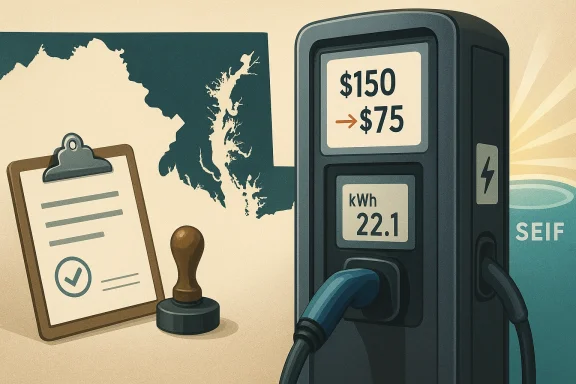
Maryland is backing away from one of the most contentious pieces of its new EV-charger oversight regime, and the change could matter well beyond Annapolis. State officials now say the annual inspection fee charged to EV charger operators is likely to be cut in half, from $150 per port to $75, after a clean-energy funding pool is redirected to help cover the program’s costs. For an industry that has been warning that Maryland’s original approach could slow charger deployment, the move is both a partial concession and a sign that the state is still trying to find the right balance between consumer protection and EV expansion. The bigger question is whether the compromise will calm the market or simply postpone a larger fight over who should pay for charging oversight.
Maryland’s EV charger fee dispute did not emerge in a vacuum. It grew out of a broader effort by state regulators to treat public charging stations more like other commercial measuring devices, such as gas pumps and scales, by bringing them under the Maryland Department of Agriculture’s Weights and Measures program. The state first announced in late 2024 that it would begin registering service agencies and technicians involved in EV fueling equipment, then moved in 2025 to launch a public charger registration system for commercial EVSE sites. That program was designed to begin in earnest by January 2026, though it was later delayed amid pushback from the charging industry and EV advocates (news.maryland.gov)
The controversy centered on the fee structure. Maryland’s initial plan would have required public charging operators to pay $150 per charger port annually, a figure critics described as unusually high and potentially punitive for stations that already face significant capital and operating costs. Maryland Matters reported that the fee was introduced through a simple cost-recovery calculation, but that the state later decided to offset a portion of the program with money from the Strategic Energy Investment Fund, or SEIF, allowing the fee to fall to $75 per port (marylandmatters.org)
That fund is not a tiny side pot. Maryland officials have increasingly used SEIF as a flexible source for energy and climate priorities, and recent reporting shows it has become a major budget pressure point as lawmakers look for money to support utility relief, clean-energy projects, and other state priorities. In practice, that means EV charger oversight is now competing with a wider set of policy goals, including ratepayer relief and renewable-energy investment (marylandmatters.org)
The central policy logic remains easy to understand: if public charging is going to be part of everyday transportation, it needs credible metering and consumer protections. The hard part is implementation. Maryland’s experience shows that even a well-intentioned inspection regime can run into trouble when the fee structure looks disproportionate to the value delivered, especially for lower-margin Level 2 charging installations that are important for workplace, retail, and destination charging (marylandmatters.org)
At the same time, Maryland’s new inspection structure began generating resistance before it even fully launched. That matters because charging operators can delay projects quickly if the regulatory math gets too ugly. The reduction to $75 is not just a fee tweak; it is a signal that officials have recognized the risk of overcorrecting before the market has time to mature (marylandmatters.org)
But logical policy does not always produce good market signals. In April 2025, Maryland Matters described the state’s first-ever inspection program for public EV chargers as a response to customer complaints and a desire to ensure stations provide accurate accounting of the electricity they dispense. That is a defensible consumer-protection goal. Still, critics quickly worried that the program would focus on a narrow measurement issue while failing to address more visible problems like charger uptime and reliability (marylandmatters.org)
By late 2025, the criticism had sharpened. Charging operators, drivers, and advocates argued that a $150-per-port charge could make Maryland a less attractive place to build public charging, especially at lower-throughput Level 2 sites. Maryland delayed the fee’s launch from January to July 2026, a sign that officials understood the original structure needed more work and more political space (marylandmatters.org)
Yet the regulatory logic becomes less persuasive when the fee itself threatens the rollout of the very infrastructure the state says it wants. That is why the shift from $150 to $75 matters so much: it is an admission that cost recovery and market development cannot be treated as separate conversations. They are part of the same equation, and the state appears to have finally acknowledged that fact (marylandmatters.org)
This distinction is important because the state is not abandoning regulation; it is subsidizing it. In policy terms, that means Maryland is shifting some of the burden from charger operators to the broader clean-energy funding ecosystem. That may make sense if the inspection regime is treated as public infrastructure support rather than a private-sector compliance charge (marylandmatters.org)
The move also suggests that political pressure worked. EV advocates had argued that the original fee structure could lead developers to build fewer chargers, or avoid public charging altogether in places where margins are thin. When policymakers start hearing that a fee could suppress the very infrastructure they want to expand, a revision usually follows (marylandmatters.org)
The revised fee is also a tacit recognition that public charging is a network business. One costly regulation can discourage one site, but enough discouragement across a region can leave drivers with sparse options and worsen range anxiety. Maryland’s compromise is therefore less about one port and more about whether the state wants to be a place where charging investment feels predictable or precarious (marylandmatters.org)
The problem is that Level 2 economics are already tight. Operators often depend on modest utilization rates, ancillary retail traffic, parking fees, or broader business models to justify installation. A recurring per-port fee, even one as small as $75, can push some projects from marginally profitable to unattractive, especially when multiplied across a full site. That is why advocates focused so heavily on the burden per charger port rather than the total statewide cost (marylandmatters.org)
This is also where policy and perception diverge. Regulators may view the fee as a modest administrative charge attached to a metered transaction. Developers may see it as a tax on participation in the EV market. Both views have some merit, but the practical consequence is the same: if the fee suppresses station deployment, the state’s charging network gets thinner exactly where drivers need breadth and convenience most (marylandmatters.org)
Maryland advocates were right to call attention to the asymmetry. Fast chargers can absorb more overhead because they support premium pricing and higher turnover, while Level 2 sites often depend on volume and convenience rather than raw throughput. The fee reduction helps, but the larger question remains whether the state should exempt low-power installations entirely or keep imposing a universal per-port fee structure (marylandmatters.org)
Using SEIF money to support charger inspections may be smart policy, but it is not free money. Every dollar diverted to this program is a dollar that cannot be used elsewhere, and Maryland has already faced criticism for leaning on the fund to plug broader fiscal gaps. That creates a classic political tradeoff: the state can smooth the path for EV infrastructure, but it may have to reduce flexibility for other climate or utility programs later (marylandmatters.org)
That tension makes the compromise more fragile than it first appears. If budget writers or lawmakers decide SEIF should prioritize ratepayer relief, solar, or battery projects, the charger-inspection subsidy could become vulnerable. In other words, the reduced fee may only be stable as long as the broader energy-politics landscape stays favorable (marylandmatters.org)
It also means Maryland is using a clean-energy fund to solve a clean-energy deployment problem. That circularity is not necessarily wrong, but it is worth watching because it can create the impression that the state is redistributing money within the EV ecosystem instead of making the whole system more efficient. Policymakers may call that pragmatism; critics may call it papering over a bad fee structure (marylandmatters.org)
Wiley Hodges of the Electric Vehicle Association of Washington, D.C., argued that the program solves a problem the market does not really have, while creating one it did not previously face. That is a powerful critique because it reframes the inspection system as a solution in search of a failure mode. If the overwhelming majority of chargers already dispense power accurately, then the burden of proof shifts back to the state to justify the administrative cost (marylandmatters.org)
Lanny Hartmann’s objection was different but related: he would prefer public funds be used to build solar or expand charging access rather than support an inspection fee. That reflects a common EV-policy tension. Should limited public money go to infrastructure expansion, or to monitoring and administration that makes the infrastructure trustworthy? The answer depends on whether the bottleneck is deployment, reliability, or both (marylandmatters.org)
But advocates are right to worry that the state may be addressing a low-frequency problem with a high-friction mechanism. If charger accuracy problems are rare and the new compliance burden is meaningful, then the policy can become counterproductive. The fee cut helps, yet the criticism is still alive because the underlying structure remains intact (marylandmatters.org)
There is also a subtle price effect. Public charging prices are shaped by electricity costs, network fees, site costs, and policy overhead. If the regulatory burden gets too heavy, those costs can be passed through to drivers. Reducing the fee from $150 to $75 should ease some of that pressure, even if it does not eliminate it entirely (marylandmatters.org)
At the same time, the consumer experience is not only about price. Reliability matters just as much, and Maryland’s inspection regime does not appear to solve the uptime problem that most frustrates drivers. A charger can be accurately metered and still be unavailable, broken, or offline. That distinction matters because some of the loudest EV complaints are about access and uptime rather than billing accuracy (marylandmatters.org)
That is why the best outcome would be a combined policy: moderate oversight, enough funding to inspect what matters, and enough incentives to keep chargers coming online. In that model, the state protects consumers without making the market feel like a compliance trap. That balance is hard, but it is the only one likely to scale (marylandmatters.org)
Still, the revised fee could make a meaningful difference for small and medium-sized deployments. Developers often decide whether to build a site based on fine margins, especially when they are weighing utility upgrades, hardware costs, permitting, and site work. Even a relatively modest fee can tilt the economics when multiplied across multiple ports and across several years of operation (marylandmatters.org)
The bigger business question is predictability. Operators can plan for a fee they understand, but they hesitate when the state appears willing to alter the rules after the fact. From a market perspective, the reduction is welcome; from a planning perspective, it is a reminder that public charging in Maryland still carries policy risk that developers must price in (marylandmatters.org)
The state does have some positive signals going for it. Maryland has continued to support charging infrastructure with grants and rebate programs, which suggests it still sees EV expansion as a policy priority. If regulators can align inspection policy with those incentives, the business environment could improve significantly (news.maryland.gov)
That matters because EV infrastructure policy is still being written in real time. States want to ensure billing accuracy and public trust, but they also need to attract private investment into a market with uncertain utilization patterns. Maryland’s compromise suggests that regulators may increasingly lean on state climate funds rather than direct industry fees when a policy looks too punitive at the outset (marylandmatters.org)
The competitive implication for neighboring states is straightforward: lower-friction charging policies may win more projects. Developers can choose among jurisdictions, and they notice the difference between an environment that feels supportive and one that feels extractive. Maryland’s fee cut improves its position, but it also reveals that policy design can directly shape who gets chargers first (marylandmatters.org)
That is the real lesson here. EV infrastructure policy is no longer about announcing support in the abstract. It is about whether the actual rulebook encourages site hosts to build, maintain, and expand chargers quickly. Maryland has now signaled that it understands this, but other states may learn faster simply by watching the debate unfold (marylandmatters.org)
Maryland also has to decide what kind of EV market it wants. A regulatory regime built around compliance alone will not be enough; the state needs a framework that encourages abundant, reliable, and affordable public charging across different use cases. The lesson from this episode is that EV adoption depends on trust, but trust must be built in a way that does not scare away the very companies that provide access.
Source: The Cool Down Maryland's controversial inspection fee to be reduced for EV charger operators
 Overview
Maryland’s EV charger fee dispute did not emerge in a vacuum. It grew out of a broader effort by state regulators to treat public charging stations more like other commercial measuring devices, such as gas pumps and scales, by bringing them under the Maryland Department of Agriculture’s Weights and Measures program. The state first announced in late 2024 that it would begin registering service agencies and technicians involved in EV fueling equipment, then moved in 2025 to launch a public charger registration system for commercial EVSE sites. That program was designed to begin in earnest by January 2026, though it was later delayed amid pushback from the charging industry and EV advocates (news.maryland.gov)The controversy centered on the fee structure. Maryland’s initial plan would have required public charging operators to pay $150 per charger port annually, a figure critics described as unusually high and potentially punitive for stations that already face significant capital and operating costs. Maryland Matters reported that the fee was introduced through a simple cost-recovery calculation, but that the state later decided to offset a portion of the program with money from the Strategic Energy Investment Fund, or SEIF, allowing the fee to fall to $75 per port (marylandmatters.org)
That fund is not a tiny side pot. Maryland officials have increasingly used SEIF as a flexible source for energy and climate priorities, and recent reporting shows it has become a major budget pressure point as lawmakers look for money to support utility relief, clean-energy projects, and other state priorities. In practice, that means EV charger oversight is now competing with a wider set of policy goals, including ratepayer relief and renewable-energy investment (marylandmatters.org)
The central policy logic remains easy to understand: if public charging is going to be part of everyday transportation, it needs credible metering and consumer protections. The hard part is implementation. Maryland’s experience shows that even a well-intentioned inspection regime can run into trouble when the fee structure looks disproportionate to the value delivered, especially for lower-margin Level 2 charging installations that are important for workplace, retail, and destination charging (marylandmatters.org)
Why this matters now
The timing is critical because EV adoption depends not just on vehicle incentives, but on the density and reliability of public charging. Maryland has already been investing in charging infrastructure grants and rebate programs, which suggests the state wants to push the market forward rather than slow it down (news.maryland.gov)At the same time, Maryland’s new inspection structure began generating resistance before it even fully launched. That matters because charging operators can delay projects quickly if the regulatory math gets too ugly. The reduction to $75 is not just a fee tweak; it is a signal that officials have recognized the risk of overcorrecting before the market has time to mature (marylandmatters.org)
How Maryland Got Here
The first important detail is that Maryland’s Weights and Measures team already had a regulatory mission long before EV chargers entered the picture. The department traditionally verifies gas pumps, grocery scales, and other devices that affect commercial transactions. Extending that authority to EV chargers was a logical bureaucratic step, especially because charging is increasingly billed by the kilowatt-hour and therefore resembles metered fuel sales in the state’s legal framework (news.maryland.gov)But logical policy does not always produce good market signals. In April 2025, Maryland Matters described the state’s first-ever inspection program for public EV chargers as a response to customer complaints and a desire to ensure stations provide accurate accounting of the electricity they dispense. That is a defensible consumer-protection goal. Still, critics quickly worried that the program would focus on a narrow measurement issue while failing to address more visible problems like charger uptime and reliability (marylandmatters.org)
By late 2025, the criticism had sharpened. Charging operators, drivers, and advocates argued that a $150-per-port charge could make Maryland a less attractive place to build public charging, especially at lower-throughput Level 2 sites. Maryland delayed the fee’s launch from January to July 2026, a sign that officials understood the original structure needed more work and more political space (marylandmatters.org)
The regulatory logic
The state’s rationale is not frivolous. Public charging networks need measurement integrity because consumers expect to pay for energy accurately, and regulators need a way to resolve disputes when a station overcharges or under-delivers. In that sense, this is a classic consumer confidence issue rather than a pure energy-policy debate (news.maryland.gov)Yet the regulatory logic becomes less persuasive when the fee itself threatens the rollout of the very infrastructure the state says it wants. That is why the shift from $150 to $75 matters so much: it is an admission that cost recovery and market development cannot be treated as separate conversations. They are part of the same equation, and the state appears to have finally acknowledged that fact (marylandmatters.org)
- Maryland’s Weights and Measures program already polices metered commerce.
- EV chargers were added because they dispense billed energy.
- The original fee structure was intended to recover program costs.
- Industry reaction suggested the fee could discourage deployments.
- The revised plan tries to preserve oversight without overburdening operators.
The Fee Cut: What Changed
The headline change is straightforward: Maryland Secretary of Agriculture Kevin Atticks said his agency will use SEIF money to help fund the inspection program, allowing the per-port fee to drop from $150 to $75. That is a substantial reduction, even if it does not eliminate the fee entirely. Maryland Matters reported that Atticks framed the adjustment as a consequence of changed circumstances rather than a retreat from the program itself (marylandmatters.org)This distinction is important because the state is not abandoning regulation; it is subsidizing it. In policy terms, that means Maryland is shifting some of the burden from charger operators to the broader clean-energy funding ecosystem. That may make sense if the inspection regime is treated as public infrastructure support rather than a private-sector compliance charge (marylandmatters.org)
The move also suggests that political pressure worked. EV advocates had argued that the original fee structure could lead developers to build fewer chargers, or avoid public charging altogether in places where margins are thin. When policymakers start hearing that a fee could suppress the very infrastructure they want to expand, a revision usually follows (marylandmatters.org)
Simple math, complicated consequences
Atticks reportedly said the original rate was based on “simple math,” but policy math is rarely simple once real-world behavior enters the equation. A fee that looks manageable on a spreadsheet can have outsized effects when applied across dozens of ports, multiple sites, and a market still trying to build scale. That is especially true for Level 2 chargers, which typically earn less revenue per port than fast chargers and are more vulnerable to fixed recurring costs (marylandmatters.org)The revised fee is also a tacit recognition that public charging is a network business. One costly regulation can discourage one site, but enough discouragement across a region can leave drivers with sparse options and worsen range anxiety. Maryland’s compromise is therefore less about one port and more about whether the state wants to be a place where charging investment feels predictable or precarious (marylandmatters.org)
- The fee is being cut in half, not eliminated.
- SEIF dollars will help subsidize inspection costs.
- The state appears to be softening, not scrapping, oversight.
- Lower fees may improve the economics of Level 2 charging.
- The change likely reflects both political pressure and practical market concerns.
Why Level 2 Chargers Became the Flashpoint
Level 2 charging has become the center of the argument because it is the workhorse of the public-charging ecosystem. These chargers are slower than DC fast chargers, but they are far cheaper to deploy and are often installed where drivers dwell: workplaces, hotels, apartment complexes, retail centers, and municipal lots. That makes them crucial for everyday EV use, particularly for people who cannot rely on home charging (marylandmatters.org)The problem is that Level 2 economics are already tight. Operators often depend on modest utilization rates, ancillary retail traffic, parking fees, or broader business models to justify installation. A recurring per-port fee, even one as small as $75, can push some projects from marginally profitable to unattractive, especially when multiplied across a full site. That is why advocates focused so heavily on the burden per charger port rather than the total statewide cost (marylandmatters.org)
This is also where policy and perception diverge. Regulators may view the fee as a modest administrative charge attached to a metered transaction. Developers may see it as a tax on participation in the EV market. Both views have some merit, but the practical consequence is the same: if the fee suppresses station deployment, the state’s charging network gets thinner exactly where drivers need breadth and convenience most (marylandmatters.org)
The business case for slower charging
Level 2 chargers are not flashy, but they are strategically important. They fill long dwell-time gaps that fast charging cannot serve economically, and they are often the only viable option for parking structures and urban curb-adjacent locations. If Maryland wants more chargers where people actually spend time, then punishing this segment is a particularly self-defeating strategy (news.maryland.gov)Maryland advocates were right to call attention to the asymmetry. Fast chargers can absorb more overhead because they support premium pricing and higher turnover, while Level 2 sites often depend on volume and convenience rather than raw throughput. The fee reduction helps, but the larger question remains whether the state should exempt low-power installations entirely or keep imposing a universal per-port fee structure (marylandmatters.org)
- Level 2 chargers are essential for workplace and destination charging.
- Their revenue per port is usually lower than fast chargers.
- Fixed fees hit them harder than large-volume networks.
- They are often the most practical option for dense urban sites.
- Their deployment is closely tied to everyday EV adoption.
SEIF Funds and the Politics of Energy Money
SEIF, the Strategic Energy Investment Fund, is the financial hinge on which this compromise turns. Maryland has increasingly relied on that fund for a growing list of clean-energy and utility-related priorities, and recent reporting shows lawmakers treating it as a convenient source for everything from rate relief to infrastructure support. That makes the EV charger fee reduction part of a much larger budget conversation (marylandmatters.org)Using SEIF money to support charger inspections may be smart policy, but it is not free money. Every dollar diverted to this program is a dollar that cannot be used elsewhere, and Maryland has already faced criticism for leaning on the fund to plug broader fiscal gaps. That creates a classic political tradeoff: the state can smooth the path for EV infrastructure, but it may have to reduce flexibility for other climate or utility programs later (marylandmatters.org)
That tension makes the compromise more fragile than it first appears. If budget writers or lawmakers decide SEIF should prioritize ratepayer relief, solar, or battery projects, the charger-inspection subsidy could become vulnerable. In other words, the reduced fee may only be stable as long as the broader energy-politics landscape stays favorable (marylandmatters.org)
The policy tradeoff
There is a broader philosophical question here: should consumer-protection oversight be funded mainly by the regulated industry, or should the public sector treat it as part of the EV transition subsidy stack? Maryland’s answer appears to be a blend of both. That may be politically elegant, but it can obscure the real cost of regulatory programs and make them harder to defend later (marylandmatters.org)It also means Maryland is using a clean-energy fund to solve a clean-energy deployment problem. That circularity is not necessarily wrong, but it is worth watching because it can create the impression that the state is redistributing money within the EV ecosystem instead of making the whole system more efficient. Policymakers may call that pragmatism; critics may call it papering over a bad fee structure (marylandmatters.org)
- SEIF is becoming a major energy-policy funding source.
- The fee cut is effectively being subsidized by broader clean-energy money.
- That makes the arrangement politically useful but fiscally competitive.
- Future budget fights could affect whether the subsidy persists.
- The policy raises questions about who should pay for EV oversight.
What Advocates Are Really Worried About
The loudest criticism from advocates was never just about the dollar amount. It was about the kind of market behavior the fee might create. If a state signals that every commercially used charger must carry a recurring inspection charge, operators may respond by building fewer ports, delaying expansion, or prioritizing only the most profitable sites (marylandmatters.org)Wiley Hodges of the Electric Vehicle Association of Washington, D.C., argued that the program solves a problem the market does not really have, while creating one it did not previously face. That is a powerful critique because it reframes the inspection system as a solution in search of a failure mode. If the overwhelming majority of chargers already dispense power accurately, then the burden of proof shifts back to the state to justify the administrative cost (marylandmatters.org)
Lanny Hartmann’s objection was different but related: he would prefer public funds be used to build solar or expand charging access rather than support an inspection fee. That reflects a common EV-policy tension. Should limited public money go to infrastructure expansion, or to monitoring and administration that makes the infrastructure trustworthy? The answer depends on whether the bottleneck is deployment, reliability, or both (marylandmatters.org)
Consumer protection versus market growth
There is a legitimate case for inspection oversight. People paying for energy should receive what they are billed for, and a light-touch compliance system can protect the EV market from reputational damage if bad actors underdeliver or overcharge. In that sense, the inspection program is a trust-building tool, not just a bureaucratic exercise (news.maryland.gov)But advocates are right to worry that the state may be addressing a low-frequency problem with a high-friction mechanism. If charger accuracy problems are rare and the new compliance burden is meaningful, then the policy can become counterproductive. The fee cut helps, yet the criticism is still alive because the underlying structure remains intact (marylandmatters.org)
- Advocates fear fewer chargers, not just higher costs.
- Some view the inspection regime as a solution to a marginal problem.
- Others want public money spent on expansion, not administration.
- The real debate is about market signaling.
- The state still has not fully convinced skeptics that the program is worth it.
Consumer Impact: What Drivers May Notice
For ordinary Maryland EV drivers, the fee reduction is good news if it leads to more public charging projects and fewer delayed builds. More ports mean shorter waits, better route planning, and less anxiety about whether a charger will be available when needed. If the state gets this right, drivers may never think about the inspection fee at all — which is usually the sign of a successful infrastructure policy (marylandmatters.org)There is also a subtle price effect. Public charging prices are shaped by electricity costs, network fees, site costs, and policy overhead. If the regulatory burden gets too heavy, those costs can be passed through to drivers. Reducing the fee from $150 to $75 should ease some of that pressure, even if it does not eliminate it entirely (marylandmatters.org)
At the same time, the consumer experience is not only about price. Reliability matters just as much, and Maryland’s inspection regime does not appear to solve the uptime problem that most frustrates drivers. A charger can be accurately metered and still be unavailable, broken, or offline. That distinction matters because some of the loudest EV complaints are about access and uptime rather than billing accuracy (marylandmatters.org)
Reliability is the real battleground
If Maryland wants to earn goodwill from EV drivers, it cannot stop at fee reduction. It will need a broader strategy that improves charger availability, maintenance, and geographic coverage. Otherwise, the state risks winning a regulatory argument while losing the user-experience war (marylandmatters.org)That is why the best outcome would be a combined policy: moderate oversight, enough funding to inspect what matters, and enough incentives to keep chargers coming online. In that model, the state protects consumers without making the market feel like a compliance trap. That balance is hard, but it is the only one likely to scale (marylandmatters.org)
- Drivers want more available chargers, not just cheaper oversight.
- The biggest frustration is often uptime, not billing accuracy.
- Lower fees may improve charger rollout and route confidence.
- Public charging prices may feel less pressured if operator costs fall.
- Reliability remains the key determinant of driver trust.
Business and Developer Impact
For charging companies and site hosts, the fee reduction lowers a visible line item, but it does not erase uncertainty. The state has delayed implementation, adjusted the funding model, and left the broader framework in place. That means developers still have to plan around a regulatory environment that is evolving in real time, which is never ideal for capital-intensive infrastructure projects (marylandmatters.org)Still, the revised fee could make a meaningful difference for small and medium-sized deployments. Developers often decide whether to build a site based on fine margins, especially when they are weighing utility upgrades, hardware costs, permitting, and site work. Even a relatively modest fee can tilt the economics when multiplied across multiple ports and across several years of operation (marylandmatters.org)
The bigger business question is predictability. Operators can plan for a fee they understand, but they hesitate when the state appears willing to alter the rules after the fact. From a market perspective, the reduction is welcome; from a planning perspective, it is a reminder that public charging in Maryland still carries policy risk that developers must price in (marylandmatters.org)
A better investment climate?
If Maryland wants to be attractive to charging investors, the state needs to project stability. That means clearer exemptions, more transparent fee justification, and a better explanation of what the inspection program actually delivers in terms of consumer value. Without that, the revised fee may reduce immediate pain without solving the deeper problem of confidence (marylandmatters.org)The state does have some positive signals going for it. Maryland has continued to support charging infrastructure with grants and rebate programs, which suggests it still sees EV expansion as a policy priority. If regulators can align inspection policy with those incentives, the business environment could improve significantly (news.maryland.gov)
- The revised fee lowers immediate operating costs.
- Developers still face uncertainty about future policy changes.
- Small sites are especially sensitive to recurring per-port charges.
- Predictability matters as much as fee size.
- Maryland’s grant programs may offset some of the regulatory friction.
Competitive Implications for Other States
Maryland’s decision will not stay local for long, because other states are watching how EV charging regulation is handled in practice. If Maryland can maintain consumer protections while avoiding a charger-damaging fee structure, it may become a template for more nuanced oversight. If it cannot, the state may end up as a cautionary tale for regulators who move too fast on metering and compliance costs (marylandmatters.org)That matters because EV infrastructure policy is still being written in real time. States want to ensure billing accuracy and public trust, but they also need to attract private investment into a market with uncertain utilization patterns. Maryland’s compromise suggests that regulators may increasingly lean on state climate funds rather than direct industry fees when a policy looks too punitive at the outset (marylandmatters.org)
The competitive implication for neighboring states is straightforward: lower-friction charging policies may win more projects. Developers can choose among jurisdictions, and they notice the difference between an environment that feels supportive and one that feels extractive. Maryland’s fee cut improves its position, but it also reveals that policy design can directly shape who gets chargers first (marylandmatters.org)
A race to the friendliest rules
In the next phase of EV adoption, the competitive advantage may not go to the state with the strictest rules or the largest subsidies. It may go to the state that gets the mix right: enough oversight to preserve trust, enough incentive to attract capital, and enough restraint not to strangle the market. Maryland has moved one step in that direction, though only after a public stumble (marylandmatters.org)That is the real lesson here. EV infrastructure policy is no longer about announcing support in the abstract. It is about whether the actual rulebook encourages site hosts to build, maintain, and expand chargers quickly. Maryland has now signaled that it understands this, but other states may learn faster simply by watching the debate unfold (marylandmatters.org)
- States are competing on EV policy design.
- High fees can discourage private charging investment.
- Subsidizing oversight may be more competitive than charging industry fees.
- Maryland’s compromise could become a model or a warning.
- Future winners will likely balance trust, cost, and speed.
Strengths and Opportunities
Maryland’s revised approach has real strengths, especially if officials use it to rebuild trust with the charging industry while preserving the public interest in accurate billing. The fee cut shows flexibility, and the use of SEIF funds demonstrates that the state is willing to align its climate finance with practical deployment goals. If that openness continues, Maryland could still emerge with a smarter, more durable charging framework.- The fee reduction is a concrete response to industry criticism.
- SEIF support spreads costs beyond individual operators.
- The state keeps a consumer-protection mechanism in place.
- Lower costs could encourage more Level 2 deployments.
- The compromise may improve market confidence.
- Maryland can still pair oversight with charger grants and rebates.
- The state has an opportunity to refine exemptions for low-risk use cases.
Risks and Concerns
The risks are equally real. Maryland may have softened the immediate backlash, but the underlying structure still raises questions about whether the state is regulating a problem that is too small to justify the friction it creates. If the fee remains tied to a broad per-port model, the state could still discourage exactly the kind of charger buildout it says it wants.- The remaining $75 fee may still burden thin-margin sites.
- The inspection program may not address the bigger uptime problem.
- Using SEIF funds can create budget competition with other priorities.
- Policy uncertainty can delay private-sector investment.
- Critics may still see the program as misaligned with market needs.
- Future legislative fights could weaken or reverse the subsidy.
- The state risks sending mixed signals to charger developers.
Looking Ahead
The next few months will show whether Maryland’s compromise is enough to restore momentum or whether further changes are coming. The most important test is not the announcement itself but how quickly projects move from pipeline to installation once the lower fee is reflected in real business decisions. If deployments accelerate, the state will have evidence that flexibility worked. If they do not, officials may have to revisit the structure again.Maryland also has to decide what kind of EV market it wants. A regulatory regime built around compliance alone will not be enough; the state needs a framework that encourages abundant, reliable, and affordable public charging across different use cases. The lesson from this episode is that EV adoption depends on trust, but trust must be built in a way that does not scare away the very companies that provide access.
- Watch for formal changes to the registration rules.
- Track whether Level 2 projects accelerate after the fee cut.
- Monitor whether the state adds new exemptions.
- Follow future SEIF decisions to see if the subsidy remains.
- Pay attention to whether advocates keep pushing for uptime-focused policy.
- See whether other states copy Maryland’s compromise model.
Source: The Cool Down Maryland's controversial inspection fee to be reduced for EV charger operators
Last edited:
