

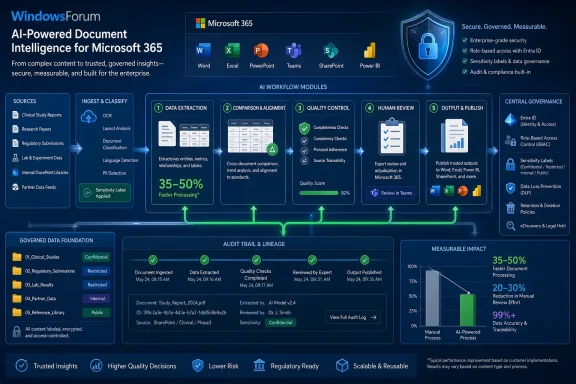
Microsoft’s latest public Copilot case study says Cactus Life Sciences has deployed Microsoft 365 Copilot and more than 30 custom AI agents to accelerate clinical and scientific document workflows, with structured data extraction reportedly running 35% to 50% faster than before. The important word is not “agent.” It is workflow. This is less a story about artificial intelligence replacing medical writers than about Microsoft trying to make enterprise AI look boring enough, governed enough, and measurable enough for regulated work.
The first wave of Copilot marketing was built around a familiar promise: put a conversational assistant inside the apps people already use, then watch meetings, documents, emails, and spreadsheets become less painful. That pitch was understandable, but it was also slippery. A general-purpose assistant is easy to demo and hard to evaluate.
The Cactus Life Sciences example points to a more serious version of the product strategy. Instead of asking users to invent value one prompt at a time, the company built more than 30 custom automation agents aimed at narrow, repeatable tasks. Those agents retrieve and structure information from scientific literature, support quality-control checks, compare content across documents, and help project managers summarize long email threads into task lists.
That distinction matters. The enterprise AI market has spent the past two years trying to sell “productivity” as a feeling. Regulated industries do not buy feelings for long. They buy controlled process changes that can be tested, governed, audited, and either expanded or killed.
Cactus, a medical communications and life sciences agency, is a good candidate for this kind of deployment precisely because its work is document-heavy, expertise-intensive, and full of repetitive extraction. Pharmaceutical and clinical communications require people to read deeply, compare evidence, maintain formatting and terminology discipline, and produce work that can survive scrutiny from clients, reviewers, and regulators. If AI cannot prove useful in that swamp of semi-structured knowledge work, it will struggle to prove useful anywhere beyond inbox hygiene.
The problem is scale. Scientific literature keeps expanding, clinical evidence packages keep growing, and teams are asked to move faster without relaxing standards. A human-led process can be effective and still fail to scale economically.
That is the opening Microsoft wants Copilot to occupy. The promise is not that a model becomes a better medical writer than a trained professional. The promise is that the model can reduce the amount of time professionals spend on mechanical translation between messy source material and usable working structure.
That framing is much more credible than the grandiose “AI colleague” rhetoric that has attached itself to agents. In practice, a useful agent in this environment is not a digital employee. It is a controlled subprocess with access to defined data, assigned to a defined task, operating inside a software and identity boundary that IT can understand.
That is why the security portion of the story is more important than it may look. Cactus handles proprietary pharmaceutical information, so the deployment reportedly required trusted authentication and dedicated project environments. In regulated and client-sensitive work, the answer to “Can the AI read this?” must be the same as the answer to “Should this person or process have access to this?”
This is where Microsoft’s enterprise pitch becomes more than bundling. Copilot can inherit the governance logic of Microsoft 365 only if the organization’s permissions, labels, storage practices, and project boundaries are already disciplined. If those foundations are sloppy, Copilot does not magically create governance; it makes weak governance more visible.
For WindowsForum readers in IT, that is the practical lesson hiding inside the shiny case study. The first Copilot project is rarely an AI project alone. It is a SharePoint, Entra ID, compliance, data classification, and change-management project wearing an AI badge.
A speedup in structured extraction does not mean the entire scientific communications workflow is 50% faster. Extraction is one component in a larger chain that includes interpretation, drafting, review, client alignment, regulatory sensitivity, and final quality control. AI can compress a step without compressing the whole process by the same amount.
That does not make the improvement trivial. In document-heavy work, bottlenecks accumulate. If writers and project teams spend less time digging through source material, normalizing terminology, checking abbreviations, and building first-pass structures, they can spend more time on analysis and judgment.
But the number should be treated as a process metric, not a revolution metric. Microsoft’s customers will get more durable value from Copilot when they measure specific workflow deltas rather than trying to prove that “AI” made the whole organization more innovative.
Scientific writing and medical communications are not merely document production. They involve judgment about evidence quality, audience, claims, risk, and client intent. An agent can retrieve and structure literature, but it cannot be the accountable professional behind a scientific argument.
The useful design pattern is therefore human-in-the-loop, though the phrase has become so overused that it risks sounding like a legal footnote. In a serious deployment, human control is not a ceremonial final click. It is embedded in scoping, review, exception handling, and escalation.
That matters because AI systems are excellent at producing fluent intermediate work. Fluency can be dangerous in regulated settings. The more polished an automated output looks, the more disciplined the review process must be.
They are, however, exactly the kind of tasks that drain expert attention. They are also tasks where an assistant can be useful without pretending to understand the totality of a clinical evidence package. A model that flags inconsistency is easier to supervise than a model that independently decides what a scientific document should argue.
That is why quality-control agents may become more valuable than content-generation agents in sensitive industries. Drafting is seductive, but review is where organizations can often define rules, thresholds, and failure modes more clearly. If an agent misses a formatting inconsistency, that is a manageable error. If it fabricates or distorts a clinical claim, the stakes change.
The broader lesson is that AI adoption may mature from “help me write this” to “help me not miss this.” That shift will make the technology less dazzling and more useful.
Cactus appears to have built agents for components of larger functions, not free-roaming bots with vague mandates. That is the safer architecture. Give the agent a narrow domain, a known corpus, a defined output format, and a human reviewer. Then measure whether the process improves.
This is also where Microsoft’s platform ambitions become visible. Copilot Studio and Microsoft 365 Copilot are not merely end-user features; they are mechanisms for turning business processes into repeatable AI-assisted units. The long-term prize is not that every employee chats with Copilot. It is that every department quietly embeds agents into the repetitive seams of its work.
That strategy will frustrate people expecting a sudden AI labor shock. It will also frustrate skeptics who judge Copilot only by whether the general chat experience feels magical. The real enterprise test is whether narrow agents keep surviving budget reviews because they save time without creating unacceptable risk.
Many organizations have discovered that giving employees access to a general-purpose AI assistant does not automatically create repeatable value. Some users become power users. Others try it twice, get a mediocre answer, and return to old habits. Still others use it in ways that make compliance teams nervous.
A phased rollout gives an organization time to find the work patterns where AI actually helps. It also gives IT and business leaders time to discover where data access is too broad, where prompts need standardization, where output review needs tightening, and where the tool simply is not worth using.
The Cactus example suggests that Copilot adoption is strongest when it is paired with internal champions, shared prompt practices, and a realistic explanation of limitations. That is less exciting than a sweeping transformation memo, but it is closer to how enterprise software really changes work.
The risk is that “inside Microsoft 365” can become a false sense of safety. Copilot can only respect the permissions and data architecture it is given. If a tenant has overshared document libraries, stale access groups, weak sensitivity labeling, or poor lifecycle management, AI may surface information more efficiently than before — including information that should have been harder to find.
That does not make Copilot uniquely dangerous. Search has always had this problem. The difference is that generative AI can synthesize and summarize across sources in ways that feel more powerful than a list of documents.
For sysadmins, the uncomfortable truth is that AI governance begins before AI procurement. If a company would be embarrassed by what a motivated employee could already find through enterprise search, Copilot will not be the root cause. It will be the flashlight.
The distinction matters because healthcare AI debates often collapse very different risk categories into one bucket. An agent that summarizes scientific literature for a trained writer is not the same as an agent that recommends treatment. Both may involve clinical data or medical subject matter, but the accountability model is different.
Microsoft benefits from that distinction. Medical communications and pharmaceutical support functions offer document-intensive use cases where enterprise AI can show value without immediately crossing into direct care. That makes them attractive proving grounds for Copilot agents.
Still, these workflows sit adjacent to high-stakes domains. Errors in scientific communication can ripple outward into client decisions, publication quality, regulatory positioning, and trust. The fact that the agents are not treating patients does not make accuracy optional.
That is still a meaningful labor shift. When repetitive extraction, formatting checks, and first-pass synthesis become faster, expectations may rise. Clients may ask for quicker turnaround. Managers may redesign capacity planning. Teams may spend less time gathering evidence and more time defending conclusions.
This is why “augmentation” should not be treated as a harmless word. Augmented work can be better work, but it can also be more compressed work. If AI removes the pauses that once existed between steps, organizations need to make sure they do not also remove the thinking time that made the final product good.
The best outcome is not simply faster throughput. It is a redistribution of attention toward the parts of scientific communication that require expertise. Whether organizations actually protect that higher-value time is a management question, not a model capability question.
That is smart marketing, but it is also a roadmap signal. Microsoft does not need every customer to believe in one universal AI assistant. It needs enough customers to believe that their own departments can build useful, governed agents inside the Microsoft stack.
The more these examples accumulate, the more Copilot becomes less like a product and more like a platform tax on enterprise knowledge work. If Microsoft can convince buyers that agents belong near the data, identity, collaboration, and compliance layers they already pay for, competitors will have to argue not just about model performance but about operational trust.
That is a much harder fight. Enterprises do not choose software only because it is clever. They choose software because it fits into procurement, security review, admin controls, training, and the existing mess of how work gets done.
Building 30 useful agents is not the same as letting 30 people create clever prompts. Someone has to define the tasks. Someone has to validate outputs. Someone has to maintain data sources, retire broken automations, update instructions, and decide when an agent is no longer fit for purpose.
This creates a new governance burden. Enterprises are used to managing applications, accounts, devices, and data. Now they must manage semi-autonomous workflow components that sit between users and information. Those components may be small, but they can multiply quickly.
The agent sprawl problem is coming. If every department builds its own assistants without lifecycle controls, organizations will end up with outdated instructions, duplicated functions, unclear ownership, and inconsistent handling of sensitive material. The winners will not be the firms with the most agents. They will be the firms with the best agent hygiene.
Admins will be asked to govern not only users and devices, but also agents that act on behalf of users or teams. They will need to understand which agents exist, what data they can reach, what actions they can take, and who is responsible for their behavior. That will require closer alignment between IT, compliance, legal, and business units than many organizations currently have.
The old model of productivity software was relatively straightforward: deploy applications, manage access, secure endpoints, and support users. The emerging model adds a layer of automated reasoning and action inside those applications. That does not eliminate traditional administration; it makes it more consequential.
The practical preparation is unglamorous. Clean up permissions. Rationalize SharePoint sites. Review guest access. Apply sensitivity labels where they matter. Document business processes before trying to automate them. Copilot will be far more useful in an orderly tenant than in a digital attic.
Microsoft’s Cactus Life Sciences story is not proof that AI agents are ready to run clinical or pharmaceutical communications on their own. It is evidence that carefully bounded agents can take friction out of the document machinery that surrounds scientific work, provided the organization treats security, training, and human accountability as design requirements rather than afterthoughts. That is where enterprise AI is likely to settle: not as a sudden replacement for expertise, but as a new layer of governed automation that makes expertise faster, more exposed, and more dependent than ever on the quality of the systems around it.
 Microsoft’s Best AI Story Is No Longer the Chatbot
The first wave of Copilot marketing was built around a familiar promise: put a conversational assistant inside the apps people already use, then watch meetings, documents, emails, and spreadsheets become less painful. That pitch was understandable, but it was also slippery. A general-purpose assistant is easy to demo and hard to evaluate.The Cactus Life Sciences example points to a more serious version of the product strategy. Instead of asking users to invent value one prompt at a time, the company built more than 30 custom automation agents aimed at narrow, repeatable tasks. Those agents retrieve and structure information from scientific literature, support quality-control checks, compare content across documents, and help project managers summarize long email threads into task lists.
That distinction matters. The enterprise AI market has spent the past two years trying to sell “productivity” as a feeling. Regulated industries do not buy feelings for long. They buy controlled process changes that can be tested, governed, audited, and either expanded or killed.
Cactus, a medical communications and life sciences agency, is a good candidate for this kind of deployment precisely because its work is document-heavy, expertise-intensive, and full of repetitive extraction. Pharmaceutical and clinical communications require people to read deeply, compare evidence, maintain formatting and terminology discipline, and produce work that can survive scrutiny from clients, reviewers, and regulators. If AI cannot prove useful in that swamp of semi-structured knowledge work, it will struggle to prove useful anywhere beyond inbox hygiene.
The Real Bottleneck Was Never a Lack of Clever Prompts
Before Copilot entered the picture, Cactus reportedly relied on manual document review and structured data extraction. That is not a primitive workflow; in many scientific and regulatory settings, manual review is the control system. Human experts read, classify, cross-check, and format because the cost of a plausible but wrong answer can be high.The problem is scale. Scientific literature keeps expanding, clinical evidence packages keep growing, and teams are asked to move faster without relaxing standards. A human-led process can be effective and still fail to scale economically.
That is the opening Microsoft wants Copilot to occupy. The promise is not that a model becomes a better medical writer than a trained professional. The promise is that the model can reduce the amount of time professionals spend on mechanical translation between messy source material and usable working structure.
That framing is much more credible than the grandiose “AI colleague” rhetoric that has attached itself to agents. In practice, a useful agent in this environment is not a digital employee. It is a controlled subprocess with access to defined data, assigned to a defined task, operating inside a software and identity boundary that IT can understand.
Cactus Shows Why Microsoft Wants Agents Inside Microsoft 365
Microsoft’s advantage here is not simply model quality. It is distribution, identity, permissions, and muscle memory. If a life sciences agency is already living in Microsoft 365, the path of least resistance is to attach automation to the productivity estate rather than move proprietary client material into a separate AI island.That is why the security portion of the story is more important than it may look. Cactus handles proprietary pharmaceutical information, so the deployment reportedly required trusted authentication and dedicated project environments. In regulated and client-sensitive work, the answer to “Can the AI read this?” must be the same as the answer to “Should this person or process have access to this?”
This is where Microsoft’s enterprise pitch becomes more than bundling. Copilot can inherit the governance logic of Microsoft 365 only if the organization’s permissions, labels, storage practices, and project boundaries are already disciplined. If those foundations are sloppy, Copilot does not magically create governance; it makes weak governance more visible.
For WindowsForum readers in IT, that is the practical lesson hiding inside the shiny case study. The first Copilot project is rarely an AI project alone. It is a SharePoint, Entra ID, compliance, data classification, and change-management project wearing an AI badge.
The 35% to 50% Number Is Meaningful, but Narrow
Cactus says structured data extraction is now 35% to 50% faster than previous workflows. That is a strong claim, and it is exactly the sort of metric enterprise AI needs more of. It is also easy to overread.A speedup in structured extraction does not mean the entire scientific communications workflow is 50% faster. Extraction is one component in a larger chain that includes interpretation, drafting, review, client alignment, regulatory sensitivity, and final quality control. AI can compress a step without compressing the whole process by the same amount.
That does not make the improvement trivial. In document-heavy work, bottlenecks accumulate. If writers and project teams spend less time digging through source material, normalizing terminology, checking abbreviations, and building first-pass structures, they can spend more time on analysis and judgment.
But the number should be treated as a process metric, not a revolution metric. Microsoft’s customers will get more durable value from Copilot when they measure specific workflow deltas rather than trying to prove that “AI” made the whole organization more innovative.
Human-in-the-Loop Is Not a Disclaimer, It Is the Product
Cactus has emphasized that its agents automate components of larger functions rather than replacing entire roles. That is not just careful public relations. In this domain, it is the only plausible deployment model.Scientific writing and medical communications are not merely document production. They involve judgment about evidence quality, audience, claims, risk, and client intent. An agent can retrieve and structure literature, but it cannot be the accountable professional behind a scientific argument.
The useful design pattern is therefore human-in-the-loop, though the phrase has become so overused that it risks sounding like a legal footnote. In a serious deployment, human control is not a ceremonial final click. It is embedded in scoping, review, exception handling, and escalation.
That matters because AI systems are excellent at producing fluent intermediate work. Fluency can be dangerous in regulated settings. The more polished an automated output looks, the more disciplined the review process must be.
Quality Control Is Where the Boring Automation Wins
Some of the most compelling uses in the Cactus deployment are not glamorous. Checking abbreviations, ensuring uniform formatting, verifying compliance with regulatory and publishing standards, and comparing material across documents are not the kind of tasks that make keynote audiences gasp.They are, however, exactly the kind of tasks that drain expert attention. They are also tasks where an assistant can be useful without pretending to understand the totality of a clinical evidence package. A model that flags inconsistency is easier to supervise than a model that independently decides what a scientific document should argue.
That is why quality-control agents may become more valuable than content-generation agents in sensitive industries. Drafting is seductive, but review is where organizations can often define rules, thresholds, and failure modes more clearly. If an agent misses a formatting inconsistency, that is a manageable error. If it fabricates or distorts a clinical claim, the stakes change.
The broader lesson is that AI adoption may mature from “help me write this” to “help me not miss this.” That shift will make the technology less dazzling and more useful.
Copilot’s Enterprise Future Depends on Constrained Autonomy
The word “agent” is doing a lot of work in technology marketing right now. In its most inflated form, it suggests software that can plan, act, and complete work independently across systems. In enterprise reality, especially in healthcare and life sciences, the better agent is often the constrained one.Cactus appears to have built agents for components of larger functions, not free-roaming bots with vague mandates. That is the safer architecture. Give the agent a narrow domain, a known corpus, a defined output format, and a human reviewer. Then measure whether the process improves.
This is also where Microsoft’s platform ambitions become visible. Copilot Studio and Microsoft 365 Copilot are not merely end-user features; they are mechanisms for turning business processes into repeatable AI-assisted units. The long-term prize is not that every employee chats with Copilot. It is that every department quietly embeds agents into the repetitive seams of its work.
That strategy will frustrate people expecting a sudden AI labor shock. It will also frustrate skeptics who judge Copilot only by whether the general chat experience feels magical. The real enterprise test is whether narrow agents keep surviving budget reviews because they save time without creating unacceptable risk.
The Deployment Story Is Also a Change-Management Story
Cactus reportedly rolled out Microsoft 365 Copilot in phases and supported adoption with education. That is not an incidental detail. It is the difference between AI as a procurement line item and AI as an operational change.Many organizations have discovered that giving employees access to a general-purpose AI assistant does not automatically create repeatable value. Some users become power users. Others try it twice, get a mediocre answer, and return to old habits. Still others use it in ways that make compliance teams nervous.
A phased rollout gives an organization time to find the work patterns where AI actually helps. It also gives IT and business leaders time to discover where data access is too broad, where prompts need standardization, where output review needs tightening, and where the tool simply is not worth using.
The Cactus example suggests that Copilot adoption is strongest when it is paired with internal champions, shared prompt practices, and a realistic explanation of limitations. That is less exciting than a sweeping transformation memo, but it is closer to how enterprise software really changes work.
Security Is the Part Microsoft Wants Buyers to Notice
The life sciences angle helps Microsoft make a broader point: Copilot is not just another AI tool employees discovered on the public web. It is an enterprise-controlled layer attached to familiar systems, identities, and data boundaries. For organizations handling sensitive client information, that distinction is the sales pitch.The risk is that “inside Microsoft 365” can become a false sense of safety. Copilot can only respect the permissions and data architecture it is given. If a tenant has overshared document libraries, stale access groups, weak sensitivity labeling, or poor lifecycle management, AI may surface information more efficiently than before — including information that should have been harder to find.
That does not make Copilot uniquely dangerous. Search has always had this problem. The difference is that generative AI can synthesize and summarize across sources in ways that feel more powerful than a list of documents.
For sysadmins, the uncomfortable truth is that AI governance begins before AI procurement. If a company would be embarrassed by what a motivated employee could already find through enterprise search, Copilot will not be the root cause. It will be the flashlight.
The Medical Communications Use Case Is Not the Same as Clinical Care
It is important not to blur the boundary between life sciences communications and bedside medicine. Cactus is using agents to support scientific document workflows, literature handling, quality control, and project operations. That is different from using AI to make clinical decisions about a patient.The distinction matters because healthcare AI debates often collapse very different risk categories into one bucket. An agent that summarizes scientific literature for a trained writer is not the same as an agent that recommends treatment. Both may involve clinical data or medical subject matter, but the accountability model is different.
Microsoft benefits from that distinction. Medical communications and pharmaceutical support functions offer document-intensive use cases where enterprise AI can show value without immediately crossing into direct care. That makes them attractive proving grounds for Copilot agents.
Still, these workflows sit adjacent to high-stakes domains. Errors in scientific communication can ripple outward into client decisions, publication quality, regulatory positioning, and trust. The fact that the agents are not treating patients does not make accuracy optional.
The Automation Story Is Smaller Than Replacement and Bigger Than Convenience
The user-facing shorthand for AI adoption often becomes a labor question: which jobs disappear? The Cactus story is more subtle. The agents do not appear to replace medical writers or project managers; they change the texture of the work those people do.That is still a meaningful labor shift. When repetitive extraction, formatting checks, and first-pass synthesis become faster, expectations may rise. Clients may ask for quicker turnaround. Managers may redesign capacity planning. Teams may spend less time gathering evidence and more time defending conclusions.
This is why “augmentation” should not be treated as a harmless word. Augmented work can be better work, but it can also be more compressed work. If AI removes the pauses that once existed between steps, organizations need to make sure they do not also remove the thinking time that made the final product good.
The best outcome is not simply faster throughput. It is a redistribution of attention toward the parts of scientific communication that require expertise. Whether organizations actually protect that higher-value time is a management question, not a model capability question.
Microsoft’s Case Study Machine Is Becoming Its AI Roadmap
Microsoft has been steadily filling the market with customer stories that frame Copilot and agents as practical enterprise infrastructure rather than experimental novelty. The pattern is clear: find a document-heavy function, deploy Copilot in a controlled environment, build role-specific agents, measure a concrete improvement, and present the result as a repeatable template.That is smart marketing, but it is also a roadmap signal. Microsoft does not need every customer to believe in one universal AI assistant. It needs enough customers to believe that their own departments can build useful, governed agents inside the Microsoft stack.
The more these examples accumulate, the more Copilot becomes less like a product and more like a platform tax on enterprise knowledge work. If Microsoft can convince buyers that agents belong near the data, identity, collaboration, and compliance layers they already pay for, competitors will have to argue not just about model performance but about operational trust.
That is a much harder fight. Enterprises do not choose software only because it is clever. They choose software because it fits into procurement, security review, admin controls, training, and the existing mess of how work gets done.
The Hidden Cost Is Operational Discipline
The Cactus deployment sounds orderly: phased rollout, trusted authentication, dedicated project environments, custom agents, employee education, and human review. That orderliness is the point. It is also the part many organizations will underestimate.Building 30 useful agents is not the same as letting 30 people create clever prompts. Someone has to define the tasks. Someone has to validate outputs. Someone has to maintain data sources, retire broken automations, update instructions, and decide when an agent is no longer fit for purpose.
This creates a new governance burden. Enterprises are used to managing applications, accounts, devices, and data. Now they must manage semi-autonomous workflow components that sit between users and information. Those components may be small, but they can multiply quickly.
The agent sprawl problem is coming. If every department builds its own assistants without lifecycle controls, organizations will end up with outdated instructions, duplicated functions, unclear ownership, and inconsistent handling of sensitive material. The winners will not be the firms with the most agents. They will be the firms with the best agent hygiene.
Windows Shops Should Read This as an Admin Story
For WindowsForum’s core audience, the Cactus example is not just a healthcare or life sciences story. It is a preview of what Microsoft wants the next phase of Microsoft 365 administration to look like.Admins will be asked to govern not only users and devices, but also agents that act on behalf of users or teams. They will need to understand which agents exist, what data they can reach, what actions they can take, and who is responsible for their behavior. That will require closer alignment between IT, compliance, legal, and business units than many organizations currently have.
The old model of productivity software was relatively straightforward: deploy applications, manage access, secure endpoints, and support users. The emerging model adds a layer of automated reasoning and action inside those applications. That does not eliminate traditional administration; it makes it more consequential.
The practical preparation is unglamorous. Clean up permissions. Rationalize SharePoint sites. Review guest access. Apply sensitivity labels where they matter. Document business processes before trying to automate them. Copilot will be far more useful in an orderly tenant than in a digital attic.
The Cactus Case Cuts Through the Agent Hype
The most useful lessons from this deployment are concrete rather than mystical. Cactus did not appear to bet the company on an all-purpose AI brain. It identified repetitive, document-heavy work and put governed automation around it.- Structured data extraction is the headline metric, with Cactus reporting a 35% to 50% improvement over previous workflows.
- The company deployed more than 30 custom agents, but those agents target pieces of larger processes rather than replacing whole professional roles.
- Security and data separation were central to the rollout because the work involves proprietary pharmaceutical information.
- The strongest use cases are repetitive scientific literature handling, quality-control checks, document comparison, email-thread summarization, and task generation.
- Human review remains essential because the value of the workflow depends on scientific judgment, not just faster document processing.
- The deployment’s broader lesson for IT teams is that Copilot success depends on governance, permissions, training, and process design as much as model capability.
Microsoft’s Cactus Life Sciences story is not proof that AI agents are ready to run clinical or pharmaceutical communications on their own. It is evidence that carefully bounded agents can take friction out of the document machinery that surrounds scientific work, provided the organization treats security, training, and human accountability as design requirements rather than afterthoughts. That is where enterprise AI is likely to settle: not as a sudden replacement for expertise, but as a new layer of governed automation that makes expertise faster, more exposed, and more dependent than ever on the quality of the systems around it.
References
- Primary source: Procurement Magazine
Published: 2026-05-29T07:33:13.675185
Microsoft: Using AI Agents to Handle Clinical Data Surge | Procurement Magazine
Cactus Life Sciences has integrated Microsoft 365 and Copilot AI to automate data processing tasks while maintaining security for pharmaceutical clients procurementmag.com
- Related coverage: healthcare-digital.com
How Microsoft AI Agents Support Cactus Life's Human-Led Work | Healthcare Digital
Cactus Life Sciences deploys Microsoft AI agents to cut scientific data extraction times by up to 50%, but retains a secure, human-anchored approach healthcare-digital.com
- Official source: learn.microsoft.com
Manage agents in the Microsoft 365 admin center - Microsoft 365 admin | Microsoft Learn
Manage agents in the Microsoft 365 admin center. Learn how to enable, assign, block, or remove agents to optimize your organization's agentic experience.learn.microsoft.com - Official source: microsoft.com
HealthEquity scales innovation with Microsoft 365 Copilot and AI agents | Microsoft Customer Stories
HealthEquity reduces friction in critical healthcare and financial moments with Microsoft 365 Copilot and AI agents.www.microsoft.com
- Related coverage: windowsforum.com
Microsoft 365 Copilot in Life Sciences: Agents, Security, and Real ROI | Windows Forum
Cactus Life Sciences, a medical communications agency operating across the United States, Europe, the United Kingdom, India, and Japan, has adopted...windowsforum.com - Related coverage: querynow.com
Why Copilot Adoption Stalls at 30 Percent and How Governed Deployment with Custom Agents Changes the Math | QueryNow®
Many M365 Copilot rollouts plateau at 30 percent adoption because they ignore governance, compliance, and role-specific workflows. In regulated industries,www.querynow.com
- Official source: adoption.microsoft.com
Agent transformation stories – Microsoft Adoption
Real customer stories. Real agent impact. Discover how organizations across industries are transforming their business with agents and find inspiration for your own AI journey.adoption.microsoft.com - Related coverage: venturebeat.com
- Official source: cdn-dynmedia-1.microsoft.com
- Related coverage: procurementtactics.com
Procurement Automations with AI Agents: 2025 2026 Industry Outlook
PDF documentprocurementtactics.com
- Official source: news.microsoft.com
- Official source: download.microsoft.com
- Official source: techcommunity.microsoft.com
Maximizing Productivity: End-to-End Content Creation with Microsoft 365 Copilot
PDF documenttechcommunity.microsoft.com
- Official source: marketingassets.microsoft.com
