

Microsoft has turned Copilot into an enterprise agent platform in 2026, making Microsoft 365 E7 and Agent 365 generally available on May 1, adding computer-using agents in Copilot Studio on May 13, and introducing multi-model Researcher workflows that use Claude to check GPT output. The strategic point is not that Copilot can chat better. It is that Microsoft wants to own the layer where autonomous work is assigned, observed, secured, priced, and justified.
That makes the current Copilot shift more consequential than another AI feature drop. For Windows shops and Microsoft 365 tenants, the question is no longer whether employees will ask an assistant to summarize a meeting. It is whether IT is ready to govern software entities that can click through applications, touch business records, and make decisions fast enough to create both productivity and liability.
The headline number is simple: Microsoft 365 E7 costs $99 per user per month, or $90.45 in the Teams-excluded version. Microsoft describes it as the “Frontier Suite,” a bundle that includes Microsoft 365 E5, Microsoft 365 Copilot, Microsoft Entra Suite, and Agent 365. Agent 365 is also available separately at $15 per user per month.
The deeper move is subtler. Microsoft is not merely charging more for Copilot; it is reframing enterprise AI as an identity, security, compliance, and lifecycle-management problem. That is a familiar Microsoft playbook. When a new class of work enters the enterprise, Redmond’s answer is to make it manageable through the same administrative gravity that already surrounds Windows, Entra, Defender, Purview, Intune, and Microsoft 365.
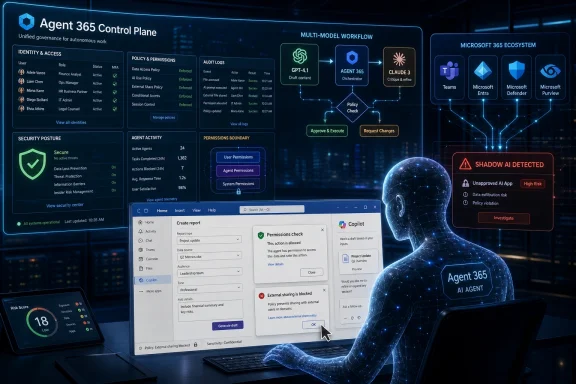
Agent 365 is the center of that argument. It is meant to register agents, assign identity, monitor behavior, enforce policy, and give administrators a way to discover unsanctioned or risky tools. Microsoft’s “Shadow AI” framing is important because it mirrors the cloud-app sprawl battles of the last decade. The pitch to CIOs is not that every agent is safe; it is that agents are already appearing, and unmanaged autonomy is worse than expensive governance.
That is why E7 matters even to organizations that are not yet ready to unleash autonomous agents across finance, HR, customer operations, or engineering. The bundle is a procurement signal. Microsoft is telling enterprise buyers that the future unit of productivity is not the user alone, but the user surrounded by a fleet of delegated software workers.
The bundle is attractive on paper if a company already wants E5, Copilot, Entra Suite, and Agent 365. In that scenario, Microsoft can argue that E7 is a discount rather than a surcharge. Partner estimates vary, but the savings versus buying components separately appear real for some customers.
The catch is that bundles tend to define roadmaps as much as reflect them. A tenant that buys E7 is not only paying for current Copilot usage; it is buying into Microsoft’s assumption that agent governance will become a required enterprise layer. That may be right, but it is still an assumption.
Many IT departments are already wary of Copilot seat expansion because the value case varies by role. Knowledge workers who live in Outlook, Teams, Word, Excel, SharePoint, and PowerPoint may see obvious time savings. A frontline or highly specialized worker may not. E7 raises the stakes by asking organizations to pay for a governance fabric whose payoff depends on agents becoming pervasive enough to need fleet management.
That matters because enterprise software is full of awkward dead ends. A company may have a proprietary system with no modern integration layer. A vendor may expose only partial APIs. A department may rely on an internal portal built years ago by people who have since left. Traditional robotic process automation can help, but it often breaks when a layout changes, a field moves, or an unexpected email format arrives.
Microsoft’s computer-using agents are meant to attack that middle ground: work that is structured enough to automate, but not clean enough to integrate elegantly. The Graebel example Microsoft has discussed is a useful one because relocation workflows involve legacy systems, unstructured requests, varied documentation, and many small judgment calls. That is exactly where old automation tools often become brittle.
For WindowsForum readers, this is the part of the announcement that should feel both exciting and alarming. A screen-driving agent can modernize a workflow without waiting for a vendor to ship an API. It can also become a privileged, tireless, semi-reasoning user operating across boundaries that were never designed for autonomous execution.
That is why Microsoft’s governance story and its computer-use story must be read together. An agent that can click through a claims system, a billing application, or an HR portal needs identity, credential controls, audit trails, policy enforcement, and human approval gates. Otherwise, the agent is just another automation credential with better eyesight and worse predictability.
Security researchers have already shown why this matters. Prompt injection against enterprise AI systems is not theoretical. If an agent can be manipulated into revealing sensitive records or changing business data, the harm is not limited to a bad answer in a chat window. It becomes an operational incident.
Microsoft’s answer is not to say agents are harmless. Its answer is to make agent activity governable through Entra, Defender, and Purview. That is the right direction, but it should not lull administrators into thinking governance equals immunity. Governance makes bad behavior visible, constrainable, and auditable. It does not make autonomous behavior inherently safe.
But Critique is also a strategic admission. Microsoft is acknowledging that enterprise AI quality will not be won by a single model vendor permanently dominating every task. The new premium layer is orchestration: choosing models, sequencing them, comparing them, governing them, and presenting the result inside a trusted work environment.
That is an important shift for Microsoft, which remains deeply tied to OpenAI but increasingly presents Copilot as model-diverse. Bringing Anthropic’s Claude into Researcher and Copilot Studio gives Microsoft flexibility. It can keep the Copilot brand in front of customers even when the best model for a task is not always an OpenAI model.
The Council feature points in the same direction. Rather than having one model silently answer, multiple models can reason over the same prompt and expose disagreement. That is not just a better demo; it is a more honest representation of where enterprise AI is headed. The model layer is competitive and unstable. The enterprise value is in the system that decides which model to trust, when, and under what policy.
The important point is not the exact score. It is the product thesis behind the score. Microsoft is betting that multi-model supervision can reduce error rates enough to make AI research more defensible inside enterprises. That is plausible, especially for tasks involving synthesis, citation checking, and competing interpretations.
Still, administrators should resist treating a benchmark as a warranty. A research agent that performs well on benchmark tasks can still hallucinate a policy detail, misread a spreadsheet, over-trust a stale document, or mishandle private context. The failure modes are narrower than they were two years ago, but they have not disappeared.
The more useful enterprise question is whether the system produces outputs that can be reviewed, traced, challenged, and improved. In that sense, Critique is most valuable not as an oracle but as a workflow pattern. It turns AI output into something closer to a review process, where one model’s confidence is not the final checkpoint.
Agent 365 extends that moat. If agents are registered through Microsoft, authenticated through Entra, protected through Defender, and audited through Purview, then Microsoft becomes the default place where enterprise AI labor is supervised. That is more valuable than owning a chatbot.
This is also where regulators are likely to pay attention. Bundling AI, cloud, security, and productivity into one premium subscription can be efficient for customers, but it can also reinforce platform lock-in. Microsoft will argue that integration is necessary for trust and security. Critics will argue that integration can become coercive when the same vendor controls the productivity suite, identity plane, security stack, and AI control plane.
Both arguments can be true. Enterprises do benefit from unified policy and logging. They also risk becoming dependent on one vendor’s interpretation of what agent governance should mean. The question is not whether Microsoft is allowed to bundle useful products. The question is whether the bundle becomes the only practical path to safe deployment.
That sounds abstract until an auditor asks who approved an agent, what credentials it used, what data it accessed, what decision logic it followed, and who reviewed the output. At that point, “it was just a Copilot workflow” will not be a sufficient answer. Agents need ownership, scope, expiration, monitoring, and incident-response procedures.
The Shadow AI concept is therefore not marketing fluff. Employees and departments will experiment with agents whether central IT is ready or not. Some will be low-risk productivity helpers. Others will be connected to code repositories, customer records, finance systems, or external services. The more useful agents become, the more dangerous unsanctioned agents become.
This is where Agent 365 has a credible opening. If it can discover, classify, and control both Microsoft and third-party agents, it gives administrators a fighting chance. If it becomes another dashboard that sees only part of the estate, organizations will still need broader controls from security vendors, CASB tools, endpoint telemetry, and identity governance platforms.
That has obvious implications for Windows environments. Many enterprises still run desktop applications, thick clients, browser-based internal tools, and remote apps that are difficult to integrate cleanly. A computer-using agent that can operate across those surfaces could become a bridge between old enterprise software and new AI workflows.
But the operating system also becomes part of the control problem. Screen access, credential handling, session isolation, clipboard behavior, browser profiles, conditional access, endpoint detection, and data-loss prevention all matter when an agent can manipulate applications through a human-like interface. The safer version of this future will not be “agent logs into a shared workstation and clicks around.” It will require hardened sessions, least privilege, strong observability, and clear boundaries between agent and human activity.
That is where Microsoft has an architectural advantage if it executes well. It owns Windows, Edge, Entra, Defender, Intune, Purview, Microsoft 365, Power Platform, and Copilot Studio. The company can connect policy points that rivals may have to approximate through integrations. The danger, as always, is that convenience becomes dependency.
The same caution applies to paid Copilot seat counts. Adoption is real, but usage depth varies. Some employees use Copilot daily; others have access but little habit formation. The jump from assisted drafting and summarization to autonomous action is not automatic.
This is the gap Microsoft must close in 2026 and beyond. It has assembled a coherent stack: Copilot as the user-facing layer, Copilot Studio as the builder environment, Agent 365 as the control plane, Entra as identity, Defender as protection, and Purview as compliance memory. Coherence, however, is not the same as ROI.
The next phase will be measured less by launch announcements and more by production stories with hard operational results. Did an agent reduce claims-processing time without increasing errors? Did a research workflow improve analyst productivity without citation failures? Did a screen agent retire brittle RPA scripts without creating new incident classes? Those are the proof points buyers will need.
That mismatch creates procurement tension. Security and AI leaders may want the governance layer now, before shadow agents spread. Finance leaders may ask why the company should pay a premium before autonomous workflows are mature. Business units may want agents deployed quickly, while compliance teams demand slower controls.
The sensible answer is not blanket adoption or reflexive refusal. Enterprises should map E7 against actual readiness. If a company already uses E5, has broad Copilot deployment, wants Entra Suite, and is actively building agents, E7 may be a rational consolidation. If Copilot is still in pilot mode and agent use is speculative, Agent 365 alone or a narrower rollout may be easier to defend.
The danger is buying the suite as a symbol of AI seriousness. Microsoft is very good at turning strategic anxiety into license motion. IT leaders should make sure the purchase corresponds to governed use cases, not just executive pressure to “do agents.”
That makes the current Copilot shift more consequential than another AI feature drop. For Windows shops and Microsoft 365 tenants, the question is no longer whether employees will ask an assistant to summarize a meeting. It is whether IT is ready to govern software entities that can click through applications, touch business records, and make decisions fast enough to create both productivity and liability.
 Microsoft Is Selling the Control Plane Before the Agents Are Fully Trusted
The headline number is simple: Microsoft 365 E7 costs $99 per user per month, or $90.45 in the Teams-excluded version. Microsoft describes it as the “Frontier Suite,” a bundle that includes Microsoft 365 E5, Microsoft 365 Copilot, Microsoft Entra Suite, and Agent 365. Agent 365 is also available separately at $15 per user per month.The deeper move is subtler. Microsoft is not merely charging more for Copilot; it is reframing enterprise AI as an identity, security, compliance, and lifecycle-management problem. That is a familiar Microsoft playbook. When a new class of work enters the enterprise, Redmond’s answer is to make it manageable through the same administrative gravity that already surrounds Windows, Entra, Defender, Purview, Intune, and Microsoft 365.
Agent 365 is the center of that argument. It is meant to register agents, assign identity, monitor behavior, enforce policy, and give administrators a way to discover unsanctioned or risky tools. Microsoft’s “Shadow AI” framing is important because it mirrors the cloud-app sprawl battles of the last decade. The pitch to CIOs is not that every agent is safe; it is that agents are already appearing, and unmanaged autonomy is worse than expensive governance.
That is why E7 matters even to organizations that are not yet ready to unleash autonomous agents across finance, HR, customer operations, or engineering. The bundle is a procurement signal. Microsoft is telling enterprise buyers that the future unit of productivity is not the user alone, but the user surrounded by a fleet of delegated software workers.
The E7 Bundle Turns AI Adoption Into a Licensing Decision
E7 is Microsoft’s first new top-end enterprise Microsoft 365 tier since E5. That alone gives it symbolic weight. E5 became the natural landing zone for security-conscious organizations because it gathered identity, compliance, threat protection, and analytics into a single high-end subscription. E7 is trying to do the same for AI operations.The bundle is attractive on paper if a company already wants E5, Copilot, Entra Suite, and Agent 365. In that scenario, Microsoft can argue that E7 is a discount rather than a surcharge. Partner estimates vary, but the savings versus buying components separately appear real for some customers.
The catch is that bundles tend to define roadmaps as much as reflect them. A tenant that buys E7 is not only paying for current Copilot usage; it is buying into Microsoft’s assumption that agent governance will become a required enterprise layer. That may be right, but it is still an assumption.
Many IT departments are already wary of Copilot seat expansion because the value case varies by role. Knowledge workers who live in Outlook, Teams, Word, Excel, SharePoint, and PowerPoint may see obvious time savings. A frontline or highly specialized worker may not. E7 raises the stakes by asking organizations to pay for a governance fabric whose payoff depends on agents becoming pervasive enough to need fleet management.
Computer-Using Agents Drag Legacy Apps Into the AI Era
The most practical of Microsoft’s recent agent announcements is computer use in Copilot Studio. These agents do not require a clean API. They can interact with applications through the screen, reading interfaces, clicking buttons, entering text, and navigating workflows much as a human would.That matters because enterprise software is full of awkward dead ends. A company may have a proprietary system with no modern integration layer. A vendor may expose only partial APIs. A department may rely on an internal portal built years ago by people who have since left. Traditional robotic process automation can help, but it often breaks when a layout changes, a field moves, or an unexpected email format arrives.
Microsoft’s computer-using agents are meant to attack that middle ground: work that is structured enough to automate, but not clean enough to integrate elegantly. The Graebel example Microsoft has discussed is a useful one because relocation workflows involve legacy systems, unstructured requests, varied documentation, and many small judgment calls. That is exactly where old automation tools often become brittle.
For WindowsForum readers, this is the part of the announcement that should feel both exciting and alarming. A screen-driving agent can modernize a workflow without waiting for a vendor to ship an API. It can also become a privileged, tireless, semi-reasoning user operating across boundaries that were never designed for autonomous execution.
Screen Automation Makes Governance a Safety Feature, Not a Nice-to-Have
Computer-using agents change the risk profile because they act where people act. An API-based integration usually has scoped permissions, logs, schemas, and predictable transaction paths. A screen agent inherits the messiness of the interface. It may encounter pop-ups, ambiguous labels, hidden state, unexpected validation errors, or data it was not supposed to process.That is why Microsoft’s governance story and its computer-use story must be read together. An agent that can click through a claims system, a billing application, or an HR portal needs identity, credential controls, audit trails, policy enforcement, and human approval gates. Otherwise, the agent is just another automation credential with better eyesight and worse predictability.
Security researchers have already shown why this matters. Prompt injection against enterprise AI systems is not theoretical. If an agent can be manipulated into revealing sensitive records or changing business data, the harm is not limited to a bad answer in a chat window. It becomes an operational incident.
Microsoft’s answer is not to say agents are harmless. Its answer is to make agent activity governable through Entra, Defender, and Purview. That is the right direction, but it should not lull administrators into thinking governance equals immunity. Governance makes bad behavior visible, constrainable, and auditable. It does not make autonomous behavior inherently safe.
Claude Checking GPT Is a Product Strategy Masquerading as Quality Control
The most interesting Copilot Researcher change is Critique, the workflow in which GPT drafts and Claude reviews before the user sees the result. In one sense, it is an obvious quality-control mechanism. Different models fail in different ways, and a second model can catch omissions, weak citations, or faulty reasoning that the first model misses.But Critique is also a strategic admission. Microsoft is acknowledging that enterprise AI quality will not be won by a single model vendor permanently dominating every task. The new premium layer is orchestration: choosing models, sequencing them, comparing them, governing them, and presenting the result inside a trusted work environment.
That is an important shift for Microsoft, which remains deeply tied to OpenAI but increasingly presents Copilot as model-diverse. Bringing Anthropic’s Claude into Researcher and Copilot Studio gives Microsoft flexibility. It can keep the Copilot brand in front of customers even when the best model for a task is not always an OpenAI model.
The Council feature points in the same direction. Rather than having one model silently answer, multiple models can reason over the same prompt and expose disagreement. That is not just a better demo; it is a more honest representation of where enterprise AI is headed. The model layer is competitive and unstable. The enterprise value is in the system that decides which model to trust, when, and under what policy.
Benchmarks Help Microsoft’s Case, but They Do Not Settle It
Microsoft says the Critique-enabled Researcher workflow improves performance on the DRACO deep-research benchmark, with reported gains over prior top-performing systems. That is useful evidence, but it should be handled carefully. Benchmarks in AI are moving targets, and vendor-run evaluations are not the same thing as independent production proof.The important point is not the exact score. It is the product thesis behind the score. Microsoft is betting that multi-model supervision can reduce error rates enough to make AI research more defensible inside enterprises. That is plausible, especially for tasks involving synthesis, citation checking, and competing interpretations.
Still, administrators should resist treating a benchmark as a warranty. A research agent that performs well on benchmark tasks can still hallucinate a policy detail, misread a spreadsheet, over-trust a stale document, or mishandle private context. The failure modes are narrower than they were two years ago, but they have not disappeared.
The more useful enterprise question is whether the system produces outputs that can be reviewed, traced, challenged, and improved. In that sense, Critique is most valuable not as an oracle but as a workflow pattern. It turns AI output into something closer to a review process, where one model’s confidence is not the final checkpoint.
Microsoft’s Real Moat Is the Tenant Boundary
For years, Microsoft’s advantage in productivity software has been the tenant. Files, messages, meetings, calendars, identities, groups, devices, policies, retention labels, and access controls already live inside Microsoft’s administrative universe. Copilot became more compelling because it could operate inside that boundary.Agent 365 extends that moat. If agents are registered through Microsoft, authenticated through Entra, protected through Defender, and audited through Purview, then Microsoft becomes the default place where enterprise AI labor is supervised. That is more valuable than owning a chatbot.
This is also where regulators are likely to pay attention. Bundling AI, cloud, security, and productivity into one premium subscription can be efficient for customers, but it can also reinforce platform lock-in. Microsoft will argue that integration is necessary for trust and security. Critics will argue that integration can become coercive when the same vendor controls the productivity suite, identity plane, security stack, and AI control plane.
Both arguments can be true. Enterprises do benefit from unified policy and logging. They also risk becoming dependent on one vendor’s interpretation of what agent governance should mean. The question is not whether Microsoft is allowed to bundle useful products. The question is whether the bundle becomes the only practical path to safe deployment.
IT Departments Now Have to Inventory Software Workers
The administrative burden is about to change. IT inventories users, groups, devices, apps, service principals, privileged accounts, and data flows. Agent governance adds a new class of actor: software that can reason, act, and sometimes improvise.That sounds abstract until an auditor asks who approved an agent, what credentials it used, what data it accessed, what decision logic it followed, and who reviewed the output. At that point, “it was just a Copilot workflow” will not be a sufficient answer. Agents need ownership, scope, expiration, monitoring, and incident-response procedures.
The Shadow AI concept is therefore not marketing fluff. Employees and departments will experiment with agents whether central IT is ready or not. Some will be low-risk productivity helpers. Others will be connected to code repositories, customer records, finance systems, or external services. The more useful agents become, the more dangerous unsanctioned agents become.
This is where Agent 365 has a credible opening. If it can discover, classify, and control both Microsoft and third-party agents, it gives administrators a fighting chance. If it becomes another dashboard that sees only part of the estate, organizations will still need broader controls from security vendors, CASB tools, endpoint telemetry, and identity governance platforms.
The Windows Angle Is Less About the Desktop Than the Work Surface
Windows users may be tempted to read computer-using agents as a desktop automation story. It is partly that, but the bigger story is the work surface. Microsoft is trying to make the boundary between local apps, web apps, Microsoft 365 content, and business systems less important to the agent.That has obvious implications for Windows environments. Many enterprises still run desktop applications, thick clients, browser-based internal tools, and remote apps that are difficult to integrate cleanly. A computer-using agent that can operate across those surfaces could become a bridge between old enterprise software and new AI workflows.
But the operating system also becomes part of the control problem. Screen access, credential handling, session isolation, clipboard behavior, browser profiles, conditional access, endpoint detection, and data-loss prevention all matter when an agent can manipulate applications through a human-like interface. The safer version of this future will not be “agent logs into a shared workstation and clicks around.” It will require hardened sessions, least privilege, strong observability, and clear boundaries between agent and human activity.
That is where Microsoft has an architectural advantage if it executes well. It owns Windows, Edge, Entra, Defender, Intune, Purview, Microsoft 365, Power Platform, and Copilot Studio. The company can connect policy points that rivals may have to approximate through integrations. The danger, as always, is that convenience becomes dependency.
The Early Numbers Are Impressive, but Production Value Is Still the Test
Microsoft has cited large internal and preview-era agent numbers, including massive registry counts and hundreds of thousands of agents operating in its own environment. Those figures are striking, but they should be treated as directional rather than definitive proof of customer value. A registered agent is not the same thing as a productive, trusted, cost-justified agent in a regulated business workflow.The same caution applies to paid Copilot seat counts. Adoption is real, but usage depth varies. Some employees use Copilot daily; others have access but little habit formation. The jump from assisted drafting and summarization to autonomous action is not automatic.
This is the gap Microsoft must close in 2026 and beyond. It has assembled a coherent stack: Copilot as the user-facing layer, Copilot Studio as the builder environment, Agent 365 as the control plane, Entra as identity, Defender as protection, and Purview as compliance memory. Coherence, however, is not the same as ROI.
The next phase will be measured less by launch announcements and more by production stories with hard operational results. Did an agent reduce claims-processing time without increasing errors? Did a research workflow improve analyst productivity without citation failures? Did a screen agent retire brittle RPA scripts without creating new incident classes? Those are the proof points buyers will need.
The Bill Comes Due Before the Autonomy Dividend
For many organizations, the hardest part of E7 will be timing. Microsoft is pricing for an agentic future that is arriving unevenly. Some companies are already building agent fleets. Others are still trying to prevent sensitive SharePoint content from surfacing in ordinary Copilot responses.That mismatch creates procurement tension. Security and AI leaders may want the governance layer now, before shadow agents spread. Finance leaders may ask why the company should pay a premium before autonomous workflows are mature. Business units may want agents deployed quickly, while compliance teams demand slower controls.
The sensible answer is not blanket adoption or reflexive refusal. Enterprises should map E7 against actual readiness. If a company already uses E5, has broad Copilot deployment, wants Entra Suite, and is actively building agents, E7 may be a rational consolidation. If Copilot is still in pilot mode and agent use is speculative, Agent 365 alone or a narrower rollout may be easier to defend.
The danger is buying the suite as a symbol of AI seriousness. Microsoft is very good at turning strategic anxiety into license motion. IT leaders should make sure the purchase corresponds to governed use cases, not just executive pressure to “do agents.”
The Agent Era Gives Admins a New Checklist
Microsoft’s Copilot shift is not a single product event; it is a change in operating assumptions. The practical question for IT is how quickly those assumptions need to become policy.- Organizations should treat AI agents as identities with owners, scopes, permissions, review cycles, and retirement dates.
- Computer-using agents should start in constrained workflows where the business value is clear and the blast radius is small.
- Multi-model research features should be evaluated for review quality, citation reliability, and cost, not just benchmark claims.
- E7 makes the most sense where Copilot, E5 security, Entra Suite, and agent governance are already part of the roadmap.
- Shadow AI discovery should become a standing governance process because unauthorized agents will multiply faster than traditional applications.
- Human approval gates should remain mandatory for sensitive workflows until organizations have enough telemetry to trust autonomous execution.
References
- Primary source: Tech Times
Published: Sun, 31 May 2026 16:10:49 GMT
Microsoft Copilot Shifts to Agent Governance: Claude Checks GPT Work, Screen Agents Go Live
Microsoft Copilot enterprise AI agents shifted from chat to governed deployment on May 1, when E7 launched at $99 per user, bundling Agent 365 governance, screen-driving computer-use agents, and awww.techtimes.com - Official source: microsoft.com
Available today: Claude Sonnet 4.5 in Microsoft Copilot Studio | Microsoft Copilot Blog
Claude Sonnet 4.5 – Anthropic’s latest and most capable model – is rolling out today in Microsoft Copilot Studio.www.microsoft.com - Official source: blogs.microsoft.com
Introducing the First Frontier Suite built on Intelligence + Trust - The Official Microsoft Blog
Today Microsoft is announcing: Wave 3 of Microsoft 365 Copilot Expanded model diversity with Claude and next-gen OpenAI models available today General availability of Agent 365 on May 1 for $15 per user General availability of the new Microsoft 365 E7: The Frontier Suite on May 1 for $99 per...blogs.microsoft.com - Official source: techcommunity.microsoft.com
Computer-using agents in Microsoft Copilot Studio are now generally available | Microsoft Community Hub
The next chapter of enterprise AI isn't about chatting with assistants—it's about agents that actually do the work. techcommunity.microsoft.com
- Related coverage: geekwire.com
GPT drafts, Claude critiques: Microsoft blends rival AI models in new Copilot upgrade – GeekWire
Microsoft is using Anthropic's Claude to fact-check work done by OpenAI's GPT inside Microsoft 365 Copilot, blending its new and old AI partnerships as it tries to accelerate adoption of its AI assistant for business.www.geekwire.com - Related coverage: trustedtechteam.com
How Much Is Microsoft 365 E7? Pricing, Promotions, & Cost Calculations – TrustedTech
Microsoft 365 E7 costs $99/user/month at list. Here's what's included, who it's for, and how to save up to 15% more with 2026 CSP promotions. www.trustedtechteam.com
- Related coverage: digitalapplied.com
Copilot Studio Computer-Use Agents: GA Deep Dive 2026
Microsoft Copilot Studio shipped computer-use agents to GA on May 13 — OpenAI CUA plus Claude Sonnet 4.5, Purview-logged, 5 Copilot Credits per step.www.digitalapplied.com - Related coverage: bitsminds.com
Microsoft Ships Computer-Using Agents in Copilot Studio to GA — AI That Drives Any App, No API Needed
Microsoft has made computer-using agents in Copilot Studio generally available across every commercial region, becoming the first major hyperscaler to put production-grade "computer use" into enterprises' hands. The agents operate desktop and web apps directly through the interface — clicking... www.bitsminds.com
- Related coverage: redresscompliance.com
Microsoft 365 E7 Licensing: 2026 Buyer Guide | Redress
There is no Microsoft 365 E7 SKU. See what buyers really mean by E7, how E5 plus targeted add ons covers it, and how to price the stack without overbuying.www.redresscompliance.com - Related coverage: blog.cloudfactorygroup.com

Microsoft 365 E7 Officially Announced: The AI-First Enterprise Bundle Arrives May 1 — Cloud Factory
Microsoft officially announces Microsoft 365 E7 at $99/user/month, bundling E5, Copilot, Agent 365, and Entra Suite. Available May 1, 2026.
blog.cloudfactorygroup.com
- Related coverage: doolpa.com
Microsoft Agent 365 GA: $15/User AI Agent Control Plane (May 2026) | Doolpa
Microsoft Agent 365 reached GA on May 1, 2026 at $15/user/month — extends Entra, Purview and Defender to AI agents and ships in the new $99 M365 E7 bundle.doolpa.com - Related coverage: techradar.com
Anthropic's Claude Sonnet 4.5 is available now - ‘the best AI model in the world for real-world agents, coding, and computer use’ | TechRadar
The next generation of Claudewww.techradar.com - Related coverage: windowscentral.com
Microsoft 365 premium E7 tier is "the First Frontier Suite" | Windows Central
Microsoft’s latest subscription tier promises AI power at $99/month, but analysts are skeptical about its benefits compared to existing plans.www.windowscentral.com - Related coverage: itpro.com
Anthropic promises ‘Opus-level’ reasoning with new Claude Sonnet 4.6 model – and all at a far lower cost | IT Pro
Anthropic has announced the launch of Claude Sonnet 4.6, boasting significant performance and cost improvements.www.itpro.com - Related coverage: troutman.com
When E5 and Copilot Aren’t Enough, Microsoft’s Latest E7 SKU Is on the AI ‘Frontier’
PDF documentwww.troutman.com
