

Microsoft’s latest push to turn AI assistants from curiosities into billable, governable “digital coworkers” lands at the intersection of product strategy, licensing economics, and enterprise risk management—and it’s already reshaping the argument over who owns the context that will make agentic AI useful and safe for business.
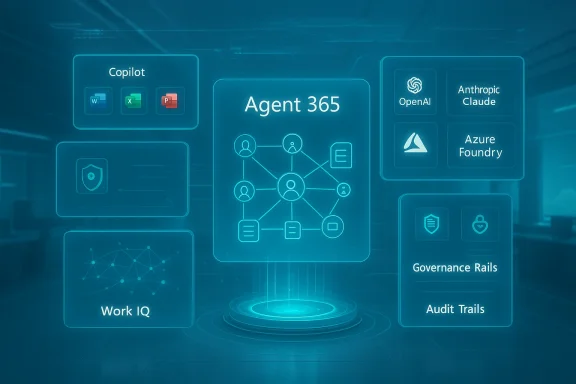
Over the past year Microsoft has moved aggressively from embedding generative features into Office apps toward an explicit platform strategy for agentic AI—systems that act on behalf of users across apps, data stores, and services. That shift centers on three linked ideas: a context layer that understands work, a control plane to observe and govern agents, and a licensing model that treats agents as first-class billable entities. The new Microsoft 365 E7 bundle, the generally described Agent 365 control plane, the expanded Copilot ecosystem that includes third‑party frontier models, and Work IQ are the practical pieces of that strategy.
Taken together, these announcements map Microsoft’s attempt to convert its longstanding strengths—Office productivity apps, identity and security tooling, and a large installed base—into an advantage where generative models are not enough. Instead, Microsoft is pitching a stack that combines models plus deep work context plus governance. The result is a productized, enterprise-grade bet on agentic workflows that can run at scale—if customers accept new licensing and governance responsibilities.
Enterprise contracts, negotiated multi‑year discounts, and existing compliance attestations mean most customers will not flip to E7 overnight. The expected adoption pattern is gradual: customers will evaluate E7 when current E5 contracts renew, when Copilot pilots mature into production, or when they need the additional governance and identity features to scale agent deployments safely.
Bottom line: E7 is designed to simplify agent licensing and governance under one SKU, but adoption will be paced by procurement cycles and the non‑trivial operational cost of deploying and governing agents across an organization.
However, the timeline, formal pricing disclosures, and count‑of‑agents claims should be treated as provisional until Microsoft publishes official licensing guidance and telemetry summaries. Where a single vendor or analyst report provides figures, independent cross‑verification is limited; IT teams should therefore regard early price and scale claims as directional rather than binding.
This multi‑model approach is strategic: it reduces dependency on any single model provider, gives customers choice for cost and alignment tradeoffs, and positions Microsoft as the neutral orchestrator of model selection and routing within enterprise workflows.
Grounding Copilot with Work IQ and exposing Claude through Microsoft surfaces signals a pragmatic approach: Microsoft will sell its own Copilot experience while enabling customers to select the best frontier model for a given task.
But turning agents into identities also multiplies the identity surface area. Key operational imperatives include:
But strategy and reality are different things. Many of the claims circulating about pricing, general availability dates, and scale metrics are still in the early press‑reporting phase or based on vendor briefings. Organizations should treat early pricing signals as planning guidance only and insist on contractual clarity before procurement decisions.
If you are responsible for Microsoft 365, security, or AI adoption in your organization, act now on governance and inventory—before you buy. Put pilot governance in place, require vendor guarantees for data handling, and insist on monitoring and cost controls. The upside is big: agents that understand work context have the potential to shift productivity curves across knowledge work. The downside—which includes hidden costs, regulatory exposure, and new security threats—can be severe if unchecked.
Enterprises that move thoughtfully—prioritizing context governance, stringent identity controls, and incremental pilots—will capture the productivity benefits. Those that treat agentic AI as another point tool without these guardrails risk expensive, embarrassing, and potentially compliance‑breaking outcomes.
Microsoft’s stack gives IT leaders the tools they need to make agentic AI enterprise ready. The most important decision now is not whether to adopt agent capabilities—that wave is coming—but how to adopt them safely, transparently, and with a clear plan for cost and risk control.
Source: Constellation Research Microsoft launches new E7 suite to integrate AI agents, Work IQ | Constellation Research
 Background / Overview
Over the past year Microsoft has moved aggressively from embedding generative features into Office apps toward an explicit platform strategy for agentic AI—systems that act on behalf of users across apps, data stores, and services. That shift centers on three linked ideas: a context layer that understands work, a control plane to observe and govern agents, and a licensing model that treats agents as first-class billable entities. The new Microsoft 365 E7 bundle, the generally described Agent 365 control plane, the expanded Copilot ecosystem that includes third‑party frontier models, and Work IQ are the practical pieces of that strategy.Taken together, these announcements map Microsoft’s attempt to convert its longstanding strengths—Office productivity apps, identity and security tooling, and a large installed base—into an advantage where generative models are not enough. Instead, Microsoft is pitching a stack that combines models plus deep work context plus governance. The result is a productized, enterprise-grade bet on agentic workflows that can run at scale—if customers accept new licensing and governance responsibilities.
What Microsoft 365 E7 aims to be
A single SKU for agentic enterprise productivity
The proposed Microsoft 365 E7 is framed as an evolution of the enterprise E-plan family: everything in Microsoft 365 E5 plus built‑in Copilot capabilities, integrated agent management, and deeper Entra identity controls—packaged as an “AI-first” enterprise tier. The public reporting around E7 positions it as the bundling of:- All E5 security, compliance, and productivity features
- Microsoft 365 Copilot capabilities across Word, Excel, PowerPoint, Outlook, and chat
- Agent governance and orchestration via Agent 365
- Expanded Entra identity and control capabilities and integrations with Work IQ
Pricing and migration realities
Early reports place a list price for E7 in the neighborhood of $99 per user per month. That figure has circulated in multiple industry reports and analyst write-ups. On paper, a $99 E7 SKU could be positioned as cheaper than buying E5 and Copilot add‑ons separately once you factor in existing E5 price increases and Copilot licensing, but real migration will be far slower and more complex than a simple arithmetic conversion.Enterprise contracts, negotiated multi‑year discounts, and existing compliance attestations mean most customers will not flip to E7 overnight. The expected adoption pattern is gradual: customers will evaluate E7 when current E5 contracts renew, when Copilot pilots mature into production, or when they need the additional governance and identity features to scale agent deployments safely.
Bottom line: E7 is designed to simplify agent licensing and governance under one SKU, but adoption will be paced by procurement cycles and the non‑trivial operational cost of deploying and governing agents across an organization.
Agent 365: the control plane for agents — promise and open questions
What Agent 365 is supposed to deliver
Agent 365 is described as Microsoft’s centralized control plane for cataloging, observing, securing, and governing AI agents at enterprise scale. The published feature set in previews and briefings outlines core capabilities:- Agent Registry: an enterprise searchable catalog for authoring, registering, and discovering active agents.
- Observability: telemetry and behavior observability for agent performance and decision traces.
- Risk signals and security templates: canned policies and risk signals to detect anomalous agent activity or policy violations.
- Lifecycle management: identity lifecycle via Entra Agent IDs, access controls, and policy enforcement.
- Governance and audit: integration points for Purview, Defender, and Sentinel to retain compliance evidence.
Pricing, scale claims, and verification
Some reports have circulated a $15 per user per month price point for Agent 365 and assert that tens of millions of agents have been added to Agent 365 registries during preview windows. Those numbers illustrate how Microsoft is trying to productize agent scale and monetize the operational layer that sits above models and storage.However, the timeline, formal pricing disclosures, and count‑of‑agents claims should be treated as provisional until Microsoft publishes official licensing guidance and telemetry summaries. Where a single vendor or analyst report provides figures, independent cross‑verification is limited; IT teams should therefore regard early price and scale claims as directional rather than binding.
Why an agent control plane matters
Without a common control plane, enterprises face several scaling risks:- Loss of visibility into what agents read, write, and decide
- Siloed agent identity and weak lifecycle policies
- Fragmented billing and unanticipated cloud compute spend
- Difficulties producing compliance evidence for regulated industries
Copilot Cowork, Anthropic Claude, and a multi‑model strategy
Copilot goes multi‑model and multi‑vendor
Microsoft’s Copilot ecosystem is explicitly moving beyond a single model. The Copilot surfaces (Word, Excel, PowerPoint, Outlook, chat) are being re‑architected to allow multiple frontier models to participate—OpenAI, Anthropic’s Claude family, Microsoft’s own Azure/Foundry choices, and even customer-hosted custom agents created in Copilot Studio. One manifestation of that approach is the inclusion of Anthropic’s Claude Cowork type capabilities into Microsoft’s workplace surfaces and “frontier” program previews.This multi‑model approach is strategic: it reduces dependency on any single model provider, gives customers choice for cost and alignment tradeoffs, and positions Microsoft as the neutral orchestrator of model selection and routing within enterprise workflows.
Anthropic’s Cowork and what it brings
Anthropic’s Cowork is a desktop‑oriented agent experience that turns Claude into a file‑aware, multistep assistant—capable of automating workflows across file systems and integrated business apps. Integrating Cowork‑level features into Copilot surfaces and Copilot Studio gives enterprises access to another frontier model family that some customers prefer for alignment, instruction‑following, or cost characteristics.Grounding Copilot with Work IQ and exposing Claude through Microsoft surfaces signals a pragmatic approach: Microsoft will sell its own Copilot experience while enabling customers to select the best frontier model for a given task.
Work IQ: Microsoft’s context layer and its leverage
What Work IQ is and why it matters
At the heart of Microsoft’s differentiation claim is Work IQ—a semantic, workspace‑level context engine that ingests signals from Outlook, Teams, SharePoint, OneDrive, and other productivity sources to build a graph of people, projects, documents, and timelines. Work IQ promises to:- Construct a semantic graph linking work artifacts and relationships
- Build a memory of collaboration patterns and preferences
- Provide proactive, contextually accurate suggestions and next steps
- Serve as the grounding/embedding source that makes Copilot and agents relevant
Data sources, privacy, and governance tradeoffs
Work IQ’s usefulness depends on broad access to signals. That raises tradeoffs every IT leader must consider:- Data residency and retention: Does Work IQ store vectors, embeddings, or traces that create a new sensitive repository?
- Scope and consent: Who decides which mailboxes, Teams spaces, and OneDrive folders are ingested?
- Revocation and audit: How easy is it to remove historical context from the semantic graph when an employee leaves or a project ends?
- LinkedIn data: Microsoft’s access to LinkedIn provides additional relational signals—but it also introduces provenance and privacy concerns that must be mapped to enterprise policy.
Security, compliance, and the inevitable new attack surface
New identity and access controls
Microsoft’s approach makes each agent a managed identity backed by Entra, with lifecycle controls, conditional access, and policy attachments. That model is defensible: identity is a natural place to anchor audit, approvals, and conditional access.But turning agents into identities also multiplies the identity surface area. Key operational imperatives include:
- Strict least‑privilege assignment for agent identities.
- Separate entitlement models for human vs. agent identities to prevent privilege creep.
- Automated attestation and periodic re‑review processes for agent permissions.
Observability and traceability requirements
Agents act; to trust them you must be able to explain what they did. Observability must include:- Action-level audit trails and decision traces
- Inputs and tool calls recorded with immutable timestamps
- Human escalation points and manual overrides for high‑risk actions
Model routing, data leakage, and third‑party models
Multi‑model routing (OpenAI, Anthropic, Azure Foundry, custom agents) introduces the risk that sensitive context could be evaluated by an external model with differing handling practices. Enterprise controls must therefore include:- Policy-driven model routing (e.g., do not send PII to third‑party models)
- On‑premise or VNet‑isolated options for highest‑sensitivity workloads
- Clear SLAs and legal terms for model providers regarding training data reuse and retention
Prompt injection and supply‑chain threats
Agents operating at scale will ingest user content that can contain malicious instruction sequences. Defenses must include sanitization, content‑type classification, and runtime policy filters. Additionally, the agent ecosystem creates a new supply chain of plugins, connectors, and adapter code that must be signed, reviewed, and monitored.Economic modeling for IT leaders: more than license math
Charging agents as “users” or packing them into a per‑seat SKU changes budgeting. IT leaders should budget for at least the following beyond any E7 list price:- Additional Azure compute and storage for agent workloads and model inference
- Engineering time to build and maintain safe agent prompts, templates, and connectors
- Ongoing governance staffing (policy owners, auditors, security analysts)
- Third‑party model costs where multi‑model routing calls external endpoints
- Shadow IT mitigation and internal change management
Strengths of Microsoft’s approach
- Integrated stack: Productivity apps, identity, security, compliance, and AI context under one vendor make end‑to‑end governance simpler than stitching many vendors together.
- Context‑first thinking: Work IQ’s semantic graph approach recognizes that context—not just model capability—is the core differentiator for workplace AI.
- Multi‑model flexibility: Allowing OpenAI, Anthropic, and other frontier models to participate prevents single‑vendor lock‑in at the model layer.
- Guardrails baked into enterprise tooling: Entra, Defender, Purview, and Sentinel integrations reduce the effort to meet regulatory needs compared to ad‑hoc agent deployments.
Real risks and unanswered questions
- Vendor lock‑in at the context layer: If Work IQ becomes the canonical semantic graph for how work is represented, customers could be locked into Microsoft’s control plane for years.
- Opaque claims and early pricing: Some pricing and availability figures remain reported through analyst/press briefings but lack formal Microsoft publishing; procurement should treat early figures as indicative.
- Scale and cost surprises: Tens of millions of agents in a registry is a plausible scenario—but the operational cost per agent is the significant factor. Monitoring, telemetry retention, and compute for multimodal and long‑context models will push cloud bills.
- Privacy and regulatory exposure: Centralized context that includes emails, chats, and files can create concentrated regulatory risk; industries with strict data residency or audit requirements will demand strong contractual and technical guarantees.
- Security maturity gap: Product previews and early control planes rarely match enterprise expectations for resilience, BCDR (business continuity and disaster recovery), and forensics out of the gate.
Practical checklist for IT leaders evaluating E7/Agent 365/Copilot Cowork
- Inventory and classify: Identify which data sources (mailboxes, Teams, SharePoint sites, OneDrive) will feed Work IQ and classify sensitivity levels.
- Pilot small, scale responsibly: Start with a limited set of agents and a clear business objective (e.g., expense classification or meeting summarization) before broad rollout.
- Identity and access blueprint: Define Entra policies for agent identities, exceptions, and approval workflows before provisioning.
- Model routing policy: Decide which classes of data can be routed to which model vendors; require VNet or private endpoints for sensitive workloads.
- Observability standards: Require action‑level audit trails, immutable logs, and retention policies aligned to regulatory needs.
- Cost governance: Set per‑agent and per‑project spending limits, alerting, and automated throttles to prevent runaway bills.
- Legal and procurement checks: Validate model provider terms on data use, retraining, and breach notification. Get written assurances on model alignment and non‑reuse where required.
- Human‑in‑the‑loop (HITL) for risky decisions: For any decision that materially affects customers, finance, or compliance, require human review and explicit approval.
- Incident playbooks: Create agent‑specific incident response plans covering malicious prompts, data exfiltration, and misbehavior.
- Sunset and rollback plan: Define how to deprovision agent identities and remove context from Work IQ and any derived indexes.
Competitive landscape and market implications
Microsoft’s strategy accelerates a market dynamic where cloud platform operators are not just infrastructure providers but curators of enterprise context and governance. Competitors—Google, AWS, Anthropic, and specialized ISVs—are each pursuing their own version of agentic tooling and control planes. The results will be:- Faster enterprise experimentation with agents, led by early adopters in software, finance, and operations teams.
- A bifurcation between vendors that own the productivity stack and those that specialize in horizontal agent tooling or domain‑specific models.
- New third‑party markets for agent auditing, policy management, and red‑teaming services.
Final analysis and recommendations
Microsoft’s move to productize agentic AI via an E7 SKU, Agent 365 governance, Copilot’s multi‑model reach, and the Work IQ context layer is coherent and inevitable: enterprises need context, identity, and controls if they want to scale agents safely. The technical architecture—semantic context + model router + agent control plane + identity and security integrations—is a sensible way to manage complexity.But strategy and reality are different things. Many of the claims circulating about pricing, general availability dates, and scale metrics are still in the early press‑reporting phase or based on vendor briefings. Organizations should treat early pricing signals as planning guidance only and insist on contractual clarity before procurement decisions.
If you are responsible for Microsoft 365, security, or AI adoption in your organization, act now on governance and inventory—before you buy. Put pilot governance in place, require vendor guarantees for data handling, and insist on monitoring and cost controls. The upside is big: agents that understand work context have the potential to shift productivity curves across knowledge work. The downside—which includes hidden costs, regulatory exposure, and new security threats—can be severe if unchecked.
Enterprises that move thoughtfully—prioritizing context governance, stringent identity controls, and incremental pilots—will capture the productivity benefits. Those that treat agentic AI as another point tool without these guardrails risk expensive, embarrassing, and potentially compliance‑breaking outcomes.
Microsoft’s stack gives IT leaders the tools they need to make agentic AI enterprise ready. The most important decision now is not whether to adopt agent capabilities—that wave is coming—but how to adopt them safely, transparently, and with a clear plan for cost and risk control.
Source: Constellation Research Microsoft launches new E7 suite to integrate AI agents, Work IQ | Constellation Research
