

Microsoft 365 E7, made generally available on May 1, 2026, bundles Microsoft 365 E5, Copilot, Agent 365, Entra Suite, and advanced Defender, Intune, and Purview capabilities into a premium enterprise package aimed at governing employees and AI agents together. For startups building enterprise AI agents, the important story is not another Microsoft SKU. It is the arrival of a default control plane that may define what “enterprise-ready” agent software is supposed to look like. The agent boom has moved from demo magic to operational liability, and Microsoft is trying to turn that liability into a platform.
The first wave of enterprise AI agents was sold as productivity theater: summarize this meeting, draft that email, fill out this form, move data from one system to another. The second wave is different. These agents are no longer just conversational interfaces; they are software actors with access, permissions, memory, tools, and the ability to trigger work across business systems.
That shift changes the buyer’s risk calculation. A chatbot that gives a bad answer is a support problem. An agent that reads the wrong document, updates the wrong record, or sends the wrong instruction into a workflow is an operational and compliance problem.
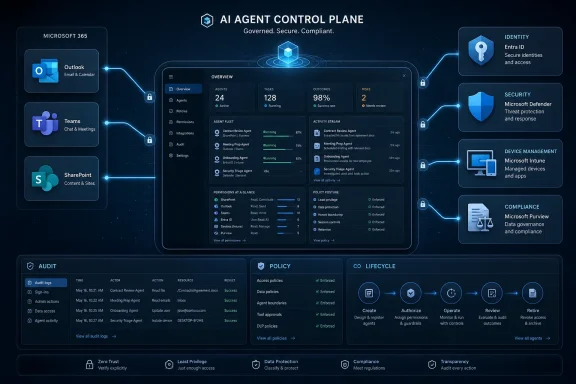
Microsoft 365 E7 is Microsoft’s answer to that problem. By bundling Copilot, Agent 365, Entra, Defender, Intune, and Purview around a single enterprise licensing story, Microsoft is effectively saying that agents should be governed with the same seriousness as employees, devices, applications, and identities.
That framing matters because Microsoft still owns much of the enterprise work surface. Outlook, Teams, SharePoint, Office documents, Entra identity, Defender security signals, Intune device management, and Purview compliance controls are where many large organizations already enforce policy. If agents are going to act inside those environments, Microsoft wants them registered, observed, constrained, and retired inside Microsoft’s administrative orbit.
For startups, this is both a warning and an opening. The warning is that enterprises may become less willing to tolerate agents that live outside established governance systems. The opening is that a clearer governance model gives startups something concrete to build against.
Those questions are still important, but they are no longer sufficient. In an enterprise sale, the real blocker often arrives after the proof of concept succeeds. The business sponsor sees value, the pilot users like the experience, and then security, compliance, procurement, IT operations, and legal begin asking the questions that determine whether the software can actually spread.
Who is the agent acting as? What identity does it use? Can access be scoped by role, department, geography, or data classification? Can the organization prove what the agent did last Tuesday at 3:17 p.m.? Can the agent be disabled without breaking a business process? Can it be updated without creating a shadow change-management path?
These are not bureaucratic distractions. They are the enterprise equivalent of gravity. A startup can ignore them only until the first large customer tries to deploy the product beyond a friendly pilot group.
Microsoft 365 E7 is important because it validates that these questions are becoming mainstream buying criteria. The suite is not merely a productivity bundle with AI sprinkled on top. It is Microsoft’s attempt to make agent governance a normal part of enterprise administration.
That normalizing effect may prove more consequential than any single feature. Once a large platform vendor teaches customers to ask for agent identity governance, lifecycle controls, audit logs, data boundary enforcement, and centralized visibility, those expectations will not remain confined to Microsoft-built agents.
That is a classic Microsoft platform move. Windows succeeded in part because it became the place where applications were installed, managed, secured, and updated. Active Directory and later Entra became the identity fabric. Microsoft 365 became the document, communication, and collaboration substrate. Agent 365 is a bid to become the registry and governance substrate for the agentic workplace.
For startups, this changes the terrain. A founder may think of an agent as a standalone product: a sales ops agent, a finance reconciliation agent, a customer success agent, a legal intake agent, a code migration agent. Microsoft’s framing encourages the customer to think of that agent as an entity inside a managed population.
That population view is powerful. It means the CIO or CISO can ask not only whether one agent is safe, but how all agents are inventoried, approved, monitored, and decommissioned. It also means every startup agent may be compared against the governance baseline established by Microsoft’s own stack.
The best startups will not fight this shift reflexively. They will use it. If Agent 365 becomes a control plane that large customers actually adopt, then integration with that control plane may become a deployment accelerator rather than a concession.
The worst position for a startup is to be brilliant in a demo and opaque in production. The better position is to be differentiated in workflow and outcome while boringly compatible with enterprise governance.
That makes trust part of the product’s distribution mechanics. If a customer cannot understand how an agent is authenticated, constrained, audited, and owned, the rollout slows down. The product does not merely face a security objection; it faces a distribution bottleneck.
Microsoft 365 E7 turns that bottleneck into an architectural category. Its message to enterprises is that AI adoption at scale requires integrated identity, security, compliance, and management. Its message to startups is less explicit but just as clear: if you want to sell agents into large organizations, you need to show how your product fits into those layers.
This is why “enterprise-ready” cannot be reduced to SOC 2, a security page, and a procurement questionnaire. Those are table stakes. Agent readiness requires answering operational questions about behavior over time.
A startup needs to know how the agent receives permissions, how those permissions are narrowed, how credentials are stored, how human approval is inserted into sensitive workflows, how tool calls are logged, how data is retained, and how a customer can investigate suspicious activity. These details are not glamorous. They are what turn a clever prototype into software a bank, hospital, manufacturer, or public-sector agency can deploy.
The irony is that many agent startups are technologically ambitious but operationally under-specified. They can explain model routing, retrieval augmentation, tool orchestration, and multi-agent planning. They are less prepared to explain lifecycle ownership, termination rights, cross-tenant isolation, audit semantics, or the difference between delegated user action and autonomous service action.
Microsoft is betting that enterprises will care deeply about the latter. It is probably right.
In the human enterprise, identity is the root of access. Entra ID, conditional access policies, multi-factor authentication, privileged identity management, and role-based access controls exist because organizations need to know who is doing what. Agents complicate that model because they may act on behalf of a user, a team, a business process, or an application.
That distinction matters. An agent using delegated user access inherits one set of risks. An agent using a service principal or app registration introduces another. An agent using API keys scattered across integrations creates yet another, often worse, operational reality.
Microsoft’s E7 framing pushes agents toward managed identity patterns. That does not solve every problem, but it forces a better conversation. Enterprises can ask whether the agent is discoverable, whether it has an owner, whether its permissions can be reviewed, and whether its access can be revoked centrally.
Startups should expect these questions earlier in sales cycles. The old answer — “we integrate with your tools securely” — will sound increasingly thin. Buyers will want to know the exact authentication model, the permission scopes required, and whether the agent supports least privilege by default.
Least privilege is not just a security virtue. It is a sales accelerant. An agent that needs broad mailbox, drive, CRM, and ticketing access will trigger lengthy review. An agent that can operate with narrow, explainable scopes has a cleaner path through enterprise approval.
That is where auditability becomes central. In regulated or security-sensitive environments, a successful outcome is not enough. The organization needs to reconstruct the path, especially when something goes wrong.
This is not merely about compliance theater. Good audit trails help customers debug failures, investigate incidents, resolve user disputes, and understand whether the agent behaved within its intended boundaries. They also help the startup support the deployment without guessing.
For agent startups, structured observability should be treated as product surface area, not internal plumbing. Logs that are meaningful only to the engineering team will not satisfy enterprise security. Customers need records that map to business events: which user or agent initiated an action, which system was accessed, which data class was touched, which policy applied, and what output or change resulted.
Microsoft 365 E7’s inclusion of Purview and Defender signals that agent activity will increasingly be read through the lens of compliance and security operations. That puts pressure on startups to produce telemetry that can be consumed by existing enterprise tools, not just viewed in a vendor dashboard.
The product implication is straightforward. If an agent cannot explain itself after the fact, it may not be allowed to act in the first place.
The answer is that the room shifts upward. Startups should be wary of trying to compete with Microsoft on generic enterprise governance. They are unlikely to out-Entra Entra or out-Purview Purview. But they can compete on domain expertise, workflow depth, vertical specialization, user experience, integration nuance, and measurable outcomes.
A healthcare revenue-cycle agent, an insurance claims agent, a semiconductor supply-chain agent, or a legal discovery agent is not valuable because it has a login screen and logs. It is valuable because it understands a messy domain deeply enough to automate work that generic copilots cannot.
The governance layer does not eliminate that opportunity. It changes how the opportunity is packaged. The winning pitch becomes: we deliver the specialized outcome your business needs, and we do it inside the governance model your IT and security teams already trust.
That is a more mature pitch than “our agent is smarter.” It is also harder to copy if the startup has real domain expertise, proprietary workflow knowledge, or data partnerships. Microsoft may provide the highway, but many valuable businesses can still be built as vehicles, logistics systems, and specialized services on top of it.
The danger is for startups whose only differentiation is being a thin wrapper around general-purpose models and enterprise connectors. E7 and Agent 365 make that category more precarious. If the core value proposition is “we let your employees ask an AI to do things in Microsoft 365,” Microsoft is standing very close to the same customer with native licensing, admin controls, and procurement leverage.
At $99 per user per month at retail, E7 is not a casual upsell. It is a premium enterprise commitment. But for organizations already paying for E5, Copilot, security add-ons, identity features, and compliance tooling, Microsoft can argue that the bundle rationalizes spending while preparing the tenant for AI at scale.
That matters for startups because budget gravity is real. If a CIO has just committed to E7, the default question for a new agent vendor may be: why can’t we do this with what we already bought? That does not kill the startup sale, but it raises the bar.
The startup must answer with specificity. It must show a workflow Microsoft does not handle well, a domain Microsoft does not understand deeply enough, an integration Microsoft does not prioritize, or a business outcome Microsoft’s generic tools cannot guarantee. “Better AI” will be an insufficient answer unless it is tied to measurable performance in a concrete job.
Procurement may also ask whether the startup integrates with Microsoft’s governance model. This is where the Microsoft-shaped conversation becomes unavoidable. The founder does not need to become a Microsoft-only vendor, but ignoring the Microsoft estate inside enterprise accounts is self-sabotage.
The practical strategy is interoperability without dependency. Startups should support Microsoft governance where it helps customers deploy, while preserving enough architectural flexibility to serve Google Workspace, Slack, AWS, Salesforce, ServiceNow, Workday, and industry-specific environments. Enterprise AI will be heterogeneous, but Microsoft is trying to make its tenant the control room.
Microsoft 365 E7 makes that visible. It reflects a market where AI enthusiasm has collided with risk management. Large organizations are no longer merely asking whether employees should have copilots. They are asking how autonomous or semi-autonomous actors should exist inside controlled systems.
Startups should not treat the security questionnaire as an afterthought produced by counsel and customer success after the deal is signed. They should treat it as an early design input. If the product cannot satisfy identity, permissioning, observability, retention, data isolation, and incident-response expectations, the roadmap is incomplete.
This does not mean every startup needs enterprise-grade everything on day one. It means founders need a credible path and a clear story. A one-page enterprise readiness brief can be more useful than a bloated compliance portal if it crisply explains the agent’s identity model, permission requirements, logging, data handling, deployment path, owner model, and shutdown process.
The best sales teams will use this material proactively. They will not wait for the CISO to stall the deal. They will show, early, that the company understands how enterprises operate.
That posture builds trust because it signals maturity. It tells the buyer that the startup is not just chasing agent hype; it is building software that can survive contact with production.
That does not make Windows less important. It makes the Windows estate part of a larger agentic operating environment. Intune policies, Defender signals, conditional access decisions, device compliance, and user context all become inputs into whether an agent should be allowed to operate.
This is where the Microsoft stack has a structural advantage. A startup can build a better agent for a specific workflow, but Microsoft can connect agent behavior to the administrative context enterprises already use. Is the user on a compliant device? Is the session risky? Is the data labeled confidential? Is the action anomalous compared with normal behavior?
Those are not abstract questions for sysadmins. They are the difference between AI as a tolerated experiment and AI as a manageable part of the workplace. The more agents touch files, mailboxes, tickets, code repositories, financial systems, and collaboration spaces, the more administrators will demand familiar levers.
For WindowsForum readers, the practical takeaway is that agent governance will not live in a separate AI wonderland. It will show up in the same places admins already spend their days: Microsoft 365 admin center, Entra, Defender, Purview, Intune, Power Platform governance, and audit tooling.
That convergence may be messy. Microsoft’s admin experiences are powerful but often sprawling, and licensing complexity remains a perennial tax on IT planning. Still, the strategic direction is clear: agents are being pulled into the managed enterprise fabric.
That creates a delicate balance for customers. Centralized governance is useful, perhaps necessary. But a control plane can become a chokepoint. If Microsoft’s governance layer makes Microsoft-built agents feel safer, simpler, or more procurement-friendly than third-party alternatives, startups may face a tilted field.
This is not new. Platform owners have always blended genuine integration benefits with ecosystem leverage. The difference is that agentic AI raises the stakes because the administrative layer may define what software is allowed to act.
Enterprises should welcome stronger governance while resisting unnecessary dependency. They should ask whether third-party agents can be registered cleanly, monitored consistently, and governed without losing meaningful functionality. They should also ask whether policy controls are portable enough to avoid trapping all agent strategy inside one vendor’s commercial model.
Startups, meanwhile, should be honest about the trade-off. Integrating with Microsoft’s agent governance may help close deals, but overfitting to one vendor’s control plane can narrow the company’s future. The right answer depends on target customers, vertical, and workflow depth.
A startup selling primarily to Microsoft 365-heavy enterprises should make Microsoft integration excellent. A startup selling across mixed enterprise stacks should make Microsoft integration one strong path among several. In either case, pretending Microsoft does not matter is not a strategy.
That checklist starts with identity and permissions. The agent must have a clear authentication model, and its access must be narrow enough to justify. Broad default access will feel increasingly reckless.
It continues with auditability. The agent’s actions must be traceable in language and formats that security, compliance, and operations teams can use. A black-box agent is a pilot, not infrastructure.
It includes policy alignment. The agent must respect data boundaries, security rules, and compliance obligations. If a company has spent years implementing sensitivity labels, retention rules, access policies, and DLP controls, an agent cannot simply route around them in the name of productivity.
It ends with lifecycle management. Agents need owners, approvals, versioning, monitoring, and retirement paths. An orphaned agent with lingering access is not innovation; it is technical debt with credentials.
Enterprise buyers are tired of one-off AI experiments that cannot be governed. They are also under pressure from boards, executives, and employees to adopt AI faster. E7 tries to reconcile those forces by making agent deployment look administratively familiar.
For founders, this creates a design mandate. Build the agent, but also build the explanation of the agent. Build the workflow, but also build the permissions model. Build the automation, but also build the audit trail. Build the user experience, but also build the admin experience.
This does not mean startups should slow down until they resemble large vendors. Speed is still an advantage. But speed without deployability is a trap in enterprise markets.
The founders who win will treat governance as part of product quality. They will understand that the buyer’s question is not simply whether the agent works. It is whether the organization can let the agent keep working after the pilot team goes home.
The most concrete lessons are already visible:
That is why Microsoft 365 E7 matters well beyond the bundle. It marks the moment agentic AI starts being absorbed into the ordinary machinery of enterprise IT: identity, access, policy, audit, lifecycle, procurement, and support. For startups, the future belongs not to the flashiest agent in the demo, but to the one powerful enough to matter and disciplined enough to be trusted inside the systems where real work happens.
 Microsoft Is Turning Agents Into Managed Enterprise Actors
The first wave of enterprise AI agents was sold as productivity theater: summarize this meeting, draft that email, fill out this form, move data from one system to another. The second wave is different. These agents are no longer just conversational interfaces; they are software actors with access, permissions, memory, tools, and the ability to trigger work across business systems.That shift changes the buyer’s risk calculation. A chatbot that gives a bad answer is a support problem. An agent that reads the wrong document, updates the wrong record, or sends the wrong instruction into a workflow is an operational and compliance problem.
Microsoft 365 E7 is Microsoft’s answer to that problem. By bundling Copilot, Agent 365, Entra, Defender, Intune, and Purview around a single enterprise licensing story, Microsoft is effectively saying that agents should be governed with the same seriousness as employees, devices, applications, and identities.
That framing matters because Microsoft still owns much of the enterprise work surface. Outlook, Teams, SharePoint, Office documents, Entra identity, Defender security signals, Intune device management, and Purview compliance controls are where many large organizations already enforce policy. If agents are going to act inside those environments, Microsoft wants them registered, observed, constrained, and retired inside Microsoft’s administrative orbit.
For startups, this is both a warning and an opening. The warning is that enterprises may become less willing to tolerate agents that live outside established governance systems. The opening is that a clearer governance model gives startups something concrete to build against.
The Enterprise Agent Problem Was Never Just Intelligence
The startup mythology around agents tends to obsess over capability. Can the agent reason? Can it call tools? Can it complete a workflow? Can it operate across Salesforce, ServiceNow, Outlook, Jira, GitHub, and a data warehouse without collapsing into hallucinated confidence?Those questions are still important, but they are no longer sufficient. In an enterprise sale, the real blocker often arrives after the proof of concept succeeds. The business sponsor sees value, the pilot users like the experience, and then security, compliance, procurement, IT operations, and legal begin asking the questions that determine whether the software can actually spread.
Who is the agent acting as? What identity does it use? Can access be scoped by role, department, geography, or data classification? Can the organization prove what the agent did last Tuesday at 3:17 p.m.? Can the agent be disabled without breaking a business process? Can it be updated without creating a shadow change-management path?
These are not bureaucratic distractions. They are the enterprise equivalent of gravity. A startup can ignore them only until the first large customer tries to deploy the product beyond a friendly pilot group.
Microsoft 365 E7 is important because it validates that these questions are becoming mainstream buying criteria. The suite is not merely a productivity bundle with AI sprinkled on top. It is Microsoft’s attempt to make agent governance a normal part of enterprise administration.
That normalizing effect may prove more consequential than any single feature. Once a large platform vendor teaches customers to ask for agent identity governance, lifecycle controls, audit logs, data boundary enforcement, and centralized visibility, those expectations will not remain confined to Microsoft-built agents.
Agent 365 Is the Real Center of Gravity
The most revealing piece of E7 is Agent 365. Microsoft describes it as a control plane for AI agents, including agents built by Microsoft, developed internally, or acquired from third parties. That language is deliberate. Microsoft is not merely trying to sell its own agents; it is trying to become the administrative layer through which agents are discovered, governed, and trusted.That is a classic Microsoft platform move. Windows succeeded in part because it became the place where applications were installed, managed, secured, and updated. Active Directory and later Entra became the identity fabric. Microsoft 365 became the document, communication, and collaboration substrate. Agent 365 is a bid to become the registry and governance substrate for the agentic workplace.
For startups, this changes the terrain. A founder may think of an agent as a standalone product: a sales ops agent, a finance reconciliation agent, a customer success agent, a legal intake agent, a code migration agent. Microsoft’s framing encourages the customer to think of that agent as an entity inside a managed population.
That population view is powerful. It means the CIO or CISO can ask not only whether one agent is safe, but how all agents are inventoried, approved, monitored, and decommissioned. It also means every startup agent may be compared against the governance baseline established by Microsoft’s own stack.
The best startups will not fight this shift reflexively. They will use it. If Agent 365 becomes a control plane that large customers actually adopt, then integration with that control plane may become a deployment accelerator rather than a concession.
The worst position for a startup is to be brilliant in a demo and opaque in production. The better position is to be differentiated in workflow and outcome while boringly compatible with enterprise governance.
E7 Makes Trust a Distribution Feature
Enterprise software has always required trust, but AI agents make trust unusually concrete. Traditional SaaS applications usually act when users click, submit, approve, or schedule. Agents blur that boundary by making decisions, calling APIs, and initiating sequences of actions based on goals and context.That makes trust part of the product’s distribution mechanics. If a customer cannot understand how an agent is authenticated, constrained, audited, and owned, the rollout slows down. The product does not merely face a security objection; it faces a distribution bottleneck.
Microsoft 365 E7 turns that bottleneck into an architectural category. Its message to enterprises is that AI adoption at scale requires integrated identity, security, compliance, and management. Its message to startups is less explicit but just as clear: if you want to sell agents into large organizations, you need to show how your product fits into those layers.
This is why “enterprise-ready” cannot be reduced to SOC 2, a security page, and a procurement questionnaire. Those are table stakes. Agent readiness requires answering operational questions about behavior over time.
A startup needs to know how the agent receives permissions, how those permissions are narrowed, how credentials are stored, how human approval is inserted into sensitive workflows, how tool calls are logged, how data is retained, and how a customer can investigate suspicious activity. These details are not glamorous. They are what turn a clever prototype into software a bank, hospital, manufacturer, or public-sector agency can deploy.
The irony is that many agent startups are technologically ambitious but operationally under-specified. They can explain model routing, retrieval augmentation, tool orchestration, and multi-agent planning. They are less prepared to explain lifecycle ownership, termination rights, cross-tenant isolation, audit semantics, or the difference between delegated user action and autonomous service action.
Microsoft is betting that enterprises will care deeply about the latter. It is probably right.
Identity Becomes the Agent’s Passport
The first hard question for any enterprise agent is identity. An agent that can act without a clear identity is a security incident waiting for a calendar invite. It might be useful, but it is not governable.In the human enterprise, identity is the root of access. Entra ID, conditional access policies, multi-factor authentication, privileged identity management, and role-based access controls exist because organizations need to know who is doing what. Agents complicate that model because they may act on behalf of a user, a team, a business process, or an application.
That distinction matters. An agent using delegated user access inherits one set of risks. An agent using a service principal or app registration introduces another. An agent using API keys scattered across integrations creates yet another, often worse, operational reality.
Microsoft’s E7 framing pushes agents toward managed identity patterns. That does not solve every problem, but it forces a better conversation. Enterprises can ask whether the agent is discoverable, whether it has an owner, whether its permissions can be reviewed, and whether its access can be revoked centrally.
Startups should expect these questions earlier in sales cycles. The old answer — “we integrate with your tools securely” — will sound increasingly thin. Buyers will want to know the exact authentication model, the permission scopes required, and whether the agent supports least privilege by default.
Least privilege is not just a security virtue. It is a sales accelerant. An agent that needs broad mailbox, drive, CRM, and ticketing access will trigger lengthy review. An agent that can operate with narrow, explainable scopes has a cleaner path through enterprise approval.
Audit Logs Are the New Demo Recording
Agent companies love showing the completed task. Enterprise buyers increasingly care about the trail. What did the agent see, decide, call, change, and produce along the way?That is where auditability becomes central. In regulated or security-sensitive environments, a successful outcome is not enough. The organization needs to reconstruct the path, especially when something goes wrong.
This is not merely about compliance theater. Good audit trails help customers debug failures, investigate incidents, resolve user disputes, and understand whether the agent behaved within its intended boundaries. They also help the startup support the deployment without guessing.
For agent startups, structured observability should be treated as product surface area, not internal plumbing. Logs that are meaningful only to the engineering team will not satisfy enterprise security. Customers need records that map to business events: which user or agent initiated an action, which system was accessed, which data class was touched, which policy applied, and what output or change resulted.
Microsoft 365 E7’s inclusion of Purview and Defender signals that agent activity will increasingly be read through the lens of compliance and security operations. That puts pressure on startups to produce telemetry that can be consumed by existing enterprise tools, not just viewed in a vendor dashboard.
The product implication is straightforward. If an agent cannot explain itself after the fact, it may not be allowed to act in the first place.
The Startup Moat Moves Up the Stack
At first glance, Microsoft’s governance push may look threatening to agent startups. If Microsoft controls the identity layer, productivity apps, agent registry, compliance tooling, security signals, and administrative console, what room is left for smaller companies?The answer is that the room shifts upward. Startups should be wary of trying to compete with Microsoft on generic enterprise governance. They are unlikely to out-Entra Entra or out-Purview Purview. But they can compete on domain expertise, workflow depth, vertical specialization, user experience, integration nuance, and measurable outcomes.
A healthcare revenue-cycle agent, an insurance claims agent, a semiconductor supply-chain agent, or a legal discovery agent is not valuable because it has a login screen and logs. It is valuable because it understands a messy domain deeply enough to automate work that generic copilots cannot.
The governance layer does not eliminate that opportunity. It changes how the opportunity is packaged. The winning pitch becomes: we deliver the specialized outcome your business needs, and we do it inside the governance model your IT and security teams already trust.
That is a more mature pitch than “our agent is smarter.” It is also harder to copy if the startup has real domain expertise, proprietary workflow knowledge, or data partnerships. Microsoft may provide the highway, but many valuable businesses can still be built as vehicles, logistics systems, and specialized services on top of it.
The danger is for startups whose only differentiation is being a thin wrapper around general-purpose models and enterprise connectors. E7 and Agent 365 make that category more precarious. If the core value proposition is “we let your employees ask an AI to do things in Microsoft 365,” Microsoft is standing very close to the same customer with native licensing, admin controls, and procurement leverage.
The Procurement Conversation Will Get More Microsoft-Shaped
Enterprise buyers do not only buy features. They buy risk allocation, vendor consolidation, administrative familiarity, and procurement simplicity. Microsoft 365 E7 bundles these forces into one expensive but legible offer.At $99 per user per month at retail, E7 is not a casual upsell. It is a premium enterprise commitment. But for organizations already paying for E5, Copilot, security add-ons, identity features, and compliance tooling, Microsoft can argue that the bundle rationalizes spending while preparing the tenant for AI at scale.
That matters for startups because budget gravity is real. If a CIO has just committed to E7, the default question for a new agent vendor may be: why can’t we do this with what we already bought? That does not kill the startup sale, but it raises the bar.
The startup must answer with specificity. It must show a workflow Microsoft does not handle well, a domain Microsoft does not understand deeply enough, an integration Microsoft does not prioritize, or a business outcome Microsoft’s generic tools cannot guarantee. “Better AI” will be an insufficient answer unless it is tied to measurable performance in a concrete job.
Procurement may also ask whether the startup integrates with Microsoft’s governance model. This is where the Microsoft-shaped conversation becomes unavoidable. The founder does not need to become a Microsoft-only vendor, but ignoring the Microsoft estate inside enterprise accounts is self-sabotage.
The practical strategy is interoperability without dependency. Startups should support Microsoft governance where it helps customers deploy, while preserving enough architectural flexibility to serve Google Workspace, Slack, AWS, Salesforce, ServiceNow, Workday, and industry-specific environments. Enterprise AI will be heterogeneous, but Microsoft is trying to make its tenant the control room.
Security Review Is Becoming Product-Market Fit
The phrase product-market fit usually describes user demand. In enterprise agent software, security-review fit may become just as important. A product that users love but security cannot approve has not truly found enterprise fit.Microsoft 365 E7 makes that visible. It reflects a market where AI enthusiasm has collided with risk management. Large organizations are no longer merely asking whether employees should have copilots. They are asking how autonomous or semi-autonomous actors should exist inside controlled systems.
Startups should not treat the security questionnaire as an afterthought produced by counsel and customer success after the deal is signed. They should treat it as an early design input. If the product cannot satisfy identity, permissioning, observability, retention, data isolation, and incident-response expectations, the roadmap is incomplete.
This does not mean every startup needs enterprise-grade everything on day one. It means founders need a credible path and a clear story. A one-page enterprise readiness brief can be more useful than a bloated compliance portal if it crisply explains the agent’s identity model, permission requirements, logging, data handling, deployment path, owner model, and shutdown process.
The best sales teams will use this material proactively. They will not wait for the CISO to stall the deal. They will show, early, that the company understands how enterprises operate.
That posture builds trust because it signals maturity. It tells the buyer that the startup is not just chasing agent hype; it is building software that can survive contact with production.
The WindowsForum Angle Is the Managed Desktop’s Return to Relevance
For Windows admins, Microsoft 365 E7 is a reminder that the endpoint is no longer the whole battlefield. The managed Windows device still matters, but the new unit of control is broader: identity, data, applications, agents, cloud sessions, and telemetry moving across the Microsoft 365 tenant.That does not make Windows less important. It makes the Windows estate part of a larger agentic operating environment. Intune policies, Defender signals, conditional access decisions, device compliance, and user context all become inputs into whether an agent should be allowed to operate.
This is where the Microsoft stack has a structural advantage. A startup can build a better agent for a specific workflow, but Microsoft can connect agent behavior to the administrative context enterprises already use. Is the user on a compliant device? Is the session risky? Is the data labeled confidential? Is the action anomalous compared with normal behavior?
Those are not abstract questions for sysadmins. They are the difference between AI as a tolerated experiment and AI as a manageable part of the workplace. The more agents touch files, mailboxes, tickets, code repositories, financial systems, and collaboration spaces, the more administrators will demand familiar levers.
For WindowsForum readers, the practical takeaway is that agent governance will not live in a separate AI wonderland. It will show up in the same places admins already spend their days: Microsoft 365 admin center, Entra, Defender, Purview, Intune, Power Platform governance, and audit tooling.
That convergence may be messy. Microsoft’s admin experiences are powerful but often sprawling, and licensing complexity remains a perennial tax on IT planning. Still, the strategic direction is clear: agents are being pulled into the managed enterprise fabric.
Microsoft’s Bundle Is Also a Lock-In Strategy
It would be naive to treat E7 only as a noble exercise in safety. Microsoft is also using governance to defend and expand its platform power. The company understands that whichever vendor controls agent administration may influence which agents get approved, discovered, trusted, and purchased.That creates a delicate balance for customers. Centralized governance is useful, perhaps necessary. But a control plane can become a chokepoint. If Microsoft’s governance layer makes Microsoft-built agents feel safer, simpler, or more procurement-friendly than third-party alternatives, startups may face a tilted field.
This is not new. Platform owners have always blended genuine integration benefits with ecosystem leverage. The difference is that agentic AI raises the stakes because the administrative layer may define what software is allowed to act.
Enterprises should welcome stronger governance while resisting unnecessary dependency. They should ask whether third-party agents can be registered cleanly, monitored consistently, and governed without losing meaningful functionality. They should also ask whether policy controls are portable enough to avoid trapping all agent strategy inside one vendor’s commercial model.
Startups, meanwhile, should be honest about the trade-off. Integrating with Microsoft’s agent governance may help close deals, but overfitting to one vendor’s control plane can narrow the company’s future. The right answer depends on target customers, vertical, and workflow depth.
A startup selling primarily to Microsoft 365-heavy enterprises should make Microsoft integration excellent. A startup selling across mixed enterprise stacks should make Microsoft integration one strong path among several. In either case, pretending Microsoft does not matter is not a strategy.
The Agent Readiness Bar Is Becoming Concrete
The most useful thing about Microsoft 365 E7 for startups may be that it makes a vague phrase more concrete. “Enterprise-ready AI agent” has been stretched almost beyond meaning. E7 and Agent 365 help define the checklist that buyers will increasingly carry into evaluations.That checklist starts with identity and permissions. The agent must have a clear authentication model, and its access must be narrow enough to justify. Broad default access will feel increasingly reckless.
It continues with auditability. The agent’s actions must be traceable in language and formats that security, compliance, and operations teams can use. A black-box agent is a pilot, not infrastructure.
It includes policy alignment. The agent must respect data boundaries, security rules, and compliance obligations. If a company has spent years implementing sensitivity labels, retention rules, access policies, and DLP controls, an agent cannot simply route around them in the name of productivity.
It ends with lifecycle management. Agents need owners, approvals, versioning, monitoring, and retirement paths. An orphaned agent with lingering access is not innovation; it is technical debt with credentials.
Founders Should Read E7 as a Buying Signal, Not a Press Release
The mistake would be to read Microsoft 365 E7 as merely a licensing announcement. The better reading is that Microsoft is describing what large customers are about to normalize.Enterprise buyers are tired of one-off AI experiments that cannot be governed. They are also under pressure from boards, executives, and employees to adopt AI faster. E7 tries to reconcile those forces by making agent deployment look administratively familiar.
For founders, this creates a design mandate. Build the agent, but also build the explanation of the agent. Build the workflow, but also build the permissions model. Build the automation, but also build the audit trail. Build the user experience, but also build the admin experience.
This does not mean startups should slow down until they resemble large vendors. Speed is still an advantage. But speed without deployability is a trap in enterprise markets.
The founders who win will treat governance as part of product quality. They will understand that the buyer’s question is not simply whether the agent works. It is whether the organization can let the agent keep working after the pilot team goes home.
The Startups That Survive the E7 Era Will Sell Control as Much as Capability
Microsoft 365 E7 does not end the enterprise agent startup wave, but it does sharpen the terms of competition. The market is moving from agent demos to agent operations, and startups that ignore that shift will discover that excitement does not equal deployment.The most concrete lessons are already visible:
- Startups should assume that enterprise buyers will ask for a clear identity model before approving broad agent deployment.
- Agents should request the minimum permissions needed for the workflow, and those permissions should be easy for customers to understand and narrow.
- Audit logs should describe business-relevant agent actions, not just engineering events buried in vendor infrastructure.
- Deployment, monitoring, updating, ownership, and retirement should be treated as product features rather than customer-success improvisations.
- Microsoft integration will matter most in Microsoft-heavy accounts, but startups should avoid becoming so dependent on one control plane that they lose cross-platform credibility.
- The strongest startup opportunities will sit above the governance layer, where domain depth and workflow outcomes matter more than generic agent administration.
That is why Microsoft 365 E7 matters well beyond the bundle. It marks the moment agentic AI starts being absorbed into the ordinary machinery of enterprise IT: identity, access, policy, audit, lifecycle, procurement, and support. For startups, the future belongs not to the flashiest agent in the demo, but to the one powerful enough to matter and disciplined enough to be trusted inside the systems where real work happens.
References
- Primary source: Microsoft
Published: 2026-06-25T22:50:29.098066
What Microsoft 365 E7 means for startups building enterprise AI agents
Startups building AI agents need more than capability. Learn how to design for enterprise governance, security, and deployment at scale.www.microsoft.com - Official source: blogs.microsoft.com
Introducing the First Frontier Suite built on Intelligence + Trust - The Official Microsoft Blog
Today Microsoft is announcing: Wave 3 of Microsoft 365 Copilot Expanded model diversity with Claude and next-gen OpenAI models available today General availability of Agent 365 on May 1 for $15 per user General availability of the new Microsoft 365 E7: The Frontier Suite on May 1 for $99 per...blogs.microsoft.com - Official source: news.microsoft.com
- Related coverage: tomshardware.com
Microsoft unveils Project Solara AI, a chip-to-cloud platform built to power a new generation of 'agent-first' enterprise devices — hardware designed to run AI agents instead of traditional apps | Tom's Hardware
Microsoft ditches Windows to build OS on Androidwww.tomshardware.com - Official source: learn.microsoft.com
Agents admin guide for Microsoft 365 | Microsoft Learn
Learn about administering and deploying agents in Microsoft 365.learn.microsoft.com - Official source: techcommunity.microsoft.com
Microsoft 365 E7 & Agent365: From Where You Are to Enterprise AI at Scale | Microsoft Community Hub
Introduction As organizations move beyond AI experimentation and begin operationalizing agent-based AI workloads, a new set of challenges is emerging... techcommunity.microsoft.com

- Related coverage: techtarget.com
Microsoft 365 E7 adds AI governance; prices draw critiques | TechTarget
Microsoft plans to add Agent 365's AI governance to Microsoft 365 E7 in May, prompting analysts to question its pricing strategy.www.techtarget.com - Related coverage: hbs.net
Microsoft 365 E7: AI Agents, Governed and Ready to Scale
Microsoft 365 E7 combines Copilot, Agent 365, Entra Suite, and E5 security into one governed platform.www.hbs.net - Related coverage: techradar.com
'A new category of agents': Microsoft reveals Scout, its first "Autopilot", which wants to change how you work for good | TechRadar
Say hello to Autopilots from Microsoftwww.techradar.com - Related coverage: windowscentral.com
Microsoft 365 premium E7 tier is "the First Frontier Suite" | Windows Central
Microsoft’s latest subscription tier promises AI power at $99/month, but analysts are skeptical about its benefits compared to existing plans.www.windowscentral.com - Related coverage: tomsguide.com
Biggest Microsoft Build 2026 announcements — agentic AI, RTX Spark Dev Box, GitHub Copilot app, new MAI models, and more | Tom's Guide
All the big news from Microsoft's AI-focused eventwww.tomsguide.com - Related coverage: itpro.com
Everything you need to know about the new E7 Microsoft 365 tier, including features, pricing, and release date | IT Pro
The new premium bundle for Microsoft 365 adds AI capabilities to traditional tierswww.itpro.com - Official source: cdn-dynmedia-1.microsoft.com
- Related coverage: licensingschool.co.uk
- Official source: info.microsoft.com
- Official source: adoption.microsoft.com
