

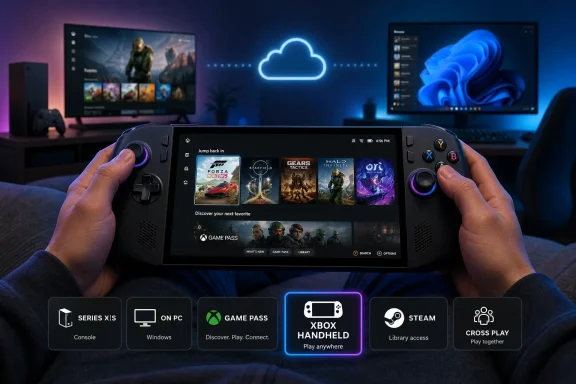
Microsoft has added an “Xbox Handheld” platform label to official Xbox game pages in June 2026, with Gears of War: E-Day showing the new logo alongside Xbox Series X|S, Xbox on PC, Game Pass, and Steam. The move is small enough to look like store-page housekeeping, but it is really Microsoft putting a name on the hardware category it has been circling for years. Xbox is no longer just a console business with a PC app attached. It is becoming a compatibility promise stretched across living-room boxes, Windows handhelds, cloud endpoints, and whatever hybrid machine Project Helix eventually becomes.
The interesting part is not that Microsoft has discovered handheld gaming. Valve, ASUS, Lenovo, MSI, Ayaneo, and others already forced that conversation. The interesting part is that Microsoft is now treating handhelds as a first-class Xbox destination rather than an awkward Windows side effect. That distinction matters, because the Xbox brand has spent the past few years trying to be everywhere without always explaining what “Xbox” means when it arrives.
The Xbox Handheld badge appears to do something simple: it tells customers that a game is meant to run on supported gaming handhelds. On the Gears of War: E-Day page, it sits in the “ways to play” lineup next to the established badges for console, PC, Game Pass, and Steam. That placement is not accidental. Storefront badges are the grammar of modern platform strategy.
For years, Microsoft has talked about Xbox as an ecosystem rather than a box. That line made sense in investor decks and Game Pass marketing, but it often collapsed when users asked a practical question: where does this game actually run, and how well? A badge cannot answer every compatibility question, but it can draw a border around a supported experience.
Until now, Windows handhelds lived in a strange limbo. They were PCs, technically. They could install the Xbox app, Steam, Epic Games Store, Battle.net, and almost anything else Windows could run. But they were not treated as a coherent Xbox class. The ROG Ally, Lenovo Legion Go, and MSI Claw were Windows gaming PCs with controller grips and compromise-ridden desktop interfaces.
The ROG Xbox Ally and ROG Xbox Ally X changed that posture. ASUS built the device, but Microsoft lent it the Xbox name and helped shape a full-screen Xbox experience designed around controllers rather than keyboards. The new Xbox Handheld label looks like the next step: not a one-off co-branding stunt, but a category Microsoft intends to use.
That matters because platform categories create expectations. “Xbox on PC” tells players they are in the Windows software universe. “Xbox Series X|S” tells them they are buying into a console performance target. “Xbox Handheld” suggests Microsoft wants a middle lane: Windows-based, portable, controller-first, and curated enough that buyers do not feel abandoned to driver updates and launcher roulette.
SteamOS succeeded on the Steam Deck not because Linux suddenly became easier than Windows in every respect, but because Valve made the device feel like a console until the user chose otherwise. The interface boots into games. The power controls make sense. The verification system gives buyers a rough expectation of whether a title is playable. The desktop is there, but it is not the opening negotiation.
Windows handhelds have often inverted that bargain. They can run more games and more anti-cheat systems, but they frequently ask the user to manage a PC disguised as a console. That is fine for enthusiasts. It is poison for mass-market hardware.
The Xbox Handheld badge is therefore a quiet admission that “it runs Windows” is not enough. If Microsoft wants Xbox to mean something on handheld PCs, it has to make Windows behave like an Xbox surface when the form factor demands it. Full-screen Xbox Mode is the software expression of that idea. The badge is the marketing expression.
The danger is that Microsoft may overpromise before the underlying experience is fully disciplined. A logo on a product page can imply a level of validation that Windows handhelds have not always earned. Battery life, suspend and resume, shader compilation, launcher behavior, controller mapping, text legibility, and performance presets all determine whether handheld gaming feels polished. A supported-platform badge needs teeth, or it becomes decorative.
Putting an Xbox Handheld badge beside E-Day sends a message about where Microsoft wants prestige Xbox games to live. The company is not merely saying that small games, cloud titles, and back-catalog releases belong on handhelds. It is suggesting that the flagship Xbox library should be legible on portable Windows machines too.
That is a bolder claim than it looks. A modern Unreal Engine blockbuster on a handheld is a very different proposition from a 2D roguelike or a last-generation remaster. The label raises questions about minimum performance targets, graphics presets, storage pressure, thermal behavior, and how much optimization Microsoft expects from first-party studios.
It also reframes the meaning of Xbox exclusivity. If a game launches on Xbox Series X|S, Windows PC, Steam, Game Pass, and Xbox Handheld, the old console-war language starts to look antique. The game may still be “Xbox” in corporate terms, but it is distributed across device classes that include open Windows hardware and potentially multiple storefronts.
That is the modern Xbox paradox. Microsoft wants the emotional benefit of a console platform and the economic reach of PC. The handheld badge tries to stitch those together by saying: yes, this is still Xbox, even when the hardware looks like a PC with grips.
That division of labor is important. Microsoft does not need to manufacture every Xbox-branded handheld itself if it can define the experience. In the PC world, platform power often comes from certification, software defaults, storefront presence, and developer targets. Intel did this with Ultrabooks. Microsoft did it with Copilot+ PCs. Valve is doing a version of it with Steam Deck Verified and SteamOS licensing ambitions.
Xbox Handheld could become Microsoft’s equivalent: a label that tells buyers a device is not merely capable of running Windows games, but tuned for a handheld Xbox experience. The word “supported” is doing a lot of work here. It leaves room for tiers, validation lists, OEM partnerships, and perhaps a future in which not every Windows handheld automatically qualifies.
That would be the sensible path. If Microsoft slaps the Xbox Handheld idea on every small Windows gaming PC, the brand will inherit the worst inconsistency of the PC market. If it is too restrictive, it risks becoming a badge for one ASUS product line and a marketing dead end. The useful middle ground is a real certification program with clear requirements for controls, display behavior, sleep states, performance overlays, update handling, and game compatibility.
There is a security and administration angle too. WindowsForum readers know that consumer gaming devices do not exist outside the management universe forever. A Windows handheld may join a home network, sign into Microsoft accounts, sync cloud saves, install kernel-level anti-cheat, and receive firmware updates from multiple vendors. If Xbox Handheld becomes a device class, Microsoft will eventually need to explain how it is serviced, secured, recovered, and supported.
The Xbox Handheld badge does not solve the Helix mystery, but it makes the direction easier to read. Microsoft is no longer treating console, PC, and handheld as separate silos. It is teaching customers to think of Xbox as a set of play surfaces with overlapping libraries. The future Xbox console can then be positioned less as a replacement for Series X and more as the high-performance anchor in a wider Xbox hardware family.
That could be clever. Sony’s PlayStation model still benefits from a clean console identity, but the gravitational pull of PC gaming has become harder to ignore. Players want cross-progression, wider storefront access, better backward compatibility, and fewer arbitrary walls between where they bought a game and where they can play it. Microsoft is structurally better positioned to answer that demand because it owns Windows.
It could also be messy. The more Xbox becomes PC-like, the more it inherits PC-like complexity. The more Xbox remains console-like, the more “plays PC games” risks sounding constrained. Microsoft’s challenge is not to merge two worlds in a slogan. It is to decide which compromises belong in the user’s hands and which should be absorbed by the platform.
Handhelds are the proving ground because they expose every weakness quickly. A living-room console can hide complexity behind HDMI and a controller. A desktop PC can assume the user has patience and peripherals. A handheld has neither luxury. It must wake quickly, scale cleanly, launch reliably, and avoid dumping the user into a Windows dialog at the worst possible moment.
Trust is exactly where Microsoft has work to do. The Xbox brand has endured years of strategic whiplash: studio acquisitions, multiplatform publishing, Game Pass shifts, console sales pressure, cloud promises, PC expansion, and recurring debates over whether dedicated Xbox hardware still matters. None of those moves is irrational in isolation. Together, they have made Xbox feel less like a product line and more like a corporate weather system.
A clean handheld category can help, but only if Microsoft resists the urge to make “Xbox” mean everything. If every screen is an Xbox, then the word loses hardware meaning. If only Microsoft-built consoles are Xbox, then the company ignores the reality of its own PC strategy. Xbox Handheld is an attempt to split the difference: not every device is an Xbox, but certain Windows gaming devices can be part of Xbox in a named, supported way.
That is a more honest position than the old “play anywhere” maximalism. Players do not need metaphysics. They need to know whether their library works, whether performance is acceptable, whether cloud saves travel, whether purchases carry across devices, and whether the interface will behave without a mouse. Microsoft’s success will depend on how often the answer is yes.
For developers, the badge could become a useful target if Microsoft defines it rigorously. A known handheld profile would let studios test UI scaling, default graphics settings, controller prompts, storage behavior, and suspend/resume flows against something more concrete than “a random Windows handheld.” Without that discipline, Xbox Handheld becomes another marketing checkbox developers learn to ignore.
Microsoft could not leave that lesson unanswered forever. Windows remains the default home of PC gaming, but default status is not the same as delight. On handhelds, Windows has often felt like an inherited advantage being spent down. Valve took a narrower library, wrapped it in a stronger experience, and made the trade-off feel acceptable.
The ROG Xbox Ally partnership and the Xbox Handheld badge are Microsoft’s counterargument. Instead of replacing Windows, Microsoft is trying to console-ize the first layer of Windows gaming. That approach has obvious benefits. It preserves access to the massive Windows catalog, supports multiple launchers, keeps anti-cheat compatibility broader than Linux-based alternatives, and lets OEMs compete on hardware.
But it also means Microsoft cannot fully control the experience. OEM utilities, GPU drivers, Windows Update, storefront overlays, and third-party launchers all remain part of the stack. A Steam Deck can be opinionated in ways a Windows handheld struggles to be. Xbox Handheld will need more than a friendly boot shell if Microsoft wants it to be viewed as equally coherent.
This is why certification matters more than branding. If the badge becomes a signal that Microsoft and its partners have done the boring work, it could be valuable. If it merely means “this game can launch on a handheld PC somewhere,” users will learn to discount it.
That would echo the PC market more than the traditional console market. It would also fit Microsoft’s corporate instincts. The company is most powerful when it owns the platform contract rather than every device. Windows, Office, Azure, and Xbox Game Pass all reflect that bias in different ways.
The risk is that consoles became popular partly because they rejected that complexity. A PlayStation or Xbox traditionally meant fixed hardware, predictable performance, simple purchasing, and a long support cycle. PC gaming meant flexibility, but also variance. If Microsoft turns Xbox into a spectrum of machines, it must preserve enough console certainty to keep the brand useful.
Handhelds are a manageable first step because the category is already variable. Buyers understand that a handheld may trade resolution, frame rate, and battery life for portability. The question is whether Microsoft can make those trade-offs transparent. A future Xbox Handheld label should ideally tell users not only that a game runs, but what kind of experience to expect.
The Xbox app and Microsoft Store also need to grow up for this world. Discovery, entitlement clarity, Play Anywhere support, cloud saves, mod expectations, save migration, and storefront duplication all become more visible when a player moves between console, PC, and handheld. A badge may invite the journey, but the account system has to make it painless.
PC freedom means multiple storefronts, variable hardware, user-controlled files, mods, overlays, drivers, and background tools. Console simplicity means locked-down assumptions, certification, consistent input, unified purchasing, and predictable performance. A Windows handheld under the Xbox brand has to decide when to behave like each.
For enthusiasts, the answer is obvious: give us the full PC and let us manage it. For mainstream Xbox customers, the answer is different: hide the PC unless I ask for it. Microsoft’s difficulty is that both groups are valuable, and both will complain loudly if the balance is wrong.
The ROG Xbox Ally line suggests Microsoft is leaning toward a layered model. The first experience is Xbox-like, but Windows remains underneath. That is probably the right compromise, provided the seams are well managed. Users should be able to install Steam and tweak settings, but they should not be forced to think about Explorer, touch targets, and driver control panels just to play a Game Pass title.
The Xbox Handheld badge will be judged by those seams. If a player buys Gears of War: E-Day, installs it on a supported handheld, and gets a credible controller-first experience with sane defaults, Microsoft’s strategy gains credibility. If that player spends launch night fighting sign-in loops, shader stutter, and unreadable UI, the badge becomes a punchline.
That contract needs public terms. Microsoft should eventually define what qualifies as a supported Xbox Handheld, how games are tested, what performance expectations apply, and whether the badge means native local play, cloud play, or both. Ambiguity may be useful during a rollout, but it becomes corrosive once customers start spending money based on the label.
There is also a naming challenge ahead. “Xbox Handheld” is clear, but it overlaps with hardware, software, and game compatibility. Is it a device class? A storefront category? A certification mark? A mode inside Windows? The answer can be “all of the above,” but only if Microsoft communicates it carefully.
For sysadmins and power users, the support model will matter. Windows handhelds are PCs, which means they participate in the broader Windows servicing reality. Firmware updates, recovery images, BitLocker behavior, account recovery, child safety controls, anti-cheat drivers, and update deferrals all become part of the ownership experience. The more Xbox-like these devices become, the more users will expect console-like recovery when something breaks.
Microsoft can turn that into an advantage. A well-supported Xbox Handheld ecosystem could be easier to trust than today’s patchwork of OEM tools and community workarounds. But that requires Microsoft to own more of the boring platform plumbing than it has historically owned for gaming PCs.
That is why the timing matters. Microsoft is entering the next Xbox cycle with Project Helix already framed as a hybrid device that plays both Xbox and PC games. It has a co-branded handheld in market. It has a full-screen Xbox experience for Windows gaming. It now has official store-page language that treats handhelds as a way to play.
These pieces point in the same direction. Xbox is becoming a hardware-software continuum, with Windows as the connective tissue and Game Pass as the recurring revenue layer. The old console remains part of the story, but it is no longer the whole story.
The uncertainty is not whether Microsoft wants this future. The uncertainty is whether it can execute it cleanly enough that users experience it as liberation rather than confusion. Microsoft has often been better at declaring ecosystems than refining the last mile of user experience. Handheld gaming is almost entirely last mile.
The interesting part is not that Microsoft has discovered handheld gaming. Valve, ASUS, Lenovo, MSI, Ayaneo, and others already forced that conversation. The interesting part is that Microsoft is now treating handhelds as a first-class Xbox destination rather than an awkward Windows side effect. That distinction matters, because the Xbox brand has spent the past few years trying to be everywhere without always explaining what “Xbox” means when it arrives.
 Microsoft Finally Names the Platform It Was Already Building
The Xbox Handheld badge appears to do something simple: it tells customers that a game is meant to run on supported gaming handhelds. On the Gears of War: E-Day page, it sits in the “ways to play” lineup next to the established badges for console, PC, Game Pass, and Steam. That placement is not accidental. Storefront badges are the grammar of modern platform strategy.For years, Microsoft has talked about Xbox as an ecosystem rather than a box. That line made sense in investor decks and Game Pass marketing, but it often collapsed when users asked a practical question: where does this game actually run, and how well? A badge cannot answer every compatibility question, but it can draw a border around a supported experience.
Until now, Windows handhelds lived in a strange limbo. They were PCs, technically. They could install the Xbox app, Steam, Epic Games Store, Battle.net, and almost anything else Windows could run. But they were not treated as a coherent Xbox class. The ROG Ally, Lenovo Legion Go, and MSI Claw were Windows gaming PCs with controller grips and compromise-ridden desktop interfaces.
The ROG Xbox Ally and ROG Xbox Ally X changed that posture. ASUS built the device, but Microsoft lent it the Xbox name and helped shape a full-screen Xbox experience designed around controllers rather than keyboards. The new Xbox Handheld label looks like the next step: not a one-off co-branding stunt, but a category Microsoft intends to use.
That matters because platform categories create expectations. “Xbox on PC” tells players they are in the Windows software universe. “Xbox Series X|S” tells them they are buying into a console performance target. “Xbox Handheld” suggests Microsoft wants a middle lane: Windows-based, portable, controller-first, and curated enough that buyers do not feel abandoned to driver updates and launcher roulette.
The Handheld Badge Is Really a Windows Admission
Microsoft’s problem in handheld gaming has never been silicon. AMD APUs made handheld PCs plausible, and OEMs have been happy to build hardware around them. Microsoft’s problem has been Windows itself. Windows remains the broadest PC gaming platform in the world, but it was designed around assumptions that handhelds violate every minute: a pointer, a keyboard, resizable windows, background services, tiny system dialogs, and a user who can tolerate friction because the machine is also a general-purpose computer.SteamOS succeeded on the Steam Deck not because Linux suddenly became easier than Windows in every respect, but because Valve made the device feel like a console until the user chose otherwise. The interface boots into games. The power controls make sense. The verification system gives buyers a rough expectation of whether a title is playable. The desktop is there, but it is not the opening negotiation.
Windows handhelds have often inverted that bargain. They can run more games and more anti-cheat systems, but they frequently ask the user to manage a PC disguised as a console. That is fine for enthusiasts. It is poison for mass-market hardware.
The Xbox Handheld badge is therefore a quiet admission that “it runs Windows” is not enough. If Microsoft wants Xbox to mean something on handheld PCs, it has to make Windows behave like an Xbox surface when the form factor demands it. Full-screen Xbox Mode is the software expression of that idea. The badge is the marketing expression.
The danger is that Microsoft may overpromise before the underlying experience is fully disciplined. A logo on a product page can imply a level of validation that Windows handhelds have not always earned. Battery life, suspend and resume, shader compilation, launcher behavior, controller mapping, text legibility, and performance presets all determine whether handheld gaming feels polished. A supported-platform badge needs teeth, or it becomes decorative.
Gears of War Is an Intentional Test Case, Not a Random Store Listing
It is significant that Gears of War: E-Day is one of the pages carrying the Xbox Handheld mark. Gears is not a minor indie release that happens to scale gracefully across odd hardware. It is one of Microsoft’s most recognizable console franchises, a series built on the Xbox 360’s old identity as the loud, muscular alternative to PlayStation.Putting an Xbox Handheld badge beside E-Day sends a message about where Microsoft wants prestige Xbox games to live. The company is not merely saying that small games, cloud titles, and back-catalog releases belong on handhelds. It is suggesting that the flagship Xbox library should be legible on portable Windows machines too.
That is a bolder claim than it looks. A modern Unreal Engine blockbuster on a handheld is a very different proposition from a 2D roguelike or a last-generation remaster. The label raises questions about minimum performance targets, graphics presets, storage pressure, thermal behavior, and how much optimization Microsoft expects from first-party studios.
It also reframes the meaning of Xbox exclusivity. If a game launches on Xbox Series X|S, Windows PC, Steam, Game Pass, and Xbox Handheld, the old console-war language starts to look antique. The game may still be “Xbox” in corporate terms, but it is distributed across device classes that include open Windows hardware and potentially multiple storefronts.
That is the modern Xbox paradox. Microsoft wants the emotional benefit of a console platform and the economic reach of PC. The handheld badge tries to stitch those together by saying: yes, this is still Xbox, even when the hardware looks like a PC with grips.
The ROG Xbox Ally Was the Prototype for a Bigger Strategy
The ROG Xbox Ally line was never just another ASUS refresh. It was Microsoft’s first credible attempt to put the Xbox brand on a Windows handheld without pretending it had built a traditional console. ASUS brought the hardware expertise, retail channel, and ROG credibility. Microsoft brought the platform layer, the Xbox interface, Game Pass integration, and the implicit promise that Windows gaming could be made less hostile to couch-and-controller usage.That division of labor is important. Microsoft does not need to manufacture every Xbox-branded handheld itself if it can define the experience. In the PC world, platform power often comes from certification, software defaults, storefront presence, and developer targets. Intel did this with Ultrabooks. Microsoft did it with Copilot+ PCs. Valve is doing a version of it with Steam Deck Verified and SteamOS licensing ambitions.
Xbox Handheld could become Microsoft’s equivalent: a label that tells buyers a device is not merely capable of running Windows games, but tuned for a handheld Xbox experience. The word “supported” is doing a lot of work here. It leaves room for tiers, validation lists, OEM partnerships, and perhaps a future in which not every Windows handheld automatically qualifies.
That would be the sensible path. If Microsoft slaps the Xbox Handheld idea on every small Windows gaming PC, the brand will inherit the worst inconsistency of the PC market. If it is too restrictive, it risks becoming a badge for one ASUS product line and a marketing dead end. The useful middle ground is a real certification program with clear requirements for controls, display behavior, sleep states, performance overlays, update handling, and game compatibility.
There is a security and administration angle too. WindowsForum readers know that consumer gaming devices do not exist outside the management universe forever. A Windows handheld may join a home network, sign into Microsoft accounts, sync cloud saves, install kernel-level anti-cheat, and receive firmware updates from multiple vendors. If Xbox Handheld becomes a device class, Microsoft will eventually need to explain how it is serviced, secured, recovered, and supported.
Project Helix Makes More Sense If Handhelds Are Part of the Same Continuum
Project Helix, Microsoft’s codename for its next-generation Xbox console effort, has been described as a machine that will play both Xbox and PC games. That sentence is either revolutionary or meaningless depending on the implementation. A console that can play PC games might be an open Windows box with an Xbox shell. It might be a locked-down Xbox that runs selected PC packages. It might be a dual-mode system that shifts between console and PC environments. Microsoft has not yet filled in the blanks.The Xbox Handheld badge does not solve the Helix mystery, but it makes the direction easier to read. Microsoft is no longer treating console, PC, and handheld as separate silos. It is teaching customers to think of Xbox as a set of play surfaces with overlapping libraries. The future Xbox console can then be positioned less as a replacement for Series X and more as the high-performance anchor in a wider Xbox hardware family.
That could be clever. Sony’s PlayStation model still benefits from a clean console identity, but the gravitational pull of PC gaming has become harder to ignore. Players want cross-progression, wider storefront access, better backward compatibility, and fewer arbitrary walls between where they bought a game and where they can play it. Microsoft is structurally better positioned to answer that demand because it owns Windows.
It could also be messy. The more Xbox becomes PC-like, the more it inherits PC-like complexity. The more Xbox remains console-like, the more “plays PC games” risks sounding constrained. Microsoft’s challenge is not to merge two worlds in a slogan. It is to decide which compromises belong in the user’s hands and which should be absorbed by the platform.
Handhelds are the proving ground because they expose every weakness quickly. A living-room console can hide complexity behind HDMI and a controller. A desktop PC can assume the user has patience and peripherals. A handheld has neither luxury. It must wake quickly, scale cleanly, launch reliably, and avoid dumping the user into a Windows dialog at the worst possible moment.
The Branding War Is Really About Trust
Platform badges are trust signals. They tell buyers that somebody has tested something, that the device is expected to work, and that the company is willing to associate its brand with the result. That is why the Xbox Handheld label is more than a logo. It is Microsoft’s first visible promise that handheld Windows gaming can be part of the Xbox experience rather than a tolerated edge case.Trust is exactly where Microsoft has work to do. The Xbox brand has endured years of strategic whiplash: studio acquisitions, multiplatform publishing, Game Pass shifts, console sales pressure, cloud promises, PC expansion, and recurring debates over whether dedicated Xbox hardware still matters. None of those moves is irrational in isolation. Together, they have made Xbox feel less like a product line and more like a corporate weather system.
A clean handheld category can help, but only if Microsoft resists the urge to make “Xbox” mean everything. If every screen is an Xbox, then the word loses hardware meaning. If only Microsoft-built consoles are Xbox, then the company ignores the reality of its own PC strategy. Xbox Handheld is an attempt to split the difference: not every device is an Xbox, but certain Windows gaming devices can be part of Xbox in a named, supported way.
That is a more honest position than the old “play anywhere” maximalism. Players do not need metaphysics. They need to know whether their library works, whether performance is acceptable, whether cloud saves travel, whether purchases carry across devices, and whether the interface will behave without a mouse. Microsoft’s success will depend on how often the answer is yes.
For developers, the badge could become a useful target if Microsoft defines it rigorously. A known handheld profile would let studios test UI scaling, default graphics settings, controller prompts, storage behavior, and suspend/resume flows against something more concrete than “a random Windows handheld.” Without that discipline, Xbox Handheld becomes another marketing checkbox developers learn to ignore.
Steam Forced Microsoft to Become Less Abstract
Valve deserves some credit for forcing the issue. The Steam Deck proved there was a large audience for portable PC gaming if the experience felt appliance-like. It did not win by having the fastest hardware. It won by making a messy platform feel coherent enough that normal people could recommend it.Microsoft could not leave that lesson unanswered forever. Windows remains the default home of PC gaming, but default status is not the same as delight. On handhelds, Windows has often felt like an inherited advantage being spent down. Valve took a narrower library, wrapped it in a stronger experience, and made the trade-off feel acceptable.
The ROG Xbox Ally partnership and the Xbox Handheld badge are Microsoft’s counterargument. Instead of replacing Windows, Microsoft is trying to console-ize the first layer of Windows gaming. That approach has obvious benefits. It preserves access to the massive Windows catalog, supports multiple launchers, keeps anti-cheat compatibility broader than Linux-based alternatives, and lets OEMs compete on hardware.
But it also means Microsoft cannot fully control the experience. OEM utilities, GPU drivers, Windows Update, storefront overlays, and third-party launchers all remain part of the stack. A Steam Deck can be opinionated in ways a Windows handheld struggles to be. Xbox Handheld will need more than a friendly boot shell if Microsoft wants it to be viewed as equally coherent.
This is why certification matters more than branding. If the badge becomes a signal that Microsoft and its partners have done the boring work, it could be valuable. If it merely means “this game can launch on a handheld PC somewhere,” users will learn to discount it.
The Console Is Becoming a Reference Design for the Ecosystem
The most provocative reading of Xbox Handheld is that Microsoft is preparing users for a world in which Xbox hardware is no longer a single canonical box. The next Xbox might still be sold as a console, but it may also function as a reference point for partner machines. In that world, ASUS, MSI, Lenovo, and others could build Xbox-adjacent devices while Microsoft defines the software and compatibility layer.That would echo the PC market more than the traditional console market. It would also fit Microsoft’s corporate instincts. The company is most powerful when it owns the platform contract rather than every device. Windows, Office, Azure, and Xbox Game Pass all reflect that bias in different ways.
The risk is that consoles became popular partly because they rejected that complexity. A PlayStation or Xbox traditionally meant fixed hardware, predictable performance, simple purchasing, and a long support cycle. PC gaming meant flexibility, but also variance. If Microsoft turns Xbox into a spectrum of machines, it must preserve enough console certainty to keep the brand useful.
Handhelds are a manageable first step because the category is already variable. Buyers understand that a handheld may trade resolution, frame rate, and battery life for portability. The question is whether Microsoft can make those trade-offs transparent. A future Xbox Handheld label should ideally tell users not only that a game runs, but what kind of experience to expect.
The Xbox app and Microsoft Store also need to grow up for this world. Discovery, entitlement clarity, Play Anywhere support, cloud saves, mod expectations, save migration, and storefront duplication all become more visible when a player moves between console, PC, and handheld. A badge may invite the journey, but the account system has to make it painless.
PC Freedom and Console Simplicity Are Still in Tension
Microsoft’s strategy sounds attractive because it promises the best of both worlds. You get the openness and catalog depth of PC gaming with the ease and brand coherence of Xbox. The problem is that these qualities often conflict.PC freedom means multiple storefronts, variable hardware, user-controlled files, mods, overlays, drivers, and background tools. Console simplicity means locked-down assumptions, certification, consistent input, unified purchasing, and predictable performance. A Windows handheld under the Xbox brand has to decide when to behave like each.
For enthusiasts, the answer is obvious: give us the full PC and let us manage it. For mainstream Xbox customers, the answer is different: hide the PC unless I ask for it. Microsoft’s difficulty is that both groups are valuable, and both will complain loudly if the balance is wrong.
The ROG Xbox Ally line suggests Microsoft is leaning toward a layered model. The first experience is Xbox-like, but Windows remains underneath. That is probably the right compromise, provided the seams are well managed. Users should be able to install Steam and tweak settings, but they should not be forced to think about Explorer, touch targets, and driver control panels just to play a Game Pass title.
The Xbox Handheld badge will be judged by those seams. If a player buys Gears of War: E-Day, installs it on a supported handheld, and gets a credible controller-first experience with sane defaults, Microsoft’s strategy gains credibility. If that player spends launch night fighting sign-in loops, shader stutter, and unreadable UI, the badge becomes a punchline.
The Store Page Is the Beginning of a Contract
The appearance of Xbox Handheld on official game pages should be read as the beginning of a contract with players. Microsoft is saying that handhelds are not merely a PC subcategory in the corner of the ecosystem. They are a named way to play Xbox games.That contract needs public terms. Microsoft should eventually define what qualifies as a supported Xbox Handheld, how games are tested, what performance expectations apply, and whether the badge means native local play, cloud play, or both. Ambiguity may be useful during a rollout, but it becomes corrosive once customers start spending money based on the label.
There is also a naming challenge ahead. “Xbox Handheld” is clear, but it overlaps with hardware, software, and game compatibility. Is it a device class? A storefront category? A certification mark? A mode inside Windows? The answer can be “all of the above,” but only if Microsoft communicates it carefully.
For sysadmins and power users, the support model will matter. Windows handhelds are PCs, which means they participate in the broader Windows servicing reality. Firmware updates, recovery images, BitLocker behavior, account recovery, child safety controls, anti-cheat drivers, and update deferrals all become part of the ownership experience. The more Xbox-like these devices become, the more users will expect console-like recovery when something breaks.
Microsoft can turn that into an advantage. A well-supported Xbox Handheld ecosystem could be easier to trust than today’s patchwork of OEM tools and community workarounds. But that requires Microsoft to own more of the boring platform plumbing than it has historically owned for gaming PCs.
The New Badge Says More Than Microsoft Has Said Out Loud
The Xbox Handheld label is not a product launch, and it is not proof that Microsoft has a first-party handheld ready to announce. It is a directional signal. The company has created a public category that can outlive any single ASUS device and sit naturally beside console and PC.That is why the timing matters. Microsoft is entering the next Xbox cycle with Project Helix already framed as a hybrid device that plays both Xbox and PC games. It has a co-branded handheld in market. It has a full-screen Xbox experience for Windows gaming. It now has official store-page language that treats handhelds as a way to play.
These pieces point in the same direction. Xbox is becoming a hardware-software continuum, with Windows as the connective tissue and Game Pass as the recurring revenue layer. The old console remains part of the story, but it is no longer the whole story.
The uncertainty is not whether Microsoft wants this future. The uncertainty is whether it can execute it cleanly enough that users experience it as liberation rather than confusion. Microsoft has often been better at declaring ecosystems than refining the last mile of user experience. Handheld gaming is almost entirely last mile.
The Xbox Handheld Era Will Be Won in the Details
The practical read for WindowsForum readers is that the badge is worth watching, but not worshipping. It signals real strategic movement, yet the value will depend on how Microsoft defines and enforces the category over the next year.- Microsoft has started treating Windows-based gaming handhelds as a distinct Xbox platform surface rather than merely small PCs.
- The appearance of Xbox Handheld beside Gears of War: E-Day suggests first-party Xbox releases are expected to participate in the category, not just lightweight or legacy titles.
- The ROG Xbox Ally and Ally X look less like isolated co-branded devices and more like the first public hardware examples of a broader Xbox-on-handheld plan.
- Project Helix makes more strategic sense if Microsoft is building a continuum across console, PC, and handheld rather than a conventional living-room box alone.
- The badge will only matter if Microsoft backs it with real compatibility standards, performance expectations, and a Windows experience that behaves properly without a mouse and keyboard.
- For users and administrators, Xbox Handheld devices should still be understood as Windows PCs unless Microsoft proves it can deliver console-grade servicing, recovery, and support.
References
- Primary source: TweakTown
Published: 2026-06-22T08:57:23.744975
Microsoft adds 'Xbox Handheld' as new platform for Xbox, joining consoles and PC
Microsoft has created a new logo and category for Xbox gaming, with Xbox Handheld appearing on the Gears of War: E-Day product page. www.tweaktown.com
- Related coverage: gamesradar.com
The Coalition says that Gears of War: E-Day "isn't a reaction to Gears 5" | GamesRadar+
Summer Preview | The Coalition takes you inside Gears of War: E-Day, the upcoming Xbox console exclusive that marks 20 years of Gearswww.gamesradar.com - Related coverage: windowscentral.com
"The rumors are false": No, Microsoft isn't already looking to 'reverse course' on Xbox exclusives — but it's not hard to understand why these rumors spread | Windows Central
Rumors picked up over the weekend spread by anonymous forum posters that Microsoft wasn't truly committed to exclusive games. Microsoft has denied them.www.windowscentral.com - Related coverage: gamespot.com
Xbox's Next Console, Project Helix, Officially Plays PC And Xbox Games - GameSpot
The rumors about PC and Xbox games being playable on the next system have been confirmed.www.gamespot.com - Related coverage: tomshardware.com
Microsoft confirms next-gen Xbox will play PC games — 'Project Helix' teased as more than just a console | Tom's Hardware
But will it be able to play all PC games?www.tomshardware.com - Related coverage: techspot.com
Microsoft confirms "Project Helix," a next-gen Xbox that runs both Xbox and PC games | TechSpot
Asha Sharma, who recently replaced Phil Spencer as the head of Microsoft's Xbox division, provided a short update on the company's next-generation console. Revealing the codename "Project...www.techspot.com
- Related coverage: rog.asus.com
ROG Xbox Ally X | Gaming Handhelds|ROG USA
2025 ROG Xbox Ally X redefines handheld gaming with next-gen power, massive battery capacity, and upgraded design. Your ultimate portable gaming companionrog.asus.com - Related coverage: techradar.com
The next Xbox is coming soon, here's what we know (and don’t know) about Project Helix so far | TechRadar
Everything we’ve learned about Xbox Project Helix so far, and the biggest question that hasn’t yet been answered.www.techradar.com - Related coverage: games.gg
Xbox Project Helix: Next-Gen Console Plays Xbox and PC Games | GAMES.GG
Microsoft officially confirms Project Helix as the codename for its next-gen Xbox console. It will play both Xbox and PC games and lead in performance.games.gg - Related coverage: pcgamer.com
Microsoft's Xbox 'Helix' chip is reportedly the basis of next-gen consoles made by Asus and MSI, but you won't be able to buy it separately | PC Gamer
Probably not the budget PC gaming saviour we've been hoping for.www.pcgamer.com - Related coverage: as.com
- Related coverage: xbox.com
Gears of War: E-Day – available 06/10/2026 on XBOX and with Game Pass | XBOX
Pre-order now. Available 6 October 2026 on XBOX Series X|S and XBOX on PC, and with Game Pass. Experience the horror of Emergence Day.www.xbox.com - Related coverage: notebookcheck.info
O logotipo do Xbox Handheld aparece, já que um novo console portátil poderia se juntar ao Projeto Helix - NotebookCheck.info News
Um fã avistou um logotipo desconhecido do Xbox Handheld em sites oficiais de jogos, incluindo o de Gears of War: E-Day. O logotipo pode indicar que um título roda sem problemas em um dispositivo portátil de jogos com Windows. Ou então, ele se tornará essencial para um suposto novo console Xbox... www.notebookcheck.info
- Related coverage: news.xbox.com
Coming to XBOX Game Pass: Starseeker: Astroneer Expeditions, Beastro, Undisputed, and More - XBOX Wire
We’re just a few days away from the XBOX Games Showcase followed by the Gears of War: E-Day Direct – but while we’re waiting for the show, let’s get to what other games you can play first, or at least pre-install.news.xbox.com - Related coverage: tomsguide.com
Xbox Games Showcase 2025: Xbox Ally gaming handheld, Persona 4 remake and all the biggest new trailers and reveals | Tom's Guide
Here's all the news you missed from Xbox's summer presentationwww.tomsguide.com - Related coverage: baodanang.vn
Logo Xbox Handheld bất ngờ xuất hiện: Microsoft sắp ra mắt máy chơi game cầm tay riêng?
Sự xuất hiện của logo Xbox Handheld trên các trang web chính thức như Gears of War: E-Day gợi mở về một thiết bị phần cứng mới, có thể là dự án Project Green Leaf đầy hứa hẹn.baodanang.vn

![Steam/Console listing for [I]Halo Infinite[/I] on a handheld, showing Game Pass and “Certified Handhelds” compatibility options.](https://data.windowsforum.com/attachments/123/123593-773ebc6702ecfa87451079aac476bcdb.jpg?hash=B2ncT_LaHK "Steam/Console listing for [I]Halo Infinite[/I] on a handheld, showing Game Pass and “Certified Handhelds” compatibility options.")
