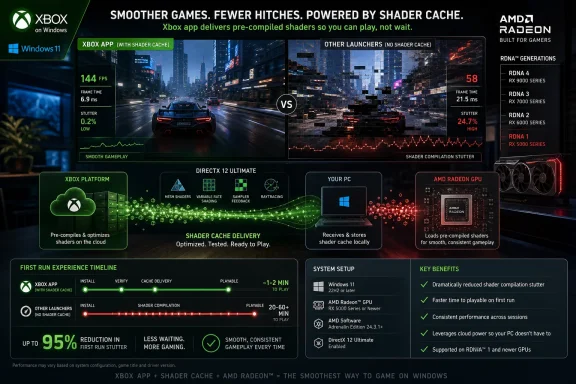
Microsoft made Advanced Shader Delivery available in public preview for Windows 11 desktop and laptop PCs on May 15, 2026, expanding the DirectX shader precompilation system beyond ROG Xbox Ally handhelds to supported AMD RDNA 3, RDNA 3.5, and RDNA 4 graphics hardware. The headline number is hard to ignore: Forza Horizon 6 loading in four seconds instead of roughly 90 seconds on Microsoft’s test system. But the bigger story is not that AMD gets a temporary marketing win over NVIDIA. It is that Microsoft is trying to move one of PC gaming’s messiest runtime problems out of the living room, off the user’s CPU, and into the Windows-and-storefront supply chain.
Shader compilation has become one of those problems that PC gamers understand emotionally before they understand technically. You buy a fast GPU, install a massive new game, hit Play, and then wait while the game “optimizes shaders,” or worse, the game lets you in quickly and punishes you with hitching as new effects appear. It is the kind of friction that makes the PC feel both powerful and oddly unfinished.
Advanced Shader Delivery is Microsoft’s attempt to make that experience more console-like without pretending the PC is a console. On a console, the hardware target is narrow and predictable. On Windows, a DirectX 12 game has to contend with GPU vendors, architectures, driver versions, OS builds, storefronts, and game updates that can invalidate previous assumptions overnight.
The old answer was to compile shaders locally. That could mean a long first-launch screen, compilation during installation, or just-in-time compilation during gameplay. The last approach is especially toxic: the player sees it not as a pipeline state object problem but as a stutter, a dropped frame, a broken port, or another entry in the long list of reasons PC gaming still feels less polished than it should.
Microsoft’s new answer is a delivery system. Developers and Microsoft collect shader-related state data into a standardized database, hardware vendors provide offline compiler support, and the Xbox PC app can deliver a precompiled shader database alongside the game. When the game launches, Windows can already have the right cache available for the player’s hardware and driver combination.
That is the important shift. Advanced Shader Delivery is not merely another driver cache, another launcher trick, or another “please wait while we optimize” screen. It is a proposal that shader compilation should become part of the distribution pipeline, not a tax collected from every player at first launch.
That result matters because it makes the problem legible. “Shader stutter” is a phrase enthusiasts use, but “four seconds instead of 90” is the sort of before-and-after number that can make a platform feature stick. Microsoft’s earlier examples on the ROG Xbox Ally family pointed to large reductions as well, including claims of up to 85 percent faster launch times in Avowed and up to 10x faster starts on supported handheld scenarios.
Still, this is a preview, not a universal fix. The feature currently depends on a narrow stack: Windows 11 24H2 or later, the right Xbox Gaming Services version, Xbox Insider participation through the PC Gaming Preview, supported AMD hardware, and a recent AMD Adrenalin driver. It also depends on the game being delivered through Microsoft’s PC gaming ecosystem, not simply existing as a DirectX 12 title on any storefront.
That is where the enthusiast excitement needs a little cold water. Advanced Shader Delivery is not something that automatically makes every Steam library entry smoother tomorrow. It is a coordinated system in which the game, the store, Windows, the GPU vendor, and the driver all have to agree on what shader data is needed and how it should be delivered.
The sales pitch is strong because the pain is real. But the demo is also carefully chosen: a Microsoft-published racing title, on Microsoft’s store path, with Microsoft’s DirectX stack, on AMD hardware that Microsoft has publicly partnered around. That does not make the result fake. It does make it a best-case example of how powerful the feature can be when all the pieces line up.
It is worth correcting one detail that has already started to blur in retellings: this is not an all-RDNA feature from RDNA 1 onward in Microsoft’s current public requirements. The official preview language points to RDNA 3, RDNA 3.5, and RDNA 4, with Adrenalin 26.5.2 or newer. If later drivers broaden the list, that would be welcome, but the current desktop preview is more limited than “all RDNA Radeon GPUs.”
That distinction matters because PC gamers are very good at turning feature announcements into assumed entitlements. Radeon RX 5000 and RX 6000 owners will reasonably ask why they are outside the first wave. Microsoft’s answer, implicitly, is that Advanced Shader Delivery is not just an API switch; it needs offline compiler integration, validation, and a matching device-and-driver matrix that can be trusted not to make things worse.
NVIDIA’s absence is more complicated than a simple “green team does not support it.” Microsoft’s own GDC-era messaging indicated NVIDIA was working with Microsoft on Advanced Shader Delivery for GeForce RTX consumers later in 2026. The feature is therefore better understood as AMD being first to this public desktop preview, not NVIDIA being permanently outside the architecture.
That matters for WindowsForum readers because the practical buying advice is still premature. If you are building a PC today and play heavily through the Xbox app or Game Pass, AMD’s early support is a meaningful point in its favor. If your library lives mostly on Steam, Epic, GOG, or Battle.net, the value is more speculative until storefront support broadens and more titles ship with day-one SODB support.
But the player-facing distribution path still has to run through a store. Someone has to compile the SODB into the correct Precompiled Shader Database for the player’s GPU and driver combination. Someone has to deliver it with the game. Someone has to update it when a driver changes. In this preview, that someone is Microsoft’s Xbox PC ecosystem.
This is not a small detail. PC gaming’s biggest technical problems often sit between layers: the game engine blames the driver, the driver blames the engine, the storefront sees itself as a download pipe, and the OS pretends not to know about any of it. Advanced Shader Delivery works precisely because Microsoft is trying to coordinate those layers instead of leaving each player’s PC to discover the answer locally.
The risk is that a good technical idea becomes another ecosystem wedge. If the Xbox app gets smoother first launches while other storefronts lag, Microsoft will have created a real user benefit that also nudges players toward Microsoft-controlled distribution. That is not inherently sinister; every platform vendor uses integration as leverage. But it is not platform-neutral in practice until Steam, Epic, publishers’ launchers, and other stores can participate at similar quality.
Microsoft has said the future vision allows other storefronts to compile and register these shader databases. That is the right answer, but the PC market will judge the implementation, not the aspiration. A standard that is technically open but operationally easiest inside Microsoft’s own app will still behave like a Microsoft advantage.
The current ASD preview requires Windows 11 24H2 or later. That means Windows 10 users are outside the official path, even if they have otherwise capable hardware and even if a given game still runs perfectly well on Windows 10. Some enthusiasts will inevitably test whether pieces of the system can be coaxed into working anyway, but for administrators and ordinary users, the official support line is the line that matters.
This is where Microsoft’s Windows strategy becomes less about persuasion and more about attrition. DirectStorage, Auto HDR, newer WDDM features, Copilot+ PC capabilities, and now shader delivery all contribute to a creeping sense that the “real” PC platform is Windows 11, with Windows 10 increasingly frozen in the role of legacy runtime. That is especially relevant in 2026, after Windows 10’s mainstream support story has already pushed many households and organizations into decision mode.
For gamers, the pitch is simple: if you want the newest platform-side quality-of-life features, you need the newest Windows branch. For IT departments managing shared gaming labs, esports venues, classrooms, or workstations that double as visualization rigs, the calculus is more nuanced. Windows 11 24H2 is not merely a gaming upgrade; it is an OS servicing and compatibility decision.
The irony is that Advanced Shader Delivery is exactly the kind of feature Windows needs if Microsoft wants PC gaming to feel less chaotic. But by tying it to Windows 11, the company also turns a technical improvement into another pressure point in the Windows migration campaign. That may be rational platform management. It will not make Windows 10 loyalists any less suspicious.
Microsoft’s tooling revolves around State Object Databases, which collect pipeline state information and can be turned into Precompiled Shader Databases. The dream is that game engines eventually generate nearly complete SODBs during development, allowing stores and vendors to prepare shader databases before players ever launch the game. In that world, the first-run experience becomes less dependent on what the end user’s CPU can compile in the moment.
That is a real improvement, but it also creates a new class of failure. What happens when a game update ships with incomplete shader coverage? What happens when a driver regression makes a freshly delivered PSDB undesirable? What happens when a store fails to deliver the right database, or a player rolls back a driver, or a modded executable changes the rendering path enough to miss the cache?
The answer may be graceful fallback to runtime compilation, but fallback is not free. If players are told a game supports Advanced Shader Delivery and they still see stutter, they will not parse the difference between a cache miss, a driver mismatch, and a game bug. They will say the feature does not work. That puts pressure on developers and storefronts to treat shader databases as first-class release artifacts rather than optional polish.
This is why Microsoft’s “console-like” language cuts both ways. Consoles feel consistent because the platform owner controls more of the stack and enforces certification. PC gaming remains valuable because it is open, messy, upgradeable, and weird. Advanced Shader Delivery tries to import some console discipline without closing the platform, which is exactly the right ambition and exactly the hard part.
ASD targets a particularly visible subset of the problem: DirectX 12 shader compilation and cache warm-up. That subset matters a lot, especially for Unreal Engine titles and other modern rendering pipelines that can generate large numbers of permutations. But when a game stutters because it is streaming an open world badly or hammering one CPU thread, precompiled shaders will not save it.
That distinction is important for consumer expectations. Microsoft says ASD can reduce or eliminate shader stutter in supported titles by avoiding just-in-time compilation during gameplay. It does not promise to make every frame-time graph flat or every PC port suddenly competent. The industry has spent years discovering that “PC optimization” is not one problem; it is a portfolio of negligence, complexity, deadlines, and genuine technical difficulty.
Still, shader delivery is one of the few areas where a platform-level fix makes sense. Asking every studio to invent its own robust shader precompilation system has not worked. Asking every player to wait at first launch is unpopular. Letting games compile on demand during traversal is worse. A Windows-level cache registration and store-level delivery mechanism is the kind of boring infrastructure that can make the flashy parts of PC gaming look better.
If Microsoft can make ASD broadly available beyond its own app, it could become one of those improvements that players stop noticing because the pain quietly disappears. That is the best fate for platform engineering. Nobody praises the absence of hitching; they just stop posting angry frame-time captures.
Advanced Shader Delivery gives the Xbox app a stronger technical argument. If Microsoft’s store can deliver not just the game but also hardware-specific precompiled shader data, it becomes more than a download manager. It becomes part of the runtime optimization chain.
That is a significant reframing. Steam has long benefited from being the default PC gaming library because it feels fast, reliable, and socially embedded. Microsoft cannot displace that with branding. But it can make the Xbox app meaningfully better for first-party and Game Pass titles if those games launch faster and stutter less there than elsewhere.
The danger is fragmentation. Imagine the same game behaving better from the Xbox app than from Steam because only one storefront has the full ASD pipeline. That would be maddening for users who think of PC games as PC games, not store-specific builds with different shader delivery behavior. It would also revive old complaints about Microsoft using Windows integration to favor its own distribution channel.
The healthier outcome is competitive pressure. If ASD becomes valuable enough, other storefronts will want equivalent support. Developers will want one pipeline that feeds multiple stores. GPU vendors will want broad coverage because shader stutter makes their hardware look bad even when the root cause is software. In that scenario, Microsoft’s early Xbox advantage becomes the bootstrap phase for a more general Windows gaming improvement.
The good news is that Microsoft’s earlier partner messaging does not sound like a vendor locked out of the room. NVIDIA has publicly aligned itself with the goal of Advanced Shader Delivery and has reportedly targeted GeForce RTX consumer support later in 2026. Intel and Qualcomm have also been part of Microsoft’s broader DirectX tooling narrative, which suggests the long-term plan is ecosystem-wide rather than Radeon-exclusive.
The harder part is execution. Offline shader compiler support is vendor-specific work. Validation across architectures and driver branches is not glamorous, but it is what determines whether a precompiled cache is a miracle or a support nightmare. NVIDIA may have strong incentives to move carefully, because a broken shader delivery path on GeForce would instantly become a high-profile Windows gaming story.
AMD, meanwhile, gets to enjoy being first in this public desktop slice. That is useful at a time when Radeon often competes not merely on frames per second but on platform features, driver confidence, and perceived smoothness. If ASD makes supported AMD systems feel less hitchy in high-profile games, that is not a benchmark victory in the traditional sense, but it is a user-experience victory.
The broader lesson is that DirectX features are not magic simply because Microsoft ships an SDK. They become real when IHVs, engine developers, game studios, and stores do the unglamorous integration work. Advanced Shader Delivery is a standardization effort, but standards in PC gaming become standards only when the big vendors make them boringly reliable.
For years, PC game coverage has overemphasized average frame rates and underemphasized the annoyance tax. A title can average 100 frames per second and still feel bad if traversal hitches every time a new effect or area appears. Shader compilation has forced reviewers to talk more about one percent lows and frame-time consistency, but ASD adds another axis: whether the cache was delivered before launch.
That means test methodology should state the OS version, driver version, storefront, whether ASD or equivalent precompiled shader delivery was active, and whether the run was a cold first launch or a warmed cache scenario. Without that, comparisons will become muddy. The same game on the same GPU could look dramatically different depending on whether the Xbox app supplied a PSDB.
This also matters for user support. If someone on WindowsForum says a game stutters on first launch, the first troubleshooting questions may soon include not only “What driver are you using?” and “Is the game on an SSD?” but “Which storefront version did you install?” and “Did the launcher show that precompiled shaders were installed?” That is a new layer of complexity, but it is also a path toward diagnosing a problem that used to be hand-waved as “PC gaming being PC gaming.”
In the long run, the best benchmark for ASD will not be Microsoft’s four-second demo. It will be whether players stop noticing shader compilation in games that used to be infamous for it. The absence of complaints will be the metric that matters.
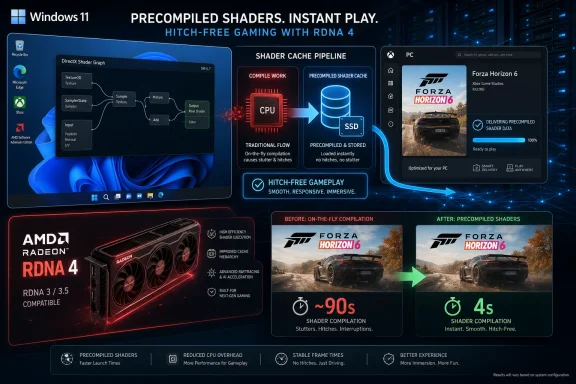 Microsoft Moves Shader Pain From the Player’s PC to the Platform
Shader compilation has become one of those problems that PC gamers understand emotionally before they understand technically. You buy a fast GPU, install a massive new game, hit Play, and then wait while the game “optimizes shaders,” or worse, the game lets you in quickly and punishes you with hitching as new effects appear. It is the kind of friction that makes the PC feel both powerful and oddly unfinished.Advanced Shader Delivery is Microsoft’s attempt to make that experience more console-like without pretending the PC is a console. On a console, the hardware target is narrow and predictable. On Windows, a DirectX 12 game has to contend with GPU vendors, architectures, driver versions, OS builds, storefronts, and game updates that can invalidate previous assumptions overnight.
The old answer was to compile shaders locally. That could mean a long first-launch screen, compilation during installation, or just-in-time compilation during gameplay. The last approach is especially toxic: the player sees it not as a pipeline state object problem but as a stutter, a dropped frame, a broken port, or another entry in the long list of reasons PC gaming still feels less polished than it should.
Microsoft’s new answer is a delivery system. Developers and Microsoft collect shader-related state data into a standardized database, hardware vendors provide offline compiler support, and the Xbox PC app can deliver a precompiled shader database alongside the game. When the game launches, Windows can already have the right cache available for the player’s hardware and driver combination.
That is the important shift. Advanced Shader Delivery is not merely another driver cache, another launcher trick, or another “please wait while we optimize” screen. It is a proposal that shader compilation should become part of the distribution pipeline, not a tax collected from every player at first launch.
The Four-Second Demo Is Real, but It Is Also the Sales Pitch
Microsoft’s showcase example is Forza Horizon 6, which it says loads in four seconds with Advanced Shader Delivery on a system using an AMD Radeon RX 7600 and Ryzen 7 5800. Without ASD, Microsoft says that same first launch takes almost a minute and a half. That is a 95 percent reduction, the kind of figure that sounds like marketing until you remember how much of a modern game’s first-run delay can be shader preparation rather than traditional loading.That result matters because it makes the problem legible. “Shader stutter” is a phrase enthusiasts use, but “four seconds instead of 90” is the sort of before-and-after number that can make a platform feature stick. Microsoft’s earlier examples on the ROG Xbox Ally family pointed to large reductions as well, including claims of up to 85 percent faster launch times in Avowed and up to 10x faster starts on supported handheld scenarios.
Still, this is a preview, not a universal fix. The feature currently depends on a narrow stack: Windows 11 24H2 or later, the right Xbox Gaming Services version, Xbox Insider participation through the PC Gaming Preview, supported AMD hardware, and a recent AMD Adrenalin driver. It also depends on the game being delivered through Microsoft’s PC gaming ecosystem, not simply existing as a DirectX 12 title on any storefront.
That is where the enthusiast excitement needs a little cold water. Advanced Shader Delivery is not something that automatically makes every Steam library entry smoother tomorrow. It is a coordinated system in which the game, the store, Windows, the GPU vendor, and the driver all have to agree on what shader data is needed and how it should be delivered.
The sales pitch is strong because the pain is real. But the demo is also carefully chosen: a Microsoft-published racing title, on Microsoft’s store path, with Microsoft’s DirectX stack, on AMD hardware that Microsoft has publicly partnered around. That does not make the result fake. It does make it a best-case example of how powerful the feature can be when all the pieces line up.
AMD Gets the First Desktop Win, Not the Whole War
The original framing around this rollout has understandably focused on AMD. Microsoft says the public preview expands to Windows 11 PCs with AMD discrete GPUs and gaming-laptop integrated GPUs, and the current official requirements name RDNA 3, RDNA 3.5, and RDNA 4 architectures. That gives recent Radeon cards and modern AMD integrated graphics a visible quality-of-life advantage in supported Xbox PC app titles.It is worth correcting one detail that has already started to blur in retellings: this is not an all-RDNA feature from RDNA 1 onward in Microsoft’s current public requirements. The official preview language points to RDNA 3, RDNA 3.5, and RDNA 4, with Adrenalin 26.5.2 or newer. If later drivers broaden the list, that would be welcome, but the current desktop preview is more limited than “all RDNA Radeon GPUs.”
That distinction matters because PC gamers are very good at turning feature announcements into assumed entitlements. Radeon RX 5000 and RX 6000 owners will reasonably ask why they are outside the first wave. Microsoft’s answer, implicitly, is that Advanced Shader Delivery is not just an API switch; it needs offline compiler integration, validation, and a matching device-and-driver matrix that can be trusted not to make things worse.
NVIDIA’s absence is more complicated than a simple “green team does not support it.” Microsoft’s own GDC-era messaging indicated NVIDIA was working with Microsoft on Advanced Shader Delivery for GeForce RTX consumers later in 2026. The feature is therefore better understood as AMD being first to this public desktop preview, not NVIDIA being permanently outside the architecture.
That matters for WindowsForum readers because the practical buying advice is still premature. If you are building a PC today and play heavily through the Xbox app or Game Pass, AMD’s early support is a meaningful point in its favor. If your library lives mostly on Steam, Epic, GOG, or Battle.net, the value is more speculative until storefront support broadens and more titles ship with day-one SODB support.
This Is a Storefront Feature Wearing a DirectX Jacket
The most interesting tension in Advanced Shader Delivery is that Microsoft presents it as a DirectX platform advance while the early consumer experience is tied tightly to the Xbox PC app. Technically, the DirectX work is real. The Agility SDK adds tools for State Object Database collection, offline compilation, and registration APIs that let Windows find precompiled shader databases for a title.But the player-facing distribution path still has to run through a store. Someone has to compile the SODB into the correct Precompiled Shader Database for the player’s GPU and driver combination. Someone has to deliver it with the game. Someone has to update it when a driver changes. In this preview, that someone is Microsoft’s Xbox PC ecosystem.
This is not a small detail. PC gaming’s biggest technical problems often sit between layers: the game engine blames the driver, the driver blames the engine, the storefront sees itself as a download pipe, and the OS pretends not to know about any of it. Advanced Shader Delivery works precisely because Microsoft is trying to coordinate those layers instead of leaving each player’s PC to discover the answer locally.
The risk is that a good technical idea becomes another ecosystem wedge. If the Xbox app gets smoother first launches while other storefronts lag, Microsoft will have created a real user benefit that also nudges players toward Microsoft-controlled distribution. That is not inherently sinister; every platform vendor uses integration as leverage. But it is not platform-neutral in practice until Steam, Epic, publishers’ launchers, and other stores can participate at similar quality.
Microsoft has said the future vision allows other storefronts to compile and register these shader databases. That is the right answer, but the PC market will judge the implementation, not the aspiration. A standard that is technically open but operationally easiest inside Microsoft’s own app will still behave like a Microsoft advantage.
Windows 11 Becomes the Compatibility Floor by Accumulation
Advanced Shader Delivery also fits a broader Windows 11 pattern. Microsoft rarely wins over skeptical power users with one must-have feature. Instead, it gradually moves new gaming, security, AI, and developer capabilities onto newer Windows builds until Windows 10 feels less like a supported predecessor and more like a compatibility holdout.The current ASD preview requires Windows 11 24H2 or later. That means Windows 10 users are outside the official path, even if they have otherwise capable hardware and even if a given game still runs perfectly well on Windows 10. Some enthusiasts will inevitably test whether pieces of the system can be coaxed into working anyway, but for administrators and ordinary users, the official support line is the line that matters.
This is where Microsoft’s Windows strategy becomes less about persuasion and more about attrition. DirectStorage, Auto HDR, newer WDDM features, Copilot+ PC capabilities, and now shader delivery all contribute to a creeping sense that the “real” PC platform is Windows 11, with Windows 10 increasingly frozen in the role of legacy runtime. That is especially relevant in 2026, after Windows 10’s mainstream support story has already pushed many households and organizations into decision mode.
For gamers, the pitch is simple: if you want the newest platform-side quality-of-life features, you need the newest Windows branch. For IT departments managing shared gaming labs, esports venues, classrooms, or workstations that double as visualization rigs, the calculus is more nuanced. Windows 11 24H2 is not merely a gaming upgrade; it is an OS servicing and compatibility decision.
The irony is that Advanced Shader Delivery is exactly the kind of feature Windows needs if Microsoft wants PC gaming to feel less chaotic. But by tying it to Windows 11, the company also turns a technical improvement into another pressure point in the Windows migration campaign. That may be rational platform management. It will not make Windows 10 loyalists any less suspicious.
Developers Get a Better Pipeline and a New Obligation
For game developers, Advanced Shader Delivery is both relief and responsibility. The relief is obvious: if the system works, studios can avoid forcing players through long compilation waits or accepting runtime hitches as the cost of shipping on a heterogeneous PC platform. The responsibility is that shader data becomes another asset pipeline that needs to be captured, tested, updated, and shipped correctly.Microsoft’s tooling revolves around State Object Databases, which collect pipeline state information and can be turned into Precompiled Shader Databases. The dream is that game engines eventually generate nearly complete SODBs during development, allowing stores and vendors to prepare shader databases before players ever launch the game. In that world, the first-run experience becomes less dependent on what the end user’s CPU can compile in the moment.
That is a real improvement, but it also creates a new class of failure. What happens when a game update ships with incomplete shader coverage? What happens when a driver regression makes a freshly delivered PSDB undesirable? What happens when a store fails to deliver the right database, or a player rolls back a driver, or a modded executable changes the rendering path enough to miss the cache?
The answer may be graceful fallback to runtime compilation, but fallback is not free. If players are told a game supports Advanced Shader Delivery and they still see stutter, they will not parse the difference between a cache miss, a driver mismatch, and a game bug. They will say the feature does not work. That puts pressure on developers and storefronts to treat shader databases as first-class release artifacts rather than optional polish.
This is why Microsoft’s “console-like” language cuts both ways. Consoles feel consistent because the platform owner controls more of the stack and enforces certification. PC gaming remains valuable because it is open, messy, upgradeable, and weird. Advanced Shader Delivery tries to import some console discipline without closing the platform, which is exactly the right ambition and exactly the hard part.
The Stutter Fight Is Bigger Than One Microsoft API
It would be a mistake to treat Advanced Shader Delivery as the final boss of shader stutter. PC performance problems are rarely that tidy. Games stutter because of shader compilation, asset streaming, CPU scheduling, decompression, traversal, memory pressure, background services, anti-cheat, overlays, storage stalls, and plain old engine bugs.ASD targets a particularly visible subset of the problem: DirectX 12 shader compilation and cache warm-up. That subset matters a lot, especially for Unreal Engine titles and other modern rendering pipelines that can generate large numbers of permutations. But when a game stutters because it is streaming an open world badly or hammering one CPU thread, precompiled shaders will not save it.
That distinction is important for consumer expectations. Microsoft says ASD can reduce or eliminate shader stutter in supported titles by avoiding just-in-time compilation during gameplay. It does not promise to make every frame-time graph flat or every PC port suddenly competent. The industry has spent years discovering that “PC optimization” is not one problem; it is a portfolio of negligence, complexity, deadlines, and genuine technical difficulty.
Still, shader delivery is one of the few areas where a platform-level fix makes sense. Asking every studio to invent its own robust shader precompilation system has not worked. Asking every player to wait at first launch is unpopular. Letting games compile on demand during traversal is worse. A Windows-level cache registration and store-level delivery mechanism is the kind of boring infrastructure that can make the flashy parts of PC gaming look better.
If Microsoft can make ASD broadly available beyond its own app, it could become one of those improvements that players stop noticing because the pain quietly disappears. That is the best fate for platform engineering. Nobody praises the absence of hitching; they just stop posting angry frame-time captures.
The Xbox App Finally Has a Technical Reason to Exist
For years, the Xbox app on PC has struggled with identity. It is a launcher, a Game Pass portal, a Microsoft Store front end, a social layer, and sometimes an obstacle between the user and the executable they actually want to run. Enthusiasts tolerate it for Game Pass value, not because it is the natural home of PC gaming.Advanced Shader Delivery gives the Xbox app a stronger technical argument. If Microsoft’s store can deliver not just the game but also hardware-specific precompiled shader data, it becomes more than a download manager. It becomes part of the runtime optimization chain.
That is a significant reframing. Steam has long benefited from being the default PC gaming library because it feels fast, reliable, and socially embedded. Microsoft cannot displace that with branding. But it can make the Xbox app meaningfully better for first-party and Game Pass titles if those games launch faster and stutter less there than elsewhere.
The danger is fragmentation. Imagine the same game behaving better from the Xbox app than from Steam because only one storefront has the full ASD pipeline. That would be maddening for users who think of PC games as PC games, not store-specific builds with different shader delivery behavior. It would also revive old complaints about Microsoft using Windows integration to favor its own distribution channel.
The healthier outcome is competitive pressure. If ASD becomes valuable enough, other storefronts will want equivalent support. Developers will want one pipeline that feeds multiple stores. GPU vendors will want broad coverage because shader stutter makes their hardware look bad even when the root cause is software. In that scenario, Microsoft’s early Xbox advantage becomes the bootstrap phase for a more general Windows gaming improvement.
NVIDIA’s Delay Is a Reminder That Standards Need Vendors
The absence of GeForce support in the current AMD desktop preview is conspicuous because NVIDIA dominates much of the discrete gaming GPU market. A Windows gaming feature that does not support GeForce at scale cannot remain central for long. Microsoft knows this, NVIDIA knows this, and developers certainly know this.The good news is that Microsoft’s earlier partner messaging does not sound like a vendor locked out of the room. NVIDIA has publicly aligned itself with the goal of Advanced Shader Delivery and has reportedly targeted GeForce RTX consumer support later in 2026. Intel and Qualcomm have also been part of Microsoft’s broader DirectX tooling narrative, which suggests the long-term plan is ecosystem-wide rather than Radeon-exclusive.
The harder part is execution. Offline shader compiler support is vendor-specific work. Validation across architectures and driver branches is not glamorous, but it is what determines whether a precompiled cache is a miracle or a support nightmare. NVIDIA may have strong incentives to move carefully, because a broken shader delivery path on GeForce would instantly become a high-profile Windows gaming story.
AMD, meanwhile, gets to enjoy being first in this public desktop slice. That is useful at a time when Radeon often competes not merely on frames per second but on platform features, driver confidence, and perceived smoothness. If ASD makes supported AMD systems feel less hitchy in high-profile games, that is not a benchmark victory in the traditional sense, but it is a user-experience victory.
The broader lesson is that DirectX features are not magic simply because Microsoft ships an SDK. They become real when IHVs, engine developers, game studios, and stores do the unglamorous integration work. Advanced Shader Delivery is a standardization effort, but standards in PC gaming become standards only when the big vendors make them boringly reliable.
The Forza Test Should Change How Reviewers Measure PC Games
One immediate consequence of ASD is that reviewers and benchmarkers need to be more precise about first-run behavior. A game that loads in 90 seconds without precompiled shaders and four seconds with them is not just “faster”; it is operating under a different preparation model. That distinction should be documented in performance reviews, especially when comparing storefronts or GPU vendors.For years, PC game coverage has overemphasized average frame rates and underemphasized the annoyance tax. A title can average 100 frames per second and still feel bad if traversal hitches every time a new effect or area appears. Shader compilation has forced reviewers to talk more about one percent lows and frame-time consistency, but ASD adds another axis: whether the cache was delivered before launch.
That means test methodology should state the OS version, driver version, storefront, whether ASD or equivalent precompiled shader delivery was active, and whether the run was a cold first launch or a warmed cache scenario. Without that, comparisons will become muddy. The same game on the same GPU could look dramatically different depending on whether the Xbox app supplied a PSDB.
This also matters for user support. If someone on WindowsForum says a game stutters on first launch, the first troubleshooting questions may soon include not only “What driver are you using?” and “Is the game on an SSD?” but “Which storefront version did you install?” and “Did the launcher show that precompiled shaders were installed?” That is a new layer of complexity, but it is also a path toward diagnosing a problem that used to be hand-waved as “PC gaming being PC gaming.”
In the long run, the best benchmark for ASD will not be Microsoft’s four-second demo. It will be whether players stop noticing shader compilation in games that used to be infamous for it. The absence of complaints will be the metric that matters.
The Radeon Preview Draws the Shape of Microsoft’s Bigger Bet
The concrete takeaways are narrower than the hype, but more important than a routine driver feature. Advanced Shader Delivery is Microsoft trying to make Windows act less like a passive runtime and more like an active gaming platform.- Advanced Shader Delivery is currently a Windows 11 24H2-or-newer public preview for supported AMD RDNA 3, RDNA 3.5, and RDNA 4 systems through the Xbox PC app and Xbox Insider PC Gaming Preview.
- Microsoft’s showcase result is Forza Horizon 6 loading in four seconds instead of roughly 90 seconds on a Radeon RX 7600 and Ryzen 7 5800 system.
- The feature works by delivering precompiled shader databases with supported games, reducing first-launch compilation work and avoiding many just-in-time shader compilation hitches.
- The current preview is not the same as universal support across all DirectX 12 games, all Radeon GPUs, all storefronts, or Windows 10.
- NVIDIA’s lack of current public desktop support is significant but likely temporary, with broader IHV support still central to Microsoft’s stated roadmap.
- The most important unresolved question is whether Steam, Epic, publisher launchers, and other PC storefronts adopt the same pipeline widely enough to make ASD feel like a Windows feature rather than an Xbox app perk.
References
- Primary source: DSOGaming
Published: 2026-06-12T17:54:07.899588
Advanced Shader Delivery Comes to Desktop PCs and Windows 11, Supported By AMD's RDNA GPUs
Microsoft has just made available Advanced Shader Delivery to desktop PCs that run Windows 11. Right now, only AMD's RDNA GPUs support it.www.dsogaming.com - Official source: devblogs.microsoft.com
Introducing Advanced Shader Delivery - DirectX Developer Blog
This year at gamescom, Microsoft is highlighting new gaming features coming for Windows, particularly for handheld devices. We want to highlight one ofdevblogs.microsoft.com - Related coverage: igorslab.de
Microsoft's Advanced Shader Delivery arrives on AMD PCs|igor´sLAB
Microsoft is expanding Advanced Shader Delivery to Windows 11 PCs with AMD graphics.www.igorslab.de - Official source: developer.microsoft.com
GDC 2026: DirectX is Bringing Console-Level Developer Tools to Windows
The DirectX team is currently working to bring console-level GPU developer tools to Windows, beginning with a wave of new DirectX tooling features.developer.microsoft.com - Related coverage: tomshardware.com
Forza Horizon 6 boots up in just 4 seconds instead of 90 with new Advanced Shader Delivery tech and AMD GPUs — Microsoft claims 95% reduction in gaming load times | Tom's Hardware
Only available with games downloaded via the Xbox PC app.www.tomshardware.com - Related coverage: adrenaline.com.br
AMD RX 7600 ganha salto enorme de desempenho em Forza Horizon 6 com novo sistema de shaders - Adrenaline
Veja como a tecnologia ASD da Microsoft reduz o tempo de carregamento em 95% no game e chega às placas RDNA 3, RDNA 3.5 e RDNA 4 da Radeon.www.adrenaline.com.br
- Related coverage: techspot.com
Microsoft's new tech cuts Forza Horizon 6's shader loading time from 90 seconds to four seconds | TechSpot
When Microsoft introduced ASD last year, it was restricted to Asus Xbox ROG Ally devices, but Turn 10 Studios' new racing title brings the feature to standard...www.techspot.com - Related coverage: betterfps.com
Forza Horizon 6 loads in 4 seconds with Microsoft's Advanced Shader Delivery tech · BetterFPS
Microsoft's new shader precompilation system cuts Forza Horizon 6 boot times from 90 seconds to 4 on AMD GPUs. The tech could spread to other DirectX 12 games.betterfps.com - Related coverage: pcgamer.com
Advanced Shader Delivery banishes long loads and shader stutter on first time launch, but only for certain games and there are a number of other caveats too | PC Gamer
I don't have this problem on PS5, I'm just saying.www.pcgamer.com - Related coverage: thefpsreview.com
AMD Adrenalin 26.5.2 Brings Microsoft Advanced Shader Delivery to RDNA 3 and RDNA 4, Speeding Up Game Loads
Shader compilation stutter has been one of PC gaming’s most persistent annoyances for years, and Microsoft just took a meaningful swing at fixing it on AMD hardware. The AMD Software: Adrenalin Edition 26.5.2 driver is now live, and it brings support for Microsoft’s Advanced Shader...www.thefpsreview.com - Official source: blogs.windows.com
Windows PC gaming in 2025: Handheld innovation, Arm progress and DirectX advances
For decades, Windows has been the platform for PC gaming: open, flexible and built with players in mind. From the days of classics like Diablo to today’s cutting-edge experiences powered by DirectX and AI-driven graphics, Windows has partblogs.windows.com - Related coverage: club386.com
Microsoft debuts Advanced Shader Delivery on Windows 11 with Forza Horizon 6, promising 95% faster loading | Club386
Microsoft partners with AMD to expand its Advanced Shader Delivery service to Windows 11 PCs, delivering faster initial loading on RDNA 3 and newer GPUs. www.club386.com
- Related coverage: windowscentral.com
Microsoft to roll out new Xbox mode for Windows 11 in April | Windows Central
At GDC 2026, Microsoft outlined the future of PC and Xbox game development, positioning Windows as the foundation for the next-generation of gaming via unified GDK.www.windowscentral.com