

Microsoft’s GDC 2026 playbook makes the company’s long‑term intention unmistakable: turn Windows 11 into a first‑class, console‑like gaming platform while keeping the open, multi‑store benefits of PC gaming intact. The headline for players is a new Xbox mode — a controller‑first, full‑screen gaming session that will begin rolling out in April across select Windows 11 devices — but the real story runs deeper. Microsoft paired the UI change with a suite of platform and developer upgrades designed to eliminate first‑run shader stutter, speed asset streaming, and bake machine‑learning primitives into the graphics pipeline. For studios and engine teams the announcements are practical and immediate; for gamers they promise snappier load times and a more predictable “day‑one” experience. For the broader PC ecosystem, however, the move raises important questions about adoption, operational complexity, and where Microsoft’s influence on PC gaming will land between helpful standardization and platform lock‑in.
Microsoft used its GDC 2026 presence to present a cross‑stack roadmap: OS UX, runtime APIs, tooling, and store integration working together to reduce friction that has long plagued PC game launches. The package includes:
Key characteristics:
What it is not: a forced replacement of the desktop. The rollout strategy and messaging emphasize optional use, and Microsoft states users can always return to the regular Windows environment. Whether perception matches reality will depend on how seamless the transitions are and whether third‑party stores and launchers are equally discoverable inside Xbox mode.
ASD addresses this by shifting shader compilation out of end users’ machines and into developers’ build pipelines:
What changed:
Potential benefits:
Strategically, Xbox mode is an attempt to converge console simplicity with PC openness. If Microsoft can avoid heavy‑handedness and keep transitions truly optional, Xbox mode could provide a welcome UX for many players without alienating traditionalists. The developer tooling additions close a decades‑long gap between console and PC capabilities for crash capture and GPU debugging — a genuine boon for studios wrestling with platform‑specific bugs.
The upside is clear: faster, smoother first runs; more predictable performance across hardware; and a runnable path for ML‑enabled rendering. The downside is operational: teams must adopt new CI practices, studios must coordinate with IHVs, and the ecosystem must ensure Xbox mode and the associated pipelines stay opt‑in and non‑coercive.
For developers, now is the time to start integrating these primitives into CI, prototyping shader‑embedded ML, and coordinating with graphics vendor partners. For players, expect a more console‑like option within Windows 11 that can improve the out‑of‑the‑box experience — but keep an eye on how stores and installers handle PSDBs and updates.
Microsoft’s plan is bold because it is practical: not a single sweeping shift, but a set of engineering primitives and UX choices that, together, can close the gap between console predictability and PC openness. Execution will determine whether that promise becomes the new normal for PC gaming, or another promising standard that took too long to reach critical mass.
Source: Trusted Reviews Microsoft is turning your Windows PC into an Xbox
 Background
Microsoft used its GDC 2026 presence to present a cross‑stack roadmap: OS UX, runtime APIs, tooling, and store integration working together to reduce friction that has long plagued PC game launches. The package includes:- Xbox mode — a rebranded full‑screen experience optimized for controllers, derived from earlier “Full Screen Experience” experiments and rolling out to laptops, desktops, tablets and handheld PCs in select markets starting in April.
- Advanced Shader Delivery (ASD) — a workflow for collecting, packaging and distributing precompiled shaders so devices receive compiled shader databases on install rather than compiling on first run.
- DirectStorage 1.4 with Zstandard (zstd) compression and a new Game Asset Conditioning Library to standardize asset packaging and improve streaming efficiency.
- DirectX runtime and language updates — expanded linear algebra primitives in HLSL and Shader Model developments to make ML workloads feasible directly in shaders.
- New developer tooling — DirectX Dump Files, DebugBreak() support inside HLSL, Shader Explorer and a major set of PIX improvements aimed at making GPU debugging and crash analysis closer to console‑style workflows.
What Xbox mode is — and what it isn’t
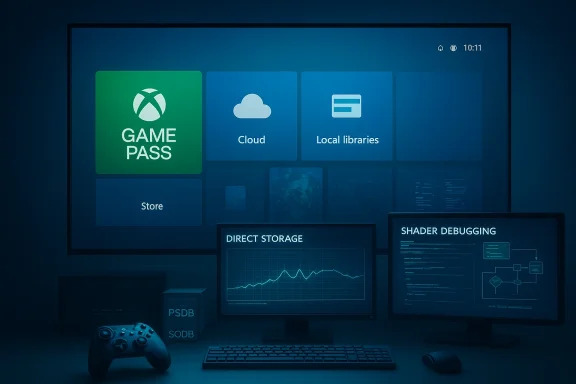
Xbox mode is a session posture for Windows 11 that prioritizes controller navigation and a simplified, full‑screen dashboard. It’s not a separate OS or a locked environment; Microsoft positions it as an opt‑in desktop modality that players can enter and leave at will. The goal is to offer a distraction‑free, “couch” UX for PC gaming that mirrors the discoverability and simplicity of console dashboards.Key characteristics:
- Full‑screen, controller‑optimized UI with large tiles and horizontal content rows.
- Consolidated access to game libraries, Game Pass/cloud content and the Game Bar without navigating the regular desktop.
- Ability to switch back to the standard Windows desktop on demand.
What it is not: a forced replacement of the desktop. The rollout strategy and messaging emphasize optional use, and Microsoft states users can always return to the regular Windows environment. Whether perception matches reality will depend on how seamless the transitions are and whether third‑party stores and launchers are equally discoverable inside Xbox mode.
Advanced Shader Delivery (ASD): solving the shader stutter problem
One of the most tangible technical complaints from PC gamers is shader stutter — the hitching and micro‑pauses that occur when a game compiles or JIT‑generates shaders the first time a particular rendering path is hit. On consoles, vendors control the full stack and can deliver precompiled artifacts; on PC the diversity of drivers, GPUs, and OS configurations makes that difficult.ASD addresses this by shifting shader compilation out of end users’ machines and into developers’ build pipelines:
- Developers collect pipeline information during development and testing to create a State Object Database (SODB).
- Offline compilers and vendor plugins produce a Precompiled Shader Database (PSDB).
- PSDBs are distributed with the game installer or via storefront pipelines and registered on the device, so the runtime can use precompiled shaders immediately.
- Fewer or no shader‑compile hitches on first run.
- Faster, more deterministic startup and smoother frame pacing during early play sessions.
- Better parity between a player’s PC experience and the console experience for the same title.
- Storage and download cost. PSDBs for large, complex titles can be sizeable. Studios must balance PSDB coverage against download/patch budgets and user bandwidth constraints.
- Driver and toolchain matching. Precompiled shaders are only safe if they accurately match the runtime driver and compiler behavior. That requires tight coordination between studios, graphics driver vendors (IHVs) and Microsoft to ensure PSDBs remain valid after driver updates.
- CI complexity. Integrating SODB collection and PSDB generation into nightly builds increases pipeline complexity, which could burden smaller teams.
DirectStorage 1.4, Zstandard, and the Game Asset Conditioning Library
DirectStorage has been the core Microsoft innovation enabling fast NVMe‑to‑GPU streaming pipelines on Windows. GDC’s update adds two practical evolutions:- Zstandard (zstd) compression: a contemporary, open compression format that offers favorable speed/ratio tradeoffs for game asset streaming. zstd is configurable, enabling teams to tune decompression latency against storage size.
- Game Asset Conditioning Library (GACL): tooling and pipeline guidance to standardize how assets are prepared for high‑throughput streaming. GACL aims to make asset packaging predictable and optimized for DirectStorage’s asynchronous streaming model.
- Faster load times and smoother streaming in dense, open worlds where asset I/O can otherwise be a bottleneck.
- A standard compression option helps studios adopt best practices without bespoke tooling for every title.
- Improvements in streaming resiliency make it easier to deliver texture and geometry data to GPUs without CPU or driver contention.
- Profile frequently streamed or large assets with zstd in your current DirectStorage harness to determine the right compression level.
- Integrate GACL into build pipelines to ensure consistent conditioning of assets across platforms and builds.
- Add DirectStorage tests into CI to monitor real NVMe throughput and decompression latency under realistic loads.
DirectX, ML primitives in HLSL, and the move to neural rendering
GDC reinforced the industry trend toward embedding machine‑learning operations into real‑time rendering pipelines. Microsoft’s DirectX evolution here is twofold: language/runtime capabilities and platform support for model integration.What changed:
- Expanded linear algebra primitives in HLSL (matrix and vector operations optimized for ML workloads) enable efficient implementation of neural ops directly inside shaders.
- A preview path to integrate Windows ML models into graphics pipelines, allowing lightweight neural networks to run closer to the GPU execution context.
- Neural denoisers, temporal accumulation upscalers, and learned material synthesis methods increasingly match or surpass hand‑coded algorithms for specific rendering tasks. Running these models in‑shader can reduce CPU‑GPU handoffs and latency.
- By providing language primitives and tooling, Microsoft lowers the barrier for engine teams to experiment with neural techniques and measure tradeoffs in register pressure, memory usage and throughput.
- Hardware heterogeneity. Different GPUs and architectures expose different tensor/AI acceleration features. A shader‑embedded model that runs well on one GPU family may be less efficient on another.
- Resource pressure. Embedding ML models in shaders affects register allocation, local memory, and spilling behavior — all of which can impact performance unpredictably if not profiled carefully.
- Lifecycle of models. Model retraining and patching becomes a shipping/QA concern: studios must plan how to update models post‑release and validate across driver updates.
Developer tooling: better debugging, crash capture, and shader introspection
Microsoft’s toolkit expansion is arguably the most developer‑forward part of the announcement. New capabilities include:- DirectX Dump Files: standardized GPU crash and state capture files for consistent post‑mortem analysis.
- DebugBreak() in HLSL: shader‑level breakpoints to pause and inspect shader execution.
- Shader Explorer: an inspector for compiled shaders with live analysis features planned.
- PIX improvements such as a Tile Mappings Viewer and hardware‑specific GPU counters in the System Monitor.
- Faster iteration on complex shading bugs and regressions.
- The ability to incorporate GPU crash captures into automated repro pipelines, improving QA and fixing elusive platform‑specific problems.
- Console‑parity in debugging: consoles have long had deterministic crash capture and deeper low‑level tooling; bringing this to PC will shorten triage cycles and reduce time‑to‑fix.
- Teams will want to incorporate DirectX Dump generation into crash telemetry and automated repro collections.
- Shader explorers and debug breakpoints accelerate root‑cause analysis but require familiarity and updated debugging workflows inside studios.
- These tools are valuable only if IHVs expose consistent counters and vendor‑specific telemetry; the deposit of vendor capabilities into PIX is therefore crucial.
Industry and ecosystem implications
Microsoft’s announcements are not a mere polish of the OS — they’re an attempt to create platform primitives that studios, engine vendors and IHVs can rely on when targeting Windows and Xbox simultaneously.Potential benefits:
- Consistent day‑one experience across PC hardware families when studios adopt PSDBs and DirectStorage best practices.
- Faster time‑to‑value for ML rendering experiments because the language and runtime support exists in HLSL and DirectX.
- Improved discoverability of subscription and cloud content through Xbox mode, potentially increasing engagement with Game Pass on PC.
- Adoption lag: historically, platform primitives require time for engines, stores, and middleware to integrate. Full benefits may take many months or several release cycles for large titles.
- Operational complexity: small teams may find the additional CI/QA requirements heavy.
- Store fragmentation risk: Xbox mode’s UX centralizes Microsoft services by default. If third‑party stores do not integrate equally, Xbox mode could favor Microsoft’s ecosystem, raising competitive concerns even if the feature itself is opt‑in.
- Driver and tooling churn: PSDBs and shader‑embedded ML only work if offline compilers and runtime drivers remain synchronized. Driver updates that change codegen behavior risk breaking precompiled artifacts unless crawled and replaced proactively.
Security, privacy and platform control concerns
Any OS‑level change that centralizes distribution of binary artifacts and adds new runtime hooks demands scrutiny.- Distribution of PSDBs requires installer‑level registration. How are these artifacts verified and updated? Who is responsible for invalidating or replacing a PSDB if a driver update introduces a mismatch?
- Xbox mode’s surface consolidates launcher and store access. If Microsoft adds telemetry or opt‑out defaults, that could shift discoverability and monetization. Transparent user controls and clear documentation are essential to avoid perceptions of forced platform steering.
- New tooling that captures GPU state and dumps may contain sensitive debugging information. Studios and platform operators will need clear policies for what data is collected, how it’s transmitted, and how it is retained.
Practical checklist — What developers should do now
- Audit your rendering pipeline for first‑run shader paths and add SODB capture to nightly/QA runs.
- Prototype PSDB generation for key titles on target platforms and validate across driver versions.
- Add DirectStorage tests to CI and evaluate zstd compression ratios and decompression latencies.
- Evaluate Shader Model and HLSL linear algebra primitives with small ML models (denoiser/upscaler) to understand register pressure and memory tradeoffs.
- Integrate DirectX Dump File capture into repro pipelines and familiarize the team with PIX additions.
- Coordinate with IHVs early: secure offline compiler access and verify PSDB compatibility across vendor drivers.
- Design QA plans for driver update regression testing that include PSDB validity and shader cache hit‑rate checks.
Practical guidance — What gamers should expect and do
- Expect a phased rollout. Xbox mode will appear in select markets and on supported device types first; don’t expect it to replace your desktop overnight.
- Xbox mode should be opt‑in. If you prefer the classic desktop and multiple storefronts, keep using them; Xbox mode is an alternative session posture, not an irreversible migration.
- Anticipate smaller installs or patches tied to PSDBs for new titles. Some games may offer larger initial downloads but deliver smoother early gameplay.
- For enthusiasts running handheld Windows devices, the combination of Xbox mode, ASD and DirectStorage improvements could dramatically improve the out‑of‑box experience on day one — fewer stutters, faster loading, and a console‑like feel.
Strengths and strategic analysis
Microsoft’s GDC package is pragmatic: it focuses on deterministic engineering outcomes rather than vague marketing promises. The combination of ASD and DirectStorage/GACL targets measurable pain points — launch stutter and streaming latency — and provides studios with concrete tooling to fix them. The addition of ML primitives in HLSL recognizes that neural rendering is not a niche research topic anymore; it’s a pragmatic route to better denoising, upscalers and material synthesis.Strategically, Xbox mode is an attempt to converge console simplicity with PC openness. If Microsoft can avoid heavy‑handedness and keep transitions truly optional, Xbox mode could provide a welcome UX for many players without alienating traditionalists. The developer tooling additions close a decades‑long gap between console and PC capabilities for crash capture and GPU debugging — a genuine boon for studios wrestling with platform‑specific bugs.
Risks and open questions
- Will storefronts beyond Microsoft’s own adopt the necessary registration hooks so Xbox mode becomes a neutral, universal dashboard? If not, users may see a biased discoverability surface.
- Can IHVs and Microsoft keep offline compilers and runtime drivers synchronized at scale? Mismatches could produce hard‑to‑diagnose regressions that erode trust in PSDB workflows.
- How heavy will the PSDB and asset‑conditioning costs be for users with constrained storage or bandwidth? Unless studios are careful, a user could face larger download bills to avoid runtime stutter.
- Finally, how quickly will smaller studios adopt these pipelines? The tools introduce CI/QA complexity that benefits large titles first; the democratizing promise will only materialize if tooling and automation reduce that barrier.
Conclusion
Microsoft’s GDC 2026 announcements represent a coordinated, cross‑layer push to make Windows 11 behave more like a console when players want it to — and to make the developer experience of shipping high‑quality games on PC more deterministic. Xbox mode offers a practical, controller‑first UX that will please many players, while Advanced Shader Delivery, DirectStorage 1.4 (zstd), Game Asset Conditioning Library, and expanded DirectX tooling address long‑standing engineering problems that cause stutter, long load times, and opaque GPU failures.The upside is clear: faster, smoother first runs; more predictable performance across hardware; and a runnable path for ML‑enabled rendering. The downside is operational: teams must adopt new CI practices, studios must coordinate with IHVs, and the ecosystem must ensure Xbox mode and the associated pipelines stay opt‑in and non‑coercive.
For developers, now is the time to start integrating these primitives into CI, prototyping shader‑embedded ML, and coordinating with graphics vendor partners. For players, expect a more console‑like option within Windows 11 that can improve the out‑of‑the‑box experience — but keep an eye on how stores and installers handle PSDBs and updates.
Microsoft’s plan is bold because it is practical: not a single sweeping shift, but a set of engineering primitives and UX choices that, together, can close the gap between console predictability and PC openness. Execution will determine whether that promise becomes the new normal for PC gaming, or another promising standard that took too long to reach critical mass.
Source: Trusted Reviews Microsoft is turning your Windows PC into an Xbox
