

Satya Nadella’s offhand line — “From a TAM‑expansive perspective for us, I look at all agents as users” — is more than a CEO soundbite. It’s a compact expression of a strategic pivot that reaches from Microsoft’s product roadmaps into the architecture of Windows, the economics of Microsoft 365, and the security model of enterprise endpoints. The remark, made during a Morgan Stanley investor conversation, captures how Microsoft’s leadership is treating agentic AI not as tool accessories but as first‑class participants in the digital workplace: identities that must be provisioned, governed, metered and monetized just like human users. (m.investing.com)
This article explains what Microsoft likely means by that sentence, how the company is building the technical plumbing to make it real, and why treating agents as users changes everything from licensing and UX to threat models and compliance. I summarize the public signals Microsoft and others have published, verify the major product claims against multiple independent reports, and offer a clear assessment of the benefits, attack surfaces, and governance hard problems IT teams will need to solve.
Microsoft has publicly framed a new phase of computing as the “agentic” era: an environment where AI agents do more than answer queries — they plan, act, persist and interact across apps and services on behalf of people and organizations. The idea surfaced prominently across Microsoft keynotes and product notes this year and has been summarized by multiple outlets as the company moving Windows and Microsoft 365 from “assistant” models toward an “agentic OS” and an “agentic web.”
Concretely, Microsoft has begun shipping and documenting components that make that claim credible:
Why this line is strategic, not rhetorical:
Key product capabilities reported in previews and independent writeups:
This model enables:
Practical implications:
Why agents are riskier than prior automation:
Best practices for early adopters:
Potential productivity benefits:
Two competing pressures will shape the ecosystem:
Regulators, however, will notice. Agentic automation that creates documents, signs contracts or interacts with consumers raises liability questions: can an organization disclaim agent‑made statements, or must it implement human sign‑off? Privacy regulators will also be interested in how agents access personal or regulated data, and whether audit logs are sufficient for investigatory needs.
These are not theoretical concerns; they will be central to procurement, risk assessments and vendor contract clauses over the next two years.
For IT leaders, the right posture is cautious pragmatism: pilot aggressively where the ROI is clear, invest in agent‑aware security and governance, and treat agent provisioning as seriously as you treat service accounts and privileged identities today. Microsoft’s vision of an “agentic” future is fast becoming a practical reality; whether it becomes a secure and manageable one depends less on marketing and more on the rigor of the governance and engineering that enterprise customers demand and validate. (m.investing.com)
Source: PC Gamer Microsoft CEO says 'I look at all agents as users', and yes that means AI ones too
This article explains what Microsoft likely means by that sentence, how the company is building the technical plumbing to make it real, and why treating agents as users changes everything from licensing and UX to threat models and compliance. I summarize the public signals Microsoft and others have published, verify the major product claims against multiple independent reports, and offer a clear assessment of the benefits, attack surfaces, and governance hard problems IT teams will need to solve.
 Background / Overview
Microsoft has publicly framed a new phase of computing as the “agentic” era: an environment where AI agents do more than answer queries — they plan, act, persist and interact across apps and services on behalf of people and organizations. The idea surfaced prominently across Microsoft keynotes and product notes this year and has been summarized by multiple outlets as the company moving Windows and Microsoft 365 from “assistant” models toward an “agentic OS” and an “agentic web.”Concretely, Microsoft has begun shipping and documenting components that make that claim credible:
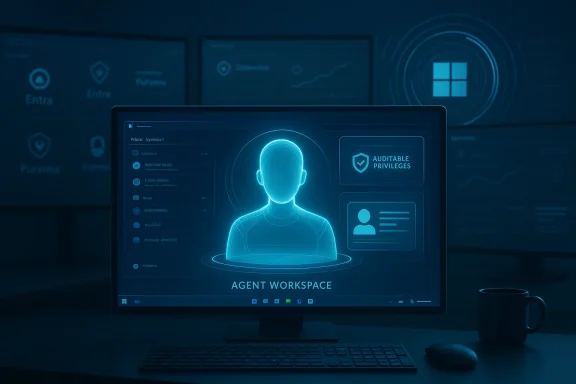
- An experimental Agent Workspace in Windows that provides a contained session for agents to operate and interact with local apps and files with scoped permissions.
- Copilot Actions (and an Agent Mode) that let agents execute multi‑step tasks — opening apps, clicking, typing, manipulating documents and orchestrating changes — inside that workspace.
- New identity and governance constructs (discussed publicly as Agent 365 and directory‑provisioned agent identities) that treat agents as directory objects with their own audit trails, credentials and policy attachments.
What Nadella actually said — and why it matters
During the Morgan Stanley session, Nadella framed three broad modes of AI interaction: (1) chat/co‑work, (2) delegated asynchronous access where you hand credentials to a tool to act on your behalf, and (3) a full digital worker — an identity with tools, a desktop and persistent context. He closed by saying the business model will likelth some limits of usage plus a meter,” and that agents should count as users for TAM purposes. (m.investing.com)Why this line is strategic, not rhetorical:
- It normalizes agents as billable seats. If an agent is treated as a user, it can be licensed, accounted for and governed via the same enterprise systems that handle human employees. That means easier forecasting for Microsoft and a straightforward commercialization path: every agent added could become another Microsoft 365 seat or a metered consumption item.
- It reframes identity, audit and compliance. Counting agents as users implies the agent must have an identity, authentication method and a place in the org directory — and those come with compliance obligations (retention, eDiscovery, role‑based access). Microsoft has signaled this with new agent governance concepts.
- It changes the attack surface. A digital worker with a directory identity that can read files, send email and operate in Teams creates a high‑value automation target for attackers; compromise of an agent is logically similar to compromise of a privileged service account. Microsoft explicitly warns of these emergent threats.
Anatomy of the agentic platform: how Microsoft is building it
Agent Workspace and Copilot Actions
Microsoft’s Agent Workspace is pitched as a contained desktop — a session where one or more agents run with explicit, auditable privileges separate from the user’s primary desktop. Agents operating in that workspace can access local files, interact with UI elements and execute multi‑step workflows. Early insider previews and product support pages make this behavior explicit: agents can “open apps, click and type” and perform chained tasks when granted permission. ([windowscentral.cscentral.com/microsoft/windows-11/microsoft-just-revealed-how-windows-11-is-evolving-into-an-agentic-os-finally-the-explanation-weve-all-been-waiting-for)Key product capabilities reported in previews and independent writeups:
- A sandboxed desktop session (Agent Workspace) that isolates agent activity and captures an audit trail.
- Copilot Actions that permit agents to manipulate applications and documents, run automation sequences and return results to the user’s main session.
- Integration hooks to Microsoft 365 services so agents can orchestrate across Teams, Exchange, SharePoint and OneDrive when organization policy allows.
Agent identities, provisioning and governance
Public descriptions of Microsoft’s roadmap and enterprise features indicate agents will be first‑class directory objects — meaning they can be given email addresses, Teams presence and Enso they show up in org charts and access logs. Independent reporting has described product entries such as “Agent 365” or “Agentic Users” that function as a control plane for discovery, provisioning and lifecycle governance.This model enables:
- Central lifecycle management (create, revoke, quarantine).
- Policy attachment (conditional access, least privilege).
- Auditing for compliance and eDiscovery.
Agent governance primitives Microsoft has signaled
- Permission flows. Agents operate only with explicit, consented access to apps and data; permissions are revocable and auditable per Microsoft’s support guidance.
- Containment and revocation. The Agent Workspace and policy controls aim to limit lateral movement and to stop agents from arbitrarily touching secure stores. That promise remains to be demonstrated at scale.
The business model: subscriptions, meters and the TAM play
Nadella’s comment about treating agents as users is squarely about TAM expansion: if every organization can spawn dozens or thousands of agents that each require identity, governance and a seat in M365, that multiplies Microsoft’s addressable market. He outlined a hybrid model: a baseline subscription with usage caps plus consumption meters for heavier workloads. (m.investing.com)Practical implications:
- Enterprises will face two licensing levers: a per‑agent subscription (predictable, familiar) or a metered consumption model (variable, token‑based) for heavy‑use agents such as continuous data ingestion or large‑scale automation.
- Microsoft’s integrated stack (Windows + M365 + Entra + Defender + Purview) becomes more valuable because it offers a single wheelhouse to manage agent cost, identity, security and compliance — a classic platform advantage.
Security and privacy: new risks that are genuinely novel
Microsoft’s own security documentation warns that letting agents act autonomously opens new classes of vulnerabilities, from cross‑prompt injection (malicious content infecting the agent’s instruction stream) to adversarial input that causes agents to leak secrets or install malware. Independent reporting highlighted Microsoft’s candid admission that agents may hallucinate, be tricked, or take unintended actions — and that the company is exposing these features initially behind experimental toggles for a reason.Why agents are riskier than prior automation:
- Persistent identities + privileges. A compromised agent is equivalent to a compromised service account with potentially broad access. Traditional endpoint defenses often assume a human in the loop; agents break that assumption.
- New attack vectors. Agentic UIs and multi‑turn decision loops introduce prompt injection pathways and cross‑context attacks where one agent’s output becomes another agent’s input. These threat modes are not well covered by existing static malware scanners.
- Data governance complexity. Agents can aggregate and export data across disparate systems. Determining data residency, retention and lawful access at the agent level will be a compliance headache if not properly instrumented.
- Agent identities that can be disabled or quarantined immediately.
- Fine‑grained consent flows and policy filters on data and action types.
- Robust audit trails and immutable agent action logs.
- Threat detection rules tuned for agent behavior (abnormal sequence patterns, sudden privilege escalation).
- Strict separation between agent runtime and sensitive stores (credential vaults, system directories).
Governance, compliance and enterprise control: the hard managerial problems
Treating agents as users reduces integration friction, but it also forces enterprises to answer uncomfortable governance questions:- Who owns an agent’s decisions? If an agent edits a contract and the organization is audited, which persona is accountable?
- Which legal hold or eDiscovery policy applies to agent communications and artifacts?
- How are provenance and chain‑of‑custody maintained when agents cut across human teams and external services?
Best practices for early adopters:
- Map out agent use cases and build a permission matrix before provisioning.
- Start with low‑risk agents that don’t touch regulated data or high‑value credentials.
- Implement mandatory audit logging and a rapid rollback pathway for misbehaving agents.
- Test adversarial scenarios (prompt injections, cross‑agent contamination) as part of your acceptance criteria.
Productivity upside — and the human cost
There’s no question that agentic automation has major upside. Early previews of Agent Mode in Office promise to turn a plain‑English brief into an auditable workbook, report or slide deck via a steerable, multi‑step agent — a workflow Microsoft calls “vibe working.” That pattern could dramatically compress routine knowledge work and free humans for higher‑value tasks.Potential productivity benefits:
- Agents can stitch data from multiple sources, run validation passes and surface a single artifact that’s closer to final form.
- Persistent agents can monitor a project, produce status updates and attend scheduled meetings with summary context.
- Teams can standardize repeatable knowledge tasks into reusable agent templates, reducing manual toil.
Ecosys: will the agentic web be open?
Microsoft has talked about an “open agentic web” and emergent protocols for agents to interoperate. That rhetoric suggests the company sees value in third‑party agents, marketplaces and interoperability — an important signal for developers and ISVs. At the same time, Microsoft’s platform advantage is its integrated governance stack: Entra for identity, Defender for security, Purview for compliance. Those are valuable hooks that encourage enterprises to standardize on Microsoft’s implementation.Two competing pressures will shape the ecosystem:
- A desire for open agentic protocols and portable agents that run across vendor stacks.
- A competing incentive to lock agents into the vendor that controls identity, governance and billing.
What IT administrators and security teams should do now
- Run pilots, not rollouts. Test agents in sandboxes and validate Microsoft’s containment and revocation promises before large‑scale deployment.
- Update threat models to recognize agent identity as a new privileged object; treat agent compromise as a high‑priority incident scenario.
- Define a data classification policy specifically for agent access. Not all data should be reachable by an autonomous agent.
- Instrument agent activity with immutable logs and monitoring to enable fast forensic reconstruction.
- Reexamine licensing and budgeting: if agents are billed as seats, finance teams must prepare for agent‑driven cost growth and meter surprises. (m.investing.com)
The broader picture: winners, losers and regulation
Microsoft’s strategy — treat agents as users, fold agent governance into existing enterprise controls, and monetize via a mix of seats and meters — gives it an advantaged position if the world accepts directory‑provisioned agents as the standard. Large enterprises that already run Microsoft software will find agent adoption easier because the management surface is familiar; that’s a competitive moat.Regulators, however, will notice. Agentic automation that creates documents, signs contracts or interacts with consumers raises liability questions: can an organization disclaim agent‑made statements, or must it implement human sign‑off? Privacy regulators will also be interested in how agents access personal or regulated data, and whether audit logs are sufficient for investigatory needs.
These are not theoretical concerns; they will be central to procurement, risk assessments and vendor contract clauses over the next two years.
Strengths, risks and a short checklist for procurement teams
Strengths
- Productivity gains from multi‑step, steerable automation inside familiar apps.
- Integrated governance reduces integration work for enterprises already using Microsoft 365.
- Clear commercialization model for Microsoft that scales TAM via agent seats and meters. (m.investing.com)
Risks
- Novel threat models (prompt injection, agent compromise) that current SOC playbooks don’t fully cover.
- Vendor lock‑in as governance becomes tied to platform identity and billing.
- Compliance and liability gaps around autonomous decision‑making and signed artifacts.
- Demand documented containment and revocation capabilities from vendors.
- Require agent audit logs with exportable, immutable formats for eDiscovery.
- Insist on role‑based permissioning for agent actions and explicit consent flows.
- Negotiate pricing guardrails for metered consumption to avoid surprise bills.
Conclusion
Satya Nadella’s line — that Microsoft looks at agents as users — neatly summarizes a design choice that has technical, commercial and governance consequences. Microsoft is building the technical scaffolding (Agent Workspace, Copilot Actions, Agent Mode) and the governance fabric (agent identities and Agent 365) to make agentic computing manageable for enterprises, and it is simultaneously defining a business model that monetizes agents. The immediate promise — more automation, higher productivity, conversational orchestration across apps — is real. The immediate risks — new attack surfaces, compliance complexity and vendor lock‑in — are also real.For IT leaders, the right posture is cautious pragmatism: pilot aggressively where the ROI is clear, invest in agent‑aware security and governance, and treat agent provisioning as seriously as you treat service accounts and privileged identities today. Microsoft’s vision of an “agentic” future is fast becoming a practical reality; whether it becomes a secure and manageable one depends less on marketing and more on the rigor of the governance and engineering that enterprise customers demand and validate. (m.investing.com)
Source: PC Gamer Microsoft CEO says 'I look at all agents as users', and yes that means AI ones too
