Microsoft’s latest push to treat AI as a first‑class member of the enterprise — provisioning autonomous, identity‑bearing AI agents that can attend meetings, send mail, edit files, and act on behalf of teams — represents one of the most consequential shifts in workplace technology since the arrival of cloud productivity suites.
Microsoft has moved rapidly from embedding language models into single‑user helpers to designing agentic systems — multi‑step, stateful actors that plan, act, and coordinate across apps and people. The company’s strategy stitches together several product pillars: Microsoft 365 Copilot, Copilot Studio (low‑code agent authoring), Azure AI Foundry (runtime and orchestration), identity primitives in Microsoft Entra for agent lifecycle control, and an in‑product Agent Store for discovery and procurement. That platform intention reframes agents not as ephemeral bots but as auditable, budgeted digital workers in enterprise catalogs.
Key elements of Microsoft’s agent architecture are now public: agents can be created in Copilot Studio and deployed into Microsoft 365 surfaces; they rely on Microsoft Graph for context (people, files, calendars); and the company is promoting interoperability through standards such as the Model Context Protocol (MCP) and agent‑to‑agent patterns to compose multi‑agent workflows. These pieces are designed to let organizations move from pilot projects to fleets of cooperating agents with observability, telemetry, and admin controls baked into the lifecycle.
However, the success of this digital‑workforce revolution depends squarely on enterprise discipline. Organizations must apply rigorous identity hygiene, conservative privilege models, clear procurement and cost controls, and ironclad auditability before letting agents act autonomously on sensitive processes. Where those controls exist, agents can be transformational; where they do not, the risk of costly mistakes, compliance violations, and runaway expenditure rises sharply. The future of work will include swarms of digital colleagues — but the difference between advantage and liability will be the governance humans build around them.
Source: WebProNews Microsoft’s AI Agents: Ushering in the Era of Digital Workforce Revolution
 Background / Overview
Microsoft has moved rapidly from embedding language models into single‑user helpers to designing agentic systems — multi‑step, stateful actors that plan, act, and coordinate across apps and people. The company’s strategy stitches together several product pillars: Microsoft 365 Copilot, Copilot Studio (low‑code agent authoring), Azure AI Foundry (runtime and orchestration), identity primitives in Microsoft Entra for agent lifecycle control, and an in‑product Agent Store for discovery and procurement. That platform intention reframes agents not as ephemeral bots but as auditable, budgeted digital workers in enterprise catalogs.Key elements of Microsoft’s agent architecture are now public: agents can be created in Copilot Studio and deployed into Microsoft 365 surfaces; they rely on Microsoft Graph for context (people, files, calendars); and the company is promoting interoperability through standards such as the Model Context Protocol (MCP) and agent‑to‑agent patterns to compose multi‑agent workflows. These pieces are designed to let organizations move from pilot projects to fleets of cooperating agents with observability, telemetry, and admin controls baked into the lifecycle.
What Microsoft announced — the core platform components
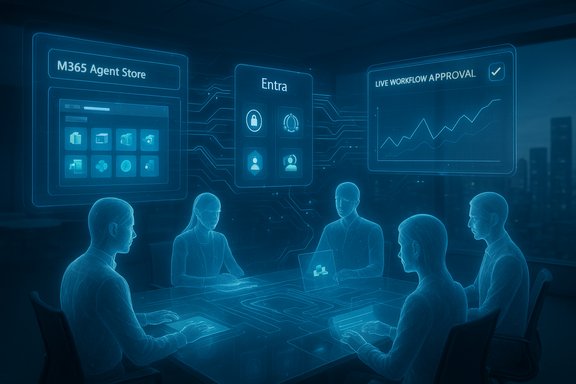
Microsoft’s agent initiative coalesces around a finite set of capabilities and commercial surfaces:- Agent Store (M365 Agent Store) — an in‑product marketplace surfaced inside Microsoft 365 Copilot and Teams where organizations can discover, request, pin and deploy agents built by Microsoft, partners or tenant teams. The store couples discovery with admin‑approval flows and lifecycle management.
- Agentic Users (Entra Agent ID) — agents will be represented as directory objects with managed identities in Microsoft Entra (often referred to as Entra Agent ID), enabling enrollment in access reviews, conditional access policies, and standard lifecycle processes. In many roadmap descriptions, these agentic users can receive mailboxes, Teams accounts, and org‑chart presence.
- Copilot Studio — a low‑code/visual authoring surface for creating, tuning, and publishing agents. Copilot Studio integrates with the Agent Store so tenant teams and partners can publish agents to an internal catalog or broader marketplace.
- Azure AI Foundry & Agent Framework — a developer‑grade runtime and SDK to orchestrate multi‑agent systems, provide observability and tracing, and run agents in production with enterprise controls. The open‑source Agent Framework aims to combine orchestration, tool integration, and governance primitives suitable for large fleets.
- Governance & Observability — Purview integrations, Copilot Control System admin surfaces, telemetry, and the promise of traceable model‑invoked actions to support auditability and compliance. These controls are built to let IT treat agents like other managed principals.
How these AI agents function in practice
At a functional level, Microsoft’s agents are intended to act like specialized, context‑aware teammates that can both advise and, where tenant policy permits, execute work:- Agents use Microsoft Graph as the context fabric (people, files, calendar, chats) so outputs are grounded in organizational metadata.
- Agent Mode / Office Agent flows allow agents to edit native documents (Word, Excel, PowerPoint) directly and present a plan view of multi‑step changes so users can inspect or roll back edits. That design choice prioritizes traceable changes over opaque generated blobs.
- Role‑specific agents (examples Microsoft has surfaced include Facilitator, Project Manager, Knowledge Agent, Interpreter) perform targeted duties: meeting facilitation and live notes, project planning and task orchestration, site‑scoped knowledge management, and real‑time translation. Some of these are in GA or public preview.
- Multi‑agent choreography is enabled by MCP and A2A patterns so agents can call each other’s tools or divide complex goals among specialist agents. This makes it practical to build composite workflows that cross teams and systems.
- Agents can be configured to take pre‑authorized actions — for example, creating Planner tasks, assigning tickets, or even calling external APIs — but tenant admins can constrain action scopes and require approval flows to reduce runaway behavior.
Early customer stories and measurable outcomes
Microsoft and partner case studies show early, concrete ROI that enterprises care about:- An educational deployment (Miami Dade College) reported higher student pass rates and lower dropout rates after piloting Copilot‑based study assistants.
- CSX built a Copilot-based assistant that handled thousands of customer interactions in weeks, accelerating self‑service and reducing manual handling.
- Industry accounts (Cineplex, Fujitsu) and partner case studies claim significant time savings and scale benefits when agentic automation replaces repetitive human tasks in customer service and sales proposal generation. These customer narratives illustrate practical scenarios where agents generate rapid value.
Strategic workforce implications
Microsoft’s framing of agents as “digital labor” has strategic consequences for how organizations plan headcount, skills and operating models. Internal and external reporting suggests three dominant shifts:- Augmentation over simple replacement: early vendor and analyst messaging emphasizes that agents remove repetitive, low‑value work so humans can focus on judgment, creativity and oversight. However, this augmentation often changes job designs more than it preserves them intact.
- New operating model — the “Frontier Firm”: Microsoft’s 2025 Work Trend Index and related roadmap language describe firms that reorganize around AI, pairing agent fleets with human oversight to unlock outsized productivity gains. That model requires new governance, cost allocation, and HR policies for digital workers.
- Hiring with leverage: some reporting indicates major tech employers are planning to hire with “more leverage” from AI — keeping headcount disciplined while expanding output through automation and agent tooling. These strategic choices will pressure HR and CIO teams to design reskilling programs and new career ladders focused on agent oversight and orchestration. This dynamic is visible in product and industry commentary but varies by firm and sector.
Security, governance and licensing: the fault lines
Introducing identity‑bearing, autonomous agents moves risk from the lab into the directory. Three categories of concern stand out:- Access & Identity Risk — Agents with Entra identities can be granted the same permissions as people. If an agent is overly privileged, compromised or misconfigured, it becomes a vector for lateral movement and data exfiltration. Microsoft’s design addresses this by bringing agents into Entra, conditional access, and access reviews — but those controls must be applied correctly for safety.
- Action & Data Governance — Agents able to edit files, send mail, or call third‑party APIs increase the surface area for mistakes and compliance breaches. Microsoft surfaces Purview integrations and action‑level gating, yet organizations must map which agents can take which actions and require approval flows for higher‑risk operations.
- Licensing, Cost and Control — Microsoft’s internal SKU references (reported as “A365” or “Agent 365” in some materials) and the Agent Store marketplace introduce questions about cost modeling, chargeback, and uncontrolled proliferation. Industry observers have warned that without strong governance, organizations may find agents proliferating — and budgets ballooning — faster than they can manage. Those concerns are grounded in early licensing commentary and roadmap leaks and merit tight IT governance.
Practical implementation checklist for CIOs and IT leaders
- Define a clear pilot scope: start with one or two low‑risk, high‑value agent use cases (meeting facilitation, templated report drafts, HR self‑service).
- Create ownership and lifecycle rules: assign a business owner, a security owner, and a cost center for each agent.
- Map privileges and data access: enumerate which connectors and datasets each agent needs and apply least‑privilege access via Entra and conditional access.
- Implement approval gates: use tenant admin flows to require sign‑off for agent templates and any action that changes production data.
- Instrument observability: enable tracing, logs, and a model‑invocation audit trail so decisions can be reconstructed.
- Price & chargeback: track agent consumption and billing tied to the Agent Store / marketplace SKU to prevent uncontrolled spend.
- Reskill & redesign roles: build oversight roles (agent steward, AI ethicist, prompt engineer) and reskill affected teams toward supervisory tasks.
- Run safety experiments: test agents in constrained sandboxes, run red‑teaming and content‑safety checks before scaling.
Critical analysis — what’s strong, and what keeps CIOs up at night
Strengths (why this could work at scale)- Platform integration is a major advantage. Microsoft can unify identity, content, telemetry, and developer workflows across Azure, GitHub, and Microsoft 365, which materially lowers the friction between prototyping and production. That end‑to‑end stack accelerates adoption for enterprises already invested in Microsoft technologies.
- Standards‑first interoperability (MCP, Agent‑to‑Agent) reduces vendor lock‑in and makes it feasible to combine partner agents and tenant agents into composite solutions — an important design choice for heterogeneous enterprise landscapes.
- Governance baked into tooling—Entra identities for agents, action gating, Purview integrations, and admin publishing flows—shows Microsoft understands the operational demands of regulated customers and is attempting to supply pragmatic tools.
- Privilege creep and identity sprawl. Agents with persistent identities invite the same drift and orphaned accounts that plague traditional IT. Without strict lifecycle management, agents could accumulate permissions and create persistent security liabilities.
- Licensing and cost management. The Agent Store model and emerging SKU references (for example, “A365” in internal materials) raise a real operational risk: uncontrolled agent proliferation can produce hidden recurring costs. Organizations will need formal procurement and chargeback policies to prevent budget shock. This is a practical, not theoretical, risk highlighted by licensing observers.
- Over‑trust in automation. Agents can act autonomously only within tenant policy constraints; still, eagerness to automate could lead organizations to grant broader privileges than necessary. Human oversight and clear fail‑safe modes are essential to prevent costly errors.
- Explainability and auditability. Despite Microsoft’s observability work, reconstructing why a multi‑step agent made a specific external API call or edited a document can be nontrivial. Regulated industries will demand auditable trails and provenance before they allow agents to act autonomously on high‑risk processes.
- Vendor & supply chain dependence. Composing agents that rely on third‑party models or external APIs introduces supply‑chain risk. Organizations should map dependencies and ensure contractual and technical mitigations for continuity and compliance.
- Some public commentary and social posts suggest organizations will deploy “hundreds of thousands” of agents or that a specific SKU name has been finalized. Those claims should be treated with caution until Microsoft’s public commercial documentation or official pricing pages confirm them. Internal roadmaps and early previews provide strong direction, but exact scale and SKU details can change before formal GA and pricing announcements.
Regulatory, ethical and societal considerations
Deploying agents at scale changes accountability lines. When an agent makes a decision that affects customers or employees, organizations must answer:- Who owns the decision and the remediation process?
- How are customers informed that they interacted with an agentic user versus a human?
- What are retention and audit requirements for agent interactions in regulated sectors?
The near‑term outlook: practical steps and realistic expectations
Expect incremental adoption in 12–18 months in structured use cases: meeting facilitation, HR self‑service, project coordination, and tactical customer service automation. Larger enterprise re‑wiring to become “Frontier Firms” will take longer because it demands cultural change, new governance disciplines, and demonstrable safety cases. Companies that succeed will balance aggressive pilots with conservative governance, instrument observability early, and treat agent budgets as first‑class financial assets.Conclusion
Microsoft’s agent strategy elevates AI from assistant to colleague — a change that promises substantial productivity gains where agents reliably remove routine work, stitch together siloed systems, and keep teams synchronized. The technical foundation is real: identity, marketplace, low‑code authoring, and a runtime for multi‑agent orchestration are already in preview or early production.However, the success of this digital‑workforce revolution depends squarely on enterprise discipline. Organizations must apply rigorous identity hygiene, conservative privilege models, clear procurement and cost controls, and ironclad auditability before letting agents act autonomously on sensitive processes. Where those controls exist, agents can be transformational; where they do not, the risk of costly mistakes, compliance violations, and runaway expenditure rises sharply. The future of work will include swarms of digital colleagues — but the difference between advantage and liability will be the governance humans build around them.
Source: WebProNews Microsoft’s AI Agents: Ushering in the Era of Digital Workforce Revolution