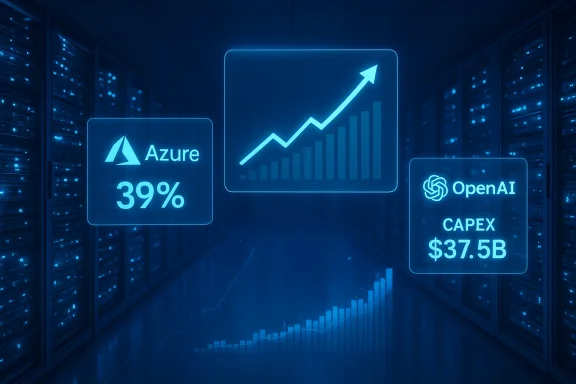
Microsoft’s latest quarter forced the market to ask a blunt question: can Azure’s still-impressive top-line growth justify an unprecedented surge in capital spending — and at what cost to margins and free cash flow?
Microsoft reported a strong quarter in absolute terms — revenue of roughly $81.3 billion and continued strength across productivity and cloud offerings — yet the numbers that dominated headlines were not revenue but capital expenditures and the shape of cloud growth going forward. Management disclosed quarterly CapEx near $37.5 billion, a year‑over‑year leap driven largely by purchases of GPUs, CPUs and other short‑lived compute assets for AI workloads. That scale of spending and the company’s disclosure that roughly 45% of its commercial remaining performance obligations (RPO) — about $625 billion — relates to OpenAI repositioned investor debate upside” to “timing, capacity and concentration risk.”
Those headline figures explain why a portion of the Street has paused: analysts at several firms, led by Stifel’s Brad Reback, downgraded or trimmed targets, arguing that Wall Street’s 2027 expectations may be too optimistic given Azure’s supply constraints and a heavier-than-expected spending phase for AI infrastructure.
These notes mattered because they were not isolated: clustered downgrades on the same theme change the market’s risk calculus, contribute to multiple compression, and can trigger mechanical selling in funds that reweight by analyst sentiment or factor exposure. That is how a beat in headline numbers becomes a catalyst for a multi‑session repricng down the narratives: bullish, bearish, and the middle ground
Analysts who downgraded Microsoft did not argue that the company’s long‑term prospects are broken; rather, they highlighted a narrower and highly relevant point: the current phase is one of heavy spending, constrained capacity and elevated concentration, which together create a higher short‑term execution bar. If utilization and monetization accelerate as capacity comes online and Copilot pricing proves durable, Microsoft’s long‑term optionality remains enormous. If monetization lags or competition forces margin concessions, investors should expect a prolonged period of multiple and cash‑flow pressure.
For readers and investors, the right position depends on horizon and risk tolerance. For enterprises, the takeaway is to treat Azure capacity and Copilot economics as active procurement variables. For investors, the quarter presents both an opportunity to buy optionality at a discount if you believe in Microsoft’s long game, and a cautionary example of how hyperscaler economics have changed in the age of generative AI. The market has re‑priced that debate — now it’s up to Microsoft to demonstrate that the heavy spending will translate into durable, high‑quality revenue and free cash flow.
Conclusion
Microsoft’s recent quarter was a reminder that extraordinary growth narratives have hard accounting consequences. The company’s leadership in enterprise AI is real, but so are the financial and operational trade‑offs of building at hyperscaler scale. Investors, customers and partners should watch CapEx cadence, Azure utilization, Copilot monetization, and RPO conversion closely — those metrics will determine whether today’s infrastructure investment becomes tomorrow’s durable competitive advantage or an extended period of compressed returns.
Source: Finviz https://finviz.com/news/309273/stre...ft-msft-amid-azure-growth-and-capex-concerns/
 Background / Overview
Microsoft reported a strong quarter in absolute terms — revenue of roughly $81.3 billion and continued strength across productivity and cloud offerings — yet the numbers that dominated headlines were not revenue but capital expenditures and the shape of cloud growth going forward. Management disclosed quarterly CapEx near $37.5 billion, a year‑over‑year leap driven largely by purchases of GPUs, CPUs and other short‑lived compute assets for AI workloads. That scale of spending and the company’s disclosure that roughly 45% of its commercial remaining performance obligations (RPO) — about $625 billion — relates to OpenAI repositioned investor debate upside” to “timing, capacity and concentration risk.”Those headline figures explain why a portion of the Street has paused: analysts at several firms, led by Stifel’s Brad Reback, downgraded or trimmed targets, arguing that Wall Street’s 2027 expectations may be too optimistic given Azure’s supply constraints and a heavier-than-expected spending phase for AI infrastructure.
Why the market hit the brakes: the math of growth vs. CapEx
Azure growth is still large — but the trend matters
Azure and related cloud services grew in the high‑30s percent year‑over‑year — around 39% in the reported quarter — a growth rate that on its own is exceptional for a business of Microsoft’s scale. Yet investors were sensitive to the trajectory rather than the headline: a modest sequential deceleration on a very large revenue base reduces the marginal dollar value of each percentage point of growth, and that matters when capital spending is accelerating even faster.CapEx at hyperscaler scale: short‑lived compute vs. long‑lived assets
Microsoft explained that roughly two‑thirds of the quarter’s CapEx was for what it calls short‑lived compute — the GPUs and CPUs that drive AI training and inference. These assets are expensive and depreciate quickly relative to large data‑center shells and networking gear. The result: a lumpy cash outflow profile where cash spent today may take quarters or years to produce steady, high‑margin revenue depending on utilization, pricing power and product monetization. That is a structural change from prior cloud investment cycles where capacity could sit longer and be monetized more predictably.Concentration risk: the OpenAI component of RPO
Microsoft reported a commercial RPO of about $625 billion, and management said roughly 45% of that backlog comes from OpenAI commitments. That creates two practical investor concerns. First, a large contracted backlog can smooth revenue visibility but may mask where growth will actually be recognized and when cash flows will materialize. Second, the concentration of commitments tied to a single partner (even a strategically aligned one) amplifies execution and counterparty risk if priorities or sourcing change. Microsoft has argued publicly that the remaining 55% of RPO is diversified, yet the headline concentration figure was enough to refocus market attention on downside scenarios.The Street’s response: downgrades, modeling changes and target cuts
Several well‑known research shops moved more defensively after the earnings release and the associated disclosures. Stifel cut its rating from Buy to Hold and slashed its price target materially — citing Azure supply limits, intensifying competition (notably Google Cloud’s GCP/Gemini and Anthropic), and materially higher CapEx forecasts (Stifel now modeling roughly $200 billion for FY‑2027). The firm loweptions to reflect the heavier AI buildout. Other shops echoed the same themes in differing tones: concerns about near‑term margin dilution, Copilot monetization risks, and the pace at which new capacity can be profitably filled.These notes mattered because they were not isolated: clustered downgrades on the same theme change the market’s risk calculus, contribute to multiple compression, and can trigger mechanical selling in funds that reweight by analyst sentiment or factor exposure. That is how a beat in headline numbers becomes a catalyst for a multi‑session repricng down the narratives: bullish, bearish, and the middle ground
Narrative A — The near‑term skeptics (Why caution is rational)
- Rising CapEx outstrips revenue acceleration: If Microsoft continues to spend at this pace while Azure growth decelerates even slightly, the ratio of incremental revenue to incremental CapEx will deteriorate, pressing margins and free cash flow.
- Capacity and prioritization risk: With constrained GPU supply and multiple internal and external high‑priority uses (OpenAI, Anthropic, Microsoft’s Copilot products, and third‑party Azure customers), Microsoft may be forced into prioritization decisions that temporarily depress reported Azure growth even if underlying demand exists.
- Concentration in contracted backlog: Heavy dependence on a few large commitments raises counterparty and execution risks; if one large partner re‑negotiates or scales differently, the headline backlog could prove less reliable than it appears.
Narrative B — The strategic builders (Why many analysts remain constructive)
- Optionality at hyperscaler scale: When capacity comes online, Microsoft’s breadth (Office, Dynamics, Azure, GitHub, Xbox, Windows) and enterprise relationships create multiple monetization channels that can compound returns beyond raw compute sales.
- Product and commercial levers: Copilot and M365 integrations offer paths to higher ARPU (average revenue per user) through higher‑value bundles and enterprise upsells; a successful monetization of productivity AI could materially improve gross margins over time.
- Barriers to entry: Large‑scale hyperscaler investments and long lead times for data centers and GPU supply create defensible moats; smaller competitors can be outgunned on price, availability and breadth of services over time.
Technical and competitive landscape: why Azure’s capacity equation is now central
GPUs, supply chains and the new unit economics
AI workloads change the underlying unit economics of cloud. Training and inference require large bundles of GPUs, which are expensive, often provided under long lead times, and subject to vendor allocation regimes. Microsoft’s recent description of “short‑lived compute” spending means the company is buying assets that will be replaced or upgraded more frequently, increasing both depreciation and the elasticity of effective capacity. That matters because revenue recognition and utilization must keep pace — otherwise idle or underutilized capacity becomes an earnings drag.Competition: Google Cloud, Anthropic and others are not idle
Investors heard management but also watched competitors. Google Cloud’s advances with Gemini and Anthropic’s momentum introducing new multi‑upplier dynamics were cited by analysts as reasons Microsoft may not re‑capture easy share gains. Competition matters not only on price and features but on the ability to sign large, multi‑year compute commitments — the same market dynamics that produced Microsoft’s OpenAI‑heavy RPO can work for competitors.Product monetization: Copilot and the productivity flywheel
Microsoft has been explicit about embedding Copilot across Office and enterprise flows, and management disclosed increased paid usage metrics (for example, millions of paid seats in Copilot variants). However, monetization timing, pricing strategy (bundling vs. standalone), and customer willingness to accept additional per‑seat charges all influence how much of Azure’s AI spend will convert to durable, high‑margin revenue rather than be absorbed as internal cost for product differentiation. Analysts flagged the risk that Copilot may need to be bundled or subsidized initially, compressing near‑term margins even as adoption rises.Financial implications: cash flow, margins and valuation mechanics
Free cash flow pressure is the immediate concern
During the reported quarter, Microsoft’s cash paid for property, plant and equipment and related finance items outpaced operating cash flow, which led to a meaningful sequential decline in free cash flow. When CapEx exceeds operating cash flow, even temporarily, investors ask pragmatic questions about financing, buybacks, dividends, and the pace at which capital converts to profitable revenue. Historically high‑quality free cash flow has been a core pillar of Microsoft’s valuation — any threat to that metric invites multiple compression.Margin re‑rating scenarios to watch
- Base case: CapEx growth moderates as supply constraints ease, Azure utilization improves, Copilot monetization increases ARPU — gross margins recover toward consensus and the stock re‑rates gradually.
- Adverse case: CapEx remains elevated while Azure growth flattens, Copilot adoption is slower or bundled, OpenAI concentration complaints grow — gross margins decline materially, and multiples compress.
- Upside case: Microsoft uses scale to reduce cost per inference, Copilot becomes a high‑mart, and OpenAI commitments generate recurring high‑margin revenue — free cash flow rebounds and multiples expand.
What enterprise customers and partners should watch
- Capacity availability: Large customers will care about scheduling and SLAs for GPU‑heavy workloads; Microsoft’s prioritization policies (internal products vs. third‑party customers) matter materially to procurement decisions.
- Pricing and bundling: If Copilot is bundled or discounted to drive adoption, enterprise procurement teams should model TCO (total cost of ownership) and compare one‑time migration costs against recurring Copilot fees.
- Data portability and multi‑cloud strategy: Customers with mission‑critical AI needs may hedge across providers to avoid vendor concentration risk; Microsoft’s OpenAI exposure in its RPO could push some large customers to diversify.
Investment implications: how different investor types should think about MSFT now
For long‑term investors (5+ years)
Microsoft remains a franchise with diversified cash flows, deep enterprise penetration, and multiple monetization levers across software, cloud, developer tools, and productivity. If you believe generative AI adoption will be widespread and Microsss these touchpoints, near‑term capex is an investment rather than a cost. Dollar‑cost averaging or opportunistic add‑on purchases during episodes of volatility are reasonable for patient investors who accept a period of cash flow normalization.For total‑return and income investors
Rising capex implies that buybacks and dividend growth could be moderated relative to prior trends if free cash flow itor quarterly free cash flow and management commentary on capital allocation priorities before betting on yield growth.For traders and short‑term speculators
Volatility is likely to persist around the cadence of capacity additions, OpenAI disclosures, and competitive product launches (Google/Anthropic). Short‑term trades should be sized carefully, and catalysts to monitor include CapEx guidance updates, RPO recognition schedules, and Copilot adoption metrics.Risks, caveats and unverifiable claims
- Management’s projections about the timing of revenue recognition from large RPOs carry model risk; how and when those contracts convert to revenue depends on service delivery, customer behavior and potential contract amendments. Treat aggregated RPO as visibility rather than guaranteed near‑term revenue.
- Analyst CapEx forecasts (for example, Stifel’s ~$200 billion FY‑2027 view) are model assumptions, not company guidance. They are reasonable sensitivity checks but should not be treated as incontrovertible facts.
- Public metrics on Copilot paid seats and other usage figures are helpful but incomplete: usage intensity, retention, and pricing are the true monetization levers and are only partially observable from disclosed headline numbers. Treat any single usage metric as directional rather than determinative.
Practical checklist for monitoring Microsoft (MSFT) going forward
- Quarterly CapEx and the breakdown between short‑lived compute and long‑lived assets.
- Azure sequential growth and any management comments on capacity prioriposition and the percentage tied to OpenAI (and other large partners).
- Copilot monetization signals: paid seats growth, ARPU, bundle vs. standalone pricing.
- Competitor announcements (Google Cloud/Gemini, Anthropic, AWS) that could re‑price cloud economics.
Final analysis: balanced view of opportunity and execution risk
Microsoft sits at the intersection of two powerful forces: the monumental commercial opportunity presented by enterprise AI and the extraordinary capital intensity required to serve that opportunity at hyperscaler scale. The company’s breadth of software and enterprise relationships gives it a structural advantage — a potential productivity flywheel where Copilot features drive platform stickiness and Azure consumption. At the same time, the market’s immediate, rational concern is mechanical: when will the billions spent on AI infrastructure translate into sustainably higher margins and free cash flow?Analysts who downgraded Microsoft did not argue that the company’s long‑term prospects are broken; rather, they highlighted a narrower and highly relevant point: the current phase is one of heavy spending, constrained capacity and elevated concentration, which together create a higher short‑term execution bar. If utilization and monetization accelerate as capacity comes online and Copilot pricing proves durable, Microsoft’s long‑term optionality remains enormous. If monetization lags or competition forces margin concessions, investors should expect a prolonged period of multiple and cash‑flow pressure.
For readers and investors, the right position depends on horizon and risk tolerance. For enterprises, the takeaway is to treat Azure capacity and Copilot economics as active procurement variables. For investors, the quarter presents both an opportunity to buy optionality at a discount if you believe in Microsoft’s long game, and a cautionary example of how hyperscaler economics have changed in the age of generative AI. The market has re‑priced that debate — now it’s up to Microsoft to demonstrate that the heavy spending will translate into durable, high‑quality revenue and free cash flow.
Conclusion
Microsoft’s recent quarter was a reminder that extraordinary growth narratives have hard accounting consequences. The company’s leadership in enterprise AI is real, but so are the financial and operational trade‑offs of building at hyperscaler scale. Investors, customers and partners should watch CapEx cadence, Azure utilization, Copilot monetization, and RPO conversion closely — those metrics will determine whether today’s infrastructure investment becomes tomorrow’s durable competitive advantage or an extended period of compressed returns.
Source: Finviz https://finviz.com/news/309273/stre...ft-msft-amid-azure-growth-and-capex-concerns/