

Microsoft and Databricks will use Data + AI Summit 2026, running June 15–18 in San Francisco and online, to position Azure Databricks as the governed enterprise platform for data engineering, analytics, AI applications, and agents. The pitch is not subtle: if AI is becoming a production workload, then the data platform underneath it has to become more unified, more open, and more politically acceptable inside large companies. That is why Microsoft’s presence as a top-tier sponsor matters less as conference theater than as a signal to Azure customers trying to decide where their next data architecture should settle. The real story is not another vendor summit; it is the accelerating contest to own the enterprise data control plane before agentic AI makes that control plane indispensable.
For years, Azure Databricks occupied a useful but slightly awkward place in Microsoft’s data estate. It was the Spark-native, lakehouse-oriented option for organizations that needed serious data engineering, machine learning, and large-scale analytics, while Microsoft also built out Synapse, Power BI, Purview, and later Fabric around its own integrated analytics story. Customers learned to live with the overlap because enterprise data platforms have never been tidy.
The 2026 summit messaging suggests a more confident alignment. Databricks and Microsoft are not presenting Azure Databricks as a satellite service bolted onto Azure, but as a first-party Microsoft offering that can function as the data-and-AI platform of record for organizations already committed to Azure. That phrasing matters because procurement, identity, networking, compliance, and support models often decide platform architecture long before engineers get to argue about query engines.
The joint post frames Azure Databricks as the “best data + AI platform on Azure,” which is exactly the kind of phrase that will make competitors wince and Microsoft platform loyalists squint. Microsoft has spent heavily to make Fabric the branded center of its data analytics push, and yet Databricks remains one of the most credible places for serious Spark, Delta Lake, MLflow, and Unity Catalog work. The result is a partnership that is both strategically convenient and structurally tense.
That tension is not necessarily bad for customers. Enterprise IT often benefits when two platform giants have to keep each other honest inside the same cloud ecosystem. Databricks gets Azure-native distribution and credibility; Microsoft gets a high-end data platform with deep open-source roots and an established base among data engineers who might otherwise drift toward AWS, Snowflake, or independent lakehouse stacks.
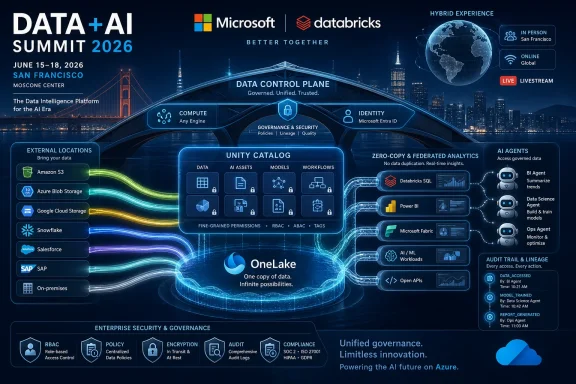
That is why Unity Catalog and external locations appear in the agenda as more than implementation details. Databricks is positioning Unity Catalog as the connective tissue between compute, storage, permissions, and AI workloads. Microsoft, meanwhile, needs that story to harmonize with Azure Data Lake Storage, OneLake, Microsoft Fabric, Azure security controls, and whatever governance posture customers have already built around Entra ID and Purview.
The planned discussion of Microsoft OneLake support for Unity Catalog external locations is especially interesting because it points toward a future where the fight is less about where bytes physically live and more about who governs them. If Databricks can read and write Unity Catalog-governed assets directly into OneLake storage without requiring another ETL pipeline, the architecture becomes more attractive to organizations that have already bought into Fabric but still want Databricks for engineering, AI, or multi-engine analytics.
This is the new center of gravity in enterprise data: fewer religious wars over the one true platform, more pressure to make multiple platforms behave as though they were designed together. That does not mean complexity disappears. It means complexity moves into the governance layer, the identity model, the catalog, and the contract between storage and compute.
The promised answer is a zero-copy, federated pattern that brings Databricks compute to the data rather than dragging data to another analytics environment. That is the sort of architecture that sounds obvious once described, but it is difficult to execute cleanly because enterprise data is rarely just a pile of files. It is wrapped in governance, regulatory expectations, specialist formats, operational workflows, and years of organizational habit.
For WindowsForum readers who spend more time in infrastructure than in upstream petroleum data, the lesson is broader. AI workloads are forcing organizations to re-evaluate old assumptions about data movement. Copying a few reports into a warehouse is one thing; copying petabyte-scale operational datasets into multiple AI sandboxes is quite another.
The zero-copy argument also reframes cloud economics. Vendors like to talk about performance and innovation, but many CIOs hear a simpler question: how many times am I paying to store, secure, scan, transform, and govern the same data? If Azure Databricks can credibly reduce that multiplication effect across specialized Microsoft data services, it gives enterprise buyers a cost and risk argument that is more durable than another AI demo.
If Microsoft and Databricks get the integration right, customers gain a more practical way to combine Fabric’s Microsoft-native analytics environment with Databricks’ engineering and AI platform. Data teams could reduce duplication, preserve governance, and choose engines based on workload rather than political allegiance. That is the idealized version, and it is attractive.
The messier version is that customers now have to understand two ambitious platform visions at once. Microsoft wants Fabric and OneLake to simplify analytics for the broad enterprise. Databricks wants its Data Intelligence Platform and Unity Catalog to unify data and AI across clouds, engines, and storage locations. Both stories use words like “open,” “unified,” and “governed,” but those words can conceal very different operational realities.
This is where administrators and architects should pay attention. The value of a OneLake external location will not be measured only by whether a demo can read and write data. It will be measured by identity behavior, permission inheritance, auditability, performance under real workloads, recovery procedures, cross-tool lineage, and how failure states present themselves to the people on call at 2 a.m.
That is the migration pattern vendors increasingly prefer to advertise because it is the one enterprises are most likely to believe. Nobody with a sprawling Hadoop estate, decades of data pipelines, and a thicket of compliance obligations wants to hear that modernization requires a cliff jump. They want coexistence, validation, performance testing, staged retirement, and enough openness to avoid being trapped in a new version of the old architecture.
Open standards are doing a lot of work in that story. Apache Iceberg and Apache Spark give vendors a shared vocabulary for interoperability, even when their commercial incentives differ. For customers, the question is whether “open” means meaningfully portable in production or merely compatible enough to support a vendor slide.
Still, the direction is encouraging. The most credible modernization pitches no longer pretend that enterprise data estates can be melted down and recast in a single platform mold. They acknowledge that modernization is usually a negotiation between old systems, new governance models, budget cycles, and business units that cannot stop operating while the architecture committee reaches consensus.
This is where Azure Databricks becomes strategically important for Microsoft. If agents are going to answer business questions, generate workflows, summarize operational records, assist analysts, or automate parts of finance and logistics, they need governed access to enterprise data. That makes the data platform less of a back-office analytics concern and more of a runtime substrate for AI-enabled work.
The Lovelytics and Lippert session, which highlights AI automation workflows for finance tasks using Azure Document Intelligence, points toward this more applied phase. The glamour in enterprise AI is often in model capability, but the implementation burden is in documents, exceptions, approvals, audit trails, and integration with existing systems. Finance automation is not impressive because a model can extract text; it is impressive only if the whole workflow can be trusted when money, compliance, and accountability are involved.
For sysadmins and IT leaders, this means AI strategy is no longer separable from data governance strategy. The moment an AI agent can act on business information, access control stops being a dashboard concern and becomes an operational safety boundary. That is why vendors are racing to place catalog, lineage, and policy enforcement at the center of their AI messaging.
That evolution mirrors the broader change in data work. A decade ago, the hard problem was often getting enough compute close enough to enough data to run large analytics jobs. Today, compute is easier to rent, but the harder problem is making data trustworthy, discoverable, governed, and usable by multiple engines and AI systems without creating a security nightmare.
The Databricks-Microsoft partnership is trying to answer that shift with a platform story that spans engineering, analytics, machine learning, governance, and AI agents. Whether that story feels elegant or sprawling depends on where you sit. A data engineer may see welcome consolidation. A Microsoft Fabric architect may see overlap. A security team may see another powerful control plane that needs careful review.
The best reading is that Azure Databricks is becoming a strategic interoperability layer for Microsoft’s highest-value data customers. That does not diminish Fabric; it clarifies that Microsoft’s data estate is too broad, and its customers too varied, for a single product narrative to carry every workload.
Azure Databricks therefore lands in the Windows and Microsoft admin world through identity, security, networking, auditing, and governance. The people approving these deployments are not only data scientists. They are cloud administrators, security architects, compliance officers, finance approvers, and platform teams who must make the service fit inside existing controls.
That is why “secure, scalable foundation” is more than marketing language. For Microsoft customers, the value of Azure Databricks depends on how well it behaves with the rest of Azure: private networking, managed identities, role-based access control, logging, key management, data residency, and operational monitoring. Those are not glamorous summit keynote topics, but they are the difference between a successful enterprise platform and a pilot that never clears security review.
The partnership also reflects Microsoft’s broader strategy of meeting customers where they already are. Rather than forcing every serious AI and analytics workload into one Microsoft-built stack, Azure can win by hosting and integrating the platforms customers already trust. That approach is less ideologically pure than a single-product vision, but enterprise IT has always rewarded workable integration over tidy branding.
That is why partner presence at Data + AI Summit matters. When IBM, SAP, KPMG, Infosys, NTT DATA, and others show up around the same event, they are not merely renting booths. They are helping customers map Databricks into consulting practices, packaged solutions, migration roadmaps, regulated-industry workflows, and board-level AI programs. Ecosystems turn platforms into defaults.
Microsoft’s role is especially consequential because Azure is already the enterprise cloud center of gravity for many Windows-heavy organizations. If Azure Databricks becomes the accepted high-end data and AI layer inside those accounts, Databricks gains distribution and Microsoft gains a credible answer to customers who want open lakehouse tooling without leaving Azure. That is a powerful mutual dependency.
But defaults are dangerous. Once a platform becomes the default, switching costs rise, skills concentrate, governance assumptions harden, and architectural alternatives become harder to justify. Customers should welcome integration while resisting complacency. The right question is not whether Azure Databricks is powerful; it is whether the organization can explain what it depends on, what remains portable, and where policy authority actually resides.
The announced and previewed sessions suggest where customers should focus their attention during and after the event:
The June summit will almost certainly bring polished demos, ambitious announcements, and the usual rhetoric about the next era of enterprise AI, but the durable impact will be measured later in architecture diagrams, security reviews, migration plans, and cloud bills. Microsoft and Databricks are betting that Azure customers want a governed bridge between their existing data estates and AI systems powerful enough to act on them. If that bet is right, Azure Databricks will become less a tool that data teams choose and more an enterprise platform that IT leaders must understand before the agents arrive in production.
 Microsoft and Databricks Are Selling the Same Future From Different Ends
For years, Azure Databricks occupied a useful but slightly awkward place in Microsoft’s data estate. It was the Spark-native, lakehouse-oriented option for organizations that needed serious data engineering, machine learning, and large-scale analytics, while Microsoft also built out Synapse, Power BI, Purview, and later Fabric around its own integrated analytics story. Customers learned to live with the overlap because enterprise data platforms have never been tidy.The 2026 summit messaging suggests a more confident alignment. Databricks and Microsoft are not presenting Azure Databricks as a satellite service bolted onto Azure, but as a first-party Microsoft offering that can function as the data-and-AI platform of record for organizations already committed to Azure. That phrasing matters because procurement, identity, networking, compliance, and support models often decide platform architecture long before engineers get to argue about query engines.
The joint post frames Azure Databricks as the “best data + AI platform on Azure,” which is exactly the kind of phrase that will make competitors wince and Microsoft platform loyalists squint. Microsoft has spent heavily to make Fabric the branded center of its data analytics push, and yet Databricks remains one of the most credible places for serious Spark, Delta Lake, MLflow, and Unity Catalog work. The result is a partnership that is both strategically convenient and structurally tense.
That tension is not necessarily bad for customers. Enterprise IT often benefits when two platform giants have to keep each other honest inside the same cloud ecosystem. Databricks gets Azure-native distribution and credibility; Microsoft gets a high-end data platform with deep open-source roots and an established base among data engineers who might otherwise drift toward AWS, Snowflake, or independent lakehouse stacks.
The Summit Agenda Turns Governance Into the Main Event
The most revealing word in the summit preview is not “AI,” “agents,” or even “analytics.” It is “governance.” Nearly every session description circles back to the same premise: enterprises do not primarily lack models, dashboards, or pipelines; they lack a way to make data usable across teams without turning access, lineage, and duplication into a bureaucratic hazard.That is why Unity Catalog and external locations appear in the agenda as more than implementation details. Databricks is positioning Unity Catalog as the connective tissue between compute, storage, permissions, and AI workloads. Microsoft, meanwhile, needs that story to harmonize with Azure Data Lake Storage, OneLake, Microsoft Fabric, Azure security controls, and whatever governance posture customers have already built around Entra ID and Purview.
The planned discussion of Microsoft OneLake support for Unity Catalog external locations is especially interesting because it points toward a future where the fight is less about where bytes physically live and more about who governs them. If Databricks can read and write Unity Catalog-governed assets directly into OneLake storage without requiring another ETL pipeline, the architecture becomes more attractive to organizations that have already bought into Fabric but still want Databricks for engineering, AI, or multi-engine analytics.
This is the new center of gravity in enterprise data: fewer religious wars over the one true platform, more pressure to make multiple platforms behave as though they were designed together. That does not mean complexity disappears. It means complexity moves into the governance layer, the identity model, the catalog, and the contract between storage and compute.
Zero-Copy Is the New Cloud Cost Argument
One of the more concrete sessions focuses on Azure Data Manager for Energy, where oil and gas companies use ADME as a subsurface system of record. The problem described is familiar far beyond energy: teams want advanced analytics and AI on large datasets, but the traditional path requires copying those datasets into downstream platforms. Every copy introduces cost, latency, security questions, and arguments over which system is the source of truth.The promised answer is a zero-copy, federated pattern that brings Databricks compute to the data rather than dragging data to another analytics environment. That is the sort of architecture that sounds obvious once described, but it is difficult to execute cleanly because enterprise data is rarely just a pile of files. It is wrapped in governance, regulatory expectations, specialist formats, operational workflows, and years of organizational habit.
For WindowsForum readers who spend more time in infrastructure than in upstream petroleum data, the lesson is broader. AI workloads are forcing organizations to re-evaluate old assumptions about data movement. Copying a few reports into a warehouse is one thing; copying petabyte-scale operational datasets into multiple AI sandboxes is quite another.
The zero-copy argument also reframes cloud economics. Vendors like to talk about performance and innovation, but many CIOs hear a simpler question: how many times am I paying to store, secure, scan, transform, and govern the same data? If Azure Databricks can credibly reduce that multiplication effect across specialized Microsoft data services, it gives enterprise buyers a cost and risk argument that is more durable than another AI demo.
OneLake Integration Is a Test of Microsoft’s Platform Diplomacy
Microsoft OneLake is one of the clearest symbols of the Fabric era. It is meant to be the single, logical data lake for Microsoft’s analytics platform, giving customers a unified storage foundation across workloads. Databricks’ Unity Catalog, meanwhile, is meant to provide consistent governance across the Databricks platform and its connected data assets. The summit session on external locations for OneLake is therefore not just a feature walkthrough; it is a diplomatic exercise.If Microsoft and Databricks get the integration right, customers gain a more practical way to combine Fabric’s Microsoft-native analytics environment with Databricks’ engineering and AI platform. Data teams could reduce duplication, preserve governance, and choose engines based on workload rather than political allegiance. That is the idealized version, and it is attractive.
The messier version is that customers now have to understand two ambitious platform visions at once. Microsoft wants Fabric and OneLake to simplify analytics for the broad enterprise. Databricks wants its Data Intelligence Platform and Unity Catalog to unify data and AI across clouds, engines, and storage locations. Both stories use words like “open,” “unified,” and “governed,” but those words can conceal very different operational realities.
This is where administrators and architects should pay attention. The value of a OneLake external location will not be measured only by whether a demo can read and write data. It will be measured by identity behavior, permission inheritance, auditability, performance under real workloads, recovery procedures, cross-tool lineage, and how failure states present themselves to the people on call at 2 a.m.
Customer Sessions Show the Migration Pattern Vendors Prefer
The GEODIS session may end up being one of the most practically relevant parts of the summit for large IT shops. The logistics provider’s story is framed around modernizing a data and AI platform with Azure Databricks while integrating with legacy Cloudera infrastructure through open standards such as Apache Iceberg and Apache Spark. The important phrase is that GEODIS avoided a “big bang” migration.That is the migration pattern vendors increasingly prefer to advertise because it is the one enterprises are most likely to believe. Nobody with a sprawling Hadoop estate, decades of data pipelines, and a thicket of compliance obligations wants to hear that modernization requires a cliff jump. They want coexistence, validation, performance testing, staged retirement, and enough openness to avoid being trapped in a new version of the old architecture.
Open standards are doing a lot of work in that story. Apache Iceberg and Apache Spark give vendors a shared vocabulary for interoperability, even when their commercial incentives differ. For customers, the question is whether “open” means meaningfully portable in production or merely compatible enough to support a vendor slide.
Still, the direction is encouraging. The most credible modernization pitches no longer pretend that enterprise data estates can be melted down and recast in a single platform mold. They acknowledge that modernization is usually a negotiation between old systems, new governance models, budget cycles, and business units that cannot stop operating while the architecture committee reaches consensus.
AI Agents Make the Data Platform Political Again
The summit preview repeatedly invokes the “agentic era,” and that phrase deserves skepticism. Enterprise software vendors have a gift for turning uncertain technology shifts into confident nouns. But behind the jargon is a real architectural problem: AI agents are only as useful as the data, permissions, tools, and operational context they can safely access.This is where Azure Databricks becomes strategically important for Microsoft. If agents are going to answer business questions, generate workflows, summarize operational records, assist analysts, or automate parts of finance and logistics, they need governed access to enterprise data. That makes the data platform less of a back-office analytics concern and more of a runtime substrate for AI-enabled work.
The Lovelytics and Lippert session, which highlights AI automation workflows for finance tasks using Azure Document Intelligence, points toward this more applied phase. The glamour in enterprise AI is often in model capability, but the implementation burden is in documents, exceptions, approvals, audit trails, and integration with existing systems. Finance automation is not impressive because a model can extract text; it is impressive only if the whole workflow can be trusted when money, compliance, and accountability are involved.
For sysadmins and IT leaders, this means AI strategy is no longer separable from data governance strategy. The moment an AI agent can act on business information, access control stops being a dashboard concern and becomes an operational safety boundary. That is why vendors are racing to place catalog, lineage, and policy enforcement at the center of their AI messaging.
Azure Databricks Is Becoming a Bridge, Not Just a Workspace
Azure Databricks began its Azure life in many organizations as a place where data engineers and data scientists worked in notebooks, clusters, and Spark jobs. That image is now too narrow. The summit agenda presents it as a bridge across cloud storage, Microsoft analytics services, legacy platforms, industry-specific systems of record, and AI application development.That evolution mirrors the broader change in data work. A decade ago, the hard problem was often getting enough compute close enough to enough data to run large analytics jobs. Today, compute is easier to rent, but the harder problem is making data trustworthy, discoverable, governed, and usable by multiple engines and AI systems without creating a security nightmare.
The Databricks-Microsoft partnership is trying to answer that shift with a platform story that spans engineering, analytics, machine learning, governance, and AI agents. Whether that story feels elegant or sprawling depends on where you sit. A data engineer may see welcome consolidation. A Microsoft Fabric architect may see overlap. A security team may see another powerful control plane that needs careful review.
The best reading is that Azure Databricks is becoming a strategic interoperability layer for Microsoft’s highest-value data customers. That does not diminish Fabric; it clarifies that Microsoft’s data estate is too broad, and its customers too varied, for a single product narrative to carry every workload.
The Windows Angle Is the Enterprise Management Angle
At first glance, a Databricks summit may seem distant from the traditional WindowsForum beat of client updates, Windows Server, endpoint management, and Microsoft ecosystem changes. But the connection is enterprise operations. The same organizations managing Windows fleets, Entra identity, Defender policies, Azure networking, and compliance baselines are now being asked to support AI platforms that touch sensitive business data.Azure Databricks therefore lands in the Windows and Microsoft admin world through identity, security, networking, auditing, and governance. The people approving these deployments are not only data scientists. They are cloud administrators, security architects, compliance officers, finance approvers, and platform teams who must make the service fit inside existing controls.
That is why “secure, scalable foundation” is more than marketing language. For Microsoft customers, the value of Azure Databricks depends on how well it behaves with the rest of Azure: private networking, managed identities, role-based access control, logging, key management, data residency, and operational monitoring. Those are not glamorous summit keynote topics, but they are the difference between a successful enterprise platform and a pilot that never clears security review.
The partnership also reflects Microsoft’s broader strategy of meeting customers where they already are. Rather than forcing every serious AI and analytics workload into one Microsoft-built stack, Azure can win by hosting and integrating the platforms customers already trust. That approach is less ideologically pure than a single-product vision, but enterprise IT has always rewarded workable integration over tidy branding.
The Real Competition Is for the Default Data Layer
Databricks is not the only company chasing this prize. Snowflake, Microsoft Fabric, Google BigQuery, AWS analytics services, IBM, SAP, and a long tail of governance and data catalog vendors all want to be the place where enterprise data becomes usable for AI. The competition is not simply about query speed or storage format. It is about becoming the default layer through which organizations define, discover, govern, and activate their data.That is why partner presence at Data + AI Summit matters. When IBM, SAP, KPMG, Infosys, NTT DATA, and others show up around the same event, they are not merely renting booths. They are helping customers map Databricks into consulting practices, packaged solutions, migration roadmaps, regulated-industry workflows, and board-level AI programs. Ecosystems turn platforms into defaults.
Microsoft’s role is especially consequential because Azure is already the enterprise cloud center of gravity for many Windows-heavy organizations. If Azure Databricks becomes the accepted high-end data and AI layer inside those accounts, Databricks gains distribution and Microsoft gains a credible answer to customers who want open lakehouse tooling without leaving Azure. That is a powerful mutual dependency.
But defaults are dangerous. Once a platform becomes the default, switching costs rise, skills concentrate, governance assumptions harden, and architectural alternatives become harder to justify. Customers should welcome integration while resisting complacency. The right question is not whether Azure Databricks is powerful; it is whether the organization can explain what it depends on, what remains portable, and where policy authority actually resides.
The Summit’s Concrete Signals Are More Useful Than the Slogans
The useful way to read the Data + AI Summit preview is not as a promise that Microsoft and Databricks have solved enterprise AI. They have not, and no vendor has. The useful reading is that several specific integration themes are moving from aspiration into product and field practice.The announced and previewed sessions suggest where customers should focus their attention during and after the event:
- Microsoft and Databricks are positioning Azure Databricks as a first-party Azure platform for governed enterprise data, analytics, and AI workloads, not merely as a Spark workspace for specialist teams.
- OneLake support through Unity Catalog external locations could make Fabric-and-Databricks coexistence more practical, especially for organizations trying to reduce ETL duplication.
- Zero-copy and federated analytics patterns are becoming central to the enterprise AI cost argument because copying large governed datasets into downstream platforms is increasingly hard to defend.
- Customer modernization stories such as GEODIS show that staged migration, open standards, and hybrid coexistence are now the credible path away from legacy big-data estates.
- Industry-specific systems of record, such as Azure Data Manager for Energy, are becoming test cases for whether AI platforms can bring compute to governed data without breaking operational trust.
- AI agents are pushing data catalogs, identity, lineage, and access control from supporting infrastructure into the center of enterprise architecture decisions.
The June summit will almost certainly bring polished demos, ambitious announcements, and the usual rhetoric about the next era of enterprise AI, but the durable impact will be measured later in architecture diagrams, security reviews, migration plans, and cloud bills. Microsoft and Databricks are betting that Azure customers want a governed bridge between their existing data estates and AI systems powerful enough to act on them. If that bet is right, Azure Databricks will become less a tool that data teams choose and more an enterprise platform that IT leaders must understand before the agents arrive in production.
References
- Primary source: Databricks
Published: Thu, 11 Jun 2026 21:40:33 GMT
Azure Databricks at Data + AI Summit 2026 featuring Industry Leaders and Partners | Databricks Blog
Join Microsoft and Databricks at the Data + AI Summit 2026 to discover how organizations are unifying data, analytics, and AI on an enterprise-ready cloud foundation. Explore exciting new joint product announcements, zero-copy federated analytics solutions, and expert-led breakout sessions...www.databricks.com - Related coverage: ibm.com
IBM at Databricks Data AI Summit
Join IBM at Data AI Summit by Databricks 2026 and explore the convergence of data and AI. www.ibm.com
- Related coverage: us.nttdata.com
Events
us.nttdata.com
- Related coverage: kpmg.com
KPMG at the Databricks Data + AI Summit 2026
KPMG is a proud sponsor of the Databricks Data + AI Summit 2026 in San Francisco, June 15 – 18, 2026.kpmg.com - Related coverage: infosys.com
Unlock AI Value | Infosys at Databricks Data + AI Summit 2026
Discover how Infosys helps enterprises unlock real AI value at Databricks Data + AI Summit 2026—agentic AI, governed data platforms, and scalable AI in action.www.infosys.com - Related coverage: community.databricks.com
Data + AI Summit 2026: Registration Now Open - Ear... - Databricks Community - 148835
June 15–18, 2026 Register Now! Join thousands of data analytics and AI professionals at Data+ AI Summit 2026 , the world’s largest - 148835community.databricks.com
- Related coverage: createwith.com
Data + AI Summit 2026 | Online | Create With
## Data + AI Summit 2026 Databricks invites you to a hybrid in-person/virtual conference in San Francisco and online, June 15–18, 2026.www.createwith.com - Related coverage: relvehq.com
Databricks Data + AI Summit 2026 | June 15-18 | San Francisco | Relve
Databricks Data + AI Summit 2026 runs June 15 to 18 at Moscone Center, San Francisco. The world's largest data and AI conference brings 30,000+ attendees and 80relvehq.com - Related coverage: solace.com
Databricks Data + AI Summit | Solace
Solace is proud to sponsor Databricks Data + AI Summit, the world’s largest data, analytics and AI conference. Come see us at booth 655 in the exhibit hall... solace.com
- Related coverage: posit.co
Events
Explore Posit events, demos, and webinars for R, Python, and data science pros. Connect, learn, and level up your analytics skills.posit.co
- Related coverage: impetus.com
Databricks Data + AI Summit 2026 - Impetus
Impetus is proud to be a Visionary Sponsor at Databricks Data + AI Summit 2026. Connect with us at booth #400 to discover how Impetus accelerates modernization, powers innovation, and enables the Intelligent Enterprise™ with software-led services and solutions. As a Databricks Gold Partner, we...www.impetus.com - Official source: learn.microsoft.com
Databricks Reference Architectures for the documentation 2025-10-14 - Google Slides
PDF documentlearn.microsoft.com
- Related coverage: exponam.com
- Related coverage: isg.sitefinity.cloud
2025 IPL Brochure Report
Business people join puzzle pieces in office. Concept of teamwork and partnership. double exposure with light effectsisg.sitefinity.cloud
- Official source: cdn-dynmedia-1.microsoft.com
- Related coverage: gdsgroup.com
- Related coverage: us-aisummit.com
Forum Europe-Global Master logos(OUTLINED)
Abstract fluid iridescent holographic neon curved wave in motion colorful background 3d render. Gradient design element for backgrounds, banners, wallpapers, posters and covers.us-aisummit.com
