

Microsoft and OpenAI have rewritten the operating logic of one of the most important partnerships in modern technology, replacing a tightly coupled exclusivity model with a more flexible framework for the next stage of artificial intelligence. The amended agreement keeps Microsoft at the center of OpenAI’s ecosystem through Azure-first product launches, long-term licensing rights, and a major shareholder position, but it also allows OpenAI to serve products across other cloud providers. This is not a divorce; it is a recognition that frontier AI has outgrown the infrastructure assumptions of its first commercial era. For Windows users, enterprise IT leaders, developers, and cloud buyers, the change signals a more competitive and more complicated AI market ahead.
That changed dramatically after the arrival of ChatGPT and the rapid spread of generative AI through productivity software, coding tools, search, customer support, and creative workflows. Microsoft moved quickly to integrate OpenAI technology into Bing, Microsoft 365 Copilot, GitHub Copilot, Azure OpenAI Service, and Windows-adjacent experiences. The alliance became a template for how a hyperscale cloud provider could turn frontier models into enterprise services.
The revised agreement reflects a different reality. AI demand now depends on massive data center capacity, specialized accelerators, energy availability, global distribution, security controls, and customer choice. No single partner, even one as large as Microsoft, can easily absorb every infrastructure need of a company trying to serve consumers, developers, enterprises, governments, and platform partners at once.
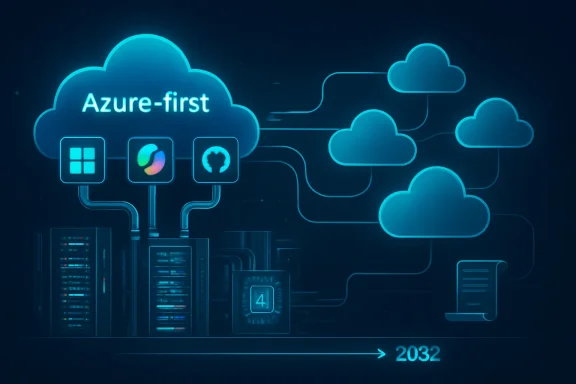
The key shift is that Microsoft retains long-term access to OpenAI models and products through 2032, but that license is now non-exclusive. OpenAI, in turn, can distribute its products across other clouds while still launching first on Azure unless Microsoft cannot or chooses not to support required capabilities.
But the scale of AI has changed faster than contractual models can comfortably absorb. Training frontier models requires enormous clusters, while inference for popular products demands global, always-on capacity that can handle unpredictable spikes. Enterprise adoption adds another layer, because regulated industries often require regional hosting, auditability, private networking, and compatibility with existing cloud contracts.
The amendment effectively acknowledges that compute scarcity is now a strategic constraint. OpenAI needs more routes to infrastructure, and Microsoft needs a clearer boundary between partnership and dependency. Both companies gain room to maneuver without publicly dismantling the relationship that helped define the AI boom.
Key pressure points likely pushed the companies toward a looser arrangement:
For enterprise customers, timing matters. Early availability can influence architecture decisions, procurement cycles, compliance reviews, and developer adoption. If the newest OpenAI capabilities continue to appear first through Azure or Microsoft-integrated products, Microsoft can maintain an edge even without full exclusivity.
Microsoft also keeps a license to OpenAI intellectual property for models and products through 2032. The important difference is that the license is now non-exclusive, meaning OpenAI can make similar or related capabilities available elsewhere. Still, long-term access gives Microsoft continuity for products like Copilot, Azure AI services, and developer platforms.
Microsoft’s retained advantages include:
Large customers increasingly want AI tools that fit existing technology estates. Some are deeply committed to AWS, others to Google Cloud, Oracle Cloud, private cloud, sovereign cloud, or hybrid infrastructure. If OpenAI can meet customers where they already operate, it can reduce friction in sales cycles and increase adoption across industries that might not want to route everything through Azure.
OpenAI also gains leverage in infrastructure negotiations. When a model developer can credibly buy capacity from multiple providers, cloud vendors must compete on price, performance, availability, security, and specialized silicon. That competition could help OpenAI lower costs and accelerate product deployment.
OpenAI’s new flexibility creates several opportunities:
Revenue-sharing arrangements can become awkward when a startup becomes a platform company. What begins as a sensible way to align incentives can later feel like a tax on expansion, especially when revenue flows through many products, partners, and cloud channels. The amended agreement appears designed to simplify that accounting while preserving Microsoft’s participation in OpenAI’s growth.
For Microsoft, capped payments reduce uncertainty and may make the economics of its OpenAI relationship easier to explain to investors. The company still benefits through cloud consumption, product differentiation, and equity exposure. For OpenAI, the cap likely improves long-term planning as it invests in compute, talent, safety, and distribution.
A practical reading of the new financial arrangement is:
The amended agreement shifts the center of gravity away from an AGI-triggered relationship and toward fixed timelines. Microsoft’s model and product license runs through 2032, while OpenAI’s revenue-share payments continue through 2030 under specified limits. That structure is easier for customers, investors, and regulators to understand.
This matters because frontier AI companies cannot run critical enterprise infrastructure on ambiguous philosophical thresholds. CIOs want service-level commitments, compliance documentation, regional availability, security controls, and pricing models. They do not want core vendor rights to depend on an argument over whether a lab has crossed a disputed scientific boundary.
The new approach has several advantages:
AWS and Google Cloud will see opportunity. AWS has enormous enterprise reach, custom silicon, and mature infrastructure relationships. Google brings deep AI research, Tensor Processing Units, Gemini, and a strong developer platform. Oracle, CoreWeave, and other specialized infrastructure players may also benefit as AI workloads fragment across providers.
But Azure’s AI position does not vanish. Microsoft has embedded OpenAI-derived capabilities across the productivity stack, which gives it a software distribution advantage that cloud rivals cannot easily duplicate. The battle shifts from “who has exclusive access” to “who can deliver the best combination of models, tools, governance, cost, and workflow integration.”
For cloud buyers, the new competitive landscape may look like this:
The more interesting question is whether Microsoft becomes more aggressive about model diversity. The company has already shown interest in using multiple models for different tasks, including smaller in-house models, specialized agents, and third-party systems. A less exclusive OpenAI relationship may accelerate that strategy.
In Microsoft 365, customers may eventually see AI features that route tasks across different model families depending on cost, latency, privacy requirements, or task type. A summarization job may not need the same model as legal drafting, code generation, spreadsheet analysis, or security triage. Microsoft’s advantage could come from orchestration rather than dependence on any single frontier model.
Windows and Microsoft 365 users should watch for:
Choice, however, brings governance challenges. If OpenAI products become available through several cloud channels, enterprises must compare security architecture, data residency, logging, identity integration, compliance certifications, and support models. The same model family may feel very different depending on how it is packaged and operated.
This is where Microsoft still has a strong hand. Azure OpenAI Service has been positioned around enterprise-grade controls, private networking, responsible AI features, and integration with Microsoft’s identity and compliance ecosystem. Organizations already standardized on Microsoft 365 and Entra ID may still prefer Azure as the cleanest route.
Enterprise evaluation should focus on:
The change also increases pressure on Microsoft’s developer platforms. GitHub Copilot, Visual Studio, Azure AI Foundry, and Windows developer tooling must compete on workflow quality rather than exclusive model access. That is healthy for developers, because it encourages better tooling, clearer pricing, and stronger interoperability.
At the same time, fragmentation could increase. Different clouds may package OpenAI capabilities with different APIs, governance layers, monitoring tools, and billing models. Developers will need abstraction strategies if they want to avoid lock-in at the model, orchestration, or cloud service layer.
Practical developer priorities include:
A non-exclusive structure gives OpenAI more freedom to work with other clouds and gives customers more paths to access its products. That could weaken arguments that Microsoft has an improper lock on a key AI input. It also makes the market appear more contestable, especially if AWS, Google, Oracle, and others can compete for OpenAI workloads or distribution.
Still, the regulatory story is not over. Microsoft remains a major shareholder and a central commercial partner. The combination of cloud infrastructure, productivity software, identity systems, developer platforms, security products, and AI assistants gives Microsoft a formidable stack.
Regulators and competitors will likely examine:
Microsoft will likely emphasize Azure’s enterprise controls, Copilot integration, and full-stack productivity advantage. OpenAI will likely pursue broader infrastructure and distribution partnerships while continuing to rely on Microsoft as a major strategic anchor. Competitors will use the opening to pitch themselves as neutral, flexible, or more cost-effective AI platforms.
What to watch next:
Microsoft and OpenAI have not ended their partnership; they have made it less brittle. The first phase of the alliance helped turn generative AI from a research breakthrough into a mainstream computing platform. The next phase will test whether two powerful companies can stay aligned while competing pressures pull AI toward multi-cloud distribution, specialized infrastructure, regulatory oversight, and enterprise pragmatism. For WindowsForum readers, the message is clear: AI’s future will not be defined by one model, one cloud, or one contract, but by the ecosystems that can deliver intelligence securely, affordably, and everywhere users already work.
Source: ET Edge Insights Microsoft and OpenAI reshape AI partnership for a more flexible future - ET Edge Insights
 Overview
From exclusive alliance to managed flexibility
The Microsoft-OpenAI partnership began in 2019 as a bold bet on large-scale AI infrastructure, with Microsoft investing heavily and Azure becoming the computing foundation for OpenAI’s ambitions. At that time, the commercial market for generative AI was still immature, and the idea of building custom supercomputing capacity for frontier models looked more like a research wager than a mainstream enterprise strategy.That changed dramatically after the arrival of ChatGPT and the rapid spread of generative AI through productivity software, coding tools, search, customer support, and creative workflows. Microsoft moved quickly to integrate OpenAI technology into Bing, Microsoft 365 Copilot, GitHub Copilot, Azure OpenAI Service, and Windows-adjacent experiences. The alliance became a template for how a hyperscale cloud provider could turn frontier models into enterprise services.
The revised agreement reflects a different reality. AI demand now depends on massive data center capacity, specialized accelerators, energy availability, global distribution, security controls, and customer choice. No single partner, even one as large as Microsoft, can easily absorb every infrastructure need of a company trying to serve consumers, developers, enterprises, governments, and platform partners at once.
The key shift is that Microsoft retains long-term access to OpenAI models and products through 2032, but that license is now non-exclusive. OpenAI, in turn, can distribute its products across other clouds while still launching first on Azure unless Microsoft cannot or chooses not to support required capabilities.
Why the Partnership Had to Change
AI demand broke the old cloud model
The original Microsoft-OpenAI structure made strategic sense when OpenAI needed a deep-pocketed infrastructure partner and Microsoft needed a frontier model advantage. Azure exclusivity gave Microsoft a differentiated story against Amazon Web Services and Google Cloud, while OpenAI gained access to capital, engineering support, and specialized compute. That bargain helped accelerate the first mainstream wave of generative AI.But the scale of AI has changed faster than contractual models can comfortably absorb. Training frontier models requires enormous clusters, while inference for popular products demands global, always-on capacity that can handle unpredictable spikes. Enterprise adoption adds another layer, because regulated industries often require regional hosting, auditability, private networking, and compatibility with existing cloud contracts.
The amendment effectively acknowledges that compute scarcity is now a strategic constraint. OpenAI needs more routes to infrastructure, and Microsoft needs a clearer boundary between partnership and dependency. Both companies gain room to maneuver without publicly dismantling the relationship that helped define the AI boom.
Key pressure points likely pushed the companies toward a looser arrangement:
- Explosive inference demand from ChatGPT, APIs, and enterprise tools.
- Data center bottlenecks involving power, chips, land, cooling, and interconnects.
- Customer requirements for multi-cloud procurement and regional deployment.
- Investor pressure for OpenAI to widen distribution and reduce platform constraints.
- Microsoft’s need to build a broader AI portfolio beyond a single model supplier.
What Microsoft Keeps
Azure-first still matters
Microsoft did not walk away empty-handed. Under the revised terms, Azure remains OpenAI’s primary cloud partner, and OpenAI products are still expected to ship first on Azure unless Microsoft cannot or chooses not to support the necessary capabilities. That “first on Azure” provision preserves a meaningful advantage for Microsoft’s cloud business.For enterprise customers, timing matters. Early availability can influence architecture decisions, procurement cycles, compliance reviews, and developer adoption. If the newest OpenAI capabilities continue to appear first through Azure or Microsoft-integrated products, Microsoft can maintain an edge even without full exclusivity.
Microsoft also keeps a license to OpenAI intellectual property for models and products through 2032. The important difference is that the license is now non-exclusive, meaning OpenAI can make similar or related capabilities available elsewhere. Still, long-term access gives Microsoft continuity for products like Copilot, Azure AI services, and developer platforms.
Microsoft’s retained advantages include:
- Primary cloud partner status for OpenAI.
- Azure-first launch positioning for OpenAI products.
- Model and product IP license extending through 2032.
- Continuing shareholder exposure to OpenAI’s growth.
- Deep product integration across Microsoft 365, GitHub, Windows, Security, and Azure.
- Enterprise trust channels built over decades with CIOs and IT departments.
What OpenAI Gains
Distribution becomes a strategic weapon
OpenAI gains something it badly needed: optionality. The company can now serve products across other cloud providers, which opens the door to broader enterprise distribution and more flexible infrastructure planning. That matters because the AI market is no longer limited to one API, one chatbot, or one cloud route.Large customers increasingly want AI tools that fit existing technology estates. Some are deeply committed to AWS, others to Google Cloud, Oracle Cloud, private cloud, sovereign cloud, or hybrid infrastructure. If OpenAI can meet customers where they already operate, it can reduce friction in sales cycles and increase adoption across industries that might not want to route everything through Azure.
OpenAI also gains leverage in infrastructure negotiations. When a model developer can credibly buy capacity from multiple providers, cloud vendors must compete on price, performance, availability, security, and specialized silicon. That competition could help OpenAI lower costs and accelerate product deployment.
OpenAI’s new flexibility creates several opportunities:
- Multi-cloud availability for customers with existing non-Azure commitments.
- More infrastructure capacity for training and inference.
- Stronger bargaining power with cloud and chip partners.
- Faster geographic expansion in markets where Azure capacity may not be optimal.
- Broader enterprise reach through multiple procurement channels.
- Reduced operational risk from relying too heavily on one infrastructure provider.
The Revenue Share Reset
A clearer financial runway
One of the most consequential changes is financial. Microsoft will no longer pay a revenue share to OpenAI, while OpenAI will continue making revenue-share payments to Microsoft through 2030 at the same percentage, subject to an overall cap. The cap matters because it gives both sides more predictability.Revenue-sharing arrangements can become awkward when a startup becomes a platform company. What begins as a sensible way to align incentives can later feel like a tax on expansion, especially when revenue flows through many products, partners, and cloud channels. The amended agreement appears designed to simplify that accounting while preserving Microsoft’s participation in OpenAI’s growth.
For Microsoft, capped payments reduce uncertainty and may make the economics of its OpenAI relationship easier to explain to investors. The company still benefits through cloud consumption, product differentiation, and equity exposure. For OpenAI, the cap likely improves long-term planning as it invests in compute, talent, safety, and distribution.
A practical reading of the new financial arrangement is:
- Microsoft stops paying revenue share to OpenAI.
- OpenAI continues paying Microsoft through 2030.
- The payment percentage remains the same, but total exposure is capped.
- Payments are no longer tied to technology milestones in the same open-ended way.
- Microsoft remains economically exposed through its shareholder position.
The AGI Clause Loses Power
From philosophical trigger to business timeline
Earlier versions of the Microsoft-OpenAI relationship were deeply shaped by the concept of artificial general intelligence, or AGI. The idea that a technical milestone could alter commercial rights created fascination, confusion, and potential conflict. In practice, AGI is hard to define, harder to verify, and almost impossible to translate cleanly into enterprise licensing terms.The amended agreement shifts the center of gravity away from an AGI-triggered relationship and toward fixed timelines. Microsoft’s model and product license runs through 2032, while OpenAI’s revenue-share payments continue through 2030 under specified limits. That structure is easier for customers, investors, and regulators to understand.
This matters because frontier AI companies cannot run critical enterprise infrastructure on ambiguous philosophical thresholds. CIOs want service-level commitments, compliance documentation, regional availability, security controls, and pricing models. They do not want core vendor rights to depend on an argument over whether a lab has crossed a disputed scientific boundary.
The new approach has several advantages:
- Clearer contract horizons for enterprise planning.
- Less dependence on contested AGI definitions.
- Reduced risk of sudden commercial discontinuity.
- Improved investor visibility into revenue and licensing rights.
- Better alignment with ordinary cloud procurement cycles.
Implications for Azure and the Cloud Wars
Microsoft’s advantage becomes execution-based
The biggest competitive question is whether Azure loses strategic ground now that OpenAI can work more freely with other clouds. The answer is nuanced. Microsoft loses exclusivity, but it retains early access dynamics, product integration, enterprise distribution, and years of operational experience running OpenAI workloads.AWS and Google Cloud will see opportunity. AWS has enormous enterprise reach, custom silicon, and mature infrastructure relationships. Google brings deep AI research, Tensor Processing Units, Gemini, and a strong developer platform. Oracle, CoreWeave, and other specialized infrastructure players may also benefit as AI workloads fragment across providers.
But Azure’s AI position does not vanish. Microsoft has embedded OpenAI-derived capabilities across the productivity stack, which gives it a software distribution advantage that cloud rivals cannot easily duplicate. The battle shifts from “who has exclusive access” to “who can deliver the best combination of models, tools, governance, cost, and workflow integration.”
For cloud buyers, the new competitive landscape may look like this:
- Azure remains the default route for Microsoft-integrated AI workloads.
- AWS gains a stronger opening for OpenAI-adjacent enterprise deployments.
- Google Cloud can compete with both first-party Gemini and possible OpenAI access.
- Oracle and specialist clouds may win capacity-driven infrastructure deals.
- Hybrid and sovereign providers may gain relevance in regulated regions.
Impact on Windows, Copilot, and Microsoft 365
The consumer experience may stay stable
For most Windows users, the immediate impact may be subtle. Copilot features in Windows and Microsoft 365 are unlikely to disappear simply because Microsoft’s license is now non-exclusive. Microsoft still has long-term access to OpenAI models and can continue integrating AI across its consumer and enterprise products.The more interesting question is whether Microsoft becomes more aggressive about model diversity. The company has already shown interest in using multiple models for different tasks, including smaller in-house models, specialized agents, and third-party systems. A less exclusive OpenAI relationship may accelerate that strategy.
In Microsoft 365, customers may eventually see AI features that route tasks across different model families depending on cost, latency, privacy requirements, or task type. A summarization job may not need the same model as legal drafting, code generation, spreadsheet analysis, or security triage. Microsoft’s advantage could come from orchestration rather than dependence on any single frontier model.
Windows and Microsoft 365 users should watch for:
- More model routing behind Copilot experiences.
- Faster feature differentiation between consumer and enterprise AI tiers.
- Improved admin controls for data handling and model selection.
- Tighter integration between Windows, Edge, Microsoft 365, and Azure AI.
- Potential branding changes as Microsoft emphasizes its own AI platform layer.
Enterprise Buyers Get More Choice
Multi-cloud AI becomes harder to ignore
For enterprise IT leaders, this amendment could be good news. OpenAI availability across multiple clouds may reduce procurement barriers and help organizations align AI projects with existing infrastructure. That is especially important for companies with long-term AWS or Google Cloud commitments.Choice, however, brings governance challenges. If OpenAI products become available through several cloud channels, enterprises must compare security architecture, data residency, logging, identity integration, compliance certifications, and support models. The same model family may feel very different depending on how it is packaged and operated.
This is where Microsoft still has a strong hand. Azure OpenAI Service has been positioned around enterprise-grade controls, private networking, responsible AI features, and integration with Microsoft’s identity and compliance ecosystem. Organizations already standardized on Microsoft 365 and Entra ID may still prefer Azure as the cleanest route.
Enterprise evaluation should focus on:
- Data residency and regional availability.
- Identity integration with existing access systems.
- Logging and auditability for regulated workflows.
- Model performance consistency across cloud environments.
- **Contractual treatment of prompts, outputs, and training data.
- Support accountability when multiple vendors are involved.
- Exit strategies if pricing or capabilities change.
Developers and the Platform Economy
APIs, agents, and tools enter a broader marketplace
Developers may benefit from a more open distribution model. If OpenAI services become easier to access across clouds, teams can build AI applications closer to their data, applications, and deployment pipelines. That reduces latency, simplifies networking, and may lower the political cost of adopting OpenAI tools inside companies committed to non-Azure platforms.The change also increases pressure on Microsoft’s developer platforms. GitHub Copilot, Visual Studio, Azure AI Foundry, and Windows developer tooling must compete on workflow quality rather than exclusive model access. That is healthy for developers, because it encourages better tooling, clearer pricing, and stronger interoperability.
At the same time, fragmentation could increase. Different clouds may package OpenAI capabilities with different APIs, governance layers, monitoring tools, and billing models. Developers will need abstraction strategies if they want to avoid lock-in at the model, orchestration, or cloud service layer.
Practical developer priorities include:
- Designing model-agnostic application layers where possible.
- Separating prompts, tools, and business logic from provider-specific APIs.
- Benchmarking latency and cost across deployment environments.
- Tracking model versioning to prevent unexpected behavior changes.
- Building observability for AI outputs, failures, and user feedback.
Regulatory and Competitive Context
Flexibility may reduce antitrust pressure
The Microsoft-OpenAI alliance has attracted scrutiny because it sits at the intersection of cloud concentration, AI model access, enterprise software, and strategic investment. When one of the world’s largest software companies holds deep rights to one of the world’s most important AI labs, regulators naturally ask whether competition is being constrained. The move away from exclusivity may help answer some of those concerns.A non-exclusive structure gives OpenAI more freedom to work with other clouds and gives customers more paths to access its products. That could weaken arguments that Microsoft has an improper lock on a key AI input. It also makes the market appear more contestable, especially if AWS, Google, Oracle, and others can compete for OpenAI workloads or distribution.
Still, the regulatory story is not over. Microsoft remains a major shareholder and a central commercial partner. The combination of cloud infrastructure, productivity software, identity systems, developer platforms, security products, and AI assistants gives Microsoft a formidable stack.
Regulators and competitors will likely examine:
- Whether Azure-first launch rights create practical market preference.
- Whether Microsoft product bundles disadvantage rival AI providers.
- Whether OpenAI cloud distribution is genuinely open or selectively constrained.
- Whether enterprise contracts steer customers toward specific AI stacks.
- Whether model access terms differ materially between Microsoft and competitors.
Strengths and Opportunities
A larger market with fewer artificial walls
The strongest argument for the amended partnership is that it aligns the contract with the reality of the AI market. Frontier AI is becoming infrastructure for software development, office work, cybersecurity, scientific research, customer support, education, and government operations. A single-cloud exclusivity model could slow that expansion just as demand is accelerating.- Microsoft preserves a central role while reducing the risk of being viewed as OpenAI’s only route to market.
- OpenAI gains infrastructure flexibility that may improve capacity, availability, and negotiating leverage.
- Enterprise customers gain more deployment choice across cloud environments and procurement models.
- Azure keeps first-launch relevance for Microsoft-centric organizations and Copilot-connected workflows.
- Developers may benefit from broader access to OpenAI tools near their existing data and applications.
- **Competition among cloud providers may improve pricing, performance, and service packaging.
- The financial reset improves predictability by replacing open-ended arrangements with clearer timelines and caps.
Risks and Concerns
More flexibility can mean more complexity
The revised structure also creates new risks. Exclusivity was restrictive, but it was simple. A multi-cloud OpenAI world may produce more options, more contracts, more integration decisions, and more confusion about where responsibility begins and ends.- Customer confusion may rise if OpenAI services vary across cloud providers.
- Governance could become harder when AI workloads span multiple infrastructure stacks.
- Microsoft may face margin pressure if Azure loses high-value OpenAI workloads to rivals.
- OpenAI may face operational strain managing more partners and deployment environments.
- Developers may encounter fragmentation in APIs, monitoring, billing, and compliance controls.
- Regulators may continue scrutiny because Microsoft still holds major economic and platform influence.
- Enterprise lock-in may shift layers from cloud exclusivity to orchestration tools, identity, or productivity suites.
Looking Ahead
The next phase will be measured in infrastructure
The next chapter of the Microsoft-OpenAI relationship will not be judged only by model benchmarks or chatbot features. It will be judged by data center buildout, chip supply, inference efficiency, enterprise adoption, security posture, and the ability to deliver AI reliably at global scale. The amended agreement gives both companies more room to attack those problems.Microsoft will likely emphasize Azure’s enterprise controls, Copilot integration, and full-stack productivity advantage. OpenAI will likely pursue broader infrastructure and distribution partnerships while continuing to rely on Microsoft as a major strategic anchor. Competitors will use the opening to pitch themselves as neutral, flexible, or more cost-effective AI platforms.
What to watch next:
- Which cloud providers receive major OpenAI workloads and how those services are packaged.
- Whether Azure retains first access to the most important OpenAI product launches.
- How Microsoft evolves Copilot with OpenAI, in-house models, and third-party systems.
- Whether enterprise pricing changes as OpenAI gains more distribution routes.
- How regulators interpret the shift from exclusivity to primary partnership.
Microsoft and OpenAI have not ended their partnership; they have made it less brittle. The first phase of the alliance helped turn generative AI from a research breakthrough into a mainstream computing platform. The next phase will test whether two powerful companies can stay aligned while competing pressures pull AI toward multi-cloud distribution, specialized infrastructure, regulatory oversight, and enterprise pragmatism. For WindowsForum readers, the message is clear: AI’s future will not be defined by one model, one cloud, or one contract, but by the ecosystems that can deliver intelligence securely, affordably, and everywhere users already work.
Source: ET Edge Insights Microsoft and OpenAI reshape AI partnership for a more flexible future - ET Edge Insights
