

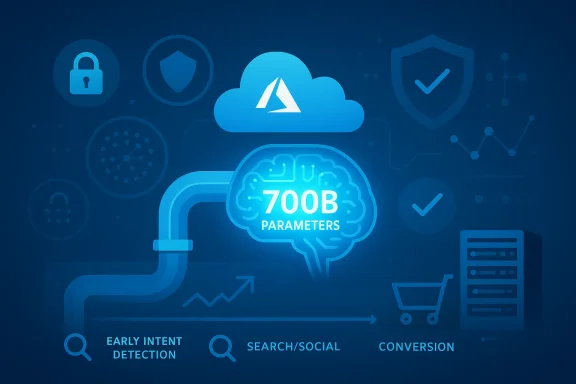
Microsoft’s backing of Yobi is a telling sign of where enterprise AI is heading: away from generic audience targeting and toward predictive, privacy-aware consumer intelligence that tries to anticipate intent before a customer ever types a search query. The startup’s pitch is ambitious, and the infrastructure behind it is even more so, with Azure positioned as the cloud engine for a 700 billion parameter model built on consented behavioral data. That combination raises real opportunities for brands that want better conversion efficiency, but it also invites hard questions about data governance, model opacity, and how far “responsible AI” can stretch when the goal is to influence buying behavior earlier in the journey.
The Microsoft-Yobi relationship did not appear out of nowhere. Microsoft highlighted Yobi in a customer story in July 2023, describing a partnership built around Azure Databricks, Azure Data Factory, and the idea of making customer behavioral data more usable without exposing raw identities. That earlier framing already positioned Yobi as a bridge between enterprise first-party data and third-party behavioral signals, with privacy-preserving embeddings used to represent behavior numerically rather than as obvious personal records.
Since then, Microsoft has continued pushing the narrative that its cloud and AI stack can support not only large language models, but also specialized partner solutions that help enterprises operationalize data more effectively. The company’s commercial marketplace has been one of the central vehicles for that strategy, giving customers a way to buy partner-built AI offerings directly through Microsoft’s procurement and cloud environment. In practical terms, that means Microsoft is not simply renting compute; it is helping shape the distribution channel for enterprise AI adoption.
Yobi, for its part, has long argued that large technology companies possess a structural advantage because they observe enormous amounts of customer behavior across digital touchpoints. The startup’s thesis is that most companies are locked out of that intelligence, especially as privacy laws and platform changes have made third-party data harder to use. Yobi’s response is to turn consented behavioral events into privacy-preserving representations that can be used for prediction, personalization, and audience modeling.
That is why this new wave of coverage matters. A partnership that once looked like a cloud collaboration has become a more explicit bet on behavioral AI at enterprise scale, with Microsoft lending platform operations and infrastructure support while Yobi focuses on model training and customer modeling. The result is a more serious industrialization of the same core idea: if you can understand likely behavior early enough, you can reshape marketing, retail, and customer engagement before the traditional conversion funnel even starts to narrow.
At the same time, the timing is revealing. Enterprise AI buyers are under pressure to justify spend, prove return on ad spend, and avoid privacy backlash. A system that promises earlier intent detection, while claiming not to reveal individual identities, is attractive precisely because it sits at the intersection of performance marketing, data science, and compliance theater — the place where many modern martech decisions are now made.
The more strategic implication is that Microsoft is signaling confidence in a category that blends AI with advertising, analytics, and customer identity resolution. That is not a generic use case; it sits in a commercially valuable but socially scrutinized part of the market. Backing Yobi suggests Microsoft sees an opportunity to sell infrastructure into a workflow where every performance gain can translate into marketing budget.
That scale also creates a perception advantage. Buyers tend to equate large models with greater sophistication, even when the business value comes from data quality, feature engineering, and deployment discipline. Yobi and Microsoft are likely aware of that, which is why the partnership language emphasizes both scale and privacy.
The bigger takeaway is that Microsoft is effectively helping define the enterprise AI stack as a platform plus partner ecosystem model. That strengthens Azure’s role against rival clouds by making vertical AI solutions easier to transact and scale. It also helps Microsoft present itself as the home for responsible, enterprise-ready AI rather than a generic compute provider.
This is also why the company’s pitch has appeal in categories like retail, consumer goods, and automotive, where purchase cycles are longer and signals are fragmented across channels. In those markets, any system that can improve propensity modeling can meaningfully affect campaign efficiency. The promise is not just more conversions; it is smarter timing.
The nuance, however, is that privacy-preserving does not automatically mean risk-free. Representations can reduce exposure, but they can still encode sensitive inference. If a model can accurately predict a person’s likely purchases, that is still a form of behavioral power, even if it never reveals a name or email address. That is the real policy question.
That could make it attractive to enterprise marketers who feel trapped between shrinking signal quality and escalating acquisition costs. It also means existing platforms may be forced to answer with better cross-channel identity models, stronger privacy controls, or more integrated offline-to-online measurement.
But the real value is stickiness. Once a company builds around Azure-based data services, model training, activation, and marketplace procurement, switching clouds becomes harder. Microsoft is making itself part of the operating system of the business, not just the vendor behind the scenes.
This matters because many AI startups are technically interesting but commercially underpowered. Microsoft can solve some of that by embedding the partner into its enterprise motion. In return, Azure gains another example of a specialized AI use case that validates the platform.
Yobi’s privacy-centric messaging gives Microsoft a more defensible story when the broader market remains nervous about data usage in AI. That is especially important in the United States, where consumer privacy expectations are rising but regulation remains fragmented. A system that emphasizes consented data and non-identifiable representations is easier to defend than a raw behavioral surveillance pitch.
Still, the distinction between a direct identifier and a predictive profile is more subtle than vendors often admit. If the system can predict purchase probability, product affinity, or conversion timing, then it becomes a powerful behavioral instrument even if the person’s name never appears in the workflow. The risk shifts from exposure to inference.
The same logic applies to attribution. Many organizations have too many data silos and too little confidence in channel-level effectiveness. Predictive behavioral models can help bridge that gap by offering a probability layer on top of historical spending.
It is less clear how well this approach generalizes to every B2B or low-frequency purchase environment. Behavioral signals there can be sparse, cycle times long, and attribution noisy. That means Yobi’s most compelling narrative is probably not universal; it is category-specific.
This is where Microsoft’s involvement helps and complicates matters. On one hand, Microsoft’s enterprise credibility may reassure customers that governance is being taken seriously. On the other hand, a larger platform makes the system more scalable, and scalability can magnify scrutiny.
This is why the language around “responsible AI” has to be examined carefully. Responsible to whom? Responsible in what jurisdiction? Responsible under what retention and access rules? Those questions matter more when the model is used to shape commercial behavior rather than simply answer a question.
The likely outcome is a market that moves toward governed inference. Companies will not necessarily stop using behavioral data; they will just use it through more abstracted, controlled, and vendor-managed systems. That is a meaningful shift, even if it does not satisfy critics.
This does not mean those channels become obsolete. It means they may become less central to the first discovery of intent and more central to final conversion capture. That is a subtle but important distinction, and it changes the economics of campaign planning.
That could force retail media and data collaboration vendors to lean harder into interoperability, measurement, and privacy guarantees. The market may reward systems that can combine first-party data with predictive intelligence across multiple environments, not just on a single platform.
That means companies like Microsoft will increasingly look for startups that can attach large models to a measurable business outcome. Pretty models do not matter much if they cannot improve acquisition cost, retention, or lifetime value.
The other thing to watch is whether this partnership becomes a template for similar deals. Microsoft has every incentive to keep assembling vertical AI offerings that run on Azure and live in the marketplace, especially in categories where data and compute are tightly linked. That would deepen Azure’s commercial moat while giving startups a route to scale that is more distribution-rich than traditional channel sales.
Source: TechRadar Microsoft backs Yobi’s behavioral AI system to reach customers faster
 Background
The Microsoft-Yobi relationship did not appear out of nowhere. Microsoft highlighted Yobi in a customer story in July 2023, describing a partnership built around Azure Databricks, Azure Data Factory, and the idea of making customer behavioral data more usable without exposing raw identities. That earlier framing already positioned Yobi as a bridge between enterprise first-party data and third-party behavioral signals, with privacy-preserving embeddings used to represent behavior numerically rather than as obvious personal records.Since then, Microsoft has continued pushing the narrative that its cloud and AI stack can support not only large language models, but also specialized partner solutions that help enterprises operationalize data more effectively. The company’s commercial marketplace has been one of the central vehicles for that strategy, giving customers a way to buy partner-built AI offerings directly through Microsoft’s procurement and cloud environment. In practical terms, that means Microsoft is not simply renting compute; it is helping shape the distribution channel for enterprise AI adoption.
Yobi, for its part, has long argued that large technology companies possess a structural advantage because they observe enormous amounts of customer behavior across digital touchpoints. The startup’s thesis is that most companies are locked out of that intelligence, especially as privacy laws and platform changes have made third-party data harder to use. Yobi’s response is to turn consented behavioral events into privacy-preserving representations that can be used for prediction, personalization, and audience modeling.
That is why this new wave of coverage matters. A partnership that once looked like a cloud collaboration has become a more explicit bet on behavioral AI at enterprise scale, with Microsoft lending platform operations and infrastructure support while Yobi focuses on model training and customer modeling. The result is a more serious industrialization of the same core idea: if you can understand likely behavior early enough, you can reshape marketing, retail, and customer engagement before the traditional conversion funnel even starts to narrow.
At the same time, the timing is revealing. Enterprise AI buyers are under pressure to justify spend, prove return on ad spend, and avoid privacy backlash. A system that promises earlier intent detection, while claiming not to reveal individual identities, is attractive precisely because it sits at the intersection of performance marketing, data science, and compliance theater — the place where many modern martech decisions are now made.
What Microsoft is actually supporting
The headline claim is simple: Microsoft is supporting Yobi’s 700 billion parameter model with Azure infrastructure. That sounds like a pure compute story, but the deeper point is that Microsoft is lending Yobi not just servers, but credibility and distribution. For a startup in a sensitive category like behavioral intelligence, cloud backing from a major vendor can be as important as the model itself.Compute is only part of the story
A model of that size implies serious training and inference demands. Large parameter counts are expensive to train, expensive to serve, and expensive to iterate on, especially when the underlying product is built around real-time behavioral activation. Microsoft’s role therefore matters because it helps de-risk the infrastructure layer, which is often the first bottleneck for startups trying to move from promising demo to enterprise-grade system.The more strategic implication is that Microsoft is signaling confidence in a category that blends AI with advertising, analytics, and customer identity resolution. That is not a generic use case; it sits in a commercially valuable but socially scrutinized part of the market. Backing Yobi suggests Microsoft sees an opportunity to sell infrastructure into a workflow where every performance gain can translate into marketing budget.
Why the 700B number matters
Parameter count is not a full proxy for model quality, but it is still a useful signal of ambition. A 700 billion parameter model implies a system designed to absorb huge amounts of behavioral variation and produce fine-grained predictions across audiences, categories, and channels. In other words, this is not a lightweight segmentation engine.That scale also creates a perception advantage. Buyers tend to equate large models with greater sophistication, even when the business value comes from data quality, feature engineering, and deployment discipline. Yobi and Microsoft are likely aware of that, which is why the partnership language emphasizes both scale and privacy.
Market positioning through Azure
Microsoft’s cloud also makes the product easier to buy. The Azure Marketplace route centralizes procurement, compliance, and integration in a way that enterprise customers already understand. In a market where many AI pilots die in procurement, that matters more than most vendors admit.The bigger takeaway is that Microsoft is effectively helping define the enterprise AI stack as a platform plus partner ecosystem model. That strengthens Azure’s role against rival clouds by making vertical AI solutions easier to transact and scale. It also helps Microsoft present itself as the home for responsible, enterprise-ready AI rather than a generic compute provider.
- Azure infrastructure reduces deployment friction.
- Marketplace availability improves enterprise procurement.
- Scale messaging helps Yobi stand out in a crowded AI market.
- Platform backing adds trust for privacy-sensitive buyers.
- Compute support lowers barriers to training large models.
How Yobi’s behavioral AI differs from traditional ad tech
Yobi’s core pitch is that it can identify likely buyers earlier than conventional search and social advertising systems. Traditional ad tech often waits for signals like keyword intent, retargeting behavior, or in-platform engagement before bidding on a user. Yobi says it can infer intent sooner by looking at consented real-world behavior such as purchases, store visits, and conversions.Earlier in the funnel is the whole point
If the system works as advertised, it could change how brands allocate spend. Instead of bidding only on people already showing overt interest, enterprises could focus on audiences whose offline and online behavior indicates future likelihood to buy. That is a major shift because it moves marketing from reaction to anticipation.This is also why the company’s pitch has appeal in categories like retail, consumer goods, and automotive, where purchase cycles are longer and signals are fragmented across channels. In those markets, any system that can improve propensity modeling can meaningfully affect campaign efficiency. The promise is not just more conversions; it is smarter timing.
Behavioral graphs and privacy-preserving representations
Yobi says it transforms raw behavior into machine-readable representations that preserve privacy. In practical terms, that means the system is meant to use abstracted behavioral patterns rather than expose a direct profile of an identifiable person. This is a familiar but important distinction in modern AI privacy architecture.The nuance, however, is that privacy-preserving does not automatically mean risk-free. Representations can reduce exposure, but they can still encode sensitive inference. If a model can accurately predict a person’s likely purchases, that is still a form of behavioral power, even if it never reveals a name or email address. That is the real policy question.
Why ad-tech rivals should care
This puts Yobi in competition not only with traditional ad networks, but also with data clean room vendors, retail media platforms, and customer data platform providers. Each of those categories has been trying to solve the same problem: how to use better data without crossing privacy lines. Yobi’s differentiator is that it claims to sit earlier in the process and to do so with a consented behavioral base.That could make it attractive to enterprise marketers who feel trapped between shrinking signal quality and escalating acquisition costs. It also means existing platforms may be forced to answer with better cross-channel identity models, stronger privacy controls, or more integrated offline-to-online measurement.
- Search ads capture explicit intent.
- Social ads often rely on platform-native engagement.
- Yobi aims to infer intent before both.
- Enterprise marketers may gain better audience timing.
- Rivals may have to improve cross-channel prediction.
A sequential view of the workflow
- Collect consented behavioral data from purchases, visits, and conversions.
- Transform data into privacy-preserving embeddings rather than raw identities.
- Train large behavioral models on the resulting data graph.
- Generate propensity signals for enterprise customers.
- Activate audiences in real time across online and in-store channels.
Why Microsoft finds this strategically useful
Microsoft’s support for Yobi fits a larger business pattern. The company has spent years trying to position Azure as the default home for enterprise AI workloads, especially those that need security, scale, and procurement simplicity. Partner stories like this help Microsoft show that Azure is not just for model hosting, but for end-to-end AI commercialization.The cloud economics are obvious
AI infrastructure is expensive, and vertical AI startups often need help reaching the level of scale where their products look credible to enterprise buyers. Microsoft benefits because the more compute-intensive the workload, the more valuable Azure becomes. That is a straightforward cloud economics story.But the real value is stickiness. Once a company builds around Azure-based data services, model training, activation, and marketplace procurement, switching clouds becomes harder. Microsoft is making itself part of the operating system of the business, not just the vendor behind the scenes.
A sales motion, not just a tech stack
There is also a commercial angle that should not be ignored. When Microsoft can surface a partner solution in Azure Marketplace, its own sales teams gain a cleaner path to bundle that offering into enterprise conversations. That can create a powerful distribution multiplier for a startup like Yobi.This matters because many AI startups are technically interesting but commercially underpowered. Microsoft can solve some of that by embedding the partner into its enterprise motion. In return, Azure gains another example of a specialized AI use case that validates the platform.
Trust as a sales lever
Judson Althoff’s framing that innovation should be built with trust and privacy at the core is not just branding. In enterprise AI, trust is now a procurement requirement. Buyers increasingly ask where data goes, how it is stored, what is inferred, and whether the system can be audited.Yobi’s privacy-centric messaging gives Microsoft a more defensible story when the broader market remains nervous about data usage in AI. That is especially important in the United States, where consumer privacy expectations are rising but regulation remains fragmented. A system that emphasizes consented data and non-identifiable representations is easier to defend than a raw behavioral surveillance pitch.
- Azure grows deeper into vertical AI.
- Marketplace distribution reduces go-to-market friction.
- Sales enablement can accelerate enterprise adoption.
- Trust language helps counter privacy concerns.
- Compute-heavy workloads reinforce Azure’s strategic position.
Enterprise use cases: marketing, retail, and customer intelligence
The most obvious beneficiaries are enterprises that live or die by customer acquisition efficiency. Retailers, consumer brands, and omnichannel businesses constantly struggle to stitch together online signals, in-store behavior, and CRM records into a single actionable view. Yobi claims to help unify those fragments into predictive intent signals.Personalization without raw identity exposure
A system like this is appealing because it promises personalization without requiring a company to directly expose raw consumer data to every internal or external tool. That matters for firms trying to balance data utility and privacy obligations. It also gives legal and compliance teams a more palatable structure for approval.Still, the distinction between a direct identifier and a predictive profile is more subtle than vendors often admit. If the system can predict purchase probability, product affinity, or conversion timing, then it becomes a powerful behavioral instrument even if the person’s name never appears in the workflow. The risk shifts from exposure to inference.
Better timing, better spend, better attribution
For marketing teams, timing is everything. If Yobi can help identify high-intent prospects before traditional channels notice them, enterprises may be able to lower acquisition costs and improve conversion rates. That is especially valuable in categories where media waste is high and margins are tight.The same logic applies to attribution. Many organizations have too many data silos and too little confidence in channel-level effectiveness. Predictive behavioral models can help bridge that gap by offering a probability layer on top of historical spending.
Where it could land first
This kind of system is likely to be strongest where there is rich offline behavior and repeat purchase potential. Think retail, consumer packaged goods, automotive, and certain financial services campaigns. In those sectors, the value of early intent detection can be substantial.It is less clear how well this approach generalizes to every B2B or low-frequency purchase environment. Behavioral signals there can be sparse, cycle times long, and attribution noisy. That means Yobi’s most compelling narrative is probably not universal; it is category-specific.
- Retailers can improve timing and audience quality.
- Consumer brands may lower acquisition waste.
- Omnichannel firms can unify offline and online signals.
- Legal teams may prefer privacy-preserving abstractions.
- Attribution teams may gain a better forecasting layer.
Data privacy and consent are the real battleground
Microsoft and Yobi both emphasize consent and responsible use, and that is not accidental. Behavioral AI sits in a highly sensitive space where customer trust can evaporate quickly if users feel tracked, profiled, or manipulated. The promise of privacy-preserving inference is therefore not a side note; it is the core of the business model.Consent does not eliminate controversy
Even when data is consented, consumers rarely understand the full extent of downstream modeling. A customer may agree to one set of terms without grasping that their visit history or purchase behavior could help train predictive systems targeting future offers. That gap between legal consent and informed consent is one of the central tensions in modern adtech.This is where Microsoft’s involvement helps and complicates matters. On one hand, Microsoft’s enterprise credibility may reassure customers that governance is being taken seriously. On the other hand, a larger platform makes the system more scalable, and scalability can magnify scrutiny.
Privacy-preserving does not mean invisible
A privacy-preserving representation can hide direct identity while still allowing powerful inference. That is a useful engineering trade-off, but it is not a moral blank check. If a model reliably predicts spending capacity, brand affinity, or shopping intent, it can still influence people in ways they do not expect.This is why the language around “responsible AI” has to be examined carefully. Responsible to whom? Responsible in what jurisdiction? Responsible under what retention and access rules? Those questions matter more when the model is used to shape commercial behavior rather than simply answer a question.
Why enterprises may still sign up
Despite those concerns, enterprises will likely keep buying tools in this category if the performance story is strong enough. Marketing departments are under pressure to do more with less, and privacy changes have reduced the effectiveness of older tracking methods. That creates a demand vacuum that behavioral AI vendors are eager to fill.The likely outcome is a market that moves toward governed inference. Companies will not necessarily stop using behavioral data; they will just use it through more abstracted, controlled, and vendor-managed systems. That is a meaningful shift, even if it does not satisfy critics.
- Consent helps, but it does not erase concern.
- Inference is still sensitive even without direct identifiers.
- Governance will matter as much as model quality.
- Scalability can magnify scrutiny.
- Enterprise demand will remain strong if ROI is clear.
Competitive implications for the wider AI and ad-tech market
Yobi’s rise, supported by Microsoft, should be read in the context of a larger race to control predictive customer intelligence. Search, social, retail media, CDPs, and clean rooms are all converging on the same prize: the ability to predict who will buy, when they will buy, and how much it will cost to influence them.Search and social are not the only game anymore
Traditional digital advertising has long relied on explicit signals or platform-controlled audience data. That model is still powerful, but it is also increasingly constrained by privacy rules, browser changes, and platform fragmentation. A behavioral AI layer that operates earlier in the buying journey could chip away at the dominance of search and social.This does not mean those channels become obsolete. It means they may become less central to the first discovery of intent and more central to final conversion capture. That is a subtle but important distinction, and it changes the economics of campaign planning.
Retail media will feel the pressure too
Retail media networks have become one of the fastest-growing parts of digital advertising because they combine transaction data with audience targeting. Yobi’s model overlaps with that logic but expands beyond a single retailer’s data silo. If it works well, it could offer a broader behavioral layer that customers can use across channels.That could force retail media and data collaboration vendors to lean harder into interoperability, measurement, and privacy guarantees. The market may reward systems that can combine first-party data with predictive intelligence across multiple environments, not just on a single platform.
The enterprise AI arms race is getting more vertical
There is also a broader lesson here about the direction of AI commercialization. The market is moving away from generic model demos and toward vertical products that solve a narrow but expensive business problem. Predicting customer intent is one of those problems, and it has a direct line to revenue.That means companies like Microsoft will increasingly look for startups that can attach large models to a measurable business outcome. Pretty models do not matter much if they cannot improve acquisition cost, retention, or lifetime value.
- Search platforms may lose some early-intent dominance.
- Social platforms may become more downstream in the funnel.
- Retail media will face pressure to integrate broader behavior.
- Vertical AI is becoming the most commercial path to scale.
- Measurement will be the deciding battleground.
A few market effects to watch
- More privacy-preserving audience modeling products.
- Greater emphasis on first-party data activation.
- Increased bundling of AI infrastructure and partner software.
- More scrutiny of inference-based marketing claims.
- Rising demand for cross-channel attribution tools.
Strengths and Opportunities
Yobi and Microsoft appear to be targeting a genuine market pain point: enterprises want better predictive intelligence without the compliance and fragmentation headaches that come with older data strategies. The partnership also gives the startup a distribution and infrastructure advantage that many competitors simply do not have. If the product delivers even a portion of what it promises, the commercial upside could be meaningful.- Large-scale infrastructure supports ambitious model development.
- Consent-based data gives the offering a stronger governance story.
- Azure Marketplace access simplifies enterprise procurement.
- Earlier intent detection could improve ad efficiency.
- Cross-channel activation is valuable for omnichannel brands.
- Privacy-preserving outputs make the product easier to pitch to legal and compliance teams.
- Microsoft credibility can reduce buyer hesitation.
Risks and Concerns
The same qualities that make this interesting also make it risky. Behavioral AI remains a sensitive category, and even anonymized or abstracted representations can create uncomfortable questions about surveillance, manipulation, and informed consent. There is also the practical issue that large models are expensive to operate and easy to overmarket.- Inference risk remains even when identities are hidden.
- Consumer trust can erode if the system feels too invasive.
- Model cost may be hard to justify outside high-value verticals.
- Regulatory scrutiny could increase as these systems scale.
- Performance claims may be difficult for outsiders to verify.
- Vendor dependence on Azure could limit flexibility.
- Overpromising precision is a real danger in behavioral prediction.
Looking Ahead
The next phase will likely be defined less by the announcement itself and more by how quickly enterprises can prove value with real campaigns. If Yobi can show better conversion rates, lower acquisition costs, or improved customer lifetime value, Microsoft’s support will look prescient. If the outcomes are vague, the story becomes another example of AI ambition outpacing measurable impact.The other thing to watch is whether this partnership becomes a template for similar deals. Microsoft has every incentive to keep assembling vertical AI offerings that run on Azure and live in the marketplace, especially in categories where data and compute are tightly linked. That would deepen Azure’s commercial moat while giving startups a route to scale that is more distribution-rich than traditional channel sales.
- Pilot performance will determine whether the story scales.
- Marketplace traction will signal enterprise demand.
- Regulatory reaction could shape how aggressively the system is marketed.
- Competitive responses from ad-tech and martech vendors will matter.
- Microsoft’s future partner choices will show whether this is a one-off or a pattern.
Source: TechRadar Microsoft backs Yobi’s behavioral AI system to reach customers faster
Last edited:
