

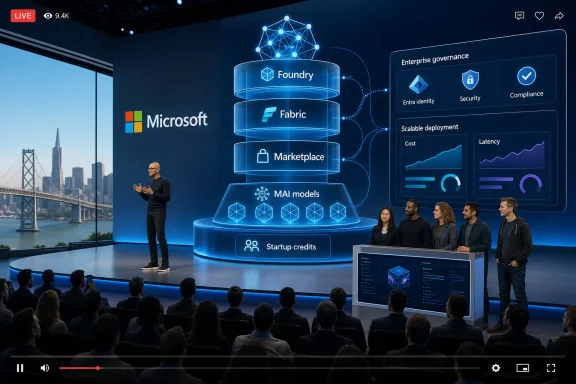
Microsoft Build 2026 ran June 2–3 in San Francisco and online, and Microsoft used the developer conference to pitch startups on a more integrated AI stack spanning Foundry, Fabric, Marketplace, in-house MAI models, and startup credits. The message was not subtle: Microsoft wants young AI companies to stop assembling their own platform from a dozen vendors and start treating Azure as the shortest path from prototype to enterprise sale. That pitch is commercially self-serving, of course, but it also reflects a real shift in the AI market. The hard part is no longer merely calling a model; it is shipping something reliable, governable, discoverable, and cheap enough to survive contact with customers.
For the past two years, AI startup infrastructure has looked like a beautiful mess. A small team might use one provider for frontier models, another for open model inference, a separate vector database, a bespoke evaluation setup, a hand-built data connector layer, and a sales motion that depends on being discovered somewhere outside the customer’s procurement workflow. That worked when the goal was a demo. It starts to creak when the goal is an enterprise deployment with identity, governance, compliance, usage controls, and finance scrutiny attached.
Build 2026’s startup announcements are Microsoft’s answer to that creak. Fireworks AI in Microsoft Foundry gives founders a managed route to open-model inference. Fabric IQ promises a business-context layer for agents. Microsoft’s new MAI models give Azure another set of first-party AI options. Marketplace intelligent discovery tries to make procurement feel more like asking a competent assistant than spelunking through a catalog. Microsoft for Startups, meanwhile, is being framed as the programmatic glue that gets early companies onto this stack with credits and go-to-market support.
The strategic point is bigger than any one product name. Microsoft is trying to collapse the distance between build, govern, sell, and scale. For startups, that is attractive because the enterprise buyer has become allergic to unmanaged AI experiments. For Microsoft, it is attractive because every layer of that journey can become another reason to keep compute, data, models, agents, and procurement inside its ecosystem.
That does not make the pitch wrong. It makes it a pitch founders should evaluate with open eyes. The same integrated platform that reduces plumbing can also narrow architectural freedom over time. The startup question after Build 2026 is not “Should we use Microsoft’s AI stack?” It is “Which parts of Microsoft’s stack remove undifferentiated work, and which parts could quietly become strategic dependency?”
That is a meaningful combination. Many startups want the flexibility of open models but do not want to become infrastructure companies. If a team can test Kimi, GLM, DeepSeek, Qwen, GPT OSS, MiniMax, or its own fine-tuned weights from within the same platform where it handles deployment and operations, the experimentation loop gets shorter. The bigger benefit arrives later, when the startup has to explain its architecture to a customer’s security review team.
The economics matter just as much as the model list. Microsoft is emphasizing the ability to begin with serverless, pay-per-token usage and then graduate to provisioned throughput units when scale and predictability matter. That maps neatly onto the startup lifecycle: explore cheaply, find product-market fit, then lock down cost and capacity when customers arrive.
There is a subtle power shift here. Model selection becomes less of a religious commitment and more of a routing and cost-optimization problem. A startup might use one model for classification, another for coding assistance, another for a customer-facing agent, and a smaller fine-tuned model for a domain-specific workflow. If Foundry makes that switching easier, it reduces the risk of betting the company on a single model provider.
But the real startup advantage is not just “more models.” It is fewer excuses. Enterprise customers increasingly ask where data goes, how prompts are governed, how models are evaluated, what happens under load, and whether the vendor can satisfy regional and contractual requirements. A founder who can answer those questions inside Azure has a cleaner path through procurement than one who has stitched together a clever but opaque chain of services.
This is where Fabric IQ fits into the broader Microsoft IQ idea. Built over OneLake and connected to Microsoft Fabric, it is designed to model how a business operates rather than merely where its data resides. Microsoft wants founders to see this as a shortcut: instead of building a one-off semantic layer for every customer, a startup can ground agents in governed context that already exists, or at least is being consolidated, inside the customer’s Microsoft data estate.
That promise lands because the current agent market has a context problem. Many agents fail not because the model is weak, but because the data environment is inconsistent. One system uses “active customer” to mean a paying account. Another uses it to mean a user who logged in last month. A third uses it as a sales status. Put an agent on top of that mess and it will confidently produce answers that are technically grounded but operationally wrong.
Fabric IQ is Microsoft’s attempt to turn enterprise semantics into a reusable substrate. For startups building sales ops, finance, support, compliance, analytics, or industry-specific workflow agents, that could be a major accelerator. It lets a small team spend less time writing brittle connectors and more time on the workflow that actually differentiates the product.
The risk is that semantic layers are only as good as the organizations maintaining them. Many enterprises do not have perfectly governed business definitions waiting to be consumed. They have political compromises disguised as dashboards. A startup building on Fabric IQ may inherit the customer’s data discipline, or lack of it. Microsoft can provide the platform, but it cannot magically settle every argument between finance, sales, operations, and IT.
Still, the direction is right. The agent era will punish companies that treat data context as an afterthought. Microsoft’s bet is that the winner is not the agent with the flashiest prompt, but the one that understands the organization well enough to be trusted.
For startups, the immediate implication is choice. If these models are available through Foundry and billed through Azure, they become part of the same procurement, credit, and governance framework as other Microsoft cloud services. That matters for teams using Microsoft for Startups credits, because first-party Azure-sold services can fit more neatly into a founder’s early financial planning than third-party services with separate commercial terms.
For Microsoft, the implication is control. The company has spent years turning OpenAI partnership access into product advantage, but Build 2026 shows a more diversified AI strategy. Microsoft still wants to host and sell access to outside models. It also wants its own models tuned to its products, economics, and developer platform. That is not a repudiation of its partnerships; it is insurance against being merely the cloud landlord for someone else’s intelligence layer.
The MAI announcement also reflects a broader industry lesson: not every workload needs the largest possible frontier model. Startups care about latency, cost, modality, fine-tuning, deployment region, and how well a model behaves in a specific workflow. A competent coding model, a cheap transcriber, a low-latency voice model, or an image model integrated into a broader enterprise app stack can be more valuable than a benchmark champion that is too expensive to use at scale.
The open question is performance. Microsoft can announce models, but founders will judge them on accuracy, latency, cost, tooling, availability, and failure modes. The smartest startups will benchmark MAI models against OpenAI, Anthropic, Google, Meta, Mistral, DeepSeek, Qwen, and other options for their actual use cases rather than treating Microsoft’s stamp as proof of superiority.
Even so, the direction benefits builders. A richer model market inside Foundry makes it easier to design systems around workload fit. If Microsoft can pair first-party models with strong evaluation, observability, and governance, it will have something more useful than a model catalog. It will have a production environment where model choice becomes an operational decision instead of a procurement adventure.
Microsoft’s preview of natural-language Marketplace discovery aims to change that. Instead of forcing buyers to search by exact keywords, the system lets customers describe what they need and receive matched solutions, filters, comparisons, and chat-style follow-up through “Ask Marketplace.” In theory, this turns Marketplace from a passive directory into an active decision surface.
For startups, that is distribution infrastructure. A founder can build a strong product and still lose because the buyer cannot find it, cannot understand it quickly, or cannot map it to an internal use case. If Marketplace can summarize listings, compare options, answer scenario-specific questions, and route buyers toward relevant agents, apps, and services, it reduces the discovery gap between a small company and an established vendor.
The catch is that intelligent discovery rewards structured clarity. Startups with vague listings, weak positioning, thin documentation, or unclear integration claims may not benefit much. If a marketplace assistant is matching buyer intent to product metadata, then the listing itself becomes part of the product surface. Founders will need to treat Marketplace copy, screenshots, security claims, support terms, and integration details as conversion-critical assets.
This also nudges startups toward Microsoft’s preferred commercial motion. A product that builds on Azure, integrates with Microsoft 365, uses Foundry, respects Entra identity, and publishes through Marketplace becomes easier for Microsoft’s ecosystem to understand and sell. That can be a gift for enterprise-facing startups. It can also become a funnel that makes non-Microsoft deployment stories feel less natural over time.
Still, distribution is one of the biggest problems in enterprise software. If Microsoft can make Marketplace discovery meaningfully smarter, it gives startups a reason to care about being present there before they have a large sales team. In the AI era, the first buyer interaction may not be with a sales rep or a website. It may be with a procurement assistant asking whether your product fits a very specific internal need.
That may sound like ordinary cloud-credit marketing, but credits shape architecture. Early technical decisions often follow the money. If a startup has meaningful Azure credits and its model inference, database, semantic layer, agent runtime, Marketplace listing, and go-to-market pathway are all available inside Microsoft’s orbit, then the default choice becomes obvious: build there first.
This is exactly why the program matters. Cloud providers know that startups are cheaper to acquire before they have hardened infrastructure habits. A small team that begins on Azure, sells through Marketplace, grounds agents in Fabric, and deploys through Foundry may eventually become a large customer. The credits are not charity. They are an investment in future platform gravity.
For founders, the question is whether that gravity helps or hurts. In the early phase, it can be extremely helpful. Credits extend runway. Integrated services reduce hiring needs. Enterprise-grade controls make security conversations easier. Marketplace and co-sell pathways can create opportunities that would be hard to access alone.
The danger arrives when early convenience substitutes for architectural judgment. A startup should not build on Microsoft simply because the credits are generous. It should build there because the stack improves product velocity, customer trust, cost structure, or distribution. If those conditions are met, the credits are leverage. If not, they are a discount on future migration pain.
The best founders will use Microsoft’s program strategically. They will spend credits on experiments that reduce risk, benchmark services against alternatives, and keep clean abstractions around the parts of the stack most likely to change. Free cloud money is useful. A product that can survive after the credits expire is better.
This is an important trend for startups. In the first wave of generative AI apps, many teams added vector stores as sidecars to existing systems. That made sense for speed, but it also created operational complexity. Data synchronization, permissions, indexing, observability, and backup practices suddenly spanned multiple systems. For production software, especially in regulated or enterprise settings, that complexity becomes expensive.
A PostgreSQL-compatible managed database with built-in vector search is Microsoft’s way of saying that AI features should live closer to the application’s core data. Founders do not want to rewrite working systems just to support retrieval, embeddings, or agent memory. They want familiar relational patterns with enough vector and AI integration to build modern features without turning the database layer into a science project.
The preview status matters. Startups should treat HorizonDB as promising infrastructure rather than a default production bet until they have tested performance, availability, migration paths, compatibility, and pricing. PostgreSQL compatibility can mean different things depending on extension support, operational behavior, and edge-case workloads. Founders with serious database needs should verify rather than assume.
Still, Microsoft’s direction is clear. The company wants Azure databases, Fabric, and Foundry to feel like one connected AI application platform. If HorizonDB succeeds, it could reduce the number of moving parts in AI-native SaaS products and make it easier for startups to explain their architecture to conservative buyers.
That explanation is underrated. A customer may not care whether a startup uses the trendiest vector database. It will care whether the product is reliable, secure, auditable, and maintainable. “PostgreSQL-compatible, managed on Azure, connected to our AI and data stack” is a procurement-friendly sentence.
This is Microsoft’s classic platform move: take the messy operational layer and make it feel boring. Agent infrastructure is currently full of sharp edges. Teams have to manage tool permissions, memory, retrieval, evaluation, model routing, identity, cost, deployment, and user access. A startup can absolutely build this itself, but every hour spent reinventing agent plumbing is an hour not spent on domain logic.
Publishing to Teams and Microsoft 365 Copilot is especially important. Enterprise AI adoption is not only about model quality; it is about meeting users where they already work. If a startup can build an agent in Foundry and surface it inside familiar Microsoft productivity environments, it lowers adoption friction. The buyer does not have to train employees to visit another portal for every workflow.
That said, the Teams and Copilot surface is not neutral ground. It privileges Microsoft’s workplace ecosystem and encourages startups to design around it. For many enterprise software companies, that is a rational trade. Microsoft 365 is already the operating environment of a large portion of the business world. But startups should understand that a deep Microsoft 365 integration can become both a sales advantage and a platform dependency.
Evaluation may be the most important part of the hosted-agent story. The AI industry has spent too much time celebrating agents that complete impressive demos and not enough time measuring how they behave under mundane, repetitive, adversarial, or ambiguous conditions. Adaptive evaluations, if implemented well, can help founders detect regressions, unsafe tool use, poor grounding, and workflow failures before customers do.
That is where Microsoft’s enterprise posture has teeth. The company knows that businesses will not deploy agents widely unless they can monitor, test, govern, and revoke them. Startups that build on a managed agent service may be able to inherit those controls rather than invent them under deadline pressure.
The coherence is real. Foundry handles models, inference, agents, tooling, and governance. Fabric and OneLake supply governed data and business context. HorizonDB promises application data infrastructure aligned with AI workloads. Marketplace gives startups a route to buyer discovery. Microsoft for Startups supplies credits and go-to-market pathways. Microsoft 365 and Teams provide the user surface. Entra and Azure governance provide the enterprise control plane.
That is a powerful architecture for a startup trying to sell into established organizations. A founder can tell a story that the CIO, CISO, procurement lead, and business sponsor can all understand. The product uses familiar identity. The data story fits Microsoft’s governance model. The agent can appear inside Microsoft 365. The purchase can flow through Marketplace. The cloud bill can sit inside existing Azure commitments.
But the same coherence creates gravitational pull. Once a startup depends on Fabric IQ semantics, Foundry agent services, Azure-specific model routing, Marketplace discovery, Teams distribution, and Microsoft startup credits, moving away becomes harder. That does not mean the choice is bad. It means it should be conscious.
The usual advice is to avoid lock-in, but that is too simplistic. Every serious startup locks into something: a cloud, a database, a model API, a framework, a distribution channel, a customer segment, or a compliance posture. The question is whether the lock-in buys speed, trust, revenue, or defensibility. Microsoft is betting that for enterprise AI startups, its lock-in buys all four.
Founders should answer with evidence. They should test whether Azure’s integrated path actually shortens sales cycles, whether Foundry reduces operational burden, whether Marketplace generates qualified demand, whether Fabric IQ improves agent accuracy, and whether MAI or Fireworks economics beat alternatives. If the answer is yes, then the dependency may be worth it. If the answer is no, the platform story becomes expensive branding.
That default is appealing because it matches how enterprises already buy and manage technology. Large organizations do not want hundreds of ungoverned AI tools negotiating their own data access, identity models, and billing. They want standard patterns. Microsoft is turning its installed base into an argument that its AI stack is not just powerful but administratively plausible.
This matters for WindowsForum readers because the center of gravity is no longer just Windows as an operating system. It is Windows, Microsoft 365, Azure, GitHub, Foundry, Fabric, and Entra as an interconnected work and development environment. For IT pros, that means the AI startup knocking on the door may increasingly arrive as a Microsoft-integrated workload rather than a standalone SaaS product. For developers, it means the Microsoft stack is becoming harder to ignore even if one’s first instinct is to build cloud-neutral.
The startup ecosystem will not become Microsoft-only. The AI world is too competitive, too open-source-aware, and too cost-sensitive for that. AWS, Google Cloud, OpenAI, Anthropic, Databricks, Snowflake, Oracle, Nvidia, and a long list of model and infrastructure players will keep pushing their own versions of the future. Many startups will deliberately stay multi-cloud or model-agnostic because their customers demand it.
But Microsoft’s advantage is that it can connect the AI development story to the place where work already happens. That is difficult to replicate. A model provider can offer intelligence. A cloud provider can offer compute. A data platform can offer storage and analytics. Microsoft can offer all of those and then put the result in Teams, Outlook, Excel, SharePoint, Windows, GitHub, and the admin center.
The consequence is that startups building for enterprises must decide whether Microsoft’s default architecture is their launchpad, their integration target, or their competitive boundary. Ignoring it is becoming less realistic.
 Microsoft Is Selling the Startup Dream Back to the Enterprise
For the past two years, AI startup infrastructure has looked like a beautiful mess. A small team might use one provider for frontier models, another for open model inference, a separate vector database, a bespoke evaluation setup, a hand-built data connector layer, and a sales motion that depends on being discovered somewhere outside the customer’s procurement workflow. That worked when the goal was a demo. It starts to creak when the goal is an enterprise deployment with identity, governance, compliance, usage controls, and finance scrutiny attached.Build 2026’s startup announcements are Microsoft’s answer to that creak. Fireworks AI in Microsoft Foundry gives founders a managed route to open-model inference. Fabric IQ promises a business-context layer for agents. Microsoft’s new MAI models give Azure another set of first-party AI options. Marketplace intelligent discovery tries to make procurement feel more like asking a competent assistant than spelunking through a catalog. Microsoft for Startups, meanwhile, is being framed as the programmatic glue that gets early companies onto this stack with credits and go-to-market support.
The strategic point is bigger than any one product name. Microsoft is trying to collapse the distance between build, govern, sell, and scale. For startups, that is attractive because the enterprise buyer has become allergic to unmanaged AI experiments. For Microsoft, it is attractive because every layer of that journey can become another reason to keep compute, data, models, agents, and procurement inside its ecosystem.
That does not make the pitch wrong. It makes it a pitch founders should evaluate with open eyes. The same integrated platform that reduces plumbing can also narrow architectural freedom over time. The startup question after Build 2026 is not “Should we use Microsoft’s AI stack?” It is “Which parts of Microsoft’s stack remove undifferentiated work, and which parts could quietly become strategic dependency?”
Fireworks AI Turns Open Models Into an Azure-Native Buying Decision
The most immediately practical announcement for AI startups is Fireworks AI becoming generally available in Microsoft Foundry. Fireworks has built its reputation around fast inference for open models, and its arrival inside Foundry means founders can access that capability through a single Azure endpoint rather than managing a separate infrastructure and vendor relationship. Microsoft is presenting this as model choice without enterprise compromise: open-model performance with Azure-style governance, security posture, and procurement.That is a meaningful combination. Many startups want the flexibility of open models but do not want to become infrastructure companies. If a team can test Kimi, GLM, DeepSeek, Qwen, GPT OSS, MiniMax, or its own fine-tuned weights from within the same platform where it handles deployment and operations, the experimentation loop gets shorter. The bigger benefit arrives later, when the startup has to explain its architecture to a customer’s security review team.
The economics matter just as much as the model list. Microsoft is emphasizing the ability to begin with serverless, pay-per-token usage and then graduate to provisioned throughput units when scale and predictability matter. That maps neatly onto the startup lifecycle: explore cheaply, find product-market fit, then lock down cost and capacity when customers arrive.
There is a subtle power shift here. Model selection becomes less of a religious commitment and more of a routing and cost-optimization problem. A startup might use one model for classification, another for coding assistance, another for a customer-facing agent, and a smaller fine-tuned model for a domain-specific workflow. If Foundry makes that switching easier, it reduces the risk of betting the company on a single model provider.
But the real startup advantage is not just “more models.” It is fewer excuses. Enterprise customers increasingly ask where data goes, how prompts are governed, how models are evaluated, what happens under load, and whether the vendor can satisfy regional and contractual requirements. A founder who can answer those questions inside Azure has a cleaner path through procurement than one who has stitched together a clever but opaque chain of services.
Fabric IQ Is Microsoft’s Bet That Agents Need a Corporate Memory
If Fireworks AI is about model supply, Fabric IQ is about context supply. Microsoft is arguing that useful agents require more than retrieval over documents or a set of API calls. They need a shared understanding of the business: metrics, definitions, relationships, entities, and operational context. In other words, an agent should know not only that “revenue” appears in a table, but which revenue number the company trusts, how it is calculated, and which systems define the customer, product, or region behind it.This is where Fabric IQ fits into the broader Microsoft IQ idea. Built over OneLake and connected to Microsoft Fabric, it is designed to model how a business operates rather than merely where its data resides. Microsoft wants founders to see this as a shortcut: instead of building a one-off semantic layer for every customer, a startup can ground agents in governed context that already exists, or at least is being consolidated, inside the customer’s Microsoft data estate.
That promise lands because the current agent market has a context problem. Many agents fail not because the model is weak, but because the data environment is inconsistent. One system uses “active customer” to mean a paying account. Another uses it to mean a user who logged in last month. A third uses it as a sales status. Put an agent on top of that mess and it will confidently produce answers that are technically grounded but operationally wrong.
Fabric IQ is Microsoft’s attempt to turn enterprise semantics into a reusable substrate. For startups building sales ops, finance, support, compliance, analytics, or industry-specific workflow agents, that could be a major accelerator. It lets a small team spend less time writing brittle connectors and more time on the workflow that actually differentiates the product.
The risk is that semantic layers are only as good as the organizations maintaining them. Many enterprises do not have perfectly governed business definitions waiting to be consumed. They have political compromises disguised as dashboards. A startup building on Fabric IQ may inherit the customer’s data discipline, or lack of it. Microsoft can provide the platform, but it cannot magically settle every argument between finance, sales, operations, and IT.
Still, the direction is right. The agent era will punish companies that treat data context as an afterthought. Microsoft’s bet is that the winner is not the agent with the flashiest prompt, but the one that understands the organization well enough to be trusted.
MAI Models Make Microsoft Less Dependent on Everyone Else’s Brain
The new MAI model family is the most strategically revealing part of the Build 2026 story. Microsoft introduced seven in-house AI models spanning reasoning, coding, image generation, transcription, and voice. The headline model, MAI-Thinking-1, is Microsoft AI’s first reasoning model, while MAI-Image-2.5, MAI Transcribe 1.5, MAI-Voice-2, and MAI-Code-1 extend the company’s coverage across multimodal and developer workflows.For startups, the immediate implication is choice. If these models are available through Foundry and billed through Azure, they become part of the same procurement, credit, and governance framework as other Microsoft cloud services. That matters for teams using Microsoft for Startups credits, because first-party Azure-sold services can fit more neatly into a founder’s early financial planning than third-party services with separate commercial terms.
For Microsoft, the implication is control. The company has spent years turning OpenAI partnership access into product advantage, but Build 2026 shows a more diversified AI strategy. Microsoft still wants to host and sell access to outside models. It also wants its own models tuned to its products, economics, and developer platform. That is not a repudiation of its partnerships; it is insurance against being merely the cloud landlord for someone else’s intelligence layer.
The MAI announcement also reflects a broader industry lesson: not every workload needs the largest possible frontier model. Startups care about latency, cost, modality, fine-tuning, deployment region, and how well a model behaves in a specific workflow. A competent coding model, a cheap transcriber, a low-latency voice model, or an image model integrated into a broader enterprise app stack can be more valuable than a benchmark champion that is too expensive to use at scale.
The open question is performance. Microsoft can announce models, but founders will judge them on accuracy, latency, cost, tooling, availability, and failure modes. The smartest startups will benchmark MAI models against OpenAI, Anthropic, Google, Meta, Mistral, DeepSeek, Qwen, and other options for their actual use cases rather than treating Microsoft’s stamp as proof of superiority.
Even so, the direction benefits builders. A richer model market inside Foundry makes it easier to design systems around workload fit. If Microsoft can pair first-party models with strong evaluation, observability, and governance, it will have something more useful than a model catalog. It will have a production environment where model choice becomes an operational decision instead of a procurement adventure.
Marketplace Discovery Is Microsoft’s Quiet Attack on Startup Distribution Pain
The least glamorous announcement may be one of the most commercially important: intelligent discovery in Microsoft Marketplace. Getting listed in a marketplace has never been the same as getting found. Catalogs are full of competent products that buyers never see because search terms, categories, filters, and procurement habits bury them under better-known names.Microsoft’s preview of natural-language Marketplace discovery aims to change that. Instead of forcing buyers to search by exact keywords, the system lets customers describe what they need and receive matched solutions, filters, comparisons, and chat-style follow-up through “Ask Marketplace.” In theory, this turns Marketplace from a passive directory into an active decision surface.
For startups, that is distribution infrastructure. A founder can build a strong product and still lose because the buyer cannot find it, cannot understand it quickly, or cannot map it to an internal use case. If Marketplace can summarize listings, compare options, answer scenario-specific questions, and route buyers toward relevant agents, apps, and services, it reduces the discovery gap between a small company and an established vendor.
The catch is that intelligent discovery rewards structured clarity. Startups with vague listings, weak positioning, thin documentation, or unclear integration claims may not benefit much. If a marketplace assistant is matching buyer intent to product metadata, then the listing itself becomes part of the product surface. Founders will need to treat Marketplace copy, screenshots, security claims, support terms, and integration details as conversion-critical assets.
This also nudges startups toward Microsoft’s preferred commercial motion. A product that builds on Azure, integrates with Microsoft 365, uses Foundry, respects Entra identity, and publishes through Marketplace becomes easier for Microsoft’s ecosystem to understand and sell. That can be a gift for enterprise-facing startups. It can also become a funnel that makes non-Microsoft deployment stories feel less natural over time.
Still, distribution is one of the biggest problems in enterprise software. If Microsoft can make Marketplace discovery meaningfully smarter, it gives startups a reason to care about being present there before they have a large sales team. In the AI era, the first buyer interaction may not be with a sales rep or a website. It may be with a procurement assistant asking whether your product fits a very specific internal need.
Startup Credits Are a Strategy, Not a Perk
Microsoft for Startups is being repositioned around a simpler path to credits, benefits, and growth. The program now emphasizes direct application, immediate building with startup credits, expanded benefits tied to verified progress and sustained Azure usage, and up to $150,000 in credits over time for qualified startups. Founders backed by Microsoft for Startups Investor Network partners can receive a more guided experience, including a dedicated point of contact, expanded go-to-market opportunities, and the possibility of additional credits beyond the standard program.That may sound like ordinary cloud-credit marketing, but credits shape architecture. Early technical decisions often follow the money. If a startup has meaningful Azure credits and its model inference, database, semantic layer, agent runtime, Marketplace listing, and go-to-market pathway are all available inside Microsoft’s orbit, then the default choice becomes obvious: build there first.
This is exactly why the program matters. Cloud providers know that startups are cheaper to acquire before they have hardened infrastructure habits. A small team that begins on Azure, sells through Marketplace, grounds agents in Fabric, and deploys through Foundry may eventually become a large customer. The credits are not charity. They are an investment in future platform gravity.
For founders, the question is whether that gravity helps or hurts. In the early phase, it can be extremely helpful. Credits extend runway. Integrated services reduce hiring needs. Enterprise-grade controls make security conversations easier. Marketplace and co-sell pathways can create opportunities that would be hard to access alone.
The danger arrives when early convenience substitutes for architectural judgment. A startup should not build on Microsoft simply because the credits are generous. It should build there because the stack improves product velocity, customer trust, cost structure, or distribution. If those conditions are met, the credits are leverage. If not, they are a discount on future migration pain.
The best founders will use Microsoft’s program strategically. They will spend credits on experiments that reduce risk, benchmark services against alternatives, and keep clean abstractions around the parts of the stack most likely to change. Free cloud money is useful. A product that can survive after the credits expire is better.
HorizonDB Shows the Database Layer Is Becoming AI Infrastructure
Among the supporting announcements, Azure HorizonDB deserves attention because it points to where application infrastructure is heading. Microsoft describes it as a fully managed, PostgreSQL-compatible database built for AI-era applications, with vector search and native connections to Foundry and Fabric. The pitch is deliberately familiar: keep the Postgres model developers already know, but add AI-native capabilities without forcing teams into a separate database architecture.This is an important trend for startups. In the first wave of generative AI apps, many teams added vector stores as sidecars to existing systems. That made sense for speed, but it also created operational complexity. Data synchronization, permissions, indexing, observability, and backup practices suddenly spanned multiple systems. For production software, especially in regulated or enterprise settings, that complexity becomes expensive.
A PostgreSQL-compatible managed database with built-in vector search is Microsoft’s way of saying that AI features should live closer to the application’s core data. Founders do not want to rewrite working systems just to support retrieval, embeddings, or agent memory. They want familiar relational patterns with enough vector and AI integration to build modern features without turning the database layer into a science project.
The preview status matters. Startups should treat HorizonDB as promising infrastructure rather than a default production bet until they have tested performance, availability, migration paths, compatibility, and pricing. PostgreSQL compatibility can mean different things depending on extension support, operational behavior, and edge-case workloads. Founders with serious database needs should verify rather than assume.
Still, Microsoft’s direction is clear. The company wants Azure databases, Fabric, and Foundry to feel like one connected AI application platform. If HorizonDB succeeds, it could reduce the number of moving parts in AI-native SaaS products and make it easier for startups to explain their architecture to conservative buyers.
That explanation is underrated. A customer may not care whether a startup uses the trendiest vector database. It will care whether the product is reliable, secure, auditable, and maintainable. “PostgreSQL-compatible, managed on Azure, connected to our AI and data stack” is a procurement-friendly sentence.
Foundry’s Agent Push Is About Removing the Last Excuse
The other supporting Foundry announcements point toward a managed agent lifecycle. Managed Compute in Microsoft Foundry, now in private preview, promises global deployment that can route workloads across regions with less infrastructure overhead and better access to GPU capacity. Hosted Agents in Foundry Agent Service are expected to reach general availability by the end of June 2026, with built-in security controls, adaptive evaluations, and one-click publishing to Microsoft Teams and Microsoft 365 Copilot.This is Microsoft’s classic platform move: take the messy operational layer and make it feel boring. Agent infrastructure is currently full of sharp edges. Teams have to manage tool permissions, memory, retrieval, evaluation, model routing, identity, cost, deployment, and user access. A startup can absolutely build this itself, but every hour spent reinventing agent plumbing is an hour not spent on domain logic.
Publishing to Teams and Microsoft 365 Copilot is especially important. Enterprise AI adoption is not only about model quality; it is about meeting users where they already work. If a startup can build an agent in Foundry and surface it inside familiar Microsoft productivity environments, it lowers adoption friction. The buyer does not have to train employees to visit another portal for every workflow.
That said, the Teams and Copilot surface is not neutral ground. It privileges Microsoft’s workplace ecosystem and encourages startups to design around it. For many enterprise software companies, that is a rational trade. Microsoft 365 is already the operating environment of a large portion of the business world. But startups should understand that a deep Microsoft 365 integration can become both a sales advantage and a platform dependency.
Evaluation may be the most important part of the hosted-agent story. The AI industry has spent too much time celebrating agents that complete impressive demos and not enough time measuring how they behave under mundane, repetitive, adversarial, or ambiguous conditions. Adaptive evaluations, if implemented well, can help founders detect regressions, unsafe tool use, poor grounding, and workflow failures before customers do.
That is where Microsoft’s enterprise posture has teeth. The company knows that businesses will not deploy agents widely unless they can monitor, test, govern, and revoke them. Startups that build on a managed agent service may be able to inherit those controls rather than invent them under deadline pressure.
The Stack Is Coherent Because It Is Also a Lock-In Machine
The charitable reading of Build 2026 is that Microsoft is making AI development less fragmented. The skeptical reading is that Microsoft is building a lock-in machine for the agent era. Both readings are true.The coherence is real. Foundry handles models, inference, agents, tooling, and governance. Fabric and OneLake supply governed data and business context. HorizonDB promises application data infrastructure aligned with AI workloads. Marketplace gives startups a route to buyer discovery. Microsoft for Startups supplies credits and go-to-market pathways. Microsoft 365 and Teams provide the user surface. Entra and Azure governance provide the enterprise control plane.
That is a powerful architecture for a startup trying to sell into established organizations. A founder can tell a story that the CIO, CISO, procurement lead, and business sponsor can all understand. The product uses familiar identity. The data story fits Microsoft’s governance model. The agent can appear inside Microsoft 365. The purchase can flow through Marketplace. The cloud bill can sit inside existing Azure commitments.
But the same coherence creates gravitational pull. Once a startup depends on Fabric IQ semantics, Foundry agent services, Azure-specific model routing, Marketplace discovery, Teams distribution, and Microsoft startup credits, moving away becomes harder. That does not mean the choice is bad. It means it should be conscious.
The usual advice is to avoid lock-in, but that is too simplistic. Every serious startup locks into something: a cloud, a database, a model API, a framework, a distribution channel, a customer segment, or a compliance posture. The question is whether the lock-in buys speed, trust, revenue, or defensibility. Microsoft is betting that for enterprise AI startups, its lock-in buys all four.
Founders should answer with evidence. They should test whether Azure’s integrated path actually shortens sales cycles, whether Foundry reduces operational burden, whether Marketplace generates qualified demand, whether Fabric IQ improves agent accuracy, and whether MAI or Fireworks economics beat alternatives. If the answer is yes, then the dependency may be worth it. If the answer is no, the platform story becomes expensive branding.
The Real Contest Is Over the Default Enterprise AI Architecture
Build 2026 makes more sense when viewed as a battle over defaults. Microsoft is not merely announcing tools. It is trying to define what a normal enterprise AI application looks like. In Microsoft’s version, the app uses a mix of first-party, partner, and open models through Foundry; grounds itself in Microsoft IQ and Fabric; stores operational data in Azure databases; ships agents through managed services; reaches users in Microsoft 365; and sells through Marketplace.That default is appealing because it matches how enterprises already buy and manage technology. Large organizations do not want hundreds of ungoverned AI tools negotiating their own data access, identity models, and billing. They want standard patterns. Microsoft is turning its installed base into an argument that its AI stack is not just powerful but administratively plausible.
This matters for WindowsForum readers because the center of gravity is no longer just Windows as an operating system. It is Windows, Microsoft 365, Azure, GitHub, Foundry, Fabric, and Entra as an interconnected work and development environment. For IT pros, that means the AI startup knocking on the door may increasingly arrive as a Microsoft-integrated workload rather than a standalone SaaS product. For developers, it means the Microsoft stack is becoming harder to ignore even if one’s first instinct is to build cloud-neutral.
The startup ecosystem will not become Microsoft-only. The AI world is too competitive, too open-source-aware, and too cost-sensitive for that. AWS, Google Cloud, OpenAI, Anthropic, Databricks, Snowflake, Oracle, Nvidia, and a long list of model and infrastructure players will keep pushing their own versions of the future. Many startups will deliberately stay multi-cloud or model-agnostic because their customers demand it.
But Microsoft’s advantage is that it can connect the AI development story to the place where work already happens. That is difficult to replicate. A model provider can offer intelligence. A cloud provider can offer compute. A data platform can offer storage and analytics. Microsoft can offer all of those and then put the result in Teams, Outlook, Excel, SharePoint, Windows, GitHub, and the admin center.
The consequence is that startups building for enterprises must decide whether Microsoft’s default architecture is their launchpad, their integration target, or their competitive boundary. Ignoring it is becoming less realistic.
Founders Should Read Build 2026 as a Procurement Map
The practical takeaway from Build 2026 is not that every startup should immediately rewrite its stack around Microsoft. The takeaway is that Microsoft has drawn a map of the enterprise AI buying journey, and founders should study it even if they do not follow every road. The announcements point to the questions buyers will ask and the shortcuts Microsoft wants to provide.- Startups should treat model choice as an operational discipline, not a one-time vendor decision, because Foundry’s expanding catalog and Fireworks integration make workload-specific selection more realistic.
- Startups building agents should invest early in governed business context, because Fabric IQ and Microsoft IQ reflect a market shift from generic chatbots toward systems that understand company-specific definitions and workflows.
- Startups should benchmark Microsoft’s MAI models on real product tasks before dismissing or adopting them, because first-party Azure billing and integration may matter as much as leaderboard performance.
- Startups planning enterprise sales should treat Microsoft Marketplace listings as conversion assets, because intelligent discovery will reward clear positioning, accurate metadata, and scenario-specific product claims.
- Startups using Microsoft credits should design for the day after the credits run out, because subsidized infrastructure is only helpful if the resulting unit economics still work at scale.
- Startups should integrate with Microsoft 365 surfaces when customers live there, but they should do it knowingly, because distribution advantage and platform dependency often arrive together.
References
- Primary source: Microsoft
Published: 2026-06-09T19:50:12.385189
Microsoft Build 2026: 5 Announcements Every Startup Should Know
Discover the top Microsoft Build 2026 announcements for startups, including AI models, Microsoft Foundry, Marketplace updates, and Startup credits.www.microsoft.com - Related coverage: windowscentral.com
Microsoft launches seven in‑house AI models to cut developer costs and reduce reliance on OpenAI | Windows Central
Microsoft’s new MAI model family includes a flagship reasoning model, zero distillation, and lower developer costs.www.windowscentral.com - Related coverage: techradar.com
From Quantum to Containers - 4 big things you might have missed at Microsoft Build 2026 | TechRadar
We round up some of the other major news from Microsoft Build 2026www.techradar.com - Official source: devblogs.microsoft.com
What's new in Microsoft Foundry | Build Edition | Microsoft Foundry Blog
Microsoft Build 2026 brings a major set of Microsoft Foundry updates for developers building agents: hosted runtimes, Toolboxes, memory, Voice Live, Foundry IQ, new models, managed compute, and trust, evaluation, and observability tools.devblogs.microsoft.com - Official source: azure.microsoft.com
Introducing Fireworks AI on Microsoft Foundry: Bringing high performance, low latency open model inference to Azure | Microsoft Azure Blog
Learn how you can access low latency, high throughput inferencing for open models and performance-optimized deployment of custom models with Fireworks AI on Microsoft Foundry. azure.microsoft.com
- Official source: partner.microsoft.com
Microsoft Build 2026: Turning innovation into partner growth
Microsoft Build 2026 highlights AI, agents, and platform updates that create new opportunities for partners to build, scale, and deliver customer solutions.partner.microsoft.com
- Related coverage: tomsguide.com
Biggest Microsoft Build 2026 announcements — agentic AI, RTX Spark Dev Box, GitHub Copilot app, new MAI models, and more | Tom's Guide
All the big news from Microsoft's AI-focused eventwww.tomsguide.com - Official source: news.microsoft.com
Microsoft Build Live
The home for real-time coverage of the news as it is announced from Microsoft Build, June 2-3, 2026.news.microsoft.com - Related coverage: ebisuda.net
Microsoft Build 2026:Azure HorizonDB・Foundry IQ・Claude正式採用——AIは「実験」から「本番運用」へ | ebisuda.net
Microsoft Build 2026でAzure HorizonDB・Foundry IQ・Claude正式統合を発表、AIの実験フェーズ終了と本番運用移行時代の到来を宣言。www.ebisuda.net
- Official source: cdn-dynmedia-1.microsoft.com
The Next Wave of AI Innovation: Microsoft Introduces Azure AI Foundry, A New Unified AI, and GenAI Platform at Ignite 2024
PDF documentcdn-dynmedia-1.microsoft.com
- Related coverage: isg.sitefinity.cloud
MSFT Blueprint 2026
Business people join puzzle pieces in office. Concept of teamwork and partnership. double exposure with light effectsisg.sitefinity.cloud
