

Microsoft used Build 2026 on June 2 to unveil seven new in-house MAI models across reasoning, coding, image, voice, and transcription, while a new Citizens note argued that investors are undervaluing Microsoft’s push toward AI sovereignty. The timing is not subtle. Microsoft is still joined at the hip with OpenAI, but it is no longer willing to look like a company whose AI destiny depends on one partner’s roadmap, pricing, governance, or ambitions.
That is the real story behind the latest wave of Microsoft AI announcements. The models matter, but the message matters more: Redmond wants customers, developers, regulators, and Wall Street to see a company building the full AI stack rather than renting the most important layer of it. For Windows users and IT shops, that shift could eventually determine what powers Copilot, what runs in Azure, what gets governed by Microsoft tools, and how much enterprise AI costs when the experimentation phase gives way to budget scrutiny.
For most of the generative AI boom, Microsoft’s advantage was easy to explain. It invested early and heavily in OpenAI, wrapped OpenAI models inside Bing, Copilot, GitHub, Microsoft 365, and Azure, and used that access to make Google, Amazon, and much of the enterprise software industry look temporarily flat-footed.
That narrative was powerful, but it had a flaw. If Microsoft’s AI advantage came mostly from OpenAI, then Microsoft’s bargaining power depended on a partner that was becoming more independent, more commercially aggressive, and more strategically complicated. The more OpenAI became a platform company in its own right, the more Microsoft’s investors had reason to ask whether Redmond was subsidizing a future rival.
The new MAI model family is Microsoft’s answer to that discomfort. The company is not walking away from OpenAI; it continues to ship OpenAI models through Microsoft products and Azure services. But it is now trying to make OpenAI one model supplier among several, not the singular engine behind Microsoft’s AI strategy.
That distinction matters. Microsoft does not need every MAI model to beat the best OpenAI model on every public benchmark. It needs enough credible in-house capability to control costs, tune models for its own products, reassure enterprise customers about governance, and negotiate from strength.
That phrase is doing a lot of work. In government circles, AI sovereignty usually means national control over data, models, compute, and digital infrastructure. In Microsoft’s case, it also means corporate sovereignty: the ability to own enough of the AI stack that no outside lab can dictate the economics or product direction of Microsoft’s most important software.
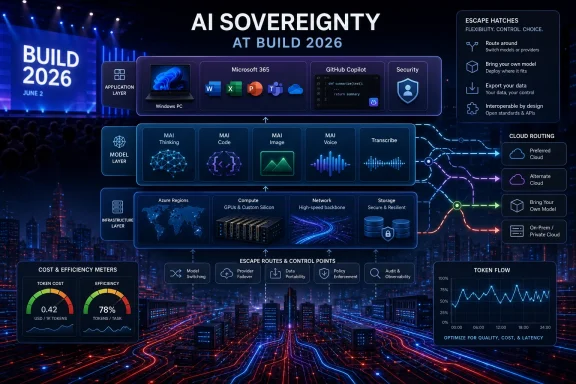
Citizens’ three-layer framing is useful because it captures where Microsoft is trying to move the debate. At the bottom is infrastructure: Azure data centers, GPUs, networking, custom silicon, and inference economics. In the middle is the model layer: OpenAI, Anthropic, Mistral, Microsoft’s own MAI systems, and whatever else enterprises choose through Foundry. At the top is the application layer: Windows, Microsoft 365, GitHub, Dynamics, Security Copilot, and the growing family of agents Microsoft wants businesses to run.
The market worry is that Microsoft has been strongest at the top and bottom while depending too much on somebody else for the middle. The Build 2026 model announcements are meant to close that narrative gap.
That is a very Microsoft way to compete. Redmond rarely needs the flashiest standalone product if it can control the distribution channel, the management layer, and the enterprise procurement conversation. Windows did not win because it was always elegant. Office did not become dominant because every component was best of breed. Azure did not need to erase AWS to become indispensable to Microsoft’s biggest customers.
The same logic is now being applied to AI models. A coding model optimized for GitHub Copilot and VS Code can be strategically valuable even if developers still prefer another model for general reasoning. A transcription model tuned for enterprise meetings, accessibility, call centers, and compliance workflows can matter even if it never becomes a household name. A voice model that powers Copilot experiences can shape user perception without appearing as a separate product.
That is why the MAI release should not be judged only as a horse race against OpenAI, Anthropic, Google DeepMind, or Meta. Microsoft is building models for a distribution machine it already owns.
Microsoft’s own language around MAI-Thinking-1 leans heavily into efficiency, low token cost, and performance within a specific weight class. That is revealing. The company knows that most enterprise tasks do not require the most expensive frontier model on every prompt. They require a routing system that can pick the cheapest adequate model, escalate when necessary, and remain governable.
This is where Microsoft’s model diversity strategy becomes more than insurance against OpenAI. If Foundry can offer OpenAI, Anthropic, Mistral, Microsoft MAI models, and other options under a common management framework, Microsoft can sell customers on optimization rather than allegiance. The pitch becomes: bring the model you trust, use the one that fits the job, and let Azure handle the messy operational layer.
That is attractive to CIOs who have spent the last two years watching AI enthusiasm run ahead of cost discipline. It also gives Microsoft a way to preserve margin. If it can shift some workloads to in-house models that are cheaper to serve, every Copilot subscription becomes more economically interesting.
But the relationship has become structurally more complicated. OpenAI has its own consumer products, enterprise ambitions, infrastructure needs, and strategic incentives. It wants leverage over compute, distribution, and future model deployment. Microsoft wants preferential access, predictable economics, and enough control to satisfy customers who do not want their AI stack to depend on a single external lab.
Those goals can coexist, but not without tension. The more OpenAI acts like an independent platform company, the more Microsoft must act like a platform owner rather than a reseller. That means building models, supporting rival models, designing its own AI chips, and making Azure the place where model competition happens.
In that sense, Microsoft’s in-house model push is not anti-OpenAI. It is anti-dependency. The difference is subtle but crucial.
AI sovereignty follows the same pattern. Microsoft wants to convince customers that control over AI does not mean going it alone. It means using Microsoft’s cloud, governance, model catalog, data fabric, agent control plane, and productivity apps as the trusted substrate for AI adoption.
That is a neat rhetorical inversion. Enterprises that fear dependence on OpenAI are invited to become more dependent on Microsoft. The dependency is simply presented as safer, broader, and more governable.
For many IT departments, that argument will land. Microsoft already owns the identity layer, document layer, endpoint layer, collaboration layer, and developer workflow in countless organizations. If the choice is between stitching together a dozen AI vendors or extending existing Microsoft contracts, procurement gravity favors Redmond.
But the model layer will shape the product experience over time. If Microsoft owns more of the stack, it can tune Copilot more aggressively for Windows settings, troubleshooting, file search, accessibility, device management, and local context. It can also decide which tasks are cheap enough to run frequently and which require premium cloud inference.
The Windows angle becomes more interesting when paired with neural processing units and local AI features. Microsoft has been trying to define the Copilot+ PC category around on-device AI capabilities, but the most useful AI experiences still depend heavily on cloud models. A mature Microsoft model family could let Redmond divide tasks more intelligently between local hardware and Azure-hosted inference.
That does not guarantee a better Windows experience. Microsoft has a long history of overstuffing Windows with services users did not ask for. But model ownership gives it more flexibility to build AI features that feel native rather than bolted on.
Coding is also where users are most likely to notice model quality. Developers may tolerate vague prose from a general assistant, but they notice broken tests, bad refactors, hallucinated APIs, and unhelpful agent loops. Microsoft cannot hide a weak coding model behind enterprise packaging for long.
That makes GitHub Copilot both an opportunity and a stress test. A Microsoft-tuned model can be deeply integrated into VS Code, repositories, pull requests, Azure deployment workflows, and enterprise policy controls. But it must compete in a market where Anthropic, OpenAI, Google, and specialist coding tools are all moving quickly.
If Microsoft succeeds there, its AI sovereignty pitch becomes concrete. If it does not, the MAI family risks looking like a bargaining chip dressed up as a platform.
But choice has a cost. More models mean more evaluation work, more governance complexity, more security review, and more difficult incident response. When an AI agent takes a bad action, it will not be enough to say the organization had a rich model catalog.
This is where Microsoft’s existing enterprise machinery becomes an advantage. The company can wrap model choice inside familiar administrative concepts: tenant controls, compliance policies, data boundaries, logs, permissions, and service-level commitments. It can turn a messy AI market into something that looks like Microsoft 365 administration.
That may not thrill AI purists, but it is exactly how enterprise technology usually gets adopted. The winning system is not always the most elegant. It is the one that can be budgeted, governed, audited, supported, and blamed when something breaks.
No hyperscaler can escape Nvidia overnight, and Microsoft is not pretending otherwise. But custom silicon gives cloud providers leverage. Even partial success can reduce costs for certain inference workloads, improve capacity planning, and give Microsoft a stronger hand in supplier negotiations.
The most important word here is inference. Training frontier models gets the glamour, but serving models to millions of users is where recurring economics bite. Every Copilot interaction, agent action, transcription job, and image generation request consumes compute. At Microsoft scale, small efficiency gains become large financial events.
That is why Wall Street cares about AI sovereignty. It is not philosophical. It is about whether Microsoft can turn AI demand into durable profit rather than simply passing revenue through to model and chip suppliers.
The old Microsoft antitrust story was about bundling browsers and media players into Windows. The modern version is more complex: bundling AI assistants, model access, identity, data governance, developer workflows, and cloud hosting into a single enterprise control plane. Customers may like the integration, but competitors will argue that Microsoft is using distribution power to advantage its own AI stack.
Microsoft’s defense will be model choice. By supporting OpenAI, Anthropic, Mistral, DeepSeek, its own MAI models, and others through Foundry, the company can say it is enabling competition rather than foreclosing it. That argument has merit, but it will be tested by defaults, pricing, telemetry, and product integration.
For IT leaders, the governance question is more practical. If Microsoft’s AI systems become embedded in email, documents, meetings, code, security alerts, and business processes, organizations will need sharper policies about what agents can do, what data they can access, and how humans remain accountable.
The bears see a less comfortable possibility. AI infrastructure could become brutally expensive, model quality could commoditize, customers could resist paying high premiums, and Microsoft could find itself sharing too much of the upside with partners and hardware suppliers. In that version of the story, AI lifts revenue but compresses margins.
The Citizens note sides with the bulls, arguing that Microsoft’s revenue growth profile and AI stack make the current share-price weakness attractive. But even bullish investors are no longer content with a simple “Microsoft plus OpenAI” thesis. They want evidence that Microsoft can own enough of the stack to defend its economics.
The MAI model releases are designed to provide that evidence. They do not settle the debate, but they change what investors can reasonably ask. Microsoft is no longer merely explaining why OpenAI access is valuable. It is trying to show that it can build, buy, route, and monetize intelligence on its own terms.
Copilot already risks this problem. Microsoft has placed the brand across Windows, Edge, Office, GitHub, Security, Dynamics, and Azure with varying degrees of clarity. Adding more underlying models could improve quality, but it could also make the product story harder to understand if Microsoft does not explain what customers are actually buying.
IT administrators will need transparency. They will want to know which models process which data, where inference happens, what retention policies apply, what compliance boundaries exist, and whether model switching changes risk. A vague promise of “AI sovereignty” will not be enough in regulated industries.
The irony is that Microsoft’s path to AI independence may make customers more dependent on Microsoft’s explanations. If Redmond wants trust, it must make the stack legible.
That is the real story behind the latest wave of Microsoft AI announcements. The models matter, but the message matters more: Redmond wants customers, developers, regulators, and Wall Street to see a company building the full AI stack rather than renting the most important layer of it. For Windows users and IT shops, that shift could eventually determine what powers Copilot, what runs in Azure, what gets governed by Microsoft tools, and how much enterprise AI costs when the experimentation phase gives way to budget scrutiny.
 Microsoft Is Rewriting the OpenAI Story Without Ending It
For most of the generative AI boom, Microsoft’s advantage was easy to explain. It invested early and heavily in OpenAI, wrapped OpenAI models inside Bing, Copilot, GitHub, Microsoft 365, and Azure, and used that access to make Google, Amazon, and much of the enterprise software industry look temporarily flat-footed.That narrative was powerful, but it had a flaw. If Microsoft’s AI advantage came mostly from OpenAI, then Microsoft’s bargaining power depended on a partner that was becoming more independent, more commercially aggressive, and more strategically complicated. The more OpenAI became a platform company in its own right, the more Microsoft’s investors had reason to ask whether Redmond was subsidizing a future rival.
The new MAI model family is Microsoft’s answer to that discomfort. The company is not walking away from OpenAI; it continues to ship OpenAI models through Microsoft products and Azure services. But it is now trying to make OpenAI one model supplier among several, not the singular engine behind Microsoft’s AI strategy.
That distinction matters. Microsoft does not need every MAI model to beat the best OpenAI model on every public benchmark. It needs enough credible in-house capability to control costs, tune models for its own products, reassure enterprise customers about governance, and negotiate from strength.
The Analyst Note Says Out Loud What Investors Have Been Whispering
Citizens analyst Patrick Walravens initiated coverage of Microsoft with an Outperform rating and a $550 price target, framing the stock’s weakness as an opportunity rather than a warning sign. The note reportedly points to investor anxiety over Microsoft’s reliance on third-party AI models, but argues that Satya Nadella has laid out a differentiated vision of “AI sovereignty.”That phrase is doing a lot of work. In government circles, AI sovereignty usually means national control over data, models, compute, and digital infrastructure. In Microsoft’s case, it also means corporate sovereignty: the ability to own enough of the AI stack that no outside lab can dictate the economics or product direction of Microsoft’s most important software.
Citizens’ three-layer framing is useful because it captures where Microsoft is trying to move the debate. At the bottom is infrastructure: Azure data centers, GPUs, networking, custom silicon, and inference economics. In the middle is the model layer: OpenAI, Anthropic, Mistral, Microsoft’s own MAI systems, and whatever else enterprises choose through Foundry. At the top is the application layer: Windows, Microsoft 365, GitHub, Dynamics, Security Copilot, and the growing family of agents Microsoft wants businesses to run.
The market worry is that Microsoft has been strongest at the top and bottom while depending too much on somebody else for the middle. The Build 2026 model announcements are meant to close that narrative gap.
Seven Models Are Less Important Than One Strategic Pivot
Microsoft’s new MAI lineup spans MAI-Thinking-1, MAI-Code-1-Flash, MAI-Image-2.5, MAI-Transcribe-1.5, MAI-Voice-2, and related efficient variants. The company is presenting them as a multimodal family built for real workloads rather than a single flagship chatbot designed to win social-media screenshots.That is a very Microsoft way to compete. Redmond rarely needs the flashiest standalone product if it can control the distribution channel, the management layer, and the enterprise procurement conversation. Windows did not win because it was always elegant. Office did not become dominant because every component was best of breed. Azure did not need to erase AWS to become indispensable to Microsoft’s biggest customers.
The same logic is now being applied to AI models. A coding model optimized for GitHub Copilot and VS Code can be strategically valuable even if developers still prefer another model for general reasoning. A transcription model tuned for enterprise meetings, accessibility, call centers, and compliance workflows can matter even if it never becomes a household name. A voice model that powers Copilot experiences can shape user perception without appearing as a separate product.
That is why the MAI release should not be judged only as a horse race against OpenAI, Anthropic, Google DeepMind, or Meta. Microsoft is building models for a distribution machine it already owns.
Cost Is the Quiet Battlefield Behind the Benchmark Theater
Public AI debate still obsesses over frontier intelligence: which model writes better code, passes harder exams, reasons longer, or refuses unsafe requests more gracefully. Enterprises care about those questions, but they also care about invoices. Once AI leaves pilot projects and becomes a line item across thousands of employees, token costs become a boardroom issue.Microsoft’s own language around MAI-Thinking-1 leans heavily into efficiency, low token cost, and performance within a specific weight class. That is revealing. The company knows that most enterprise tasks do not require the most expensive frontier model on every prompt. They require a routing system that can pick the cheapest adequate model, escalate when necessary, and remain governable.
This is where Microsoft’s model diversity strategy becomes more than insurance against OpenAI. If Foundry can offer OpenAI, Anthropic, Mistral, Microsoft MAI models, and other options under a common management framework, Microsoft can sell customers on optimization rather than allegiance. The pitch becomes: bring the model you trust, use the one that fits the job, and let Azure handle the messy operational layer.
That is attractive to CIOs who have spent the last two years watching AI enthusiasm run ahead of cost discipline. It also gives Microsoft a way to preserve margin. If it can shift some workloads to in-house models that are cheaper to serve, every Copilot subscription becomes more economically interesting.
OpenAI Remains the Crown Jewel and the Complication
It would be wrong to describe this as a breakup. Microsoft still benefits enormously from OpenAI’s model quality, brand recognition, and developer mindshare. OpenAI models remain central to many Microsoft products, and Microsoft would not have achieved its current AI position without that partnership.But the relationship has become structurally more complicated. OpenAI has its own consumer products, enterprise ambitions, infrastructure needs, and strategic incentives. It wants leverage over compute, distribution, and future model deployment. Microsoft wants preferential access, predictable economics, and enough control to satisfy customers who do not want their AI stack to depend on a single external lab.
Those goals can coexist, but not without tension. The more OpenAI acts like an independent platform company, the more Microsoft must act like a platform owner rather than a reseller. That means building models, supporting rival models, designing its own AI chips, and making Azure the place where model competition happens.
In that sense, Microsoft’s in-house model push is not anti-OpenAI. It is anti-dependency. The difference is subtle but crucial.
Satya Nadella’s AI Sovereignty Is Really a Cloud Strategy
Nadella’s Microsoft has always been strongest when it turns product shifts into cloud consumption. Office became Microsoft 365. Windows management became Intune and Entra. Developer tools became GitHub plus Azure. Security became a sprawling cloud business tied to identity, endpoints, and telemetry.AI sovereignty follows the same pattern. Microsoft wants to convince customers that control over AI does not mean going it alone. It means using Microsoft’s cloud, governance, model catalog, data fabric, agent control plane, and productivity apps as the trusted substrate for AI adoption.
That is a neat rhetorical inversion. Enterprises that fear dependence on OpenAI are invited to become more dependent on Microsoft. The dependency is simply presented as safer, broader, and more governable.
For many IT departments, that argument will land. Microsoft already owns the identity layer, document layer, endpoint layer, collaboration layer, and developer workflow in countless organizations. If the choice is between stitching together a dozen AI vendors or extending existing Microsoft contracts, procurement gravity favors Redmond.
Windows Is Not the Center of the Story, but It Is in the Blast Radius
For WindowsForum readers, the immediate question is what this means for Windows and Copilot on the PC. The honest answer is that the near-term effect may be less dramatic than the branding suggests. Most users will not know whether a Copilot answer came from OpenAI, Microsoft, Anthropic, or a routed combination of models.But the model layer will shape the product experience over time. If Microsoft owns more of the stack, it can tune Copilot more aggressively for Windows settings, troubleshooting, file search, accessibility, device management, and local context. It can also decide which tasks are cheap enough to run frequently and which require premium cloud inference.
The Windows angle becomes more interesting when paired with neural processing units and local AI features. Microsoft has been trying to define the Copilot+ PC category around on-device AI capabilities, but the most useful AI experiences still depend heavily on cloud models. A mature Microsoft model family could let Redmond divide tasks more intelligently between local hardware and Azure-hosted inference.
That does not guarantee a better Windows experience. Microsoft has a long history of overstuffing Windows with services users did not ask for. But model ownership gives it more flexibility to build AI features that feel native rather than bolted on.
GitHub Copilot Is Where Microsoft Can Prove the Point Fastest
The developer market is the most immediate proving ground for Microsoft’s in-house models. GitHub Copilot already has distribution, user habits, enterprise contracts, and a clear productivity story. If MAI-Code-1-Flash can handle meaningful coding-agent work at lower cost, Microsoft has a direct path from model efficiency to product margin.Coding is also where users are most likely to notice model quality. Developers may tolerate vague prose from a general assistant, but they notice broken tests, bad refactors, hallucinated APIs, and unhelpful agent loops. Microsoft cannot hide a weak coding model behind enterprise packaging for long.
That makes GitHub Copilot both an opportunity and a stress test. A Microsoft-tuned model can be deeply integrated into VS Code, repositories, pull requests, Azure deployment workflows, and enterprise policy controls. But it must compete in a market where Anthropic, OpenAI, Google, and specialist coding tools are all moving quickly.
If Microsoft succeeds there, its AI sovereignty pitch becomes concrete. If it does not, the MAI family risks looking like a bargaining chip dressed up as a platform.
Enterprise IT Wants Choice, but It Also Wants Someone to Blame
Microsoft’s model-diversity pitch aligns with what many enterprises say they want: choice among models, control over data, auditable behavior, and the ability to route different tasks to different systems. No CIO wants to be locked into a single model provider if prices rise, terms change, or regulators start asking hard questions.But choice has a cost. More models mean more evaluation work, more governance complexity, more security review, and more difficult incident response. When an AI agent takes a bad action, it will not be enough to say the organization had a rich model catalog.
This is where Microsoft’s existing enterprise machinery becomes an advantage. The company can wrap model choice inside familiar administrative concepts: tenant controls, compliance policies, data boundaries, logs, permissions, and service-level commitments. It can turn a messy AI market into something that looks like Microsoft 365 administration.
That may not thrill AI purists, but it is exactly how enterprise technology usually gets adopted. The winning system is not always the most elegant. It is the one that can be budgeted, governed, audited, supported, and blamed when something breaks.
The Custom Silicon Piece Is About Bargaining Power
Microsoft’s Maia 200 accelerator and broader infrastructure push are part of the same sovereignty story. AI models are only as useful as the compute economics underneath them. If Microsoft depends entirely on Nvidia for hardware and OpenAI for models, it has two major external constraints on its AI margins.No hyperscaler can escape Nvidia overnight, and Microsoft is not pretending otherwise. But custom silicon gives cloud providers leverage. Even partial success can reduce costs for certain inference workloads, improve capacity planning, and give Microsoft a stronger hand in supplier negotiations.
The most important word here is inference. Training frontier models gets the glamour, but serving models to millions of users is where recurring economics bite. Every Copilot interaction, agent action, transcription job, and image generation request consumes compute. At Microsoft scale, small efficiency gains become large financial events.
That is why Wall Street cares about AI sovereignty. It is not philosophical. It is about whether Microsoft can turn AI demand into durable profit rather than simply passing revenue through to model and chip suppliers.
The Antitrust and Governance Shadow Will Grow Longer
As Microsoft builds more of the AI stack, it also invites more scrutiny. The company is already a giant in operating systems, productivity software, cloud infrastructure, identity, developer tools, and enterprise security. Adding proprietary models and agent infrastructure to that bundle will not go unnoticed by regulators.The old Microsoft antitrust story was about bundling browsers and media players into Windows. The modern version is more complex: bundling AI assistants, model access, identity, data governance, developer workflows, and cloud hosting into a single enterprise control plane. Customers may like the integration, but competitors will argue that Microsoft is using distribution power to advantage its own AI stack.
Microsoft’s defense will be model choice. By supporting OpenAI, Anthropic, Mistral, DeepSeek, its own MAI models, and others through Foundry, the company can say it is enabling competition rather than foreclosing it. That argument has merit, but it will be tested by defaults, pricing, telemetry, and product integration.
For IT leaders, the governance question is more practical. If Microsoft’s AI systems become embedded in email, documents, meetings, code, security alerts, and business processes, organizations will need sharper policies about what agents can do, what data they can access, and how humans remain accountable.
The Stock Debate Is Really About Whether AI Becomes Office Again
Microsoft’s bulls see a familiar pattern. A major computing shift emerges, Microsoft absorbs it into its platform, enterprises standardize on the Microsoft version, and a new recurring revenue layer appears. If AI becomes another Office-like annuity, today’s capital spending will look rational in hindsight.The bears see a less comfortable possibility. AI infrastructure could become brutally expensive, model quality could commoditize, customers could resist paying high premiums, and Microsoft could find itself sharing too much of the upside with partners and hardware suppliers. In that version of the story, AI lifts revenue but compresses margins.
The Citizens note sides with the bulls, arguing that Microsoft’s revenue growth profile and AI stack make the current share-price weakness attractive. But even bullish investors are no longer content with a simple “Microsoft plus OpenAI” thesis. They want evidence that Microsoft can own enough of the stack to defend its economics.
The MAI model releases are designed to provide that evidence. They do not settle the debate, but they change what investors can reasonably ask. Microsoft is no longer merely explaining why OpenAI access is valuable. It is trying to show that it can build, buy, route, and monetize intelligence on its own terms.
The Real Risk Is Not That Microsoft Falls Behind, but That It Over-Integrates
Microsoft’s greatest strength in enterprise AI may also become its most annoying habit. The company tends to integrate successful ideas everywhere. Sometimes that produces seamless workflows. Sometimes it produces licensing fog, admin sprawl, and features that feel less like tools than obligations.Copilot already risks this problem. Microsoft has placed the brand across Windows, Edge, Office, GitHub, Security, Dynamics, and Azure with varying degrees of clarity. Adding more underlying models could improve quality, but it could also make the product story harder to understand if Microsoft does not explain what customers are actually buying.
IT administrators will need transparency. They will want to know which models process which data, where inference happens, what retention policies apply, what compliance boundaries exist, and whether model switching changes risk. A vague promise of “AI sovereignty” will not be enough in regulated industries.
The irony is that Microsoft’s path to AI independence may make customers more dependent on Microsoft’s explanations. If Redmond wants trust, it must make the stack legible.
Redmond’s AI Independence Day Is Still a Work in Progress
The concrete lesson from this week is not that Microsoft has replaced OpenAI. It has not. The lesson is that Microsoft is building credible escape hatches, negotiating leverage, and product-specific model capacity at the same time.- Microsoft’s June 2026 MAI launch is best understood as a sovereignty move, not merely a benchmark contest.
- OpenAI remains central to Microsoft’s AI business, but Microsoft is reducing the strategic risk of appearing dependent on one outside lab.
- The most important enterprise impact may be cost routing, governance, and model choice rather than a visible change in the Copilot interface.
- GitHub Copilot, Microsoft 365 Copilot, and Azure Foundry are the places where Microsoft can turn in-house models into measurable business value.
- For Windows users, the payoff will come only if Microsoft uses its models to make Copilot more useful, controllable, and context-aware rather than simply more present.
- Investors are treating AI sovereignty as a margin and bargaining-power story, which is why model ownership now matters almost as much as model quality.
References
- Primary source: intellectia.ai
Published: 2026-06-07T00:40:09.204586
- Related coverage: windowscentral.com
Microsoft launches seven in‑house AI models to cut developer costs and reduce reliance on OpenAI | Windows Central
Microsoft’s new MAI model family includes a flagship reasoning model, zero distillation, and lower developer costs.www.windowscentral.com - Related coverage: axios.com
Microsoft debuts Scout agent, homegrown reasoning model
Microsoft is seeking to show it is a serious player in AI.www.axios.com
- Related coverage: techradar.com
‘We need an AI that places humanity first’: Microsoft AI CEO outlines hopes to build “humanist superintelligence” - and has seven new models to help him do it | TechRadar
Microsoft unveils seven new AI models to keep developers buildingwww.techradar.com - Related coverage: tomsguide.com
Biggest Microsoft Build 2026 announcements — agentic AI, RTX Spark Dev Box, GitHub Copilot app, new MAI models, and more | Tom's Guide
All the big news from Microsoft's AI-focused eventwww.tomsguide.com - Related coverage: techspot.com
Microsoft debuts in-house AI models as it builds independence from OpenAI | TechSpot
Microsoft is developing and testing proprietary large language models, signaling a shift from its previous heavy reliance on OpenAI technology.www.techspot.com
- Related coverage: techcrunch.com
Microsoft takes on AI rivals with three new foundational models | TechCrunch
MAI released models that can transcribe voice into text as well as generate audio and images after the group's formation six months ago.techcrunch.com - Related coverage: tipranks.com
Microsoft initiated with an Outperform at Citizens - TipRanks.com
Citizens analyst Patrick Walravens initiated coverage of Microsoft (MSFT) with an Outperform rating and $550 price target The shares are down 7% year-to-date as man...www.tipranks.com
- Official source: news.microsoft.com
- Related coverage: arstechnica.com
Microsoft ends OpenAI exclusivity in Office, adds rival Anthropic - Ars Technica
Microsoft will end OpenAI's exclusive hold on its productivity suite, adding second AI supplier.arstechnica.com - Related coverage: gadgets360.com
Microsoft Unveils Its First Fully Homegrown AI Models; Set to Bring New Features to Copilot | Technology News
Microsoft unveiled the company's first two homegrown artificial intelligence (AI) models on Thursday.www.gadgets360.com - Related coverage: investing.com
Microsoft brings Anthropic AI models to 365 Copilot, diversifies beyond OpenAI By Reuters
Microsoft brings Anthropic AI models to 365 Copilot, diversifies beyond OpenAIwww.investing.com - Related coverage: geekwire.com
Microsoft releases new AI models to expand further beyond OpenAI – GeekWire
Microsoft announced MAI-Transcribe-1, a new speech-to-text model, and made its in-house MAI-Voice-1 and MAI-Image-2 models broadly available to developers for commercial use for the first time, expanding its proprietary AI capabilities beyond its OpenAI partnership.www.geekwire.com - Related coverage: testingdocs.com
Microsoft Launching Its Own AI Models | TestingDocs
Microsoft has quietly shifted gears in the AI race: alongside longtime partnerships that use OpenAI technology, the company has begun releasing its own www.testingdocs.com
- Related coverage: windowsreport.com
Microsoft AI launches MAI-Voice-1 and previews MAI-1 foundation model
Microsoft AI unveils MAI-Voice-1 for expressive speech and MAI-1-preview, its first foundation model, powering Copilot’s future. windowsreport.com
- Official source: microsoft.com
- Official source: microsoft.ai
- Official source: blogs.microsoft.com
Microsoft Build 2026: Be yourself at work - The Official Microsoft Blog
Platforms shift when developers build. We explore, choose tools, dream, create. This platform shift comes with more information than ever, ready at your fingertips. This shift, it’s about building fast AND THEN: it’s about building, operating, optimizing and observing. Securing your...blogs.microsoft.com


