

Microsoft used Build 2026 in San Francisco to unveil a new family of in-house MAI models for reasoning, coding, image generation, transcription, and voice, with limited-preview access through Microsoft’s AI Playground and developer channels. The blunt consumer verdict so far is less dramatic than the keynote: Microsoft has built a credible model portfolio, not a category-defining one. That distinction matters because MAI is not just another Copilot feature drop. It is Microsoft’s attempt to prove that the company can own more of the AI stack it has spent the last several years wrapping around Windows, Azure, GitHub, and Microsoft 365.
The PCMag hands-on test that triggered this round of skepticism lands in exactly the uncomfortable place Microsoft would prefer to avoid. The models mostly work. They are not embarrassing. But in a market where OpenAI, Google, Anthropic, ElevenLabs, Adobe, and a crowd of specialized labs are iterating at frightening speed, “fine” is not a launch thesis.
For years, Microsoft’s AI story was easy to summarize: it had the cloud, the apps, the enterprise relationships, and a privileged relationship with OpenAI. Copilot was the user-facing brand, Azure was the infrastructure story, and GitHub Copilot was the proof that AI could become an everyday developer tool rather than a laboratory demo. That strategy worked spectacularly well, but it also left Microsoft exposed to an awkward question: what exactly did Microsoft own?
The MAI family is the answer Microsoft wants to give. MAI, pronounced like “FBI,” is Microsoft AI’s in-house model line, distinct from Copilot even when the two eventually feed into the same user experiences. Copilot is the assistant and product surface; MAI is part of the model supply chain beneath it.
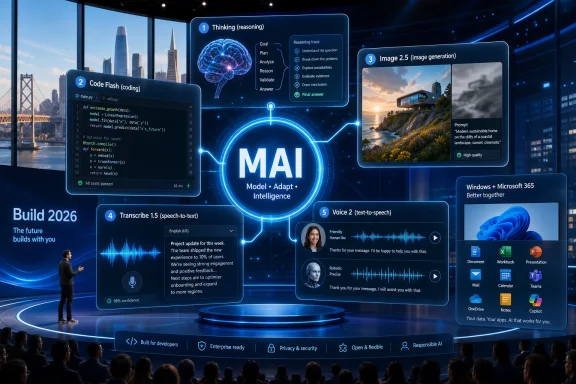
At Build 2026, Microsoft announced a broader set of MAI models than the four consumer-facing ones PCMag tested. The lineup includes MAI-Thinking-1 for reasoning, MAI-Code-1-Flash for coding, MAI-Image-2.5 and its Flash variant for image generation, MAI-Transcribe-1.5 for speech-to-text, and MAI-Voice-2 plus a Flash version for text-to-speech. Microsoft’s own framing emphasizes cost, efficiency, commercially licensed data, and developer choice.
That framing is important. Microsoft does not need every MAI model to beat the strongest frontier model on every benchmark. It needs models that are good enough, cheap enough, controllable enough, and integrated enough to make economic sense across its ecosystem. The brutal truth, then, is not simply that a reviewer preferred Claude, Gemini, or Nano Banana Pro in several tests. The more interesting truth is that Microsoft may be optimizing for a different battlefield than the one consumer reviewers naturally test.
That matters because Microsoft’s strongest AI products are rarely impressive in isolation. Copilot in Word is valuable because it is near the document. Copilot in Excel is valuable because it can reason over the spreadsheet the user already lives in. GitHub Copilot is valuable because it appears inside the developer workflow rather than asking the developer to visit a separate chatbot tab.
A bare model playground changes the evaluation. Suddenly MAI-Voice-2 is not “the voice system that will make Teams summaries and narration more accessible.” It is just a voice generator beside other voice generators. MAI-Image-2.5 is not “the model that can create quick draft visuals inside PowerPoint.” It is just another image model competing against Google’s and OpenAI’s best. MAI-Transcribe-1.5 is not “a fast Azure Speech component that can be deployed at scale.” It is a transcript box next to Gemini.
In that environment, Microsoft loses the home-field advantage. Users are not judging procurement posture, enterprise compliance, latency budgets, or integration with Microsoft Foundry. They are judging output. The PCMag verdict is therefore unsurprising: when experienced as standalone consumer tools, the new MAI models appear serviceable but not exceptional.
That is a sensible strategy. Enterprises do not run on leaderboard screenshots. They run on invoices, latency, security reviews, procurement constraints, and predictable behavior. A model that is slightly less dazzling than a frontier system but much cheaper and easier to deploy can win real workloads.
The problem is that “cheaper and good enough” is not emotionally satisfying in a keynote. Nor is it especially persuasive in a consumer test where the reviewer asks for game-mechanics advice, database structure help, or nuanced explanations and then compares the output to Claude Sonnet. If MAI-Thinking-1 lacks web access in the tested environment, that alone turns many modern prompts into a mismatch. Users have been trained to expect live retrieval, citations, current context, and tool use.
The deeper challenge is that reasoning has become a slippery marketing term. A model can be better at structured problem solving without feeling better to an end user. It can score well on coding benchmarks and still fail to delight in everyday troubleshooting. It can be optimized for enterprise tasks and still look bland when asked to explain a game build or brainstorm a database schema.
This is where Microsoft’s model strategy collides with Microsoft’s product strategy. If MAI-Thinking-1 is meant to disappear into Copilot workflows, users may never care what it is called. If Microsoft wants developers and enthusiasts to choose it directly, it needs a clearer reason than “Microsoft made one too.”
PCMag’s comparison with Google’s Nano Banana Pro is therefore damaging in the way only visual evidence can be damaging. The Microsoft images were described as usable but less sharp, with particular weakness around text in comics and diagrams. That is exactly the sort of flaw that matters for WindowsForum’s audience because many practical image-generation use cases are not fantasy art. They are presentation slides, documentation graphics, quick mockups, thumbnails, internal explainers, and diagrams.
If an image model cannot reliably render text, arrows, labels, UI fragments, or structured layouts, it becomes less useful for office work even if it can produce attractive scenery. Microsoft does not need MAI-Image-2.5 to win every art contest. It does need it to be dependable in the kinds of contexts where Microsoft 365 users will encounter it.
There is a second problem: Google, OpenAI, Adobe, and others are not standing still. The image-generation market is moving from “make me a picture” toward editing, consistency, controllable composition, brand-safe output, and integration into creative workflows. Microsoft’s opportunity is obvious because it owns PowerPoint, Designer, OneDrive, Windows, Edge, and a massive base of business users. But the opportunity only matters if the model can produce assets that users do not have to apologize for.
The fairest interpretation is that MAI-Image-2.5 is now viable. That is progress. But viability is not enough to justify Microsoft’s swagger unless the surrounding products turn it into something competitors cannot easily match.
PCMag’s test found MAI-Transcribe-1.5 competent but not superior to Gemini on a GoTranscript-style sample, and more notably, it reportedly cut off before the end of a hardcore song test. The song example is not necessarily a fair enterprise benchmark, but it is a useful stress test. Real audio is messy. People talk over one another, change volume, use jargon, mumble, laugh, cough, switch languages, and record in hostile environments.
The awkward part for Microsoft is that transcription has become an expected feature rather than a miracle. Users already see speech-to-text in phones, meeting apps, browsers, video platforms, and creative tools. If a dedicated Microsoft transcription model does not obviously beat a general-purpose rival, the marketing story gets harder.
But here again, the enterprise interpretation is more forgiving. Microsoft can win transcription not by being the most dazzling one-off demo, but by being available where the audio already lives. Teams, Azure Speech, SharePoint, OneDrive, Stream, Dynamics, and Windows accessibility features give Microsoft distribution that specialist vendors envy.
The risk is complacency. Enterprise distribution can carry a merely adequate model for a while, especially if the cost and compliance story is strong. But once users notice that another tool is consistently more accurate, pressure builds from the bottom up. IT departments can standardize on Microsoft, but they cannot make employees unhear bad transcripts.
PCMag’s assessment is blunt: MAI-Voice-2 sounds robotic. That does not mean it is useless. Robotic speech still has value for drafts, accessibility, internal narration, prototyping, and low-stakes automation. But the bar has moved. Modern voice models from specialist labs can sound startlingly human, emotionally responsive, and context-aware.
Microsoft’s advantage is language support, workflow integration, and responsible deployment. Those are not trivial. Voice cloning and synthetic speech raise obvious abuse risks, and a company selling to governments, schools, regulated industries, and enterprises cannot treat safeguards as an afterthought. Microsoft is likely optimizing MAI-Voice-2 for a balance of naturalness, safety, controllability, and scale.
Still, users do not hear a compliance framework. They hear a voice. If the result sounds like a machine reading copy, the model will be judged as behind, regardless of how sensible the safety architecture may be.
This may prove to be the hardest consumer perception gap for Microsoft to close. A slightly weaker reasoning model can hide inside a workflow. A slightly weaker image model can be edited. A slightly weaker transcription model can be corrected. A synthetic voice that sounds wrong is the product.
That same critique now threatens MAI. Microsoft has announced a broad family of models across reasoning, coding, images, transcription, and voice. Breadth is strategically useful because Microsoft can reduce dependence on external model providers and tune different systems for different workloads. But breadth also invites comparison across every category at once.
In 2026, no serious user evaluates “AI” as a single thing. They ask which model writes best, which reasons best, which codes best, which generates the cleanest diagrams, which transcribes messy audio, which voice sounds human, which tool respects privacy, which integrates with their stack, and which bill will not explode at scale. Microsoft has answers to many of those questions, but not always the answer enthusiasts want.
The company’s bet is that integration plus economics can beat isolated excellence. That has precedent. Windows itself was not always the most elegant operating system; Office was not always the most beautiful productivity suite; Teams was not always the most beloved collaboration tool. Microsoft often wins by being present, compatible, manageable, and bundled into the workflows that organizations already fund.
AI may not be so forgiving. Model quality is unusually visible, and switching costs can be surprisingly low at the individual level. A user can paste the same prompt into Claude, Gemini, ChatGPT, Copilot, or a niche tool in seconds. If Microsoft wants MAI to be more than infrastructure plumbing, it has to compete in that brutally transparent arena.
That vision depends on models that are inexpensive, responsive, and controllable. A Windows agent that can see context, summarize activity, manipulate files, interpret voice, generate images, and coordinate apps cannot rely exclusively on the most expensive frontier models for every micro-task. The economics would be ugly, and the latency would be worse.
This is where MAI could matter even if the first public impressions are lukewarm. Microsoft needs a portfolio of models that can route tasks intelligently. A simple transcription should not require the same system as a complex coding plan. A quick UI mockup does not need a heavyweight frontier model. A local or near-local assistant may prioritize speed and privacy over maximum theoretical intelligence.
For sysadmins, that future brings both opportunity and dread. AI features embedded into Windows and Microsoft 365 can reduce repetitive work, improve accessibility, and automate documentation. They can also create new governance headaches: data boundaries, model selection, auditability, prompt logging, user permissions, hallucinated actions, and shadow AI usage.
The question is not whether Microsoft can make AI appear in Windows. It already has. The question is whether it can make that AI trustworthy enough for administrators to leave enabled.
But Microsoft’s real MAI audience may be developers and enterprise buyers rather than consumers picking a favorite chatbot. The company is emphasizing Microsoft Foundry, Azure deployment, API access, partner availability, and lower token costs. Those are buying criteria for software builders, not casual users.
A developer building a product does not necessarily need the world’s most powerful model. They need predictable pricing, acceptable quality, documentation, safety controls, regional availability, throughput, service-level confidence, and integration with the rest of their stack. If Microsoft can deliver those, MAI can succeed commercially while still losing a YouTube comparison test.
That does not make the criticism irrelevant. Developer adoption is influenced by reputation. If MAI becomes known as Microsoft’s “almost good enough” model family, the company will have to discount aggressively or bundle deeply to gain mindshare. If, instead, Microsoft can show that MAI models are fast, cheap, safe, and improving rapidly, the narrative changes.
The first few months will matter. AI reputations harden quickly. A model that launches as second-tier can recover, but only if users see visible progress and clear reasons to return.
Both sides are telling part of the truth. Benchmarks can reveal capabilities that casual testing misses. Casual testing can reveal product failures that benchmarks politely ignore. The most useful evaluation is not “which model is best?” but “which model is best for this job, at this price, inside this workflow, with this risk tolerance?”
By that standard, MAI’s launch is neither a flop nor a triumph. It is an infrastructure move disguised as a consumer model showcase. Microsoft is building optionality. It wants to depend less on OpenAI, negotiate from a stronger position, offer developers more model choices, and fill its own products with systems it can tune and price.
The danger is that Microsoft’s public AI brand is already muddy. Copilot means many things. MAI now means many models. Foundry, Playground, Azure Speech, GitHub Copilot, Windows agents, and Microsoft 365 Copilot all overlap in the user’s mental map. Without a crisp quality story, the brand sprawl becomes exhausting.
The best version of MAI is invisible. The user asks for something in Windows, Office, Teams, or a developer tool, and Microsoft routes the task to the right model. The worst version is a menu of model names that asks users to care about Microsoft’s org chart.
The PCMag hands-on test that triggered this round of skepticism lands in exactly the uncomfortable place Microsoft would prefer to avoid. The models mostly work. They are not embarrassing. But in a market where OpenAI, Google, Anthropic, ElevenLabs, Adobe, and a crowd of specialized labs are iterating at frightening speed, “fine” is not a launch thesis.
 Microsoft Is No Longer Content to Be OpenAI’s Distribution Layer
For years, Microsoft’s AI story was easy to summarize: it had the cloud, the apps, the enterprise relationships, and a privileged relationship with OpenAI. Copilot was the user-facing brand, Azure was the infrastructure story, and GitHub Copilot was the proof that AI could become an everyday developer tool rather than a laboratory demo. That strategy worked spectacularly well, but it also left Microsoft exposed to an awkward question: what exactly did Microsoft own?The MAI family is the answer Microsoft wants to give. MAI, pronounced like “FBI,” is Microsoft AI’s in-house model line, distinct from Copilot even when the two eventually feed into the same user experiences. Copilot is the assistant and product surface; MAI is part of the model supply chain beneath it.
At Build 2026, Microsoft announced a broader set of MAI models than the four consumer-facing ones PCMag tested. The lineup includes MAI-Thinking-1 for reasoning, MAI-Code-1-Flash for coding, MAI-Image-2.5 and its Flash variant for image generation, MAI-Transcribe-1.5 for speech-to-text, and MAI-Voice-2 plus a Flash version for text-to-speech. Microsoft’s own framing emphasizes cost, efficiency, commercially licensed data, and developer choice.
That framing is important. Microsoft does not need every MAI model to beat the strongest frontier model on every benchmark. It needs models that are good enough, cheap enough, controllable enough, and integrated enough to make economic sense across its ecosystem. The brutal truth, then, is not simply that a reviewer preferred Claude, Gemini, or Nano Banana Pro in several tests. The more interesting truth is that Microsoft may be optimizing for a different battlefield than the one consumer reviewers naturally test.
The Playground Makes the Weaknesses Visible
The MAI Playground is a useful but dangerous venue for Microsoft. It gives curious users a way to try experimental models without waiting for them to disappear into Copilot, PowerPoint, OneDrive, Azure Speech, or GitHub tooling. It also strips away the product context that often makes Microsoft’s AI feel useful.That matters because Microsoft’s strongest AI products are rarely impressive in isolation. Copilot in Word is valuable because it is near the document. Copilot in Excel is valuable because it can reason over the spreadsheet the user already lives in. GitHub Copilot is valuable because it appears inside the developer workflow rather than asking the developer to visit a separate chatbot tab.
A bare model playground changes the evaluation. Suddenly MAI-Voice-2 is not “the voice system that will make Teams summaries and narration more accessible.” It is just a voice generator beside other voice generators. MAI-Image-2.5 is not “the model that can create quick draft visuals inside PowerPoint.” It is just another image model competing against Google’s and OpenAI’s best. MAI-Transcribe-1.5 is not “a fast Azure Speech component that can be deployed at scale.” It is a transcript box next to Gemini.
In that environment, Microsoft loses the home-field advantage. Users are not judging procurement posture, enterprise compliance, latency budgets, or integration with Microsoft Foundry. They are judging output. The PCMag verdict is therefore unsurprising: when experienced as standalone consumer tools, the new MAI models appear serviceable but not exceptional.
MAI-Thinking-1 Shows the Cost Strategy Hiding Behind the Reasoning Hype
MAI-Thinking-1 is the symbolic centerpiece because reasoning models are where AI companies currently perform their most theatrical claims. A reasoning model suggests deeper problem-solving, better planning, stronger coding, and more reliable multi-step answers. Microsoft says MAI-Thinking-1 is its first in-house reasoning model, and the company has positioned it as a midsized system designed to compete partly on cost and efficiency rather than brute-force supremacy.That is a sensible strategy. Enterprises do not run on leaderboard screenshots. They run on invoices, latency, security reviews, procurement constraints, and predictable behavior. A model that is slightly less dazzling than a frontier system but much cheaper and easier to deploy can win real workloads.
The problem is that “cheaper and good enough” is not emotionally satisfying in a keynote. Nor is it especially persuasive in a consumer test where the reviewer asks for game-mechanics advice, database structure help, or nuanced explanations and then compares the output to Claude Sonnet. If MAI-Thinking-1 lacks web access in the tested environment, that alone turns many modern prompts into a mismatch. Users have been trained to expect live retrieval, citations, current context, and tool use.
The deeper challenge is that reasoning has become a slippery marketing term. A model can be better at structured problem solving without feeling better to an end user. It can score well on coding benchmarks and still fail to delight in everyday troubleshooting. It can be optimized for enterprise tasks and still look bland when asked to explain a game build or brainstorm a database schema.
This is where Microsoft’s model strategy collides with Microsoft’s product strategy. If MAI-Thinking-1 is meant to disappear into Copilot workflows, users may never care what it is called. If Microsoft wants developers and enthusiasts to choose it directly, it needs a clearer reason than “Microsoft made one too.”
Image Generation Is Better, But Better Is Not the Same as Best
MAI-Image has apparently improved quickly. That is not a minor achievement. Text-to-image generation is one of the most visible and unforgiving AI categories because failures are instantly legible. Bad hands, mangled text, warped signage, strange spatial logic, over-smoothed faces, and fake-looking diagrams announce themselves before a user reads a single benchmark.PCMag’s comparison with Google’s Nano Banana Pro is therefore damaging in the way only visual evidence can be damaging. The Microsoft images were described as usable but less sharp, with particular weakness around text in comics and diagrams. That is exactly the sort of flaw that matters for WindowsForum’s audience because many practical image-generation use cases are not fantasy art. They are presentation slides, documentation graphics, quick mockups, thumbnails, internal explainers, and diagrams.
If an image model cannot reliably render text, arrows, labels, UI fragments, or structured layouts, it becomes less useful for office work even if it can produce attractive scenery. Microsoft does not need MAI-Image-2.5 to win every art contest. It does need it to be dependable in the kinds of contexts where Microsoft 365 users will encounter it.
There is a second problem: Google, OpenAI, Adobe, and others are not standing still. The image-generation market is moving from “make me a picture” toward editing, consistency, controllable composition, brand-safe output, and integration into creative workflows. Microsoft’s opportunity is obvious because it owns PowerPoint, Designer, OneDrive, Windows, Edge, and a massive base of business users. But the opportunity only matters if the model can produce assets that users do not have to apologize for.
The fairest interpretation is that MAI-Image-2.5 is now viable. That is progress. But viability is not enough to justify Microsoft’s swagger unless the surrounding products turn it into something competitors cannot easily match.
Transcription Is a Commodity Until It Fails
MAI-Transcribe-1.5 may be the most quietly consequential model in the group. Transcription is not glamorous, but it is everywhere. Meetings, calls, lectures, podcasts, legal interviews, medical dictation, accessibility workflows, video editing, support logs, and compliance archives all depend on turning speech into text with acceptable accuracy.PCMag’s test found MAI-Transcribe-1.5 competent but not superior to Gemini on a GoTranscript-style sample, and more notably, it reportedly cut off before the end of a hardcore song test. The song example is not necessarily a fair enterprise benchmark, but it is a useful stress test. Real audio is messy. People talk over one another, change volume, use jargon, mumble, laugh, cough, switch languages, and record in hostile environments.
The awkward part for Microsoft is that transcription has become an expected feature rather than a miracle. Users already see speech-to-text in phones, meeting apps, browsers, video platforms, and creative tools. If a dedicated Microsoft transcription model does not obviously beat a general-purpose rival, the marketing story gets harder.
But here again, the enterprise interpretation is more forgiving. Microsoft can win transcription not by being the most dazzling one-off demo, but by being available where the audio already lives. Teams, Azure Speech, SharePoint, OneDrive, Stream, Dynamics, and Windows accessibility features give Microsoft distribution that specialist vendors envy.
The risk is complacency. Enterprise distribution can carry a merely adequate model for a while, especially if the cost and compliance story is strong. But once users notice that another tool is consistently more accurate, pressure builds from the bottom up. IT departments can standardize on Microsoft, but they cannot make employees unhear bad transcripts.
Voice Is Where “Good Enough” Sounds Worst
MAI-Voice-2 faces the harshest perceptual test because humans are exquisitely sensitive to unnatural speech. We forgive a chatbot for a bland sentence and an image generator for a slightly weird background object. A synthetic voice that breathes wrong, stresses the wrong word, or lands in the uncanny valley becomes irritating almost instantly.PCMag’s assessment is blunt: MAI-Voice-2 sounds robotic. That does not mean it is useless. Robotic speech still has value for drafts, accessibility, internal narration, prototyping, and low-stakes automation. But the bar has moved. Modern voice models from specialist labs can sound startlingly human, emotionally responsive, and context-aware.
Microsoft’s advantage is language support, workflow integration, and responsible deployment. Those are not trivial. Voice cloning and synthetic speech raise obvious abuse risks, and a company selling to governments, schools, regulated industries, and enterprises cannot treat safeguards as an afterthought. Microsoft is likely optimizing MAI-Voice-2 for a balance of naturalness, safety, controllability, and scale.
Still, users do not hear a compliance framework. They hear a voice. If the result sounds like a machine reading copy, the model will be judged as behind, regardless of how sensible the safety architecture may be.
This may prove to be the hardest consumer perception gap for Microsoft to close. A slightly weaker reasoning model can hide inside a workflow. A slightly weaker image model can be edited. A slightly weaker transcription model can be corrected. A synthetic voice that sounds wrong is the product.
Copilot’s Problem Is Becoming MAI’s Problem
The recurring criticism of Copilot is not that it lacks features. It has too many surfaces to count: Windows, Edge, Office, Teams, GitHub, security products, admin centers, and mobile apps. The criticism is that Copilot often feels less defined than its competitors. It is everywhere, but not always excellent anywhere.That same critique now threatens MAI. Microsoft has announced a broad family of models across reasoning, coding, images, transcription, and voice. Breadth is strategically useful because Microsoft can reduce dependence on external model providers and tune different systems for different workloads. But breadth also invites comparison across every category at once.
In 2026, no serious user evaluates “AI” as a single thing. They ask which model writes best, which reasons best, which codes best, which generates the cleanest diagrams, which transcribes messy audio, which voice sounds human, which tool respects privacy, which integrates with their stack, and which bill will not explode at scale. Microsoft has answers to many of those questions, but not always the answer enthusiasts want.
The company’s bet is that integration plus economics can beat isolated excellence. That has precedent. Windows itself was not always the most elegant operating system; Office was not always the most beautiful productivity suite; Teams was not always the most beloved collaboration tool. Microsoft often wins by being present, compatible, manageable, and bundled into the workflows that organizations already fund.
AI may not be so forgiving. Model quality is unusually visible, and switching costs can be surprisingly low at the individual level. A user can paste the same prompt into Claude, Gemini, ChatGPT, Copilot, or a niche tool in seconds. If Microsoft wants MAI to be more than infrastructure plumbing, it has to compete in that brutally transparent arena.
The Windows Angle Is Bigger Than a Chatbot
For Windows users, the MAI story is not just about whether a playground demo beats Gemini on a transcript. Microsoft is trying to turn Windows from an operating system into an agent platform. Build 2026’s broader message pointed toward AI agents, local and cloud-assisted workflows, and a future in which the PC becomes less a destination than a coordination layer.That vision depends on models that are inexpensive, responsive, and controllable. A Windows agent that can see context, summarize activity, manipulate files, interpret voice, generate images, and coordinate apps cannot rely exclusively on the most expensive frontier models for every micro-task. The economics would be ugly, and the latency would be worse.
This is where MAI could matter even if the first public impressions are lukewarm. Microsoft needs a portfolio of models that can route tasks intelligently. A simple transcription should not require the same system as a complex coding plan. A quick UI mockup does not need a heavyweight frontier model. A local or near-local assistant may prioritize speed and privacy over maximum theoretical intelligence.
For sysadmins, that future brings both opportunity and dread. AI features embedded into Windows and Microsoft 365 can reduce repetitive work, improve accessibility, and automate documentation. They can also create new governance headaches: data boundaries, model selection, auditability, prompt logging, user permissions, hallucinated actions, and shadow AI usage.
The question is not whether Microsoft can make AI appear in Windows. It already has. The question is whether it can make that AI trustworthy enough for administrators to leave enabled.
Microsoft’s Real Audience May Not Be the Reviewer With Five Browser Tabs
The PCMag critique is valuable because consumer impressions often reveal what vendor benchmarks obscure. If a model feels mediocre, that matters. If output is less sharp, less accurate, or less natural than a rival’s, users will notice.But Microsoft’s real MAI audience may be developers and enterprise buyers rather than consumers picking a favorite chatbot. The company is emphasizing Microsoft Foundry, Azure deployment, API access, partner availability, and lower token costs. Those are buying criteria for software builders, not casual users.
A developer building a product does not necessarily need the world’s most powerful model. They need predictable pricing, acceptable quality, documentation, safety controls, regional availability, throughput, service-level confidence, and integration with the rest of their stack. If Microsoft can deliver those, MAI can succeed commercially while still losing a YouTube comparison test.
That does not make the criticism irrelevant. Developer adoption is influenced by reputation. If MAI becomes known as Microsoft’s “almost good enough” model family, the company will have to discount aggressively or bundle deeply to gain mindshare. If, instead, Microsoft can show that MAI models are fast, cheap, safe, and improving rapidly, the narrative changes.
The first few months will matter. AI reputations harden quickly. A model that launches as second-tier can recover, but only if users see visible progress and clear reasons to return.
The Benchmark War Is Giving Way to the Workflow War
Microsoft’s challenge is that benchmark claims and human impressions are increasingly out of sync. Vendors announce preference tests, coding scores, efficiency curves, multilingual coverage, and cost advantages. Users respond with screenshots of broken text, dull prose, hallucinated answers, clipped transcripts, and robotic voices.Both sides are telling part of the truth. Benchmarks can reveal capabilities that casual testing misses. Casual testing can reveal product failures that benchmarks politely ignore. The most useful evaluation is not “which model is best?” but “which model is best for this job, at this price, inside this workflow, with this risk tolerance?”
By that standard, MAI’s launch is neither a flop nor a triumph. It is an infrastructure move disguised as a consumer model showcase. Microsoft is building optionality. It wants to depend less on OpenAI, negotiate from a stronger position, offer developers more model choices, and fill its own products with systems it can tune and price.
The danger is that Microsoft’s public AI brand is already muddy. Copilot means many things. MAI now means many models. Foundry, Playground, Azure Speech, GitHub Copilot, Windows agents, and Microsoft 365 Copilot all overlap in the user’s mental map. Without a crisp quality story, the brand sprawl becomes exhausting.
The best version of MAI is invisible. The user asks for something in Windows, Office, Teams, or a developer tool, and Microsoft routes the task to the right model. The worst version is a menu of model names that asks users to care about Microsoft’s org chart.
The First MAI Report Card Is a Warning, Not a Verdict
The early evidence suggests Microsoft has built a competent in-house AI portfolio, but not yet one that forces consumers to abandon the best tools from Google, Anthropic, OpenAI, or specialist voice and image labs. That is a warning because Microsoft is putting AI at the center of Windows and its productivity empire. It is not yet a verdict because these models are in limited preview, and the company has both the compute and the distribution to improve them quickly.- Microsoft’s MAI models are separate from Copilot, even though they are likely to power Copilot experiences over time.
- MAI-Thinking-1 is strategically important because it gives Microsoft an in-house reasoning model, but early consumer testing has not shown a decisive advantage over Claude-class rivals.
- MAI-Image-2.5 appears much improved, yet text rendering and diagram reliability remain critical weaknesses for practical office and Windows use.
- MAI-Transcribe-1.5 looks useful for quick transcription, but “useful” is a low bar in a category where accuracy failures are easy to compare.
- MAI-Voice-2 may be the hardest sell because synthetic speech quality is judged instantly and emotionally.
- The strongest case for MAI is not standalone superiority but Microsoft’s ability to embed cheaper, controlled, first-party models throughout Windows, Azure, GitHub, and Microsoft 365.
References
- Primary source: PCMag
Published: 2026-06-06T16:50:18.635670
I Tested Microsoft's New AI Models, and They're Surprisingly Mediocre | PCMag
Microsoft released a suite of fresh MAI models at Build 2026. They work fine, but they can't compete with Claude and Gemini.www.pcmag.com - Related coverage: windowscentral.com
Microsoft launches seven in‑house AI models to cut developer costs and reduce reliance on OpenAI | Windows Central
Microsoft’s new MAI model family includes a flagship reasoning model, zero distillation, and lower developer costs.www.windowscentral.com - Related coverage: axios.com
Microsoft debuts Scout agent, homegrown reasoning model
Microsoft is seeking to show it is a serious player in AI.www.axios.com
- Related coverage: tomsguide.com
Biggest Microsoft Build 2026 announcements — agentic AI, RTX Spark Dev Box, GitHub Copilot app, new MAI models, and more | Tom's Guide
All the big news from Microsoft's AI-focused eventwww.tomsguide.com - Related coverage: techradar.com
‘We need an AI that places humanity first’: Microsoft AI CEO outlines hopes to build “humanist superintelligence” - and has seven new models to help him do it | TechRadar
Microsoft unveils seven new AI models to keep developers buildingwww.techradar.com - Official source: news.microsoft.com
Microsoft Foundry (国际版) 推出全新 MAI 模型 - Source Asia
 news.microsoft.com
- Related coverage: ai-tldr.dev
Microsoft Launches Seven New MAI Models at Build… | AI/TLDR
Microsoft AI's biggest first-party launch yet: a reasoner, a coding flash model, image + voice updates, and a speech-to-text engine claimed to be 5x fas…ai-tldr.dev - Related coverage: techtimes.com
Microsoft Build 2026: MAI-Thinking-1 Is First In-House Reasoning Model, Trained Without OpenAI Data
Microsoft Build 2026 launched MAI-Thinking-1, the company’s first in-house reasoning model, trained without OpenAI data. MAI-Code-1-Flash rolls out to all GitHub Copilot plans today. Independentwww.techtimes.com - Official source: techcommunity.microsoft.com
Introducing MAI-Transcribe-1, MAI-Voice-1, and MAI-Image-2 in Microsoft Foundry | Microsoft Community Hub
Another Step Towards a Complete AI Platform Since inception, our goal with Microsoft Foundry has been to deliver the most complete AI and app agent factory;... techcommunity.microsoft.com
- Related coverage: techcrunch.com
Microsoft takes on AI rivals with three new foundational models | TechCrunch
MAI released models that can transcribe voice into text as well as generate audio and images after the group's formation six months ago.techcrunch.com - Official source: microsoft.ai
- Official source: playground.microsoft.ai
MAI Playground | Microsoft AI
Explore MAI Playground, the Microsoft AI Playground for running and experimenting with new AI models.playground.microsoft.ai
- Related coverage: testingcatalog.com
Microsoft released MAI voice and image models for Build 2026
Microsoft is preparing several AI models, including MAI-Image-2.5, MAI-Transcribe-1.5, and multilingual MAI-Voice-2, for unveiling at Build 2026. www.testingcatalog.com
- Related coverage: byteiota.com
- Related coverage: windowsforum.com
Microsoft Build 2026: MAI-Image 2.5, MAI-Voice 2, and MAI-Transcribe 1.5 | Windows Forum
Microsoft is preparing MAI-Image-2.5, MAI-Transcribe-1.5, and MAI-Voice-2 for its Build 2026 developer conference, which opens June 2 at Fort Mason Center...windowsforum.com - Related coverage: moneycontrol.com
Microsoft unveils seven new AI models with reasoning, coding, image and voice capabilities
New MAI family includes reasoning, coding, image, voice and transcription models aimed at developers and enterprises.www.moneycontrol.com - Related coverage: zeronoise.ai
- Related coverage: techxplore.com


