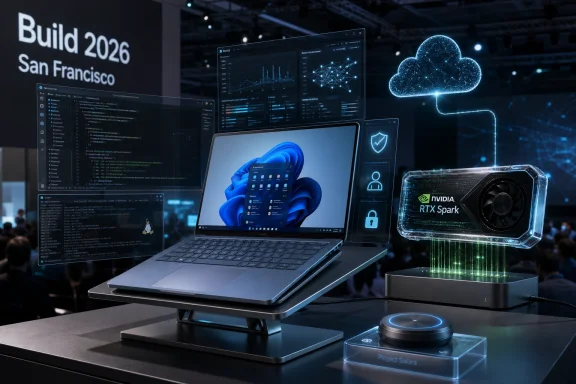
Microsoft Build 2026 begins June 2 at Fort Mason Center in San Francisco, with Satya Nadella opening a developer conference that will be streamed online and centered on Windows 11, AI agents, and NVIDIA’s new RTX Spark platform for Windows on Arm PCs. The viewing instructions are the least interesting part of the story. What matters is that Microsoft is using Build to argue that the PC’s next act is not just thinner laptops or faster NPUs, but a Windows platform reorganized around local AI, agentic workflows, and Arm-native software.
Build has always been Microsoft’s most revealing conference because it is where the company talks past consumers and directly to the people who make its platforms useful. This year, that audience matters more than usual. Windows has spent two years trying to make “AI PC” mean something more than a Copilot key and a benchmark slide.
The conference runs June 2–3, 2026, with in-person attendance sold out and online access split between the opening keynote and selected streamed sessions. Microsoft’s own event page confirms San Francisco as the venue and Satya Nadella as the keynote speaker, while reporting around the event points to a sharp focus on AI development, Windows agents, and platform work around Windows on Arm.
That is a notable shift in tone. Build is not being framed merely as a place to announce SDKs and cloud services. It is becoming the week when Microsoft tries to prove that Windows can be a serious local AI platform rather than a client for cloud-hosted intelligence.
That combination attacks the old Windows on Arm problem from both ends. Microsoft has spent years improving compatibility and developer tooling, but Qualcomm-based Windows machines have still had to fight a perception problem: excellent battery life, improving performance, but uneven app and driver confidence. NVIDIA enters with a very different brand promise. For developers, creators, gamers, and AI tinkerers, RTX means software ecosystems, CUDA, drivers, rendering pipelines, and GPU acceleration.
The pitch is not subtle. NVIDIA and Microsoft are calling this a new era for the PC, and while that language deserves skepticism, the hardware premise is real. A Windows laptop or desktop-class system with workstation-grade GPU acceleration, Arm efficiency ambitions, and unified memory large enough for serious local AI workloads is not just another Copilot+ PC refresh.
The question is whether Windows can meet the hardware halfway. A fast chip does not make an ecosystem. If RTX Spark systems arrive with awkward emulation gaps, inconsistent game support, missing developer dependencies, or enterprise management caveats, the “new era” will feel more like another Windows on Arm reset.
That is where Microsoft’s language around identity, containment, audit trails, and manageability matters. The agentic PC is exciting only if it does not become a security administrator’s nightmare. An AI assistant that can act on a user’s behalf must be governed like software, not trusted like a person.
This is also why Build is the right venue. Microsoft cannot ship useful agents by itself. It needs Windows developers to add connectors, expose app functions, adopt modern app frameworks, and make software intelligible to AI systems without giving those systems reckless access to everything on the machine.
The stakes are larger than convenience. If Microsoft gets this right, Windows becomes a place where agents can orchestrate real work across local apps, enterprise resources, and cloud services. If it gets it wrong, agents become another layer of pop-up automation that users disable and admins block.
Build sessions reportedly include material on porting Windows apps to Arm and on Microsoft’s own experience moving parts of Windows 11 to native code. That is an important admission. Emulation is a bridge, not a destination. Prism can soften the landing, but the platform only becomes credible when major apps, plug-ins, drivers, launchers, utilities, and developer tools treat Arm64 as first-class.
RTX Spark sharpens that pressure. The more powerful these systems become, the less acceptable it will be for professional software to run in a compatibility layer or fail because of architecture assumptions. Developers who ignored Windows on Arm when it meant thin ultraportables may feel differently when the target machine is pitched as a local AI workstation.
Microsoft’s challenge is to make the porting story boring. The winning version of Windows on Arm is not one where users celebrate every native app. It is one where nobody checks.
But the keynote will be enough to understand the company’s direction. Watch for how much time Microsoft spends on Windows itself rather than Azure abstractions. Watch whether agents are shown as polished product features or developer primitives. Watch whether RTX Spark appears as a premium hardware showcase or as the start of a broader Windows platform bet.
The most revealing demos will be the messy ones. A polished AI assistant summarizing documents is old news. A secure agent invoking a real Windows app, respecting permissions, producing an audit trail, and running meaningfully on local hardware would say much more about where Microsoft thinks the PC is headed.
That is the optimistic reading. The more cautious reading is that Microsoft still has to prove its AI vision can survive contact with users who prize control, admins who prize predictability, and developers who do not want yet another integration surface to maintain. The company’s recent history with Copilot in Windows has been uneven enough that skepticism is earned.
Still, RTX Spark changes the tone of the conversation. Windows on Arm is no longer just about battery life and fanless laptops. It is being repositioned as a place for high-end local AI, creative workloads, development, and gaming-adjacent performance. That is a much bigger swing.
 Microsoft Moves Build to the Center of the PC Fight
Build has always been Microsoft’s most revealing conference because it is where the company talks past consumers and directly to the people who make its platforms useful. This year, that audience matters more than usual. Windows has spent two years trying to make “AI PC” mean something more than a Copilot key and a benchmark slide.The conference runs June 2–3, 2026, with in-person attendance sold out and online access split between the opening keynote and selected streamed sessions. Microsoft’s own event page confirms San Francisco as the venue and Satya Nadella as the keynote speaker, while reporting around the event points to a sharp focus on AI development, Windows agents, and platform work around Windows on Arm.
That is a notable shift in tone. Build is not being framed merely as a place to announce SDKs and cloud services. It is becoming the week when Microsoft tries to prove that Windows can be a serious local AI platform rather than a client for cloud-hosted intelligence.
RTX Spark Gives Windows on Arm a Different Kind of Credibility
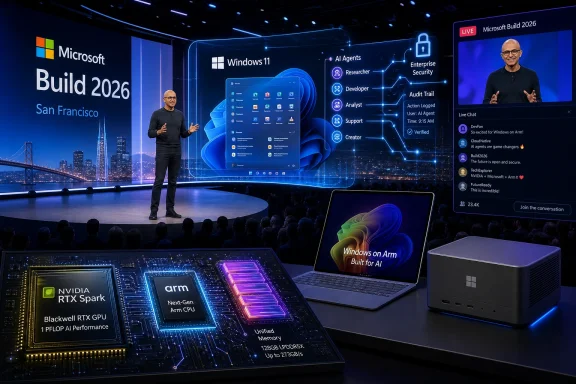
The most consequential pre-Build announcement is NVIDIA RTX Spark, a Windows-focused platform built around an Arm CPU, Blackwell RTX GPU, and large unified memory configurations. NVIDIA says the RTX Spark superchip combines a 20-core Grace CPU with a Blackwell GPU, fifth-generation Tensor Cores, FP4 support, and NVLink-C2C interconnect technology. Microsoft’s Windows team says Prism, its emulator for 32-bit and 64-bit x86 apps on Windows on Arm, will be optimized for RTX Spark-powered PCs.That combination attacks the old Windows on Arm problem from both ends. Microsoft has spent years improving compatibility and developer tooling, but Qualcomm-based Windows machines have still had to fight a perception problem: excellent battery life, improving performance, but uneven app and driver confidence. NVIDIA enters with a very different brand promise. For developers, creators, gamers, and AI tinkerers, RTX means software ecosystems, CUDA, drivers, rendering pipelines, and GPU acceleration.
The pitch is not subtle. NVIDIA and Microsoft are calling this a new era for the PC, and while that language deserves skepticism, the hardware premise is real. A Windows laptop or desktop-class system with workstation-grade GPU acceleration, Arm efficiency ambitions, and unified memory large enough for serious local AI workloads is not just another Copilot+ PC refresh.
The question is whether Windows can meet the hardware halfway. A fast chip does not make an ecosystem. If RTX Spark systems arrive with awkward emulation gaps, inconsistent game support, missing developer dependencies, or enterprise management caveats, the “new era” will feel more like another Windows on Arm reset.
Agents Are the Real Build 2026 Product
Microsoft’s most important Build message may not be a chip at all. It is the idea that Windows apps should expose themselves to AI agents in structured, manageable ways. The company has been preparing developers for a model in which agents can interact with applications, automate workflows, and use local system capabilities without turning the desktop into an uncontrolled macro recorder.That is where Microsoft’s language around identity, containment, audit trails, and manageability matters. The agentic PC is exciting only if it does not become a security administrator’s nightmare. An AI assistant that can act on a user’s behalf must be governed like software, not trusted like a person.
This is also why Build is the right venue. Microsoft cannot ship useful agents by itself. It needs Windows developers to add connectors, expose app functions, adopt modern app frameworks, and make software intelligible to AI systems without giving those systems reckless access to everything on the machine.
The stakes are larger than convenience. If Microsoft gets this right, Windows becomes a place where agents can orchestrate real work across local apps, enterprise resources, and cloud services. If it gets it wrong, agents become another layer of pop-up automation that users disable and admins block.
The Arm Porting Push Is No Longer Optional
Windows on Arm has lived for years in an uncomfortable middle state. It was technically viable, often impressive in narrow conditions, but still treated by many developers as a secondary target. Microsoft now appears determined to close that gap by making Arm-native Windows software a mainstream expectation rather than a boutique optimization.Build sessions reportedly include material on porting Windows apps to Arm and on Microsoft’s own experience moving parts of Windows 11 to native code. That is an important admission. Emulation is a bridge, not a destination. Prism can soften the landing, but the platform only becomes credible when major apps, plug-ins, drivers, launchers, utilities, and developer tools treat Arm64 as first-class.
RTX Spark sharpens that pressure. The more powerful these systems become, the less acceptable it will be for professional software to run in a compatibility layer or fail because of architecture assumptions. Developers who ignored Windows on Arm when it meant thin ultraportables may feel differently when the target machine is pitched as a local AI workstation.
Microsoft’s challenge is to make the porting story boring. The winning version of Windows on Arm is not one where users celebrate every native app. It is one where nobody checks.
The Livestream Is a Window Into Microsoft’s Priorities
For ordinary viewers, the practical answer is simple: the Build 2026 opening keynote is available online, while deeper access to the full conference experience requires registration or in-person attendance. Tickets were sold out before the event began, and the in-person program includes sessions, labs, demos, community activities, and access to Microsoft experts that online viewers will not fully replicate.But the keynote will be enough to understand the company’s direction. Watch for how much time Microsoft spends on Windows itself rather than Azure abstractions. Watch whether agents are shown as polished product features or developer primitives. Watch whether RTX Spark appears as a premium hardware showcase or as the start of a broader Windows platform bet.
The most revealing demos will be the messy ones. A polished AI assistant summarizing documents is old news. A secure agent invoking a real Windows app, respecting permissions, producing an audit trail, and running meaningfully on local hardware would say much more about where Microsoft thinks the PC is headed.
This Week’s Windows Story Is Bigger Than One Keynote
Build and Computex landing in the same week gives Microsoft an unusually strong stage. Computex supplies the hardware drama; Build supplies the platform rationale. Together, they let Microsoft argue that Windows is not merely adapting to the AI era but becoming one of its primary runtimes.That is the optimistic reading. The more cautious reading is that Microsoft still has to prove its AI vision can survive contact with users who prize control, admins who prize predictability, and developers who do not want yet another integration surface to maintain. The company’s recent history with Copilot in Windows has been uneven enough that skepticism is earned.
Still, RTX Spark changes the tone of the conversation. Windows on Arm is no longer just about battery life and fanless laptops. It is being repositioned as a place for high-end local AI, creative workloads, development, and gaming-adjacent performance. That is a much bigger swing.
The Signals Windows Users Should Watch This Week
The most useful way to follow Build 2026 is not to chase every session, but to separate platform commitments from keynote theater. Microsoft will show ambition. The important question is where it shows plumbing.- Microsoft Build 2026 runs June 2–3 in San Francisco, with Satya Nadella’s keynote streamed online and the broader event split between digital access and sold-out in-person programming.
- NVIDIA RTX Spark gives Windows on Arm a more aggressive performance story, pairing Arm CPU design with Blackwell RTX graphics and large unified memory for local AI and creative workloads.
- Microsoft’s Windows agent strategy depends on security boundaries, app connectors, identity, auditability, and management controls, not just clever demos.
- Prism remains essential for compatibility, but native Arm64 applications are still the long-term test of whether Windows on Arm can become ordinary.
- Developers should watch for tooling, SDKs, migration guidance, and real app integration patterns rather than only consumer-facing Copilot announcements.
- IT admins should treat agentic Windows features as a governance story first and a productivity story second.
References
- Primary source: Windows Central
Published: Mon, 01 Jun 2026 13:55:03 GMT
How to watch Microsoft Build 2026: Windows 11, NVIDIA RTX Spark, AI agents, and more | Windows Central
Build isn't just some boring developer conference. It showcases the future of Windows and computing.www.windowscentral.com - Related coverage: axios.com
Microsoft debuts Nvidia-powered Microsoft Surface Ultra laptop
Microsoft is trying again to redefine the PC for the AI era.www.axios.com
- Related coverage: techradar.com
10 products that launched at Microsoft Build — and what happened to them | TechRadar
From Windows 8 to Copilot, here’s everything that was born at Buildwww.techradar.com - Related coverage: tomshardware.com
Nvidia and Microsoft tease "a new era of PC" ahead of Computex 2026 — coordinated social media posts could indicate that rumored N1X laptops will be Windows on Arm systems | Tom's Hardware
An Nvidia-powered Arm PC running Windows could inspire new local AI experiences beyond Copilot+.www.tomshardware.com - Related coverage: notebookcheck.net
Microsoft Build 2026: What to expect from the June 2 keynote - Notebookcheck News
Microsoft Build 2026 opens June 2 in San Francisco with AI agents, GitHub Copilot updates, and Windows local AI. Here is what developers can expect. www.notebookcheck.net
- Related coverage: notebookcheck.com
Microsoft Build 2026: Das erwartet Zuschauer bei der Keynote am 2. Juni - Notebookcheck News
Die Microsoft Build 2026 beginnt am 2. Juni in San Francisco. Im Mittelpunkt stehen KI-Agenten, Neuerungen für GitHub Copilot sowie lokale KI-Funktionen für Windows. Das können Entwickler von der Konferenz erwarten. www.notebookcheck.com
- Official source: build.microsoft.com
Your home for Microsoft Build
Go deep on real code and real systems with the teams building and scaling AI at Microsoft Build, June 2–3, 2026, in San Francisco and online.build.microsoft.com - Related coverage: investor.nvidia.com
NVIDIA Corporation - NVIDIA and Microsoft Reinvent Windows PCs for the Age of Personal AI
RTX Spark — a 1-Petaflop Superchip, the Full CUDA and RTX Ecosystem, and Windows-Native Agents — a New Beginning for Personal Computers News Summary: NVIDIA RTX Spark powers the world’s first Windows PCs purpose-built for personal agents, featuring 1 petaflop of AI performance, industry-leading...investor.nvidia.com - Official source: learn.microsoft.com
Windows on Arm documentation | Microsoft Learn
Learn more about running Windows on PCs powered by Arm processors. Find guidance on how to build Windows apps for Arm64 devices or iteratively update your existing Windows app to take advantage of Arm64 native capabilities.learn.microsoft.com - Related coverage: nvidia.com
Join NVIDIA at Microsoft Build 2026
Learn how NVIDIA and Microsoft are partnering to accelerate the development and deployment of Generative AI across Microsoft Azure, Azure AI services, and more.www.nvidia.com - Related coverage: windowslatest.com
Report: Nvidia prepares multiple Arm-based chips for 2026 and 2027, first-gen could debut with Windows 11 26H1
NVIDIA is still planning a Windows on Arm chip, with N1X-based laptops expected as early as Q1 2026. More CPUs are planned. www.windowslatest.com
- Official source: blogs.windows.com
Introducing a powerful new chapter for Windows PCs, accelerated by NVIDIA RTX Spark
Today at NVIDIA GTC, Microsoft and NVIDIA announced the world’s most powerful and efficient thin-and-light Windows PCs ever. Accelerated by NVIDIA RTX Sparkblogs.windows.com - Official source: developer.microsoft.com
Windows Agentic | Microsoft Developer
The secure, open platform for AI & agents. Native support for MCP and Agent workspace on Windows.developer.microsoft.com - Related coverage: elpais.com
Nvidia anuncia la reinvención del ordenador personal con un chip de IA con el que reta a Intel y AMD | Economía | EL PAÍS
El gigante crea un procesador diseñado junto a Microsoft. Fabricantes como Dell, HP y Asus se unen al proyectoelpais.com - Official source: news.microsoft.com
- Related coverage: developer.arm.com