

Microsoft Build 2026, held this week in San Francisco and streamed online, centered on Microsoft’s attempt to turn Windows, Azure, GitHub, Surface, and Copilot into a single platform for AI agents. The company did not merely announce more chatbot features; it tried to redraw the boundary between the operating system, the app, and the assistant. For Windows users and administrators, the message was clear enough: the next phase of Microsoft’s platform strategy is not Windows 12, but Windows as an agent runtime. That is both more practical and more unsettling than another start-menu redesign.
The headline from Build 2026 is that Microsoft has decided the AI agent is no longer a side panel, a button, or a branded helper living somewhere near the taskbar. It is becoming a platform object. The company spent the conference describing a future in which agents can understand enterprise context, call tools, automate workflows, and operate across Windows, Microsoft 365, GitHub, and Azure with fewer seams.
That is a meaningful shift from the first Copilot wave, which too often felt like Microsoft had bolted the same chat box onto every product it owned. Build 2026 was less about “Copilot is everywhere” and more about “agents need plumbing.” Microsoft talked about context layers, identity, model hosting, app actions, governance, and local runtimes because those are the pieces that determine whether AI can safely do useful work rather than merely narrate it.
The PCMag Australia recap captured the event’s surface: a long keynote, hundreds of sessions, demos of a streamlined Windows experience, RTX Spark-powered Surface hardware, and personalized OpenClaw agents. But the deeper story is that Microsoft is trying to industrialize agentic computing before the term itself has settled. Build was not a victory lap; it was a land grab.
For WindowsForum readers, that matters because Windows is once again being positioned as the place where Microsoft’s grandest platform ambitions become unavoidable. The PC is not just a client device in this story. It is the local execution environment, the policy boundary, the identity endpoint, and the user’s last line of defense.
The practical pieces are scattered across developer-facing announcements: Windows AI APIs, local model support, Foundry Local, Phi Silica on Copilot+ PCs, app actions, agent connectors, and broader support for Model Context Protocol. None of these is individually as eye-catching as a new Start menu, but together they suggest a more profound architectural bet. Microsoft wants the OS to know what apps can do, expose those capabilities to agents, and police the transaction.
That is a different model from the traditional Windows app ecosystem. Historically, Windows software exposed automation through COM, shell extensions, URI handlers, scripts, plug-ins, accessibility interfaces, browser protocols, and whatever private APIs a vendor cared to document. The result was powerful, messy, and often dangerous. Agentic Windows is Microsoft’s attempt to replace that sprawl with a governed discovery and execution layer.
The promise is easy to understand. If an agent can ask Windows what an installed app is allowed to do, invoke that action with user consent, run inside a constrained workspace, and leave an audit trail, automation becomes less of a hack. The risk is just as obvious. If Microsoft overreaches, Windows becomes not a neutral desktop but a broker that decides which workflows are blessed, which apps are legible, and which competitors are second-class citizens.
At Build, the company did not retreat from AI. It reframed the pitch around utility. The old Copilot story often sounded like a consumer marketing campaign; the new agent story sounds like an infrastructure roadmap. That is smarter, but it does not erase the trust deficit.
Windows users have been trained to be skeptical when Microsoft says a feature is optional, especially when the feature aligns with the company’s cloud and subscription priorities. An agent-native Windows may begin as a developer platform and enterprise productivity layer, but the history of Windows is full of capabilities that started as opt-in conveniences and became persistent background assumptions.
For administrators, the important question is not whether AI agents are interesting. They are. The question is whether Microsoft will give organizations the same level of control over agents that they expect over scripts, macros, browser extensions, remote management tools, and line-of-business apps. If agents can read, reason, and act, they belong in the same mental category as automation tools with privileged context—not productivity toys.
Microsoft and Nvidia are trying to make a simple case: serious AI development should not require every experiment to round-trip through a cloud endpoint. A Windows machine with enough GPU, NPU, memory, and thermal headroom can run meaningful AI workloads locally. That matters for latency, privacy, cost, offline availability, and developer iteration speed.
The Surface Laptop Ultra and RTX Spark Dev Box fit into that strategy as halo devices. They are not meant to be the average office PC any more than the old Windows Dev Kit represented the average Arm desktop. They are reference points, designed to tell developers and OEMs what Microsoft thinks the next serious Windows workstation should be able to do.
There is a tension here. Copilot+ PCs were originally sold around NPUs and lightweight local AI experiences, while Build’s Nvidia-heavy messaging points toward larger models, heavier workloads, and creator-class or developer-class hardware. Microsoft is trying to support both ends of that spectrum. The risk is that buyers hear “AI PC” and get a fog of incompatible expectations: some features need an NPU, some need an RTX GPU, some need the cloud, and some need all of the above.
That does not mean Windows is being abandoned. It means Microsoft is increasingly willing to separate the Windows business from the broader Microsoft platform. If the company believes an always-available agent device needs a lightweight edge OS, tight cloud integration, and Android-derived foundations, it will build that even if it complicates the Windows narrative.
This is not without precedent. Microsoft has spent the last decade becoming far less doctrinaire about Windows as the center of every strategy. Azure, Microsoft 365, Teams, Edge, GitHub, and Copilot all matter more to Microsoft’s future revenue mix than protecting old Windows orthodoxies. Build 2026 simply made that reality visible in a new form.
The more interesting question is whether Windows becomes one endpoint among many in Microsoft’s agent mesh. A future worker might use Windows for full desktop productivity, a Solara-style device for ambient agents, Teams for collaboration, GitHub for development, and Azure for governed execution. In that world, Windows remains important, but it is no longer the whole stage.
The enterprise AI problem has never been just model quality. It is identity, access control, stale knowledge, fragmented data, compliance, and the terrifying possibility that a confident assistant will surface the right answer to the wrong person. Microsoft’s advantage is that it already sits on Entra ID, Microsoft Graph, SharePoint, Exchange, Teams, Purview, Defender, Intune, and Azure. Microsoft IQ is an attempt to turn that sprawl into a coherent grounding system.
That is also why competitors should be nervous. A generic AI assistant can answer questions. A Microsoft-grounded agent can potentially know the org chart, meeting history, codebase, documents, tickets, policies, and permissions that shape actual work. If Microsoft gets the governance right, it has a distribution advantage few rivals can match.
The caveat is that “context” is a polite word for access. Every expansion of context increases the blast radius of misconfiguration, prompt injection, oversharing, or bad retention policy. Microsoft will sell IQ as a way to make agents smarter. IT departments should evaluate it as a new layer in the data-governance stack.
That is a natural move. Developers were among the earliest mainstream users of generative AI, and code is one of the domains where AI assistance can be measured against concrete outcomes. A model either produces a plausible patch, explains an error, writes a test, or fails. The ambiguity is lower than in many office-productivity scenarios.
But the developer angle also reveals the limits of the agent dream. Software projects are full of implicit assumptions, fragile dependencies, security constraints, and human judgment. An agent that can modify a repository must be treated like a junior developer with a fast keyboard and uneven instincts. It needs review, sandboxing, provenance, and rollback.
Microsoft’s best chance is to make Copilot feel less like magic and more like disciplined automation. The closer it gets to normal development workflows—issues, pull requests, CI logs, code review, policy checks—the more useful it becomes. The more it behaves like a mysterious agent acting on vibes, the more resistance it will meet from serious engineering teams.
This is classic Microsoft. When a market is chaotic, Microsoft tries to become the management plane. It did this with Windows on heterogeneous PC hardware, with Azure over sprawling cloud infrastructure, with Microsoft 365 over enterprise collaboration, and now with AI models. The company does not need every winning model to be its own if it can become the place where enterprises safely use them.
The inclusion of third-party model providers alongside Microsoft’s own MAI and Phi models is part of that strategy. Customers want flexibility, but enterprises want flexibility wrapped in procurement, policy, logging, residency, and lifecycle management. Foundry is Microsoft’s attempt to make model choice feel less like shadow IT.
The challenge is that abstraction layers can obscure meaningful differences. Models vary in cost, latency, reasoning behavior, safety profile, licensing terms, and data-handling guarantees. A tidy model catalog does not eliminate those differences; it merely makes them easier to ignore. Enterprises will still need people who understand what is being deployed, not just where the deploy button lives.
Personalized agents are the seductive end of this strategy. If an agent knows your files, meetings, style, preferences, apps, and workflows, it can be genuinely useful in ways a generic chatbot cannot. It can draft in context, prepare before meetings, perform multi-step tasks, and reduce the glue work that makes knowledge work so irritating.
It is also where the privacy stakes become most visible. A personal agent that is not personal enough is useless. A personal agent that is too personal becomes creepy, risky, or both. Microsoft’s task is to convince users and administrators that personalization can be constrained, inspected, and revoked.
That will require more than trust-me language. Users need clear controls, understandable history, predictable boundaries, and a way to say “never use this” that actually means never. If Microsoft hides agent behavior behind cheerful branding, it will repeat the mistakes of the first Copilot wave.
Microsoft cannot credibly ask users to let Windows agents take action across apps while the OS itself still feels unpredictable in places. Trust starts with basics: performance, update reliability, coherent settings, fewer ads, consistent UI, and respect for user intent. AI does not excuse rough edges; it magnifies them.
This is why the “not about AI” interpretation of Build matters. Some of Microsoft’s most important Windows work in 2026 may be the unglamorous work of making the platform feel less like a moving target. Developers need stable APIs. Admins need policies that work. Users need the computer to do what they asked without surprise detours into upsells or unsolicited suggestions.
The agent layer will fail if it lands on an OS people already distrust. Before Windows can become an intelligent runtime, it must remain a competent desktop. That sounds obvious, but Windows history shows that obvious truths often need to be relearned at scale.
Microsoft’s answer is to wrap agent connectors, action discovery, identity, and auditability in managed frameworks. This is the correct direction. If agents are going to interact with local apps and enterprise systems, they need containment, permissions, and logs. The worst possible version of this future is one where every vendor ships its own opaque agent with its own token store and its own idea of consent.
Still, even a well-designed framework will face hard problems. Prompt injection becomes more dangerous when an agent can act. Data-loss prevention must account for generated summaries and cross-app transformations. Endpoint detection tools will need to distinguish legitimate agent activity from malicious automation. Help desks will need to diagnose not just what a user did, but what an agent did on the user’s behalf.
For security-minded Windows users, the sensible posture is neither panic nor blind enthusiasm. Treat agents as a new class of endpoint actor. Demand logs. Demand revocation. Demand policy. Demand a clear chain of responsibility when automated action causes damage.
The enterprise calculus is complicated. Agents could reduce administrative toil, help users navigate internal systems, accelerate software development, and automate repetitive work across Microsoft 365 and line-of-business apps. That is the upside. The downside is another layer of licensing complexity, support tickets, compliance review, user training, and security exposure.
The early winners will probably be narrow, governed scenarios. An agent that helps developers triage build failures is easier to approve than a general office agent that can roam across a user’s entire document history. An agent that summarizes a Teams channel under existing permissions is easier than one that takes external actions. The more bounded the task, the easier the risk model.
Microsoft’s job now is to make the governance story concrete. Admins do not need inspirational language about the future of work. They need Intune controls, Defender visibility, Purview integration, Entra-aware permissions, reliable documentation, and licensing that does not turn every pilot into a procurement maze.
For Windows developers, App Actions and MCP support are invitations to expose functionality in structured ways. A photo editor might expose crop, export, tag, and batch-resize actions. A finance app might expose reconciliation or report-generation actions. A ticketing app might expose create, update, assign, and summarize. The app remains the authority, but the agent becomes a new caller.
This can be good for users. The Windows desktop is full of powerful software whose features are buried behind menus, ribbon tabs, context dialogs, and keyboard shortcuts. Agent-readable actions could make that power more accessible. It could also reduce the need for brittle UI automation.
But it creates pressure. Large vendors will adapt quickly because Microsoft will court them. Smaller developers may face another platform tax: new manifests, new policies, new test matrices, new security reviews, and new expectations from users who ask why Copilot cannot control their app. Microsoft needs to make participation cheap, documented, and optional enough that the ecosystem does not split between agent-ready incumbents and everyone else.
But the center of gravity remains the cloud. Foundry, Microsoft IQ, Copilot Studio, Azure governance, model catalogs, enterprise data, and large-scale agent orchestration all point back to Microsoft’s cloud. The local PC is powerful in this architecture, but it is not sovereign.
That hybrid model is probably inevitable. Some tasks belong on the device; others require larger models, enterprise context, or integration with cloud systems. The question is whether users and admins can tell which is which. If a Windows feature says it uses AI, people should know whether data stays local, travels to Microsoft, touches a third-party model, or becomes part of a broader enterprise index.
Microsoft has an opportunity to make this transparent. It also has a business incentive to keep the boundaries fuzzy enough that cloud value remains attached to local experiences. The companies that win trust in the AI PC era will be the ones that explain locality plainly.
This is why the conference felt both exciting and familiar. Microsoft has always been strongest when it turns complexity into a platform others must build on. Windows abstracted PC hardware. Office standardized productivity workflows. Azure abstracted infrastructure. GitHub organized development. Now Microsoft wants to abstract agentic work.
The danger is that abstraction can become enclosure. If Microsoft succeeds too well, the agentic future of work could become another Microsoft-administered layer sitting between users and software. That may be convenient. It may even be secure. But it will also raise familiar questions about lock-in, defaults, bundling, and competition.
For Windows enthusiasts, the right stance is productive skepticism. The technology is real enough to matter, early enough to shape, and risky enough to scrutinize. Build 2026 did not answer every concern, but it showed where Microsoft is moving.
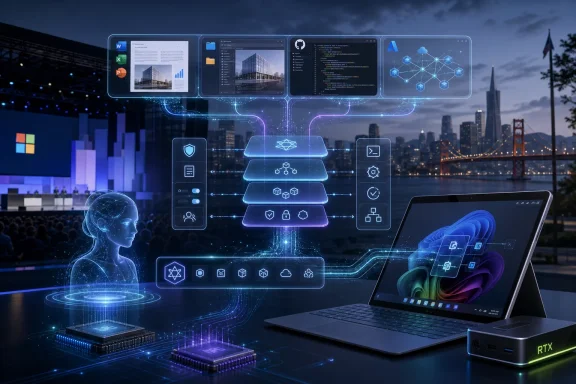 Microsoft Makes the Agent the New App
The headline from Build 2026 is that Microsoft has decided the AI agent is no longer a side panel, a button, or a branded helper living somewhere near the taskbar. It is becoming a platform object. The company spent the conference describing a future in which agents can understand enterprise context, call tools, automate workflows, and operate across Windows, Microsoft 365, GitHub, and Azure with fewer seams.That is a meaningful shift from the first Copilot wave, which too often felt like Microsoft had bolted the same chat box onto every product it owned. Build 2026 was less about “Copilot is everywhere” and more about “agents need plumbing.” Microsoft talked about context layers, identity, model hosting, app actions, governance, and local runtimes because those are the pieces that determine whether AI can safely do useful work rather than merely narrate it.
The PCMag Australia recap captured the event’s surface: a long keynote, hundreds of sessions, demos of a streamlined Windows experience, RTX Spark-powered Surface hardware, and personalized OpenClaw agents. But the deeper story is that Microsoft is trying to industrialize agentic computing before the term itself has settled. Build was not a victory lap; it was a land grab.
For WindowsForum readers, that matters because Windows is once again being positioned as the place where Microsoft’s grandest platform ambitions become unavoidable. The PC is not just a client device in this story. It is the local execution environment, the policy boundary, the identity endpoint, and the user’s last line of defense.
Windows Is Being Recast as the Runtime Microsoft Needed All Along
Microsoft’s Windows message at Build 2026 was unusually direct: the company wants Windows to be a trusted platform for AI development and agent execution. That framing is doing a lot of work. It lets Microsoft talk about Windows as both familiar desktop OS and new automation substrate, without announcing a clean break called Windows 12.The practical pieces are scattered across developer-facing announcements: Windows AI APIs, local model support, Foundry Local, Phi Silica on Copilot+ PCs, app actions, agent connectors, and broader support for Model Context Protocol. None of these is individually as eye-catching as a new Start menu, but together they suggest a more profound architectural bet. Microsoft wants the OS to know what apps can do, expose those capabilities to agents, and police the transaction.
That is a different model from the traditional Windows app ecosystem. Historically, Windows software exposed automation through COM, shell extensions, URI handlers, scripts, plug-ins, accessibility interfaces, browser protocols, and whatever private APIs a vendor cared to document. The result was powerful, messy, and often dangerous. Agentic Windows is Microsoft’s attempt to replace that sprawl with a governed discovery and execution layer.
The promise is easy to understand. If an agent can ask Windows what an installed app is allowed to do, invoke that action with user consent, run inside a constrained workspace, and leave an audit trail, automation becomes less of a hack. The risk is just as obvious. If Microsoft overreaches, Windows becomes not a neutral desktop but a broker that decides which workflows are blessed, which apps are legible, and which competitors are second-class citizens.
The Copilot Backlash Has Not Gone Away; Microsoft Has Merely Changed the Vocabulary
Build 2026 landed after a bruising period for Copilot in Windows. Users complained about AI entry points appearing in places where they were not wanted, while IT administrators worried about privacy, policy, and supportability. Microsoft’s earlier promise to reduce unnecessary Copilot surfaces in Windows 11 was an implicit acknowledgment that “AI everywhere” had become a product liability.At Build, the company did not retreat from AI. It reframed the pitch around utility. The old Copilot story often sounded like a consumer marketing campaign; the new agent story sounds like an infrastructure roadmap. That is smarter, but it does not erase the trust deficit.
Windows users have been trained to be skeptical when Microsoft says a feature is optional, especially when the feature aligns with the company’s cloud and subscription priorities. An agent-native Windows may begin as a developer platform and enterprise productivity layer, but the history of Windows is full of capabilities that started as opt-in conveniences and became persistent background assumptions.
For administrators, the important question is not whether AI agents are interesting. They are. The question is whether Microsoft will give organizations the same level of control over agents that they expect over scripts, macros, browser extensions, remote management tools, and line-of-business apps. If agents can read, reason, and act, they belong in the same mental category as automation tools with privileged context—not productivity toys.
Build’s Hardware Story Was Really About Local Inference
The RTX Spark-powered Surface Laptop Ultra and Surface developer hardware attracted attention because new Surface gear always does. But the hardware story at Build 2026 was not really about industrial design. It was about compute locality.Microsoft and Nvidia are trying to make a simple case: serious AI development should not require every experiment to round-trip through a cloud endpoint. A Windows machine with enough GPU, NPU, memory, and thermal headroom can run meaningful AI workloads locally. That matters for latency, privacy, cost, offline availability, and developer iteration speed.
The Surface Laptop Ultra and RTX Spark Dev Box fit into that strategy as halo devices. They are not meant to be the average office PC any more than the old Windows Dev Kit represented the average Arm desktop. They are reference points, designed to tell developers and OEMs what Microsoft thinks the next serious Windows workstation should be able to do.
There is a tension here. Copilot+ PCs were originally sold around NPUs and lightweight local AI experiences, while Build’s Nvidia-heavy messaging points toward larger models, heavier workloads, and creator-class or developer-class hardware. Microsoft is trying to support both ends of that spectrum. The risk is that buyers hear “AI PC” and get a fog of incompatible expectations: some features need an NPU, some need an RTX GPU, some need the cloud, and some need all of the above.
Project Solara Shows Microsoft Thinking Beyond Windows, Even When It Talks About Windows
One of the stranger signals around Build 2026 was Project Solara, Microsoft’s vision for agent-first enterprise devices that reportedly uses the Microsoft Device Ecosystem Platform, built on Android rather than Windows. For a Windows audience, that detail should not be ignored. Microsoft’s most futuristic device-platform experiment may not be Windows-based at all.That does not mean Windows is being abandoned. It means Microsoft is increasingly willing to separate the Windows business from the broader Microsoft platform. If the company believes an always-available agent device needs a lightweight edge OS, tight cloud integration, and Android-derived foundations, it will build that even if it complicates the Windows narrative.
This is not without precedent. Microsoft has spent the last decade becoming far less doctrinaire about Windows as the center of every strategy. Azure, Microsoft 365, Teams, Edge, GitHub, and Copilot all matter more to Microsoft’s future revenue mix than protecting old Windows orthodoxies. Build 2026 simply made that reality visible in a new form.
The more interesting question is whether Windows becomes one endpoint among many in Microsoft’s agent mesh. A future worker might use Windows for full desktop productivity, a Solara-style device for ambient agents, Teams for collaboration, GitHub for development, and Azure for governed execution. In that world, Windows remains important, but it is no longer the whole stage.
Microsoft IQ Is the Enterprise Context Layer the Company Has Been Missing
Microsoft also used Build 2026 to emphasize Microsoft IQ, a context layer intended to ground agents in enterprise and world knowledge across GitHub Copilot, Microsoft Foundry, and Copilot Studio. This is not a glamorous announcement, but it may be one of the more important ones. Agents are only as useful as the context they can retrieve and the permissions they respect.The enterprise AI problem has never been just model quality. It is identity, access control, stale knowledge, fragmented data, compliance, and the terrifying possibility that a confident assistant will surface the right answer to the wrong person. Microsoft’s advantage is that it already sits on Entra ID, Microsoft Graph, SharePoint, Exchange, Teams, Purview, Defender, Intune, and Azure. Microsoft IQ is an attempt to turn that sprawl into a coherent grounding system.
That is also why competitors should be nervous. A generic AI assistant can answer questions. A Microsoft-grounded agent can potentially know the org chart, meeting history, codebase, documents, tickets, policies, and permissions that shape actual work. If Microsoft gets the governance right, it has a distribution advantage few rivals can match.
The caveat is that “context” is a polite word for access. Every expansion of context increases the blast radius of misconfiguration, prompt injection, oversharing, or bad retention policy. Microsoft will sell IQ as a way to make agents smarter. IT departments should evaluate it as a new layer in the data-governance stack.
GitHub Copilot Becomes the Developer Front Door
Build remains a developer conference, and GitHub Copilot was again central to Microsoft’s story. The company wants Copilot to be more than autocomplete. It wants it to be the interface through which developers plan, edit, test, reason about, and ship software across local machines and cloud environments.That is a natural move. Developers were among the earliest mainstream users of generative AI, and code is one of the domains where AI assistance can be measured against concrete outcomes. A model either produces a plausible patch, explains an error, writes a test, or fails. The ambiguity is lower than in many office-productivity scenarios.
But the developer angle also reveals the limits of the agent dream. Software projects are full of implicit assumptions, fragile dependencies, security constraints, and human judgment. An agent that can modify a repository must be treated like a junior developer with a fast keyboard and uneven instincts. It needs review, sandboxing, provenance, and rollback.
Microsoft’s best chance is to make Copilot feel less like magic and more like disciplined automation. The closer it gets to normal development workflows—issues, pull requests, CI logs, code review, policy checks—the more useful it becomes. The more it behaves like a mysterious agent acting on vibes, the more resistance it will meet from serious engineering teams.
Foundry Is Microsoft’s Answer to Model Chaos
The AI model market is moving too fast for most organizations to standardize around a single provider with confidence. Microsoft knows this, which is why Foundry has become such an important part of its platform pitch. Build 2026 reinforced Foundry as the place where developers can choose, govern, host, evaluate, and deploy models and agents.This is classic Microsoft. When a market is chaotic, Microsoft tries to become the management plane. It did this with Windows on heterogeneous PC hardware, with Azure over sprawling cloud infrastructure, with Microsoft 365 over enterprise collaboration, and now with AI models. The company does not need every winning model to be its own if it can become the place where enterprises safely use them.
The inclusion of third-party model providers alongside Microsoft’s own MAI and Phi models is part of that strategy. Customers want flexibility, but enterprises want flexibility wrapped in procurement, policy, logging, residency, and lifecycle management. Foundry is Microsoft’s attempt to make model choice feel less like shadow IT.
The challenge is that abstraction layers can obscure meaningful differences. Models vary in cost, latency, reasoning behavior, safety profile, licensing terms, and data-handling guarantees. A tidy model catalog does not eliminate those differences; it merely makes them easier to ignore. Enterprises will still need people who understand what is being deployed, not just where the deploy button lives.
OpenClaw and Personalized Agents Make the Demo Feel Personal Again
PCMag’s recap called out personalized OpenClaw agents as one of the Build demos, and that kind of demo is important because it translates Microsoft’s infrastructure talk into something normal users can imagine. People do not buy “agent runtimes.” They respond to software that knows their habits, handles repetitive work, and appears in the right place at the right time.Personalized agents are the seductive end of this strategy. If an agent knows your files, meetings, style, preferences, apps, and workflows, it can be genuinely useful in ways a generic chatbot cannot. It can draft in context, prepare before meetings, perform multi-step tasks, and reduce the glue work that makes knowledge work so irritating.
It is also where the privacy stakes become most visible. A personal agent that is not personal enough is useless. A personal agent that is too personal becomes creepy, risky, or both. Microsoft’s task is to convince users and administrators that personalization can be constrained, inspected, and revoked.
That will require more than trust-me language. Users need clear controls, understandable history, predictable boundaries, and a way to say “never use this” that actually means never. If Microsoft hides agent behavior behind cheerful branding, it will repeat the mistakes of the first Copilot wave.
The Streamlined Windows Pitch Is Really a Repair Job
Among the Build themes was a more streamlined Windows experience. That phrase sounds minor, but it points to one of Microsoft’s biggest platform problems: Windows 11 still carries too much friction, inconsistency, and promotional noise for an OS that now wants to be trusted with autonomous agents.Microsoft cannot credibly ask users to let Windows agents take action across apps while the OS itself still feels unpredictable in places. Trust starts with basics: performance, update reliability, coherent settings, fewer ads, consistent UI, and respect for user intent. AI does not excuse rough edges; it magnifies them.
This is why the “not about AI” interpretation of Build matters. Some of Microsoft’s most important Windows work in 2026 may be the unglamorous work of making the platform feel less like a moving target. Developers need stable APIs. Admins need policies that work. Users need the computer to do what they asked without surprise detours into upsells or unsolicited suggestions.
The agent layer will fail if it lands on an OS people already distrust. Before Windows can become an intelligent runtime, it must remain a competent desktop. That sounds obvious, but Windows history shows that obvious truths often need to be relearned at scale.
Security Becomes the Argument Microsoft Cannot Avoid
Every serious conversation about agentic Windows eventually becomes a security conversation. Agents are not just search boxes. They can reason over data, invoke tools, trigger workflows, and potentially make mistakes at machine speed. That puts them closer to automation frameworks than assistants.Microsoft’s answer is to wrap agent connectors, action discovery, identity, and auditability in managed frameworks. This is the correct direction. If agents are going to interact with local apps and enterprise systems, they need containment, permissions, and logs. The worst possible version of this future is one where every vendor ships its own opaque agent with its own token store and its own idea of consent.
Still, even a well-designed framework will face hard problems. Prompt injection becomes more dangerous when an agent can act. Data-loss prevention must account for generated summaries and cross-app transformations. Endpoint detection tools will need to distinguish legitimate agent activity from malicious automation. Help desks will need to diagnose not just what a user did, but what an agent did on the user’s behalf.
For security-minded Windows users, the sensible posture is neither panic nor blind enthusiasm. Treat agents as a new class of endpoint actor. Demand logs. Demand revocation. Demand policy. Demand a clear chain of responsibility when automated action causes damage.
Enterprise IT Will Decide Whether This Becomes Real
Microsoft can demo agents all day, but enterprise IT will decide the pace of adoption. That has always been true for Windows platform shifts. Consumers may encounter the visible features first, but organizations determine whether a new Windows capability becomes normal, managed, and boring.The enterprise calculus is complicated. Agents could reduce administrative toil, help users navigate internal systems, accelerate software development, and automate repetitive work across Microsoft 365 and line-of-business apps. That is the upside. The downside is another layer of licensing complexity, support tickets, compliance review, user training, and security exposure.
The early winners will probably be narrow, governed scenarios. An agent that helps developers triage build failures is easier to approve than a general office agent that can roam across a user’s entire document history. An agent that summarizes a Teams channel under existing permissions is easier than one that takes external actions. The more bounded the task, the easier the risk model.
Microsoft’s job now is to make the governance story concrete. Admins do not need inspirational language about the future of work. They need Intune controls, Defender visibility, Purview integration, Entra-aware permissions, reliable documentation, and licensing that does not turn every pilot into a procurement maze.
The Windows Ecosystem Gets a New Compatibility Test
Build 2026 also sent a message to independent software vendors: if your app’s capabilities are not legible to agents, your app may become invisible in the next interface layer. That is a major ecosystem shift. Search once forced websites to think about indexing; mobile forced services to think about APIs; agents will force desktop apps to think about action surfaces.For Windows developers, App Actions and MCP support are invitations to expose functionality in structured ways. A photo editor might expose crop, export, tag, and batch-resize actions. A finance app might expose reconciliation or report-generation actions. A ticketing app might expose create, update, assign, and summarize. The app remains the authority, but the agent becomes a new caller.
This can be good for users. The Windows desktop is full of powerful software whose features are buried behind menus, ribbon tabs, context dialogs, and keyboard shortcuts. Agent-readable actions could make that power more accessible. It could also reduce the need for brittle UI automation.
But it creates pressure. Large vendors will adapt quickly because Microsoft will court them. Smaller developers may face another platform tax: new manifests, new policies, new test matrices, new security reviews, and new expectations from users who ask why Copilot cannot control their app. Microsoft needs to make participation cheap, documented, and optional enough that the ecosystem does not split between agent-ready incumbents and everyone else.
The Cloud Is Still the Center, No Matter How Local the Demo Looks
Microsoft talked a lot about local AI at Build, and that is not just marketing. Local inference matters. On-device models can reduce latency, protect sensitive data, and make AI features feel immediate. For Windows, local AI is also a way to justify new PC hardware at a time when many users still see little reason to replace a perfectly adequate machine.But the center of gravity remains the cloud. Foundry, Microsoft IQ, Copilot Studio, Azure governance, model catalogs, enterprise data, and large-scale agent orchestration all point back to Microsoft’s cloud. The local PC is powerful in this architecture, but it is not sovereign.
That hybrid model is probably inevitable. Some tasks belong on the device; others require larger models, enterprise context, or integration with cloud systems. The question is whether users and admins can tell which is which. If a Windows feature says it uses AI, people should know whether data stays local, travels to Microsoft, touches a third-party model, or becomes part of a broader enterprise index.
Microsoft has an opportunity to make this transparent. It also has a business incentive to keep the boundaries fuzzy enough that cloud value remains attached to local experiences. The companies that win trust in the AI PC era will be the ones that explain locality plainly.
Build 2026 Was a Platform Conference Wearing an AI Costume
The temptation is to describe Build 2026 as another AI event. That is not wrong, but it is incomplete. Microsoft’s real announcements were about platform control: who defines agent interfaces, who manages models, who owns context, who governs actions, and who turns hardware capabilities into developer targets.This is why the conference felt both exciting and familiar. Microsoft has always been strongest when it turns complexity into a platform others must build on. Windows abstracted PC hardware. Office standardized productivity workflows. Azure abstracted infrastructure. GitHub organized development. Now Microsoft wants to abstract agentic work.
The danger is that abstraction can become enclosure. If Microsoft succeeds too well, the agentic future of work could become another Microsoft-administered layer sitting between users and software. That may be convenient. It may even be secure. But it will also raise familiar questions about lock-in, defaults, bundling, and competition.
For Windows enthusiasts, the right stance is productive skepticism. The technology is real enough to matter, early enough to shape, and risky enough to scrutinize. Build 2026 did not answer every concern, but it showed where Microsoft is moving.
The Build 2026 Ledger for Windows Users Is Already Taking Shape
The immediate aftermath of Build is not a buying guide; it is a map of where Microsoft will push developers, OEMs, and enterprises over the next year. The consumer-facing features will arrive unevenly, the developer tools will mature in waves, and the enterprise controls will determine adoption speed. The story is less about one keynote than about the platform assumptions Microsoft is now trying to normalize.- Microsoft is positioning Windows 11 as an agent-native runtime rather than waiting for a Windows 12 branding reset.
- Local AI matters more than before, but Microsoft’s cloud remains the backbone for governance, context, model access, and enterprise-scale deployment.
- RTX Spark-powered Surface hardware is best understood as a developer and workstation signal, not a mainstream PC requirement.
- App Actions, MCP support, and agent connectors could become the next compatibility layer Windows developers must understand.
- Enterprise adoption will depend less on keynote demos than on policy controls, audit trails, identity integration, and clear data boundaries.
- The first useful agents will likely be narrow and governed, while broad personal agents will face the hardest trust and privacy questions.
References
- Primary source: PCMag Australia
Published: Thu, 04 Jun 2026 15:13:03 GMT
Microsoft Build 2026 Recap: Didn't Catch the Live Stream? Here's Everything You Missed
We attended Microsoft's annual Build Conference this week to see the biggest announcements and demos firsthand, including a streamlined Windows experience, an RTX Spark-powered Surface Laptop Ultra, and personalized OpenClaw agents.au.pcmag.com
