

Satya Nadella stunned developers in Bengaluru by live‑demoing a compact research app that chains multiple large models and decision frameworks into what he called a “chain of debate,” and he teased that the approach is slated to move into Copilot — a move with important technical, product and market implications for Microsoft, enterprise AI workflows and a subset of AI‑focused crypto tokens that trade on sentiment.
Satya Nadella’s onstage prototype is not a marketing demo in the conventional sense; it’s a hands‑on prototype he described as an app he built for deep research that “pits” multiple models against one another under structured decision frameworks, then synthesizes the result — a workflow he summarized as a “chain of debate.” The post and onstage excerpts make clear the demo used a mixture of models, roles (chair, council members) and decision patterns Nadella labels chairman synthesis, DXO and ensemble, and he explicitly said the capability will be integrated into Copilot. This announcement arrives at a moment when large vendors are racing to make multi‑model, agentic and ensemble systems reliable for enterprise workloads. Microsoft’s own strategy — build services that orchestrate multiple models, integrate them into Office/365 tooling and expose them through Copilot — is consistent with public comments and product worklines Microsoft has shown since its deeper partnership with OpenAI and subsequent Copilot rollouts. The Bengaluru demo signals a practical, productized direction: take the multi‑model research concept from R&D labs and embed it into productivity surfaces.
Key technical components:
For stocks, positive product headlines can buoy investor sentiment in MSFT and its ecosystem partners; for crypto, niche tokens positioned as AI infrastructure (compute tokens, decentralized AI marketplaces, GPU‑oriented utilities) often trade on sentiment because their real‑world revenue ties are nascent and expectations drive price. This dynamic does not prove fundamental linkage, but it explains why coins like those tied to decentralized AI platforms often move in response to mainstream AI news.
Market reactions — from equities to AI‑narrative tokens — will continue to trail headlines, but traders and CIOs should treat sentiment moves as short‑term phenomena unless they are backed by demonstrable on‑chain activity or enterprise revenue. The sensible path forward is iterative: pilot the decision frameworks, validate model diversity and provenance, and keep human judgement central to any critical decision pipeline. If Microsoft does integrate this into Copilot at scale, the defining metrics of success will not be demo applause or token pumps, but demonstrable improvements in decision quality, transparent audit trails and cost‑efficient, governed deployments.
Source: Blockchain News Satya Nadella Live-Demos New Multi-Model 'Chain of Debate' AI App in Bengaluru; Next Stop: Copilot | Flash News Detail
 Background / Overview
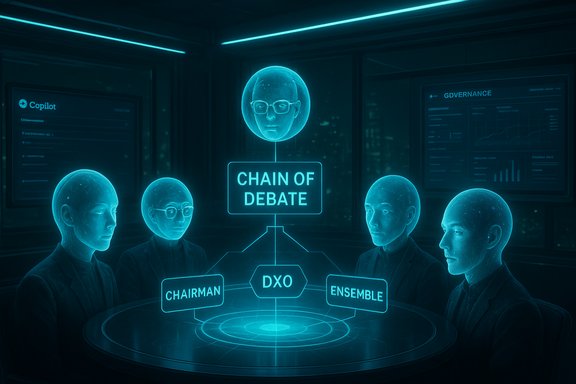
Satya Nadella’s onstage prototype is not a marketing demo in the conventional sense; it’s a hands‑on prototype he described as an app he built for deep research that “pits” multiple models against one another under structured decision frameworks, then synthesizes the result — a workflow he summarized as a “chain of debate.” The post and onstage excerpts make clear the demo used a mixture of models, roles (chair, council members) and decision patterns Nadella labels chairman synthesis, DXO and ensemble, and he explicitly said the capability will be integrated into Copilot. This announcement arrives at a moment when large vendors are racing to make multi‑model, agentic and ensemble systems reliable for enterprise workloads. Microsoft’s own strategy — build services that orchestrate multiple models, integrate them into Office/365 tooling and expose them through Copilot — is consistent with public comments and product worklines Microsoft has shown since its deeper partnership with OpenAI and subsequent Copilot rollouts. The Bengaluru demo signals a practical, productized direction: take the multi‑model research concept from R&D labs and embed it into productivity surfaces. What is a “chain of debate”? Technical anatomy
Multi‑model ensembles vs. single model reasoning
A chain of debate is effectively a structured ensemble: multiple models — potentially different architectures and vendors — are given roles (e.g., lead researcher, critic, domain expert), asked to deliberate on the same prompt, and then a synthesizer or chair combines, weighs and annotates their outputs. This differs from a simple “chain of thought” inside one model because it intentionally leverages inter‑model disagreement and critique as a signal for uncertainty or deeper reasoning.Key technical components:
- Model orchestration layer — routes prompts to selected models and controls the order and role assignments.
- Role definitions and decision frameworks — pre‑defined schemas (e.g., exhaustive search + critical review + synthesis) that determine how contributions are interpreted.
- Synthesis/Chair module — aggregates outputs, resolves conflicts, assigns confidence scores and surfaces reasoning traces.
- Audit & provenance logs — records which model made what claim and why, enabling downstream validation and compliance.
Why this can improve accuracy — and where it might fail
A multi‑model debate can improve outcome robustness by surfacing disagreements and forcing models to defend or modify claims; consensus across diverse models often correlates with higher factuality on common benchmarks. But it’s not a silver bullet. If models share correlated training artifacts or the prompt design introduces anchoring bias, debates can converge on incorrect consensus — the so‑called echo‑chamber failure mode. In addition, multi‑model orchestration multiplies compute costs and latency, and raises engineering complexity for versioning and safety testing.How the Bengaluru demo maps into Copilot’s roadmap
From prototype to product surface
Nadella explicitly said the demo is “Next stop, Copilot,” signaling Microsoft’s intent to fold the approach into Copilot’s agentic capabilities and research workflows. In practice this will likely mean:- Copilot will be able to spawn multi‑model research sessions inside Office apps and developer tools.
- Businesses will gain built‑in decision templates (e.g., procurement, clinical review, legal brief) that use chain of debate as an evaluation primitive.
- Copilot’s UI and audit trails will need to surface which models contributed to each conclusion to satisfy compliance and explainability requirements.
Product benefits for enterprise users
- Richer evidence trails: Teams get not just an answer, but a debate transcript showing dissenting viewpoints and confidence bands.
- Domain specialization: Firms can compose vendor models (e.g., internal LLM + third‑party models) to retain IP while leveraging external strengths.
- Decision templates: Repeatable decision frameworks mean Copilot can offer “decision recipes” for supply chain, HR, healthcare reviews, risk assessments, and more.
Engineering and operational requirements
- Model governance: Version control, lineage and permissions for third‑party models must be built into Copilot.
- Cost controls: Running multiple models increases cloud spend; expect features that limit model count, sample size, or “auto‑select” lower‑cost options during exploratory phases.
- Safety tooling: Continuous red‑teaming and bias audits will be necessary to prevent subtle consensus errors or manipulative prompt injections.
Market reaction — why AI product demos move crypto and equities
Public demonstrations by major tech leaders often create narrative waves that ripple through capital markets. Nadella’s Bengaluru demo accomplishes two narrative shifts simultaneously: it reinforces Microsoft’s position as a model‑agnostic orchestrator of AI services (a central part of the Copilot story), and it reframes multi‑model systems as practical, production‑ready features.For stocks, positive product headlines can buoy investor sentiment in MSFT and its ecosystem partners; for crypto, niche tokens positioned as AI infrastructure (compute tokens, decentralized AI marketplaces, GPU‑oriented utilities) often trade on sentiment because their real‑world revenue ties are nascent and expectations drive price. This dynamic does not prove fundamental linkage, but it explains why coins like those tied to decentralized AI platforms often move in response to mainstream AI news.
Where the numbers actually stand (verified price and volume snapshot)
Many roundups circulating on social feeds include specific token prices and trading volumes tied to the Nadella demo; these figures vary across aggregators and exchange venues. Below are validated data points from major market data providers — note that crypto prices can vary widely by exchange and across token variants (rebrands and contract migrations complicate historical comparisons).- Microsoft (MSFT): trade data from mainstream equity feeds show Microsoft trading in the high‑$400s in early December 2025 (recent closes reported around the $480–$490 range on major exchanges). This is substantially higher than some social summaries that quoted a $450 close for December 11. Use official exchange‑level historical data for trade execution purposes.
- Render / RNDR (RENDER): major crypto market aggregators list Render (rebranded as RENDER) trading around $1.6–$1.7 in early December 2025, with daily volume in the tens of millions on aggregate feeds. Some legacy data sources or mismatched token identifiers occasionally show older highs (or legacy contract prices) — be careful to confirm token contract addresses if you trade.
- Fetch.ai (FET): reported prices differ by provider and date, but within Dec 2025 the range reported by different aggregators sits between roughly $0.25 and $0.70; intraday spikes and listings across different venues explain most of the spread. Check exchange‑level order book depth and a timestamped feed before assuming a single universal price.
- SingularityNET (AGIX): depending on the ticker mapping used by the aggregator, AGIX has displayed both sub‑$0.15 levels and, in a few synthetic or legacy feeds, higher nominal values — the safer interpretation is that AGIX trading around $0.10–$0.12 in early December 2025 on listed centralized exchanges and that on‑chain activity metrics vary by source. Always reconcile the token contract, exchange pair and time window.
Crypto market mechanics: why an AI demo can lift AI‑linked tokens
- Short‑term sentiment plays: Retail traders and algorithmic scalpers often react to headlines; if a credible figure like Nadella signals a feature that increases demand for decentralized AI compute or coordination, traders will re‑price speculative tokens tied to that narrative.
- Liquidity concentration: Many AI‑token markets are thin; small inflows can produce large percent moves and volume spikes.
- Correlation with equities: Empirical observations show AI‑narrative correlation — a positive move in MSFT or other AI giants sometimes coincides with larger percent moves in niche AI tokens as capital rotates into risk‑on microcaps.
Trading strategies amid the “chain of debate” hype (practical, risk‑aware playbook)
The following tactics are educational, not investment advice. They outline how traders have historically approached narrative‑driven token moves; each step emphasizes risk management.- Confirm the signal:
- Check multiple reputable price feeds (CoinGecko, CoinMarketCap, exchange API) and the token contract address before executing.
- Watch for contract migrations or rebrands that can create false price readings.
- Time entries with volume confirmation:
- Prefer entries when price moves are accompanied by genuine volume spikes on reliable venues (not only thin OTC markets).
- Rule of thumb used by many traders: require a 1.5×–2× lift in 24‑hour volume versus the 7‑day average to treat a breakout as credible.
- Use paired hedges:
- Hedge narrative risk by pairing a long on an AI token with a short (or put option) on a correlated equity if you expect reversion. Historical cross‑asset correlations can change quickly.
- Limit exposure and size by volatility:
- Token markets tied to narratives show elevated realized volatility; size positions smaller than your ordinary allocation and set stop‑loss orders at predefined technical levels (e.g., below the 50‑day moving average on the exchange of your choice).
- Avoid overnight leverage:
- Leverage magnifies headline risk; avoid holding leveraged longs through major news cycles that can reverse sentiment.
- Monitor on‑chain flows:
- Watch large transfers to exchanges (supply signals) and rising active address counts for evidence of sustained interest — but validate the source (DEX vs centralized exchange) and check whether the transfer is custody rebalancing rather than new buying. Dune, Glassnode and Etherscan dashboards are helpful but require careful interpretation. (Note: claims of specific on‑chain rises should be traced to the actual Dune or Glassnode dashboard; many secondary articles quote those dashboards without direct links.
Ethical, safety and regulatory considerations
Explainability and audit trails
A multi‑model debate produces richer metadata; however, it also multiplies the number of opaque model outputs you must explain. Enterprise Copilot deployments will require robust provenance: which model made which assertion, what data it used, and why the chair synthesized the way it did.Bias and manipulation risk
A “debate” can be gamed by adversarial prompts or poisoned models; if a bad actor controls even one highly persuasive model in the council, they can skew outcomes. Pre‑deployment model vetting and differential trust weights per model are critical mitigations.Data privacy and compliance
Bringing multiple models into a decision workflow raises GDPR, HIPAA and contractual data concerns. Each model provider’s data retention and training policies must be assessed before the model participates in sensitive decision frameworks.Governance and product liability
When Copilot begins making higher‑stakes recommendations derived from ensemble debates (e.g., clinical triage, legal advice), organizations must define who is accountable for final decisions and implement human‑in‑the‑loop signoffs and audit logs.Strengths and likely business impact
- Improved decision quality for complex tasks: By forcing cross‑examination among models, some classes of errors and hallucinations may be easier to detect and mitigate.
- Faster enterprise adoption: Copilot integration reduces friction to adoption for knowledge workers who want repeatable, auditable decision workflows.
- Vendor flexibility: Microsoft’s model‑agnostic orchestration supports customers who want to combine internal proprietary models with third‑party models without vendor lock‑in.
Risks and open questions
- Consensus fallacy: Consensus among models does not guarantee truth; correlated training data can produce confident but wrong consensus.
- Compute & cost: Multi‑model debates increase inference costs; pricing and quotas will determine practical viability for many customers.
- User trust and mental overhead: Presenting multiple, divergent model outputs to average knowledge workers risks information overload unless UI/UX and synthesis are well designed.
- Market hype volatility: For traders of AI tokens, short‑term price action tied to demos is noisy and reverses fast if the narrative fades or the demo lacks product follow‑through.
Practical recommendations for corporate buyers, developers and traders
- Corporates:
- Start a pilot with a single decision framework (e.g., procurement triage) to measure accuracy improvements and cost impact.
- Define governance playbooks that include model vetting, retention policies and human sign‑off points.
- Developers:
- Build modular orchestration layers that allow swapping model backends without changing decision templates.
- Instrument every stage for provenance and expose model confidence scores to the chair synthesizer.
- Traders:
- Treat AI demo headlines as short‑term sentiment catalysts; always verify price/volume on your execution venue and size positions for volatility.
- Prefer scalps and hedged trades to multi‑week directional bets unless you can validate sustained on‑chain utility or revenue growth for the token.
Conclusion
Satya Nadella’s live demo in Bengaluru — a practical, hands‑on prototype he framed as a chain of debate — brings a concept popularized in research circles into a mainstream product trajectory: Copilot. The technical idea of orchestrating multiple models under structured decision frameworks promises better evidence trails, domain specialization and a new class of decision recipes for enterprise users. But the approach also raises significant engineering, governance and safety questions: it increases compute and complexity, can produce false consensus, and requires stronger auditability.Market reactions — from equities to AI‑narrative tokens — will continue to trail headlines, but traders and CIOs should treat sentiment moves as short‑term phenomena unless they are backed by demonstrable on‑chain activity or enterprise revenue. The sensible path forward is iterative: pilot the decision frameworks, validate model diversity and provenance, and keep human judgement central to any critical decision pipeline. If Microsoft does integrate this into Copilot at scale, the defining metrics of success will not be demo applause or token pumps, but demonstrable improvements in decision quality, transparent audit trails and cost‑efficient, governed deployments.
Source: Blockchain News Satya Nadella Live-Demos New Multi-Model 'Chain of Debate' AI App in Bengaluru; Next Stop: Copilot | Flash News Detail
