

Microsoft is preparing Cloud-Initiated Driver Recovery for Windows, a Windows Update mechanism that lets Microsoft remotely roll back faulty drivers after distribution, with validation running from May through August 2026 and broader automatic use expected from September. The pitch is simple: when Windows Update ships a bad driver, Windows should not wait for every affected user to become their own support technician. The more important story is that Microsoft is quietly admitting that driver servicing is no longer just a vendor problem. It is a platform reliability problem, and the cloud is now part of the repair path.
Bad Windows drivers occupy a special place in PC misery. A broken app can usually be closed, reinstalled, or ignored; a broken driver can take the display stack, networking, storage, audio, Bluetooth, or the whole boot path down with it. For most people, the failure looks like “Windows broke my PC,” even when the root cause is a vendor-supplied package that merely arrived through Microsoft’s update pipeline.
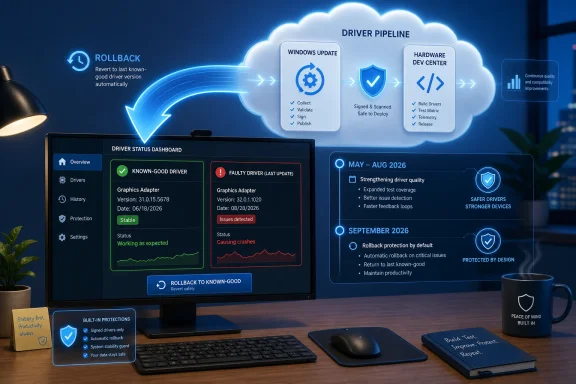
Cloud-Initiated Driver Recovery, or CIDR, is Microsoft’s attempt to shorten that failure window. When a driver distributed via Windows Update is later identified as defective, Microsoft can trigger a rollback from the Hardware Dev Center Driver Shiproom. The affected machines are then steered back to a previously known-good driver or another approved replacement through Windows Update.
That distinction matters. This is not a new troubleshooting wizard, a Device Manager refresh, or a friendlier button buried in Settings. It is an operational change in the way Windows Update handles known-bad driver packages after they have already escaped into the field.
The old model left an ugly gap. Hardware partners could submit a corrected driver, or knowledgeable users could manually uninstall and roll back the bad one. Everyone else waited, searched forums, unplugged peripherals, disabled updates, or learned more about Device Manager than they ever wanted to know.
CIDR does not make bad drivers impossible. It makes Microsoft more directly responsible for cleaning them up.
Drivers are where that chaos touches the kernel. They are also where the neat consumer fiction of “the update” collapses. A Windows Update scan may include Microsoft code, vendor code, firmware, optional components, and hardware-targeted packages selected by IDs that ordinary users never see.
When it works, it feels invisible. Your trackpad behaves, your printer appears, your display wakes, and your Wi-Fi card silently gains a bug fix. When it fails, the user rarely knows whether to blame Microsoft, Intel, Realtek, NVIDIA, AMD, Synaptics, the laptop maker, the dock vendor, or the person who pressed “Check for updates.”
That ambiguity has made driver failures uniquely corrosive to trust. Users do not experience a driver regression as a nuanced supply-chain problem. They experience it as an operating system that accepted an update and then stopped behaving.
CIDR is Microsoft’s answer to that trust problem. It says, in effect, that if Microsoft’s update channel helped deliver the damage, Microsoft’s update channel should also help reverse it.
That makes CIDR less dramatic on the desktop and more dramatic behind the scenes. The recovery action begins in Microsoft’s driver operation process, where a problematic driver can be rejected or flagged after quality evaluation. From there, Windows Update can target the affected devices and push the rollback path through the same infrastructure that delivered the original package.
This is a cloud control-plane move. Microsoft is centralizing not merely the distribution of driver updates but the remediation of driver failures. The benefit is speed and consistency; the risk is that administrators and power users will want clearer visibility into what was rolled back, why, and under whose authority.
For consumer PCs, the trade-off is likely welcome. Most users do not want to arbitrate between driver versions; they want the machine to stop crashing. For managed environments, the story is more complicated. A silent rollback can be lifesaving if it restores a fleet’s Wi-Fi adapters before Monday morning, but it can also complicate change control if reporting lags behind action.
Microsoft’s challenge is not only to make CIDR work. It is to make it auditable enough that IT departments trust it.
A rollback system for drivers has to be conservative. If it misidentifies a package, it could pull a working driver from machines that need it. If it targets too broadly, it could trade one regression for another. If it targets too narrowly, it may leave affected users stranded and undermine the feature’s purpose.
The company says the process is limited to specific hardware targets affected by a problematic update. That is the correct design principle. Driver failures are often not universal; they can depend on device IDs, firmware revisions, OS builds, regional SKUs, OEM customizations, or interactions with other installed components.
This is why the phrase “previously known-good” deserves scrutiny. Known-good for whom? A graphics driver that works on one laptop design may not work properly on another using the same GPU. A networking package may be stable on one firmware branch and flaky on another. Windows Update’s targeting logic has to understand those boundaries or CIDR becomes another source of mystery.
Still, the September timeline is encouraging because it frames CIDR as part of the publishing pipeline rather than a one-off rescue feature. If it becomes routine, Microsoft can reduce the time between detection and remediation from “whenever a vendor ships something better” to “when Microsoft has enough confidence to reverse the blast radius.”
That boundary is reasonable, but it should temper expectations. Many Windows users, especially gamers and workstation owners, install drivers directly from hardware vendors. Many enterprises stage drivers through management tools. Some laptop makers bundle drivers inside support assistants that operate outside the ordinary Windows Update experience.
CIDR cannot unwind everything users can do to their systems. It can only remediate the part of the driver ecosystem Microsoft controls through its update channel.
That still covers a large and consequential surface area. Windows Update is the default driver path for many mainstream PCs, and it is often the mechanism that silently brings in device support after a clean install. The less technical the user, the more likely they are to rely on it entirely.
Microsoft’s move is therefore not a universal driver safety net. It is a safety net for the default lane — and the default lane is where the trust damage is most acute.
The consumer PC market has been saturated with visible features: AI buttons, assistant panels, redesigned settings pages, widgets, search experiments, account prompts, and cloud tie-ins. Some are useful, some are intrusive, and many are irrelevant to the user whose Bluetooth disappears after an update. Driver rollback is the opposite kind of feature. It does not sell a laptop, but it can save one from being returned.
This is why CIDR lands differently from another Windows shell tweak. It targets a class of failure that ordinary users have long understood viscerally, even if they lacked the vocabulary for it. “The update broke my sound” is not a rare edge case in the folk memory of Windows; it is practically a genre.
There is also a psychological benefit. A system that can correct a bad update automatically feels less brittle. Users may still resent forced or automatic updates, but a visible pattern of rapid repair can soften that resentment.
Microsoft has spent years telling users that staying updated is the safest path. CIDR is one of the mechanisms required to make that advice feel credible.
Those questions matter because driver state is not trivia in enterprise environments. A single network, storage, smart card, camera, or GPU driver can affect authentication, compliance, remote support, conferencing, device encryption, and line-of-business apps. When something changes across a fleet, administrators need to know whether they are observing a fix, a failure, or drift.
The ideal version of CIDR gives IT departments clear telemetry without forcing them to micromanage every recovery. The worst version would be a black box that “helps” by changing driver state faster than support teams can explain it.
Microsoft’s recent Windows servicing story has increasingly depended on rings, gradual rollout, safeguard holds, compatibility signals, and cloud-side decisions. CIDR fits that philosophy. But driver rollback sits closer to the hardware than many other servicing controls, and that makes transparency more important.
Enterprises may welcome Microsoft taking faster action on defective Windows Update drivers. They will welcome it more if the platform tells them exactly what happened.
That is an important shift in leverage. If a defective driver causes crashes, Microsoft is no longer limited to nudging the vendor and hoping users tolerate the interim. It can intervene through the same pipeline that made the driver widely available in the first place.
OEMs and component vendors may not love every consequence of that arrangement. A rollback is a public admission inside the servicing system that a package failed quality expectations. It also means Microsoft’s Driver Shiproom becomes more visibly central to post-release driver quality.
But the practical result should be healthier. Vendors still need to monitor quality metrics, respond to rejected submissions, and produce corrected packages. Microsoft simply gains a faster way to reduce user harm while that happens.
This is how a mature update ecosystem should work. Distribution, telemetry, rejection, and remediation should be part of one loop, not four disconnected chores divided among Microsoft, OEMs, component vendors, and confused users.
CIDR is not being framed primarily as a security feature, and it should not be oversold as one. It rolls back problematic drivers distributed through Windows Update when Microsoft has an approved replacement path. It does not solve bring-your-own-vulnerable-driver attacks, shady third-party installers, or every legacy compatibility mess.
Even so, faster removal of known-bad driver packages is part of a healthier security posture. A driver that degrades stability can lead users to disable protections, freeze updates, or install random packages from forums. A driver that blocks a security feature can hold back an organization’s hardening plan.
Reliability and security often meet in the same place: keeping users on a supported, trusted path. If CIDR reduces the incentive to avoid Windows Update altogether, it helps Microsoft’s broader security argument.
This history explains why CIDR will be greeted with both relief and skepticism. Relief, because automatic rollback of bad drivers is obviously useful. Skepticism, because users who have been burned by automation are being asked to trust more automation as the cure.
That tension is the heart of modern Windows servicing. Microsoft cannot realistically return to a world where every user manually curates every update. The ecosystem is too large, the threat environment too active, and the hardware matrix too complex. But Microsoft also cannot keep treating user patience as an infinite resource.
CIDR is persuasive because it is not asking users to love updates more. It is making the update system more accountable when it gets something wrong.
The best argument for automatic updates has always been that centralized maintenance can respond faster than individual users. Driver recovery finally applies that argument to one of Windows Update’s most painful failure modes.
Underneath the jargon, however, Microsoft’s strategy is plain. Windows is moving toward a servicing model where cloud-side intelligence does more than offer updates. It evaluates health, narrows targeting, blocks suspect packages, and initiates recovery when the field data turns ugly.
That model is not unique to drivers. It echoes safeguard holds for feature updates, staged rollouts, known issue rollback for some Windows fixes, and the broader industry pattern of treating client software as part of a managed service. The PC may sit under your desk, but the decision logic increasingly lives elsewhere.
Power users may bristle at that, and not without reason. Local control matters, especially when a machine is a tool rather than an appliance. But the alternative cannot be nostalgia for a simpler driver world that no longer exists.
The real demand should be for meaningful controls, clear records, and respect for managed deployment policies. Cloud remediation is not inherently hostile to user agency. Opaque cloud remediation is.
CIDR is a recovery feature, but it is also a philosophical correction. It recognizes that update quality cannot be judged only at release time. Quality has to be measured after deployment, across real hardware, and the platform needs a first-class path to undo damage.
This is where Windows has often felt less modern than cloud services, even as Microsoft has pushed cloud thinking into the OS. Web services roll back deployments constantly. Mobile app platforms can yank bad releases, though device-side effects vary. Windows, with its hardware drivers and legacy complexity, has had a tougher job — but the need for rollback is no less urgent.
A PC operating system cannot be operated exactly like a web service. The local machine has peripherals, firmware, offline states, recovery partitions, and users who may be in the middle of a presentation when the fix arrives. But the principle is the same: if centralized distribution creates centralized blast radius, it also requires centralized remediation.
That is the real significance of CIDR. It makes rollback part of the normal driver servicing conversation rather than an afterthought.
For WindowsForum readers, the useful mental model is this: Microsoft is adding a cloud-triggered corrective action for drivers that came through Windows Update, provided there is an approved driver to fall back to and the affected hardware can be properly targeted.
Source: Mint Windows 11 will soon detect and automatically uninstall faulty driver updates before they crash your PC | Mint
 Microsoft Gives Windows Update a Undo Button It Should Have Had Years Ago
Bad Windows drivers occupy a special place in PC misery. A broken app can usually be closed, reinstalled, or ignored; a broken driver can take the display stack, networking, storage, audio, Bluetooth, or the whole boot path down with it. For most people, the failure looks like “Windows broke my PC,” even when the root cause is a vendor-supplied package that merely arrived through Microsoft’s update pipeline.Cloud-Initiated Driver Recovery, or CIDR, is Microsoft’s attempt to shorten that failure window. When a driver distributed via Windows Update is later identified as defective, Microsoft can trigger a rollback from the Hardware Dev Center Driver Shiproom. The affected machines are then steered back to a previously known-good driver or another approved replacement through Windows Update.
That distinction matters. This is not a new troubleshooting wizard, a Device Manager refresh, or a friendlier button buried in Settings. It is an operational change in the way Windows Update handles known-bad driver packages after they have already escaped into the field.
The old model left an ugly gap. Hardware partners could submit a corrected driver, or knowledgeable users could manually uninstall and roll back the bad one. Everyone else waited, searched forums, unplugged peripherals, disabled updates, or learned more about Device Manager than they ever wanted to know.
CIDR does not make bad drivers impossible. It makes Microsoft more directly responsible for cleaning them up.
The Driver Problem Was Always Bigger Than Device Manager
Windows has spent decades becoming the operating system of nearly infinite hardware variation. That flexibility is its superpower and its curse. A single Windows release must tolerate boutique gaming rigs, bargain laptops, enterprise fleets, industrial PCs, USB docks, Thunderbolt chains, Wi-Fi chipsets, biometric sensors, GPU control panels, firmware adjuncts, and devices that exist in three nearly identical OEM-specific revisions.Drivers are where that chaos touches the kernel. They are also where the neat consumer fiction of “the update” collapses. A Windows Update scan may include Microsoft code, vendor code, firmware, optional components, and hardware-targeted packages selected by IDs that ordinary users never see.
When it works, it feels invisible. Your trackpad behaves, your printer appears, your display wakes, and your Wi-Fi card silently gains a bug fix. When it fails, the user rarely knows whether to blame Microsoft, Intel, Realtek, NVIDIA, AMD, Synaptics, the laptop maker, the dock vendor, or the person who pressed “Check for updates.”
That ambiguity has made driver failures uniquely corrosive to trust. Users do not experience a driver regression as a nuanced supply-chain problem. They experience it as an operating system that accepted an update and then stopped behaving.
CIDR is Microsoft’s answer to that trust problem. It says, in effect, that if Microsoft’s update channel helped deliver the damage, Microsoft’s update channel should also help reverse it.
The Cloud Is Not Just Delivering the Fix — It Is Making the Decision
The phrase Cloud-Initiated Driver Recovery sounds like one more branded Windows service, but the architecture tells the story. Microsoft is not asking every OEM to build a separate rollback mechanism. It is not asking users to install a recovery client. It is wiring rollback authority into the existing Windows Update and Hardware Dev Center publishing machinery.That makes CIDR less dramatic on the desktop and more dramatic behind the scenes. The recovery action begins in Microsoft’s driver operation process, where a problematic driver can be rejected or flagged after quality evaluation. From there, Windows Update can target the affected devices and push the rollback path through the same infrastructure that delivered the original package.
This is a cloud control-plane move. Microsoft is centralizing not merely the distribution of driver updates but the remediation of driver failures. The benefit is speed and consistency; the risk is that administrators and power users will want clearer visibility into what was rolled back, why, and under whose authority.
For consumer PCs, the trade-off is likely welcome. Most users do not want to arbitrate between driver versions; they want the machine to stop crashing. For managed environments, the story is more complicated. A silent rollback can be lifesaving if it restores a fleet’s Wi-Fi adapters before Monday morning, but it can also complicate change control if reporting lags behind action.
Microsoft’s challenge is not only to make CIDR work. It is to make it auditable enough that IT departments trust it.
September Is the Real Test, Not the Announcement
Microsoft’s rollout plan is cautious. Manual validation and testing are expected to run from May through August 2026, with automatic support for the Hardware Dev Center publishing process planned from September onward. That schedule suggests Microsoft knows this cannot be treated like a cosmetic Windows feature.A rollback system for drivers has to be conservative. If it misidentifies a package, it could pull a working driver from machines that need it. If it targets too broadly, it could trade one regression for another. If it targets too narrowly, it may leave affected users stranded and undermine the feature’s purpose.
The company says the process is limited to specific hardware targets affected by a problematic update. That is the correct design principle. Driver failures are often not universal; they can depend on device IDs, firmware revisions, OS builds, regional SKUs, OEM customizations, or interactions with other installed components.
This is why the phrase “previously known-good” deserves scrutiny. Known-good for whom? A graphics driver that works on one laptop design may not work properly on another using the same GPU. A networking package may be stable on one firmware branch and flaky on another. Windows Update’s targeting logic has to understand those boundaries or CIDR becomes another source of mystery.
Still, the September timeline is encouraging because it frames CIDR as part of the publishing pipeline rather than a one-off rescue feature. If it becomes routine, Microsoft can reduce the time between detection and remediation from “whenever a vendor ships something better” to “when Microsoft has enough confidence to reverse the blast radius.”
This Fix Only Covers the Windows Update Lane
The biggest limitation is also the most important: CIDR applies to problematic drivers delivered through Windows Update. It does not magically police every executable installer from a motherboard vendor, every GPU driver downloaded manually, every OEM utility, every enterprise driver package, or every enthusiast beta release.That boundary is reasonable, but it should temper expectations. Many Windows users, especially gamers and workstation owners, install drivers directly from hardware vendors. Many enterprises stage drivers through management tools. Some laptop makers bundle drivers inside support assistants that operate outside the ordinary Windows Update experience.
CIDR cannot unwind everything users can do to their systems. It can only remediate the part of the driver ecosystem Microsoft controls through its update channel.
That still covers a large and consequential surface area. Windows Update is the default driver path for many mainstream PCs, and it is often the mechanism that silently brings in device support after a clean install. The less technical the user, the more likely they are to rely on it entirely.
Microsoft’s move is therefore not a universal driver safety net. It is a safety net for the default lane — and the default lane is where the trust damage is most acute.
The User Benefit Is Boring, Which Is Exactly the Point
The best version of CIDR is one most people never notice. A bad driver is detected, the rollback is targeted, Windows restores a stable package, and the PC stops misbehaving before the user has lost an afternoon. That is boring infrastructure, and Windows needs more of it.The consumer PC market has been saturated with visible features: AI buttons, assistant panels, redesigned settings pages, widgets, search experiments, account prompts, and cloud tie-ins. Some are useful, some are intrusive, and many are irrelevant to the user whose Bluetooth disappears after an update. Driver rollback is the opposite kind of feature. It does not sell a laptop, but it can save one from being returned.
This is why CIDR lands differently from another Windows shell tweak. It targets a class of failure that ordinary users have long understood viscerally, even if they lacked the vocabulary for it. “The update broke my sound” is not a rare edge case in the folk memory of Windows; it is practically a genre.
There is also a psychological benefit. A system that can correct a bad update automatically feels less brittle. Users may still resent forced or automatic updates, but a visible pattern of rapid repair can soften that resentment.
Microsoft has spent years telling users that staying updated is the safest path. CIDR is one of the mechanisms required to make that advice feel credible.
Enterprise IT Will Want Logs, Controls, and No Surprises
For sysadmins, automatic rollback is both a promise and a procurement of new questions. If Microsoft rolls back a driver on a managed device, where is that recorded? How quickly can Intune, Windows Update for Business reporting, or other inventory systems reflect the change? Can administrators distinguish a Microsoft-initiated rollback from a user action, a vendor update, or a failed install?Those questions matter because driver state is not trivia in enterprise environments. A single network, storage, smart card, camera, or GPU driver can affect authentication, compliance, remote support, conferencing, device encryption, and line-of-business apps. When something changes across a fleet, administrators need to know whether they are observing a fix, a failure, or drift.
The ideal version of CIDR gives IT departments clear telemetry without forcing them to micromanage every recovery. The worst version would be a black box that “helps” by changing driver state faster than support teams can explain it.
Microsoft’s recent Windows servicing story has increasingly depended on rings, gradual rollout, safeguard holds, compatibility signals, and cloud-side decisions. CIDR fits that philosophy. But driver rollback sits closer to the hardware than many other servicing controls, and that makes transparency more important.
Enterprises may welcome Microsoft taking faster action on defective Windows Update drivers. They will welcome it more if the platform tells them exactly what happened.
OEMs Lose a Little Excuse, But Not Their Responsibility
Microsoft’s new mechanism does not absolve hardware partners. It changes the timing of the response. Instead of waiting for a vendor to submit a fixed driver before users can escape a broken one, Microsoft can send affected systems back to a safer version while the vendor works on the proper repair.That is an important shift in leverage. If a defective driver causes crashes, Microsoft is no longer limited to nudging the vendor and hoping users tolerate the interim. It can intervene through the same pipeline that made the driver widely available in the first place.
OEMs and component vendors may not love every consequence of that arrangement. A rollback is a public admission inside the servicing system that a package failed quality expectations. It also means Microsoft’s Driver Shiproom becomes more visibly central to post-release driver quality.
But the practical result should be healthier. Vendors still need to monitor quality metrics, respond to rejected submissions, and produce corrected packages. Microsoft simply gains a faster way to reduce user harm while that happens.
This is how a mature update ecosystem should work. Distribution, telemetry, rejection, and remediation should be part of one loop, not four disconnected chores divided among Microsoft, OEMs, component vendors, and confused users.
The Security Angle Is Quiet but Real
Driver quality is usually discussed as a stability problem, but it has security implications too. Kernel-mode drivers operate with deep privileges, and Windows has spent years tightening rules around driver signing, memory integrity, vulnerable driver blocklists, and hardware-backed protections. A bad driver is not always merely crashy; it can also be an attack surface or a compatibility obstacle for security features.CIDR is not being framed primarily as a security feature, and it should not be oversold as one. It rolls back problematic drivers distributed through Windows Update when Microsoft has an approved replacement path. It does not solve bring-your-own-vulnerable-driver attacks, shady third-party installers, or every legacy compatibility mess.
Even so, faster removal of known-bad driver packages is part of a healthier security posture. A driver that degrades stability can lead users to disable protections, freeze updates, or install random packages from forums. A driver that blocks a security feature can hold back an organization’s hardening plan.
Reliability and security often meet in the same place: keeping users on a supported, trusted path. If CIDR reduces the incentive to avoid Windows Update altogether, it helps Microsoft’s broader security argument.
The Windows Update Trust Deficit Did Not Come From Nowhere
Windows users are not irrational when they distrust updates. They have lived through driver regressions, feature update blocks, printer incidents, compatibility holds, and the occasional monthly patch that required a follow-up patch. Even when most updates install successfully for most people, the failures are memorable because they arrive uninvited and interrupt work.This history explains why CIDR will be greeted with both relief and skepticism. Relief, because automatic rollback of bad drivers is obviously useful. Skepticism, because users who have been burned by automation are being asked to trust more automation as the cure.
That tension is the heart of modern Windows servicing. Microsoft cannot realistically return to a world where every user manually curates every update. The ecosystem is too large, the threat environment too active, and the hardware matrix too complex. But Microsoft also cannot keep treating user patience as an infinite resource.
CIDR is persuasive because it is not asking users to love updates more. It is making the update system more accountable when it gets something wrong.
The best argument for automatic updates has always been that centralized maintenance can respond faster than individual users. Driver recovery finally applies that argument to one of Windows Update’s most painful failure modes.
The Name Is Clunky, But the Strategy Is Clear
Cloud-Initiated Driver Recovery is not a name destined for normal conversation. Nobody is going to tell a relative, “Good news, CIDR remediated your PnP stack.” They will say Windows fixed the bad driver.Underneath the jargon, however, Microsoft’s strategy is plain. Windows is moving toward a servicing model where cloud-side intelligence does more than offer updates. It evaluates health, narrows targeting, blocks suspect packages, and initiates recovery when the field data turns ugly.
That model is not unique to drivers. It echoes safeguard holds for feature updates, staged rollouts, known issue rollback for some Windows fixes, and the broader industry pattern of treating client software as part of a managed service. The PC may sit under your desk, but the decision logic increasingly lives elsewhere.
Power users may bristle at that, and not without reason. Local control matters, especially when a machine is a tool rather than an appliance. But the alternative cannot be nostalgia for a simpler driver world that no longer exists.
The real demand should be for meaningful controls, clear records, and respect for managed deployment policies. Cloud remediation is not inherently hostile to user agency. Opaque cloud remediation is.
The Repair Path Now Matters as Much as the Update Path
For years, Microsoft’s Windows Update story focused on getting devices current. That remains important, but the harder problem is reversibility. In a software ecosystem as large as Windows, the question is not whether something will occasionally go wrong. It is how quickly the platform can stop the bleeding when it does.CIDR is a recovery feature, but it is also a philosophical correction. It recognizes that update quality cannot be judged only at release time. Quality has to be measured after deployment, across real hardware, and the platform needs a first-class path to undo damage.
This is where Windows has often felt less modern than cloud services, even as Microsoft has pushed cloud thinking into the OS. Web services roll back deployments constantly. Mobile app platforms can yank bad releases, though device-side effects vary. Windows, with its hardware drivers and legacy complexity, has had a tougher job — but the need for rollback is no less urgent.
A PC operating system cannot be operated exactly like a web service. The local machine has peripherals, firmware, offline states, recovery partitions, and users who may be in the middle of a presentation when the fix arrives. But the principle is the same: if centralized distribution creates centralized blast radius, it also requires centralized remediation.
That is the real significance of CIDR. It makes rollback part of the normal driver servicing conversation rather than an afterthought.
The Fine Print Windows Users Should Actually Remember
The practical implications are narrower than the most excited headlines suggest, but still meaningful. CIDR is not a magic shield against every driver disaster; it is a targeted rollback mechanism for a specific update channel.For WindowsForum readers, the useful mental model is this: Microsoft is adding a cloud-triggered corrective action for drivers that came through Windows Update, provided there is an approved driver to fall back to and the affected hardware can be properly targeted.
- Cloud-Initiated Driver Recovery is designed for drivers distributed through Windows Update, not every driver installed manually or through an OEM utility.
- Microsoft plans validation from May through August 2026, with broader automatic integration into the driver publishing process expected from September 2026.
- The rollback path uses existing Windows Update infrastructure rather than a new client agent or separate vendor tool.
- Affected devices should receive a previously known-good driver or another approved stable package when one is available.
- The feature should reduce the time users spend stuck on bad drivers, but it will not prevent all driver regressions from reaching PCs.
- Administrators should watch for how Microsoft exposes rollback events in reporting, because fleet visibility will determine whether CIDR feels like a repair tool or another black box.
Source: Mint Windows 11 will soon detect and automatically uninstall faulty driver updates before they crash your PC | Mint
