

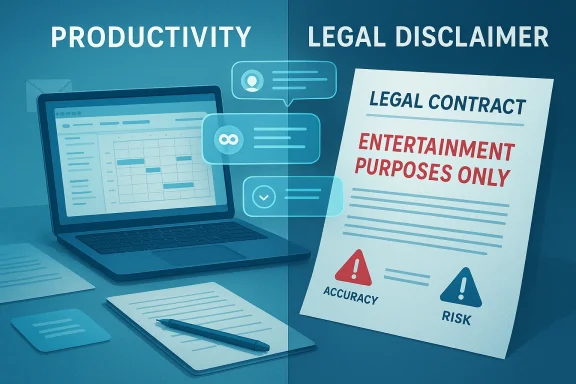
Microsoft’s Copilot disclaimer has landed in an awkward place: it is marketing itself as a serious productivity platform while its consumer terms still describe the service as being “for entertainment purposes only.” That tension is real, but it does not mean Microsoft has suddenly abandoned its enterprise AI ambitions. Instead, it exposes a familiar pattern in the AI industry: companies aggressively position assistants as business tools, while their legal language keeps them firmly inside the guardrails of risk transfer, hallucination warnings, and liability limits.
Copilot’s current consumer terms, effective October 24, 2025, contain the language that sparked the latest online debate. Microsoft’s own wording warns that Copilot can make mistakes, may not work as intended, and should not be relied on for important advice. That is not unusual by AI-industry standards, but the “entertainment purposes only” phrasing is unusually blunt for a product that Microsoft has spent the last two years positioning as a daily work companion.
The controversy widened because Microsoft has been pushing Copilot in the opposite direction in public. In its fiscal Q2 2026 earnings call on January 28, 2026, Satya Nadella described Microsoft 365 Copilot’s accuracy and latency as “unmatched” and framed it as part of a broader family of Copilots spanning information work, coding, security, science, health, and consumer use. That makes the legal disclaimer look less like a brand fit and more like a relic of an earlier product era.
Microsoft has since tried to soften the blow. A company spokesperson told PCMag, later reported by Business Insider, that the entertainment language is legacy phrasing from Copilot’s Bing roots and will be updated in the next revision. That explanation matters, because it suggests Microsoft is not rethinking Copilot’s business direction; it is correcting legal language that failed to keep pace with the product’s evolution.
That history matters because legal boilerplate often trails product strategy by years. Microsoft spent 2024 and 2025 deepening Copilot’s role in Windows, Microsoft 365, and adjacent enterprise services, while also adding shopping, automated actions, and experimental Copilot Labs features. Each new layer makes Copilot feel less like a novelty chatbot and more like an assistant that can initiate, organize, and complete tasks.
At the same time, Microsoft has repeatedly emphasized that Copilot sits on top of a larger AI stack designed for work. In 2024 and 2025, Microsoft described Copilot as the “UI for AI,” with Copilot Studio extending the system through connectors, agents, and autonomous workflows. In other words, the brand has already outgrown the old Bing companion frame, even if the consumer terms have not fully caught up.
The broader AI industry has normalized this contradiction. OpenAI’s terms say users must not rely on output as a sole source of truth or substitute for professional advice, while Meta and xAI similarly constrain use and shift responsibility onto the user. So Microsoft is not alone in warning against overtrust; what stands out is the friction between the company’s serious business messaging and its consumer legal disclaimer.
The reaction also reflects a wider anxiety about AI credibility. Consumers have learned that models can hallucinate, but they still assume a platform carrying the Microsoft brand should be held to a higher standard. When a company says one thing in marketing and another in legal fine print, the mismatch feels less like caution and more like a confession. That perception is as important as the wording itself.
At the same time, these disclaimers are not proof that a company lacks confidence in the product. They are often standard risk management, especially for services that generate probabilistic outputs. Microsoft, OpenAI, Meta, and others all disclaim accuracy, but the tone varies widely, and tone shapes trust. That is where Microsoft misstepped.
The most important addition may be Copilot Actions. Microsoft defines those as automated sets of tasks Copilot performs on the user’s behalf at the user’s request. That shifts Copilot from passive responder to active agent, which in turn raises the stakes for accuracy, permissions, and consumer protection.
Shopping brings another layer of complexity. Microsoft’s support pages say product recommendations may be inaccurate, prices can change, and users should verify details on the retailer’s site. Microsoft also says purchases through Copilot are sold and shipped by third-party merchants, not Microsoft, and that Microsoft does not process payments for those purchases. That arrangement protects Microsoft, but it also makes Copilot less like a storefront owner and more like a referral layer.
Yet the consumer terms read like the opposite. The mismatch creates a communications problem, even if the legal and product teams would argue they serve different audiences. Both can be true at the same time, but the public rarely makes that distinction when a single brand name spans consumer chat, office productivity, and action-oriented features.
For consumers, however, the disclaimer is more visible and more awkward. Microsoft 365 Personal and Family now include Copilot in apps, but consumer trust remains fragile because users are often less shielded by organizational policy, training, or review processes. That makes blunt legal warnings more noticeable, even if the underlying risk is similar across segments.
Meta’s AI terms also explicitly discourage reliance for medicine, finance, law, and pharmaceuticals. That is a familiar pattern: as AI tools become more capable, their vendors respond by narrowing expected use cases and warning against regulated decision-making. The legal posture across the sector is converging, even if the product brands differ.
What differs is how each company balances utility and caution. Microsoft wants Copilot to feel mainstream, integrated, and trustworthy enough for everyday work. OpenAI wants the model’s broad capability to remain central, while clearly distancing itself from professional decision-making. Meta and xAI are likewise protecting themselves, but Microsoft’s branding is the most exposed because its products are already embedded in business workflows.
Once Copilot becomes a platform, the stakes change. A platform can power productivity, shopping, scheduling, customer support, and workflow automation, but it also becomes harder to describe in a single legal paragraph. That may be why Microsoft’s terms have grown more detailed around conduct, actions, and experiments.
Microsoft has already begun talking in this language across enterprise products. Recent Microsoft materials frame Copilot as a way to help finance, HR, sales, and other functions work faster and with more confidence, while preserving controls. That indicates a clear strategic direction: Copilot is becoming the layer through which Microsoft intends to monetize AI behavior, not just AI conversation.
What it does change is the conversation around credibility. If Microsoft wants Copilot to be believed as a serious work instrument, it cannot afford avoidable wording that suggests the opposite. Perception lag is a real problem in AI: the product can evolve faster than the public narrative, but the legal copy may keep dragging the narrative backward.
For Microsoft, the bigger issue is not whether Copilot is “industry” or “entertainment.” It is whether the company can align product language, legal language, and investor language before those inconsistencies become a recurring punchline. The next update to the terms will likely be watched closely for exactly that reason.
The current controversy also gives Microsoft a chance to simplify its story. If the company cleans up the terms and better distinguishes consumer, enterprise, and experimental experiences, it can turn an embarrassing headline into a clarification moment. Good companies use these moments to reduce ambiguity.
There is also a deeper operational risk. As Copilot becomes more agentic, its errors can move from embarrassing to consequential, especially in shopping, scheduling, and work automation. Microsoft can disclaim a lot, but the more users depend on Copilot for real tasks, the more expectations will outpace disclaimers.
The sector-wide litigation climate adds more pressure. OpenAI and others are already facing lawsuits tied to model behavior and alleged harms, which means every major AI vendor is being forced to think about output reliability, user dependence, and the boundaries of professional use. Microsoft is not isolated from that trend; it is merely navigating it with a larger consumer and enterprise footprint.
What matters more is whether Microsoft uses the moment to draw cleaner lines between consumer guidance, enterprise productivity, and experimental agent features. The company has already shown it can evolve the product quickly; now it has to evolve the narrative with equal speed. Otherwise, every new Copilot feature risks being filtered through the same skeptical headline.
Source: techround.co.uk Is Microsoft Copilot Venturing Into A New Industry? - TechRound
 Overview
Copilot’s current consumer terms, effective October 24, 2025, contain the language that sparked the latest online debate. Microsoft’s own wording warns that Copilot can make mistakes, may not work as intended, and should not be relied on for important advice. That is not unusual by AI-industry standards, but the “entertainment purposes only” phrasing is unusually blunt for a product that Microsoft has spent the last two years positioning as a daily work companion.The controversy widened because Microsoft has been pushing Copilot in the opposite direction in public. In its fiscal Q2 2026 earnings call on January 28, 2026, Satya Nadella described Microsoft 365 Copilot’s accuracy and latency as “unmatched” and framed it as part of a broader family of Copilots spanning information work, coding, security, science, health, and consumer use. That makes the legal disclaimer look less like a brand fit and more like a relic of an earlier product era.
Microsoft has since tried to soften the blow. A company spokesperson told PCMag, later reported by Business Insider, that the entertainment language is legacy phrasing from Copilot’s Bing roots and will be updated in the next revision. That explanation matters, because it suggests Microsoft is not rethinking Copilot’s business direction; it is correcting legal language that failed to keep pace with the product’s evolution.
Background
Copilot did not begin life as a workplace assistant. It launched as a consumer-facing chat companion tied to Bing, and its early legal framing reflected that origin story. Microsoft’s archived terms show that the service has long carried broad warnings about accuracy, non-reliance, and user responsibility, even if the wording has now become more pointed and more embarrassing in the age of AI agents.That history matters because legal boilerplate often trails product strategy by years. Microsoft spent 2024 and 2025 deepening Copilot’s role in Windows, Microsoft 365, and adjacent enterprise services, while also adding shopping, automated actions, and experimental Copilot Labs features. Each new layer makes Copilot feel less like a novelty chatbot and more like an assistant that can initiate, organize, and complete tasks.
At the same time, Microsoft has repeatedly emphasized that Copilot sits on top of a larger AI stack designed for work. In 2024 and 2025, Microsoft described Copilot as the “UI for AI,” with Copilot Studio extending the system through connectors, agents, and autonomous workflows. In other words, the brand has already outgrown the old Bing companion frame, even if the consumer terms have not fully caught up.
The broader AI industry has normalized this contradiction. OpenAI’s terms say users must not rely on output as a sole source of truth or substitute for professional advice, while Meta and xAI similarly constrain use and shift responsibility onto the user. So Microsoft is not alone in warning against overtrust; what stands out is the friction between the company’s serious business messaging and its consumer legal disclaimer.
Why the Phrase Triggered a Reaction
The phrase “for entertainment purposes only” hit a nerve because it sounds almost dismissive. Users do not expect that wording from a product embedded in Windows, Microsoft 365, and other productivity surfaces. They expect cautionary language, yes, but not wording that seems to reduce a purported workplace assistant to the status of a hobby app.The reaction also reflects a wider anxiety about AI credibility. Consumers have learned that models can hallucinate, but they still assume a platform carrying the Microsoft brand should be held to a higher standard. When a company says one thing in marketing and another in legal fine print, the mismatch feels less like caution and more like a confession. That perception is as important as the wording itself.
Why legal language matters
Legal disclaimers are not just there to please lawyers. They shape how a product is understood in court, in consumer disputes, and in public debate. A phrase like “use at your own risk” is especially meaningful in a market where users increasingly ask AI systems to summarize meetings, draft emails, compare products, or even initiate actions on their behalf.At the same time, these disclaimers are not proof that a company lacks confidence in the product. They are often standard risk management, especially for services that generate probabilistic outputs. Microsoft, OpenAI, Meta, and others all disclaim accuracy, but the tone varies widely, and tone shapes trust. That is where Microsoft misstepped.
- The wording sounded harsher than typical AI caution language.
- It clashed with Microsoft’s productivity-first branding.
- It amplified public suspicion about AI reliability.
- It created an easy narrative for rivals and critics.
- It turned a routine legal update into a branding problem.
What Microsoft Actually Changed
The October 24, 2025 update was not just about the “entertainment” line. Microsoft’s summary of changes says it clarified when the terms apply to certain Copilot services and experiences, added terms for Copilot Actions, Copilot Labs, and shopping experiences, and rewrote and reorganized the agreement for clarity. That is a substantive expansion, not a cosmetic edit.The most important addition may be Copilot Actions. Microsoft defines those as automated sets of tasks Copilot performs on the user’s behalf at the user’s request. That shifts Copilot from passive responder to active agent, which in turn raises the stakes for accuracy, permissions, and consumer protection.
Copilot Actions, Labs, and shopping
Copilot Labs is described as experimental and potentially unreliable, with Microsoft reserving the right to modify or remove features at any time. That is classic early-stage platform behavior, but it also signals that Microsoft expects users to encounter rough edges. If a feature can book, order, or schedule, the margin for error stops being theoretical.Shopping brings another layer of complexity. Microsoft’s support pages say product recommendations may be inaccurate, prices can change, and users should verify details on the retailer’s site. Microsoft also says purchases through Copilot are sold and shipped by third-party merchants, not Microsoft, and that Microsoft does not process payments for those purchases. That arrangement protects Microsoft, but it also makes Copilot less like a storefront owner and more like a referral layer.
- Copilot Actions introduces task execution, not just chat.
- Copilot Labs formalizes experimentation and instability.
- Shopping experiences create third-party transaction risk.
- Merchant terms become part of the user’s obligation.
- Microsoft keeps the liability wall between itself and commerce.
Why the Public Messaging Feels Inconsistent
Satya Nadella’s January remarks matter because they show how Microsoft wants Copilot perceived at the highest level. By tying Copilot’s accuracy to Work IQ and describing it as central to information work, Microsoft is telling investors and enterprise customers that Copilot is maturing into a core productivity layer. That is not the language of a toy.Yet the consumer terms read like the opposite. The mismatch creates a communications problem, even if the legal and product teams would argue they serve different audiences. Both can be true at the same time, but the public rarely makes that distinction when a single brand name spans consumer chat, office productivity, and action-oriented features.
Enterprise vs consumer positioning
For enterprises, Microsoft 365 Copilot is packaged as an attached capability inside a managed software stack, with administrative controls, enterprise data grounding, and broader compliance expectations. Microsoft’s enterprise messaging leans heavily on workflows, connectors, and governance. In that context, the “entertainment purposes” line looks like consumer-only baggage rather than a description of the whole Copilot family.For consumers, however, the disclaimer is more visible and more awkward. Microsoft 365 Personal and Family now include Copilot in apps, but consumer trust remains fragile because users are often less shielded by organizational policy, training, or review processes. That makes blunt legal warnings more noticeable, even if the underlying risk is similar across segments.
- Enterprise Copilot is framed as governed and integrated.
- Consumer Copilot is framed as personal and experimental.
- Legal wording has to cover both, but branding does not.
- The same disclaimer can read prudent in one market and insulting in another.
- The split reinforces the need for cleaner product taxonomy.
How Rivals Handle the Same Problem
OpenAI’s terms are more sober in tone, but the substance is similar. The company says users should not rely on output as a sole source of truth or as a substitute for professional advice, and that they use the service at their own risk. The difference is that OpenAI’s language reads as standard AI caution, not a branding mismatch.Meta’s AI terms also explicitly discourage reliance for medicine, finance, law, and pharmaceuticals. That is a familiar pattern: as AI tools become more capable, their vendors respond by narrowing expected use cases and warning against regulated decision-making. The legal posture across the sector is converging, even if the product brands differ.
xAI and the hard edge of liability
xAI goes further in its legal protection, using indemnification language that pushes more responsibility onto the user. That style is not unusual in software contracts, but it reflects a more aggressive risk posture than Microsoft’s consumer terms. The broader industry lesson is that all AI vendors are worried about liability, especially as their systems start influencing high-stakes decisions.What differs is how each company balances utility and caution. Microsoft wants Copilot to feel mainstream, integrated, and trustworthy enough for everyday work. OpenAI wants the model’s broad capability to remain central, while clearly distancing itself from professional decision-making. Meta and xAI are likewise protecting themselves, but Microsoft’s branding is the most exposed because its products are already embedded in business workflows.
- OpenAI emphasizes non-reliance and user judgment.
- Meta restricts regulated advice use cases.
- xAI foregrounds indemnity and legal shielding.
- Microsoft has the strongest branding clash between legal text and product promise.
- The market is moving toward standardized AI liability disclaimers.
Copilot as a Platform, Not Just a Chatbot
The phrase “Copilot” now covers a stack of experiences rather than a single service. Microsoft has talked about Copilot, Copilot Studio, agents, and autonomous agents as parts of one spectrum, with the assistant acting as the interface layer for AI. That is a very different ambition from the old Bing chatbot model.Once Copilot becomes a platform, the stakes change. A platform can power productivity, shopping, scheduling, customer support, and workflow automation, but it also becomes harder to describe in a single legal paragraph. That may be why Microsoft’s terms have grown more detailed around conduct, actions, and experiments.
The agentic future
Copilot Actions is especially important because it moves Microsoft into the agentic AI era, where the system does not merely answer questions but executes tasks. That raises obvious governance questions: permissions, auditability, merchant relationships, and user intent. The more Copilot does on a user’s behalf, the more its disclaimers must anticipate real-world consequences.Microsoft has already begun talking in this language across enterprise products. Recent Microsoft materials frame Copilot as a way to help finance, HR, sales, and other functions work faster and with more confidence, while preserving controls. That indicates a clear strategic direction: Copilot is becoming the layer through which Microsoft intends to monetize AI behavior, not just AI conversation.
- Copilot is evolving from assistant to orchestrator.
- Actions create value, but also create liability.
- Shopping and scheduling add transactional complexity.
- Enterprise agents need governance; consumer agents need clarity.
- Microsoft’s platform strategy depends on trust at scale.
Does This Change Copilot’s Commercial Direction?
Short answer: no. The consumer disclaimer does not mean Microsoft is backing away from Copilot as a business product. The company’s earnings calls, product announcements, and enterprise blogs all point in the opposite direction, with Copilot positioned as a growth engine across work, security, and consumer scenarios.What it does change is the conversation around credibility. If Microsoft wants Copilot to be believed as a serious work instrument, it cannot afford avoidable wording that suggests the opposite. Perception lag is a real problem in AI: the product can evolve faster than the public narrative, but the legal copy may keep dragging the narrative backward.
Competitive implications
Competitors will likely use this episode as proof that Microsoft’s AI story is less mature than it looks. That may be unfair, but it is effective messaging. In a market where adoption depends on trust, a viral disclaimer can do reputational damage even when the underlying legal risk is routine.For Microsoft, the bigger issue is not whether Copilot is “industry” or “entertainment.” It is whether the company can align product language, legal language, and investor language before those inconsistencies become a recurring punchline. The next update to the terms will likely be watched closely for exactly that reason.
Strengths and Opportunities
Microsoft still has a strong hand here because Copilot sits inside a vast software ecosystem, not on the margins of it. The company can distribute AI through Windows, Microsoft 365, Edge, and enterprise tools in a way rivals cannot easily match. That distribution advantage is the core reason Copilot remains strategically important even when the messaging gets messy.The current controversy also gives Microsoft a chance to simplify its story. If the company cleans up the terms and better distinguishes consumer, enterprise, and experimental experiences, it can turn an embarrassing headline into a clarification moment. Good companies use these moments to reduce ambiguity.
- Microsoft has unmatched distribution through Windows and Microsoft 365.
- Copilot already spans consumer and enterprise workflows.
- Actions and agents open new monetization paths.
- Shopping and commerce features broaden the product surface.
- The terms update can be used to tighten trust language.
- Enterprise governance tools give Microsoft a credibility edge.
- Consumer bundling can accelerate adoption if messaging improves.
Risks and Concerns
The main risk is reputational, not technical. The wording episode reinforces the idea that AI vendors are still hedging their claims, and it gives critics a neat way to frame Microsoft’s enterprise AI push as overhyped. When trust is fragile, a legal clause can do more damage than a feature bug.There is also a deeper operational risk. As Copilot becomes more agentic, its errors can move from embarrassing to consequential, especially in shopping, scheduling, and work automation. Microsoft can disclaim a lot, but the more users depend on Copilot for real tasks, the more expectations will outpace disclaimers.
The legal and product tension
A consumer disclaimer may be fine for a hobby chatbot, but it becomes awkward when the same brand is embedded in business processes. That does not create legal doom on its own, but it does make Microsoft vulnerable to criticism whenever Copilot is marketed as indispensable. The problem is not the warning; it is the contradiction.The sector-wide litigation climate adds more pressure. OpenAI and others are already facing lawsuits tied to model behavior and alleged harms, which means every major AI vendor is being forced to think about output reliability, user dependence, and the boundaries of professional use. Microsoft is not isolated from that trend; it is merely navigating it with a larger consumer and enterprise footprint.
- Brand confusion can depress trust even when products are improving.
- Agentic features increase the cost of mistakes.
- Shopping and third-party commerce add new liability edges.
- Consumer and enterprise expectations may diverge further.
- Viral legal language can overshadow actual feature progress.
- AI litigation is pushing vendors toward more defensive terms.
Looking Ahead
Microsoft’s next terms update will probably be more revealing than the uproar itself. If the company removes or rephrases the entertainment line, it will be implicitly acknowledging that the old language no longer fits the Copilot brand. That would be the right move, because clarity is now part of the product.What matters more is whether Microsoft uses the moment to draw cleaner lines between consumer guidance, enterprise productivity, and experimental agent features. The company has already shown it can evolve the product quickly; now it has to evolve the narrative with equal speed. Otherwise, every new Copilot feature risks being filtered through the same skeptical headline.
What to watch next
- A revised consumer Copilot terms page with softened or removed “entertainment” language.
- New wording that distinguishes consumer Copilot from Microsoft 365 Copilot more clearly.
- Expanded disclosures around Copilot Actions and transaction responsibility.
- More guidance on Copilot Labs and other experimental features.
- Additional enterprise messaging about governance, controls, and auditability.
- The pace of adoption in Microsoft 365 Personal, Family, and business plans.
Source: techround.co.uk Is Microsoft Copilot Venturing Into A New Industry? - TechRound
