

Microsoft’s Copilot experienced a short-lived accessibility and performance disruption that affected North American users earlier today, but engineers restored service within hours; at the same time, Microsoft announced a sweeping internal change—closing employee libraries and cutting many long‑standing subscription services as it pivots learning toward AI‑driven platforms—an organization‑level move that raises cultural, vendor‑relationship, and governance questions for a company that is itself refactoring around generative AI.
Microsoft Copilot is the generative‑AI assistant surface embedded across Microsoft 365—visible in Word, Excel, Outlook and Teams, as well as in standalone Copilot apps and web portals. Its delivery chain is highly distributed: client front ends, global edge/CDN routing, identity (Microsoft Entra/Azure AD), orchestration microservices, and GPU‑backed inference/model endpoints. That architectural complexity makes localized or layer‑specific failures look like broad outages to end users.
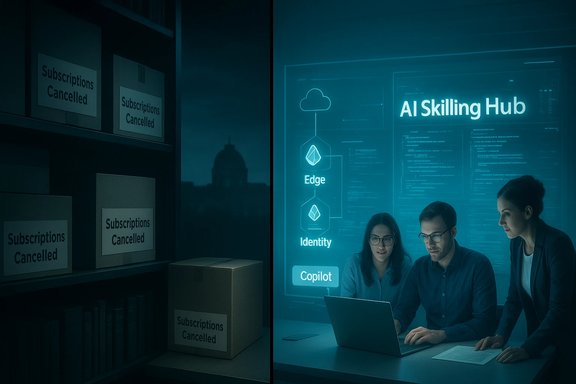
Meanwhile, Microsoft’s employee library—an institutional resource of books, journals and long‑running vendor reports—has been shuttered or repurposed in several global campuses as the company redirects staff learning to an internal “Skilling Hub” and AI‑first programs. Reporting from major outlets confirms the closures and subscription cancellations, which Microsoft frames as modernization rather than purely cost cutting.
At the same time, Microsoft’s decision to close physical libraries and cancel many long‑running subscriptions demonstrates a corporate pivot: learning is being reorganized around AI systems. That strategic choice offers scale and personalization, but it sacrifices a human‑curated archive whose value is hard to quantify until it is gone. The net effect is a classic trade‑off between modernization and the stewardship of institutional knowledge—one that corporate leaders should navigate with explicit preservation plans, vendor transition frameworks, and clear governance over the new AI learning stack. Both stories—availability and internal learning transformation—are facets of the same larger thesis: when software runs the workplace, and AI becomes the interface to knowledge, operational reliability, security, and cultural stewardship become inseparable challenges. Microsoft’s near‑term performance shows competent engineering and decisive change, but sustained trust from customers and employees will depend on predictable uptime, demonstrable security, and careful handling of institutional knowledge during the AI transition.
Source: Windows Report https://windowsreport.com/microsoft...mid-layoffs-debate-as-ai-learning-takes-over]
 Background
Microsoft Copilot is the generative‑AI assistant surface embedded across Microsoft 365—visible in Word, Excel, Outlook and Teams, as well as in standalone Copilot apps and web portals. Its delivery chain is highly distributed: client front ends, global edge/CDN routing, identity (Microsoft Entra/Azure AD), orchestration microservices, and GPU‑backed inference/model endpoints. That architectural complexity makes localized or layer‑specific failures look like broad outages to end users.Meanwhile, Microsoft’s employee library—an institutional resource of books, journals and long‑running vendor reports—has been shuttered or repurposed in several global campuses as the company redirects staff learning to an internal “Skilling Hub” and AI‑first programs. Reporting from major outlets confirms the closures and subscription cancellations, which Microsoft frames as modernization rather than purely cost cutting.
What happened today: a concise timeline
- Early reports and outage monitors showed users in parts of North America experiencing Copilot timeouts, truncated responses, repeated fallback messages such as “Sorry, I wasn’t able to respond to that,” or the Copilot pane failing to load. Crowdsourced trackers registered multiple short anomalies in the morning window.
- Microsoft’s operational teams investigated telemetry and applied targeted mitigations. Typical responses for incidents of this class include manual capacity increases, load‑balancer rule adjustments and, when appropriate, rolling back a problematic code change. In this episode, engineers prioritized rapid stabilization and rolled back or rebalanced the offending change to restore service for affected users within a short span.
- By mid‑morning the majority of affected sessions had recovered. Microsoft’s tenant and service‑health channels reflected resolution indicators and administrators reported declining complaint volumes on public trackers. Independent aggregators confirmed the anomaly cleared within hours.
Technical anatomy: why Copilot outages look broad
Copilot is not a single monolithic service you can ping; it’s a chain of coordinated systems. Failure in any one layer can present as a full Copilot outage to users.- Client front‑ends: Office desktop apps, Teams and the Copilot web app collect context and submit prompts. Problems in client integration or stale tokens can prevent requests from ever entering the service chain.
- Edge / CDN / Gateway: TLS termination, caching and routing happen at this layer. Misconfigurations or third‑party edge provider incidents can block healthy back ends from being reached, producing 5xx errors that look like origin failures. Past industry incidents have shown this layer can masquerade as application faults.
- Identity / Token plane: Microsoft Entra/Azure AD issues authentication tokens. If tokens fail or conditional access rules misapply, sessions break before prompts reach inference hosts—another common “false outage” mode.
- Orchestration and control plane: Microservices stitch context, mediate file actions and enqueue inference jobs. Autoscalers, rate limiters and health checks live here. Sudden traffic surges can outpace reactive autoscaling, producing queue saturation, timeouts or the appearance of degraded service even when some compute capacity exists.
- Model/inference endpoints: These GPU‑backed services have longer warm‑up profiles than ordinary HTTP servers. If warm pools are cold or autoscalers lag, latency and truncation appear rapidly to end users.
How Microsoft responded (what worked and what didn’t)
Microsoft’s remediation toolkit for Copilot incidents is well‑worn and effective at reducing visible disruption quickly:- Engineers used telemetry to isolate the failure mode and executed capacity and routing mitigations to relieve autoscaling pressure. These manual interventions are documented in community reconstructions of prior incidents and in Microsoft service‑health notes.
- Where a recent code or policy change is implicated, rollback remains the definitive quick fix. In past outages a rollback restored service rapidly; where rollbacks aren’t applicable, manual scaling and routing changes bought the time needed for a controlled recovery.
- Microsoft communicated through the Microsoft 365 Admin Center and status channels—standard practice that ensures tenant administrators get authoritative notifications first, even when public monitors lag. Community threads encourage admins to watch tenant‑scoped incident entries since those will contain incident codes and guidance relevant to their tenancy.
- Speed: manual scaling and targeted rollbacks limit user‑visible downtime.
- Instrumentation: detailed telemetry and tenant alerts helped narrow scope and tailor fixes.
- Playbook maturity: the combination of autoscaler, load‑balancer and rollback actions reflects a seasoned operational playbook.
- Reactive scaling still exposes brief windows of outage for bursty AI workloads; predictive/pre‑warmed capacity would reduce shock.
- Edge/third‑party coupling can confound root‑cause analysis when a downstream CDN or proxy is implicated.
- Communication gaps: public status pages can lag tenant notices, creating confusion for end users and external monitors.
Security context: a reminder that availability and safety are linked
Reliability incidents are not the only risk vector for Copilot. Recent vulnerability research (reported publicly in January) described a “Reprompt” style exploit that could coerce Copilot to fetch external URLs and exfiltrate sensitive data after a single phishing click—an attack chain that bypassed some enterprise controls and required rapid patching. Microsoft issued mitigations after disclosure. Operational incidents and security vulnerabilities are related: degraded or misrouted services can complicate detection and incident response, and attackers often probe during instability windows. Administrators must treat availability and security remediation as integrated parts of resilience planning.The broader story: Microsoft’s internal shift from libraries to AI learning
Concurrently, Microsoft is closing or repurposing on‑campus libraries (Redmond and other global sites) and discontinuing many longstanding digital subscriptions and vendor reports in favor of an internal “Skilling Hub” and AI‑driven learning tools. Coverage by multiple outlets confirms the program and the timing, and internal communications describe an explicit move toward AI‑centric learning experiences. What’s happening in practice:- Longstanding subscription services (including some high‑value business publications and long‑running intelligence feeds) were not renewed and vendor contracts were allowed to lapse. Some publishers received automated non‑renewal notices starting in November 2025.
- Physical library spaces are being repurposed into collaborative “Skilling Hub” areas intended to host group learning and experimentation with AI tooling. Microsoft frames the change as modernization—aligning learning resources with an AI‑first corporate strategy—rather than as a simple cost‑cutting measure.
- Scale and personalization: AI platforms can deliver tailored learning paths at global scale and integrate hands‑on labs and skill verification.
- Alignment to strategy: an AI‑first company benefits from internal programs that train staff on the very tooling the company builds and sells.
- Loss of curated expertise: editorially curated vendor reports and deep, human‑edited analysis (for example, niche industry intelligence) are not trivially replaced by automated summaries. Long‑running institutional knowledge and serendipitous discovery from physical collections risk being lost.
- Vendor and research ecosystem impacts: publishers and small specialist vendors who supplied curated reports may lose critical revenue and distribution outlets. That ripple can reduce the diversity of perspectives available to employees.
- Employee morale and cultural cost: libraries and reading rooms are symbolic investments in institutional learning; sudden shuttering can be experienced as another round of cost trimming, particularly following layoffs. Several outlets tie these changes to workforce reductions earlier in the company’s restructuring. Where factual counts of layoffs vary across reporting, that number should be treated with caution unless confirmed by Microsoft.
Practical guidance for IT leaders and Windows professionals
As Copilot and AI become woven into productivity, the operational and governance bar rises. The following checklist is pragmatic and actionable.- Monitor & verify
- Subscribe to Microsoft 365 tenant Service Health notifications and watch for incident codes; this is the authoritative signal for tenant impact.
- Cross‑check crowd monitors and social signals (DownDetector and equivalents) for early detection, but prioritize tenant messages for remediation steps.
- Resilience planning
- Treat Copilot as critical infrastructure if teams rely on it for workflows; require vendors to provide capacity commitments or failover plans in procurement.
- Design human fallbacks for critical tasks (meeting notes templates, manual review windows, and alternate toolchains).
- Security and incident readiness
- Incorporate Copilot‑specific threat scenarios (prompt injection, reprompt exploitation) into tabletop exercises.
- Enforce cautious URL handling, phishing defenses and enterprise browsing policies; patch advisories from vendor research teams should be prioritized.
- Vendor and procurement posture
- Negotiate SLAs that address AI‑service peculiarities: warm‑pool commitments, pre‑warmed inference capacity, and regional failover guarantees.
- If internal learning resources are being replaced with AI systems, require transparency on data sources, provenance, and curation methods from the Skilling platform.
- Organizational change & knowledge preservation
- Preserve a curated archive of high‑value vendor content or migrate it to a searchable controlled repository before subscriptions lapse.
- Maintain human editorial oversight over AI summaries to avoid losing nuance in complex domains.
Risks Microsoft must manage going forward
- Operational fragility from scale: AI workloads scale differently from traditional web traffic—bursty, compute‑heavy spikes require pre‑warmed capacity and more predictive autoscaling strategies.
- Perception and trust: Frequent, even brief, outages erode user confidence just as Copilot becomes embedded in workflows. Rapid remediation helps, but predictable availability matters more to enterprise buyers than heroic recoveries.
- Security and data governance: Prompt‑level vulnerabilities and exfiltration vectors create a parallel class of risk that must be fixed in hours, not weeks. Availability incidents can increase exposure windows.
- Knowledge ecosystem contraction: Replacing curated vendor analyses and library collections with AI summaries risks losing context and reducing exposure to contrarian viewpoints—especially harmful for strategic decision‑making. Vendors and researchers displaced by cancelled subscriptions may not be trivially replaceable by algorithmic feeds.
Closing analysis
Today’s Copilot disruption—detected early, triaged with standard telemetry workflows, and resolved through capacity and routing interventions—is a reminder that integrating generative AI into everyday productivity tools increases the operational stakes for platform providers and IT teams alike. Microsoft’s incident response shows maturity and a well‑practiced playbook, yet the underlying limitations of reactive autoscaling and third‑party edge dependencies remain a material operational risk.At the same time, Microsoft’s decision to close physical libraries and cancel many long‑running subscriptions demonstrates a corporate pivot: learning is being reorganized around AI systems. That strategic choice offers scale and personalization, but it sacrifices a human‑curated archive whose value is hard to quantify until it is gone. The net effect is a classic trade‑off between modernization and the stewardship of institutional knowledge—one that corporate leaders should navigate with explicit preservation plans, vendor transition frameworks, and clear governance over the new AI learning stack. Both stories—availability and internal learning transformation—are facets of the same larger thesis: when software runs the workplace, and AI becomes the interface to knowledge, operational reliability, security, and cultural stewardship become inseparable challenges. Microsoft’s near‑term performance shows competent engineering and decisive change, but sustained trust from customers and employees will depend on predictable uptime, demonstrable security, and careful handling of institutional knowledge during the AI transition.
Source: Windows Report https://windowsreport.com/microsoft...mid-layoffs-debate-as-ai-learning-takes-over]
