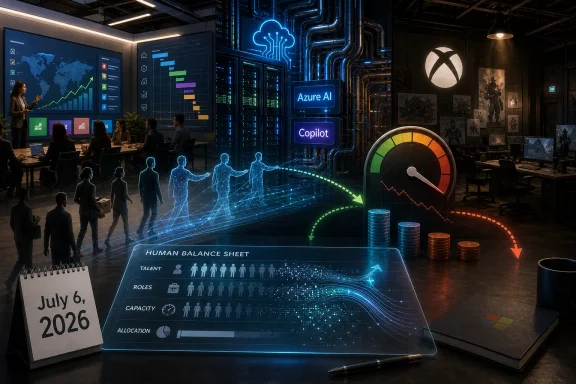
Microsoft announced on July 6, 2026, that it will cut about 4,800 jobs, roughly 2.1 percent of its global workforce, with reductions concentrated in commercial sales, consulting, and Xbox as it redirects spending toward artificial intelligence infrastructure and enterprise AI deployment. The company says the affected roles are not simply being replaced by AI, but that distinction is thinner than it sounds. The deeper story is not a robot taking a desk; it is a balance sheet being rewritten around data centers, GPUs, Copilot, Azure, and the promise that AI will eventually pay for itself. As Reuters, the Associated Press, GeekWire, Windows Central, and Microsoft’s own investor materials make clear, Redmond is entering the expensive middle act of the AI boom: the phase where enthusiasm has to become operating discipline.
The cleanest way to understand this layoff is not as a sudden crisis at Microsoft. It is a repricing exercise inside one of the world’s most profitable companies. Microsoft is still growing, Azure remains strong, and the company’s April earnings release said its AI business had surpassed a $37 billion annual revenue run rate. But the spending required to keep that growth story alive has become staggering.
In its fiscal third-quarter earnings materials, Microsoft told investors it expected roughly $190 billion in calendar-year 2026 capital expenditures, including about $25 billion attributed to higher component pricing. That is not a normal infrastructure budget. It is an industrial buildout, and Microsoft is asking investors to believe that the servers, chips, storage, power contracts, networking gear, and data-center leases behind AI will become the foundation of the next computing platform.
That belief is plausible. It is also expensive enough to force trade-offs. Reuters framed the 4,800 job cuts as part of a broader AI-driven restructuring wave across Big Tech, while AP reported that Xbox would absorb a significant share of the pain. Microsoft can insist that AI did not “replace” these workers in a literal one-for-one sense, and that may be true. But AI has plainly changed the internal investment map.
When a company commits hundreds of billions of dollars to infrastructure, every division has to justify its place in the new capital stack. Teams that do not attach directly to Azure growth, Copilot adoption, enterprise AI deployment, or high-margin recurring revenue become vulnerable. That is the part of “AI-led” restructuring that corporate language tends to obscure: the technology does not need to perform every job to alter which jobs survive.
That history matters because it prevents overreaction. This is not Microsoft suddenly discovering cost control. It is a company with a long habit of trimming, reshaping, and reallocating at fiscal-year boundaries, now doing so under the largest technology transition since cloud computing.
But the 2026 cuts land differently because they arrive after a year in which AI moved from keynote theater to budget line item. Microsoft is no longer merely selling Copilot demos, promising agentic workflows, or touting its OpenAI relationship. It is building the factories required to run those systems and then reorganizing the workforce around monetizing them.
Windows Central reported before the announcement that Microsoft was expected to cut thousands of jobs in what had become an annual July restructuring, with sales, consulting, and Xbox among the affected areas. GeekWire later detailed the commercial and gaming impact, including Washington state filings and a broader Xbox overhaul. The pattern is not random. Microsoft is cutting in places where it sees either duplication, slower growth, or a need to shift from conventional selling toward AI implementation work.
That is why the timing matters as much as the number. Just days before the layoff announcement, Microsoft unveiled the Microsoft Frontier Company, a $2.5 billion initiative to embed thousands of industry experts, engineers, and AI specialists inside customer organizations. In other words, Microsoft is not retreating from labor-intensive enterprise work. It is changing what kind of labor counts.
But Xbox has been under pressure for reasons that overlap with Microsoft’s AI pivot even if they are not caused by it directly. Gaming is expensive, hit-driven, and culturally high-profile, but it is not the center of Microsoft’s investor narrative in 2026. Azure, enterprise AI, Copilot, security, and data platforms are. When capital becomes scarce inside a company spending at data-center scale, even strategically important but lower-priority units get squeezed.
The Xbox cuts also expose the limits of Microsoft’s acquisition-era logic. The company spent enormous sums building a gaming empire, including its Activision Blizzard deal, while simultaneously pushing Game Pass, cloud gaming, and a broader multiplatform strategy. Those moves may still make sense over time, but they also left Xbox with sprawling assets, overlapping functions, and a need to prove that scale can become sustainable profit.
AI did not make those problems. It sharpened the knife. A company that once could afford to subsidize multiple bets now faces a world where every dollar not going to AI infrastructure or enterprise deployment is a dollar that must defend itself.
For WindowsForum readers, Xbox is not just a console story. It is a reminder that Microsoft’s consumer businesses increasingly live at the mercy of enterprise economics. Windows, Xbox, Surface, Microsoft Store, and consumer subscriptions all still matter, but the gravitational center of the company is cloud infrastructure and business software. AI has strengthened that pull.
But the strategic reality is broader. AI is changing where Microsoft believes future leverage exists. If AI makes some internal processes more efficient, reduces the need for layers of management, changes how customers are sold to, or shifts services work toward embedded technical specialists, then AI has influenced the layoff even without being a direct replacement.
This is the difference between automation and reallocation. Automation is the simple story people argue about online: software does the job, worker leaves. Reallocation is more subtle and more common: leadership decides that a smaller workforce can support legacy functions while more capital and talent flow toward the new growth engine.
That is what appears to be happening here. Microsoft is cutting commercial and Xbox roles while funding AI infrastructure and launching Frontier Company. It is not ending human-intensive work. It is saying that the most valuable humans are now those who can help customers make AI operational.
This is also why the company’s language can sound evasive even when it is technically defensible. Workers do not experience “resource adjustment” as a spreadsheet category. They experience it as job loss in a company that is simultaneously spending historic sums on machines and hiring or redeploying specialists for AI programs.
That model is revealing. The industry spent the first phase of the AI boom pretending that generative AI would sell itself. Put a chatbot in the productivity suite, add a Copilot button to the ribbon, show an executive demo, and adoption would follow. The reality has been messier. Enterprise customers have data-quality problems, governance concerns, integration work, compliance requirements, workflow complexity, and nervous employees.
Microsoft now appears to be acknowledging that AI’s biggest bottleneck is not only compute supply. It is implementation. A business does not become an AI company because it bought a license. It becomes one when its processes, data estate, security model, and employee incentives change enough for the technology to matter.
That is why Frontier Company sits uneasily beside the layoffs. Microsoft is reducing headcount in some conventional functions while funding a labor-intensive AI deployment machine. The company is not saying people are obsolete. It is saying the old deployment model is.
For IT administrators, this matters because it hints at how Microsoft will sell AI over the next several years. Expect less passive licensing and more bundled advisory, engineering, migration, governance, and operational work. Microsoft wants customers not merely to subscribe to Copilot, but to reorganize around it.
Still, AI infrastructure is different from earlier cloud expansion. GPUs and specialized accelerators are costly, depreciate quickly, and can become obsolete faster than traditional server fleets. Power and cooling demands are substantial. Memory prices have surged under data-center demand, contributing to higher cost forecasts not only for Microsoft but across the industry.
That turns Azure into both the growth story and the capital problem. The more demand Microsoft sees for AI services, the more infrastructure it must build in advance. The more infrastructure it builds, the more pressure it faces to keep margins, free cash flow, and investor confidence intact.
This is why layoffs at a profitable company are not contradictory. They are part of the same economic system. Microsoft can be strong and still cut jobs because its strongest business is demanding unprecedented upfront investment.
The investor question is brutally simple: will AI revenue grow fast enough, at high enough margins, to justify the buildout? Microsoft’s answer is yes. The layoffs are one way of keeping that answer credible while the proof is still arriving.
The phrase AI-led job cuts can be misleading if it implies panic. Microsoft is not a distressed company. But it is a company under pressure to prove that AI is not merely a capital sink. Every cloud provider now faces some version of this test: build enough capacity to meet demand, avoid overbuilding, keep enterprise customers from stalling in pilot projects, and show that AI tools expand rather than cannibalize software revenue.
There is also a subtler risk to Microsoft’s traditional software model. If AI agents can automate routine business tasks, customers may eventually question seat-based pricing, app boundaries, and even the need for some traditional software workflows. Microsoft wants to own that disruption rather than be disrupted by it, but owning it requires investment that may hurt in the short term.
That is the uncomfortable symmetry. AI threatens parts of Microsoft’s old software economics while also powering its next growth engine. The company is spending heavily to stay on the winning side of that trade.
For administrators and CIOs, this should temper both hype and cynicism. Microsoft is not spending like a company dabbling in AI. It is spending like a company that believes the enterprise stack is being rebuilt. But the layoffs show that even Microsoft does not get to pursue that future without sacrifice.
The moral tension is sharpened by Microsoft’s profitability. Layoffs at a struggling company are grim but legible. Layoffs at a booming AI giant feel different because they expose the asymmetry of modern tech work: employees are asked to adapt to a company’s long-term ambitions, but the company’s tolerance for roles that do not fit the next model can be short.
Microsoft’s defenders will argue that large companies must constantly reallocate resources. That is true. Microsoft’s critics will argue that AI has become a convenient justification for cutting workers while protecting margins. That is also not baseless. The most honest reading is that both things are happening at once.
The company is not simply using AI as a cover story. Its infrastructure spending, Azure demand, Frontier Company launch, and Copilot strategy are real. But neither is AI an innocent bystander. It has become the organizing principle around which Microsoft decides which costs are strategic and which are expendable.
That distinction will matter across the industry. When Amazon, Meta, Microsoft, and others cut jobs while expanding AI budgets, they are not merely optimizing headcount. They are teaching workers what the new hierarchy looks like.
Windows has increasingly become a surface for Microsoft’s cloud and AI ambitions. Copilot integration, Microsoft account nudges, Edge tie-ins, OneDrive defaults, security telemetry, and subscription pathways are all part of a strategy that treats the operating system as an entry point into services. The more Microsoft reorganizes around AI revenue, the more Windows will be asked to serve that goal.
That does not mean every AI feature is bad. Some are useful, particularly for accessibility, search, scripting assistance, endpoint management, and security operations. But it does mean users should expect Microsoft to keep pushing AI into the operating system even when demand is uneven.
Enterprise administrators should watch the support and consulting side even more closely. If Microsoft trims conventional customer-facing roles while building new AI deployment teams, service quality may become more uneven for organizations that are not part of strategic AI accounts. The customers aligned with Microsoft’s AI roadmap may get more attention; those trying to run stable, conventional environments may find themselves nudged toward transformation whether they asked for it or not.
This is where the layoff story meets day-to-day IT reality. A company’s internal priorities eventually become its product priorities. Microsoft’s internal priority is now unmistakable.
Sometimes efficiency means a tool genuinely helps fewer people do more work. Sometimes it means management layers are compressed. Sometimes it means support and sales coverage are reduced because a company believes customers will self-serve. Sometimes it means cutting mature businesses to fund speculative ones.
The danger is that AI lets companies blend all those meanings together. A layoff can be framed as technological progress even when the immediate cause is capital discipline. A restructuring can be framed as workforce modernization even when it is partly an investor-relations exercise. A company can say AI is changing work without specifying whether the change is productivity, cost transfer, or strategic abandonment.
Microsoft’s case contains all of these elements. AI tools may well improve internal productivity. AI infrastructure absolutely requires capital reallocation. Enterprise AI sales require new deployment models. Xbox and traditional commercial operations are being resized around those priorities.
The question is not whether Microsoft is lying. The question is whether the public language of AI is now too broad to explain what is actually happening. “AI is changing how work gets done” is true. It is also vague enough to cover almost any workforce decision a technology company wants to make.
That is why Frontier Company may be more important than the layoff number. Microsoft seems to understand that AI cannot be sold only like Office. It has to be implemented more like a strategic consulting engagement, but with software margins waiting on the other side.
This is a major shift for enterprise IT. If Microsoft embeds experts inside customer organizations, the boundary between vendor, consultant, and platform owner becomes blurrier. Customers may get faster AI deployments, but they may also become more dependent on Microsoft’s preferred architecture, tooling, governance model, and cloud services.
There is opportunity here. Many enterprises are stuck between executive pressure to “do AI” and the messy reality of legacy systems. Microsoft can help bridge that gap. But there is also risk in letting the same vendor that sells the platform define the transformation, measure the outcome, and capture the recurring spend.
The layoffs, then, are not simply about cutting old roles. They are about funding a new sales motion. Microsoft is moving from selling software seats to selling organizational redesign with software attached.
That should make everyone more skeptical of empire-building as strategy. Buying studios, expanding services, and pursuing every platform can create optionality, but it can also create complexity that later has to be unwound. When corporate priorities change, the teams inside that complexity become exposed.
The same lesson applies beyond gaming. AI expansion today is creating its own sprawl: infrastructure commitments, model partnerships, custom agents, deployment teams, security frameworks, governance tools, and customer-specific integrations. If the returns materialize, Microsoft will look prescient. If they lag, future restructurings may hit parts of today’s AI machine with the same force now landing on Xbox.
That is not a prediction of failure. It is a warning against assuming that attaching “AI” to a business immunizes it from economics. Microsoft is cutting jobs in 2026 precisely because even a dominant company has limits.
The irony is that Xbox once represented Microsoft’s willingness to spend through uncertainty for a long-term platform bet. AI now occupies that privileged position. Gaming is being asked to become more disciplined because AI is being allowed to remain expansive.
That should inform how IT leaders read every Microsoft roadmap from here. Copilot features, Azure AI services, Fabric integrations, security copilots, agent frameworks, endpoint management changes, and licensing bundles are not isolated product decisions. They are pieces of a corporate mandate to turn AI capital expenditure into durable revenue.
This does not mean customers should reject Microsoft’s AI push reflexively. Some organizations will gain real value from automation, natural-language interfaces, developer assistance, security triage, and business-process augmentation. But customers should approach the next wave with clear metrics, careful governance, and skepticism toward vague transformation language.
The most important thing administrators can do is separate vendor urgency from organizational readiness. Microsoft may need AI adoption to accelerate. Your environment may need data cleanup, access control, compliance review, training, and cost modeling before it is ready. Those timelines are not always the same.
The layoffs reinforce that Microsoft is optimizing for its own future first. Customers should do the same.
The new report says Xbox’s new head, Asha Sharma, told employees that Microsoft plans to divest four studios: Compulsion Games, Double Fine Productions, Ninja Theory, and Undead Labs. Compulsion and Double Fine are expected to become independent studios, while Ninja Theory and Undead Labs would be spun off around the Senua and State of Decay franchises. Reuters also reports that Arkane Studios management has begun consultations with its workers union in France over options for that studio.
That makes the Xbox reset more concrete than a general headcount reduction. For Windows and PC gaming users, the practical impact is less about immediate platform changes and more about Microsoft narrowing what it wants Xbox to be: fewer internal studio commitments, more pressure on franchises that can justify investment, and continued movement toward distributing games across more platforms rather than relying mainly on Xbox hardware exclusives.
Reuters also notes that Microsoft has raised Xbox console prices amid soft demand and higher memory-chip costs linked to data-center demand, tying the gaming pressure more directly to the company’s broader AI infrastructure spending squeeze.
 Microsoft’s AI Bill Has Come Due Before the AI Dividend Is Fully Visible
The cleanest way to understand this layoff is not as a sudden crisis at Microsoft. It is a repricing exercise inside one of the world’s most profitable companies. Microsoft is still growing, Azure remains strong, and the company’s April earnings release said its AI business had surpassed a $37 billion annual revenue run rate. But the spending required to keep that growth story alive has become staggering.In its fiscal third-quarter earnings materials, Microsoft told investors it expected roughly $190 billion in calendar-year 2026 capital expenditures, including about $25 billion attributed to higher component pricing. That is not a normal infrastructure budget. It is an industrial buildout, and Microsoft is asking investors to believe that the servers, chips, storage, power contracts, networking gear, and data-center leases behind AI will become the foundation of the next computing platform.
That belief is plausible. It is also expensive enough to force trade-offs. Reuters framed the 4,800 job cuts as part of a broader AI-driven restructuring wave across Big Tech, while AP reported that Xbox would absorb a significant share of the pain. Microsoft can insist that AI did not “replace” these workers in a literal one-for-one sense, and that may be true. But AI has plainly changed the internal investment map.
When a company commits hundreds of billions of dollars to infrastructure, every division has to justify its place in the new capital stack. Teams that do not attach directly to Azure growth, Copilot adoption, enterprise AI deployment, or high-margin recurring revenue become vulnerable. That is the part of “AI-led” restructuring that corporate language tends to obscure: the technology does not need to perform every job to alter which jobs survive.
The Layoffs Are Smaller Than Last Year’s, but the Signal Is Louder
On paper, 4,800 jobs is a smaller move than Microsoft’s July 2025 cut of roughly 9,000 workers and its earlier May 2025 reduction of about 6,000 employees. Microsoft has long used the turn of its fiscal year, which begins July 1, to reset budgets and headcount. Anyone who has watched Redmond closely knows that summer reorganizations are practically part of the company’s operating calendar.That history matters because it prevents overreaction. This is not Microsoft suddenly discovering cost control. It is a company with a long habit of trimming, reshaping, and reallocating at fiscal-year boundaries, now doing so under the largest technology transition since cloud computing.
But the 2026 cuts land differently because they arrive after a year in which AI moved from keynote theater to budget line item. Microsoft is no longer merely selling Copilot demos, promising agentic workflows, or touting its OpenAI relationship. It is building the factories required to run those systems and then reorganizing the workforce around monetizing them.
Windows Central reported before the announcement that Microsoft was expected to cut thousands of jobs in what had become an annual July restructuring, with sales, consulting, and Xbox among the affected areas. GeekWire later detailed the commercial and gaming impact, including Washington state filings and a broader Xbox overhaul. The pattern is not random. Microsoft is cutting in places where it sees either duplication, slower growth, or a need to shift from conventional selling toward AI implementation work.
That is why the timing matters as much as the number. Just days before the layoff announcement, Microsoft unveiled the Microsoft Frontier Company, a $2.5 billion initiative to embed thousands of industry experts, engineers, and AI specialists inside customer organizations. In other words, Microsoft is not retreating from labor-intensive enterprise work. It is changing what kind of labor counts.
Xbox Shows How AI Restructuring Spills Beyond AI Teams
The most emotionally charged part of the cuts is Xbox. AP reported that Microsoft’s gaming business would lose a large number of employees, and GeekWire described the move as part of a major reset for Xbox, including thousands of role reductions over the fiscal year and changes to studio operations. That makes the “AI layoffs” label feel strange at first glance. Xbox developers, producers, marketers, and support staff are not obviously the people being replaced by Copilot.But Xbox has been under pressure for reasons that overlap with Microsoft’s AI pivot even if they are not caused by it directly. Gaming is expensive, hit-driven, and culturally high-profile, but it is not the center of Microsoft’s investor narrative in 2026. Azure, enterprise AI, Copilot, security, and data platforms are. When capital becomes scarce inside a company spending at data-center scale, even strategically important but lower-priority units get squeezed.
The Xbox cuts also expose the limits of Microsoft’s acquisition-era logic. The company spent enormous sums building a gaming empire, including its Activision Blizzard deal, while simultaneously pushing Game Pass, cloud gaming, and a broader multiplatform strategy. Those moves may still make sense over time, but they also left Xbox with sprawling assets, overlapping functions, and a need to prove that scale can become sustainable profit.
AI did not make those problems. It sharpened the knife. A company that once could afford to subsidize multiple bets now faces a world where every dollar not going to AI infrastructure or enterprise deployment is a dollar that must defend itself.
For WindowsForum readers, Xbox is not just a console story. It is a reminder that Microsoft’s consumer businesses increasingly live at the mercy of enterprise economics. Windows, Xbox, Surface, Microsoft Store, and consumer subscriptions all still matter, but the gravitational center of the company is cloud infrastructure and business software. AI has strengthened that pull.
Microsoft’s Denial Is Technically True and Strategically Incomplete
Microsoft’s message, according to reporting from Windows Central and others, is that the impacted roles are not being replaced by AI. That sentence deserves careful handling. It may be accurate in the narrow HR sense: a laid-off sales manager is not necessarily being swapped for an AI agent with a quota. A gaming producer is not being replaced by a prompt window. A consultant is not simply disappearing because Copilot can summarize meetings.But the strategic reality is broader. AI is changing where Microsoft believes future leverage exists. If AI makes some internal processes more efficient, reduces the need for layers of management, changes how customers are sold to, or shifts services work toward embedded technical specialists, then AI has influenced the layoff even without being a direct replacement.
This is the difference between automation and reallocation. Automation is the simple story people argue about online: software does the job, worker leaves. Reallocation is more subtle and more common: leadership decides that a smaller workforce can support legacy functions while more capital and talent flow toward the new growth engine.
That is what appears to be happening here. Microsoft is cutting commercial and Xbox roles while funding AI infrastructure and launching Frontier Company. It is not ending human-intensive work. It is saying that the most valuable humans are now those who can help customers make AI operational.
This is also why the company’s language can sound evasive even when it is technically defensible. Workers do not experience “resource adjustment” as a spreadsheet category. They experience it as job loss in a company that is simultaneously spending historic sums on machines and hiring or redeploying specialists for AI programs.
The Frontier Company Is the Tell
If the layoffs show where Microsoft is cutting, Frontier Company shows where it is placing the new bet. Announced on July 2, the unit is designed to help customers select, build, deploy, and operate AI systems that generate measurable returns. Reuters reported that it begins with $2.5 billion in funding and work with customers including Unilever and Novo Nordisk. GeekWire and TechCrunch described it as an effort to embed Microsoft experts inside customer organizations.That model is revealing. The industry spent the first phase of the AI boom pretending that generative AI would sell itself. Put a chatbot in the productivity suite, add a Copilot button to the ribbon, show an executive demo, and adoption would follow. The reality has been messier. Enterprise customers have data-quality problems, governance concerns, integration work, compliance requirements, workflow complexity, and nervous employees.
Microsoft now appears to be acknowledging that AI’s biggest bottleneck is not only compute supply. It is implementation. A business does not become an AI company because it bought a license. It becomes one when its processes, data estate, security model, and employee incentives change enough for the technology to matter.
That is why Frontier Company sits uneasily beside the layoffs. Microsoft is reducing headcount in some conventional functions while funding a labor-intensive AI deployment machine. The company is not saying people are obsolete. It is saying the old deployment model is.
For IT administrators, this matters because it hints at how Microsoft will sell AI over the next several years. Expect less passive licensing and more bundled advisory, engineering, migration, governance, and operational work. Microsoft wants customers not merely to subscribe to Copilot, but to reorganize around it.
Azure Is the Engine, but Cash Flow Is the Constraint
Azure is the reason Microsoft can tell this story with confidence. The company’s April earnings release said Microsoft Cloud revenue reached $54.5 billion for the quarter ended March 31, 2026, up 29 percent, and Microsoft said Azure continued to show strong growth. That gives Redmond the strategic permission to spend heavily. The cloud business is not a speculative side project; it is the core engine.Still, AI infrastructure is different from earlier cloud expansion. GPUs and specialized accelerators are costly, depreciate quickly, and can become obsolete faster than traditional server fleets. Power and cooling demands are substantial. Memory prices have surged under data-center demand, contributing to higher cost forecasts not only for Microsoft but across the industry.
That turns Azure into both the growth story and the capital problem. The more demand Microsoft sees for AI services, the more infrastructure it must build in advance. The more infrastructure it builds, the more pressure it faces to keep margins, free cash flow, and investor confidence intact.
This is why layoffs at a profitable company are not contradictory. They are part of the same economic system. Microsoft can be strong and still cut jobs because its strongest business is demanding unprecedented upfront investment.
The investor question is brutally simple: will AI revenue grow fast enough, at high enough margins, to justify the buildout? Microsoft’s answer is yes. The layoffs are one way of keeping that answer credible while the proof is still arriving.
Wall Street Is No Longer Paying for AI Poetry
The article provided by Kashmir Dot Com, drawing on Reuters-style framing, notes that Microsoft’s shares fell nearly 23 percent in the first six months of 2026, their worst first-half performance since 2022. That matters because investor tolerance has shifted. In 2023 and 2024, AI ambition was often enough. In 2026, AI ambition has to come with operating leverage.The phrase AI-led job cuts can be misleading if it implies panic. Microsoft is not a distressed company. But it is a company under pressure to prove that AI is not merely a capital sink. Every cloud provider now faces some version of this test: build enough capacity to meet demand, avoid overbuilding, keep enterprise customers from stalling in pilot projects, and show that AI tools expand rather than cannibalize software revenue.
There is also a subtler risk to Microsoft’s traditional software model. If AI agents can automate routine business tasks, customers may eventually question seat-based pricing, app boundaries, and even the need for some traditional software workflows. Microsoft wants to own that disruption rather than be disrupted by it, but owning it requires investment that may hurt in the short term.
That is the uncomfortable symmetry. AI threatens parts of Microsoft’s old software economics while also powering its next growth engine. The company is spending heavily to stay on the winning side of that trade.
For administrators and CIOs, this should temper both hype and cynicism. Microsoft is not spending like a company dabbling in AI. It is spending like a company that believes the enterprise stack is being rebuilt. But the layoffs show that even Microsoft does not get to pursue that future without sacrifice.
The Human Cost Is Not an Accounting Footnote
There is a temptation in technology coverage to treat layoffs as evidence of strategy and move on. That is too tidy. The 4,800 people affected are not abstractions. They are salespeople, consultants, engineers, producers, program managers, support staff, and specialists who helped build the products and relationships Microsoft now wants to monetize in a different way.The moral tension is sharpened by Microsoft’s profitability. Layoffs at a struggling company are grim but legible. Layoffs at a booming AI giant feel different because they expose the asymmetry of modern tech work: employees are asked to adapt to a company’s long-term ambitions, but the company’s tolerance for roles that do not fit the next model can be short.
Microsoft’s defenders will argue that large companies must constantly reallocate resources. That is true. Microsoft’s critics will argue that AI has become a convenient justification for cutting workers while protecting margins. That is also not baseless. The most honest reading is that both things are happening at once.
The company is not simply using AI as a cover story. Its infrastructure spending, Azure demand, Frontier Company launch, and Copilot strategy are real. But neither is AI an innocent bystander. It has become the organizing principle around which Microsoft decides which costs are strategic and which are expendable.
That distinction will matter across the industry. When Amazon, Meta, Microsoft, and others cut jobs while expanding AI budgets, they are not merely optimizing headcount. They are teaching workers what the new hierarchy looks like.
Windows Users Will Feel This Indirectly First
For Windows enthusiasts, the immediate impact will probably not be a missing Start menu feature or a delayed Patch Tuesday update. These layoffs do not appear to be a Windows engineering bloodbath. But Microsoft’s broader AI-driven reallocation will shape the Windows experience over time.Windows has increasingly become a surface for Microsoft’s cloud and AI ambitions. Copilot integration, Microsoft account nudges, Edge tie-ins, OneDrive defaults, security telemetry, and subscription pathways are all part of a strategy that treats the operating system as an entry point into services. The more Microsoft reorganizes around AI revenue, the more Windows will be asked to serve that goal.
That does not mean every AI feature is bad. Some are useful, particularly for accessibility, search, scripting assistance, endpoint management, and security operations. But it does mean users should expect Microsoft to keep pushing AI into the operating system even when demand is uneven.
Enterprise administrators should watch the support and consulting side even more closely. If Microsoft trims conventional customer-facing roles while building new AI deployment teams, service quality may become more uneven for organizations that are not part of strategic AI accounts. The customers aligned with Microsoft’s AI roadmap may get more attention; those trying to run stable, conventional environments may find themselves nudged toward transformation whether they asked for it or not.
This is where the layoff story meets day-to-day IT reality. A company’s internal priorities eventually become its product priorities. Microsoft’s internal priority is now unmistakable.
The Industry Is Rewriting the Meaning of Efficiency
The word efficiency has become one of the defining corporate terms of the AI era. Meta used it. Amazon has used it. Microsoft is now living inside it. But efficiency can mean several different things, and not all of them are technological.Sometimes efficiency means a tool genuinely helps fewer people do more work. Sometimes it means management layers are compressed. Sometimes it means support and sales coverage are reduced because a company believes customers will self-serve. Sometimes it means cutting mature businesses to fund speculative ones.
The danger is that AI lets companies blend all those meanings together. A layoff can be framed as technological progress even when the immediate cause is capital discipline. A restructuring can be framed as workforce modernization even when it is partly an investor-relations exercise. A company can say AI is changing work without specifying whether the change is productivity, cost transfer, or strategic abandonment.
Microsoft’s case contains all of these elements. AI tools may well improve internal productivity. AI infrastructure absolutely requires capital reallocation. Enterprise AI sales require new deployment models. Xbox and traditional commercial operations are being resized around those priorities.
The question is not whether Microsoft is lying. The question is whether the public language of AI is now too broad to explain what is actually happening. “AI is changing how work gets done” is true. It is also vague enough to cover almost any workforce decision a technology company wants to make.
The Old Microsoft Would Have Sold Licenses; the New Microsoft Sells Transformation
Microsoft’s historical superpower was packaging complexity into repeatable platforms: Windows on PCs, Office on desktops, Exchange in enterprises, Azure in the cloud. The company thrived by creating standardized products that partners, administrators, and developers could deploy at scale. AI is more difficult because the value often depends on customer-specific data, workflows, compliance regimes, and business processes.That is why Frontier Company may be more important than the layoff number. Microsoft seems to understand that AI cannot be sold only like Office. It has to be implemented more like a strategic consulting engagement, but with software margins waiting on the other side.
This is a major shift for enterprise IT. If Microsoft embeds experts inside customer organizations, the boundary between vendor, consultant, and platform owner becomes blurrier. Customers may get faster AI deployments, but they may also become more dependent on Microsoft’s preferred architecture, tooling, governance model, and cloud services.
There is opportunity here. Many enterprises are stuck between executive pressure to “do AI” and the messy reality of legacy systems. Microsoft can help bridge that gap. But there is also risk in letting the same vendor that sells the platform define the transformation, measure the outcome, and capture the recurring spend.
The layoffs, then, are not simply about cutting old roles. They are about funding a new sales motion. Microsoft is moving from selling software seats to selling organizational redesign with software attached.
The Xbox Reset Warns Against Infinite Expansion
Microsoft’s gaming cuts deserve one more look because they challenge a common assumption about Big Tech: that scale always protects a business. Xbox had scale, brand recognition, subscriptions, cloud ambitions, and a massive acquired content portfolio. It still faced a significant reset.That should make everyone more skeptical of empire-building as strategy. Buying studios, expanding services, and pursuing every platform can create optionality, but it can also create complexity that later has to be unwound. When corporate priorities change, the teams inside that complexity become exposed.
The same lesson applies beyond gaming. AI expansion today is creating its own sprawl: infrastructure commitments, model partnerships, custom agents, deployment teams, security frameworks, governance tools, and customer-specific integrations. If the returns materialize, Microsoft will look prescient. If they lag, future restructurings may hit parts of today’s AI machine with the same force now landing on Xbox.
That is not a prediction of failure. It is a warning against assuming that attaching “AI” to a business immunizes it from economics. Microsoft is cutting jobs in 2026 precisely because even a dominant company has limits.
The irony is that Xbox once represented Microsoft’s willingness to spend through uncertainty for a long-term platform bet. AI now occupies that privileged position. Gaming is being asked to become more disciplined because AI is being allowed to remain expansive.
Redmond’s Message to IT: Follow the Money, Not the Memo
Microsoft’s internal memos and public statements will naturally emphasize transition, skill-building, customer outcomes, and operational focus. Those words are not meaningless, but they are less revealing than the money. The money says Microsoft is putting extraordinary weight behind AI infrastructure and enterprise deployment.That should inform how IT leaders read every Microsoft roadmap from here. Copilot features, Azure AI services, Fabric integrations, security copilots, agent frameworks, endpoint management changes, and licensing bundles are not isolated product decisions. They are pieces of a corporate mandate to turn AI capital expenditure into durable revenue.
This does not mean customers should reject Microsoft’s AI push reflexively. Some organizations will gain real value from automation, natural-language interfaces, developer assistance, security triage, and business-process augmentation. But customers should approach the next wave with clear metrics, careful governance, and skepticism toward vague transformation language.
The most important thing administrators can do is separate vendor urgency from organizational readiness. Microsoft may need AI adoption to accelerate. Your environment may need data cleanup, access control, compliance review, training, and cost modeling before it is ready. Those timelines are not always the same.
The layoffs reinforce that Microsoft is optimizing for its own future first. Customers should do the same.
The Concrete Read From Microsoft’s July Reset
The story is not that Microsoft is collapsing, nor that AI has already made thousands of Redmond jobs obsolete. The sharper reading is that Microsoft is cutting conventional headcount to protect margins and focus resources while it spends massively on the infrastructure and human deployment machinery required to make AI pay.- Microsoft’s July 6 job cuts affect about 4,800 workers, or roughly 2.1 percent of its global workforce.
- The reductions are concentrated in commercial sales, consulting, and Xbox rather than being a simple replacement of workers by AI tools.
- Microsoft’s roughly $190 billion 2026 capital-expenditure plan is the financial backdrop for every workforce decision the company now makes.
- The new $2.5 billion Microsoft Frontier Company shows that Redmond still needs people, but increasingly wants people who can turn AI pilots into enterprise deployments.
- Xbox’s heavy exposure shows that AI-era restructuring can hit businesses that are not directly building AI.
- Windows and enterprise customers should expect Microsoft’s product, support, and licensing priorities to keep bending toward Copilot, Azure AI, and measurable AI adoption.
Update: Reuters Details Xbox Studio Spin-Offs and 3,200 Gaming Cuts (July 7, 2026)
Reuters now adds more specific detail on the Xbox side of Microsoft’s restructuring, reporting that the gaming overhaul accounts for 3,200 of the 4,800 total job cuts, including 1,600 employees laid off on Monday.The new report says Xbox’s new head, Asha Sharma, told employees that Microsoft plans to divest four studios: Compulsion Games, Double Fine Productions, Ninja Theory, and Undead Labs. Compulsion and Double Fine are expected to become independent studios, while Ninja Theory and Undead Labs would be spun off around the Senua and State of Decay franchises. Reuters also reports that Arkane Studios management has begun consultations with its workers union in France over options for that studio.
That makes the Xbox reset more concrete than a general headcount reduction. For Windows and PC gaming users, the practical impact is less about immediate platform changes and more about Microsoft narrowing what it wants Xbox to be: fewer internal studio commitments, more pressure on franchises that can justify investment, and continued movement toward distributing games across more platforms rather than relying mainly on Xbox hardware exclusives.
Reuters also notes that Microsoft has raised Xbox console prices amid soft demand and higher memory-chip costs linked to data-center demand, tying the gaming pressure more directly to the company’s broader AI infrastructure spending squeeze.
References
- Primary source: Kashmir Dot Com
Published: 2026-07-07T09:30:08.949869
Microsoft To Lay Off 4,800 Workers In Latest Wave Of AI-Led Job Cuts – Kashmir Dot Com
New Delhi, Jul 07: Microsoft is cutting about 2.1 per cent of its workforce, or roughly 4,800 jobs, the latestkashmirdotcom.in - Related coverage: windowscentral.com
Microsoft expected to lay off thousands in what has become an annual July restructuring | Windows Central
Reportedly, thousands of roles will be cut across Xbox, sales, and consulting as the tech giant starts its new fiscal year.www.windowscentral.com - Related coverage: investing.com
Microsoft to cut 4,800 jobs, overhaul Xbox unit By Reuters
Microsoft to cut 4,800 jobs, overhaul Xbox unitwww.investing.com - Related coverage: geekwire.com
Microsoft cuts 4,800 jobs, about 2% globally, revamps salesforce and launches massive Xbox overhaul – GeekWire
Microsoft is cutting 4,800 jobs and overhauling its Xbox gaming business in what its new gaming CEO calls the biggest restructuring in Xbox history, while reshaping its sales and consulting division amid record AI spending and a 30% stock slide.www.geekwire.com - Related coverage: business-standard.com
- Related coverage: techcrunch.com
Microsoft lays off nearly 5,000 employees across Xbox, commercial sales | TechCrunch
Microsoft cut around 4,800 roles, or 2.1% of its global workforce, on Monday — the latest in a series of layoffs that’s stoking fears of AI replacing jobs. The layoffs will hit Xbox and commercial sales the hardest.techcrunch.com
- Related coverage: financialexpress.com
- Related coverage: tbsnews.net
Microsoft joins AI-driven tech layoff wave with 4,800 job cuts
The company's shares were down 1.5% in early trading.www.tbsnews.net
- Related coverage: ksl.com
Microsoft joins AI-driven tech layoff wave with 4,800 job cuts
Microsoft is cutting about 2.1% of its workforce, or roughly 4,800 jobs, as the Windows maker restructures parts of its commercial and Xbox businesses, \u200bjoining other tech titans in a wave of layoffs. www.ksl.com
- Related coverage: straitstimes.com
Microsoft AI layoffs: 4,800 jobs cut | The Straits Times
Microsoft announces 4,800 job cuts, joining other tech giants in shifting investments towards AI infrastructure amid restructuring. Read more at straitstimes.com.www.straitstimes.com
- Related coverage: ndtv.com
- Related coverage: how2shout.com
Microsoft Lays Off 4,800, Xbox Hit Hardest — and Says It's Not AI
Microsoft is cutting 4,800 jobs (2.1% of staff), mostly in Xbox and commercial sales. Xbox will shed ~3,200 this fiscal year. Microsoft insists AI isn't replacing the roles. Here's the full picture.www.how2shout.com - Related coverage: techradar.com
Microsoft CEO says AI-induced job cuts "weighing heavily" on him | TechRadar
Satya Nadella acknowledges job cuts are hardwww.techradar.com - Official source: microsoft.com
FY26 Q3 - Press Releases - Investor Relations - Microsoft
FY26 Q3 - Press Releases - Investor Relations - Microsoftwww.microsoft.com
- Related coverage: techtimes.com
Microsoft Frontier Company: $2.5B and 6,000 Engineers Target AI Pilot Failures
Microsoft Frontier Company launches with $2.5 billion and 6,000 embedded engineers as all four major AI vendors race to solve the same problem: 95% of enterprise AI pilots deliver zero measurablewww.techtimes.com - Related coverage: whatjobs.com
- Related coverage: aisheetreport.com
Microsoft commits $2.5B and 6,000 engineers to Frontier Company, outbidding AWS in enterprise AI deployment race — AI Sheet Report
Judson Althoff's new operating unit, led by former Asia chief Rodrigo Kede Lima, lands two days after AWS's $1B FDE pledge and follows May launches from OpenAI and Anthropic. aisheetreport.com
- Related coverage: nequitco.com
Nequit V3
NeQuit Wealth equity research brief on Microsoft (NASDAQ: MSFT) Q3 FY2026 earnings. www.nequitco.com
- Related coverage: globbrief.com
Microsoft launches Frontier AI division with 6,000 engineers and $2.5B investment — World News No Spin
Microsoft announces a $2.5 billion Frontier Company unit deploying 6,000 engineers at enterprise clients to speed up AI adoption, as AWS, OpenAI and Anthropic launch rival programs. globbrief.com
- Related coverage: techmarketview.com
Microsoft joins the FDE push with new Frontier Company | TechMarketView
Bringing you opinionated, authoritative research & analysis on the UK technology scene. www.techmarketview.com
- Related coverage: cincodias.elpais.com
- Official source: local.microsoft.com
</rdf:Alt> </dc:title> <dc:creator> <rdf:Seq> <rdf:li>Luiz Tourinho (OML INC)
PDF documentlocal.microsoft.com
Last edited: